

10 Questions with Bichen Liu
Al-Tiba9 Art Magazine ISSUE22 | Featured Artist
Bichen Liu is a Chinese lens-based visual artist working across fine art photography, black-and-white image-making, and experimental photographic practice. His work investigates overlooked urban spaces, displaced memory, ecological pressure, and non-human forms of survival within contemporary environments. Drawing on a background in directing and visual design, he develops concept-led photographic works that transform everyday streets, ecological traces, and residual spaces into reflective visual narratives. Rather than treating photography as direct description, Liu uses the camera as a method of reorienting attention towards what is usually obscured, ignored, or taken for granted. His current practice explores how environments register disturbance, and how hidden systems of support, erosion, and transformation can be made perceptible through photographic form.

Bichen Liu - Portrait
What Lies Beneath| Project Statement
What Lies Beneath is a black-and-white photographic series focusing on exposed root systems and coastal residues. Through close framing and high contrast, the project transforms overlooked ecological fragments into visual records of support, erosion, and displacement. Rather than presenting nature as scenery, the series treats the landscape as a site where pressure, memory, and survival become materially visible.
Usually buried beneath the surface, roots sustain life while remaining outside the field of vision. Here, erosion, disturbance, and environmental pressure force them into visibility. Liu photographs these forms not as botanical subjects, but as material evidence of tension: attachment and collapse, endurance and exposure, concealment and revelation. Through black-and-white photography, the roots become less a part of the landscape than a record of pressure acting upon it. Background is brought forward; what is normally hidden becomes temporarily legible. The series reflects on how environments remember disturbance, and how fragile forms continue to persist, shift, and leave traces within unstable ecological conditions.
What Lies Beneath — Residue, Black-and-white digital photograph, 25 × 25 cm, 2026 © Bichen Liu
AL-TIBA9 ART MAGAZINE ISSUE22
DISCOVER THE INTERNATIONAL ART SCENE WITH AL-TIBA9
LIMITED EDITION | Shipping worldwide.
Premium museum art paper.
Printed in London.
Grab 3 or more prints and get your FREE digital magazine.
Get your limited edition copy now
INTERVIEW
Could you tell us about your background and how your experiences in directing and visual design influenced your path toward photography and lens-based art?
My background in directing and visual design taught me to think through images before I began to think of myself primarily as a photographer. Directing trained me to pay attention to space, rhythm, atmosphere, and the relationship between what is shown and what remains outside the frame. Visual design, meanwhile, made me more conscious of contrast, structure, and the emotional weight of composition. Over time, I became increasingly drawn to still images because they allowed me to slow down perception and stay with details that moving images often pass over. Photography gradually became a way for me to move away from narrative explanation and towards a more concentrated form of observation, where overlooked spaces, ecological traces, and residual forms could carry meaning without being resolved into a fixed story.
What first attracted you to photography as a medium, and what possibilities does the camera offer you that other artistic forms cannot?
What first attracted me to photography was its ability to hold together observation and interpretation. The camera begins with something that exists in front of it, but through framing, distance, light, and timing, that reality can be reorganised into something psychologically and symbolically charged. I was drawn to this tension between evidence and ambiguity. Unlike forms that begin from a blank surface, photography allows me to work directly with traces already present in the world: a damaged surface, an exposed root, an empty street, or a fragment of urban residue. The camera gives me a way to isolate these details from their ordinary context and make them newly visible. For me, its unique possibility lies in transforming what appears incidental into something that can sustain attention, memory, and reflection.
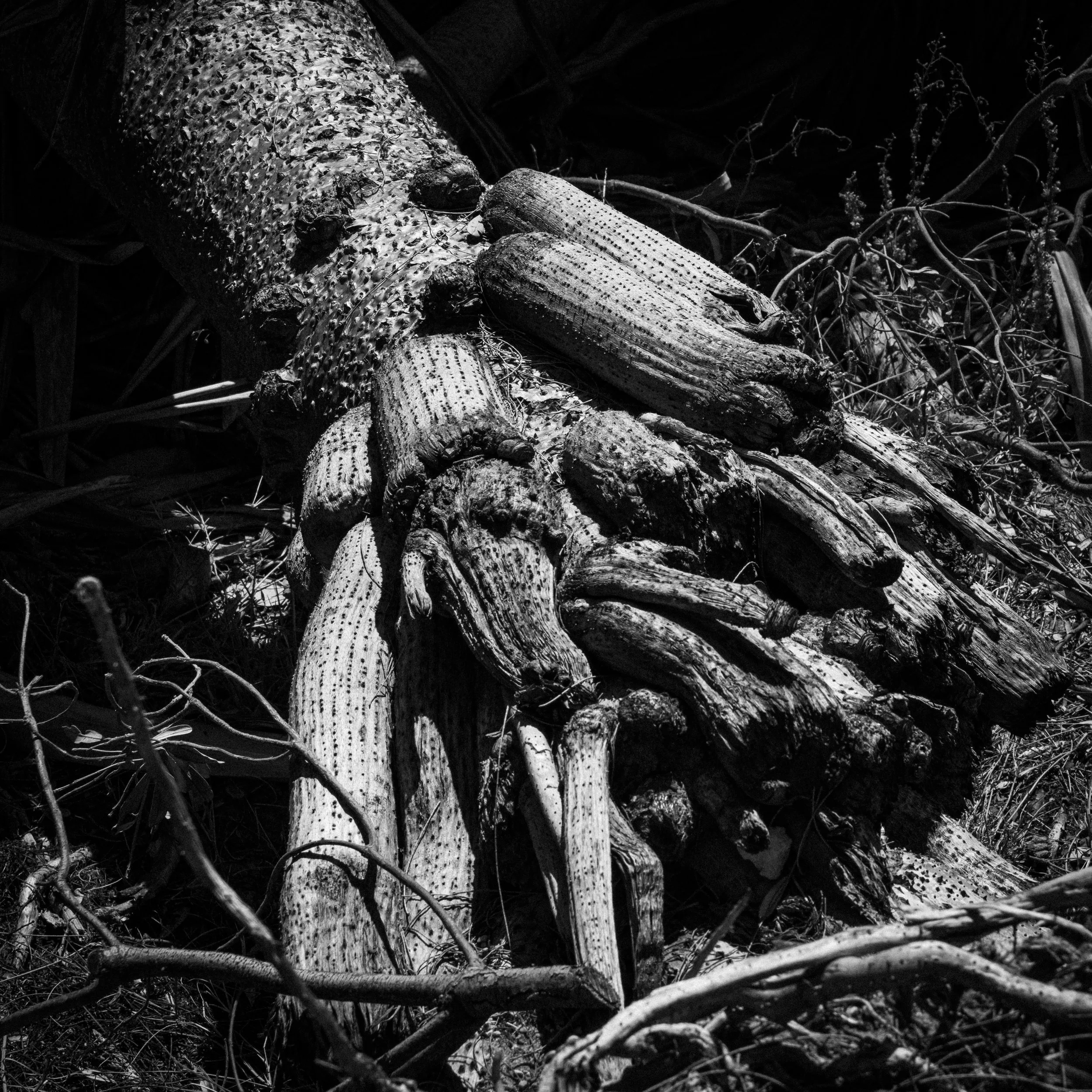
What Lies Beneath - Compression, Black-and-white digital photograph, 25 × 25 cm, 2026 © Bichen Liu
Your work focuses on overlooked spaces, hidden traces, and environments that often go unnoticed. What draws you to these subjects, and what do you hope viewers will discover through them?
I am drawn to overlooked spaces because what is immediately visible has often already declared itself. What remains at the edge of attention is usually quieter, more ambiguous, and more difficult to read. As cities and environments continue to change, peripheral landscapes, damaged surfaces, non-human life, and residual spaces are often pushed further outside public view. Yet these places frequently preserve traces of pressure, interruption, memory, and adaptation. I am interested in the way they reveal aspects of social and environmental change that are easy to miss. Through photography, I try to bring these overlooked details back into view. I hope viewers recognise that they are not insignificant, but part of the changes taking place around us.
Can you describe your creative process, from the initial idea or observation to the development of a complete photographic series?
My process usually begins with a small observation rather than a fully formed concept. I may notice a damaged surface, an exposed root system, an empty street, or a detail that seems visually ordinary but carries a certain tension. I often return to the same place several times, photographing from different distances and under changing conditions, while gradually understanding what connects the images. The concept usually develops through this repeated act of looking rather than being imposed at the beginning. After shooting, I spend a long time editing and sequencing the photographs, removing images that feel too explanatory or disconnected. A complete series emerges when the individual images begin to speak to one another and form a consistent visual and conceptual rhythm.
Your works often transform ordinary urban or ecological elements into reflective visual narratives. How do you decide what deserves attention and how to frame it within your images?
I am usually drawn to subjects that appear ordinary, familiar, or even undesirable, but reveal a more complex condition when observed closely. What interests me is not simply their visual form, but the way they carry traces of pressure, adaptation, exclusion, or survival. This may be an exposed root system shaped by erosion, or an urban bird that has learned to live within spaces designed primarily for humans. I often choose subjects that sit uneasily within their surroundings, because they can reflect wider questions about how we define order, value, belonging, and coexistence. When framing an image, I consider how distance, compression, contrast, and the removal of context can alter the way a subject is perceived. I often work closely enough for the subject to become slightly unfamiliar, while retaining enough of its environment to preserve the tension between the two. The aim is not to beautify what is overlooked, but to make its presence harder to dismiss.
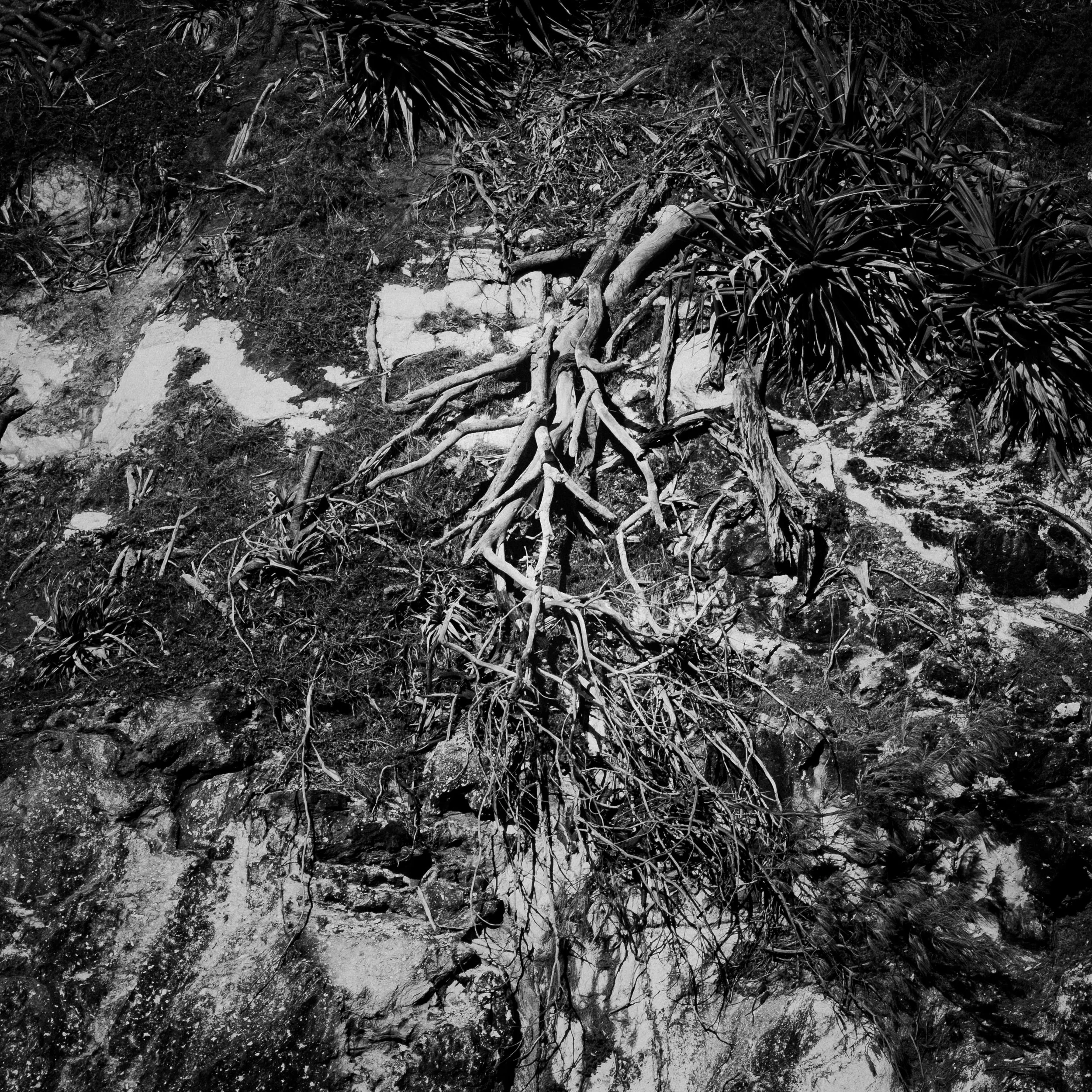
What Lies Beneath - Exposure, Black-and-white digital photograph, 25 × 25 cm, 2026 © Bichen Liu

What Lies Beneath - Support, Black-and-white digital photograph, 25 × 25 cm, 2026 © Bichen Liu
In your project What Lies Beneath, exposed roots and coastal residues become symbols of support, displacement, and survival. What inspired you to focus on these fragile natural structures?
The project began with my repeated observation of exposed roots along eroded ground and coastal edges. I was especially drawn to the sight of waves repeatedly washing over the remaining roots. They seemed to exist under constant pressure: displaced, exposed, and altered, yet still holding on. This image connected closely with a recurring concern in my practice: the way overlooked structures, spaces, and forms of life often carry the greatest burden while remaining largely unseen. Roots normally sustain life beneath the surface, but erosion forces their labour and vulnerability into view. For me, this also has a social dimension. Many forms of support within families, communities, and societies remain invisible until they are placed under strain. Through these fragile natural structures, I began to think about survival not as stability, but as the ability to continue while being continually reshaped by forces beyond one’s control.
The series uses black-and-white photography with strong contrasts. How does this visual language help communicate the themes of memory, erosion, and environmental change?
Black-and-white photography allows me to set colour aside and focus more directly on structure, surface, and tension. In What Lies Beneath, the strong contrasts make the exposed roots, eroded textures, and coastal residues feel more physical and immediate. My background in film also shapes this visual language. I have always been interested in the way black-and-white cinema uses light and shadow not only to describe space, but to create psychological atmosphere and suggest what remains unspoken. I bring a similar approach to these photographs. Deep shadows hold what is still concealed, while brighter areas reveal forms that have been forced into visibility. Monochrome also creates a certain distance from the present, connecting the images with memory and the traces left by change. For me, this visual language reflects erosion itself: parts of the landscape disappear, while others become more exposed. It allows environmental change to be understood not as a single event, but as a gradual process that leaves visible marks over time.
How have audiences responded to What Lies Beneath and to your broader photographic practice? Have viewers interpreted the hidden narratives in ways that surprised you?
In the conversations I have had around What Lies Beneath, viewers have often responded first to the physical quality of the images, the exposed roots, eroded surfaces, and strong contrasts. The works have prompted associations with pressure, instability, endurance, and the effort to remain connected. What has interested me is that viewers do not necessarily read the roots only as part of a landscape; they often bring their own experiences into the images. Some have focused on vulnerability, while others have recognised a sense of persistence within the forms. I value this openness because it allows the work to carry emotional and psychological meaning without being limited to a single interpretation. In my broader practice, viewers are often drawn to ordinary subjects that gradually begin to feel more charged through sustained attention.
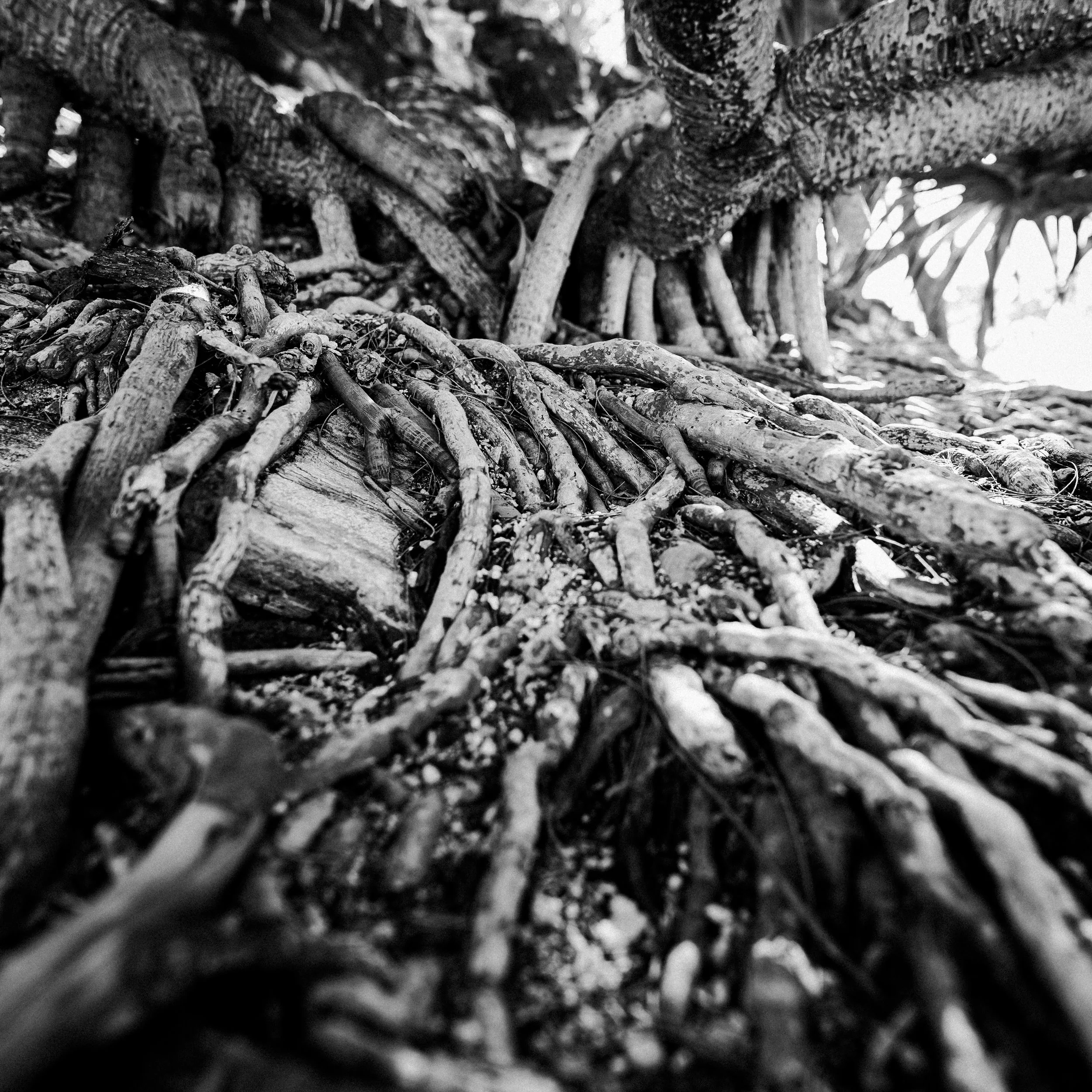
What Lies Beneath - Proliferation, Black-and-white digital photograph, 25 × 25 cm, 2026 © Bichen Liu
As your practice continues to evolve, what new themes, environments, or photographic experiments are you currently exploring?
At the moment, I am interested in exploring how photographic images can move beyond the flat surface. I would like to experiment with spatial photography, stereoscopic imaging, and other immersive technologies that can strengthen the emotional and perceptual impact of both still and moving images. I am also beginning to think about the relationship between artificial intelligence and photographic reality. Rather than using AI simply as a tool for image generation, I am interested in placing it in dialogue with real environments, material traces, and camera-based observation. I am particularly interested in what happens when constructed images encounter photographic evidence, and how this tension changes our understanding of memory, truth, and visibility. These experiments raise broader questions about authenticity, authorship, and the future role of photography.
Lastly, looking ahead five years, what would you like to achieve as an artist? Are there particular projects, collaborations, or directions you hope to pursue in your career?
Over the next five years, I would like to develop a more sustained and recognisable body of work around overlooked environments, ecological pressure, memory, and non-human forms of survival. I hope to expand these concerns through long-term photographic projects, moving image, and spatial or immersive image-making, while continuing to work from real places and material conditions. I would also like to collaborate with curators, researchers, and artists across photography, film, ecology, and new media, particularly on projects connecting visual practice with environment and technology. More broadly, I want to build a practice that can move between exhibitions, publications, and interdisciplinary research without losing its clarity. My aim is not simply to produce more images, but to build a body of work that becomes more precise, ambitious, and recognisable over time.
Artist’s Talk
Al-Tiba9 Interviews is a curated promotional platform that offers artists the opportunity to articulate their vision and engage with our diverse international readership through insightful, published dialogues. Conducted by Mohamed Benhadj, founder and curator of Al-Tiba9, these interviews spotlight the artists’ creative journeys and introduce their work to the global contemporary art scene.
Through our extensive network of museums, galleries, art professionals, collectors, and art enthusiasts worldwide, Al-Tiba9 Interviews provides a meaningful stage for artists to expand their reach and strengthen their presence in the international art discourse.




David Moješčík - MojDa is a Czech sculptor. His work is centred on figurative sculpture, the human body, and the female figure. Modelling in clay and with digital tools, he ultimately prioritises manual engagement with materials. . He draws inspiration from yoga philosophy with the concepts of non-violence and human-centeredness, as well as from Egyptian, ancient, and European classical sculpture.