

10 Questions with Ayumi Kajiwara
Al-Tiba9 Art Magazine ISSUE22 | Featured Artist
Ayumi Kajiwara is a Japanese sculptor based in London/ Tokyo, working across textile, installation, and found materials. Her practice explores the sculptural potential of textiles through knitting, binding, and material transformation, creating forms that exist between body, creature, and landscape. Working with both reclaimed materials and handcrafted textiles, she investigates material memory, vulnerability, and transformation. Originally trained in fashion, Kajiwara approaches textiles as a sculptural medium, extending them beyond function into immersive spatial works. She graduated from the Royal College of Art and Central Saint Martins, London. In 2024, she won the Pyratex Award at the Bilbao International Art & Fashion (BIAAF) competition. Her work has been exhibited internationally, including at the Barbican Centre, London.
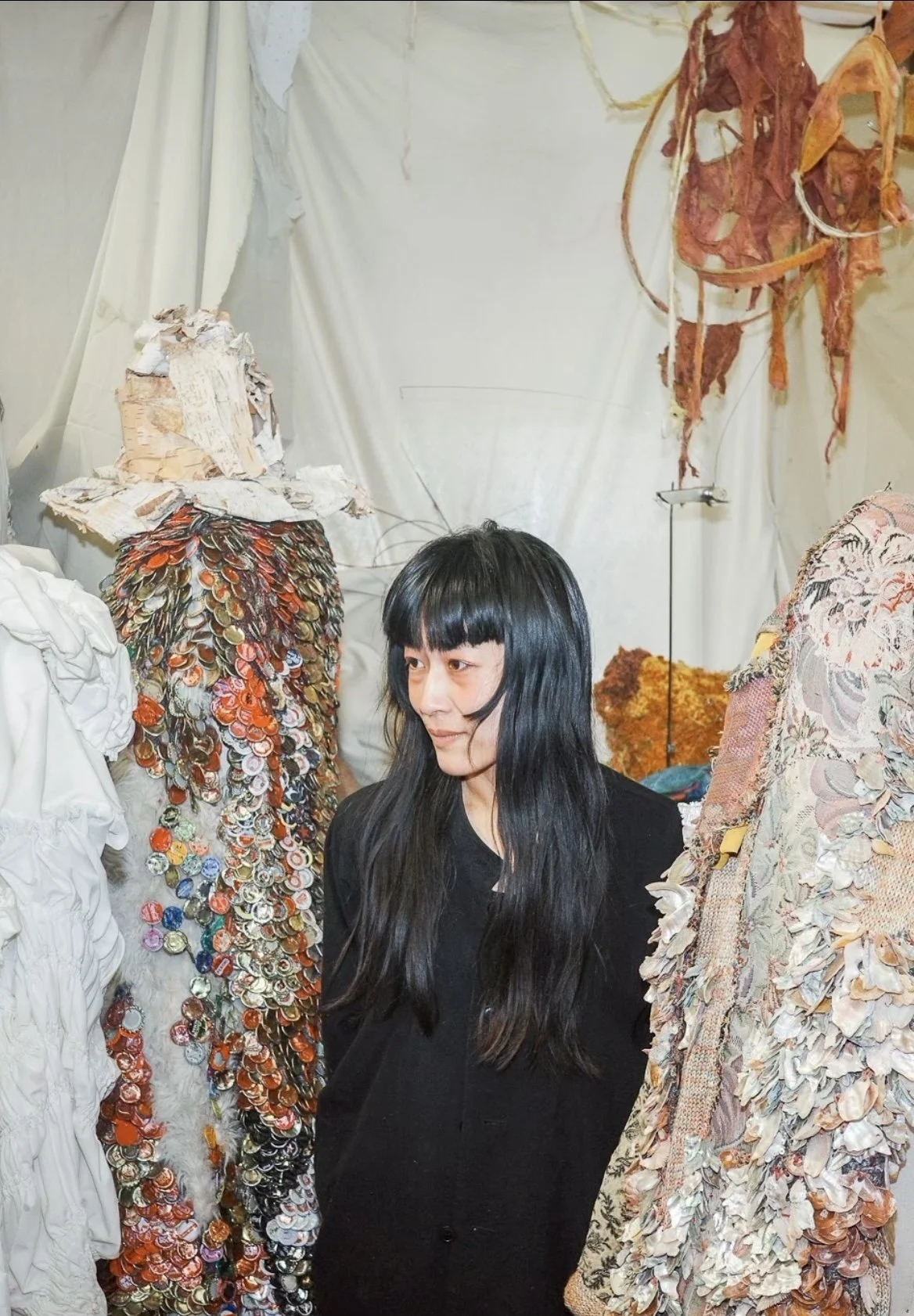
Ayumi Kajiwara - Portrait
ARTIST STATEMENT
Ayumi Kajiwara’s practice explores transformation through textile as a sculptural medium. Using knitting, binding, accumulation, and material reconstruction, she creates forms that exist between body, organism, and landscape. Her works emerge through slow, repetitive processes in which handcrafted textiles and reclaimed materials are reconfigured into tactile structures that retain traces of memory, labour, and previous lives. Rather than concealing their histories, Kajiwara allows materials to remain visibly altered, revealing vulnerability, resilience, and continual change. Existing between sculpture, installation, and wearable form, her practice questions relationships between protection and exposure, care and consumption, permanence and decay. Through acts of making and remaking, she approaches sculpture as a living process of material transformation.
Apocalyptic Romance, found objects, metal, shells, beads, animal bones, hand-worked textiles, variable dimensions, 2023 © Ayumi Kajiwara
AL-TIBA9 ART MAGAZINE ISSUE22
DISCOVER THE INTERNATIONAL ART SCENE WITH AL-TIBA9
LIMITED EDITION | Shipping worldwide.
Premium museum art paper.
Printed in London.
Grab 3 or more prints and get your FREE digital magazine.
Get your limited edition copy now
INTERVIEW
You originally studied fashion before moving into sculpture. What inspired that shift, and how has your background in fashion shaped the way you work with textiles today?
I was initially interested in fashion because of its relationship with the body. Clothing is never simply something we wear; it can become a language through which we express identity, expectations, gender, status, memories, and attachment. I often found myself wondering: do we wear clothes, or do clothes wear us?
Moving into sculpture allowed me to expand these questions beyond the functional boundaries of clothing. I became interested in what happens when textiles leave the body and begin to occupy space independently. The body is still present in my work, but it becomes one element within a larger relationship between material, space, and the viewer.
My background in fashion continues to influence the way I think through textiles. I approach them not only as surfaces or techniques, but as materials that can shape, surround, and transform the body.

Ghost of Waste I, Waste yarns from industrial knitting and sewing machines, hand-knitted, discarded textile fragments, 160 × 80 × 80 cm, 2025 © Ayumi Kajiwara | Ph. Davide Cossu
Textiles are often associated with clothing or craft. What drew you to explore them instead as a sculptural medium?
I became interested in textiles because they can behave almost like living systems. Through knitting, binding, knotting, and accumulation, a form can grow through repetition rather than being constructed all at once.
I am particularly fascinated by natural structures such as coral, fungi, roots, and nests, where form develops gradually through countless small processes. Knitting has a similar generative quality for me: every stitch creates the condition for the next one, and the final form emerges through tension, gravity, repetition, and the behaviour of the material itself.
This allows textiles to become more than a surface or a craft technique. They become a way of thinking about how forms grow, transform, and come into existence.
Your work brings together reclaimed textiles, found materials, natural dyes, and different forms of textile construction. How do you approach materials and techniques within your practice?
I tend to begin with the material rather than a predetermined image of what the final work should be. I am interested in what a material already carries, its history, texture, limitations, and possibilities, and then in discovering what it might become through the process of making.
Each work becomes an evolving investigation into what a material is capable of becoming. Every stitch, knot, or layer changes the conditions for the next, allowing the work to grow gradually rather than appear all at once.
Working with reclaimed and found materials also means accepting their previous lives rather than trying to erase them. Their imperfections, traces, and differences become part of the language of the work.

Apocalyptic Romance, found objects, metal, shells, beads, animal bones, hand-worked textiles, variable dimensions, 2023 © Ayumi Kajiwara

Crocodile Tears Liquor, Bottle caps, discarded keys, waste yarns from knitting and sewing machines, tree bark, found objects, 180 × 50 × 50 cm, 2023 © Ayumi Kajiwara
Your sculptures often seem to exist somewhere between body, creature, and landscape. Why is this space between forms important to you?
I am interested in forms that resist being completely defined. A sculpture might suggest a body, a creature, a landscape, or something organic, but I don’t want it to belong entirely to any one category.
For me, this ambiguity creates a space where the viewer’s imagination can become part of the work. The sculpture exists physically before it is seen, but its meaning only begins to unfold through each encounter.
I like the idea that a work can feel familiar and unfamiliar at the same time, something that the body recognises before the mind can name it.
Your process is often slow and accumulative. What does time mean within the act of making?
Time is not simply something that happens while I make; it becomes part of the material itself. I work through repetition, accumulation, and small decisions, allowing one action to influence the next.
I don’t always know what the final form will be when I begin. Each stitch, knot, or layer creates a new condition, and I respond to what has already happened. In this way, making becomes a form of investigation rather than the execution of a fixed idea.
The slowness gives the material space to reveal possibilities that might not appear through a faster or more controlled process. The work gradually becomes something that I could not have completely planned at the beginning.

Dream of Foetus, Hand-knitted cotton yarn, silk yarn, natural dyes from food waste, 120 × 80 × 60 cm, 2025 © Ayumi Kajiwara | Ph. Davide Cossu
Memory and transformation seem to be important throughout your practice. How do these ideas enter the work?
I am interested in materials as carriers of memory. A material can have a previous life, and when it is transformed, that history does not necessarily disappear. It can remain through traces, textures, marks, or simply through our awareness that it has existed somewhere else before.
Transformation, for me, is therefore not about completely replacing one thing with another. It is about allowing previous states to remain present while something new emerges.
I think this is also connected to the body. We are constantly changing, while carrying our previous experiences with us. My sculptures similarly exist between what they were, what they are, and what they might become.
Many of your materials have existed before they entered your work. How do you think about the relationship between their past lives and their future possibilities?
I like the idea that a material can hold several lives at once. Something that has been discarded can enter the work carrying traces of its previous existence, while also becoming part of something that has not existed before.
Rather than seeing waste as an ending, I am interested in it as a point of transition. The material’s past remains part of it, but it is given another possibility.
This also makes me think about time as something non-linear. A material can connect past, present, and future within the same object. The work becomes a place where these different states can coexist.
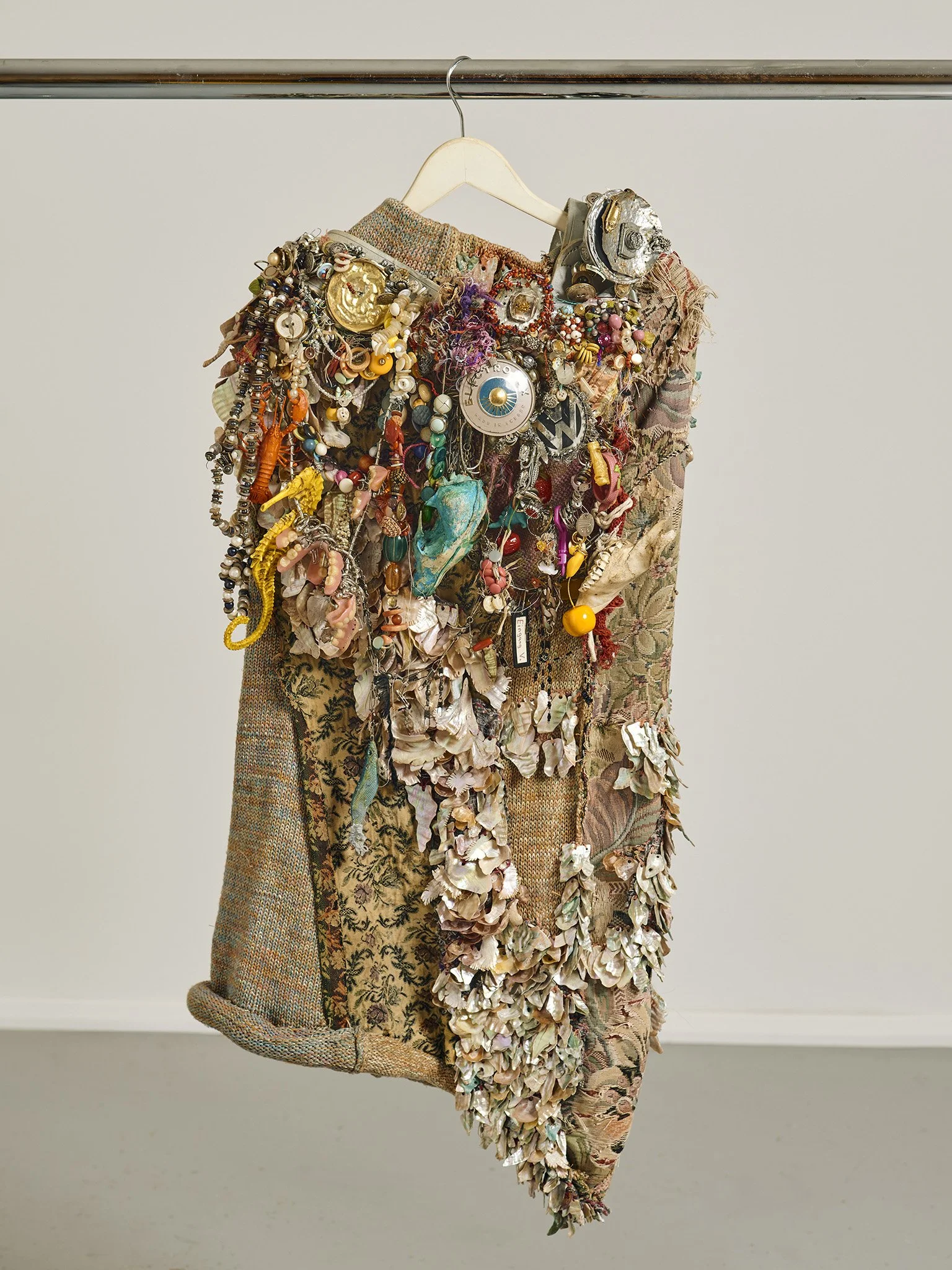
Apocalyptic Romance, found objects, metal, shells, beads, animal bones, hand-worked textiles, variable dimensions, 2023 © Ayumi Kajiwara | Ph. Davide Cossu
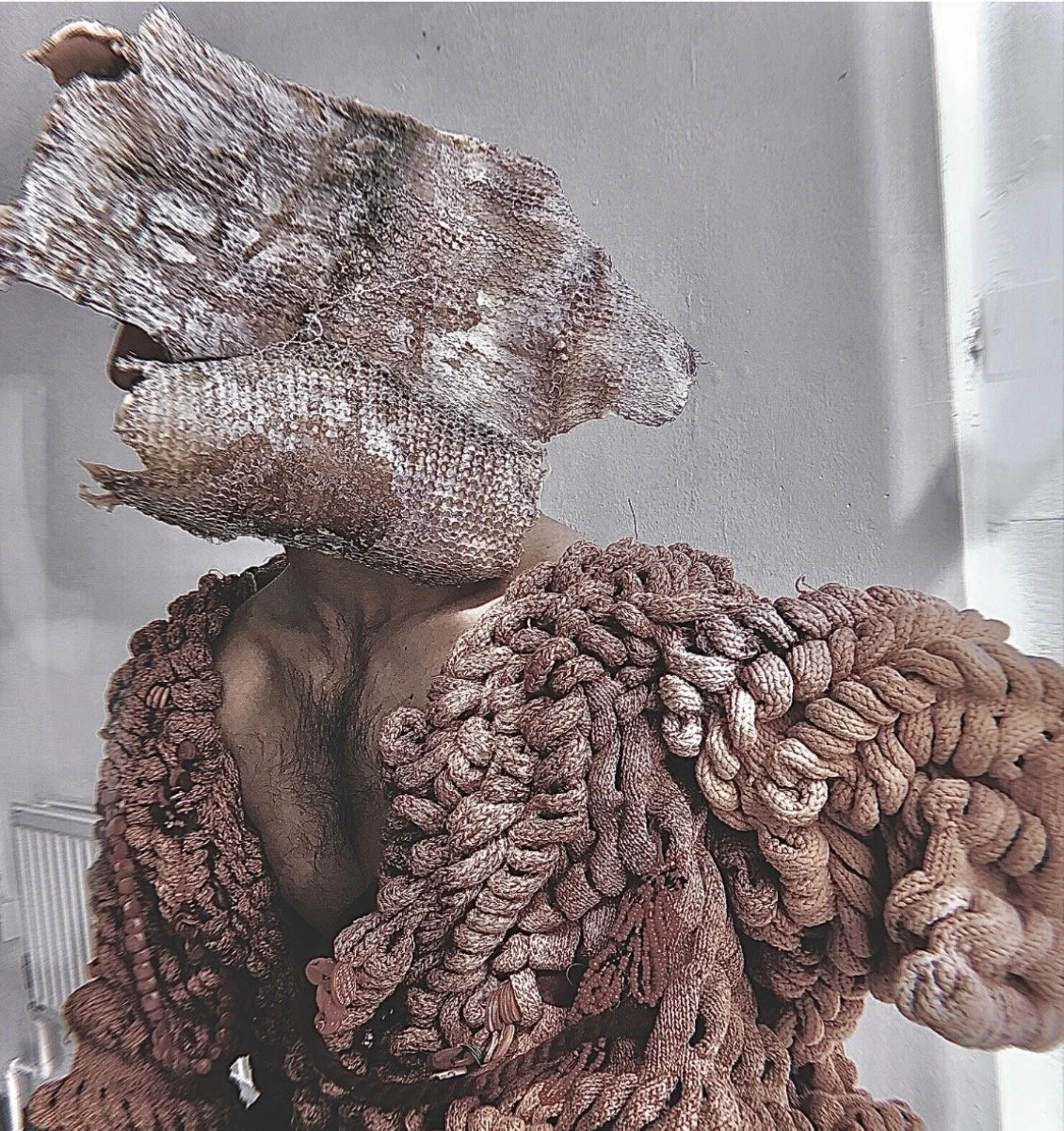
Skin of becoming, bio-leather, Hand-knitted cotton yarn, silk yarn, natural dyes from food waste, 120 × 80 × 60 cm, 2025 © Ayumi Kajiwara
Your sculptures can be interpreted very differently depending on who encounters them. How important is the viewer’s perspective to the life of a work?
The sculpture isn’t complete until someone brings their own imagination to it. Every person arrives with different memories, cultural references, emotions, and ways of seeing, so the same work can continue to unfold differently through each encounter.
Different audiences don’t change the sculpture itself, but every encounter changes the way it continues to exist. Each person brings something of their own to the work, and in that sense, every exhibition becomes part of the sculpture’s ongoing life.
I don’t want to determine exactly what a work should mean. I would rather create a space where the sculpture can speak for itself and where the viewer has room to form their own relationship with it.
What materials or processes are you interested in exploring in the future?
I am increasingly interested in materials that are not static, but exist through processes of change, growth, and transformation. My research is moving towards living systems, natural cycles, and materials that carry their own histories and possibilities. I am curious about biomaterials, fungi, and organic processes, not only as new substances to work with, but as collaborators that can challenge my understanding of making.
Rather than asking how I can control a material, I want to explore what a material is capable of becoming when given time, space, and the right conditions. This interest is leading me towards larger spatial installations where materials, bodies, and environments can interact and continuously evolve.
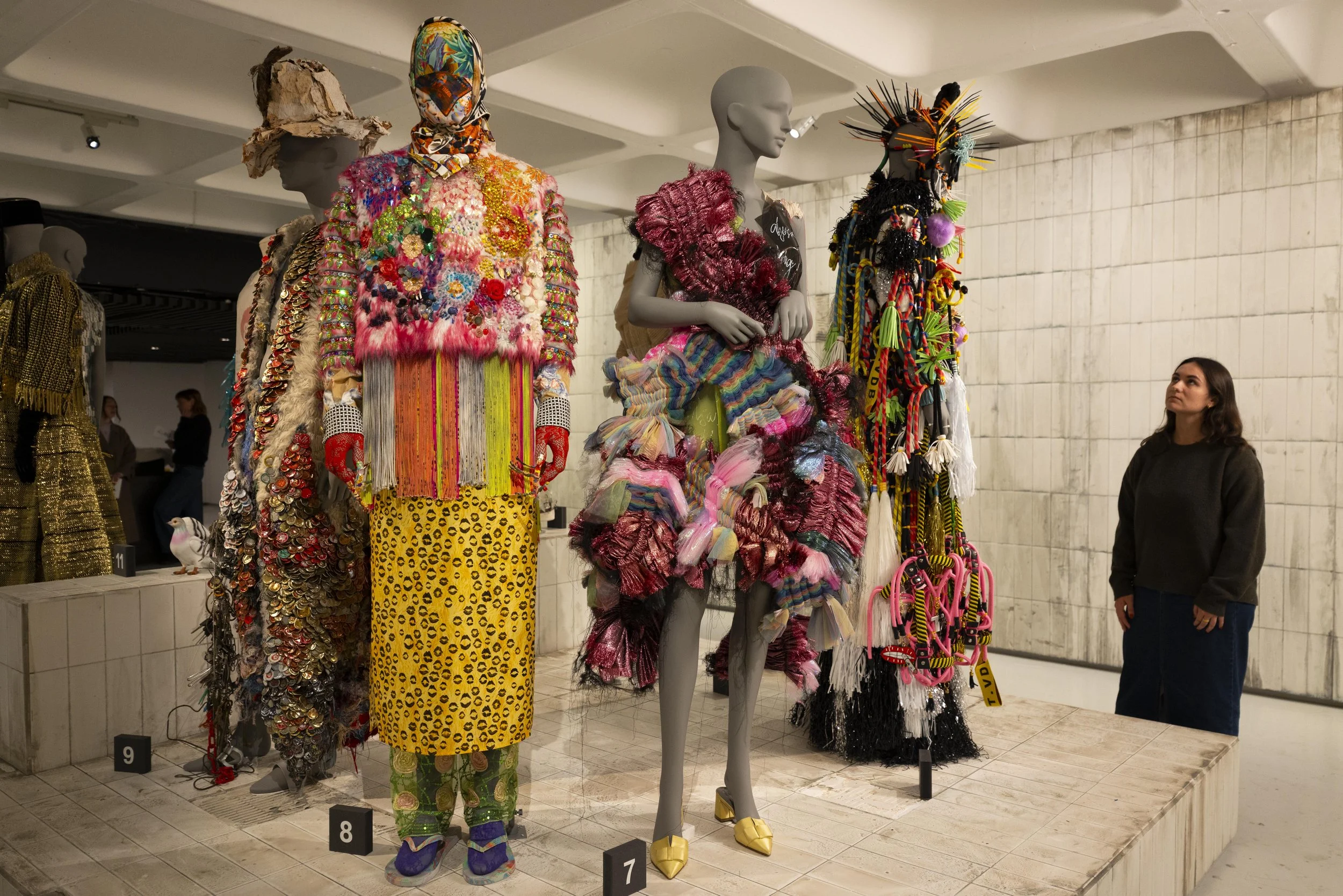
Installation view of Dirty Looks: Desire and Decay in Fashion, Barbican Art Gallery, London, 2025. Photo: David Parry © Barbican Art Gallery - Ayumi Kajiwara
What are your hopes and ambitions for the future of your practice?
Looking ahead, I hope to deepen my practice through sustained research and collaboration across different fields. I also want to create in a more peaceful environment, where my everyday life and artistic practice can exist in closer relationship with nature. I am currently developing a studio in the Japanese countryside with a garden, where I can grow plants for natural dyeing and continue experimenting with local materials, seasonal changes, and ecological processes. I hope to divide my time between Europe and rural Japan, learning from different cultures and ways of living with the natural world.
I want the work to expand both in scale and in depth, from the microscopic worlds of fibres, fungi, and living organisms to large-scale installations that transform entire spaces. I am interested in long-term research, residencies, and collaborations with scientists, craftspeople, and local communities, allowing these encounters to open up new ways of thinking and making.
Ultimately, I hope the work can contribute to a different way of relating to materials and to the living world. I want to encourage slower forms of making and attention, to reconsider our ideas of waste and repair, and to challenge the perceived separation between humans and nature. The body is the first landscape we inhabit, and I am interested in how learning to touch and understand materials differently might also change how we experience our own bodies and the environments around us.
I don’t want the sculptures to provide fixed answers. I hope they can speak in their own way, while creating a space for each person to enter the work with their own memories, imagination, and questions. If, through that encounter, the work can shift the way someone looks at, touches, or understands the materials and living systems around them, then that would be a meaningful direction for my practice.
Artist’s Talk
Al-Tiba9 Interviews is a curated promotional platform that offers artists the opportunity to articulate their vision and engage with our diverse international readership through insightful, published dialogues. Conducted by Mohamed Benhadj, founder and curator of Al-Tiba9, these interviews spotlight the artists’ creative journeys and introduce their work to the global contemporary art scene.
Through our extensive network of museums, galleries, art professionals, collectors, and art enthusiasts worldwide, Al-Tiba9 Interviews provides a meaningful stage for artists to expand their reach and strengthen their presence in the international art discourse.




David Moješčík - MojDa is a Czech sculptor. His work is centred on figurative sculpture, the human body, and the female figure. Modelling in clay and with digital tools, he ultimately prioritises manual engagement with materials. . He draws inspiration from yoga philosophy with the concepts of non-violence and human-centeredness, as well as from Egyptian, ancient, and European classical sculpture.