

10 Questions with Yanice Yang
Yanice Yang (Liuqingqing Yang) is an HCI researcher and AI product designer based in the Bay Area. Her work explores how human intention becomes guidance that computational systems can interpret, and how people retain authorship through review, correction, and creative choice.
With graduate training in human-computer interaction at the University of Michigan and a fine-arts background at Pratt Institute, Yang brings research, visual judgment, and prototyping into a shared practice. Her coauthored research investigates diffusion-based interface generation, including the roles of user input, design constraints, and feedback. In collaborative AI product work, she designs creative workflows for video and brand expression, shaping how people communicate direction, assess generated material, and refine results. Her practice also includes care-oriented design concepts and personal code-based visual experiments.
Across these forms, Yang connects the behavior of computational systems with the decisions people can understand and make. Her focus is on keeping increasingly automated creative processes open to human interpretation and intervention.

Yanice Yang - Portrait
ARTIST STATEMENT
Yanice Yang’s practice begins with a question: when a computational system can produce many possibilities, how does a person decide which ones express what they mean? As an HCI researcher and AI product designer, she explores the relationship between the guidance a system receives, the possibilities it produces, and the decisions a person makes in response.
In AI-assisted creative workflows, she designs ways for people to express direction through visual references, language examples, and editable controls. Her work extends from the visible interface to the structure of that guidance: how a preference is represented, how a correction changes the next result, and when a choice should remain specific to one task. In agentic brand workflows, she designs how approved creative decisions can carry into later work while remaining available for human review and revision.
Research and prototyping inform this process. Her coauthored work on diffusion-based interface generation examines how input, constraints, and feedback can guide generated outcomes. In practice, she tests how model outputs respond to design choices and uses unexpected results to reconsider the controls people are given.
Her personal code-based visual experiments approach computation as a material for composition, motion, and interaction. Care-oriented design brings a related concern into everyday experience: how complex behavior can become understandable and responsive to the person encountering it.
Across collaborative design projects and personal experiments, Yang locates authorship in the continuing acts of directing, observing, selecting, and revising. Her work asks how automation can expand what people can make while leaving them room to interpret, intervene, and decide what to keep.
Breezy iF Award, Digital Product Design Composite, 1217x782 px, 2026 © Yanice Yang
INTERVIEW
First, you have a background in both fine arts and human-computer interaction. How have these two disciplines shaped the way you approach your work today?
I define myself as an AI product builder, working at the intersection of HCI research and AI product design. My fine arts background has a lot to do with how I approach that work. It made me more sensitive to people's experiences and to how a visual choice can affect what someone understands or feels. HCI gave me ways to investigate those observations, and working in industry has pushed me to make them useful in real situations.
When stepping into fine arts, I used art to express my own feelings. One project was about Alzheimer's disease, which someone in my family was living with. I was trying to express the feeling of memories disappearing. But as I worked on it, I started thinking about how I could help more practically. That became my first UX project, a medical assistive tool intended to help hospital caregivers communicate with patients' families. My HCI studies also helped me develop that further as an approach: understanding people's routines, asking questions, and testing whether a design actually helps.
In industry, those questions become very concrete. At Cummins, I researched technicians' work and designed diagnostic workflows, so I had to think about what information would help someone take the next step in a repair. With AI products, I need to understand what the model can do and how someone without technical expertise can use it. Can they give it a direction? Can they tell when something is wrong and fix it? That's where I bring these parts of my background together.
Your practice explores how human intention can be translated into something a computational system understands. What first drew you to this question, and why has it become central to your work?
What drew me to this is the gap between human intent and what a computer understands. Someone might know the story they want a video to tell, but not how to edit it. Or they might recognize the right visual direction without being able to describe it in technical terms. I think there's a lot of design work in that gap.
With large language models, it becomes even more interesting. Through research and working with them, I see capabilities that people don't necessarily know are available. So I think a designer needs to go quite deeply into the technology as well as the user's needs. What can this model actually do? What kind of context helps it? Where does it still struggle, even when the request is clear?
That understanding affects the experience I can design. For example, someone might find it much easier to show a few visual references than to write a detailed prompt. If those references can guide the model, I can build a way for them to work like that.
This is central to my work because I want people to benefit from what AI can do in their actual lives and work. Having access to a model is only the beginning. They still need to express what they need, judge the response, and do something when it doesn't work.

BrandKit Laptop, Digital Product Design Mockup, 1024x1536 px, 2026 © Yanice Yang
You work across research, AI product design, and personal code-based visual experiments. How does your approach differ between these contexts, and what connects them?
In research, I need to narrow a question down enough to study it. My work includes diffusion-based interface generation and computer-vision approaches to gesture interaction. I'm looking at how systems respond to different kinds of human input. In product design, I have to follow that through a whole task. Someone needs to get something done, so I have to think beyond whether the system produced a result.
My code-based work gives me more freedom. I can explore motion graphics or an interactive response just because there's something interesting about it. I don't need to know immediately what product it belongs in. I like having that space alongside the more applied work.
I also see my research contributing to how other researchers approach problems beyond my original studies. In “Not Another EHR,” the authors draw on my interface-generation research as part of the case for using generative interfaces in physicians' work. They explore how a physician could ask for patient information in natural language and receive a presentation that fits what they need. My work helps support the technical possibility behind that direction. What interests me is how they take that possibility into a specific setting: the physician already has the expertise, and the interface needs to give that expertise a way to guide the system.
My gesture-tracking research also serves as a strong reference for work on assistive communication. In one study, the authors cite it when discussing how recognized hand gestures can be turned into meaningful actions or text. For me, that's a meaningful way for research to have influence: it becomes part of the knowledge other researchers draw on as they explore a different problem. These connections bring my work into wider research on healthcare interfaces and accessibility. They also relate closely to why I do this work in the first place, which is to help people express what they need and make technology more useful to them.
When working with AI-generated images or other creative outputs, what does your creative process look like? How do you move from an initial idea to a result that feels right to you?
I usually start with what I'm trying to communicate and what I don't want to lose along the way. That might mean collecting visual references, working with source footage, or writing down a few constraints. I need something to judge the output against, because it's very easy to see an attractive image and feel that it works.
Then I look more closely. Does it actually follow the idea? Has the model assumed something I didn't intend? Sometimes an unexpected detail is worth keeping, and sometimes it takes the work in the wrong direction. I might change the reference, make a constraint clearer, or rethink part of the idea.
The way I make those changes depends on the medium. With code-based work, I can adjust the rules behind the motion or composition and see what happens. In a Gen-AI-native workflow, I might want to build solutions that balance among LLM capabilities, user goals and the nature of the platform. I want to be able to work on that part without throwing away everything that's already working.
For me, a result feels right when the choices make sense together. It doesn't have to match exactly what I imagined at the start, but I need to understand why I'm keeping it.

AI Assistive, Digital Interface Design Composite, 1920x1641 px, 2026 © Yanice Yang
You often emphasise the importance of human choice within automated processes. Where do you see the artist’s authorship residing when a computational system contributes to the final outcome?
I think it's in the designer's intuitive judgment. A model can generate something I wouldn't have thought of, but I still need to decide whether it's right for the work. Is it expressing what I mean? Is there something worth exploring? Or does it just look good?
My experience and taste affect those decisions. The things I've noticed, the work I've made, and my sensitivity to visual relationships all shape what I choose. Someone else could use the same model and see completely different possibilities in its output.
As a product builder, I'm also thinking about more than the output itself. Who is going to use this? What will they understand from it? What happens after they make a decision? A model can contribute to the final result, but I still have to think through those different dimensions.
I bring that judgment into mentoring and judging as well, including my judging experience with several international design awards. My research and product experience give me a perspective I can share, while someone else's ideas and taste may lead them somewhere different. For me, that's also part of design's impact: helping other people think through their work without taking away their authorship.
That's why I care about how a generative workflow is designed. References, constraints, and feedback are ways for someone's judgment to influence what happens. If the only options are to accept the result or generate another one, it's difficult to bring much of that experience into the process. I want people to be able to make specific decisions about what they keep and what they change.
Your work explores how feedback, constraints, and visual references can guide computational systems. Can you share an example of how an unexpected result has changed the direction of a project or your understanding of the process?
In one generative content project, we ran into two problems that seemed to pull in opposite directions. With too little context, the model could fill in details that weren't supported. But adding a lot of references could also make the direction less clear.
I started looking at what we were actually asking the person to do. We were collecting their material, but that didn't necessarily tell us which direction they wanted to follow. A group of images could represent several different ideas. More information wasn't going to settle that choice for them.
I redesigned the workflow around a reference board where people could choose a coherent visual direction, review how the system interpreted it, and correct it before generation. I also separated visual preferences from facts and explicit restrictions. An image could guide the atmosphere without giving the model permission to change what the product was.
What changed for me was how I thought about the workflow itself. I couldn't decide all the steps first and expect the model to fit neatly into them. The unexpected results showed me where a person needed a choice that wasn't there yet. Testing helped me work out the structure of the experience, as well as how to improve the result.

BrandKit Agent Palette, Digital Interface Design, 2176x1374 px, 2026 © Yanice Yang

BrandKit UI Collection, Digital Interface Design, 1672x941 px, 2026 © Yanice Yang
You are interested in making complex computational behaviour more understandable and responsive to people. How do you balance the technical complexity of these systems with the need to make them intuitive and accessible?
For me, human-centered AI starts with what someone needs to know to do the task. They probably don't need to understand the model's internal process, but they do need to know what material it's using and what will happen when they approve something.
A lot of the design is about making those decisions easier. Choosing a visual reference may be easier than writing a long prompt. Seeing a preview may be easier than reading a technical explanation. More detailed controls can be there when someone needs them, without making them learn everything at the beginning.
But I don't want to make the interface look simple by hiding something important. A suggestion isn't an approved change. A preview doesn't mean an action has been completed. Those distinctions affect what the person does next.
This is also where understanding the technology matters. If a control says it will change something, I need to know whether the system can actually do that. And if information is missing or a step fails, the person needs to know what that means for their work and how to continue. Those are the moments I pay attention to in research and testing. A clean screen alone doesn't tell me whether an experience is easy to use.
Care-oriented design is another aspect of your practice. How do you understand the relationship between care, technology, and the way people interact with increasingly automated systems?
For me, care includes noticing how much we're asking of the person using a product. How much do they have to understand? How much attention does it take? If something goes wrong, how hard is it to recover? Those things can feel very different when someone is tired, worried, or unfamiliar with the technology.
In Breezy, a pediatric respiratory-care product, I explored visual and light-based feedback to make a specialized process more approachable to a child. I also applied 3D hand-skeleton models and optimized convolutional neural networks (CNNs) to support natural gesture interaction. Testing showed a reduction in users' cognitive load of over 31%. For me, that connects the technical work directly to care: I need to think about how much effort an interaction asks of someone, as well as what the device needs to communicate.
I think about something similar with automation. Giving people control matters, but it can also become a lot of work if we're asking them to check every detail and resolve every uncertainty. The design has to help them with that. Important choices should be clear, and routine steps shouldn't demand more attention than they need.
I also think care shows up when the system can't help. Can someone correct it without having to start again? Do they know when they need human help? It's easy to focus on the successful version of an interaction. I want to consider what the experience is like when the person is having a difficult time with it.
As AI becomes more involved in creative work, what do you think we risk losing when we automate too much, and what new possibilities do you believe this technology can open up?
I think we risk losing some of the process through which we develop our own judgment. When I compare two versions and try to understand why one works better, I'm learning something. If the system makes all of those decisions before I get involved, I might accept a result without really thinking about them.
I also think about this through my mentorship with University of Michigan students and at Cal Hacks. It's a way to share what I've learned from research and design, and to support other people as they develop their own thinking. That matters to me when I look at AI tools, too: I hope they help people grow in confidence and judgment as they make things.
There are also parts of the work I'd happily make easier. Repetitive production tasks can take a lot of time without helping someone express their idea. AI can reduce that work and let people try a medium they couldn't easily work in before. Someone can have a very good idea without having the technical skills to produce it.
What matters to me is where that leaves the person in the process. Can they compare possibilities, change a particular part, or decide the whole direction is wrong? Those are useful opportunities to think, and I don't want to design them out just to make the process faster.
I'd like more people to be able to make things with these tools. At the same time, I hope working with them helps people become more confident in their own choices, rather than simply more comfortable accepting whatever the system produces.
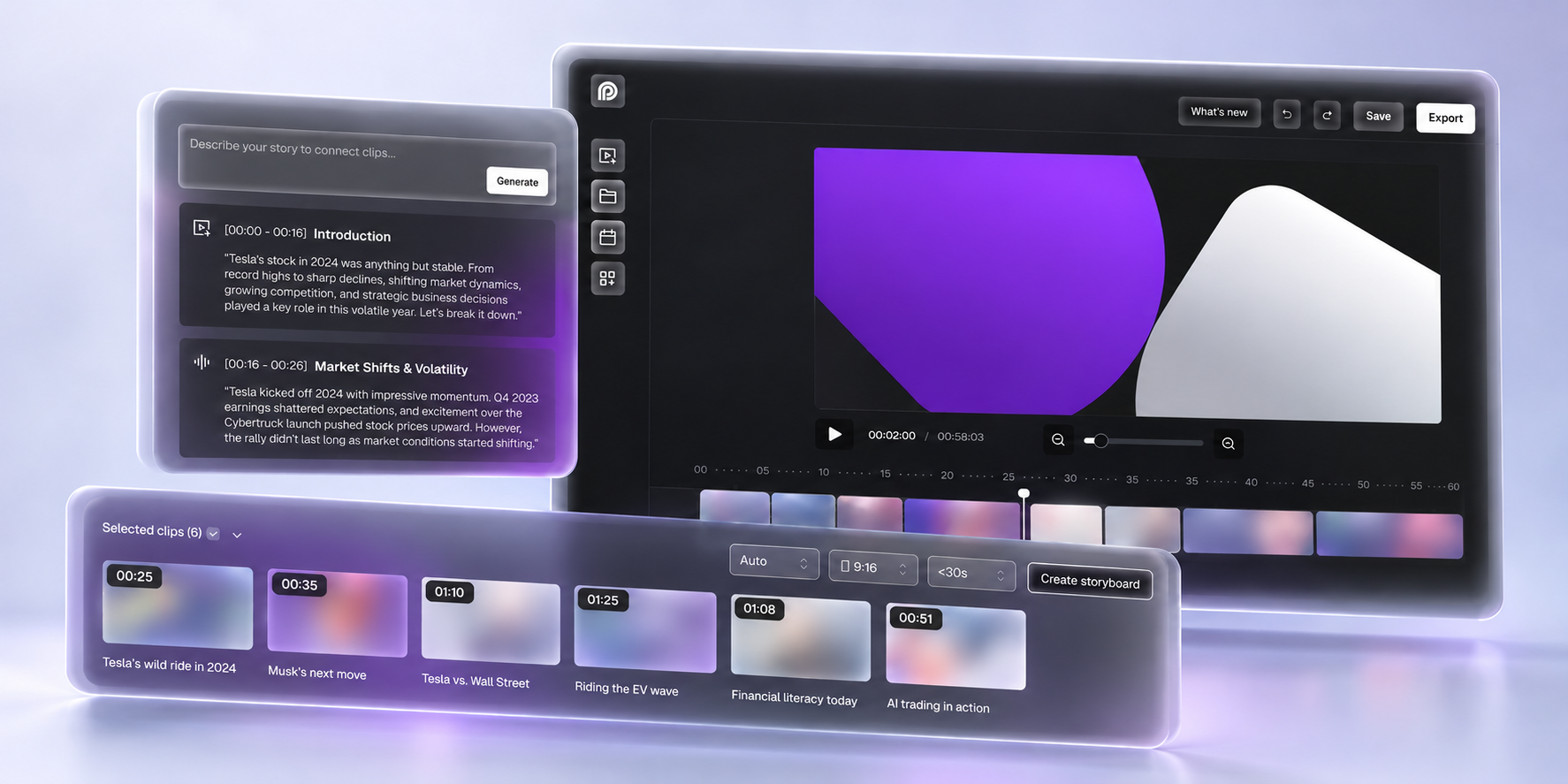
Opus Clip, Digital Product Design Mockup, 1774x887 px, 2026 © Yanice Yang
Looking ahead, are there particular questions, mediums, or collaborations you would like to explore further? Is there a project you are currently developing that represents a new direction in your practice?
Right now, I'm working on generative AI workflows where assistance continues across several steps. The system needs to carry context forward so the person doesn't have to explain everything again. But then there are questions about what it should remember and how the person can change that.
For example, if I reject one output, it might just be wrong for this particular task. If I choose a visual style once, that doesn't mean I want it applied to everything. I'm interested in how we make those distinctions understandable, so people can see what the system has learned from them and correct it.
That's an area where I'd like to keep working across HCI research, AI engineering, and product design. Seeing other researchers draw on my work makes me want to keep contributing to that exchange, and mentoring and judging are other ways I can be part of it. I also want to explore accessibility and care further, including caregiver communication and interactions for older adults. Those interests connect back to why I started doing UX in the first place.
And I'd like to keep making code-based visual work. I can explore movement, perception, or expression without needing to turn every experiment into a product. I don't have to know exactly where an idea will go before I start working with it.
Artist’s Talk
Al-Tiba9 Interviews is a curated promotional platform that offers artists the opportunity to articulate their vision and engage with our diverse international readership through insightful, published dialogues. Conducted by Mohamed Benhadj, founder and curator of Al-Tiba9, these interviews spotlight the artists’ creative journeys and introduce their work to the global contemporary art scene.
Through our extensive network of museums, galleries, art professionals, collectors, and art enthusiasts worldwide, Al-Tiba9 Interviews provides a meaningful stage for artists to expand their reach and strengthen their presence in the international art discourse.



Yanice Yang (Liuqingqing Yang) is an HCI researcher and AI product designer based in the Bay Area. Her work explores how human intention becomes guidance that computational systems can interpret, and how people retain authorship through review, correction, and creative choice. Her focus is on keeping increasingly automated creative processes open to human interpretation and intervention.