

10 Questions with Ruoyan Er
Ruoyan Er is a fashion artist and designer specialising in knitwear, textiles, draping, and garment construction. Her practice explores the relationship between material, emotion, memory, and time, approaching clothing as both a tactile object and a form of visual storytelling.
Er currently works as a lead designer for Peter Jensen and Yours Truly, Copenhagen, developing knitwear and textile-based designs. Her professional practice also includes collaborations with established fashion and creative organizations, including SHEIN and Alibaba, where she has contributed to fashion, visual, and design projects. She has worked across freelance design, styling, creative development, and education, collaborating with more than 20 fashion brands and creative projects internationally.
Alongside her commercial practice, Er develops an independent body of work rooted in material experimentation and textile craftsmanship. Her latest collection, AFTERMatter, examines time, decay, and reconstruction through knitwear. Inspired by moss reclaiming weathered stone, fragmented monuments, and the writings of Brave New World and One Hundred Years of Solitude, the collection explores how systems collapse, memories accumulate, and forms are continuously remade. Through deconstruction, reconstruction, and intricate hand-developed techniques, Er transforms fragments and traces of time into new structures.
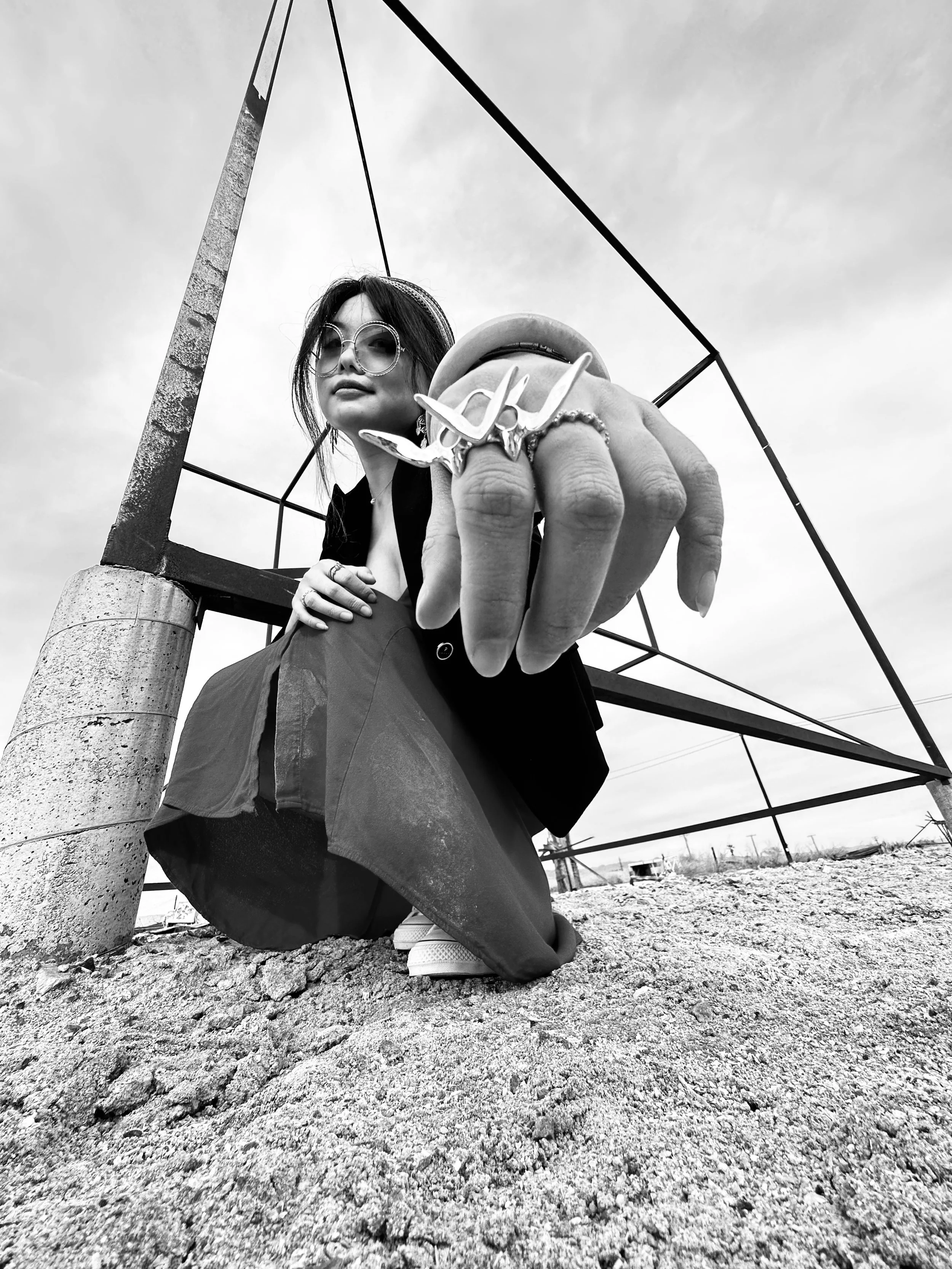
Ruoyan Er - Portrait
AFTERMatter | Project Description
AFTERMatter is a meditation on time, decay, and reconstruction. Inspired by my recent readings of Aldous Huxley’s Brave New World and Gabriel García Márquez’s One Hundred Years of Solitude, the collection reflects on the fragile structures we build to impose order upon the world: systems, monuments, memories, and identities that inevitably fracture, collapse, and take new forms.
Moss becomes a quiet witness to this process: slowly covering weathered stone, fallen trees, and the remains of what once seemed permanent. In the collection, knitting becomes a parallel language of time. Each stitch accumulates, while each unravelling releases what was once constructed. Through deconstruction, distortion, fragmentation, and reconstruction, garments are dismantled and woven together again, allowing remnants to become the foundation of something new.
Time records everything, yet eventually forgets everything. What remains is neither the original form nor complete disappearance, but a surface rewritten again and again, where decay becomes growth, collapse becomes reconstruction, and what has been forgotten quietly begins to grow over what remains.
Verdigrism, film, 2673 × 3348 px, 2026 © Ruoyan Er
INTERVIEW
First off, could you tell us a little about your background and how you first became interested in fashion and textiles?
Of course. I’ve been working as a designer in the industry for about ten years now, and I actually feel that “finding yourself” is a lifelong task for everyone. It was during my graduate studies that one of my professors suddenly noticed that I had a particular talent for textiles. With almost any hands-on technique, I didn’t seem to need much practice before finding the most natural way for a material to express itself. So I eventually tried making a collection through knitwear, the same collection that was featured in your magazine at the time. And then the story continued with me becoming a designer for Peter Jensen’s brand, Yours Truly. From there, my knitwear work just kept growing. I’m actually very happy about that, because knitting itself makes me happy.
What was it about fashion, and particularly knitwear and textiles, that made you want to pursue it as a creative practice?
I think yarn carries emotion. To me, it is much harder to tame than a calm, obedient fabric. Because every stitch is made from a strand of yarn, one small movement can affect everything else. It reminds me of a network of relationships in life: everything is connected, dependent on one another, and sometimes even felted together. When a strand becomes a stitch, stitches become rows, and rows become a surface, everything starts to mean something different. But you are still you. Your weight, material, and colour haven’t changed. They have simply embraced one another and become a garment. I think that alone can make this sometimes-boring world a little more diverse. And there are so many ways of combining textiles. Knots, knitting, crochet, whatever it is, the ways of creating feel incredibly free to me.

Lichenfall, film, 2673 × 3348 px, 2026 © Ruoyan Er
Your work moves between commercial design and independent artistic projects. How do these two sides of your practice influence each other?
Because I have to eat. (Hahaha, I’m sorry.) I suppose I should give a more serious answer. Recently, I’ve actually become a little pessimistic about this relationship. When I do a lot of commercial design, I sometimes find myself becoming less free when I return to my own experimental or avant-garde work. You start unconsciously making silhouettes look more like ready-to-wear, thinking about the target customer, the selling environment, and where the garment is supposed to exist. But it’s a double-edged sword. The more you understand the market, the more you also realise that clothing is, after all, a commercial and functional product. When I work on commercial projects, I can very clearly feel the material budget becoming smaller. Sometimes my client will say, “Er, should we take this detail and this detail out?”
And ironically, those are often the parts that contain my thinking, experimentation, and the most creative elements. So maybe my answer now is not to balance the two. It is to stop trying to balance them, because trying to do so can actually make me more internally conflicted. Once I understand who the final customer is, I will design to please them. That doesn’t stop me from using design to be myself.
How would you describe your creative process, from the first idea or reference to the finished garment?
At the beginning of everything, I usually choose an opportunity to play. If I start from an abstract concept, whether I’m making a collage, drawing something abstract, or simply playing with raw materials, I don’t define what I am ultimately supposed to get. But at the same time, I also don’t simply make a garment according to a design drawing. I collage and drape at the same time. And then you start discovering that every yarn and every material has its own character. Sometimes the result is more beautiful than the original collage. Sometimes it is completely opposite to it. When I reach the final stage of the design, I become very rational. I usually give the entire project only five keywords, generally adjectives. They help me make that transition from abstraction into reality. At that moment, I stop floating so much and start moving toward those final words. Only when the garment is almost fully formed do I go back and draw the design that already has its silhouette and construction established. And the opposite can happen too. If the client, or the intention of the project, is already very clear, then I tend to be more conservative during the research stage. I start with the design drawings and push one silhouette forward at a time. I think your mind needs both the square and the circle. What is a “cloud”? What is a “building”? There is always a ratio between floating and grounding in my mind.

Entropy, digital, 2673 × 3348 px, 2026 © Ruoyan Er

Entropy, digital, 2673 × 3348 px, 2026 © Ruoyan Er

Entropy, digital, 2673 × 3348 px, 2026 © Ruoyan Er

Entropy, digital, 2673 × 3348 px, 2026 © Ruoyan Er
Your work often explores material, emotion, memory, and time. What draws you to these themes, and how do they find their way into your work?
I really want abstract things to become something people can touch. In a slightly inaccurate way of putting it, I use different materials to write my diary. When I find inspiration, I don’t think it usually comes from one specific thing. It might instead be the symbiosis between a song and its author, or the relationship that still exists between a book and its reader many years later. These are the kinds of things you can talk about with someone, and they may not really get what you mean. For example… what *AFTERMatters* is trying to do, in a way, is to observe the peaceful Ursula that represents time. (Laughs.) My imagination sometimes makes me ramble and leaves me unable to express exactly what I mean in words. But the work can express the feeling much more precisely through material. Because words like “soft,” “precise,” and “continuous” can actually be felt in a piece of yarn.
Could you tell us about the starting point for *AFTERMatters* and what led you to explore ideas of decay, collapse, and reconstruction through knitwear?
The official answer is that I was reading *One Hundred Years of Solitude*. (Laughs.) But actually, the more immediate reason was that I had a very comfortable sweater that started to age. Some of its fibers began to break apart, while other parts remained strong and continued to hold the original arrangement of stitches. Those two things were happening at the same time. My answer sounds a little magical-realistic too. While I was creating the collection, I kept feeling that the keywords I was interested in through knitwear were very close to what Márquez was trying to express, or at least what I, as a reader, felt he was expressing: Chaos and order are actually one thing, and everything is gradually pushed toward disintegration and forgetting by time. So you can feel that progression throughout *AFTERMatters* as well. The design moves from extremely precise knit structures calculated through my own patterns, to the reconstruction of traditional granny squares, then into draping, and finally toward dissolution and deconstruction.

Palimpsest, digital, 2673 × 3348 px, 2026 © Ruoyan Er
Moss reclaiming weathered stone is one of the key images behind *AFTERMatters*. What does this relationship between nature, decay, and human-made structures mean to you?
I’ve always thought that humans are actually quite hypocritical. (Sorry for saying that.) I sometimes feel that when humans talk about sustainability, we turn it into another commercial system, and commerce can, in its own way, become the beginning of destroying the world. I found this metaphor because I feel that the real order of this world is actually nature itself. In places like the Arctic glaciers, where human systems can barely impose themselves at all, moss, a stubborn, almost prehistoric civilisation, continues to quietly grow, decline, attach itself, and form its own kind of life. So for me, there is something very unforced about it. It is not that fallen leaves mean decay and spring means growth, in the traditional way we like to describe these things. It has been there since prehistory. Does it need a tiny human being to praise it, evaluate it, or criticize it? No. The seasons turn. The universe continues. Whatever belongs somewhere will be there.
The collection is built around the idea of “matter → unravel → fragment → accumulate → reconstruct,” as you mention in your statement. How did this process shape the way you designed and constructed the garments?
I’ve already touched on some of this: the relationship between control and research in my design process. At the very beginning of this collection, many of the textures I “played” into existence were quite concrete. So as I developed the silhouettes, I actually wanted them to become more abstract. And one of the frustrating things about knitwear is that you have to calculate density and stitches. When I wanted to move into that abstract stage of “deconstruct → fragment → accumulate,” the reconstruction afterwards became much more complicated and required even more time and energy. So if I had to say how this process influenced my design, I would say that my designs are never really developed from A to Z. They constantly move forward and backwards. I start again, accumulate, reconstruct, establish a new order, and then disrupt it again. The final garment comes out of all of that unpredictability. But I actually love the process. In our last interview, I mentioned a sentence: “Only the reconstructors can experience joy again.” Maybe that is exactly what I mean. My design is “myself.”

Reliquary, digital, 2673 × 3348 px, 2026 © Ruoyan Er

Verdigrism, film, 2673 × 3348 px, 2026 © Ruoyan Er
What would you like viewers to take away from *AFTERMatter*s? Is there a particular message or feeling you hope remains with them?
I actually really hope that viewers have different feelings. When people think about the idea of looking back through time, they will inevitably think about their own lives. If my work can make someone reflect on something while they are looking at it, remember something, and maybe even smile to themselves for a moment, then that is enough for me.
Lastly, looking ahead, what are you currently interested in exploring, and are there any new projects or directions you can share with us?
Oh, this one you can definitely look forward to! I’m currently working with an installation artist on a 3D project. This time, I’m pushing myself to explore a combination of knitwear and 3D printing, and I think it will create a very interesting visual impact. Because this time, the knitwear will actually become the rigid core, while the soft lace and structures will be the hard elements. So… stay tuned.And I hope to collaborate with Al-Tiba9 again.
Artist’s Talk
Al-Tiba9 Interviews is a curated promotional platform that offers artists the opportunity to articulate their vision and engage with our diverse international readership through insightful, published dialogues. Conducted by Mohamed Benhadj, founder and curator of Al-Tiba9, these interviews spotlight the artists’ creative journeys and introduce their work to the global contemporary art scene.
Through our extensive network of museums, galleries, art professionals, collectors, and art enthusiasts worldwide, Al-Tiba9 Interviews provides a meaningful stage for artists to expand their reach and strengthen their presence in the international art discourse.


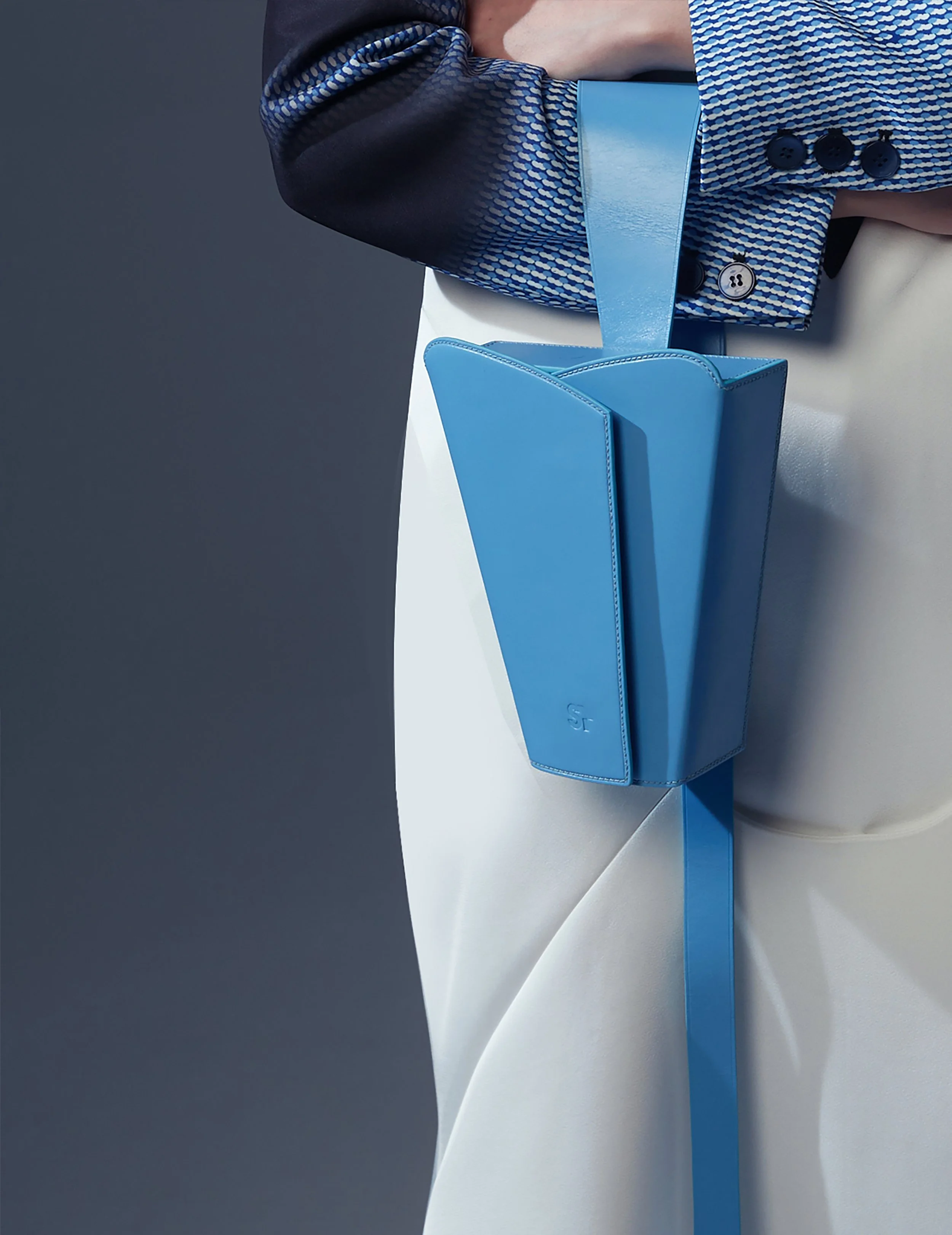

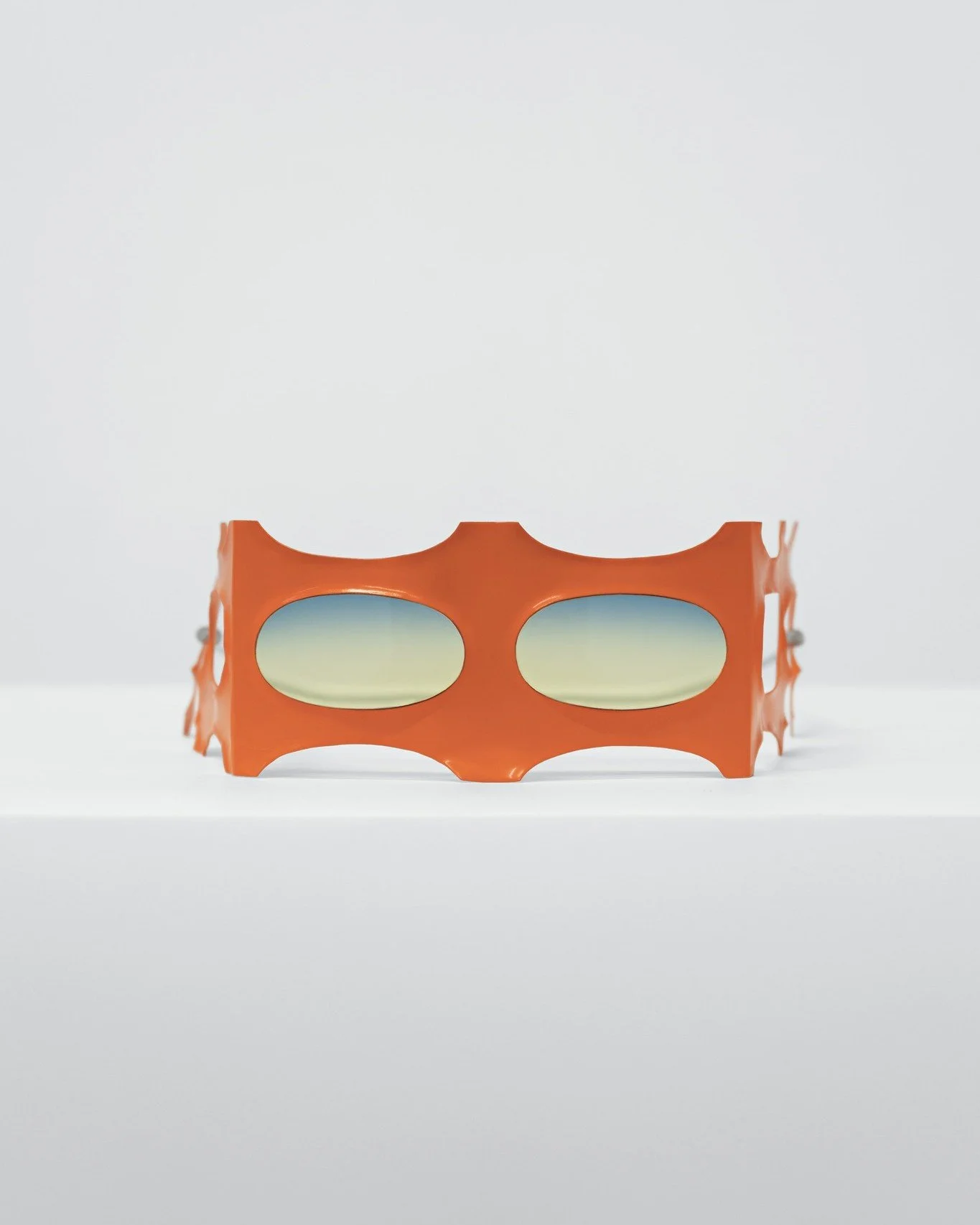
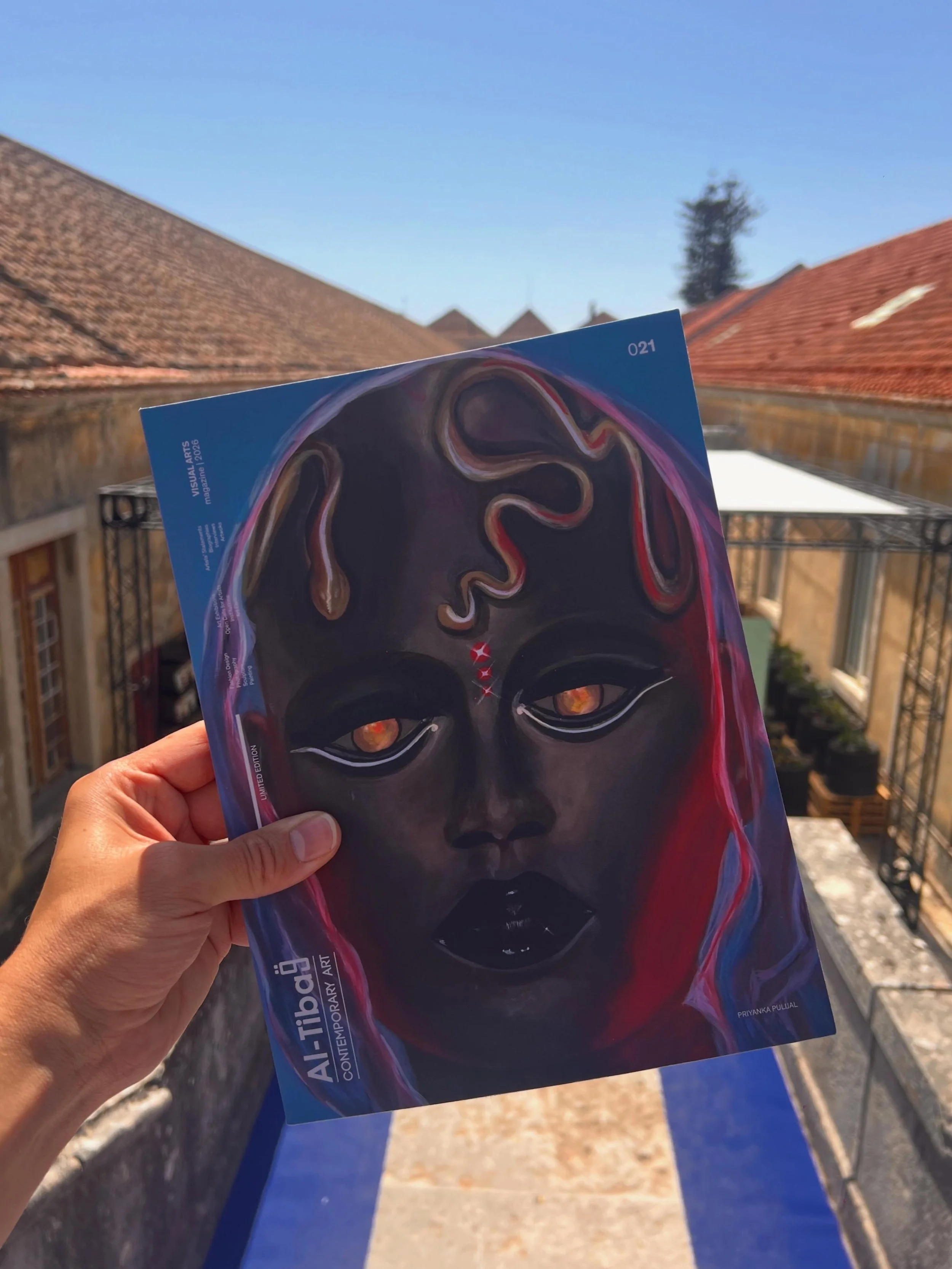
Ruoyan Er is a fashion artist and designer specialising in knitwear, textiles, draping, and garment construction. Her practice explores the relationship between material, emotion, memory, and time, approaching clothing as both a tactile object and a form of visual storytelling. Her latest project AFTERMatter is a meditation on time, decay, and reconstruction.