
10 Questions with Jialiang Guo
Jialiang Guo is a Dallas-based furniture designer whose practice explores the relationship between furniture, material, space, and human interaction. He received his Bachelor of Fine Arts degree in User Experience Design from the Savannah College of Art and Design in 2023 and later earned his Master of Science degree in Furniture, Lighting and Fixture Design from ArtCenter College of Design in 2025.
Guo’s work ranges from sculptural furniture and material-driven objects to modular systems that engage with the way people inhabit and interact within contemporary spaces. His projects have been exhibited at ICFF Launch Pad in New York and LA Design Weekend in Los Angeles. His work has also received recognition from international design competitions, including a Platinum Award from the MUSE Design Awards, as well as honors from the European Product Design Award, International Design Awards, and SIT Furniture Design Award. Drawing inspiration from nature, architecture, craft, and everyday human behavior, Guo approaches furniture as more than a functional object, but as an interface between people and their surrounding environment.
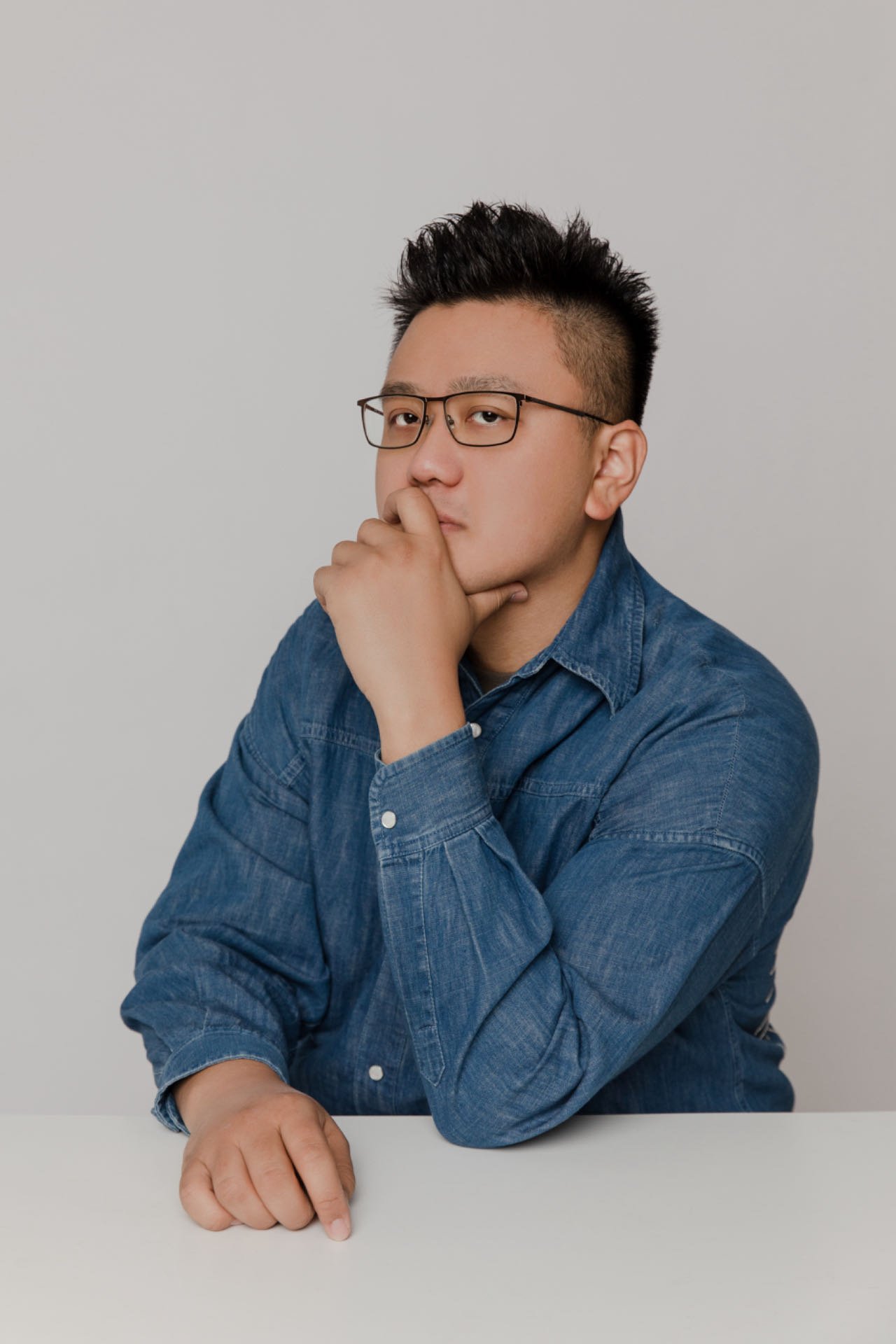
Jialiang Guo - Portrait
ARTIST STATEMENT
Jialiang Guo’s design practice explores furniture as a quiet interface between the human body, objects, and the surrounding environment. Rooted in minimalism, his work seeks to reduce visual complexity while preserving a strong sense of character, emotion, and physical presence.
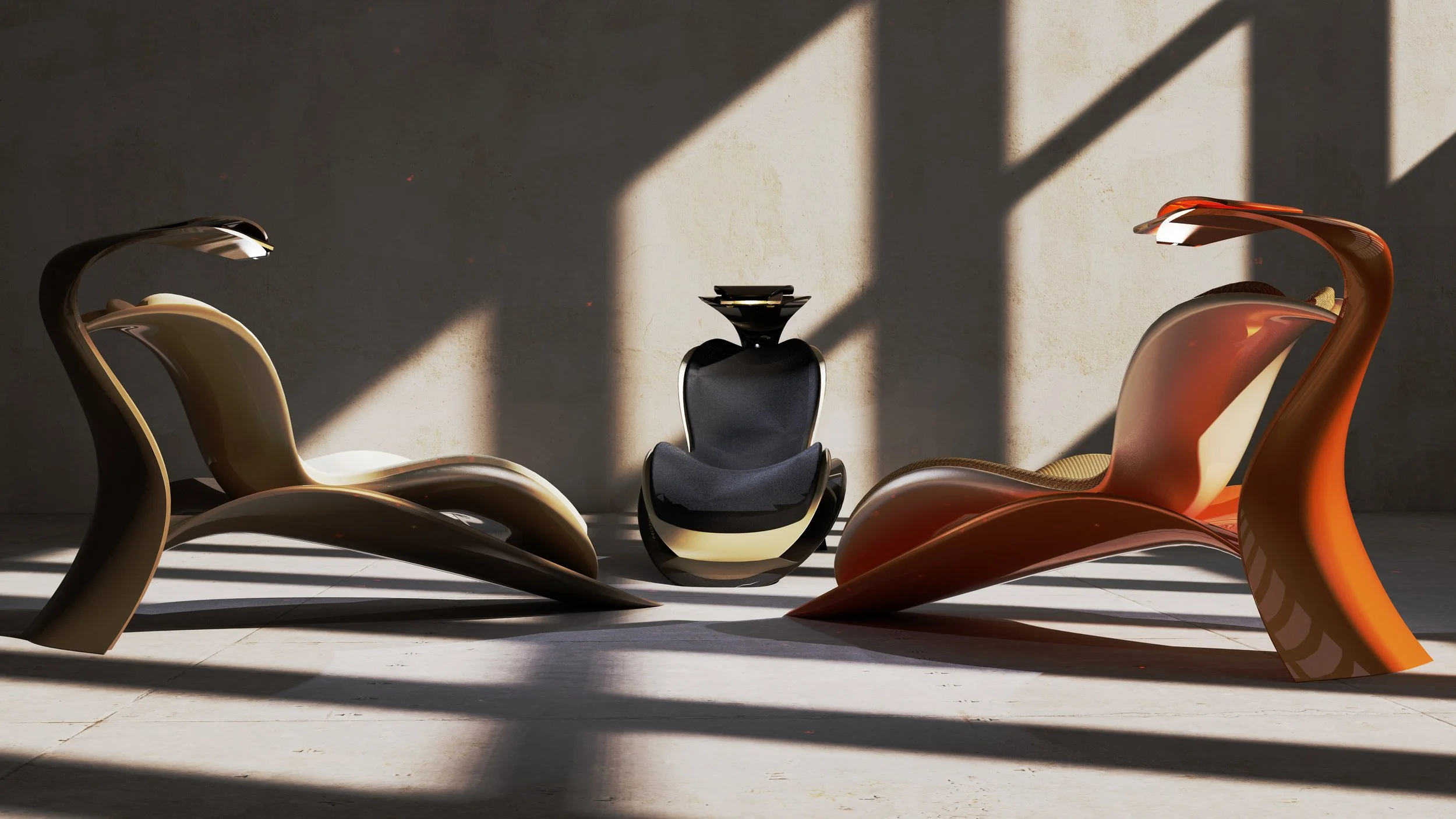
Languido reflects this approach by exploring furniture as a continuous sculptural form rather than an assembly of separate components. Its outer shell rises from the base and wraps around the body in a single flowing gesture, allowing the backrest, seat, and base to read as one unified volume. The continuous silhouette follows a relaxed sitting posture, while its soft curves give the object a sense of stillness and ease.
Material and form are considered as part of the same expression. A high-gloss lacquered GFRP shell reinforces Languido’s seamless, sculptural character, while the upholstered interior introduces softness and tactile contrast. The relationship between the rigid exterior and the relaxed seating experience creates a deliberate tension between structure and comfort, protection and openness.
Through Languido, Guo explores how furniture can move beyond pure function and become an emotional presence within space, an object that quietly shapes posture, atmosphere, and the relationship between the body and its surroundings.
Languido, Lacquered GFRP and Outdoor Fabric, 1350 x 550 x775 mm, 2023 © Jialiang Guo
INTERVIEW
First of all, could you tell us a little about your background and what first drew you to furniture and product design?
I am currently a furniture designer based in Dallas. I began my design education at Savannah College of Art and Design, where I studied User Experience Design. That background introduced me to human-centered design and taught me how to observe behavior, understand user needs, and translate those observations into design decisions.
What first drew me to furniture design was an introductory furniture course I took as an undergraduate. In that class, I used woodworking tools for the first time and developed my first furniture piece, Frame Side Table, from drawings into a physical object. That experience became an important turning point for me. I discovered how rewarding it was to take an idea that existed only on paper and transform it into something tangible, something that could be touched, used, and experienced in space.
That experience eventually led me to pursue furniture design at the graduate level. I later studied Furniture, Lighting and Fixture Design at ArtCenter College of Design, where I explored furniture more systematically through form, proportion, materials, fabrication, and the relationship between people and objects.
What I still enjoy most about furniture design is the process itself. I often begin with a small or playful idea and gradually develop it through sketches, models, material studies, and prototyping until it becomes a real object. The process is rarely straightforward, but working through those uncertainties is what makes it exciting to me.

Languido, Lacquered GFRP and Outdoor Fabric, 1350 x 550 x775 mm, 2023 © Jialiang Guo
You studied User Experience Design before specialising in Furniture, Lighting and Fixture Design. How has your background in UX influenced the way you design furniture?
User Experience Design and Furniture Design are very different disciplines. UX often deals with digital interfaces and intangible experiences, while furniture exists physically in three-dimensional space and involves the body, scale, materials, tactility, and fabrication. I think it is precisely the combination of these different fields that has shaped the way I design today.
The most important thing I carried from UX was not a particular tool or methodology, but a human-centered way of thinking. At its core, user experience design is about understanding people and considering how design can make an experience more intuitive, comfortable, or meaningful. That mindset stayed with me when I moved into furniture design.
I still borrow certain approaches from UX research, such as observing behavior and understanding people’s preferences and their relationship with their surroundings. However, the purpose of that research has changed. I do not always begin a furniture project with a narrowly defined problem or pain point. Instead, I am often looking for more emotional and subjective information: how people respond to certain forms, materials, postures, or atmospheres, and what kind of visual language might resonate with them.
This background has also made me interested in furniture as a medium through which people interact with their surroundings. I do not see furniture simply as an object to be looked at. It interacts with the body through touch, posture, movement, and even the distances it creates between people. My UX background taught me to observe those relationships from the perspective of the user, while furniture design gives me a physical medium through which I can translate those observations into form.
Your practice explores the relationship between furniture, the human body, and space. What interests you most about the way people interact with the objects around them?
What interests me most is that the interaction between people and furniture often happens unconsciously. We rarely stop to think about the height of a chair, the width of a sofa, or the distance between our bodies and a table, yet these decisions are constantly influencing our posture, movement, behavior, and even the way we communicate with other people.
Furniture is interesting to me because it is both an object and a medium between the body and space. It can influence how we sit, how long we stay, which direction we face, how close we are to others, and whether we feel relaxed, secure, or open to interaction.
A loveseat, for example, naturally brings two people closer through its compact scale, while the width of a conference table creates a more defined distance between people sitting across from one another. Furniture does not directly tell us how to behave, but its dimensions and form can quietly guide our actions.
That kind of nonverbal influence is what fascinates me most. I am interested in how small design decisions can shape not only the way we use an object, but also our relationship with the surrounding space and with other people.
You describe furniture as an “interface” between people and their environment. What does this idea mean to you in practice?
In UX, an interface can be understood as the layer through which a person interacts with a system. The user does not interact with the system directly; instead, the interface allows them to achieve a particular goal. That logic has influenced the way I think about furniture as well.
In a physical environment, people also have different goals. If someone wants to sit down, a chair becomes the means through which they establish that relationship with the space. If they need a surface for working, reading, or placing objects, they use a table. If they want to keep a space organized, they rely on some form of storage furniture.
In that sense, I see furniture as an interface between people and the physical environment. It helps translate an intention into an action and an experience.
When I design, I often think in reverse: if someone wants to accomplish something in a space, what do they actually need, and what kind of furniture can support that purpose most naturally? From there, I begin to define the form, scale, function, and relationship between the object, the body, and the surrounding space.
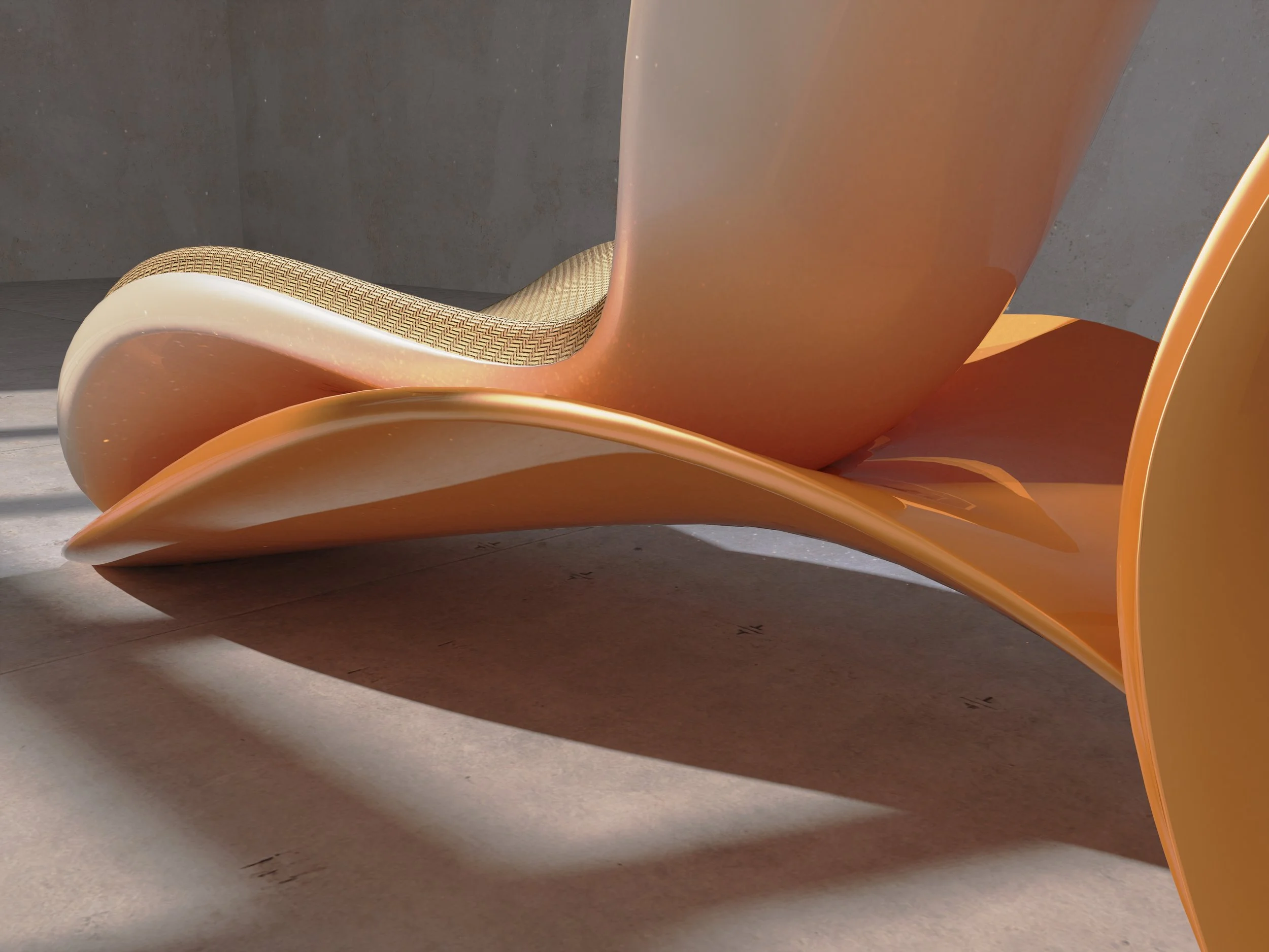
Languido, Lacquered GFRP and Outdoor Fabric, 1350 x 550 x775 mm, 2023 © Jialiang Guo

Languido, Lacquered GFRP and Outdoor Fabric, 1350 x 550 x775 mm, 2023 © Jialiang Guo
Your work is rooted in minimalism, but you also aim to give each piece a strong sense of character and emotion. How do you find the balance between simplicity and expression?
For me, minimalism does not mean removing personality from a piece of furniture. It is about reducing unnecessary elements so that the most important characteristic of the design can emerge more clearly.
In my process, I often take a figurative idea and gradually abstract it. I try to remove overly decorative or literal elements, allowing each piece to retain one central characteristic and then reinforcing that quality throughout the design. The goal is not to remove emotion, but to let emotion be communicated through a more distilled form.
Languido is a direct example of this approach. Its original inspiration came from the posture of a cat stretching its body. Rather than depicting the animal literally, I extracted the movement, curvature, and sense of relaxation from that gesture and translated them into the silhouette and volume of the chair.
So for me, minimalism is really a process of distillation. It is not about reducing expression, but about removing what is unnecessary so that one essential emotion, gesture, or characteristic can be felt more clearly.
Could you walk us through your creative process when developing a new piece, from the first idea or sketch to the final object?
I am constantly collecting observations and ideas from things that catch my attention. It might be a form found in nature, a certain gesture, the way a material behaves, or something very ordinary that I happen to notice in daily life. I also enjoy spending time in nature because it gives me energy and often becomes an important source of inspiration in my work.
When an idea really stays with me, I usually do not begin by immediately deciding what the furniture should look like. Instead, I try to translate that inspiration into a design story. That story becomes the central reference for the project and helps guide the development of the form.
In the early stage, I work very loosely and intuitively. I might make quick sketches, rough clay studies, or simple paper models. These are not meant to be precise models; they are simply tools to help me think, discover unexpected forms, and explore proportion, movement, and volume without becoming too attached to details too early.
Once I find a direction that feels right, I move into digital modeling and rendering. At that stage, I can evaluate the form more precisely and begin to consider proportion, material, and overall character. For me, rendering is not only a presentation tool; it is also a way to judge whether the design is actually communicating the original idea and emotion. If it is not, I go back, adjust the form, and continue refining it.

Languido, Lacquered GFRP and Outdoor Fabric, 1350 x 550 x775 mm, 2023 © Jialiang Guo
In Languido, you treat the chair as one continuous sculptural form rather than a collection of separate components. What inspired this approach to the design?
Our understanding of a chair is often shaped by a fairly fixed construction logic: the seat is the seat, the backrest is the backrest, and the legs or base provide support. They are usually understood as separate components assembled together.
With Languido, I wanted to step away from that conventional way of thinking. Instead of treating the back, base, and seat as independent parts, I wanted them to interact with and respond to one another. An unconventional back structure and base interlock with the seat, creating a stable triangular configuration. Each element contributes both structurally and visually to the others.
I like to describe it in a very simple way: the parts talk to each other. For me, that is more interesting than treating the legs simply as legs and the backrest simply as a backrest. It allows the chair to be read as one complete form rather than an assembly of separate pieces.
The continuous sculptural form also supports the original design story behind Languido. I wanted to capture the light, playful, and relaxed gesture of a cat stretching its body. Continuous curves allowed me to abstract that movement without literally depicting the animal.
So for me, the continuity of Languido is both a structural and expressive decision. It creates a stronger relationship between each part while giving the overall object a lighter and more animated presence.
Material plays an important role in your work. How do you choose materials, and how do qualities such as texture, softness, or rigidity influence the final form?
Material choice has a profound influence on both the form and the experience of a piece of furniture. For me, material is not something that is applied after the design is finished; it is part of the design process from the beginning.
A new material, or even an improvement in material performance, can change the way furniture is designed. For example, greater rigidity and structural strength can allow a designer to reduce thickness and create forms that feel visually lighter and more delicate. Changes in material performance can open up entirely new formal possibilities.
At the same time, I am very interested in the emotional qualities that materials communicate. Different materials can suggest very different characters. Metal often feels durable, precise, and professional to me, while wood tends to feel warmer and more inviting. Frosted glass, because it reveals and conceals at the same time, can create a sense of mystery and curiosity. Softer materials such as felt can make an object feel more approachable and invite touch.
So when I choose a material, I consider both its physical performance and its emotional expression. Rigidity, softness, texture, transparency, and even the perceived temperature of a surface can influence the proportion, thickness, silhouette, and the way a person physically engages with the final piece.
Your designs draw inspiration from nature, architecture, craft, and everyday human behaviour. How do you translate these observations into furniture?
Nature and architecture fascinate me because they are rarely arbitrary. Whether it is a natural formation or a building, the reason something feels balanced or visually compelling often comes from an underlying logic of structure, proportion, rhythm, or function. I try to understand where that attraction comes from, then abstract the essential qualities rather than directly copying the appearance, and translate them into proportion, silhouette, or structural relationships in furniture.
At the same time, furniture design ultimately has to exist within real material, technological, and manufacturing constraints. Whether an idea can become a real object often depends on the processes available to produce it. Conversely, when a new material or fabrication technique emerges, it can change the way designers think and make forms possible that were previously difficult to achieve.
Human behavior is equally important because furniture is also shaped by the way people live. Dining traditions are a simple example. In many Chinese communal dining settings, round tables support the sharing of multiple dishes placed at the center and give each person relatively equal access. In many Western dining settings, rectangular tables are more common and often support individual place settings and more linear seating arrangements.
What interests me is not the cultural difference itself, but how repeated human behaviors gradually become embedded in the typology of an object. I see nature, architecture, craft, and human behavior as different sources of information. I am less interested in copying them directly than in understanding why they take the form they do, and then translating that underlying logic into a new language for furniture.

Languido, Lacquered GFRP and Outdoor Fabric, 1350 x 550 x775 mm, 2023 © Jialiang Guo
Lastly, looking ahead, what new ideas, materials, or types of furniture would you like to explore in your future projects?
In my future work, I would like to explore how distance influences communication between people. I am interested in the idea that a certain amount of distance can sometimes create better conditions for interaction. Physical closeness does not always lead to better communication; a sense of boundary, personal space, and partial privacy can sometimes make people feel more relaxed and more willing to engage with one another.
I would like to develop a piece of furniture around this idea, something that creates opportunities for connection without making people feel overly exposed or forced into interaction. It might eventually become a shelving system that also divides space, a type of seating, or even something between furniture and spatial structure. At this stage, I do not want to define the typology too early. I would rather allow the final form to emerge from the way people communicate and behave.
For me, this is an exploration of the balance between distance, privacy, and connection. I am interested in how furniture can not only accommodate the body, but also create the conditions for communication to happen more naturally.
Artist’s Talk
Al-Tiba9 Interviews is a curated promotional platform that offers artists the opportunity to articulate their vision and engage with our diverse international readership through insightful, published dialogues. Conducted by Mohamed Benhadj, founder and curator of Al-Tiba9, these interviews spotlight the artists’ creative journeys and introduce their work to the global contemporary art scene.
Through our extensive network of museums, galleries, art professionals, collectors, and art enthusiasts worldwide, Al-Tiba9 Interviews provides a meaningful stage for artists to expand their reach and strengthen their presence in the international art discourse.



Jialiang Guo is a Dallas-based furniture designer whose practice explores the relationship between furniture, material, space, and human interaction. Guo’s work ranges from sculptural furniture and material-driven objects to modular systems that engage with the way people inhabit and interact within contemporary spaces.