

10 Questions with Julie Machallová
Al-Tiba9 Art Magazine ISSUE22 | Featured Artist
Julie Machallova is a Czech visual artist and painter based in Ostrava. She studied Painting and Art Education at the University of Ostrava and completed an art internship at Escuela de Arte de Sevilla, Spain. Her international practice includes exhibitions and residencies across Italy, Germany, Switzerland and Poland. In 2023, she presented her work at PechaKucha Night, Colours of Ostrava. In 2024, she participated in the Il Sublime residency at CRAG Gallery in Turin and exhibited at Klüber Galerie in Weinheim. Recent projects include the Videoinsight® Foundation Open Call, founded by Rebecca Russo, with an exhibition at Magazzini dell’Arte Contemporanea in Trapani, Sicily. She is currently exhibiting at Alteos Gallery in Poznań in a project exploring Tinder and contemporary relationships. Her work explores love, introspection and intimacy.
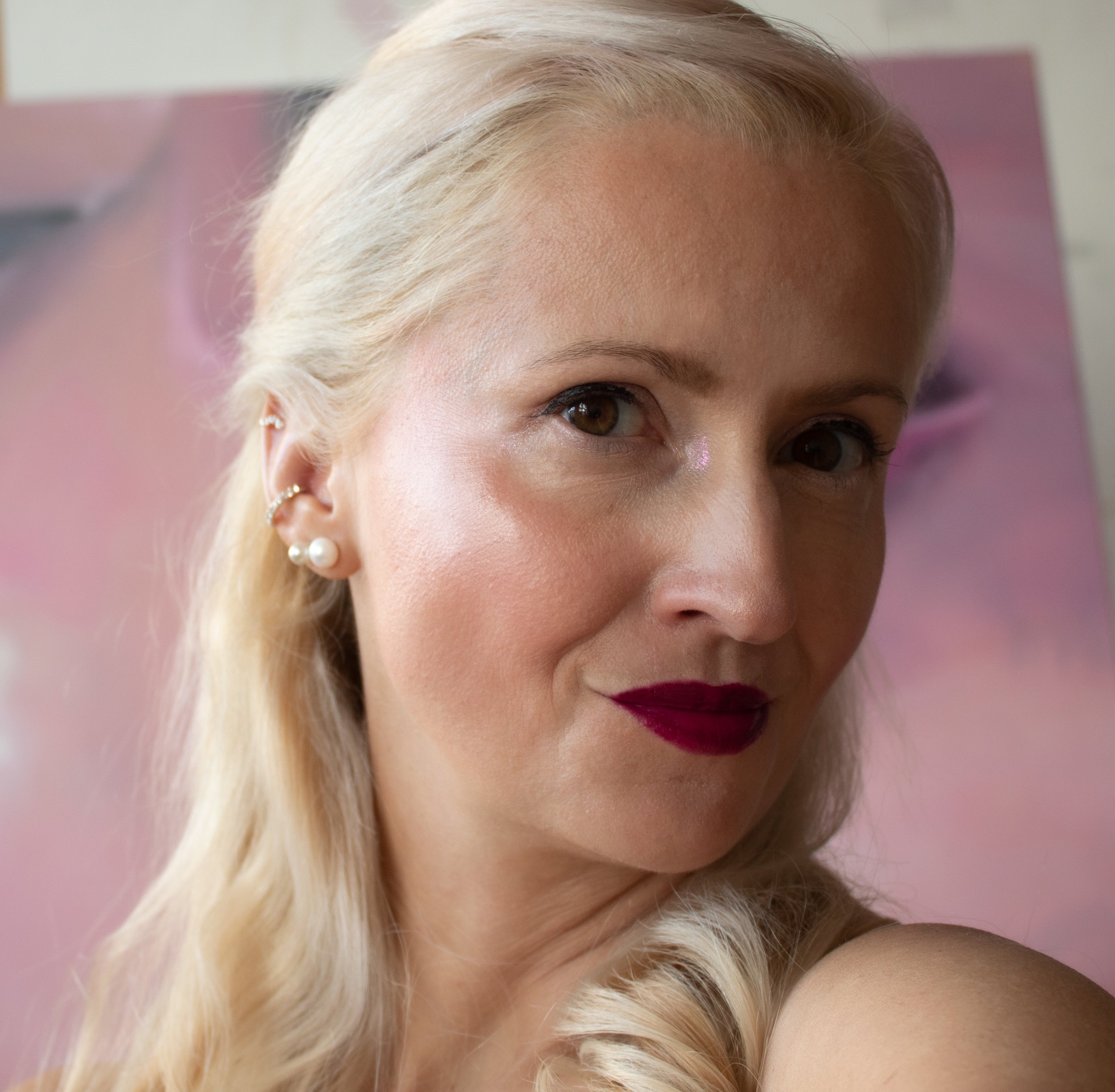
Julie Machallová - Portrait
ARTIST STATEMENT
Julie Machallova’s artistic exploration focuses on love, intimacy and female sexuality, asking whether true love can exist in a time of increasingly fragile relationships. Her paintings explore vulnerability, desire, introspection, loneliness, memories and the fleeting beauty of intimate moments. Drawing on Freud and Jung, she understands love as a mirror, a space of projection through which we encounter another person and ourselves. Desire, loss and abandonment become a path to self-knowledge: learning to love one’s own life without losing oneself in another. Female sexuality is central to her work as a form of freedom and self-acceptance. Beyond age and social roles, women desire to be seen, desired and to experience intimacy. Her paintings embrace the imperfect body, sensuality and confidence. As curator Roberto Mastroianni writes: “She appears to be an ecstatic beauty among abandonment, nostalgia, and eroticism.”
I Dream about Love, oil on canvas, 50x60 cm, 2025 © Julie Machallová
AL-TIBA9 ART MAGAZINE ISSUE22
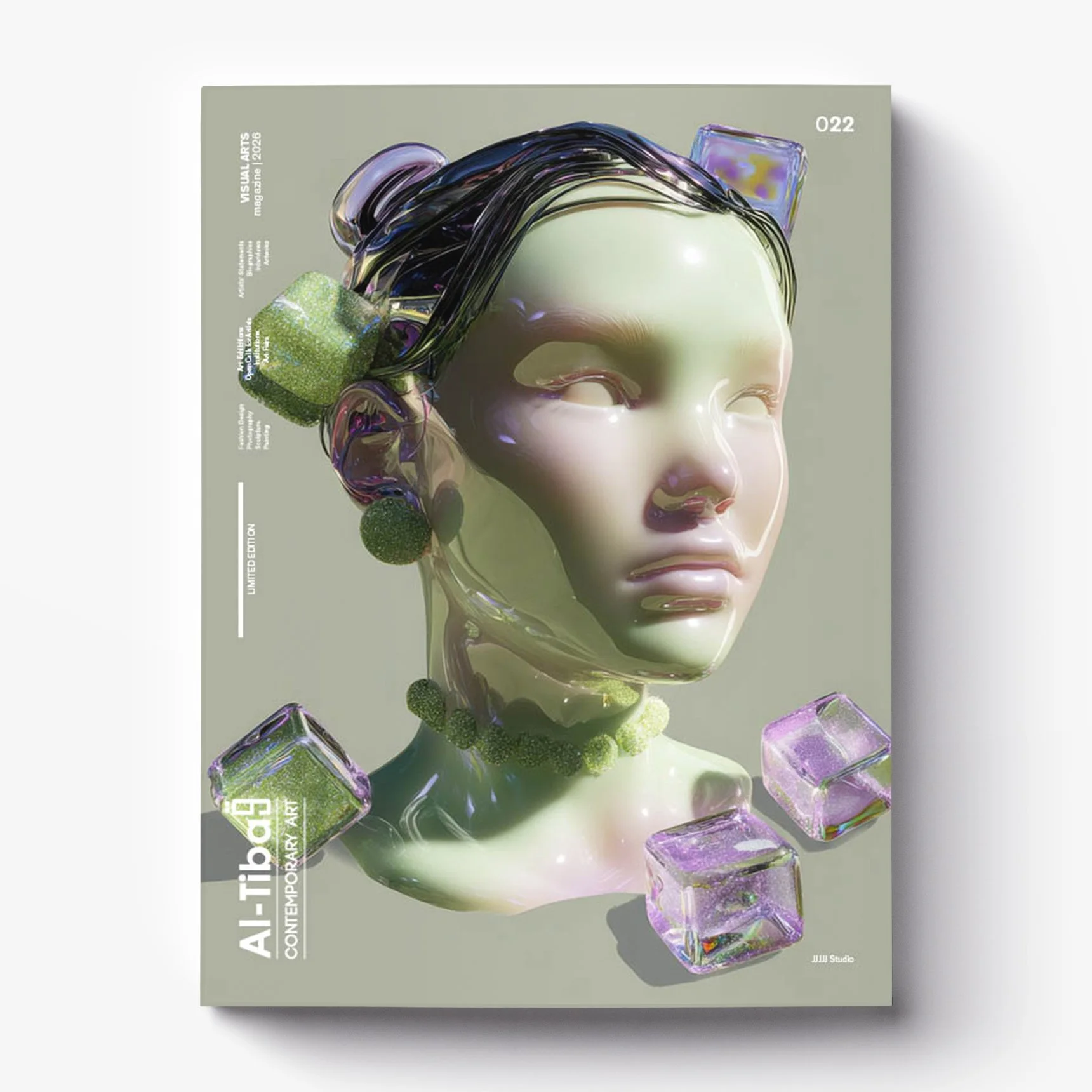
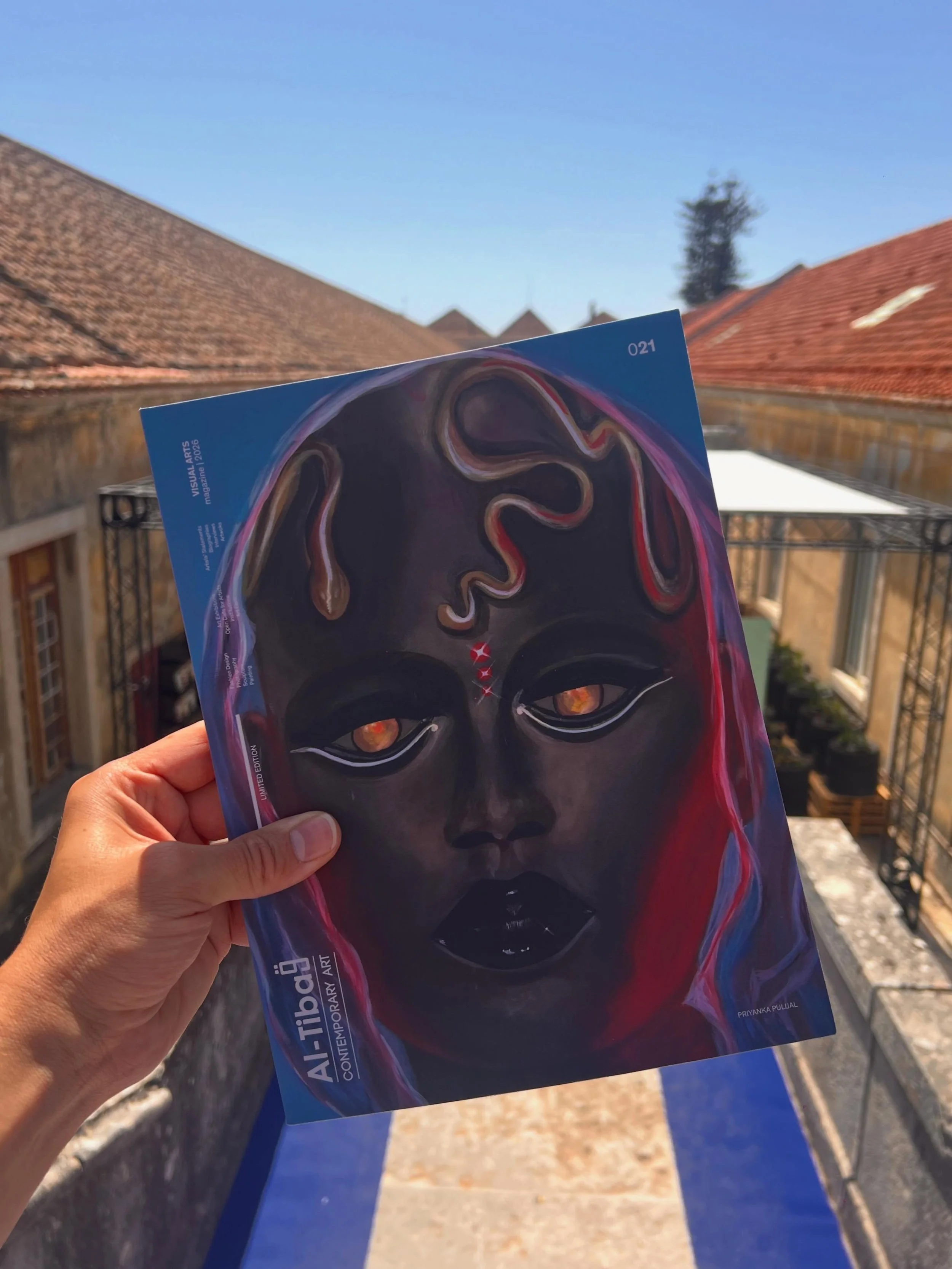
DISCOVER THE INTERNATIONAL ART SCENE WITH AL-TIBA9
LIMITED EDITION | Shipping worldwide.
Premium museum art paper.
Printed in London.
Grab 3 or more prints and get your FREE digital magazine.
Get your limited edition copy now
INTERVIEW
You studied Painting and Art Education at the University of Ostrava and later completed an internship at the Escuela de Arte de Sevilla. How did your studies shape the way you approach painting today?
My journey towards painting began very early, when I was around fifteen and studying at an art high school. I was very fortunate to have a teacher with whom I had long conversations about contemporary art, and we regularly travelled to exhibitions in Germany. It was there that I first encountered German and European contemporary painting in a truly intensive way.
This was a formative period for me because I began to understand how contemporary painting and art can open up social questions and engage not only with the image itself, but also with memory, psychology and human experience.
At the same time, I regularly visited the Venice Biennale and travelled throughout Italy, where I discovered the Italian Renaissance. I had already begun learning Italian in high school, and Italy gradually became a kind of inner space for me, a place associated with beauty, art and history. Even then, I felt very strongly that I wanted to become a painter.
Later, I studied Painting at the Faculty of Fine Arts at the University of Ostrava, followed by Art Education. During this period, I became more interested in gallery education as a way of mediating and communicating art, as well as in psychology. I encountered the ideas of Erik Erikson, Carl Gustav Jung and Sigmund Freud. Psychology and philosophy gradually became a natural part of my life and, later, of my painting practice.
Another important experience was my study internship at the Escuela de Arte de Sevilla, where I studied mural techniques and mosaics. I was particularly fascinated by azulejos, traditional Arabic ornamental principles and the techniques behind them. I also worked with mosaics based on ancient methods.
Seville also awakened my relationship with flamenco, with its physicality, intensity and its ability to express very powerful emotions. I think this connection between painting, psychology, history and embodied experience continues to return, in different forms, throughout my current work.

Black Roses, oil on canvas, 60x60 cm, 2025 © Julie Machallová
What first drew you to painting as your main medium, and what does painting allow you to express that other media cannot?
I fell in love with painting at art high school, when I first encountered the work of Gerhard Richter, Neo Rauch and Marlene Dumas in German galleries. At the same time, I was deeply influenced by the Italian Renaissance, particularly Michelangelo, and later by the Italian Baroque and Caravaggio.
At university, I also experimented with other media, including performance, film and animation. With film, I felt that I needed other people in order to express a story, while animation meant spending a great deal of time in front of a computer. I missed large studios, large canvases, brushes, the smell of gesso, turpentine and paint.
I love mixing colours, searching for new possibilities within different shades and observing how colours change in the light. I even love the physical rituals of painting, wearing my studio clothes and ending the day covered in paint.
What I love most is the possibility of immersing myself completely in a painting, almost becoming part of it, until I lose my sense of time and space. Painting creates a space where I feel safe and free to inhabit my inner world.
Your work often explores love, intimacy, desire, loneliness and memory, as you mention in your statement. How do these themes enter your creative process? Do you begin with a personal experience, an image, an emotion, or something else?
My current work begins with personal experience, but for me the personal story is primarily a starting point for exploring broader questions. I began asking myself what it actually means to truly love someone, and whether something we might call “true love” really exists.
I am interested in the boundaries between attraction, falling in love and a profound emotional relationship. What makes us attracted to a particular person not only physically, but also emotionally, with such intensity? Why can we desire someone so deeply that we want to connect with them both physically and psychologically? And what happens when we cannot be with that person?
This is where loneliness, longing, memory and silence begin to emerge. Silence can contain the hope of love, a space in which we are still waiting for the other person to return. At other times, that same silence becomes endless, and we realise that something has come to an end.
I also feel close to Jung's understanding of relationships as spaces of projection and mirroring. Certain people enter our lives almost as mirrors or projections, revealing parts of ourselves that until then we were unable, or perhaps unwilling, to see. In this sense, love for me is not only a relationship with another person, but also a journey into one's own unconscious.
I am interested in Jung's concepts of the anima and animus, as well as Freud's understanding of libido as a fundamental sexual energy. At the same time, I am drawn to the way Gabor Maté considers relationships in connection with our early wounds, trauma and unconscious patterns. In my paintings, I do not treat these ideas as theories that I want to illustrate. Rather, they form part of the theoretical research underlying my practice.
I am particularly interested in the moment when psychological and sexual desire become so intensely intertwined that the encounter between two people takes on an almost transcendent dimension, as though, for a brief moment, the boundaries between two bodies, between consciousness and the unconscious, begin to disappear.
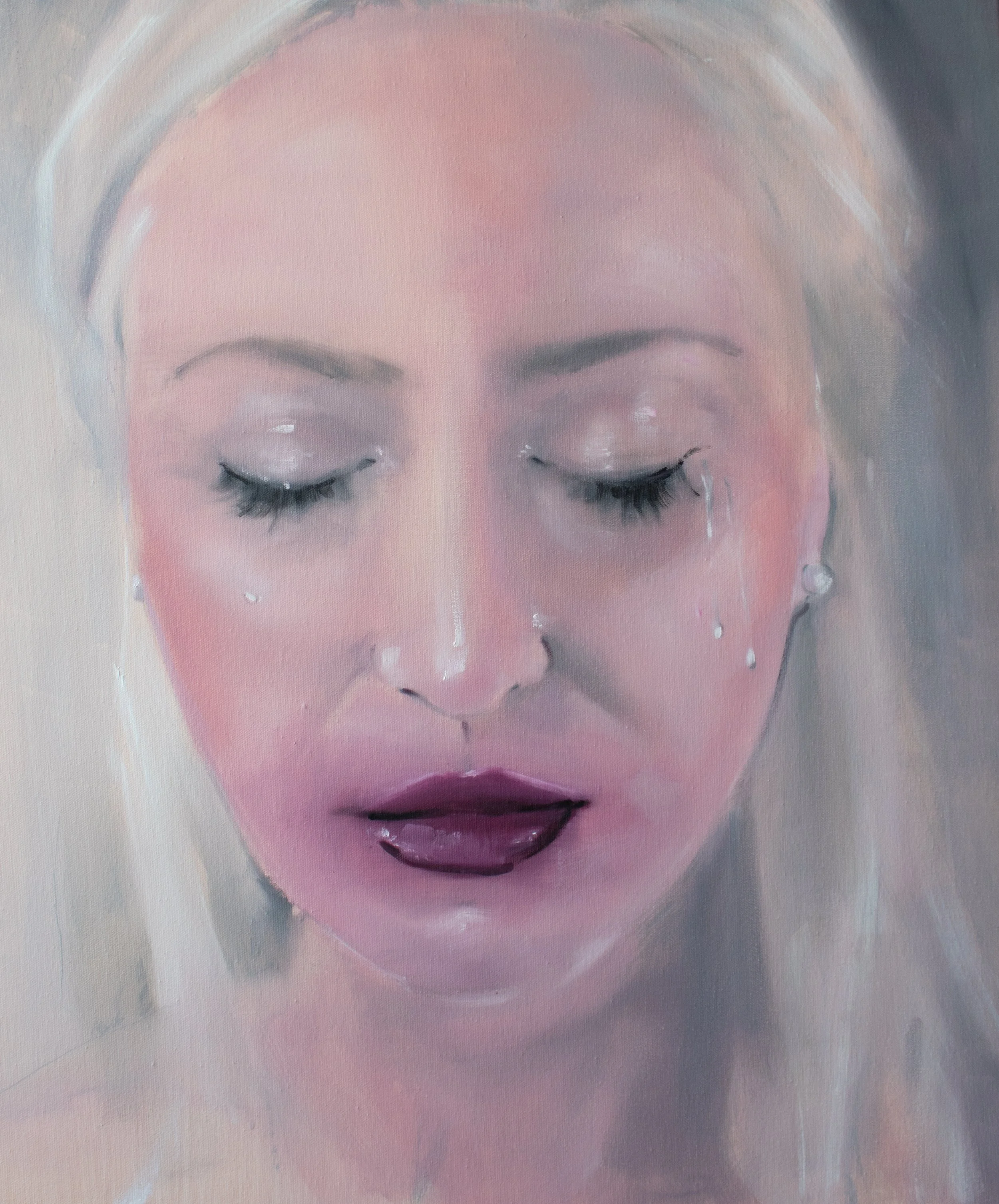
Dolorosa, oil on canvas, 100×80 cm, 2026 © Julie Machallová
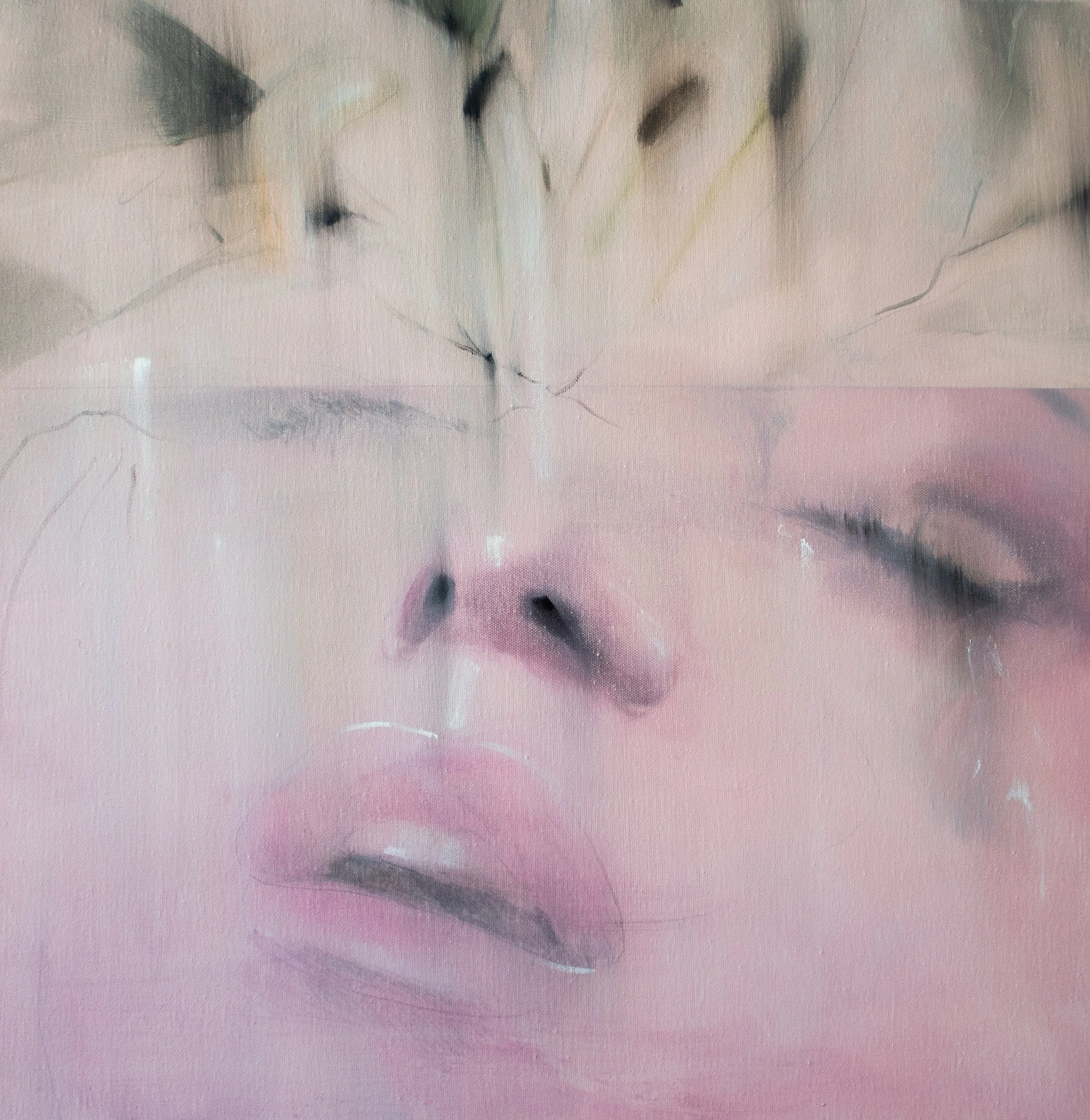
Lily, oil on canvas, 50x60 cm, 2025 © Julie Machallová
Your paintings often depict intimate and vulnerable moments. How do you balance personal stories with emotions and experiences that viewers can relate to?
My current paintings often involve self-portraiture, but for me, a self-portrait is not simply a representation of my own identity. I see it primarily as a means of introspection and an authentic way of communicating emotion.
Through my own body, I explore the fragility of love, vulnerability, desire, intimacy and loneliness. Personal experience may be the beginning of a painting, but I do not want the work to remain enclosed within my own story. I am interested in the moment when an individual experience begins to transform into something universal.
Sharing these paintings and ideas with audiences, friends and other artists has been very important to me. People began sharing their own experiences of love, loss and painful relationships with me. It made me realise very strongly that experiences we perceive as deeply private can, in fact, be profoundly shared.
The more I explore intimacy, the more aware I become of the fragility of the human body and of human life itself. We long for closeness, yet sometimes we resist it because love also brings with it the possibility of being hurt. People who have been wounded can, in turn, pass those wounds on to others.
I am also interested in a certain paradox of contemporary life. Through social media, we have almost unlimited possibilities to meet new people, and yet genuine intimacy can seem increasingly difficult to achieve. The possibilities for connection multiply, while deep relationships can become more fragile and more easily replaced.
At the same time, some people deliberately experiment, continually seeking new bodies and purely sexual experiences. This tension between an abundance of possible encounters and the difficulty of genuine intimacy is gradually finding its way into my work as well.
Female sexuality and women’s relationship with their bodies are important aspects of your practice. What do you hope your paintings can say about freedom, desire and self-acceptance?
I understand female sexuality primarily as the ability to be connected with one's own body, to accept it with its imperfections and to experience sexuality on one's own terms, beyond the male gaze that has defined women for centuries. For me, this is where a certain form of female freedom lies: a woman can decide for herself how she experiences her body, how she expresses her desire and how she wants to be seen.
Throughout art history, women have predominantly been represented as muses, models or objects of the artist's gaze. In my work, I try to reverse this relationship. I am interested in the idea that a woman can become her own muse. She can decide for herself how she experiences her sexual energy and how her body is represented and seen.
In this context, I also feel a connection to the principle of the Sex Siren within ballroom culture, as well as to the physicality of flamenco and tango. I am not interested in sexuality performed for the satisfaction of another person's gaze. I am interested in sexuality experienced from within, through one's own body, movement, self-confidence and awareness of one's own desire.
At the same time, for me sexuality is inseparable from intimacy. When we truly desire someone, we do not simply want to be physically attractive to them. We long to be seen in a deeper sense; we want the other person to see our body, but also our soul, our vulnerability and the parts of ourselves that normally remain hidden. Perhaps it is precisely within this tension, between the desire to be seen and the need to remain oneself, that I find the space for my paintings.

Beauty of Darkness, oil on canvas, 50×40 cm, 2025 © Julie Machallová
You draw on ideas from Freud and Jung, particularly the idea of love as a mirror through which we encounter both another person and ourselves. How does this idea influence the way you portray relationships?
I began exploring this idea primarily through self-portraiture. For me, the self-portrait functions in a way similar to the first-person narrative in literature: it allows me to draw on my own experience while transforming it into an image that no longer has to be solely about me. I am interested in the emotions that a particular experience leaves within me and in how painting can make those emotions present.
Both self-portraits and fragments of intimate parts of the body carry a certain psychological expression for me. The body becomes a bearer of emotion, memory, and desire. I approach colour in a similar way. Delicate shades of pink, for example, evoke tenderness, romance, intimacy, and love, while in a particular context they can also become intensely physical and erotic.
In the painting Kissing, I worked with the motif of a couple kissing, attempting to capture the moment when physical closeness transforms into a feeling of almost complete merging, of both body and soul. By contrast, El Mundo donde reina un silencio eterno (The World Where Eternal Silence Reigns) emerges from desire, loss, and silence. The figure finds herself almost at the bottom of the ocean, in a space separated from the surrounding world. I see her as a kind of siren or mythological Kore, a female figure who must leave her love behind and descend into another world.
It is precisely this moment of mirroring that is important to me. In a relationship, we look at another person, but through them we often glimpse something that had previously remained hidden within ourselves. This is why the relationships in my paintings are not simply images of two people. They are also images of the inner world, of projection, desire, and the unconscious.
You have exhibited and participated in residencies across several European countries. Has working in different cultural environments changed your perspective on intimacy, relationships or your own artistic identity?
Definitely. Every environment in which I have spent an extended period of time working has influenced not only my painting, but also the way I think about my own identity as an artist.
During my residency at Kunstfabrik in Austria, I met the conceptual artist ONA B, whose practice has long engaged with feminist themes. Our conversations were very important to me and encouraged me to explore female sexuality more openly. We also spoke about the identity of the woman artist and mother, and about whether it is possible to combine an artistic career with motherhood.
This question had already been personal to me since I first began studying art. At the time, I encountered the view, expressed by some male teachers, that women often stop painting after having children and that, for this reason, pursuing a professional artistic career may not be worthwhile for them. This experience left me for a long time with the question of whether motherhood, personal life, and a genuinely ambitious artistic practice could coexist.
My study period at the Escuela de Arte de Sevilla also had a profound influence on me. Andalusia, its intense light, and the local culture awakened in me a stronger need for colour, figurative painting, and a return to traditional approaches to drawing and oil painting. I experienced a similar transformation later during my residency at Crag Gallery in Turin, where I gradually began working with softer colour tones and almost completely moved away from monochrome painting.
I became increasingly aware of how profoundly light shapes our perception of colour. For a painter, light is a fundamental experience; painting exists through the spectrum of colour, light, and shadow. I am therefore fascinated by observing the differences between individual countries, their particular qualities of light, colour, and visual culture. Similar differences can, of course, also be observed in historical frescoes and paintings. I find it equally interesting to observe how different cultures approach the body, intimacy, and sexuality. I come from the Czech Republic, where sexuality, for example, is approached relatively openly in many contexts. Spending time in other countries allows me to observe these cultural differences while becoming more aware of how they shape my own perspective.
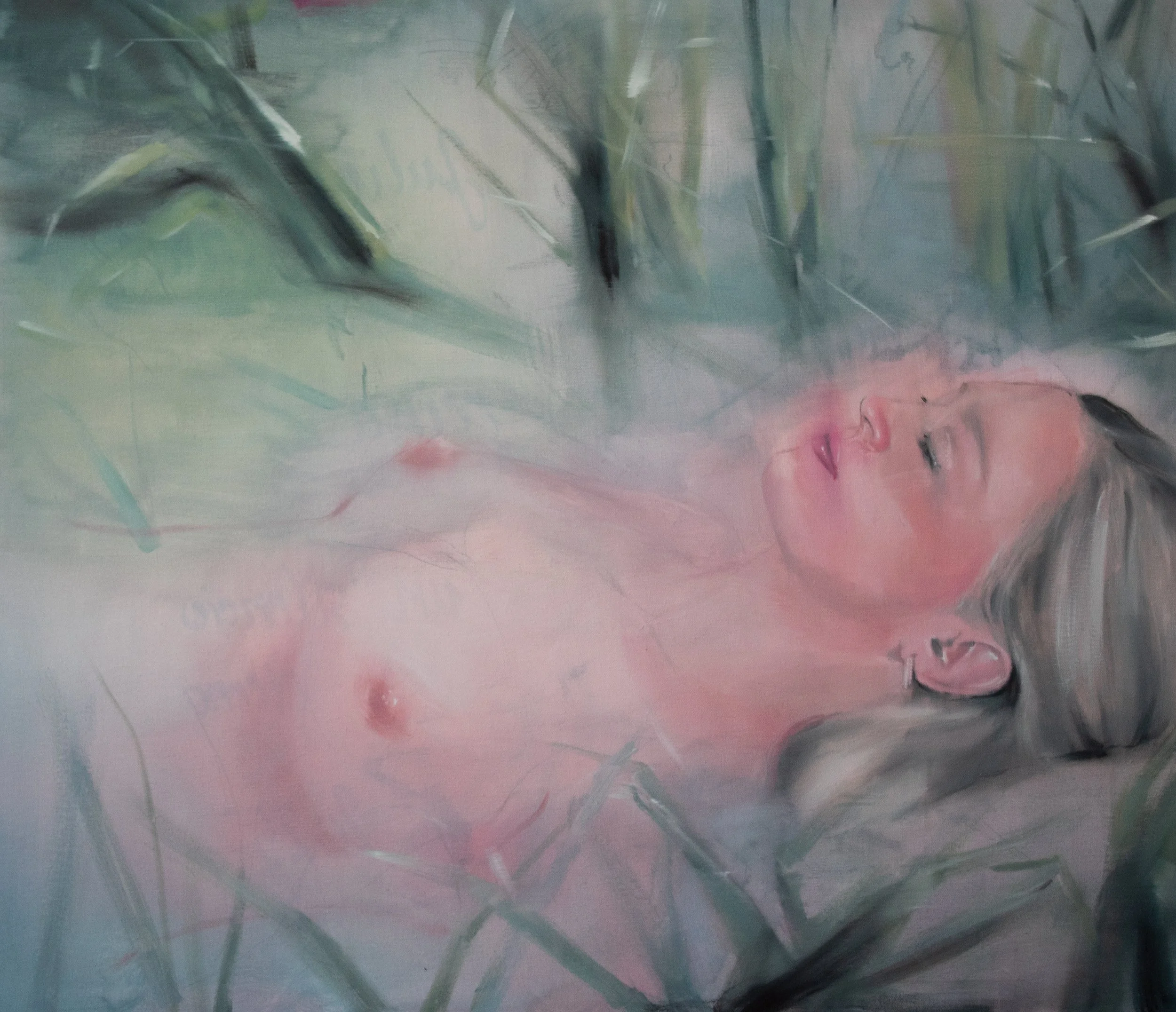
A world Where Eternal Silence Reigns, oil on canvas, 80×90 cm, 2025 © Julie Machallová
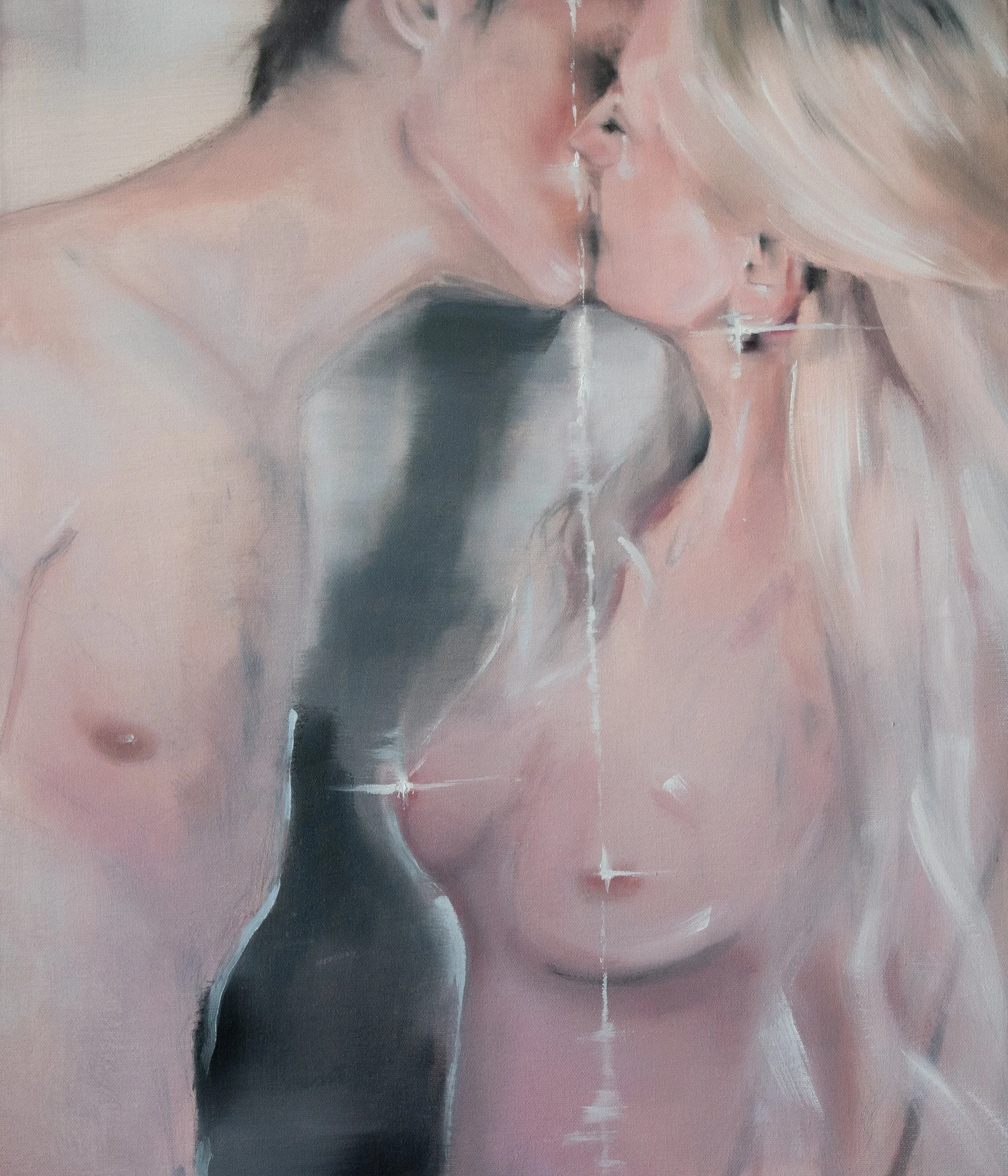
Kissing, oil on canvas, 60×50 cm, 2026 © Julie Machallová
Your current project at Alteos Gallery explores Tinder and contemporary relationships. What does the world of dating apps reveal to you about how people experience desire, connection and loneliness today?
My project, Does True Love Exist?, was also particularly interesting to me because it placed my work in dialogue with other artists exploring themes such as gender identity, digital culture, Japanese anime, and Tinder, often through media other than painting.
The project emerged from a simple question: Does true love exist? In this context, I also began using Tinder as a space for informal artistic research. I was interested in what men expect from relationships today, whether they are looking for monogamous partnerships, open relationships, polyamory, short-term encounters, or long-term relationships, and, above all, what the idea of “true love” means to them. What I found particularly interesting was the possibility of comparing responses from men in different European cities, including Amsterdam, Paris, London, Rome, Naples, and Vienna. I communicated primarily with those with whom I matched and who were genuinely willing to discuss these questions.
Throughout these conversations, I repeatedly encountered different alternatives to the traditional relationship model, open relationships, polyamory, and relationships without clear definitions. Some of the men had personal experience with polyamory and spoke openly about its complexities. Other phenomena characteristic of digital dating also emerged: situationships, ghosting, short-term sexual encounters, and the exchange of intimate photographs.
I am fascinated by the paradox created by dating apps. It has never been easier to make contact with someone new, yet the sheer availability of other possibilities does not necessarily mean that we have become more capable of creating intimacy. This contradiction between an almost endless possibility of connection and a persistent sense of loneliness is artistically very powerful to me. I place this contemporary experience in a certain contrast with Plato’s Symposium and Aristophanes’ myth of the original whole beings who were divided into two by Zeus. From that moment on, human beings long for their lost other half, and Eros becomes the force driving them towards reunion. What fascinates me about this myth is precisely its understanding of desire as something born from a sense of absence or incompleteness.
Contemporary psychology, by contrast, often emphasises that another person should not become the missing half that makes us whole. The ability to create a healthy relationship is also connected to our ability to exist as independent individuals and not to place responsibility for our own happiness entirely on a partner. It is the tension between these two ideas, the romantic longing for complete union and the need to remain a whole individual, that interests me deeply.
I see a similar experience in art. A work of art may initially attract us through its beauty or through something we cannot yet name. We want to approach it, see it, and understand it. But this initial impulse can then transform into an experience and a memory that remains within us. In this sense, encounters with both love and art can possess a certain transcendental dimension.
When someone encounters one of your paintings, what kind of emotional response or reflection would you ideally like the work to provoke? Is there a particular message you hope stays with them?
I would like each painting to carry a certain emotional intensity, desire, tenderness, pain, loneliness, but also erotic tension. On social media, I sometimes accompany my paintings with short poetic texts drawn from personal experience. For me, the text is not an explanation of the painting; rather, it creates another layer that can expand its emotional space.
I am very interested in the way paintings, much like relationships, can function as mirrors or surfaces for projection. Every viewer approaches them with their own experience and may discover something different within them, sometimes precisely what they are missing in their own life at that particular moment.
Through conversations with people who follow my work, I have discovered that the paintings have opened up questions about their own intimacy. Some began to think more deeply about their need for closeness, while others became aware of its absence in their own lives. This kind of feedback is very powerful for me because, at that moment, the painting ceases to be merely my personal statement and becomes a space for someone else’s experience.
Dialogue with women is particularly important to me because female experience remains one of the central themes of my practice. When women are able to recognise themselves in the paintings or connect with them emotionally, I see it as confirmation that a personal experience can acquire a broader meaning.
At the same time, I would like my paintings to open this space for men as well. I believe that representing female experience from a female perspective is important precisely because it can create a space for mutual understanding, not only among women, but also between women and men.
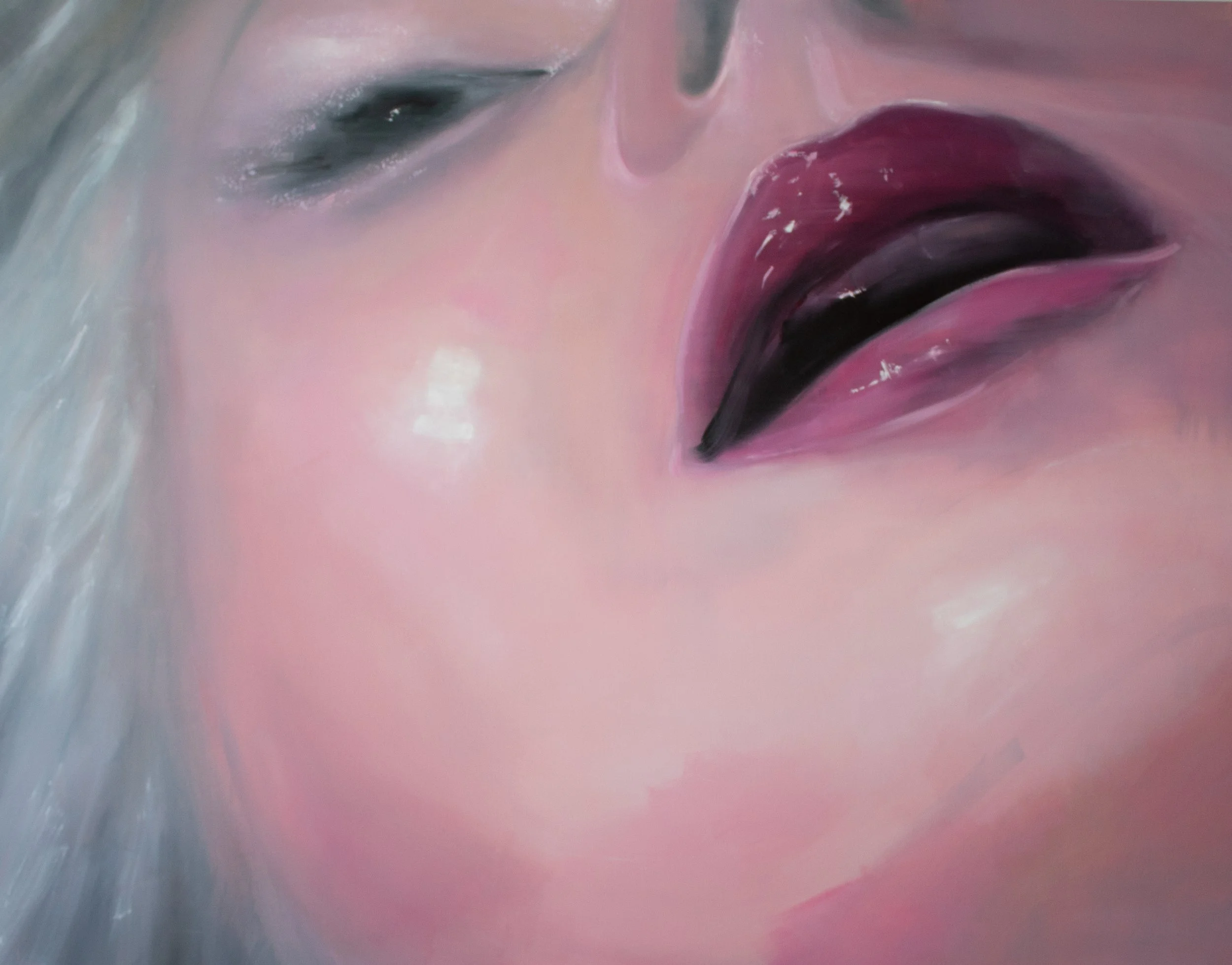
Frozen Love, oil on canvas, 120×150 cm, 2026 © Julie Machallová
Looking toward the rest of 2026, what projects or ideas are you most excited to develop, and what would you like to achieve with your practice in the coming years?
I would like to continue developing the themes of love, intimacy, and female sexuality, while moving even further towards a more poetic form of painting. I am increasingly interested in how painting can communicate emotion without the need to explain a story explicitly. I want to create paintings with a strong sensual and emotional presence, images in which beauty can encounter desire, vulnerability, melancholy, and a certain form of transcendence. I would like to continue developing my own painterly language and gradually establish a stronger presence within the European art scene. And I also hope to find true love.
Artist’s Talk
Al-Tiba9 Interviews is a curated promotional platform that offers artists the opportunity to articulate their vision and engage with our diverse international readership through insightful, published dialogues. Conducted by Mohamed Benhadj, founder and curator of Al-Tiba9, these interviews spotlight the artists’ creative journeys and introduce their work to the global contemporary art scene.
Through our extensive network of museums, galleries, art professionals, collectors, and art enthusiasts worldwide, Al-Tiba9 Interviews provides a meaningful stage for artists to expand their reach and strengthen their presence in the international art discourse.




David Moješčík - MojDa is a Czech sculptor. His work is centred on figurative sculpture, the human body, and the female figure. Modelling in clay and with digital tools, he ultimately prioritises manual engagement with materials. . He draws inspiration from yoga philosophy with the concepts of non-violence and human-centeredness, as well as from Egyptian, ancient, and European classical sculpture.