

10 Questions with Siqi Fan
Siqi Fan is a Los Angeles–based artist whose practice spans painting, sculpture, video installation, performance, and photography. Drawing inspiration from food culture, hospitality, and everyday encounters, her work reflects on migration, labor, memory, and the ways people create a sense of belonging. Through material experimentation and research, she often focuses on overlooked stories and forms of care embedded within ordinary spaces. Fan received her MFA from the California Institute of the Arts and her BFA from the School of Visual Arts. Her work has been exhibited at Vox Populi, the Asian American Museum at Great Park, Palos Verdes Art Center, Canyon Country Community Center, and A60 Contemporary in Milan, Italy. She currently lives and works in Los Angeles.
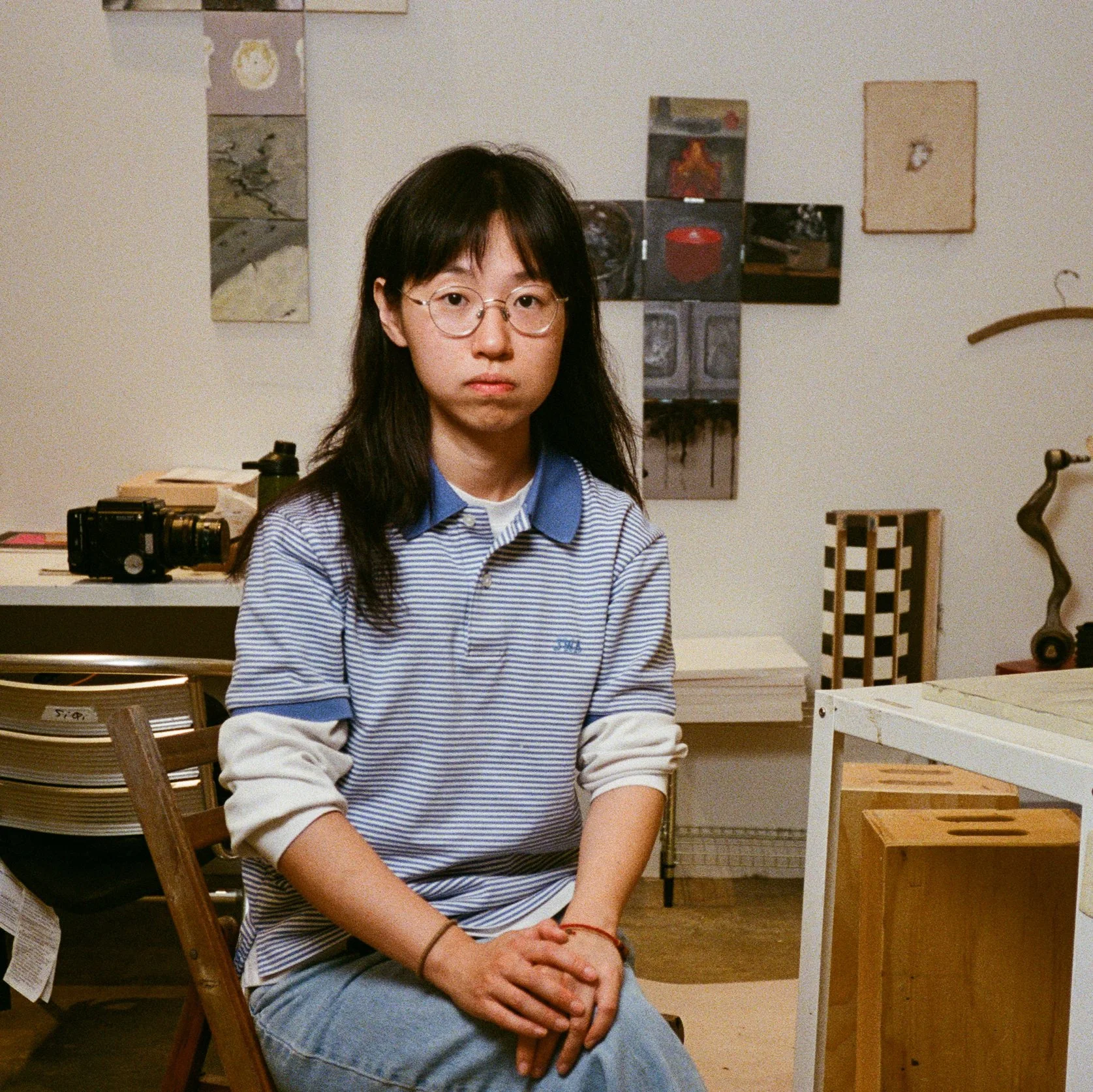
Siqi Fan - Portrait
ARTIST STATEMENT
Siqi Fan's practice explores the intersections of hospitality, labor, migration, and belonging through painting, sculpture, installation, performance, and photography. Working between historical research and material experimentation, she is interested in the people, objects, and spaces that quietly sustain everyday life but often remain outside public attention. Kitchens, storage rooms, service corridors, and sites of food production become places where questions of visibility, memory, and identity unfold.
Food functions as both a material and a social language throughout Fan's work. Rather than treating hospitality simply as an act of welcome, she approaches it as a system shaped by labor, migration, care, and economic exchange. By bringing together found objects, handcrafted materials, documentary references, and painterly surfaces, her work reveals the infrastructures that make experiences of comfort and community possible while questioning whose labor becomes visible and whose histories are forgotten.
Central to Fan's practice is the idea of strangerhood: the experience of existing between familiarity and distance, belonging and exclusion. She is drawn to moments where personal memory intersects with broader social histories, allowing ordinary materials to carry emotional and political weight. Her installations often blur the boundaries between painting and object, image and architecture, inviting viewers to move through works physically as well as visually.

Tie Sing, Oil painting on wooden panel, 12x 48 in, 2026 © Siqi Fan
INTERVIEW
Could you tell us about your background and what first inspired you to pursue a career as an artist?
I grew up in China and later moved to the United States to study photography and art, first at the School of Visual Arts in New York and later at CalArts in Los Angeles. My practice has evolved across photography, painting, sculpture, installation, performance, and moving image, but it has always been rooted in observation and making. I have always been fascinated by the ordinary moments that often go unnoticed. Rather than looking for extraordinary subjects, I find myself drawn to everyday spaces and routines that quietly shape our lives.
Over time, I realized that art allows me to connect personal experience with broader histories and social structures. It became a way to ask questions rather than provide answers, and to create spaces where viewers can reflect on their own relationships to labor, migration, memory, hospitality, and belonging.
Your practice spans painting, sculpture, installation, performance, photography, video, and sound. How do you decide which medium is best suited to a particular idea?
I don't begin with a medium. I begin with a question. Each project develops through research, observation, and material experimentation, and eventually the work tells me what form it needs. Sometimes a photograph can preserve a fleeting moment that painting cannot. Painting allows me to reconstruct history with a slower, more subjective language. Sculpture and installation create physical encounters that invite viewers to move through space rather than simply look at an image. Performance introduces the body and time, allowing ideas to unfold through lived experience instead of representation alone.
My performances rarely exist on their own. I often combine live cooking with video, sound, sculpture, and installation to create an immersive environment. The sounds of a working kitchen, moving images, cooking utensils, architectural structures, and eventually the shared meal all become materials within the work. Rather than asking audiences to observe from a distance, I want them to experience the physical, sensory, and emotional conditions surrounding hospitality and labor.
For me, these different media are not separate disciplines but different ways of thinking. They often coexist within a single project because each contributes something the others cannot.

A Caviar Factory in Quzhou, China, Sculpture, 23.5 x 23.5 x 1 in, 2026 © Siqi Fan
Food and hospitality play a central role in your work. What first drew you to these subjects as a way of exploring larger social and cultural questions?
Food is one of the most universal forms of human connection, but it is also deeply political. Behind every meal is a network of labor, migration, trade, memory, and cultural exchange.
I became interested in hospitality because it reveals generosity and inequality at the same time. Hospitality promises comfort and welcome, yet it often depends on forms of labor that remain invisible. I see food not simply as a subject but as a language through which we can think about care, identity, class, and belonging.
Historically, Western philosophy often privileged sight and hearing as the highest senses, while taste, smell, and touch were regarded as secondary because they were considered too closely tied to the body. I'm interested in challenging that hierarchy. Eating is one of the most intimate actions we perform, it literally becomes part of us. When audiences eat food prepared as part of my performances, they are not simply observing an artwork; they become participants in an exchange of labor, care, memory, and energy. For me, the meal is not an extension of the artwork. It is the artwork.
Your work often highlights the hidden labour behind everyday experiences. Why is it important for you to bring attention to these often-overlooked stories?
Many of the systems that sustain our daily lives remain out of sight. We rarely think about who prepares the food we eat, cleans the spaces we occupy, or maintains the environments that make comfort possible.
I'm interested in making those invisible structures visible, not to assign blame or offer simple political statements, but to encourage closer observation. I believe attention itself can be a meaningful gesture. By slowing down and looking carefully, we begin to recognize the people and infrastructures that quietly shape our everyday experiences.
Rather than presenting labor as something heroic or tragic, I'm interested in revealing its complexity. Labor is repetitive, physical, emotional, and often deeply connected to care. These ordinary acts are what sustain communities, yet they rarely receive the same attention as the spaces they make possible.

Ophelia, Sculpture, 18 x 21 x 1 in, 2024 © Siqi Fan

The Fit That Fails, Sculpture, 18 x 12 x 12 in, 2026 © Siqi Fan
The idea of "strangerhood" appears throughout your practice. What does this concept mean to you, and how has your own experience shaped your understanding of it?
To me, strangerhood is not simply about being unfamiliar to others. It is a condition of constantly negotiating where and how one belongs.
Living between different cultures has made me aware that belonging is never fixed. It is something that is continually produced through everyday interactions, language, labor, and shared spaces. Rather than seeing strangerhood as purely alienating, I think it also creates possibilities. It encourages us to question assumptions about identity and to recognize the relationships that exist between people who may initially appear disconnected.
Hospitality plays an important role in this process. Sharing food with strangers has the ability to temporarily suspend social boundaries. It creates moments of encounter that may not erase difference but allow people to experience proximity, vulnerability, and care together.
Many of your works combine historical research with found objects and handcrafted materials. How does your creative process balance research, experimentation, and intuition?
Research gives me a starting point, but it never determines the final work.
I spend time reading archives, collecting photographs, visiting historical sites, and gathering materials. Once I enter the studio, intuition becomes equally important. I experiment with materials, allow accidents to happen, and remain open to unexpected connections. Sometimes a found object completely changes the direction of a project because it carries its own history and physical presence.
I don't think of research as illustrating history. Instead, I'm interested in creating conversations between historical narratives, personal experience, and material transformation. The work exists somewhere between careful research and material discovery, and each continually reshapes the other.
Your installations invite viewers to move through the work physically as well as visually. How do you think the experience of the audience changes when they become part of the space?
I'm interested in creating situations rather than simply presenting objects.
When viewers move through an installation, they become aware of their own bodies in relation to the work. Their perspective changes with every step, and meaning unfolds through movement rather than from a single fixed viewpoint.
When performance is involved, that relationship becomes even more direct. Audiences hear the sounds of cooking, smell the food being prepared, watch labor unfold in real time, and eventually share the meal together. These sensory experiences cannot be separated from the ideas behind the work. Rather than remaining observers, viewers become participants whose own presence completes the installation.
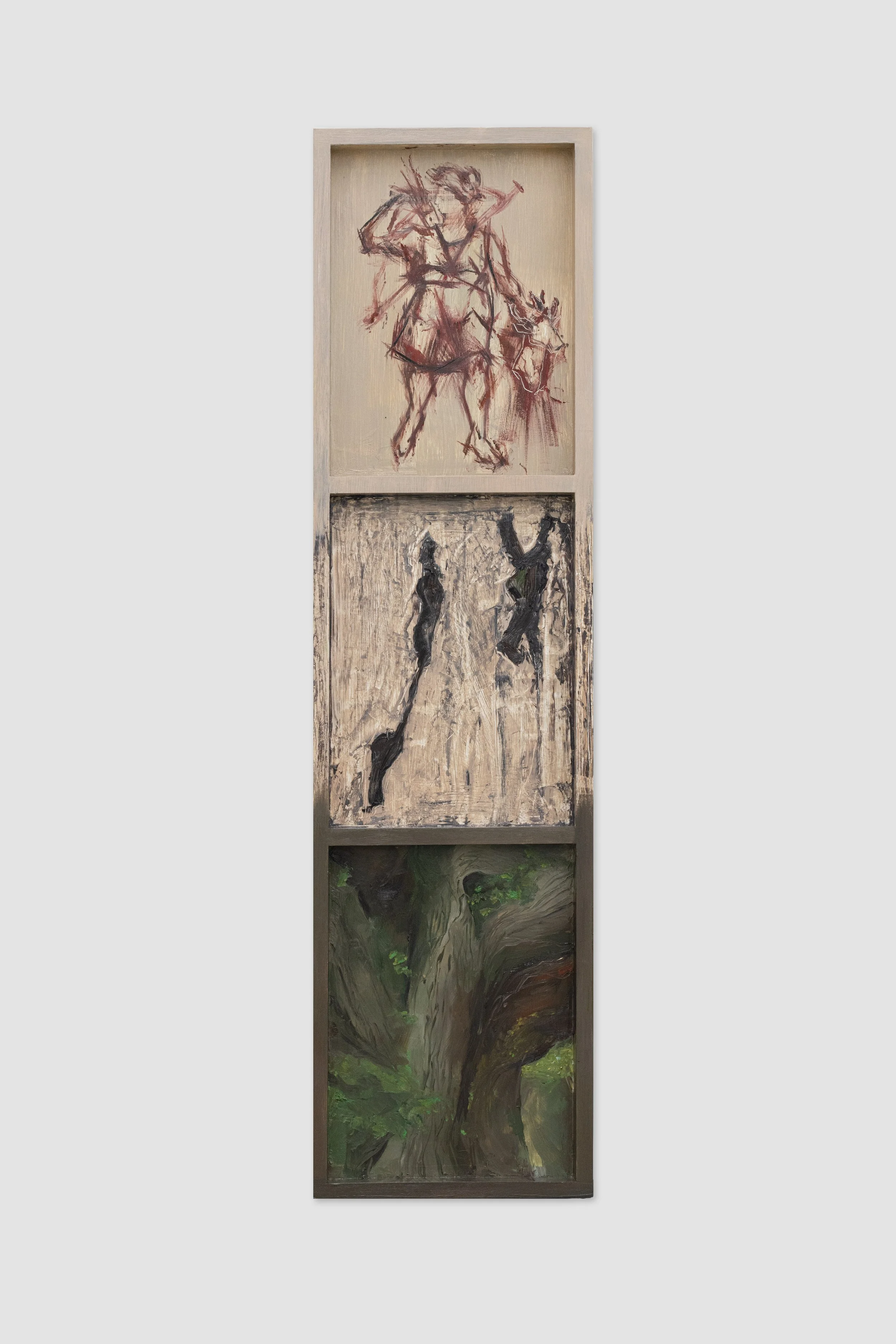
Artemis, Oil painting on wooden panel, 12 x 48 in, 2026 © Siqi Fan
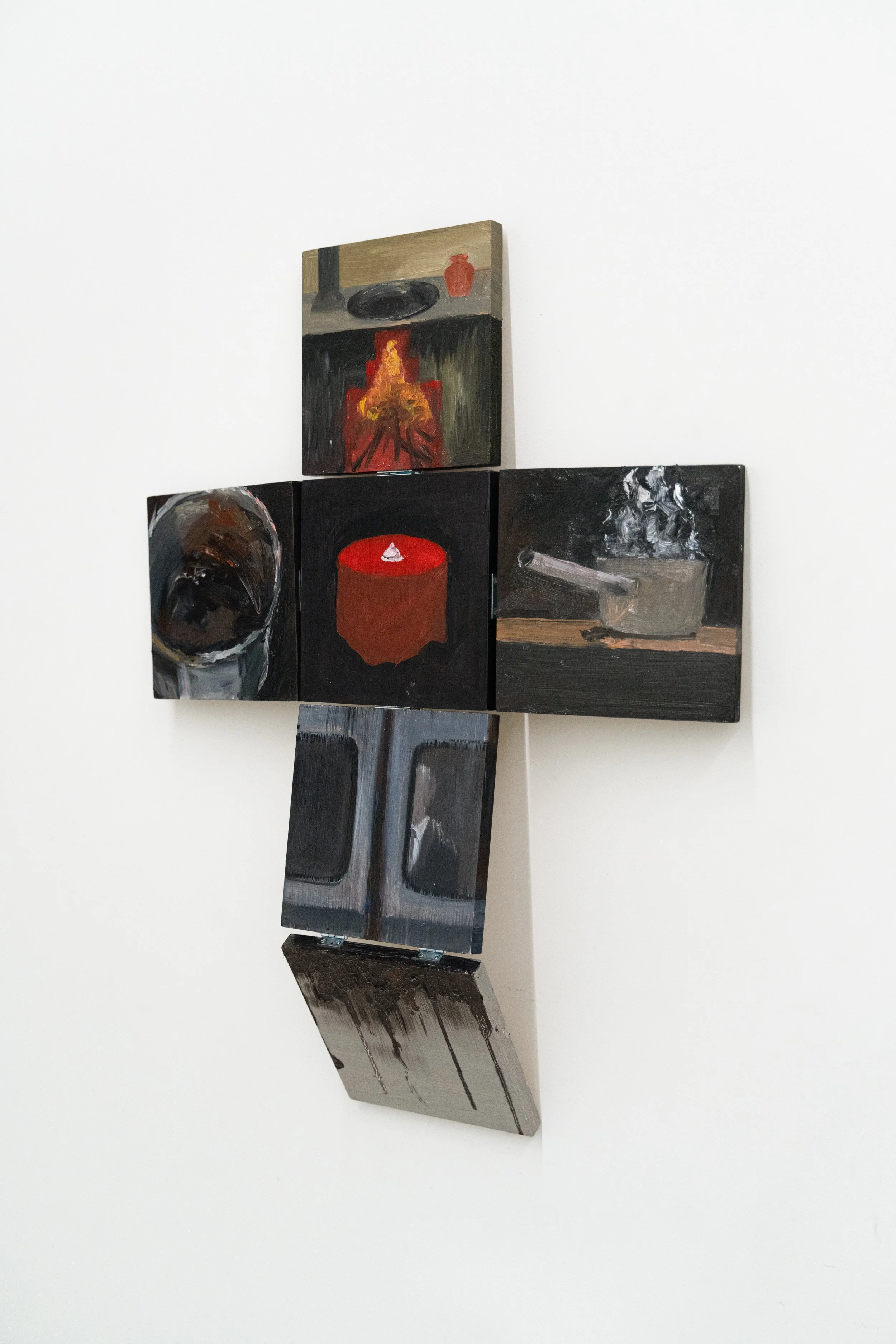
Cube I - Fire, FIRE, Oil painting on wooden panel, 24 x 32 in, 2026 © Siqi Fan
Themes of migration, memory, belonging, and care are deeply connected in your work. How do you see these ideas influencing one another?
For me, these themes cannot really be separated.
Migration transforms memory. Memory shapes our understanding of belonging. Care often becomes the way belonging is expressed in everyday life, whether through cooking, maintaining spaces, or supporting communities.
Rather than treating these ideas as abstract concepts, I'm interested in how they appear through ordinary gestures and material practices. They become visible in the objects we keep, the spaces we build, the recipes we inherit, and the routines we repeat. These everyday actions quietly shape how people construct a sense of home, even while living between cultures or existing within unfamiliar environments.
Your practice transforms ordinary spaces, such as kitchens, storage rooms, and service areas, into places of reflection. What do these everyday environments reveal that more traditional subjects might not?
Back-of-house spaces reveal the systems that make front-of-house experiences possible.
These environments are often considered purely functional, yet they are full of human relationships, improvisation, care, exhaustion, humor, and resilience. They are places where social hierarchies become visible but also where communities are formed.
I'm interested in these spaces because they challenge conventional ideas about what deserves attention. They remind us that every polished public experience depends on an invisible infrastructure. By bringing these overlooked environments into the gallery, I hope viewers begin to recognize that the systems supporting everyday life are worthy of reflection, both aesthetically and socially.

Chessboard_Mixed Media 16 x 10 x 4 in, 2026 © Siqi Fan
Lastly, looking ahead, are there any new materials, collaborations, or ideas you are excited to explore in your future projects?
I am particularly interested in expanding painting beyond the wall. In Back of House, I began treating wooden panels as sculptural objects through hinged structures that allow painting to occupy space rather than remain flat. I'm interested in how painting can function as architecture, partition, or stage rather than simply as an image.
At the same time, I'm continuing to develop immersive performance installations that combine painting, sculpture, video, sound, cooking, and audience participation. Rather than treating these media separately, I'm interested in how they can work together to construct a shared sensory environment. Video and sound provide historical and emotional context, while the live preparation and sharing of food allow labor, care, and hospitality to unfold in real time.
I'm also interested in challenging the traditional hierarchy of the senses. For centuries, Western philosophy privileged sight and hearing as the primary ways of acquiring knowledge, while taste, smell, and touch were considered secondary. My work attempts to reverse that hierarchy. Eating is one of the most intimate actions we perform, it becomes part of our bodies. When audiences share food prepared as part of a performance, they are not simply observing an artwork; they become participants in an exchange of labor, care, memory, and energy. I want the experience of the work to extend beyond visual spectatorship into something embodied and collective.
These ideas continue to develop through my current projects. On July 26, I will participate in a virtual artist talk for Here, Where the Body Knows at Vox Populi Gallery, where I'll discuss how painting, performance, hospitality, and sensory experience intersect within my practice, and how the act of sharing food can become a way of thinking about labor, belonging, and community.
I continue to explore how painting, sculpture, moving image, sound, and culinary performance can create experiences that invite audiences not only to see, but also to listen, smell, touch, and eat. For me, art is not simply something to be viewed, it is something to be encountered, shared, and lived.
Artist’s Talk
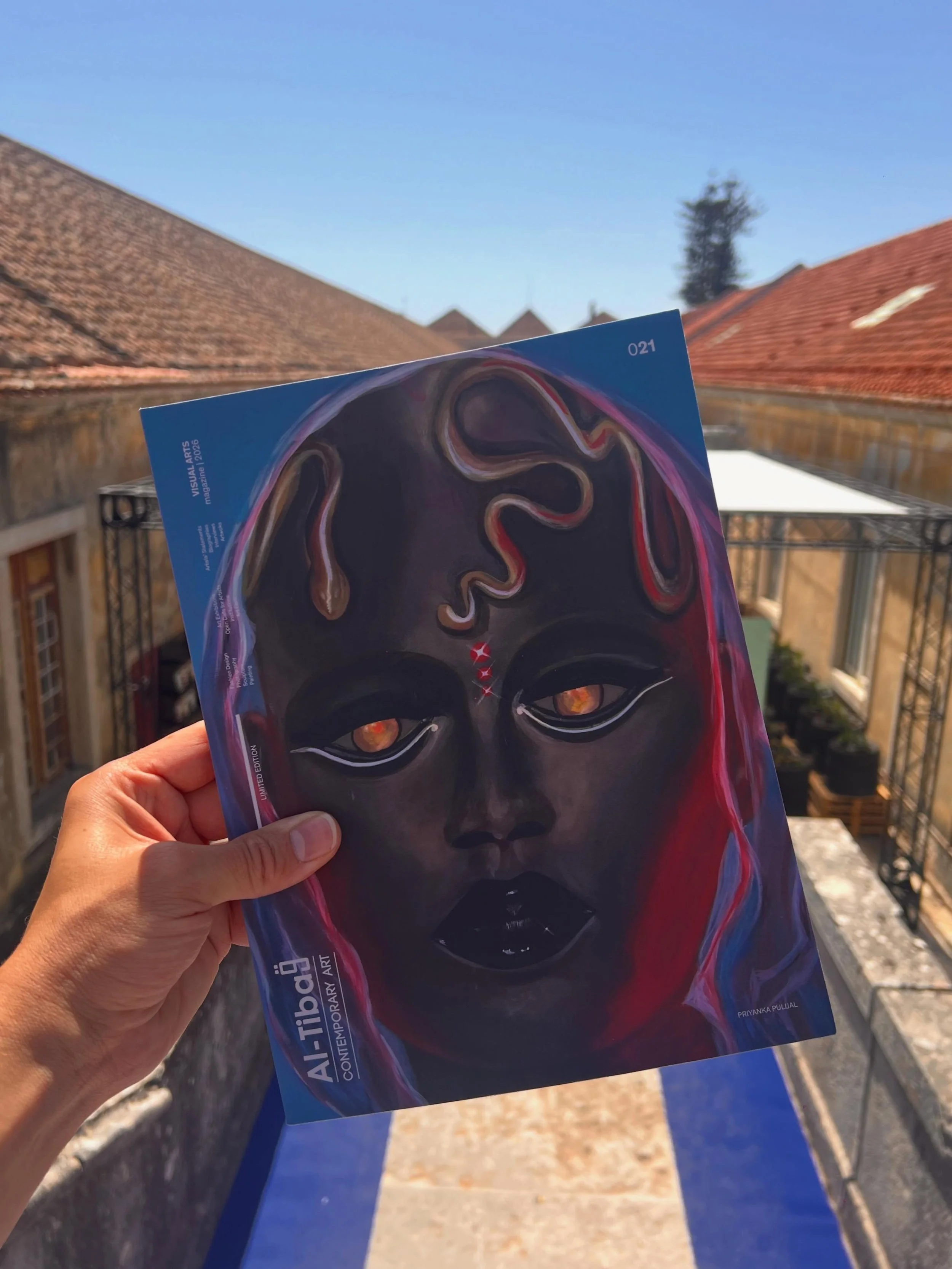
Al-Tiba9 Interviews is a curated promotional platform that offers artists the opportunity to articulate their vision and engage with our diverse international readership through insightful, published dialogues. Conducted by Mohamed Benhadj, founder and curator of Al-Tiba9, these interviews spotlight the artists’ creative journeys and introduce their work to the global contemporary art scene.
Through our extensive network of museums, galleries, art professionals, collectors, and art enthusiasts worldwide, Al-Tiba9 Interviews provides a meaningful stage for artists to expand their reach and strengthen their presence in the international art discourse.


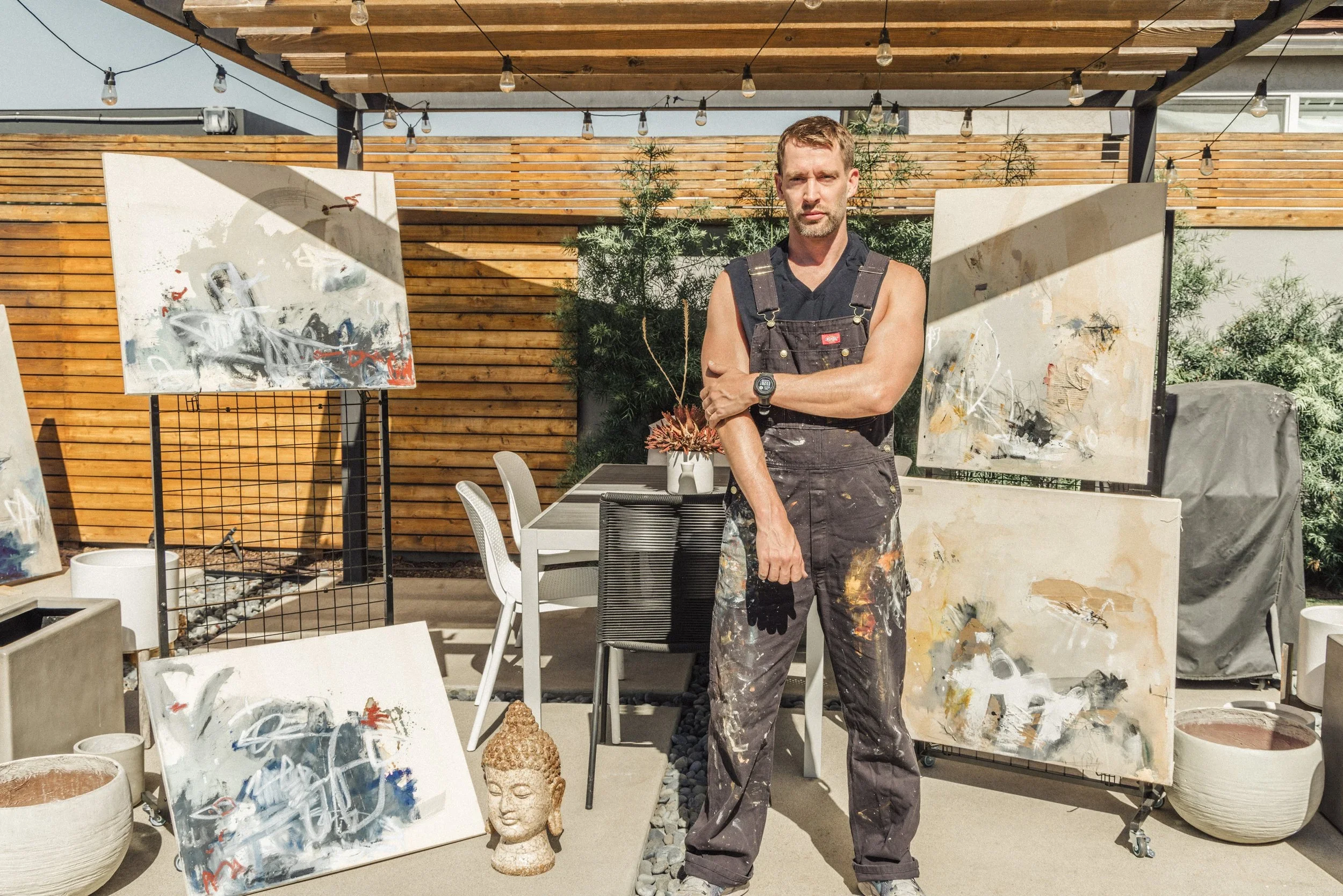

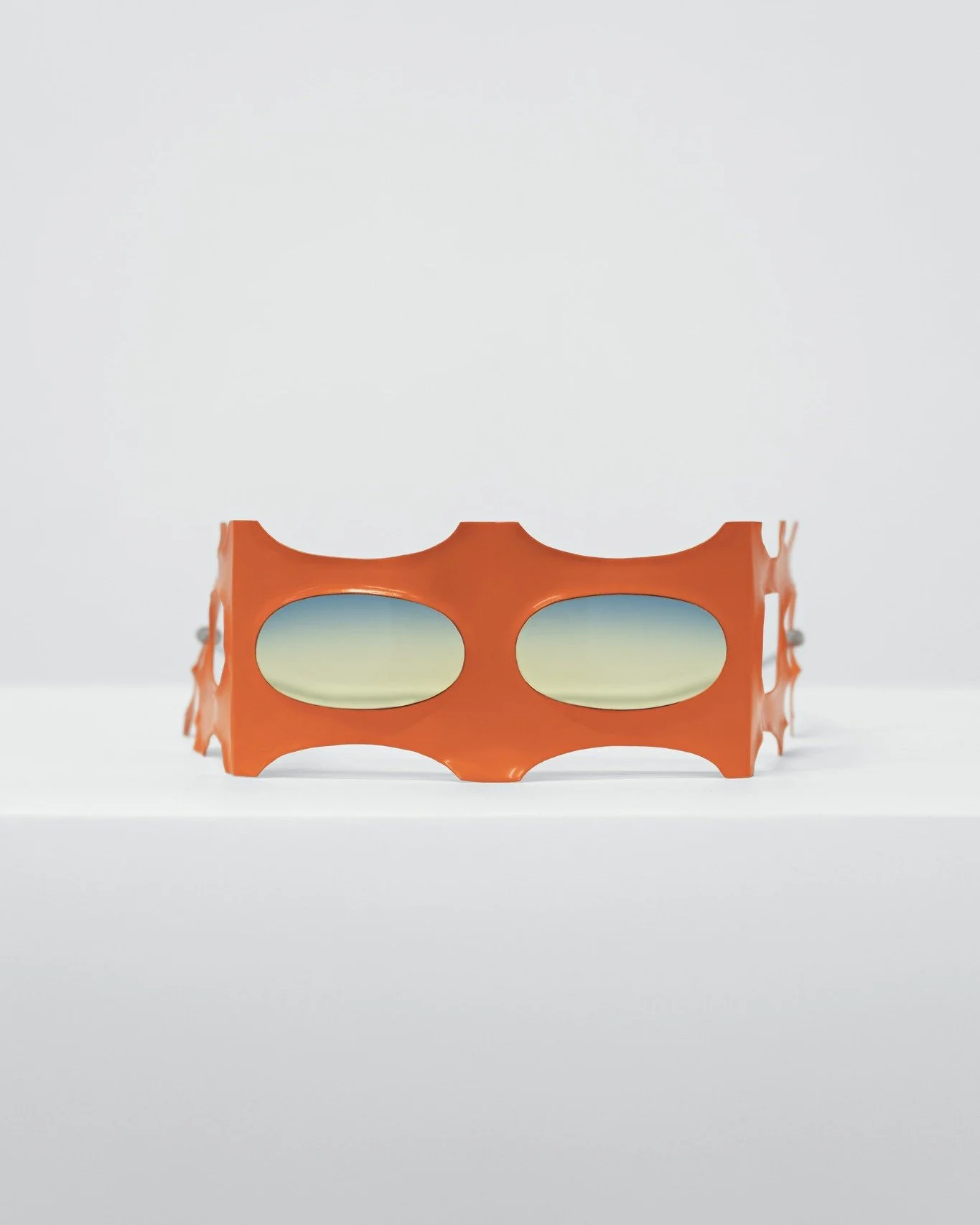
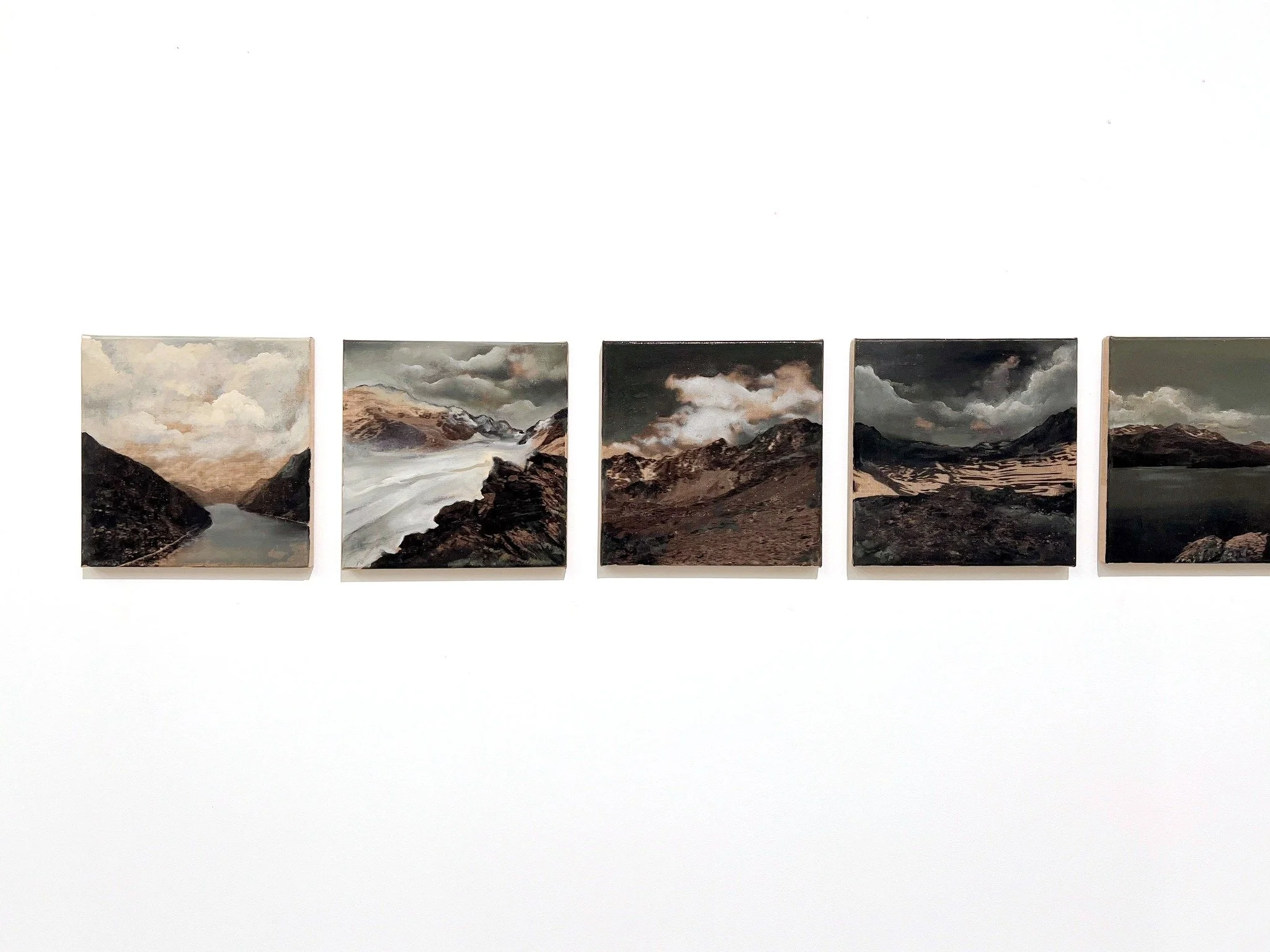
Kfir Galatia-Azulay Darash is an architect, engineer, multidisciplinary designer, and artist. In his practice, architecture defines the framework, scale, rhythm, and light; interior design addresses the body and the human experience; product design approaches detail, material, and physical contact; and art allows an idea to move beyond function and become emotion, memory, and interpretation.