

10 Questions with Abir Kobeissi
Al-Tiba9 Art Magazine ISSUE21 | Featured Artist
Abir Kobeissi is a Lebanese artist based in Munich. She studied at the Lebanese University, Institute of Fine Arts and Architecture (2011), and the Academy of Fine Arts, Munich (2024). Her multidisciplinary practice explores value, authorship, and power through painting, sculpture, photography, textiles, and installation. Alongside her art, she has been working as an Artistic/Research Associate with Prof. Alexandra Pirici at the Academy of Fine Arts in Munich since 2023. Kobeissi lives and works in Munich.
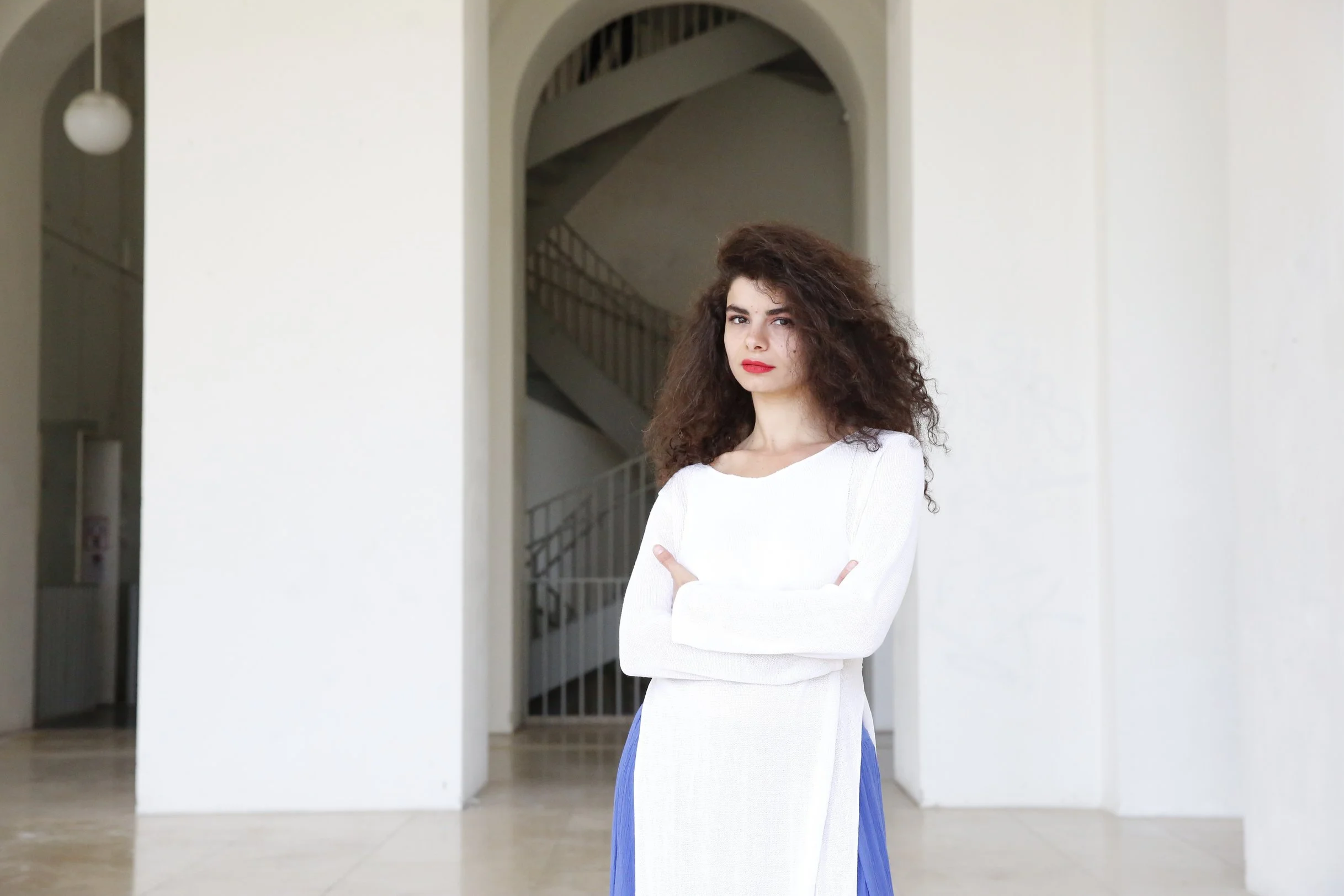
Abir Kobeissi - Portrait
ARTIST STATEMENT
Kobeissi examines how value, authorship, and power are constructed. Working across painting, sculpture, photography, textiles, and installation, she explores socio-political and economic systems through material and conceptual inquiry. Born and raised in Beirut, her practice is shaped by Lebanon's ongoing crises, which inform her choice of materials and mediums. Her work combines introspection with critical observation, creating spaces for reflection on contemporary power structures and the mechanisms that define worth and meaning.
Ahlaknahom/We defeated them, Ceramic glazed, 60x60 cm, 2025 © Abir Kobeissi
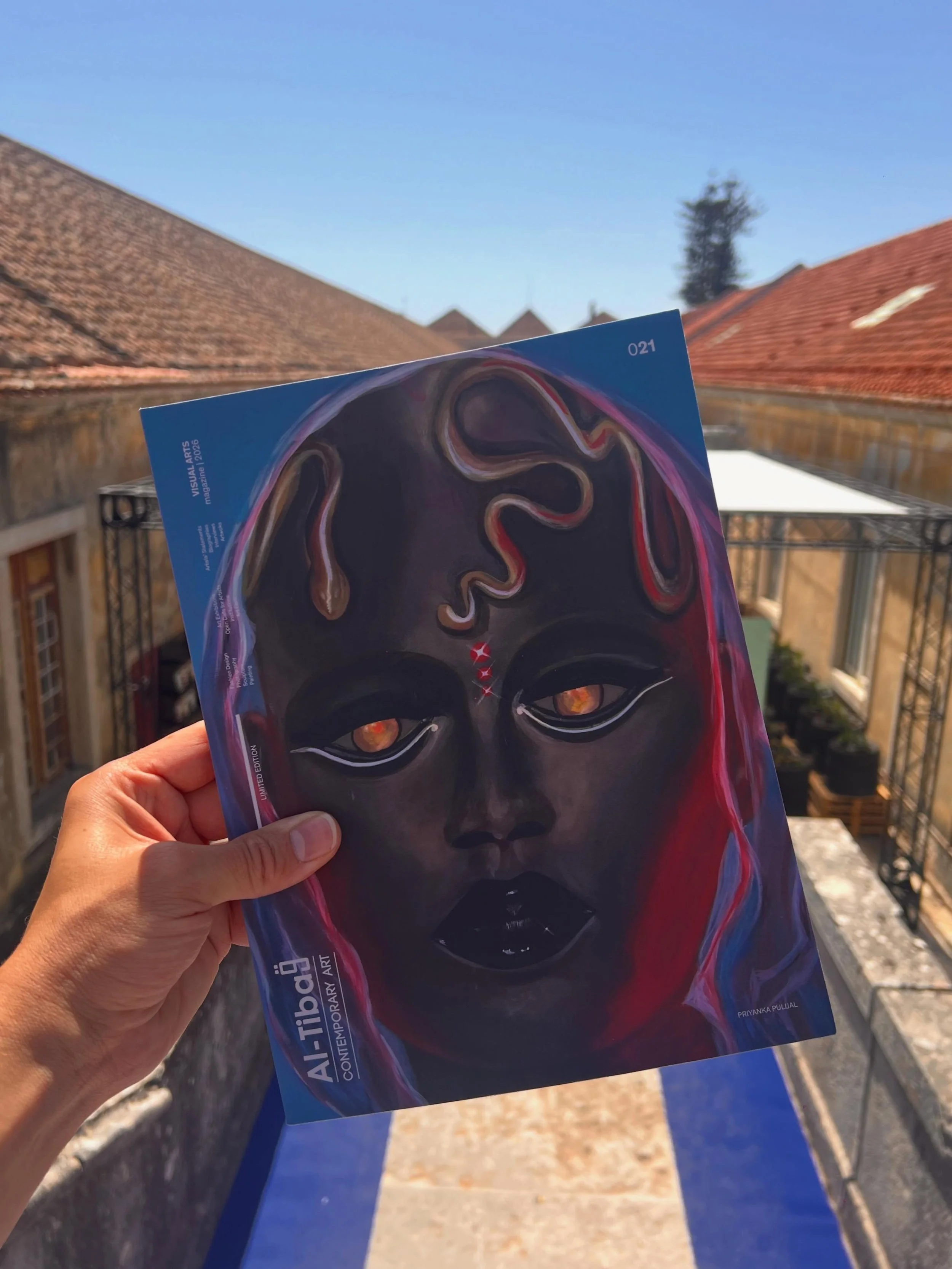
AL-TIBA9 ART MAGAZINE ISSUE21

DISCOVER THE INTERNATIONAL ART SCENE WITH AL-TIBA9
LIMITED EDITION | Shipping worldwide.
Premium museum art paper.
Printed in London.
Grab 3 or more prints and get your FREE digital magazine.

Digital Magazine - Available SOON…
INTERVIEW
You were born and raised in Beirut and are now based in Munich. How has this geographical shift influenced the way you think about authorship, identity, and artistic responsibility?
When I decided to move abroad to fully dedicate myself to an intensive art practice, Lebanon was going through one of its more stable periods, very different from what followed after 2019.
At first, the geographical shift and cultural shock strongly affected my sense of belonging and identity. A lot of thoughts that had been dormant began to surface. This was reflected in my work at the time, which was more intuitive and rooted in painting, before I developed a closer relationship with clay and ceramics.
As time passed, and as both global and Lebanese crises unfolded, especially since 2019, I found myself deepening my technical skills while also widening my perspective. Studying at the Academy of Fine Arts in Munich gave me access to a wide range of materials and techniques as well as people of expertise, and I tried to make the most of that environment. And I think I succeeded.
It is during the period of bankruptcy in Lebanon and when hyperinflation occurred that my work began to shift more clearly toward questions of value, authorship, and how narratives are constructed and validated. Looking back at the past years, I realise that my sense of responsibility also became more pronounced over time. Even though it was present from the beginning, being abroad makes you aware that you are not just an artist, you are often read as "the Lebanese artist."
That awareness has shaped how I think about authorship and responsibility. It took time and distance to fully recognise it, but it has become central to how I position my work today.

Women defeated them not Heaven, Glass, Leather, 30x35x40 cm, 2025 © Abir Kobeissi
Lebanon's ongoing crises are described as shaping your practice. How do these realities translate into material choices and working processes rather than remaining purely conceptual references?
The real conflict for me was living in a stable and secure environment while my body and nervous system were still reacting as if I were in Lebanon. It took time to adapt, and this tension inevitably entered the work.
Coming from an economy of scarcity and finding myself in a context like Germany, especially Bavaria, where materials are abundant, even discarded in the streets or within the Academy, forced me to rethink my relationship to material. I became very aware of this contrast. At some point, I was even afraid of losing that sensitivity, of becoming indifferent to material because of its excess. I come from a context of scarcity, so encountering abundance didn't make me consume more-it made me question the value of every material I use.
Instead, I chose to approach this abundance consciously. I became interested in understanding materials more deeply-their histories, their value, and their transformation. This is when my work shifted more toward sculpture, working with materials like metal, copper, foam, ceramic, porcelain, glass, gold, and silver, materials I would not have had access to in Lebanon at that time.
In that sense, my material choices operate between reaction and decision. On one hand, they are shaped by the conditions I come from-scarcity, limitation, and adaptation. On the other hand, they are a conscious response to the environment I am currently in. The material becomes a way to reflect both contexts at once.
For me, especially in the early stages of a practice, it is important to work with what is available rather than forcing something else. Sometimes scarcity makes decisions for you, and that can be a strength. It allows the work to emerge more organically, grounded in its conditions of production.
Your work investigates how value and power are constructed. When did these concerns first become central to your artistic research?
Very early on, around two years into my studies, once the initial shock of moving abroad had settled, I began to think more consciously about the direction of my practice. I started questioning not only the artistic aspect of my work, but also its economic reality: where it exists, how it circulates, and what it means to produce within a system.
I remember making a video performance in which I was asking what the art market actually is, and whether there is a mechanism that allows us to understand it. I sent this video via WhatsApp as an invitation to a self-organised exhibition in my apartment in Munich, where I presented works I had produced over the previous one to two years. That moment marked a turning point. It came from an immediate need to present the work, but it also opened a more conscious reflection on visibility, circulation, and value.
Around 2019, this questioning intensified, coinciding with the beginning of the crises in Lebanon, followed by the economic collapse. At the same time, as a foreign student in Germany, I was required to prove financial stability-something that became increasingly difficult due to the situation in Lebanon. These conditions made the question of value very concrete, not only conceptually but in daily life.
It was during this period that questions of value, economy, and authorship became central to my practice, and my work began to respond more directly to the conditions surrounding it.

Silver Armor, 100% Silver thread around cotton thread, 200x80 cm, 2020-2025 © Abir Kobeissi

Unarmed, Porcelain, Glass, 18K Gold & Polyester 3D prints, 39x9 cm each, 2023 © Abir Kobeissi
You work across painting, sculpture, textiles, photography, and installation. How do you decide which medium best carries a particular idea or inquiry?
There is often an expectation that an artist should be associated with one medium, one style, or one clear identity, but I see it differently. Even within my own family, this approach was sometimes questioned, which made me more aware of how strongly we expect artists to fit into fixed categories. I believe an artist can maintain a strong and recognisable language while working across different mediums, techniques, and forms of expression. I like exploring, and I consider it a privilege not to be fixed in one form.
One of the reasons I am an artist is that the process allows me to understand more while working. Because of that, I feel that any material should be available if it serves the work.
This does not come from uncertainty. When I work with a material, I often stay with it for an extended period, sometimes months or even years. So it's not about constant change, but about allowing each body of work to find its own form.
My approach has also been shaped by the conditions I have been working in. Being in Germany, and especially within an institution that offers access to a wide range of workshops and materials, I was very aware of the opportunity to experiment and expand my technical understanding. I didn't want to leave that context without having fully engaged with what was available. After all, this was the main reason for me moving there, so I fully dedicated my life to it for more than 6 years.
I remain attentive to the opposite condition as well. If at some point the only thing I have access to is paper and a pencil, then that is what I will use. The work adapts to its conditions.
Ultimately, the decision comes from a dialogue between concept, material, and context. Sometimes the idea dictates the medium, and sometimes the material itself defines what is possible. For me, it also has to make sense economically, not only conceptually. That relationship is always present in the work.
Your practice combines personal reflection with broader socio-political observation. How do you balance these two dimensions while developing a work?
The private and the public constantly reflect each other. Even when artists work on subjects that seem distant from their personal lives, there is always something of themselves present in the way they approach those topics.
If we look at art history, we often return to the artist's biography after the work has been produced and shown over time. Even artists who try to keep their private life separate eventually become read through it. In that sense, the personal is never entirely absent.
In my case, the work rarely begins with something explicitly personal. It often starts from an impression or from a condition I am observing. I am more interested in collective contexts-shared histories, systems, and environments-rather than focusing directly on my individual experience.
I am not interested in presenting something that remains purely individual. Personal elements can enter the work, but only when they resonate beyond my own situation.
So the balance is not something I try to control. It happens through the process itself, by allowing the work to move between these layers while remaining grounded in something that can be shared or recognised beyond me.

GRWM, Installation, Porcelain, Ceramic, Glass, Gold, Foam, Copper, Wood, Polyesther, Textile and Silver, 5x5 m, 2025 © Abir Kobeissi
In GRWM, preparation becomes both a personal and collective act. What does "getting ready" mean to you within today's political and social climate?
Anthropologically speaking, if we look at human behaviour across societies and economies, one recurring aspect is the act of "getting ready." Whether it is preparing for a new season, moving from one place to another, or transitioning from one phase of life to another, readiness or getting ready is a constant and often underestimated collective behaviour.
In GRWM, this idea is shifted into both a geographical and material context. The project was originally intended as my final exhibition in Munich, marking a transition in my own path. At the same time, external circumstances-particularly the war events in Lebanon in 2023 and 2024-directly affected the production of the work. A key element, a silver armour, was being developed through a production process based in Lebanon, which could not be completed due to the circumstances. This interruption also led to a shift in the development of the project and its continuation in another work, A Last Dance.
Within this framework, "getting ready" becomes more than a preparatory gesture-it can be understood as a state of awareness. It relates to questions of safety, value, vulnerability, and systems of survival. While working on GRWM, I was not only engaging with materials but also with the underlying concepts they carry, including how value is constructed, how vulnerability is perceived, and how systems of protection operate.
Over time, the process of developing this body of work opened up a broader reflection on history and on how we position ourselves toward the future. The notion of readiness, in this sense, becomes both personal and collective, and also somewhat ironic when borrowed from its popular use on social media. It points to a shared condition where preparation is not only about appearance, but about anticipating change, uncertainty, and the possibility that what we take for granted may not always remain stable.
The metaphorical weapons in GRWM appear strong yet fragile. What kinds of protection or vulnerability are these objects meant to evoke?
The series was developed over a period of almost seven years. During that time, of course, it was not the only body of work I was producing, but the objects that became part of Get Ready With Me were created cumulatively, often in parallel with other works. I would return to them over long periods, working in a very slow, almost meditative and meticulous way. Many of them were developed one after the other and then set aside, until a moment came when I could look at them together.
Each object relates to a specific moment in my life, both in terms of the topic I was engaging with and the material I was working with at the time. Many of them carry forms that suggest aggression, invasion, or protection. But the materials and their functions often contradict that first impression. This contrast became a way for me to rethink objects that we usually take for granted, and to question what we assume their role should be.
I also think this is connected to my own sense of security. In the beginning, I found it difficult to fully trust the stability around me in Germany. It felt almost unreal, as if it could disappear at any moment.
Recent global events, like the disruptions in supply chains caused mainly by conflicts and wars, have shown how fragile our systems actually are. Structures that appear stable can shift very quickly. In that sense, the objects may look like they perform a certain function, but in reality, they can produce the opposite effect.
When I finally saw them together, it felt like I was looking at an arsenal that needed to be exposed. But instead of offering protection, these objects question it. This also extends to the series of coins minted for GRWM, where the value itself is no longer something that can be trusted. They point to the fragility behind what we often assume to be secure, whether it is a material weapon or a more abstract one like money or currency.

Archetypes 2, Acrylic on Canvas, 60x90 cm, 2019 © Abir Kobeissi

Archetypes 2, Acrylic on Canvas, 60x90 cm, 2019 © Abir Kobeissi
In A Last Dance, your body becomes part of the installation through performance. How did embodying the work alter your understanding of power, presence, and absence?
Performing within a contemporary art context was, for me, one of the most difficult experiences. If this had been a dance piece with a clear stage and a defined distance between the audience and the work, it would have been much easier. But in A Last Dance, that distance did not exist.
The work was conceived as a site-specific piece in a historical neoclassical architecture building. Within this setting, my body became part of the installation, moving between a symbolic tomb and a pedestal. These positions carried different states: powerlessness on one side, and a form of elevation or visibility on the other.
Bringing my body into the work was the most challenging aspect. It introduced a level of exposure that I was not fully comfortable with. There was a constant tension between being present and trying to detach from myself at the same time. I found myself in conflict while performing. In fact, if I were to repeat the work, I might choose to work with another performer instead of placing my own body in that position.
This work demanded a lot physically and technically. I worked with materials and techniques I had never used before, including glasswork and metal. Every element, from the glass to the copper structures, required a high level of precision and physical engagement. In that sense, it became one of the most demanding works I have produced.
Interestingly, I sometimes found that I could experience the work more fully when my body was absent. The installation itself already carried traces of the body, making its presence felt even without being physically there.
So embodying the work did not give me a sense of control or power. On the contrary, it exposed a vulnerability and a responsibility that I was not entirely at ease with. Even now, I have mixed feelings about the work. Conceptually, it remains complex for me, but technically and aesthetically, it is one of the works I am most proud of.
This experience also clarified something for me. While embodiment became necessary in this moment, I find myself more drawn to forms where the presence of the body can be implied, constructed, or displaced rather than directly performed. I think my understanding of this will continue to evolve over time.
How has audience reception shaped your perspective on these recent projects? Have viewers interpreted the works in ways that surprised you?
Audience reception has been an important learning process for me, and not always an easy one. I became very aware that each context brings its own framework for engaging with the work.
In some European contexts, I sometimes felt that the work was approached primarily through an aesthetic or thematic lens. Certain expectations seemed to guide the reading, which at times created a distance between the intention of the work and how it was received. In some cases, I felt the work resisted the frameworks through which it was being approached.
In contrast, in Beirut, the engagement often felt more immediate and relational. Viewers tended to connect the work more directly to lived experience and context, which allowed for different kinds of interpretations to emerge.
These differences made me more conscious of how reception is shaped by cultural, social, and institutional structures. It also made me realise that understanding the audience is not about adapting the work, but about being aware of the conditions in which it is encountered.
There were moments where I also became aware of how my background influenced the way the work was perceived, which added another layer to how I think about positioning and communication.
At times, the gap between intention and reception can be challenging, but it is also productive. It forces me to reflect more precisely on how the work operates, what it communicates, and where it resists easy interpretation.

A last dance, Glass, Silver, Copper, Iron, Installation, 15x10x1,8 m, 2024, Photo by Stephanie Rössing © Abir Kobeissi
Lastly, considering the current situation in Lebanon and your position abroad, how is your practice evolving, and what directions or questions are guiding your future projects?
It is very difficult for me to process what is happening in Lebanon right now from a distance. I hope that by the time this interview is published, the war will have stopped. In moments like this, I know many Lebanese abroad can relate-I would rather be with my family, even if it is dangerous, than live two parallel lives: one emotionally there, and another here that requires me to remain functional.
Although I was born and raised in Beirut, like many southerners, I remain deeply attached to the south of Lebanon. There is a constant feeling that everything I am doing now is temporary, and that returning to Lebanon is not just a possibility but a reality. This creates a kind of suspended state-if this is the truth, then why postpone it? Why not now?
Sometimes I find myself questioning whether it makes sense to continue producing work within Western frameworks, or whether it would be more meaningful to return, perhaps to work the land, to live a different rhythm, and allow my practice to develop from there. There is something deeply calling in that: the Lebanese landscape, the climate, the ecological system, the cuisine, a way of life that feels both familiar, slow and essential. If it were not for the current security situation, I believe I would already be there, trying to build something.
At the same time, I remain aware of the value of what I have been given in Munich. The opportunity to study, to access resources, and to develop my work in this context is something I take seriously. This is also part of my reality, and it has shaped me in fundamental ways.
The distance creates helplessness, but also a certain clarity. It pushes me to rethink what resilience and resistance can be, and what role art can realistically play within that.
These directions do not fully collide yet, and it is still unclear to me how they can coexist. But these questions, even in their unresolved state, are beginning to shape the direction of my work-and perhaps the need for an updated kind of practice that responds to those needs.
Artist’s Talk
Al-Tiba9 Interviews is a curated promotional platform that offers artists the opportunity to articulate their vision and engage with our diverse international readership through insightful, published dialogues. Conducted by Mohamed Benhadj, founder and curator of Al-Tiba9, these interviews spotlight the artists’ creative journeys and introduce their work to the global contemporary art scene.
Through our extensive network of museums, galleries, art professionals, collectors, and art enthusiasts worldwide, Al-Tiba9 Interviews provides a meaningful stage for artists to expand their reach and strengthen their presence in the international art discourse.




Lim Won Ji (Oneg) is a South Korean artist based in Chicago. Working across sculpture, installation, performance, and process-based experimentation, Lim investigates hypervigilance as a bodily condition shaped by anxiety, uncertainty, anticipation, and the desire for control, constructing unstable situations in which order is continually negotiated through gravity, time, repetition, and chance.