
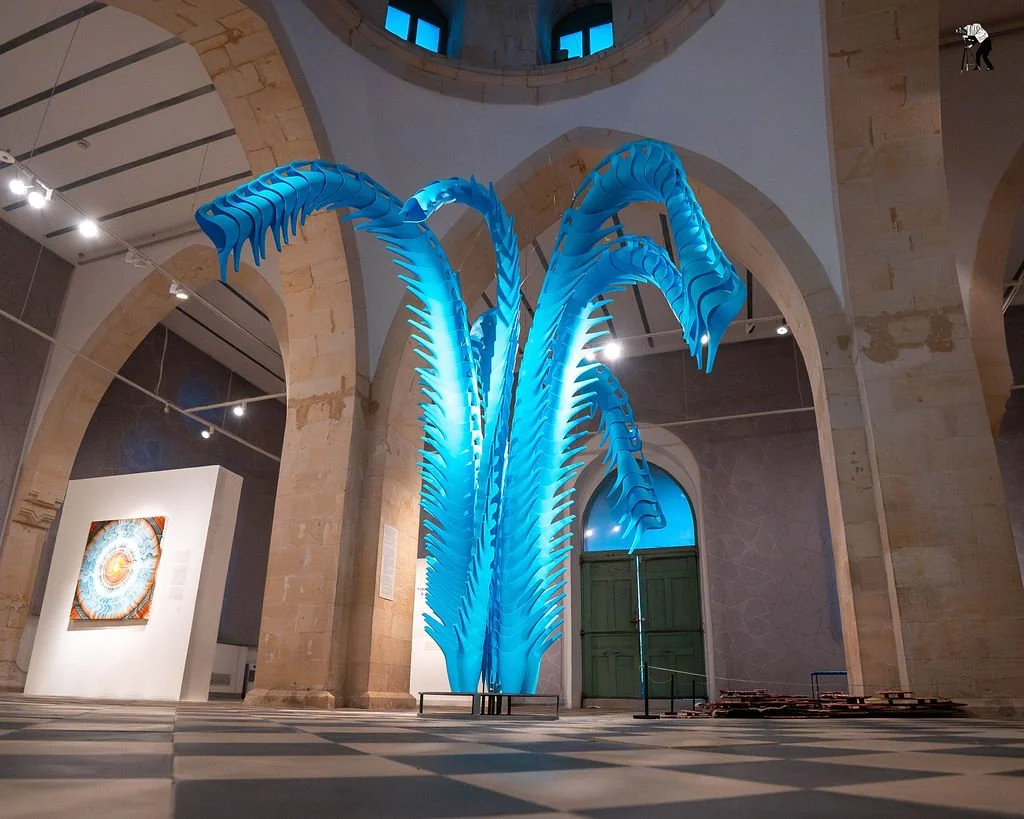
10 Questions with Danielle Feldhaker
Danielle Feldhaker (b. New York, 1982) lives and works in Emek Hefer. She studied in the personal program of HaMidrasha School of Arts at Beit Berl College (2014–2016). In 2010–2011 at “Hatahana-Studio of figurative arts”, Tel Aviv, Israel. Before that, she obtained an L.L.B. in Law and a B.A. in Business Management, Financing Minor at the IDC (Interdisciplinary Centre), Herzeliya, Israel (2003–2007).
In recent years, her works address notions associated with the haphazardness, demarcated territories, or transient shelters in the context of acute global issues concerning the future and integrity of our planet. Feldhaker has been creating site-specific installations and sculptural objects, using ready-made and materials extracted from the mundane and functional office life. In her works, she uses industrial materials such as PVC sheets, fibreglass, fluorescent lights, plexiglass, polyurethane, etc.
Feldhaker’s works are exhibited in various solo and group shows in Israel and around the world. To name a few, Museum of Islamic and Near Eastern Cultures, Beer Sheva, Nakanojo Biennial, Japan, Larnaka Biennial, Cyprus, Eretz Israel Museum, Tel Aviv, Haifa Museum for contemporary art, JannKossen Gallery, New York, Jaffa Museum of art, Janko Dada Museum, Ein Hod, Jerusalem Biennial and more.

Danielle Feldhaker - Portrait
ARTIST STATEMENT
Feldhaker was born in New York, and the influence of the urban space, street art, graffiti, the glass-clad towering high-rise and the city reflected in them, along with the local urban landscape of Tel Aviv where she grew up, are ingrained in her creative realm. In her work, she takes on the relationship between inside and outside, between opaque and transparent, hidden and visible, soft and hard, "high" and "low," while marking the private and public spheres and revealing the gap between the singularities of labour's intensive hand made to the reproducibility of the industrial products she uses. Her works address notions associated with the haphazardness, demarcated territories, or transient shelters in the context of acute global issues concerning the future and integrity of our planet.
In recent years, she has been creating site-specific installations and sculptural objects, using ready-made and materials extracted from the mundane and functional office life. Electrical and plastic cables, sockets and plugs, fluorescent and LED lights, PVC sheets, bubble wrap, and other ready-made items undergo a process of transformation into a new material and geometrical syntax. These come together and formulate a constructive language that transports the material from its physical dimension into sculptural, poetic, symbolic, and conceptual realms.
Through this work process, which disrupts the common function and purpose of the various elements, emerges a new language and aesthetics, embodied by complex assemblages that resonate with their original function. One example is the use of nylon filaments to "weave" long, thin fluorescent lights, creating a free-standing sculptural and structural system. For Feldhaker, the objects, as well as the space around them, function together like screens or divides of sorts, allowing the viewer intimacy and respite.
The layers and processes of her practice are uncovered in installations that combine transparent PVC sheets, which she uses as support for a range of techniques. The transparent plastic surface allows and exposes the stages of her work process, exposing what happens "backstage" and connecting the inside with the outside, the front with the back. In addition, due to the support's transparency, the painted elements appear to be "floating," breaking away from it into the space. In Tube A, a piece comprising soft PVC sheets, Feldhaker created a 3-meter-high cylindrical shelter of sorts, which the viewers could enter. Its transparency undermines a sense of an impervious and protective shelter.
Prior to focusing on sculpture, her main practice involved painting on transparent plexiglass panels or plastic packaging sheets. These works maintained the tension between figurative images and abstract brushstrokes. The traces of the paint and colourful wallpaper strips echoed an urban aesthetic of towers, like a relic of an urban setting, construction and destruction, growth and withering. Alongside formalist, geometric abstract painting, she also engaged in miniature, labour-intensive, elaborate drawing that resembled a cryptic and obscure language. This was an autonomous world of images comprising many symbols, some drawn from reality but most of them fictional. The obsessive and labour-intensive drawing evolved into the repetitive drawing of patterns, like lacework or tapestry. Later, these were duplicated to form a digital pattern, which she used to create a textile or an "epidermal cover," with which she clads different work surfaces. In Eyes Wide Shut, for instance, this material shifted to Plexiglas, from which emanated a video projection of two eyes that open and close intermittently, while they change colour.
For Feldhaker, the eyes that peek through a lace-like cover stand for a stereotypical representation of feminine craft, generating contemplation on discrimination and exclusion of women.
Fountain, plastic water cans, metal, nylon string, 3x2 meters, 2024-2025 © Danielle Feldhaker | Photo by Daniel Yasano
INTERVIEW
You originally studied law and business before turning to art. What prompted this shift, and how does your background influence your current practice?
Art was always a vital passion for me, though for some years it remained in the background as I pursued other interests, law among them. Even while studying law and business, I continued to paint; creativity was never dormant. Upon completing my degree, I recognised that my true vocation lay in art and made the conscious decision to devote myself fully to artistic practice. My background in law and business informs my work in unexpected ways; it sharpened my analytical thinking, instilled a discipline of research and structure, and, I think, takes a part of the materials and themes I explore in my art.
What experiences have most shaped you into the artist you are today? And looking back, what do you wish you had known about the contemporary art world before getting started on this career path?
My course as an artist was most profoundly shaped by my studies at Hamidrasha – Beit Berl College of Art between 2014 and 2016. It was a designed personal program for individual artists that permitted a very close studio work with my preferred teachers- artists. This program allowed me to cultivate my own artistic language in dialogue with teachers who left a lasting imprint on my methods and thinking. I think my path is an ongoing process of growing up, gaining more knowledge, harnessing my curiosities towards new materials, observing, researching and reacting to what is happening in the world around me, near and far.

Mashrabia DIY, wooden trestles and cable tye, 280x175x70 cm, 2023 © Danielle Feldhaker

Mashrabia DIY (detail), wooden trestles and cable tye, 280x175x70 cm, 2023 © Danielle Feldhaker
Industrial and office materials, PVC, fibreglass, cables, and fluorescent lights, are central to your work. What initially drew you to these utilitarian materials, and what do they allow you to express that traditional media might not?
My fascination with industrial and office materials, PVC, fibreglass, electrical cables, fluorescent lights, and other utilitarian objects stems from their overlooked presence in daily life. I'm drawn to their intrinsic forms and latent potential, viewing them as the DNA of contemporary material culture. In my studio, these everyday elements undergo labour-intensive transformations, acquiring new geometries and entering an aesthetic and conceptual register far removed from their original functions. By crafting handmade sculptures and installations from mass-produced matter, I seek to chart a personal response to issues of urbanism, consumption, and the built environment. These materials enable a language of assembly and mutation that is at once poetic, critical, and deeply attuned to the conditions of our era, making visible the structures, systems, and contradictions we inhabit.
Your process transforms the banal and functional into something poetic and contemplative. Could you walk us through a specific moment in your studio when an everyday material suddenly "clicked" and became something entirely new in your eyes?
One pivotal moment unfolded as I began working with discarded fluorescent tubes. I found a handful in the bins around my studio and decided to collect more from around the city. Weaving these slender glass tubes with black nylon thread, and later drawing on their surfaces with acrylic markers, I realised they could bear both structure and personal mark-making, my own idiosyncratic vocabulary. This led to my first work with fluorescents, "Woven", which was later exhibited in several galleries. The transformation reached a new dimension at the first MUSA Biennale in Tel Aviv, where I incorporated motion detectors into an installation of active fluorescent lights. The lights responded to viewers' movements, their on-off rhythm activating a dialogue between the rigidity of industrial production and the improvisational, hand-crafted intervention. The process crystallised how the familiar can become estranged and luminous, opening onto new modes of encounter.

Welcome, door mats, 4x1.9 meters, 2023 © Danielle Feldhaker
Many of your works engage with notions of shelter, transparency, and the fragile boundaries between inside and outside. Do you see these as metaphors for personal experience, or are they primarily reflections on broader global instability?
These works operate on multiple levels, reflecting both personal sensibility and broader global anxieties. "Tube A" and "And the Dreams So Rich in Colour" probe the precariousness of boundaries, transient shelters, and demarcated spaces, registering both intimate vulnerability and collective uncertainty. In "Tube A", a three-meter-high PVC cylinder, transparency subverts the promise of security, inviting viewers inside yet denying them true protection. "And the Dreams So Rich in Colour" stages a post-apocalyptic architecture. A skeletal structure of lashed wooden planks, scattered belongings, and climbing greenery. It evokes the aftermath of upheaval, a threshold between loss and potential renewal. While these installations are rooted in acute contemporary crises, they also channel autobiographical undercurrents, meditating on displacement, fragility, and the perpetual search for place.
Your DIY series offers a fascinating commentary on self-sufficiency, domestic labour, and construction. How did this series originate, and what conversations did you hope to spark through its improvisational, "do-it-yourself" aesthetic?
The DIY series evolved organically from my ongoing engagement with mass-produced, everyday materials, safety pins, bubble wrap, and functional objects designed for transient use. My approach is fundamentally hands-on, weaving, assembling, and repurposing hundreds or thousands of units until their original function dissolves into a new visual logic. The installations are site-specific and always reversible, a 'kit-of-parts' ethos that mirrors both practical ethics and conceptual play. Over the past five years, the series has increasingly focused on everyday, global products, especially IKEA items. By recontextualising these objects, I invite viewers to reconsider what is public and private, handmade and industrial, Eastern and Western. Works like DIY Mashrabiya, Welcome, Fountain, and Carpet transform familiar things into architectural screens, multilingual thresholds, suggesting that other futures are possible if we are willing to re-pattern the ordinary.
Your exhibition at the Museum of Islamic and Near Eastern Cultures in Beer Sheva introduced your work to a distinct architectural and cultural setting. How did the site influence your installation decisions, and what dialogues did you hope to create between your materials and the museum's historical context?
The exhibition was deeply responsive to the museum's architecture, a building originally conceived as a mosque and its layered histories. I focused on the logic of repetition, seriality, and modularity, echoing both Islamic architectural motifs and the cycles of construction, decay, and renewal. A site-specific conversation emerges in the work "Fountain". The museum's original fountain is mirrored by my own, composed of stacked blue plastic funnels forming a vertical arc that 'remembers' water. Here, industrial materials participate in a chromatic, spatial, and conceptual dialogue with the sacred, blurring distinctions between permanence and transience, ordinary and admired. I hoped visitors would recognise how forms migrate across time and function, how the memory of a place can reshape even the most humble materials.

Carpet (detail), candles, 3.3x2.5 meters, 2024-2025 © Danielle Feldhaker

Carpet, candles, 3.3x2.5 meters, 2024-2025 © Danielle Feldhaker

Carpet (detail), candles, 3.3x2.5 meters, 2024-2025 © Danielle Feldhaker
How was the series received by the public? And what did you learn about yourself and your practice from the feedback of the visitors?
The response has been both generous and illuminating, from viewers and curators in Israel and abroad. The DIY series has been featured at the Larnaca Biennale, the Biennale of Design and Craft at the MUZA in Tel Aviv, and most recently at the Museum of Islamic and Near Eastern Cultures in Beer Sheva. I was especially interested in how visitors engaged with the origins of each installation, recognising the constituent parts and then seeing them reimagined. These exchanges sharpened my understanding of how the familiar, once reworked, can provoke both estrangement and delight.
Your practice constantly evolves. What directions or new materials are you currently exploring, and how do they connect to your ongoing themes?
My work on the DIY project continues, with ongoing research into new ready-mades and found objects that might catalyse future installations. I make a point of visiting IKEA and similar stores, searching for forms that spark curiosity or possess untapped potential. This process remains an open-ended quest, guided by both intuition and conceptual precision, a continuous negotiation between material, site, and idea.
Finally, if you could imagine your next large-scale project without any budget or spatial limitations, what would it look like and what message would you want it to leave behind?
If freed from all constraints, I would envision an expansive outdoor environment, a hybrid between playground and park, populated by monumental sculptural 'shelters' inspired by earlier works. These would invite adults and children alike to inhabit, explore, and find refuge. I would use reclaimed as well as industrial materials, emphasising on ideas of reuse, adaptability, and communal space. My hope is that such a project would not only offer physical sanctuary but also provoke reflection on the fragility and necessity of shelter in all its forms, reminding us that every space we inhabit, individually or collectively, is provisional, and that creativity can foster both resilience and belonging.



Lim Won Ji (Oneg) is a South Korean artist based in Chicago. Working across sculpture, installation, performance, and process-based experimentation, Lim investigates hypervigilance as a bodily condition shaped by anxiety, uncertainty, anticipation, and the desire for control, constructing unstable situations in which order is continually negotiated through gravity, time, repetition, and chance.