

10 Questions with ChingKe Lin
“Unity of Heaven, Humanity, and Bamboo.”
ChingKe Lin is a bamboo artist rooted in material philosophy, expanding the contemporary possibilities of bamboo. Rather than reproducing traditional craft, he approaches bamboo as an explorer, studying its tension and resilience to seek a deeper bond between nature and human experience. His work grows from the essence of the material, turning bamboo weaving into a fluid spatial language and developing new forms in contemporary art across installation and public space.
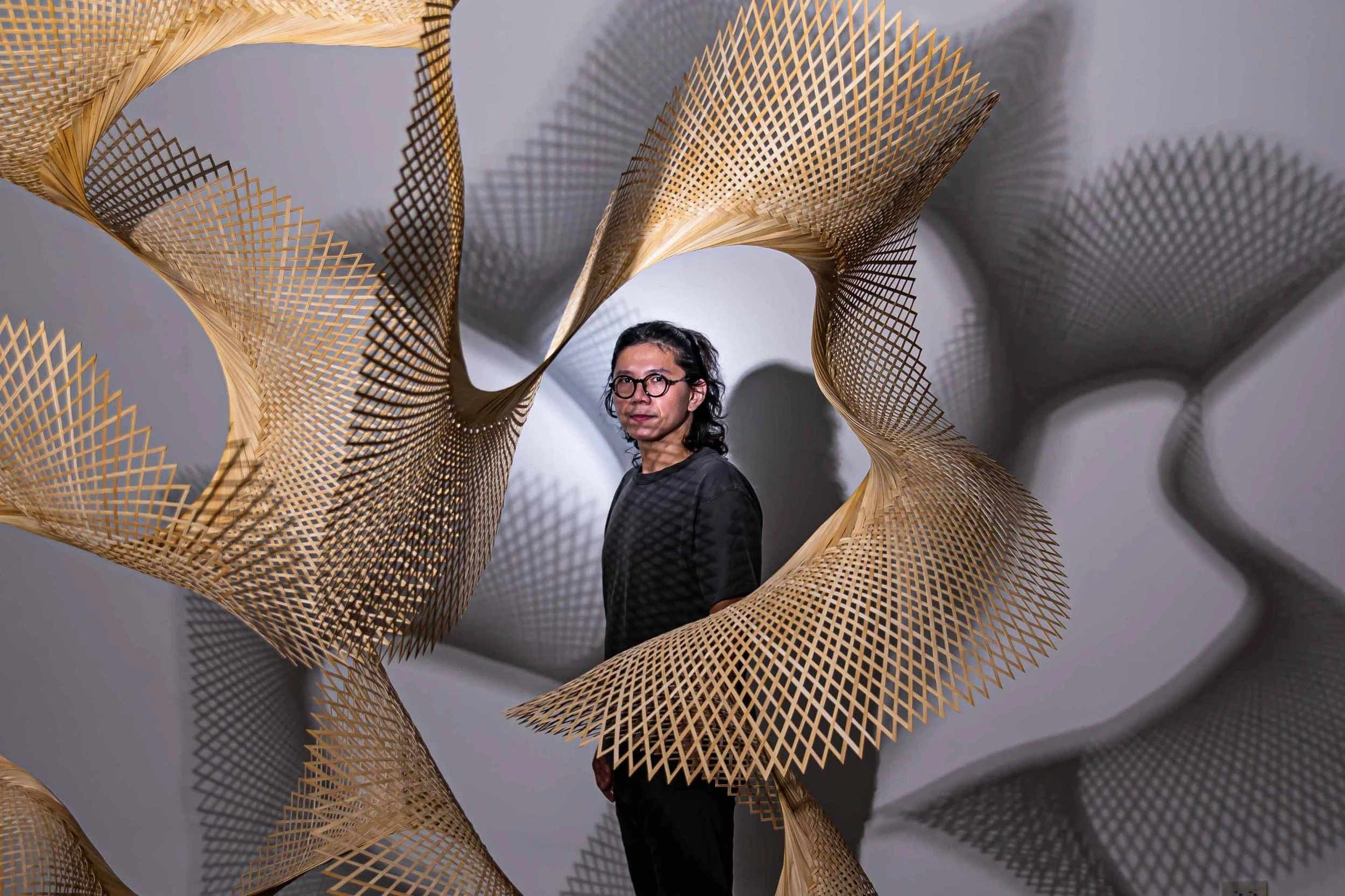
ChingKe Lin - Portrait
ARTIST STATEMENT
ChingKe Lin’s work not only presents the beauty of craft but also uses bamboo to reflect on time, belief, environment, and the mind. In his hands, bamboo shifts from object to emotional and spiritual sign, guiding viewers toward a calm state between nature and thought. By placing bamboo works in architectural, commercial, and public settings, he creates immersive experiences that invite people to rediscover their breathing, movement, and sense of place, and to reimagine how humanity and nature might coexist.
The Garment of the Forest, Bamboo, 2000x2000x400 cm, 2025 © ChingKe Lin
Deep within the forest, the wind becomes invisible threads, weaving a delicate, flowing gown. Bamboo strips, soft as silk, layer upon layer, rise and sway with the breeze. Their graceful interlacing forms a gentle hem, draping the forest in a tender embrace, like a finely crafted garment. This creation extends the ancient art of bamboo weaving, allowing the bamboo strips to intertwine naturally with the land, forming an organic structure that grows harmoniously with its surroundings. Just as fabric hugs the body, this garment blends seamlessly with the environment, transforming the bamboo forest from a mere backdrop into an integral part of the design. As time flows, this living garment breathes with the rhythm of the wind and light, shifting and unfolding into new forms. Moving through the bamboo strands feels like stepping into the forest's own folds, an artwork gently crafted by nature itself, spread across the earth, an ethereal garment, unfolding softly between heaven and land.
INTERVIEW
Let’s start with your background. Your artistic practice is deeply rooted in Taiwanese culture and craftsmanship. Could you tell us about your training and how your early experiences shaped your approach to art making?
My creative core stems from a primal curiosity about the world, a mindset akin to an inquirer perpetually gazing into the boundless, maintaining a pure imagination toward the universe. While my background is rooted in rigorous training regarding structure and materiality, I soon realised that art must not remain merely at the surface of form.
This shaped my philosophy of 'going deep to emerge simple.' I peel back the layers of cultural texture and material essence like an onion, digging deep to unearth forgotten traditional vocabularies. Ultimately, however, the work must return to universal emotions, presented in the most intuitive manner. This obsession with 'essence,' combined with a profound emotional bond to this land, where we say 'the soil is sticky,' implying an inseparable attachment, forms the bedrock of my entire practice.
You work primarily with bamboo, a material strongly tied to both tradition and daily life in Taiwan. What drew you to this material initially, and at what point did it shift from a craft material to a central conceptual element in your work?
Bamboo embodies a fascinating 'Material Paradox.' Botanically, it exists between grass and wood, possessing the pliancy of herbaceous plants, capable of intricate winding and bending to the will, yet retaining the structural integrity of wood. This biological duality grants it a dual cultural identity: it is both the wild, untamed 'landscape' covering the mountains and the domesticated presence woven into the fabric of everyday 'life.'
For me, the pivotal shift from medium to concept occurred when I realised bamboo is a form of 'Solidified Flow.' It transforms the fleeting dynamic of grass swaying in the wind, through the order of weaving, into an eternal, static structure. Its surface, honestly recording the patina of sunlight, wind, and rain, elevates it beyond a mere object, rendering it the gauge I use to measure the instant and the eternal.
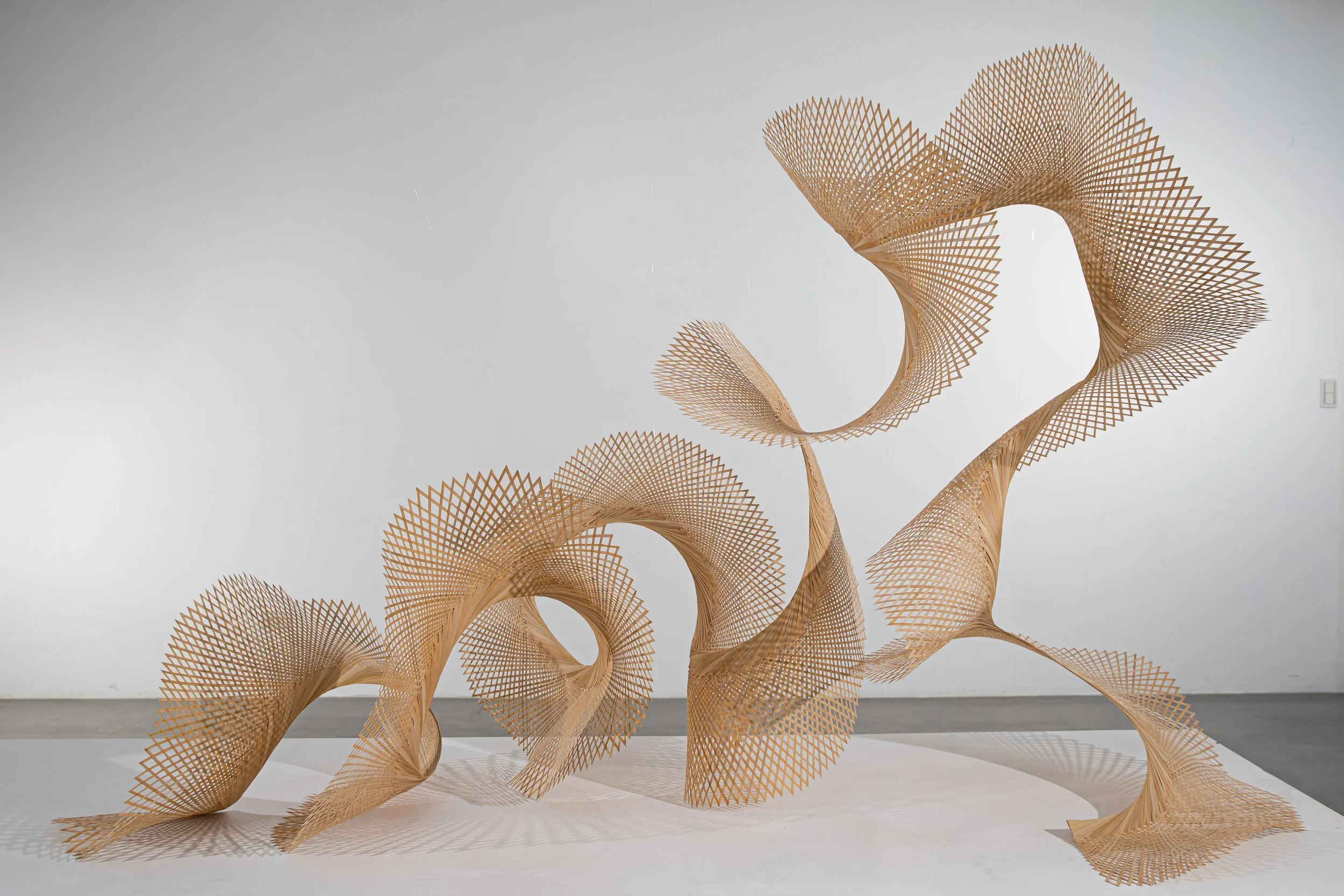
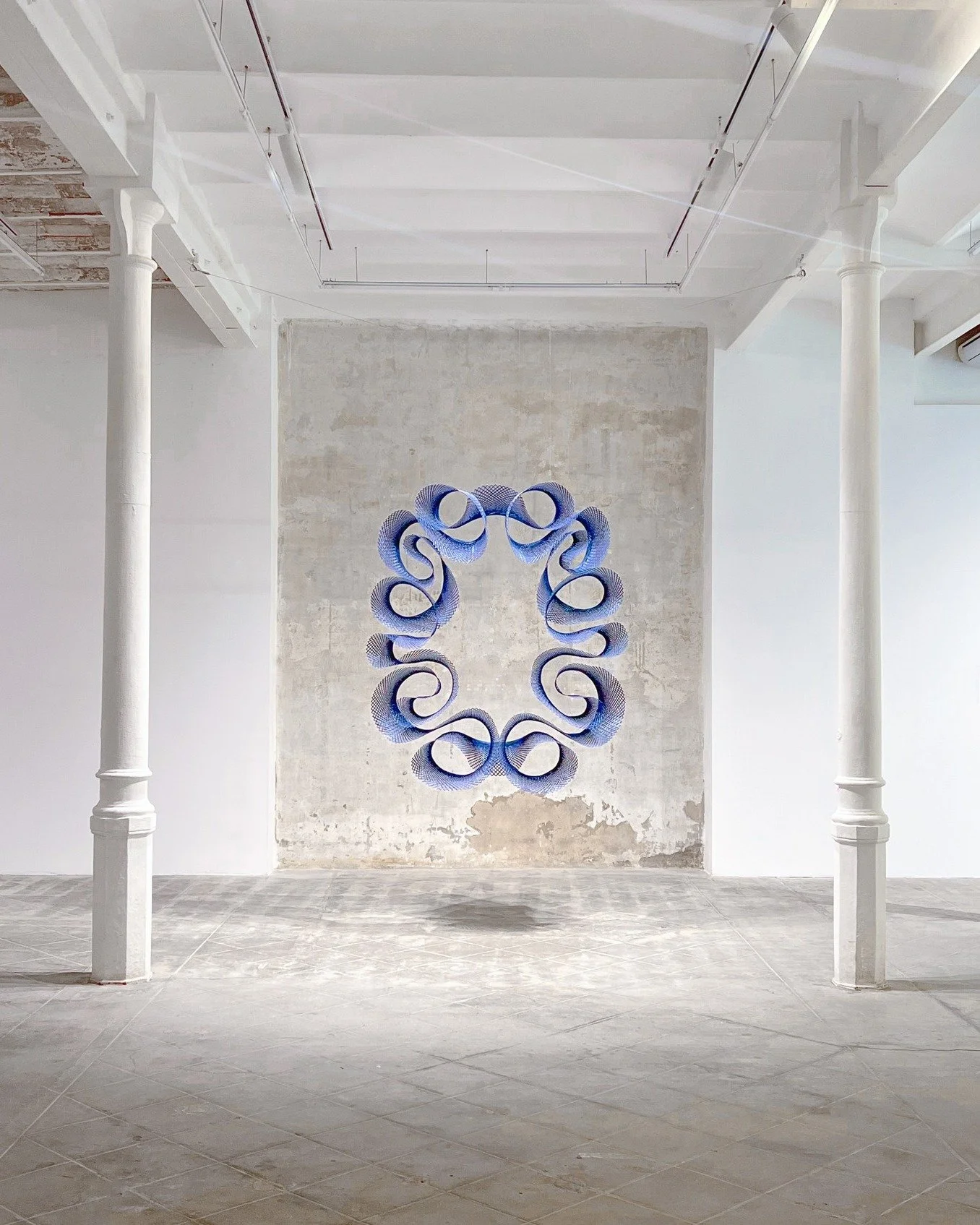
Clouds of Smoke - Sinking, bamboo, 165x285x115 cm, 2022 © ChingKe Lin
Clouds of Smoke is an ongoing sculptural installation series that transforms the structural precision of traditional Taiwanese bamboo craftsmanship into ephemeral, spatial phenomena. Rooted in the circular weaving technique commonly used in lantern making, the work employs hundreds of bamboo strips layered and rotated at precise, repeated angles to form spiral and star-like geometries. These structures evoke organic rhythms found in smoke, breath, and atmospheric movement.
What begins as an investigation into material logic gradually unfolds into a meditation on impermanence. The installations hover, coil, and disperse within space, possessing both architectural clarity and an elusive, transient presence. They are at once rational and poetic, systems built from repetition and geometry, yet resistant to fixity. Each curve refuses rigidity, allowing form to extend beyond itself and dissolve into its surrounding environment.
In Clouds of Smoke, bamboo, often associated with nostalgia or utilitarian craft, is reimagined as a medium of lightness, ambiguity, and spiritual resonance. Suspended within space, the forms exist in symbiosis with their environment, shifting with perception and movement. The series proposes a contemporary vision of Eastern aesthetics, where structure and dissolution coexist. Both a structural experiment and a contemplative environment, the work asks: what remains when material form begins to loosen, fade, and transform?
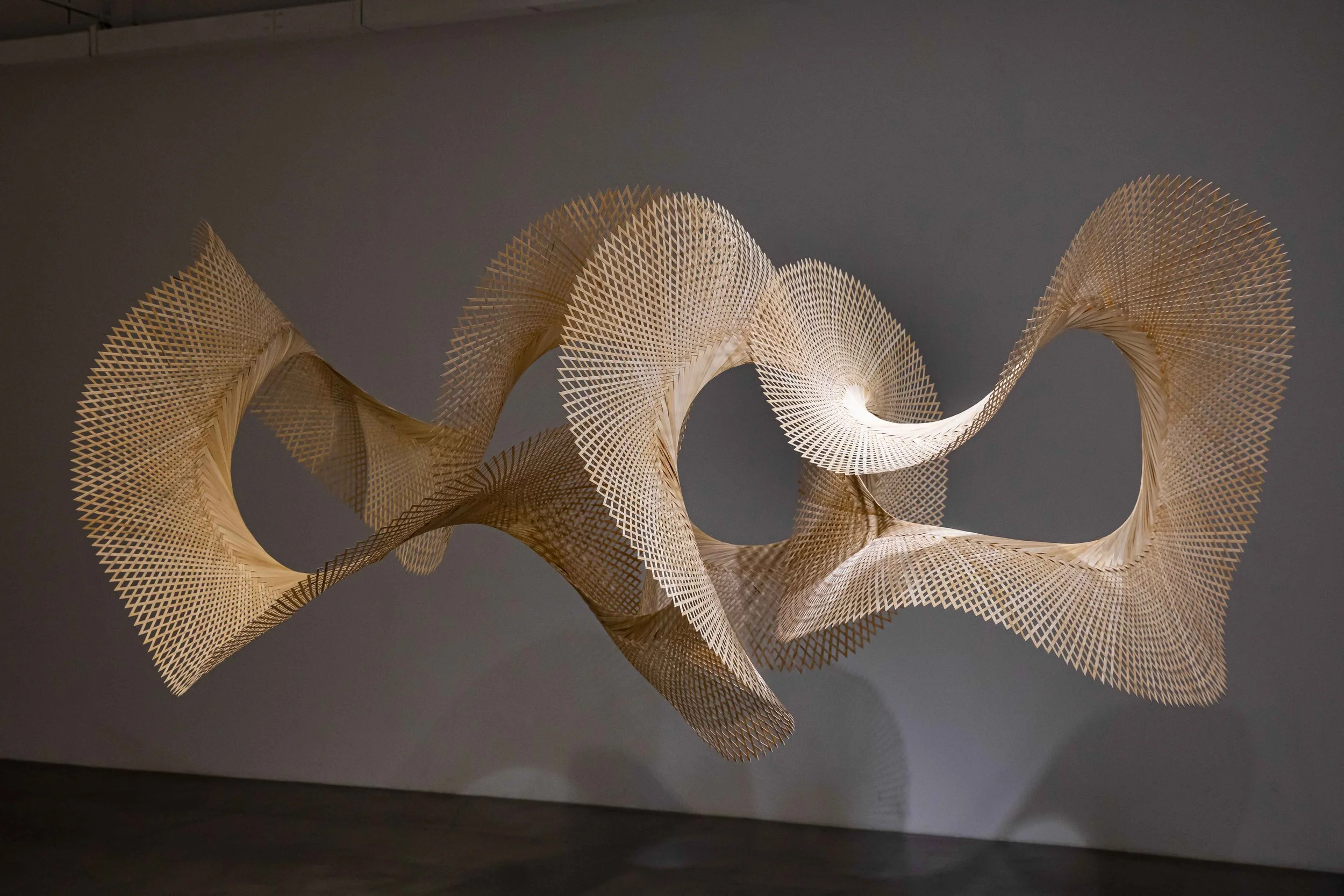
Clouds of Smoke - Infinite, bamboo, 115x210x130 cm, 2022 © ChingKe Lin
You draw inspiration from traditional bamboo weaving techniques, but transform and adapt them to your language. How do you approach the balance between respecting inherited craftsmanship and pushing it into a contemporary territory?
Inheritance is not about the replication of form, but the perpetuation of thought. I attempt to extract the ancient aesthetic of 'lyrical expression' (writing the heart and intent), transposing it into a contemporary temporal and spatial dimension. This is a process of 'leveraging force': I do not seek to tame the bamboo, but rather to harness its inherent tension and elasticity. Combined with contemporary spatial computation, I amplify microscopic weaving textures into macroscopic spatial experiences.
My aim is for the work to exhibit confidence and openness, ensuring that traditional craft is not merely a relic of the past, but a living organism capable of dialogue with modern architecture and natural environments. It is an attempt to envision infinite horizons within a square inch, translating Eastern craft philosophy into a contemporary artistic language.
What physical, symbolic, or spiritual qualities does bamboo offer that other materials could not support within your practice?
In terms of materiality, bamboo exhibits a natural wildness described as 'following the law of no-law.' Unlike precise, cold industrial materials, bamboo is organic; every single strip possesses its own unreplicable organic will. During the weaving process, I cannot force conquest, but must align with its organic will. This act of 'compliance' is, in itself, a physical exercise in humility.
Spiritually, bamboo is not merely a substance but a quiet 'philosophical vessel.' Its hollow physical nature serves as a precise metaphor for the Eastern values of humility and inclusivity ('emptiness'), while its nodes symbolise the rhythm of life and moral integrity. My work attempts to initiate a deep dialogue with nature and ancestral wisdom through this organic medium. This quality is irreplaceable by cold, industrial synthetic materials because bamboo is alive; it continues to breathe within the work, embodying a gentle reminder of life cycles and natural laws.

The Thank You Bouquet, Bamboo, metal, 2000x1600x300 cm, 2021 © ChingKe Lin
A flower is the ultimate state in which a plant draws the energy from its environment and blooms at the right timing and extending its vitality in a form of beauty. Artist Ching ke Lin responds to the core idea of PX Mart’s “2021 We Together” charity festival, turning the strong and durable bamboo into warm and soft blossoms with his weaving technique. The bamboo-weaving buds and flowers form a bouquet of gratitude and the landscape that invites people to offer their praise in the midst of the turbulent society. In the midst of 180 flowers in array in Daan Forest Park square, we look up, walk through and let our bodies and minds wander through the gaps, May we not forget our vitality and creative instincts in a turbulent environment. We are grateful to doctors, nurses, police and fire brigade who contribute enormously during the pandemic and to each of us.
Your installations are large-scale and site-responsive, as you mention in your statement. Can you walk us through your creative process, from the first conceptual idea to the construction and eventually the final result?
My creative process begins with a deep reading of the site: asking what kind of response the wind, light, and history require within that specific time and space. When inspiration strikes, it is a visceral sensation, a physiological throb, as if my entire body’s blood has been exchanged and renewed.
The process is akin to writing a novel; I place immense value on the power of the 'ending.' From the wild imagination of preliminary sketches to the rational calculation of structure, and finally the improvisational dialogue with the environment during installation, every layer serves to pave the way toward that final 'conclusion.' I hope the moment of completion offers not merely visual impact, but a spiritual anchor that fastens itself within the viewer's mind, lingering for days to provide new horizons and inspiration.
Themes of belief, memory, and impermanence recur throughout your work. How do these ideas emerge during the making process, and how consciously do you frame them when developing a new project?
These are not pre-scripted agendas, but life experiences that surfaced naturally as I excavated the land and culture beneath my feet. I hold a deep affection for the waning sense of ritual, such as Taiwan's unique traditions of inviting fortune and blessing. This attitude of 'mourning the past while cherishing the present' naturally permeates my practice.
When developing new projects, I consciously translate 'faith' into a universal psychological need, the human desire to anchor the self when facing a vast and impermanent world. I attempt to employ art as a spiritual vessel, capturing those fluid, impermanent states, so that viewers may rediscover the connections between the self, the land, and invisible forces.
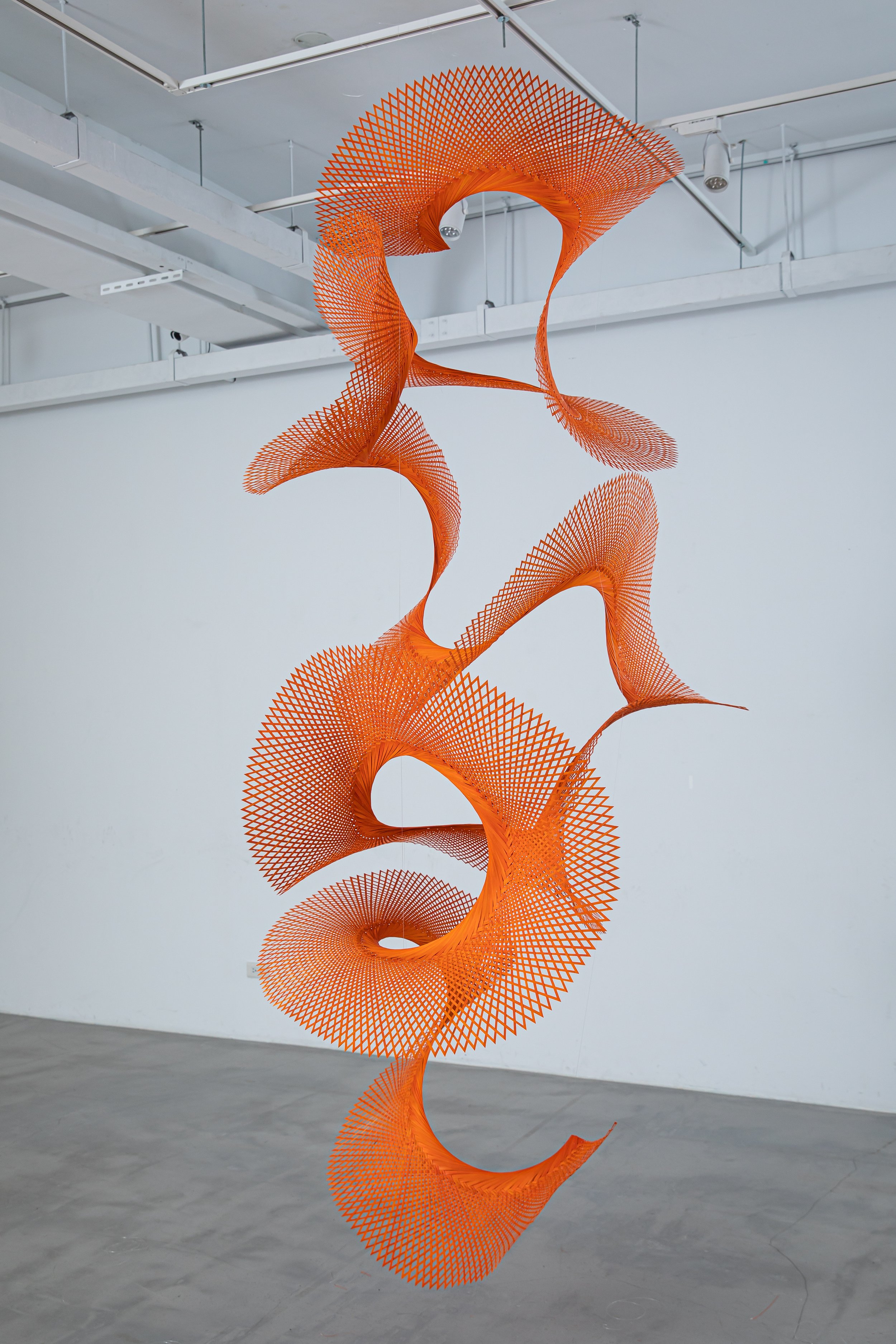
Clouds of Smoke - Radiance, bamboo, 280x95x90 cm, 2023 © ChingKe Lin
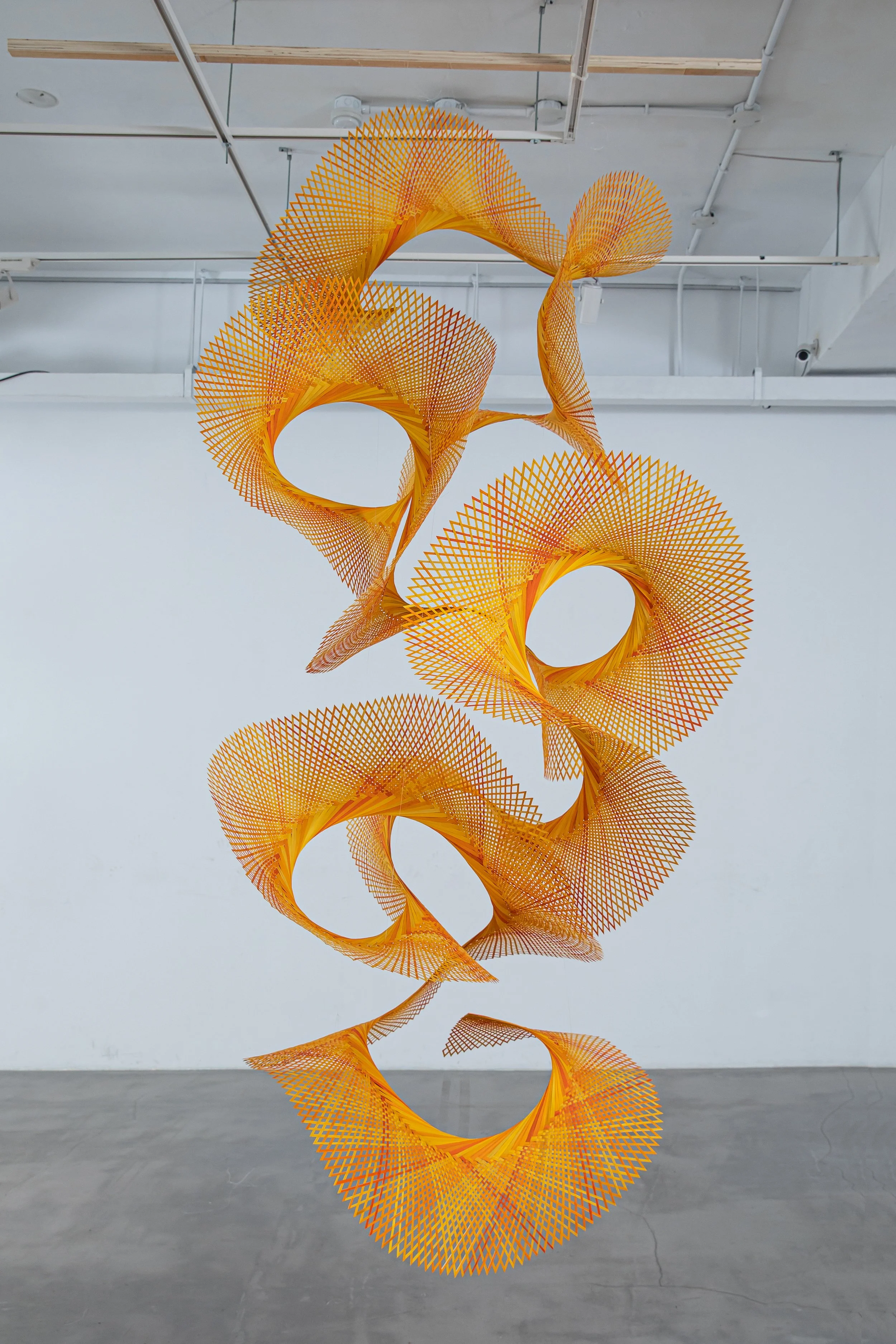
Clouds of Smoke - Gradient, bamboo, 270x110x95 cm, 2023 © ChingKe Lin
You recently presented the series Clouds of Smoke. What was the initial impulse behind this series, and how did the metaphor of smoke become central to its conceptual framework?
'Clouds of Smoke' originates from a yearning for ultimate freedom. I sought to challenge the physical limits of the medium, coercing rigid and straight bamboo to manifest the fluidity and weightlessness of smoke. It is a process of material 'sublimation.'
'Smoke' became the core metaphor because it exists in the liminal space between 'being' and 'non-being.' In ritual contexts, smoke acts as a medium bridging heaven and earth; visually, it represents the dialectic of the instant and the eternal. Through the rotation and intersection of bamboo, I simulate the diffusion of smoke, attempting to crystallise that fleeting moment. This is not merely visual mimicry, but a metaphor for the spirit liberating itself from material constraints, entering a more ethereal state.
The works in Clouds of Smoke seem to hover between structure and dissolution. How important is the viewer’s bodily movement and sensory perception in completing the work?
The work is not defined merely by the completion of its physical structure; its true 'realisation' occurs at the moment of the viewer's intervention. Due to the penetrative nature of the woven bamboo, as the viewer moves, their gaze passes through the layered interstices, generating a Moiré pattern. This optical effect animates the originally static sculpture, making it appear to breathe and flow.
This is an immersive sensory experience. I desire for the viewer not to remain a passive observer, but to inhabit the work. As they move, the structure coalesces and dissipates before their eyes; this sensory oscillation between the substantial and the insubstantial is precisely what I wish to convey, that the world is in a state of flux, and we are immersed within it.

The Garment of the Forest, Bamboo, 2000x2000x400 cm, 2025 © ChingKe Lin
Your work has been presented internationally and recognised with multiple awards. How has the reception of your bamboo installations differed across cultural contexts, and has this feedback influenced the way you think about your practice?
In the international arena, I occasionally encounter specific expectations or a 'gaze of distance' regarding Eastern materials. However, this 'cultural parallax' acts as a mirror, reinforcing my conviction to excavate the essence from within.
I have realised that the deeper I delve into local cultural implications, the more I touch upon universal emotions shared by humanity. I no longer seek a superficial alignment of cultural symbols, but focus instead on transmitting the spirit behind the work, a profound reverence for nature, homeland, and life. International feedback has confirmed a singular truth: amidst the vastness of the world, my homeland is my anchor. As long as I sincerely confront the relationship between the self and the land, art can transcend linguistic barriers. This strengthens my resolve to walk the path of 'going deep to emerge simple,' employing the most local language to narrate the most global stories.
Lastly, looking ahead, what directions or questions are currently driving your work? Are there new materials, scales, or conceptual territories you are eager to explore in future projects?
Looking ahead, I am dedicated to a singular, definitive axis: reconstructing the contemporary grammar of bamboo weaving. For me, creation is an endless cultivation. What drives me forward is no longer merely the search for possibilities, but the challenge of translating ancient craft logic into an artistic language capable of dialoguing with contemporary space.
In future projects, I anticipate expanding my experiments with mixed media. This is not a pursuit of visual spectacle, but an attempt to introduce new materials into a dialogue with bamboo, aimed at excavating the psychological metaphors underlying the archaic physical actions of 'binding, knotting, and coiling', themes of identity, memory, and the interpersonal bonds that connect us.
Regardless of shifts in materiality or scale, what I wish to preserve is the spirit of that 'boy who loves wild imagination': maintaining an unfettered imagination toward the world, and bravely continuing to articulate ancient wisdom through a contemporary modality.
Artist’s Talk
Al-Tiba9 Interviews is a curated promotional platform that offers artists the opportunity to articulate their vision and engage with our diverse international readership through insightful, published dialogues. Conducted by Mohamed Benhadj, founder and curator of Al-Tiba9, these interviews spotlight the artists’ creative journeys and introduce their work to the global contemporary art scene.
Through our extensive network of museums, galleries, art professionals, collectors, and art enthusiasts worldwide, Al-Tiba9 Interviews provides a meaningful stage for artists to expand their reach and strengthen their presence in the international art discourse.



David Moješčík - MojDa is a Czech sculptor. His work is centred on figurative sculpture, the human body, and the female figure. Modelling in clay and with digital tools, he ultimately prioritises manual engagement with materials. . He draws inspiration from yoga philosophy with the concepts of non-violence and human-centeredness, as well as from Egyptian, ancient, and European classical sculpture.