

10 Questions with Jiwoong Jang
Jiwoong Jang is an interdisciplinary artist in New York City. Jiwoong's practice is built on delicate observations and connections. Working in post-photography, he explores how the charge of past experiences, pleasant or painful, informs new or anticipated encounters in unexpected ways. These instances of surprise, moments that are surprisingly painful or surprisingly beautiful, are collected and transmuted into photography and sculpture, often thinking in terms of exhibition and narrative structure. Most recently, he presented a solo exhibition, Tread Water (2025), at BLADE STUDY in New York. He was also selected as a 2025 Be Like Water Fellow at Baxter St at the Camera Club of New York. He earned his MFA in Studio Art from Hunter College, CUNY New York in 2023 and his BFA in Photography & Video from the School of Visual Arts, New York, in 2018.
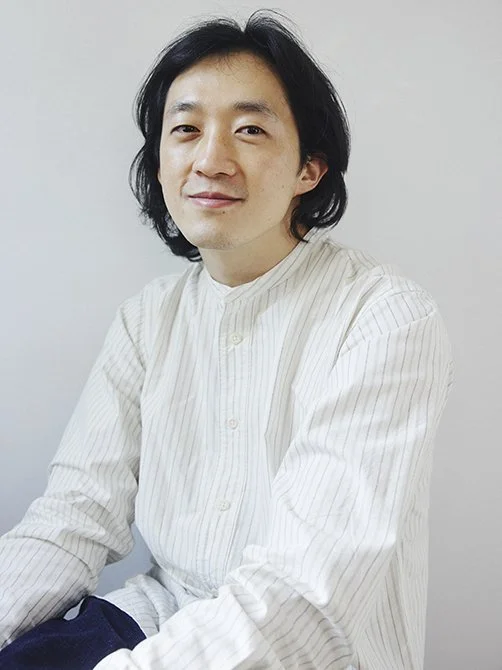
Jiwoong Jang - Portrait
ARTIST STATEMENT
“I work across installation, sculpture, ceramics, metal, photography, and artist books to build visual narratives through relationships between materials and forms. While a single medium can offer clarity and accessibility, I'm drawn to what becomes possible when mediums meet, creating friction, resonance, and multiple entry points for viewers. I try to make spaces where people can move through the work, interpret it, and locate themselves within it rather than receive a fixed reading.
From project to project, I expand my material vocabulary by learning new techniques. For my recent solo exhibition, Tread Water, I began working with metal for the first time through workshops and hands-on practice after recognising how metal's physical and symbolic qualities fit the exhibition's narrative, and I made some metal works for the show. Within individual pieces, I combine materials, embedding ceramic cigarette butts inside a household telephone or welding photographs onto metal sheets, to generate new tensions, associations, and questions, keeping the narrative open, layered, and materially grounded.”
— Jiwoong Jang
Calling II, Found telephone, LED strip light, 8x4.5x9 in © Jiwoong Jang
INTERVIEW
You studied Photography & Video at the School of Visual Arts and later completed your MFA at Hunter College. How did your education shape the shift toward an interdisciplinary and post-photographic practice?
My time at SVA provided a foundational lesson in the art of constructing narratives through the juxtaposition of multiple images. I became fascinated by how the spatial relationship between works, including their scale, the distance between them, and their sequencing, could dictate a viewer’s expectations, sometimes leading them in one direction only to subvert that anticipation entirely. This practice initially manifested in my love for making photo books, where I could control the narrative flow.
Beyond the classroom, SVA instilled in me the essential habit of a New York artist: the constant navigation of the city’s vast gallery landscape. By spending significant time as a spectator, my 'reading eye' began to evolve. I stopped looking only at how images create a narrative and started observing how an entire exhibition functions as a narrative space.
This growing curiosity about other media naturally led me to the MFA in Studio Art program at Hunter College. Immersed for three years in a studio environment alongside artists from diverse disciplines, I found the organic integration I was looking for. The dialogue with my peers at Hunter allowed me to expand my photographic roots, blending them with other forms to create the interdisciplinary practice I pursue today.

Light Vessels, Silver gelatin print on ceramic, Dimensions Variable, 2023 © Jiwoong Jang
You describe your practice as post-photography. How do you define that term in relation to your own work?
It is a good question. For me, this term is defined less through a broad art-historical lens and more within the specific context of my personal practice. A pivotal turning point occurred when I began viewing the photographic medium not as a fictional image, but as a container that stores elements such as time, space, and light. This shift allowed me to explore how photography can exist within diverse environments and materials.
In my work Light Vessels (2023), for example, the photographic image is not immediately apparent on the surfaces of the stone-shaped ceramics, and it is difficult to imagine that a photograph exists there at all. However, the texture of the work is created using liquid silver gelatin in the darkroom, where it undergoes the exact same exposure and development process as a traditional black-and-white print. I was able to create these works because I consider the process itself, materiality, and the physical residues to be photography.
As you mention in your statement, your work is rooted in “delicate observations and connections.” What kinds of moments tend to stay with you long enough to become artworks?
If I were to put 'observations and connections' into different words, they would be ‘empathy and care.’ I rarely have a moment where I immediately decide to transform an experience into a work of art. Instead, the practice of observing mundane life in minute detail has become an intrinsic part of me, a habit cultivated through my background in photography.
As these moments accumulate over time, there are instances when a specific observation resurfaces in my mind, leading me to reflect deeply on the meaning it holds for me. This thinking process occupies the largest portion of my overall practice. It is only after this reflection that I go to the studio to find the right materials and to build visual empathy. In this sense, my process is an act of caring for the inspirations and emotions I find in things that others might overlook.
This approach also extends into the process of making in the studio. Whenever the situation allows, I spend a significant amount of time looking at the work and simply existing with it. This stage often involves many revisions. During this time, I focus on finding a more solid empathy within the work and strive to develop it as much as possible.

Water vessels, Metal, mirrored acrylic panel, found comb, Dimensions Variable © Jiwoong Jang
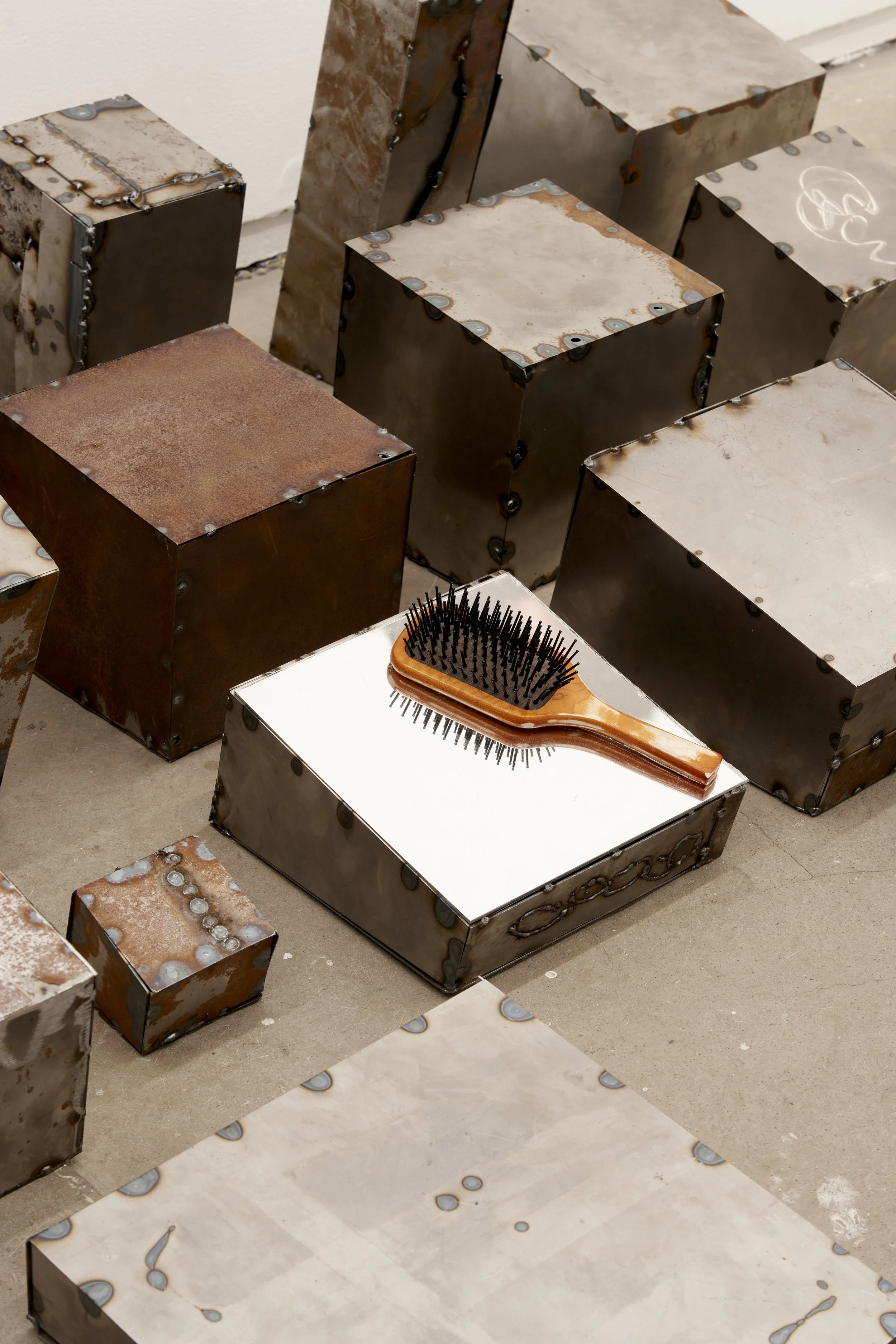
Water vessels (detail) © Jiwoong Jang
Photography and sculpture often operate differently in space. How do you decide when an idea should remain photographic and when it should expand into sculpture?
These decisions are primarily guided by intuition. When I am creating, I often let my intuition steer the process while I take the passenger seat and enjoy the drive. Rather than following a rigid set of rules, I allow the work to lead me.
However, as I mentioned earlier, if a piece does not resonate with me once it is made, I will attempt a different form. If an idea does not feel right as a photograph, I might explore its potential as a sculpture, or vice versa. The decision is ultimately determined by whether the final form achieves that core sense of empathy I am seeking to establish.
Memory, both pleasant and painful, appears central in your work. How do you translate something intangible like memory into material form?
Interpretation is a vital experience that occurs across the entire field of art, manifesting between the artist and the work, and between the work and the viewer. I do not have a fixed formula for how this happens, and I believe the process is unique every time.
When reflecting on my solo exhibition, Tread Water, the most prominent image from the memories of my uncle was metal. Metal is resilient and strong, yet it can also be easily cut or bent. The way separate metal pieces can be welded to become truly united felt similar to the texture of my memories of him. Although I had no prior experience with metal, I enrolled in a class to learn the necessary techniques for the exhibition. I believe that finding a material that matches a specific memory or emotion is a crucial part of the interpretation process.

Calling I, Found telephone, Ceramic, 8 x 4.5 x 9 in © Jiwoong Jang
Surprise seems to play an important role in your process. Are you trying to recreate surprise for the viewer, or to process it for yourself?
When I enter the studio, my primary intention is always to let myself be surprised. I do not create with the viewer’s reaction in mind. Of course, it is a significant compliment if a viewer finds the work surprising, but I do not consciously aim for that response during the production process.
For me, the necessity of being surprised stems from a desire to break away from artistic habits and inertia. It is a vital way to prevent myself from producing work mechanically. By remaining open to the unexpected, I ensure that my practice remains a genuine exploration rather than a repetitive exercise.
In your recent solo exhibition, Tread Water at BLADE STUDY, what narrative were you hoping to build through the installation?
For my solo exhibition Tread Water, I envisioned my uncle as someone perpetually treading water within the confines of his own room. To reflect this, I wanted the gallery to evoke the intimacy and stillness of a domestic space. It was only after completing nearly all the works and seeing them together in the studio that I realised each piece represents an attempt to seize a specific moment from my life or my uncle’s own.
I found it fascinating how these individual attempts gather to form a narrative that engages in a dialogue with the present. Perhaps we all hide a secret room within ourselves, a private space where we are constantly treading water? My hope was that these elements would allow viewers not simply to take away something I have created, but to fill the work with their own experiences and memories.

MN-049.0507.bKM, Metal, 13 x 30 x 17 in © Jiwoong Jang

Never home, Praxinoscope, pigment inkjet print, colored acrylic panel, metal, ceramic, spray paint, found shoe, 12 x 18 x 12 © Jiwoong Jang
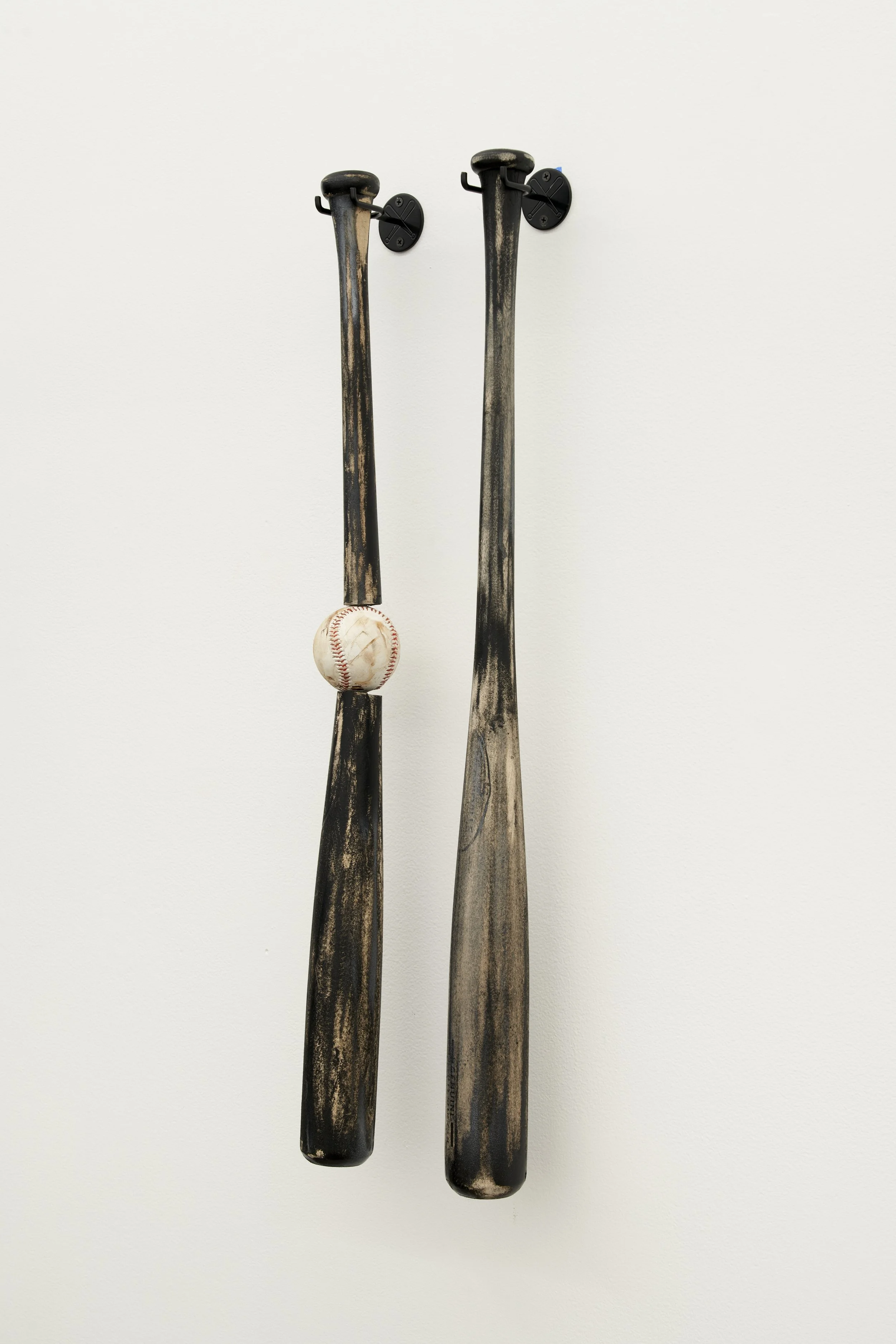
Sleep Field, Baseball bats, baseball, wall mount display stands, spray paint, rust water, 5 x 33 x 3 in © Jiwoong Jang

Calling III, Found telephone, LED strip light, spray paint, 8 x 4.5 x 9 © Jiwoong Jang
How does thinking about exhibition structure influence the way you produce individual works?
At this stage of my practice, I do not establish an overarching narrative before I begin creating individual works. I prefer to view each work as a 'word.' I collect these individual words to form sentences, which eventually grow into paragraphs. My focus during the production of a single piece is not necessarily on the final exhibition structure. Instead, I focus on the 'words' or 'sentences' first, and then begin the process of arranging them.
Through this assembly, I might revise certain pieces, remove others, or even create entirely new works to ensure the elements flow together. It is a process of organic accumulation and refinement. While I am interested in exploring a more structured approach in the future, my current practice relies on this method, where the narrative emerges naturally through the gathering of individual parts.
As a 2025 Be Like Water Fellow at Baxter St at the Camera Club of New York, what kind of experimentation are you currently exploring?
At this moment, I am not focusing on a specific experiment. However, the Be Like Water fellowship has offered something far more significant: a profound sense of community. The cohort consists of artists who share similar cultural backgrounds and the experience of the Diaspora in New York. This shared identity allowed us to build a deep, supportive bond almost immediately. We actively support one another’s exhibitions and publications with genuine passion.
Furthermore, Baxter St at the Camera Club of New York provides an exceptional environment. They consistently look after their alumni and remain attentive to our evolving needs. Having such a reliable support system has been incredibly empowering and serves as a vital foundation as I look toward my future projects.
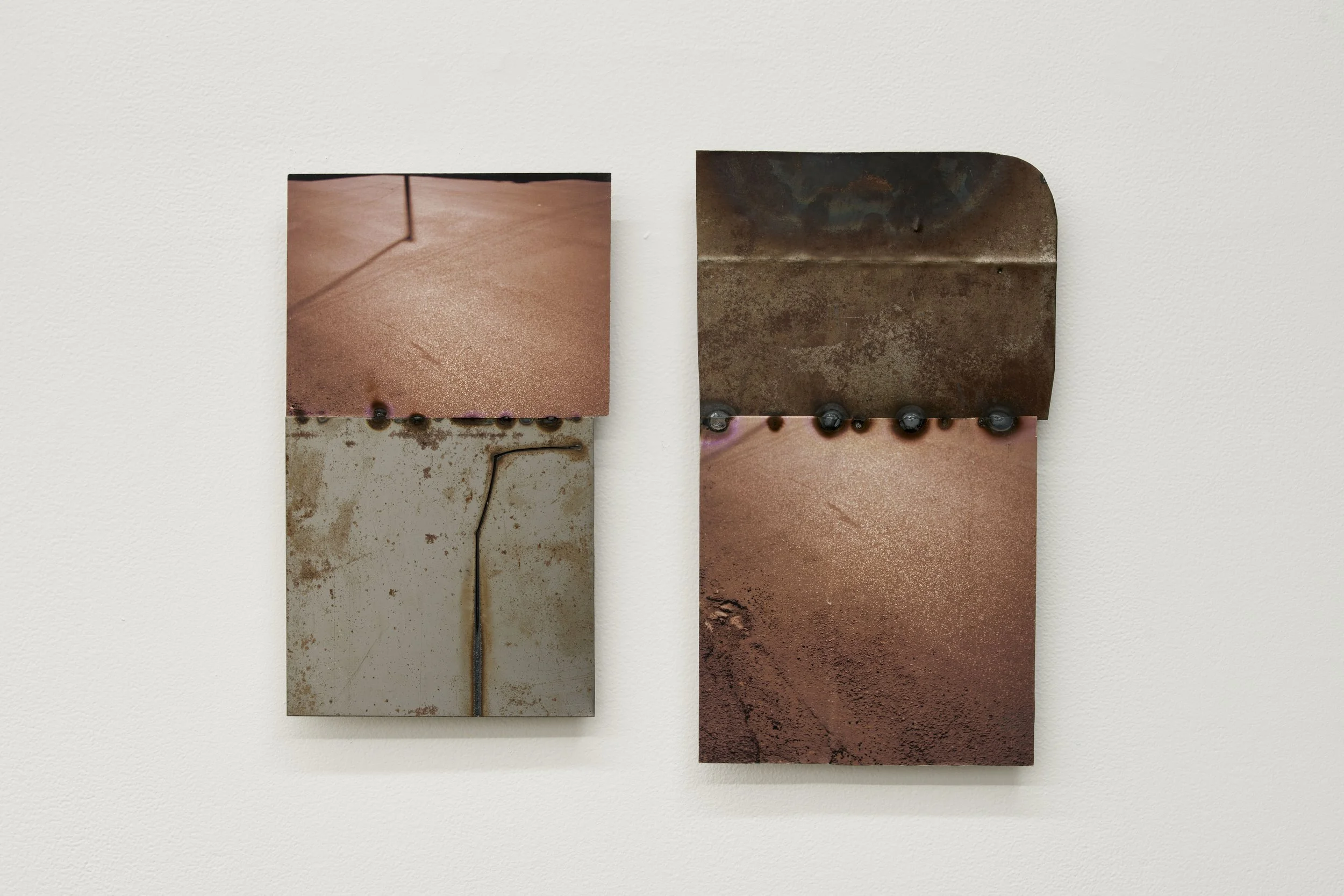
Broken sunset, Pigment inkjet prints and found metal sheets, 19 x 17 in © Jiwoong Jang
Looking ahead, are there new materials, formats, or themes you feel ready to challenge yourself with?
Looking forward, I am drawn to the idea of creating sound-producing sculptures. I have always had an interest in musical instruments, and I am eager to explore how a physical form can also function as an auditory vessel. While these ideas are still in their early stages, I hope to develop them into concrete works in the near future.
In addition to these material explorations, I plan to challenge myself by applying to various residencies over the next two years. My goal is to temporarily step away from the familiar pace of New York City and immerse myself in new environments. I am curious to see how a change in rhythm and the energy of an unfamiliar setting might inspire fresh directions in my practice. I look forward to discovering how these new experiences will translate into the next phase of my work.
Artist’s Talk
Al-Tiba9 Interviews is a curated promotional platform that offers artists the opportunity to articulate their vision and engage with our diverse international readership through insightful, published dialogues. Conducted by Mohamed Benhadj, founder and curator of Al-Tiba9, these interviews spotlight the artists’ creative journeys and introduce their work to the global contemporary art scene.
Through our extensive network of museums, galleries, art professionals, collectors, and art enthusiasts worldwide, Al-Tiba9 Interviews provides a meaningful stage for artists to expand their reach and strengthen their presence in the international art discourse.




David Moješčík - MojDa is a Czech sculptor. His work is centred on figurative sculpture, the human body, and the female figure. Modelling in clay and with digital tools, he ultimately prioritises manual engagement with materials. . He draws inspiration from yoga philosophy with the concepts of non-violence and human-centeredness, as well as from Egyptian, ancient, and European classical sculpture.