
10 Questions with Wanqing (Rita) Zhang
Wanqing Zhang is a New York-based designer whose practice sits at the intersection of graphic design and installation. She specialises in addressing complex social issues, such as mental health and gender equality, by transforming research and insights into tangible, design systems. Her work investigates how design can shape understanding of identity, memory, and collective experience. Grounded in a material-driven methodology, she treats everyday materials as carriers of meaning, strategically using light, texture, and booklet binding method to create immersive environments that engage the senses and provoke reflection.
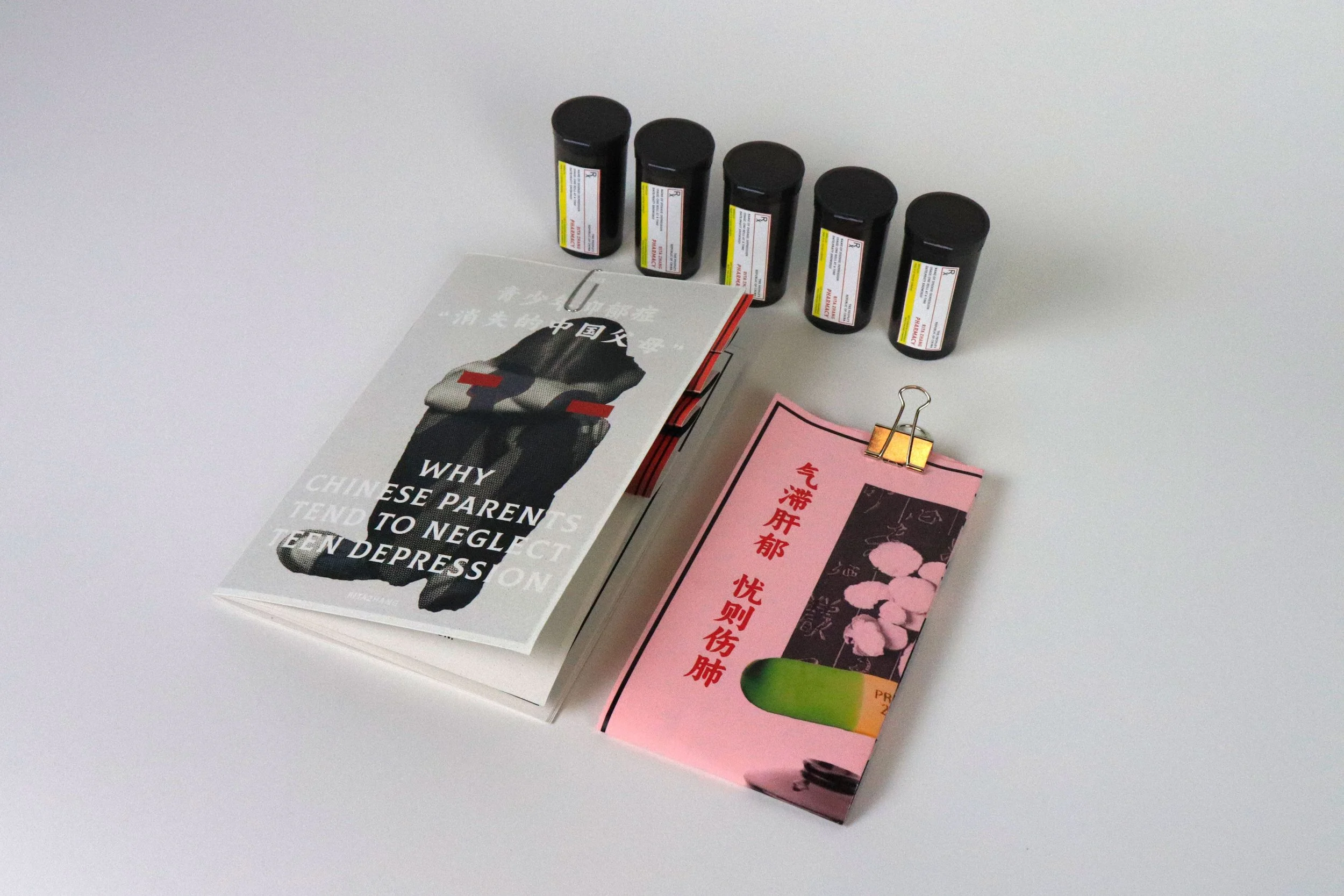
In her project “Adolescent Depression in China,” Zhang conducted research into familial and social dynamics, developing a visual diagnostic system through booklet design and small installation. The work gives form to often-invisible forces like emotional neglect, intergenerational trauma, and social pressure, offering a tool for awareness and dialogue. For the project “She Said,” she designed a participatory storytelling platform that transforms individual narratives into collective resonance. The project serves as both an archive and a tool, encouraging public engagement with women’ s rights and amplifying underrepresented voices. Through systematic design thinking, Zhang builds open frameworks that facilitate public engagement, foster dialogue, and support social reflection, moving beyond visual communication toward actionable, experience-driven outcomes.
Wanqing (Rita) Zhang - Portrait
INTERVIEW
Your work moves between graphic design and installation. What drew you to work across these two fields?
As a graphic designer, my practice is rooted in the language of print, typography, and visual systems. I believe in the power of a well-designed page, the way a fold can conceal or reveal, the way a typeface carries cultural memory. But the themes I engage with, mental health, cultural identity, and female voice, often carry a weight that exceeds the boundaries of the printed page. This is what drew me to installation: not to leave graphic design behind, but to extend its vocabulary into space. When I address depression, for example, I begin with graphic design's core question: How do I give form to the invisible? In my booklet work, I use typographic fragmentation and rhythmic pacing to mirror the experience ofrumination. But I also recognise that some experiences demand more than what a page can hold. I have begun experimenting with diverse methods to interpret these ideas. Through performance art, I simulate the torment of the mental world and the comprehensive collapse of daily life, transforming unspeakable inner experience into externally perceivable bodily narrative. This fosters empathetic understanding among viewers. And in my booklet work, I continue to push the form itself, treating each book as a readable installation. Through metaphorical binding techniques and typographic rhythms, I embed cultural textures into the physical object, guiding audiences toward deeper interpretation through the ritual of turning pages. For me, the medium itself is an extension of the concept. Moving from a flat surface to space, from graphic to experiential, this cross-disciplinary exploration seeks the most fitting material vessel for abstract issues and ignites a more public dialogue.

She Said, Print, 2023 © Wanqing (Rita) Zhang
This is a design project centred on women's rights, which systematically collects and presents personal narratives of injustices faced by women in intimate relationships. It aims to shed light on the multiple forms of oppression and challenges encountered by Chinese women in such contexts—whether from men, family structures, or even within their own gender. The work seeks to create a resonant space for expression, encouraging more women to speak out courageously, set clear boundaries, and break the silence. It calls on society to listen attentively to women’s lived experiences and inner needs, fostering public reflection on the structural nature of gender inequality, and contributing collectively to the building of a more equitable and supportive gender environment.
You often choose everyday materials, light, and booklets as your primary media. What do they allow you to express?
The choice of everyday materials, light, and booklet is a deliberate one. For me, they are more than just mediums; they are bridges. They guide people into my work and cultivate an environment. When an audience encounters a piece ofpaper, shards of glass, or cardboard, they recognise fragments of their own lives. This dissolves any sense of distance, and a familiar feeling of 'this relates to me' quickly takes its place. As a graphic designer, I am trained to think about how materials carry meaning. The texture of paper, the weight of a book in hand, the way light falls on a printed surface, these are not after thoughts. They are the grammar of my visual language.
How does research inform your creative process, especially when dealing with sensitive social issues?
First-hand research allows me to quickly understand the pain points of the target group. Through methods such as questionnaires or interviews, I can gather direct insights. For example, in addressing adolescent depression, data collected from surveys help me identify the most pressing challenges young people are currently facing. Secondary research serves as a tool to help me see the bigger picture, especially when dealing with society topics. It allows me to review existing data and established studies, ensuring that my approach remains objective and well-informed. Moreover, existing research can spark inspiration and guide me in responding to the issue more thoughtfully through design. It also supports a kind of backward reasoning: when a certain outcome is already known, secondary research can help trace back the possible contributing factors, offering a pathway to better understand the root of the problem.
Chinese Adolescent Depression, Multi Media, 2023 © Wanqing (Rita) Zhang
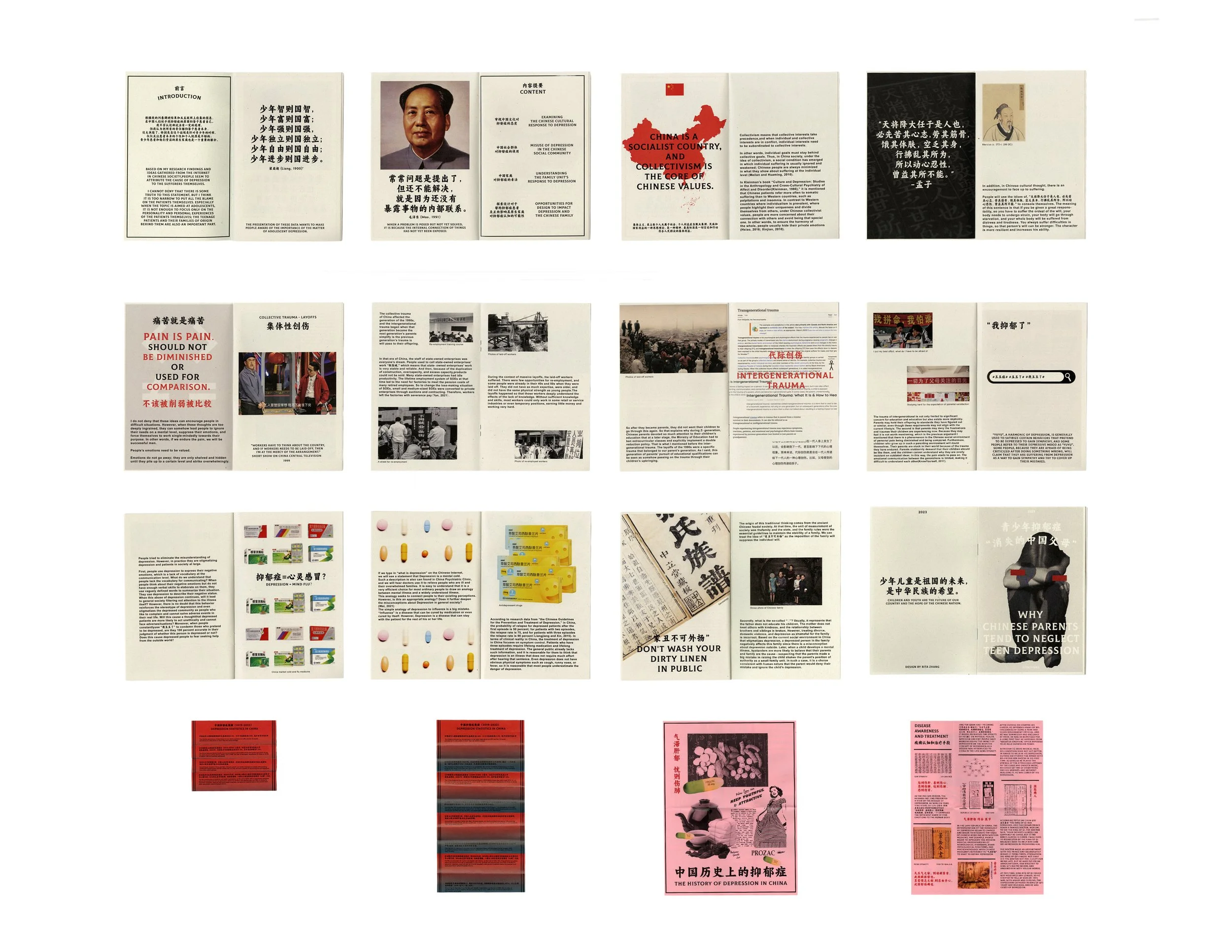
This project focuses on a pressing and concerning issue in contemporary Chinese society: Many Chinese parents often fail to adequately detect or neglect depression in their adolescent children during the upbringing process. The design project aims to systematically analyse the complex causes behind this neglectful behaviour by integrating perspectives from Chinese Cultural Response to depression, Social Structural Transformation, and Traditional Cultural Values, conducting a multi‐level and cross‐dimensional exploration. It seeks to raise public awareness of the high prevalence, hidden nature, and detrimental effects of adolescent depression, while highlighting the urgency of early identification and effective intervention. The project also intends to provide insights for fostering collaboration among family support, public attention, and professional prevention and treatment efforts.
Chinese Adolescent Depression, Multi Media, 2023 © Wanqing (Rita) Zhang
In Adolescent Depression in China, why did you choose the booklet design and small-scale installation as the main format?
I see this choice less as a selection of individual media and more as a strategic combination, a coordinated approach where each medium supports the other. The topic I'm engaging with is both serious and deeply layered. It touches ontraditional cultural values, specific socio-historical contexts, intergenerational trauma, the shaping force of public discourse, and the persistent stigma surrounding mental illness. To carry such weight, I needed a medium that is restrained and calm, one that allows me to unfold my thoughts gradually and present them to the audience with clarity and respect.This is where the booklet comes in. Its quiet, sequential nature offers a space for measured reflection. It allows me to lay out the rational framework of the issue without overwhelming the viewer. However, I also recognised a critical challenge: the subject is not only heavy but also highly abstract. Relying on text alone risks losing the audience, either because the topic feels too heavy to confront or because its complexity makes it difficult to fully understand through words alone.That's why I paired the booklet with an installation. The installation takes on the task of translating the intangible, the lived experience of depression itself. It gives form to symptoms that are otherwise invisible: rumination thinking, insomnia, and emotional changes. By offering a first-person, sensory encounter, the installation allows viewers to directly experience that depression is not simply "feeling bad." It is something far more pervasive and profound. Together, these two media work in tandem: the booklet provides the framework for understanding through graphic design and visual language, while the installation creates the conditions for feeling.
The project She Said is participatory and archive-based. What motivated you to create a platform centred on collective storytelling?
From my personal background and my daily observations, I've come to realise that the scrutiny placed on women in public discourse is far more severe, and that this itself is a form of injustice. So many narratives are still told from a maleperspective, and what's more troubling is that some women, in judging other women, end up defending the very system that makes the world so much more forgiving to men. It feels as though, in intimate relationships, women's voices areoften overlooked. But the deeper layer is this: even women themselves are not always aware that they are neglecting the voices of other women, or that their own voice deserves to be heard. And this is a problem that should not be ignored.
Across your projects, themes like identity, memory, and social pressure frequently appear. How do these themes connect to your personal or cultural experiences?
My personal experiences are the archive for my themes. I witnessed firsthand the gender-based power imbalances within my family, how women, raised in an environment that favoured males over females, were continually overlooked andunjustly treated. More striking was how everyone in that environment sustained this system, ensuring its smooth operation, and then replicated the same patterns, patterns that dismiss women's worth and silence their voices, onto the next generation of women. So,my project is not merely a historical record of myself, but a living, emotional weight. When I explore "women's rights," I am not trying to diagnose a society; rather, I am trying to trace the contours of my own past. I am trying to understand those quiet moments at the dinner table when certain topics are avoided. These intimate, personal experiences are what I translate into my work.
Mirror, Installation, 2021 © Wanqing (Rita) Zhang
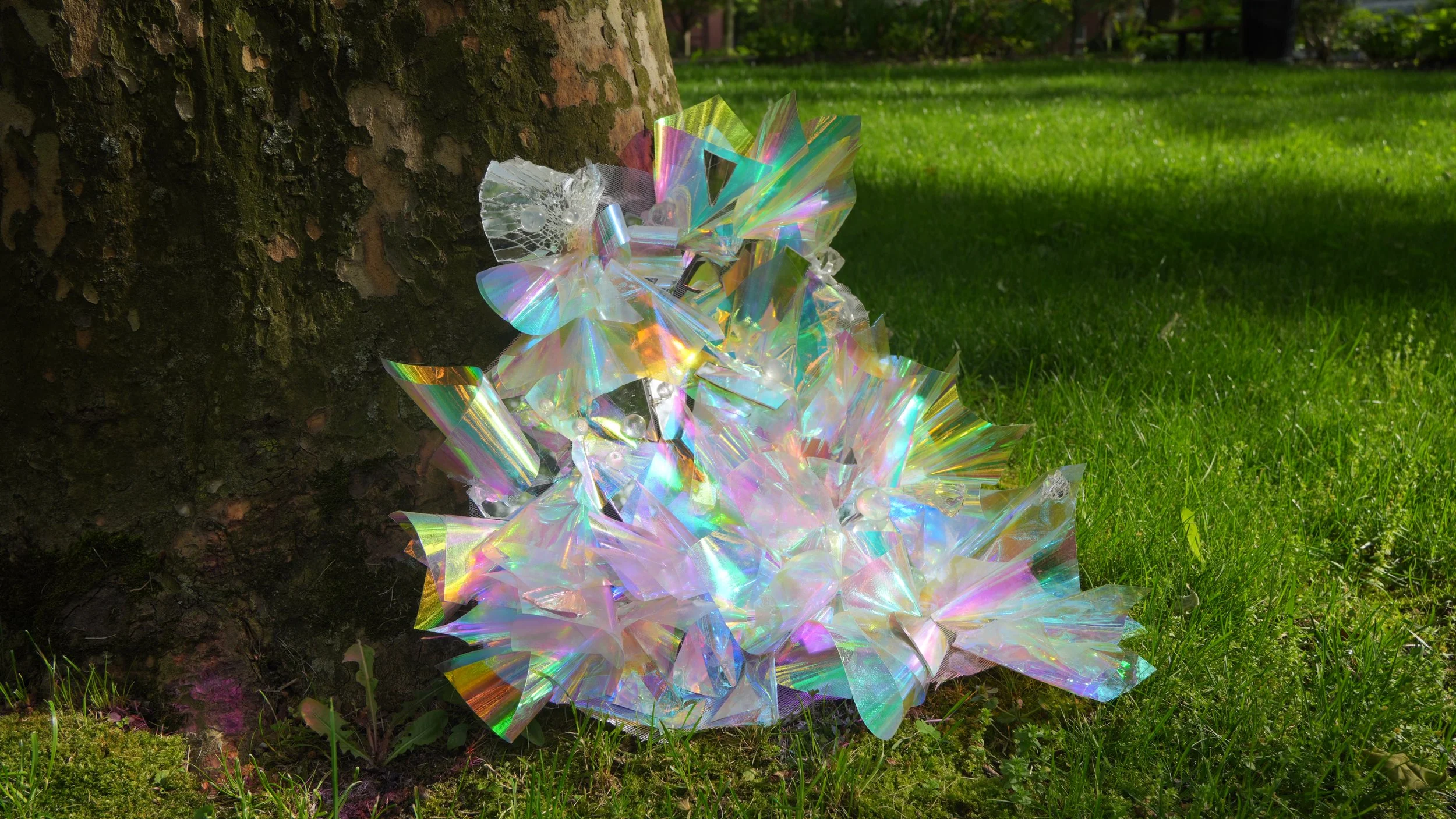
This installation creates a phenomenological field of "seeing" and "being seen" through the interplay of light and shadow on its surface. Each shift in external light or in the position of the viewer’s handheld light generates a unique, unrepeatable pattern of reflection across its material interfaces. This is not merely a physical interaction but also a metaphor for the becoming of perception: art is not a static object, but an existence constantly reinterpreted and reshaped within relational networks the moment a subject engages with it. In terms of material choice, the sharp edges of broken glass, the permeable grid of metal mesh, reflective spherical forms, and controllable light sources together constitute a visual "liminal field." They capture and distort, reflect and conceal, suggesting the fragmented nature of truth, the limits of perception, and the epistemic reality that meaning always emerges through multiple refractions. Thus, the work invites viewers to contemplate: what we see, is it the essence of art, or a provisional construct woven from our own gaze and the situated context? And the ever-changing light becomes a fluid poetics of understanding, encounter, and possibility.
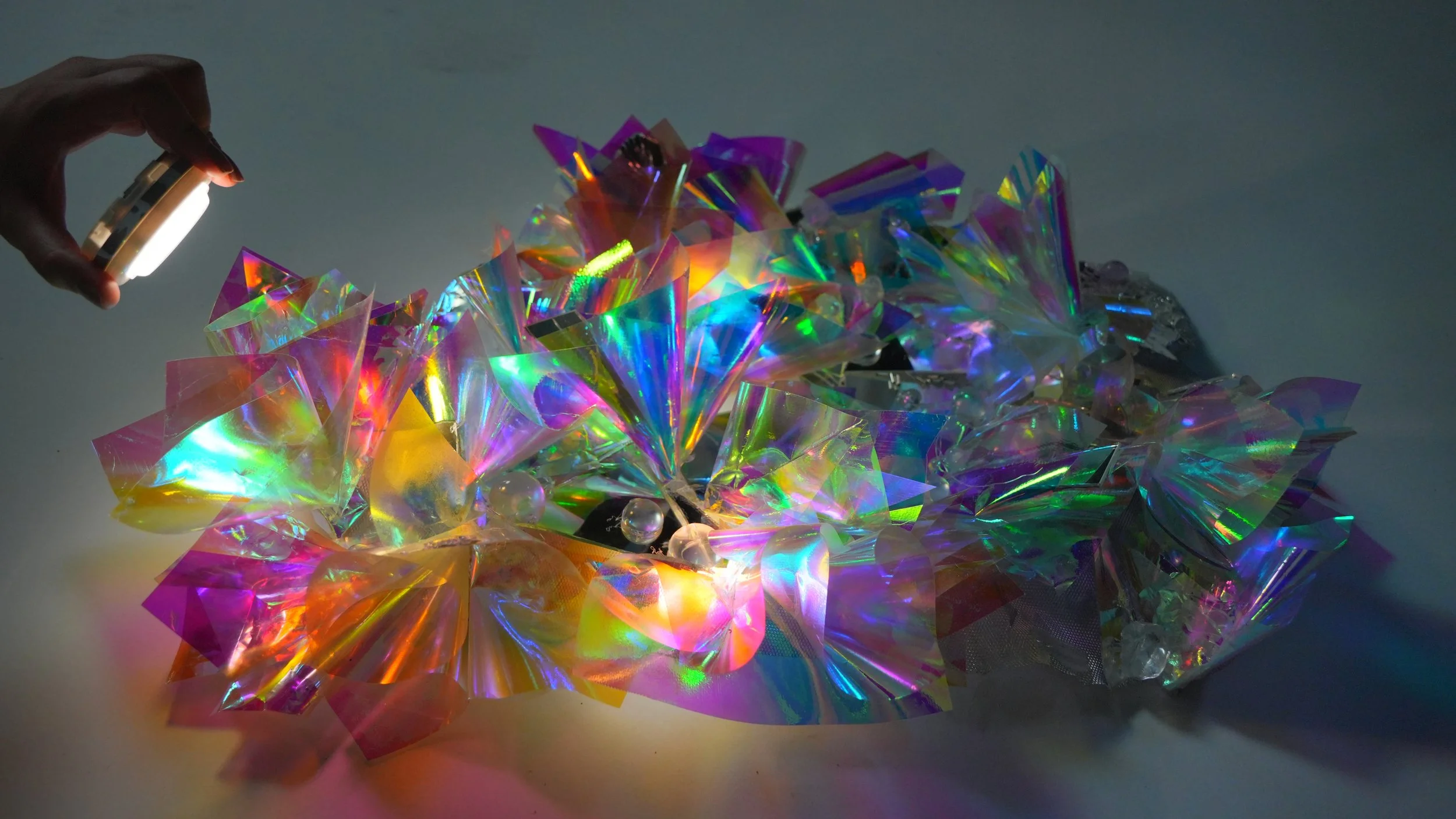
Mirror, Installation, 2021 © Wanqing (Rita) Zhang
Can you describe how the installation Mirror differs from your more research-driven projects, and what it explores conceptually?
This project differs from my previous research-driven work in one crucial way: the role of the audience. In my research-driven projects, I had a clear result or question in mind. I used graphic design and installation to guide viewers along my thinking path, slowly unravelling the story I wanted to tell. “Mirror” is different. It is an open-ended invitation. I am not leading the audience to my conclusion; I am creating a space for them to explore, to interact, and to discover their own story.
How do you hope audiences engage with your work, whether emotionally, intellectually, or through direct participation?
I hope that through my work, the audience will begin to engage with the questions I raise and reflect on the conclusions I offer. Even if they disagree with me, that is still a good thing. Because when a question is asked, when it is seen and discussed, it moves one step closer to being solved.
And lastly, what directions or themes are you interested in exploring in your future projects?
In my future projects, I want to continue exploring social issues, but through a specific lens: the relationship between humans and the "third party." By "third party," I mean the other beings or entities that share our world, pets, nature, or even the different identities we carry within ourselves. And I want to do this through graphic design. Design gives me a way to visualise these invisible connections: to map them, to give them voice, to make them felt. I'm curious not just about how these relationships shape us, but how design might help us reshape them.
Artist’s Talk
Al-Tiba9 Interviews is a promotional platform for artists to articulate their vision and engage them with our diverse readership through a published art dialogue. The artists are interviewed by Mohamed Benhadj, the founder & curator of Al-Tiba9, to highlight their artistic careers and introduce them to the international contemporary art scene across our vast network of museums, galleries, art professionals, art dealers, collectors, and art lovers across the globe.



David Moješčík - MojDa is a Czech sculptor. His work is centred on figurative sculpture, the human body, and the female figure. Modelling in clay and with digital tools, he ultimately prioritises manual engagement with materials. . He draws inspiration from yoga philosophy with the concepts of non-violence and human-centeredness, as well as from Egyptian, ancient, and European classical sculpture.