

10 Questions with Lohrasb Bayat
Lohrasb Bayat (b. 1990, Tehran, Iran) is a self-taught artist based in Tehran. His practice delves into the dynamics of power, uncertainty, and resilience within socio-political and psychological landscapes. Working primarily with painting, Bayat explores the tension between vulnerability and defiance, often through figures caught in ambiguous or constrained situations.
Since his debut solo exhibition at Dastan Gallery in 2014, Bayat has presented four solo exhibitions and participated in numerous group shows. His work continues to evolve through an engagement with questions of perception, control, and human adaptability in the face of instability.
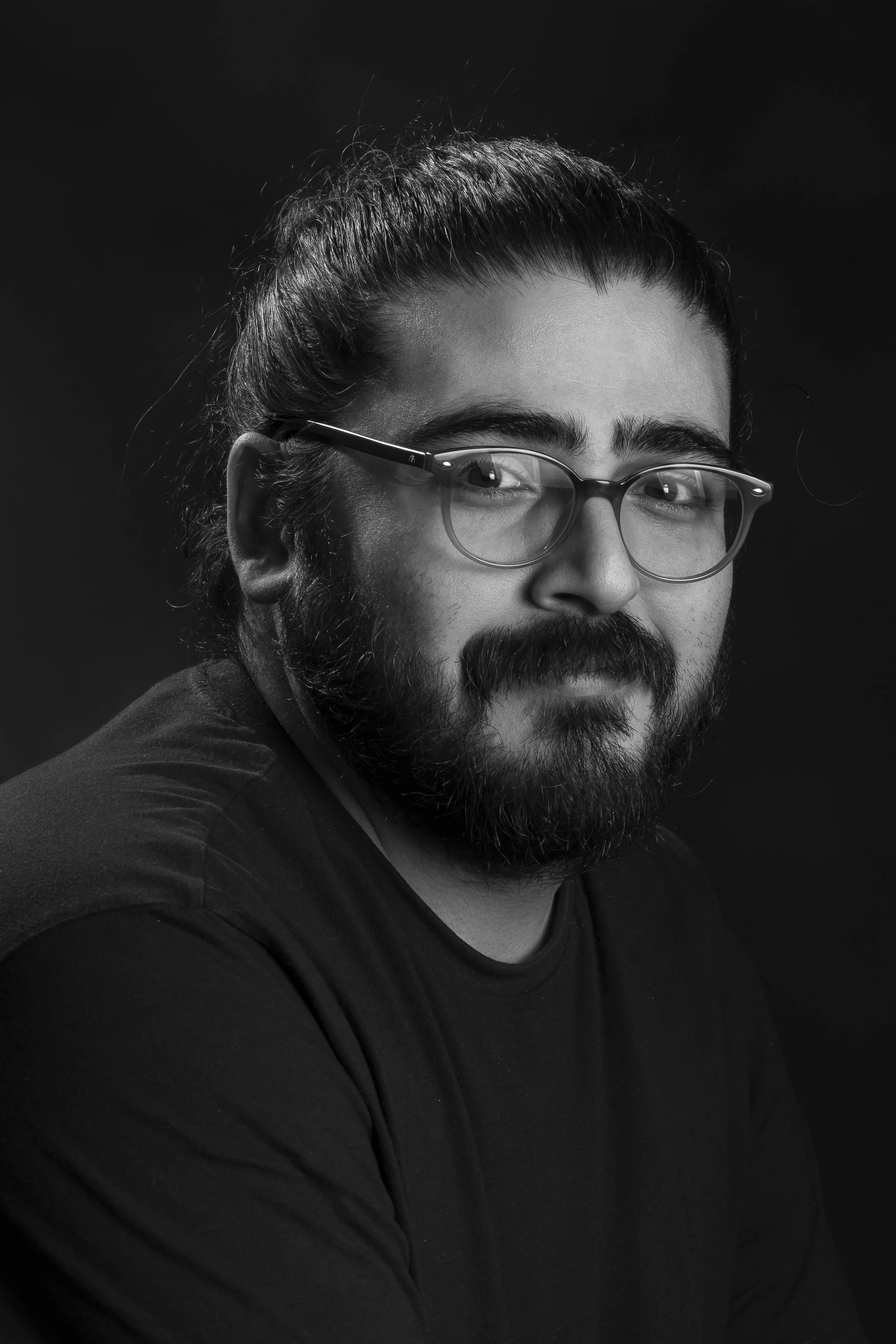
Lohrasb Bayat - Portrait
ARTIST STATEMENT
Lohrasb Bayat’s paintings explore the interplay of vulnerability, resilience, and the human capacity to navigate uncertainty. His figures often inhabit ambiguous states, blindfolded or constrained, yet moving with humor, defiance, and vitality. Through these works, Bayat reflects on the invisible forces that shape society and the individual’s response to them, inviting viewers to confront notions of power, identity, and perception. Each piece captures the tension between fragility and strength, questioning what it means to persist and find freedom in a world of unseen constraints. Even in constrained or precarious situations, his figures embody resilience and quiet defiance, suggesting that freedom and expression persist in unexpected ways.
A New Error (or Explosions Make Great Percussion), Marker on paper, Triptich, overall 125x300 cm, each panel 125x100 cm, 2025 © Lohrasb Bayat. INQUIRE >>
Superposition | Series Description
One of the most intriguing concepts in quantum mechanics is Schrödinger's cat. It is a thought experiment that highlights the strange and paradoxical nature of a concept called quantum superposition. So it goes that if you seal a cat in a box with something that can eventually kill it, you will not know if the cat is dead or alive until you open the box. So, until you open the box and observe the cat, the cat is simultaneously dead and alive. Or in other terms, the cat is in a superposition. The blindfolded figures in my new series are also ensnared by the concept of superposition. They exist in a state of ambiguity and multiple possibilities. Just as the cat is suspended in a state of uncertainty, unaware of its own fate, the blindfolded figures dance and laugh with an exuberance that defies their predicament. Embracing the uncertainty of their existence, they laugh and move with a sense of assumed liberation, evoking vulnerability, resilience, and optimism all at the same time. They do so in the face of the nebulous external forces that have placed them in such a predicament. We do not see those external forces. We see only the fruits of the havoc they have wrought. And it is not horror. It is ambivalence. It is the superposition of affect. As these blindfolded figures dance in the uncertain times in which they’ve found themselves, they are not only expressing buoyancy, but also defiance. Like the struggles faced by many within the region. And so, even as their eyes are covered and their fates unknown, these figures do not yield to the situation at hand. It is not just a matter of resistance. It’s a matter of living despite; living in the face of. The blindfolds act as both a physical and metaphorical shroud of degradation and limitation. They represent the imposition of darkness, robbing the figures of their most vital sense — sight. Deprived of their sight, these figures find themselves in a state of existential need, doubt, and pure vulnerability. Paradoxical to its customary role as a degrader, the blindfold is thus redefined as a liberator. It has opened up new ways of seeing the world, new ways of rebelling, and new ways with which to mock the external forces attempting to confine and control. The limitations forged have merely given way to new methods for survival, for expression. All this serves as a visual testament to humanity's capacity to confront uncertainty with a spirit both fragile and unyielding. These figures stand as both jesters and philosophers. They offer a darkly humorous commentary on the precarious balancing act between societal dynamics and legal structures of the region. The unforgiving nature of markers on paper adds an element of risk and vulnerability to the creative process. Much like the figures in the artwork, I embrace the uncertainties and limitations inherent in working with this medium. In further contemplating the complex nature of producing art in Iran, my intention is to explore deeper connections within the current landscape of the state of Iranian art. The figures in this series were created through a series of live interactions (photoshoots) between me and other painters, photographers, sculptors, musicians, architects, etc. In these collaborative sessions, I blindfold the participants. With dance music resonating in the studio, I encourage them to dance freely, liberating themselves from the constraints of their vulnerable predicament. The chosen titles for each painting are drawn from the songs that accompany these dance sessions. At times, humor becomes a tool, a shared language that transcends barriers and fosters a sense of camaraderie. Laughter punctuates the studio, breaking down the barriers of convention and expectation. This dialogical approach extends beyond the canvas, inspiring private moments of expression in a safe setting. It fosters a reflective analysis of individual experiences within the Iranian artistic communities. The paintings, born from these collaborative sessions, stand as visual testaments to the resilience, creativity, and shared humanity within a community that persistently confronts the challenges of self-expression in a complex sociopolitical landscape. This series, therefore, stands as a catalyst for dialogue, empathy, and a deeper understanding of the multifaceted nature of the Middle East and a nuanced understanding of the challenges experienced by many in the region. It invites the viewer to a collective journey in search of hope and inspiration in the pursuit of freedom, justice, and self-expression.
Korobeyniki (or what do you do when you lose), Marker on paper, Triptich, overall 100x300 cm, each panel 100x100 cm, 2024 © Lohrasb Bayat. SOLD
INTERVIEW
Lohrasb, welcome to the Al-Tiba9 Gallery artist roster. As a self-taught artist based in Tehran, could you tell us about your background and how your journey into art began?
Thank you. I began working seriously as an artist in the early 2010s. At the time, I was not connected to the local art scene and had no formal academic training. My entry into professional practice came through an informal introduction to an established artist in Tehran, after which I spent a period working in his studio. Being present in that environment, observing the process, discipline, and decision-making, was formative for me.
Drawing quickly became my primary tool, both as a way of learning and as a way of engaging with the conditions around me, how individuals adapt, resist, or perform within systems larger than themselves. My practice developed through sustained work rather than institutional frameworks, and I held my first solo exhibition in 2014.
Without formal academic training, how did you develop your artistic language and grow into the artist you are today?
Because I didn’t come through an academic system, my development depended on time and repetition. I worked continuously, drawing daily and returning to the same problems over long periods, allowing the work to establish its own internal rules.
Through this process, the work became less about expression and more about control and decision-making. Small shifts in rhythm or density began to matter, and I learned to recognize when an image was resolved without being pushed further.
This self-directed method continues to shape my practice today, where development comes through sustained use rather than instruction.
Drop it like it's hot, Marker on paper, 150x150 cm, 2023 © Lohrasb Bayat. INQUIRE >>
Industry baby, Marker on paper, 150x150 cm, 2024 © Lohrasb Bayat. SOLD
Marker drawing is central to your practice. What draws you to this medium, and how do technique and process shape your ideas?
I began working with markers in the early 2010s and stayed with them because they demand a high level of control and decisiveness. The medium allows little room for adjustment, which places responsibility on each mark from the outset. With markers, every decision is final; marks cannot be revised or corrected, and that condition creates a particular intensity within the process. Precision becomes essential, and attention shifts toward pacing, accumulation, and control rather than revision or expression.
Your works often show figures in constrained or ambiguous situations. When did these themes of vulnerability and defiance first enter your work?
Themes of constraint and ambiguity were already present in earlier bodies of work, particularly in the Domesticatedseries, where figures were often positioned within limited or controlled environments. In that sense, these concerns didn’t begin with Superposition, but gradually carried forward and shifted form over time.
Around three years ago, those ideas took on a different urgency. I became increasingly aware of a shared sense of suspension, of being caught between states, decisions, or outcomes without resolution. Rather than addressing this directly, it began to surface through the figures themselves, particularly through restriction of vision and orientation.
As the work developed, I began staging photographs as source material for the paintings. I blindfolded people from my immediate professional and social circle, introduced music, and asked them to move freely while I photographed them. These images were then used directly as models for the paintings.
While questions of power have always been present in my work, Superposition approaches them less through overt structure and more through condition, where vulnerability and defiance exist simultaneously, and where control is never fully visible.

It's a sin, Marker on paper, 125x150 cm, 2025 © Lohrasb Bayat. SOLD
Power, uncertainty, and resilience recur throughout your works on paper. How do your personal and social surroundings influence these themes?
My surroundings influence the work less through specific events and more through persistent conditions. Living and working in a context where uncertainty is part of everyday life sharpens attention to balance, adaptation, and control. These are not themes I set out to illustrate, but pressures that quietly shape how bodies are positioned, how space is negotiated, and how tension is held within an image. Rather than responding directly to social realities, the work absorbs them.
Superposition draws inspiration from Schrödinger’s cat and quantum uncertainty. What sparked this conceptual interest in your work?
I was already familiar with Schrödinger’s cat, but reading Something Deeply Hidden by Sean Carroll is what led me to begin the Superposition series.
I wasn’t interested in illustrating the idea. I wanted to work through it visually. Sight is central to how I understand the world as an artist, so I removed it from the figures. What interested me was how they continue to move, laugh, and persist under that limitation.
The blindfolded figures in this series appear joyful and defiant despite their limitations. What do these figures represent for you?
I don’t think of the figures as direct representations or fixed symbols. They function as human bodies placed under specific conditions, where perception is limited but the capacity to respond remains. The blindfold restricts vision, but it doesn’t remove agency, which is where the tension in the work begins.
What interests me is resilience as a lived condition rather than a heroic one. The figures continue to move, balance, and interact despite uncertainty. Joy, defiance, and vulnerability coexist not as messages but as responses to being placed in an unresolved situation.
In that sense, the figures are not meant to describe a particular group or circumstance. They reflect a state that feels broadly familiar, moments where orientation is lost, outcomes are unclear, and yet life continues. The work stays open so that this condition can be recognized rather than explained.
The figures rarely appear alone, and that collectivity matters to me, it allows energy, friction, and excess to enter the work without resolving into a single meaning.

Rum and coca-cola, Marker on paper, 125x125 cm, 2025 © Lohrasb Bayat. INQUIRE >>

Temptations, Marker on paper, 100x100 cm, 2025 © Lohrasb Bayat. SOLD
Collaboration plays a key role in Superposition, through live photoshoots, music, and shared movement. How did this process change your way of working?
For Superposition, I worked with a much larger number of models than in previous series, often returning to the same people over multiple, extended sessions. That scale and duration changed the rhythm of my working process.
The sessions are structured but open. Music is present, movement unfolds over time, and my role shifts between observing, directing, and recording. I intervene only when necessary, adjusting posture or expression, but mostly I allow the figures to inhabit the situation fully. That sustained interaction produces source material with a different kind of intensity, which then has to be distilled and controlled through the drawing.
How has the series been received so far, both domestically and internationally? Did any reactions surprise you?
The response to Superposition has been consistently attentive. In exhibitions and fairs, the work tends to resist quick readings and hold its presence over time.
What has stood out is how easily the work is recognized and engaged with, across different contexts, without needing much explanation.
Lastly, after Superposition, what directions or questions are you interested in exploring next in your practice?
I tend to move forward once a language feels understood, but rarely through abrupt shifts. Transitions in my work usually happen gradually, as one set of questions gives way to another.
New directions often begin conceptually. I spend time reading, looking, and absorbing material until an idea starts to take shape, and only then does it become visual.
For now, I’m interested in allowing that process to continue naturally, letting new concerns emerge without forcing them, and seeing how the work evolves through sustained attention rather than sudden change.
Artist’s Talk
Al-Tiba9 Interviews is a curated promotional platform that offers artists the opportunity to articulate their vision and engage with our diverse international readership through insightful, published dialogues. Conducted by Mohamed Benhadj, founder and curator of Al-Tiba9, these interviews spotlight the artists’ creative journeys and introduce their work to the global contemporary art scene.
Through our extensive network of museums, galleries, art professionals, collectors, and art enthusiasts worldwide, Al-Tiba9 Interviews provides a meaningful stage for artists to expand their reach and strengthen their presence in the international art discourse.


David Moješčík - MojDa is a Czech sculptor. His work is centred on figurative sculpture, the human body, and the female figure. Modelling in clay and with digital tools, he ultimately prioritises manual engagement with materials. . He draws inspiration from yoga philosophy with the concepts of non-violence and human-centeredness, as well as from Egyptian, ancient, and European classical sculpture.