

10 Questions with In June Park
In June Park is a Korean painter currently based in New York. He spent his teenage years in Santiago and moved to the United States to pursue his career in the arts. His paintings capture archived moments in our lives and are rendered on canvas in slow, acrylic layers. He received his BFA in Painting at the Rhode Island School of Design and his MFA in Visual Arts from Columbia University. He has exhibited both nationally and internationally, including at the Anton Kern Gallery, Wallach Gallery, MAMA Projects, Albert Van Abbe Huis, Alyssa Davis Gallery, Petitree Gallery, and Latitude Gallery, among others. He is a recipient of the Glassier Fellowship, the Hopper Prize, and the Becky Westcott Memorial Award and will be participating in the Radio28CS International Artist Residency in Mexico City this spring.

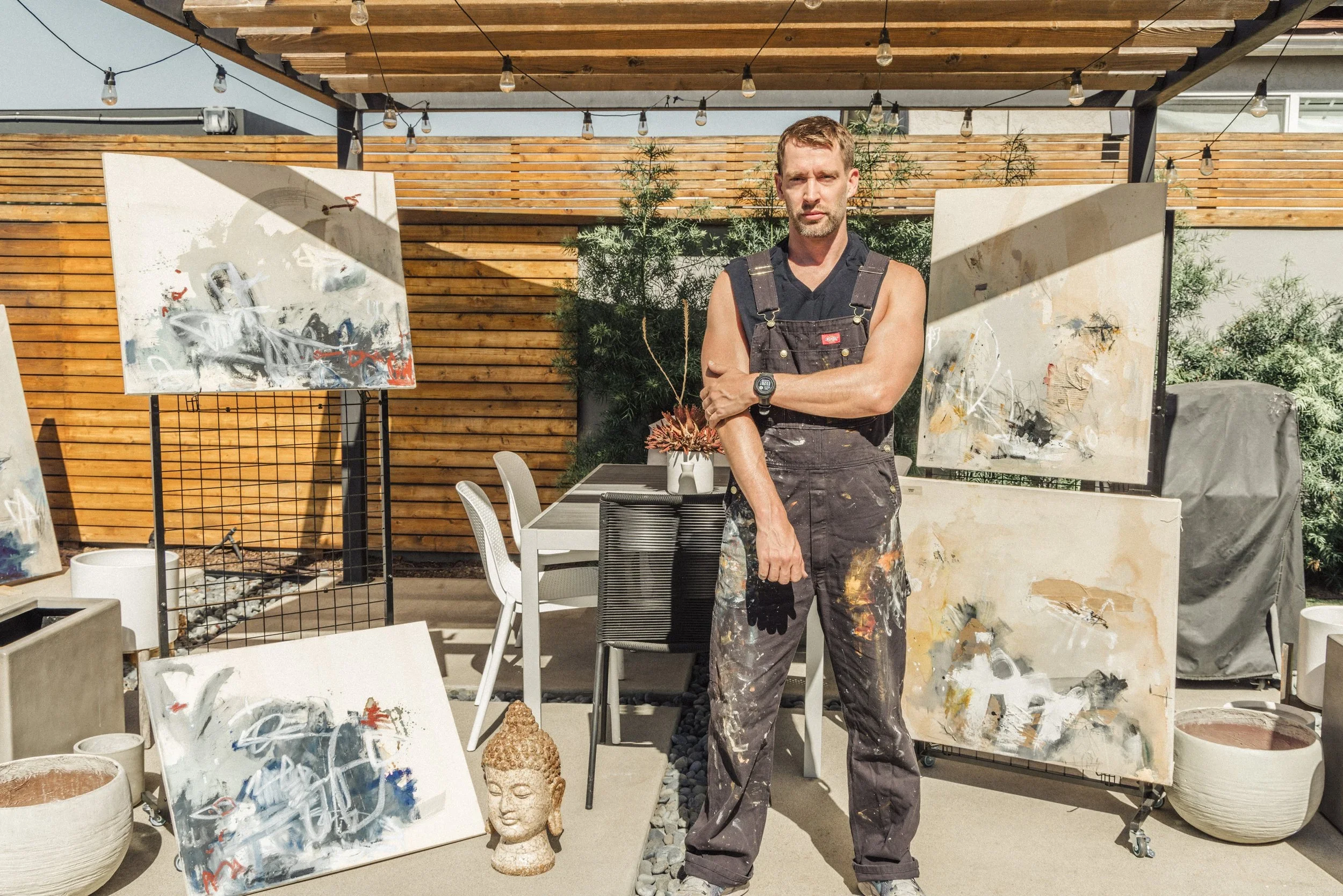
In June Park - Portrait
ARTIST STATEMENT
In June Park's painting practice is an ongoing bricolage of images that mirror and reveal, and also obscure, his life experiences. He uses the camera generation's strategies of distance, composition, cropping, and collage to delineate the boundaries of his canvas. Mirror reflections are captured with varying degrees of proximity and relevance and are brought to the surface. Park is attracted to painting for its ability to single out a subject over its existing context for interpretation and dissection. Ranging from religious icons to left-behind household items, his subjects are pulled out of their environment to engage with other works in the series, forming a collective narrative. His practice represents his interest in using painting as a critical tool for examining how power operates through visual and material language. In a world where we all receive and digest hundreds of new images, Park aims to think about the act of slowly revealing images through painting and play the role of an observer.
Achilles, Acrylic on canvas, 30x42 in, 2025 © In June Park
INTERVIEW
First, you grew up between Korea, Santiago, and now New York. How have these different cultural contexts shaped the way you see and paint the world?
Each of these places offers a different light onto the sights I'm carefully archiving in my practice. They sit and collect differently, each in its own chroma and shade, and yet they all seem to hold their deepest information within the same kinds of crevices. I think navigating between these places trained me to actively seek out those cultural contexts that fold quietly into the cracks.
You studied at the Rhode Island School of Design and later at Columbia University. What did each institution give you that still resonates in your practice today?
RISD gave me a rigorous foundation in the physical act of making and how to build taste and make choices when working with materials. It pushed me to always go back to the studio to look for questions and answers. The MFA program at Columbia University pushed me to actively break the wall between the studio and the world around it. Perhaps it was due to its proximity to the art world, or maybe it was due to the pressure of building a career after graduation, but making art felt heavier, more sincere, and it turned out to be the most important period during my time at this institution.
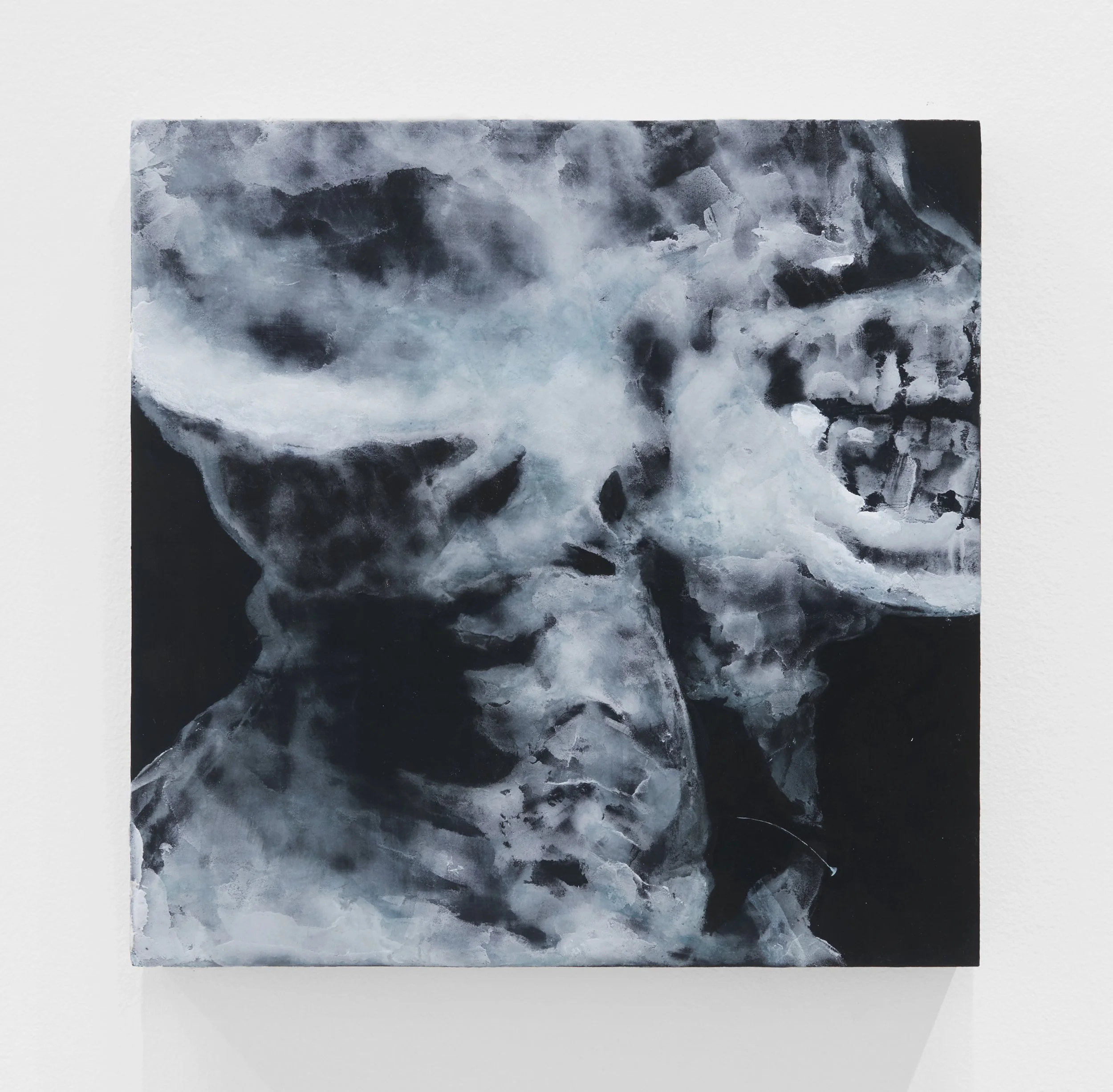
How to Remove a Fishbone from Your Throat, Mixed Media on Panel, 12x12 in, 2024 © In June Park
In an image-saturated era, why does painting remain your chosen medium?
There is something only a painting can offer. Materially, I appreciate the layers and the decision-ridden information stored between its folds. I also like to experience a painting through its scale to the human experience, and approaching it feels special because painting is a form of slowing down. When I spend weeks building up diluted washes on canvas, I'm committing to a duration that runs against the grain of how images circulate now. There is something almost obstinate about it, and I think that obstinacy is meaningful. Painting also has a body. It has weight, surface, and evidence of time.
Your work often isolates subjects from their original context. What draws you to this act of extraction and re-framing?
I like to participate as a painter in the cropping. It becomes the most personal and immediate intervention in my painting process. I am interested in what gets cropped out, in the oblique perspectives that create more questions than answers. I enjoy building a library of fragmented images that subtly point to the possibility of a larger context, thereby justifying their urgency and immediacy. The fragmentary, provisional, and accumulative nature of this way of working draws me into the act of extraction and reframing.

Rearview, Acrylic on canvas, 12x19 in, 2026 © In June Park

Overloaded, Acrylic on canvas, 50x46 in, 2025 © In June Park
Mirrors and reflections appear frequently in your paintings. What do they allow you to explore about memory, distance, or self-perception?
Honestly, the repetitive appearance is somewhat non-intentional. In my studio, I am always in the middle of building myself a library of images, and these images are guided by my current interests and concerns. So it is funny to me that you noticed a repetition in mirrors in my work, and I would have to go back and think about why that is, but my best guess at the moment is that a mirror becomes a space where the subject is looking back at me.
You describe your process as slow, building acrylic layers over time. How does slowness function conceptually within your work?
I like to build up surface through watered-down acrylic layers, adding density to an image through very thin, controlled passes. There is something satisfying about the way uncontrolled layers slowly resolve into a single coherent image. Slowness is not aesthetic for me; it is structural. The diluted washes I work with demand patience because they are fragile, and pushing too hard collapses what is already there. But conceptually, each layer is also a kind of accumulation, a record of attention. By the time a painting is finished, it carries the evidence of weeks of looking. I am interested in how that kind of intimate, sustained observation translates into something a stranger can read.
Your subjects range from religious icons to everyday domestic objects. What connects these seemingly different images within your larger narrative?
What interests me is the quality of attention these objects receive. A religious icon has been looked at for centuries by people who needed it to mean something. A domestic object, something ordinary kept for decades, has been looked at in a quieter but not so different way. That prolonged, need-driven look leaves a kind of residue in the object. My paintings are trying to locate that residue and give it another life. They also have lived next to each other in my household, blurring their original functions into an everyday sight.
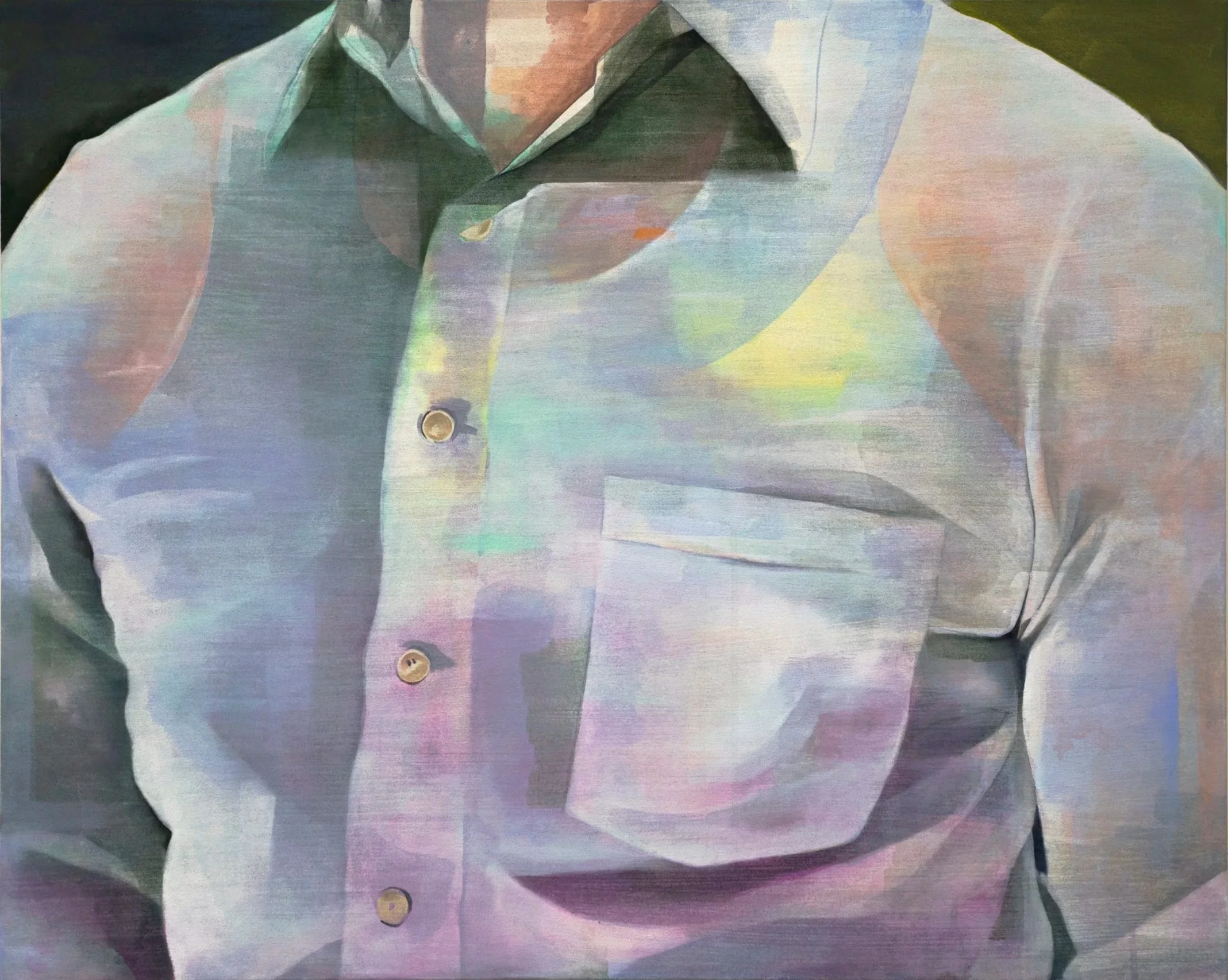
Under Shirt, Acrylic on canvas, 32x40 in, 2025 © In June Park

Winter Tragedy, Acrylic on canvas, 34x40 in, 2025 © In June Park
You speak about painting as a critical tool to examine power within visual language. What kind of power structures are you most interested in questioning?
Rancière has this idea about the distribution of the sensible, about who gets to be seen and heard within a given order. I find that framework useful because it is not just about content but about form, about what visual languages get treated as serious and which get categorised as minor, ethnic, decorative. That hierarchy is built into institutions, into criticism, into the market. Painting can operate as a kind of pressure against those categories or power structures.
Having exhibited internationally and received awards such as the Hopper Prize, how have audiences responded to the intimacy and fragmentation in your work?
What I didn't anticipate was how much people bring to the work themselves. The fragmentation, which I worried might create distance, seems to do the opposite. Because the image is incomplete, there is room for the viewer to enter it with something of their own. I think my paintings can function on their own as they have all once existed in the audience's vision.
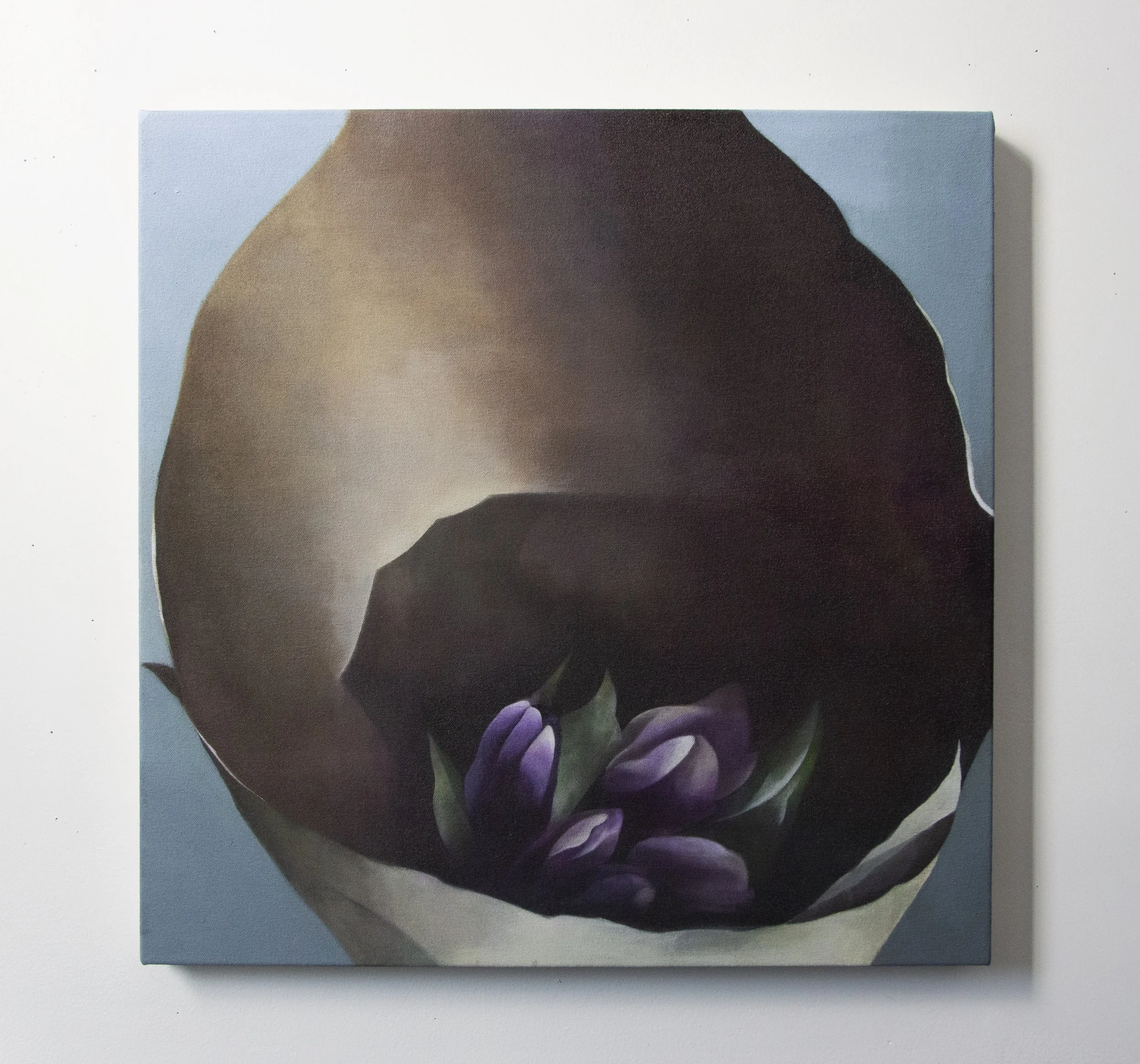
Bouquet, Acrylic on canvas, 24x24 in, 2025 © In June Park
Lastly, as you look toward 2026, what are your main goals, whether in terms of scale, experimentation, residencies, or new thematic directions?
I am interested in letting more narrative into the work this year. Up until now, I have been quite protective of ambiguity, quite resistant to anything that felt too resolved. But I am curious about what happens when I allow a sequence, a before and after, a sense that something is unfolding. Working under one single series might make the works feel richer when experienced together.
Scale is something I would like to push this year as well. Since these are images that have existed materially, I would like to critically push their presence as an image on a wall. I think this will naturally make my work more complicated and perhaps feel more urgent.
Artist’s Talk
Al-Tiba9 Interviews is a curated promotional platform that offers artists the opportunity to articulate their vision and engage with our diverse international readership through insightful, published dialogues. Conducted by Mohamed Benhadj, founder and curator of Al-Tiba9, these interviews spotlight the artists’ creative journeys and introduce their work to the global contemporary art scene.
Through our extensive network of museums, galleries, art professionals, collectors, and art enthusiasts worldwide, Al-Tiba9 Interviews provides a meaningful stage for artists to expand their reach and strengthen their presence in the international art discourse.



Brooklyn-Born Allan Gorman is a contemporary fine artist based in Jersey City, NJ, with a unique artistic vision cultivated by a distinguished commercial career that helped refine a sense of aesthetics and unwavering commitment to excellence that continues to define his artistic process to this day. His latest series of paintings is titled Imaginary Spaces.