

10 Questions with Alexandru Crisan
Alexandru Crișan (b. Bucharest, Romania, 1978) is a visual artist interested in the existential complementarity of objective and nonobjective forms of expression. As far as the latter is to be unpacked, his “counter-professional” career in photography began in 2008; his paintings stand, for almost three decades, as the most intimate, borderline atavistic, acts of divulgence. Assuming that taxonomy is of any consequence, he is partial to fine-art photography and Abstract Expressionism. The eclectic nature of his projects is, therefore, a given. His photography is a direct result of compulsive visual disquisitions on impromptu portraiture, architectural equivocations, parametric manipulations, “hybrid storytelling” and evocative conservationism. Most of his long-term, open-ended photographic series, such as “Minimal White / Minimal Black”, or “Lost Highway / My Car is Your Avatar”, are meditations on loci and human perceptions. The research on and within photography gradually afforded him a surreal vision of immateriality, which he debonairly likes to describe as “tormenting several stages of a hyperrealist mise en abyme”. Since 2015, he has developed quite a few “meta-projects”: “Erotoarchitecture”, “Metropoesis”, “Hortus Conclusus”, “Alex Transcends the Balkans for a Bottle of Perfume”, “Mechaniarchy” and “Shoah”, under the compelling awareness and besetting exploration of otherness and of self. Crișan’s works have been presented in over 50 international exhibitions, have been published in over 100 peer-reviewed magazines and books, have received over 500 international awards and nominations, and are part of several privately owned collections and art galleries.
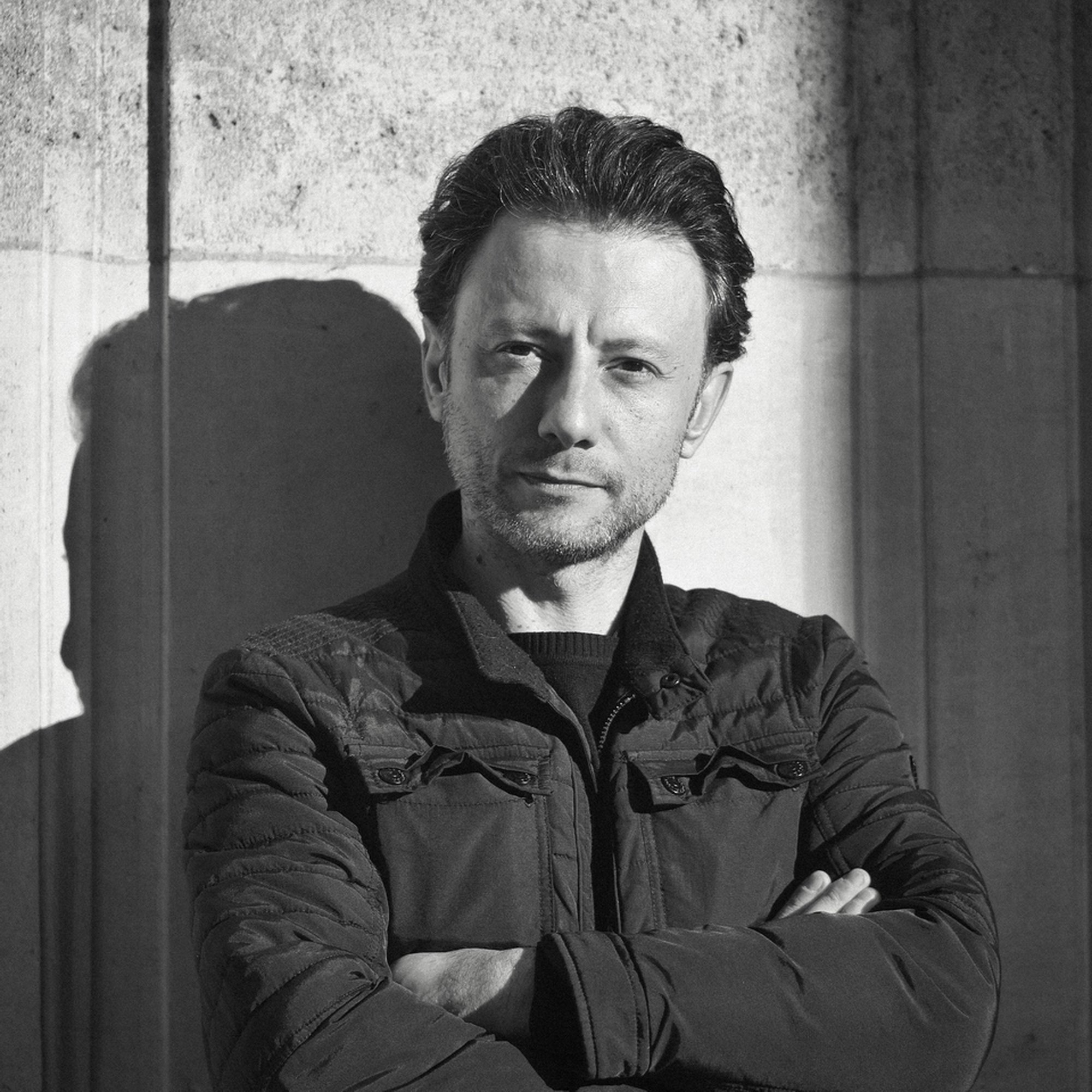
Alexandru Crisan - Portrait
FRAGMENTA DEORUM I | Project Description
FRAGMENTA DEORUM I proposes a contemporary archaeology of the mythic body. In this series, Alexandru Crișan constructs a visual language that fractures and reconstitutes the divine. The works do not illustrate mythology; they excavate it. They treat the classical canon not as a stable heritage but as a malleable archive, one that can be decomposed, recomposed, multiplied, and dreamt anew.
Classical sculpture is repeatedly dismantled into micro-fragments, then reorganised through symmetrical lattices, pareidolic structures, and architectural matrices. Crișan’s approach mirrors the analytical processes of architectural drawing, where form is disassembled into its operative parts and then reconstructed in pursuit of spatial revelation. Yet here the reconstruction resists completion. Instead of coherence, the viewer encounters a controlled destabilisation: bodies that echo, multiply, dissolve, and re-emerge in new configurations. What remains constant is the sense of a divine presence that has been shattered but not destroyed, a pantheon redistributed across the image surface. At the core of FRAGMENTA DEORUM is a tension between recognition and uncertainty. The images are engineered to provoke pareidolia: the perceptual impulse to find faces, limbs, gestures, or symbolic forms within ambiguous or repetitive structures. This semiotic instability is intentional. Crișan invites the viewer to become the interpreter, the excavator, the dreamer. In these works, meaning is not given; it is activated through looking. The divine becomes a field of potential readings rather than a fixed iconographic reference.
This dream logic aligns the series with psychoanalytic theory, particularly Freud’s and Lacan’s understanding of the dream as a site where fragments of memory, visual, sensual, and mythic, are condensed and displaced into new symbolic forms. In Crișan’s images, the gods return not as whole figures but as dispersed signals: a gesture that resembles Medeia, a face reminiscent of Cassiopeia, a serpentine curve suggesting Hecate. Myth becomes unconscious architecture. The works function as dream surfaces on which fragments of antiquity reassemble themselves into new psychic anatomies. Despite their digital precision and photographic origin, the compositions behave like architectural relics or ritual artefacts. Their symmetry recalls mosaics, temples, mandalas, and the sacred geometries of ancient cosmologies. Yet the eroticism embedded within the images, touch, exposure, and bodily dissolution, places them firmly within the lexicon of contemporary art. Crișan’s practice acknowledges that the Greco-Roman world was erotically charged, ritually transgressive, and psychologically complex. The erotic becomes a method of inquiry, a way of revealing the tension between sacred desire and human vulnerability.
FRAGMENTA DEORUM is thus not a return to antiquity, but a reanimation of its semiotic and psychological residue. The works imagine what happens when gods are no longer worshipped but remembered; when myth persists not as story but as structure; when divine bodies are held together not by belief but by the dreamlike persistence of form. Crișan transforms classical fragments into contemporary apparitions, suspended between sculpture and photography, memory and hallucination, decay and rebirth. In this series, deities do not appear; they assemble themselves across the surface as afterimages. Divinity becomes an unstable architecture, an oneiric metamorphosis that both conceals and reveals its origin. FRAGMENTA DEORUM situates itself precisely in this liminal zone: between archaeology and dream, between mythology and psychoanalysis, between architectural reasoning and visual desire. It is less a catalogue of gods than a study of the forms they leave behind when their stories have been forgotten, but their images continue to haunt us.
In Crișan’s hands, fragmentation is not destruction, it is a generative force. Through decomposition and reconfiguration, the mythic body becomes newly legible, not as a relic of the past but as an evolving, living, dream-bound presence. These are not merely images; they are thresholds. Portals through which the viewer confronts the shifting nature of myth, the malleability of the sacred, and the enduring power of visual imagination when freed from narrative certainty. FRAGMENTA DEORUM proposes that the gods were never lost. They were shattered, and in the fragments, they continue to breathe.
METIS R.2 (Fragmenta Doni), archival art print, 150 x 210 cm, 2025 © Alexandru Crisan
INTERVIEW
First of all, tell us a bit about yourself. How did your artistic journey begin, and when did you first feel compelled to make images?
I’ve started crafting images – and imagery – as a pushback against structure. Art is rebellious, and so is childhood. Both my parents were engineers, so they were all about precision and functionality. Twisting a line into a zigzag, smashing a point into a smear, teasing orthodox colours with what I was thinking were brand new skins… Such playfulness might seem trivial, but testing boundaries through tinkering with visual acts of disobedience is what has opened my appetite for art and what keeps me shape-hungry. In hindsight, I realise that the curvatures and the colour bombs of my early teenhood were the pillars of my identity formation.
A few years later, I started drawing and photographing as a way of thinking. I wasn’t trying to document the familiarity of my own world, but to test how every bit of the “outer world” becomes legible through form, and by form, I mean distorted form. I’ve started reshaping the fringes of a reality that was becoming increasingly canonical. Think Basquiat. Think Ion Țuculescu. I didn’t know anything about them back then, but I knew that what I was creating was something very, very different from Brâncuși’s Infinity Column, on which my father was doing structural restoration work.
The (let’s say grown-up) compulsion to “make images” came from the heightening sensation that perception itself is unstable - that what “the others” are addressing with formal certainty as “reality” is being, in fact, flowingly mediated by memory, desire, and cultural residue. I became interested in images not as illustrations, but as thresholds: surfaces where something blatantly new can appear, only to recoil and then to resurface as new shapely coherences.

CASSIOPEIA (Fragmenta Arcadiae), archival art print, 150 x 170 cm, 2025 © Alexandru Crisan
Having trained as an architect, how does architectural thinking influence the way you construct images today?
Architecture has taught me how to translate intuition into functional structure; photography has taught me that structure can carry ambiguity without resolving it.
Architectural thinking breaks into my photography as a method: disassembly, indexing, re-composition. In architecture, you learn that a form is never simply “seen”; it is a systemic output, plans, sections, grids, proportions, and concatenations. I carry this analytic instinct into photography. My images are not freeze-framing singular, static moments; they are manufactured fields for the curious eye to navigate, to compare, and to reassemble.
This is particularly evident in FRAGMENTA DEORUM, where the grid and the modular logic are functioning as a remnant of an architectural drawing: a rational instrument that pinpoints the limits of rationality. The image becomes a spatial system, which is more encompassing than a narrative scene. It is built to be read as a stepping stone and to facilitate, well, illumination.
Your practice moves between painting and photography, and you describe photography as a “counter-professional” path. What does that term mean to you, and how has this unconventional trajectory shaped your artistic identity?
By “counter-professional”, I mean that I’m labouring & delivering a dream, not a function. For/to me, photography is neither a conventional career track nor a leisurely pastime. It is simply a different facet of who I am. Architecture has its procedures, responsibilities, and constraints; photography is a field where I can either booby-trap the conventional or dismantle wholesale certainties, only to test other forms of fluid coherence: intuition, drift, obsession, and, of course, the oneiric.
This trajectory has shaped my identity because it defies oversimplification. I did not become “only” a photographer, “only” an architect, or “only” a painter. My work is defined by transit, by one utilitarian back-and-forth, by navigating between construction and apparition, between method and lust. That hybridity is not a compromise; it is the very core of my language.

MEDEIA (Fragmenta Arcadiae), archival art print, 150 x 150 cm, 2025 © Alexandru Crisan
Photography has become one of your primary media. What drew you specifically to it, and what possibilities did you find there that painting alone could not offer?
Photography offers a peculiar authority: it arrives with the cultural assumption of the real. I was drawn to that tension - between the indexical promise of photography, on the one hand, and its capacity to produce hallucination, on the other. Painting can openly mastermind worlds, only to test their resilience; photography can reinvent worlds, while seemingly attesting their validity. There is a “mythological logic” in this almost paradoxical tension, since any myth operates as a kind of truth that is not factual.
In my practice, photography also allows for a particular kind of precision: the ability to work with micro-fragments, with tonal nuance, with repetition and symmetry, and by doing this, to incorporate shards of memory, i.e., material evidence. It lets me treat “the archive”, classical sculpture, historical nostalgias, not as something to copy, but as a malleable substance that can be recomposed into new anatomies.
Your works often balance objective structures with nonobjective expression. How do you navigate intuition and analysis within your creative process?
I treat analysis as a scaffold, and intuition as the force that unsettles it. Structure is necessary because it generates complexity without turning it into noise; intuition is necessary because it prevents structure from becoming merely decorative or didactic. For me, the most interesting “zone” is where the image behaves as if it were set in stone, yet it remains semantically unstable.
In practical terms, I’m working my way through structures: grids, lattices, mirrored axes, modular de/re-compositions. But I am not necessarily chasing the stability of continuity. I am interested in controlled destabilisation, where identification and uncertainty coexist. The end-image should feel as inevitable as a functional construction, but as open-ended as a rendezvous.

TETRAD OF DESIRE (Quattuor Figurae), archival art print, 150 x 180 cm, 2025 © Alexandru Crisan
In FRAGMENTA DEORUM, mythology appears through fragmentation rather than direct representation. What first motivated you to revisit classical myths through this method of decomposition and recomposition?
I was motivated by the daily fact that mythology is still sanguinely active, even if canonical belief has faded. We, the cosmopolitans, no longer worship a bulk of gods, yet their incarnations continue to steer our collective imagination, through cinema & streaming, through museum escapades & city-breaks, through occasional textbook browsing, through our inherited iconographic habits. I wanted to treat our legacies not as ossified heritage, but as a living archive, something mutable and decomposable, something rather messy, something relievable.
Fragmentation became essential simply because it mirrors how myths survive us, their “users”: discontinuously, as afterimage and residue. The gods return not as patronising figures, but as dispersed signals, curves, gestures and facial slices, as some critical recognition thresholds. The de- & re- compositions are allowing me to reactivate the myths as structures, rather than stories, and to access the oneiric register via condensation, displacement and symbolic pressure-points.
The series strongly engages ideas of pareidolia and perception. How important is the viewer’s imagination in completing the work?
The viewer’s inner-world is crucial. These works are engineered to activate pareidolia because pareidolia is not a trick, but a mechanism of perception-testing. These works underline the fact that the act of seeing is never neutral. We’re singling out certain shapes because we’ve been primed, culturally, if not biologically, to find meaning in ambiguity. It is a survival mechanism, it’s survival by imagination.
In this sense, the viewer becomes a co-producer. The work is not completed by decoding a fixed message, but by entering a semiotic field where meanings are being activated through continuous looking. Different viewers will conjure up different mythic presences, different narratives and different emotional temperatures. Such intercourses are not emotional residue; they are ongoing battles for meaning.

MINOTAURUS R.2 (Fragmenta Labyrinthi), archival art print, 150 x 170 cm, 2025 © Alexandru Crisan
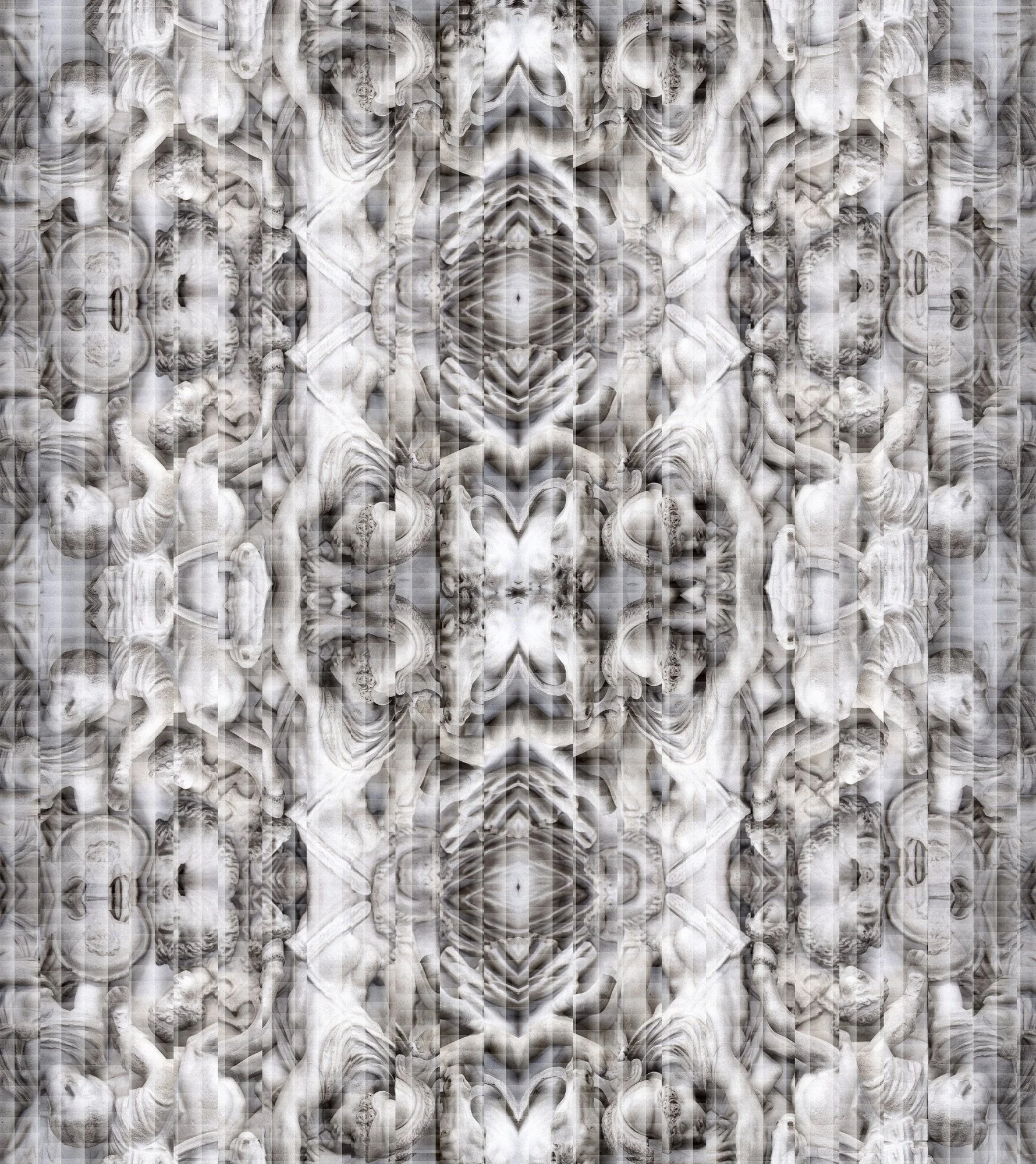
ODYSSEIA R.2 (Fragmenta Gorgonis), archival art print, 150 x 170 cm, 2025 © Alexandru Crisan
Your images create a tension between recognition and uncertainty. Are you aiming to destabilise meaning, or to invite a more personal form of interpretation?
I’m not interested in destabilisation as a defying aesthetic gesture. What I’m aiming for is a disciplined openness: I’m welcoming any interpretation that doesn’t collapse into arbitrariness. Discernment must not be obscured for the sake of artsy fancifulness: otherwise, the image will become a vacuum. However, certainty must remain unstable; otherwise, the image quietly becomes an illustration.
This is why FRAGMENTA DEORUM shoutingly operates between archaeology and utopia. Archaeology provides structure and legacy; the dream provides the emotional shifts, the aspirations and the evolution. The tension between recognition and uncertainty shapes the space where the most intimate breed of readings becomes possible: it is where the myth can be re-accessed not as doctrine, but as experience.
Your work has received extensive international exposure and recognition. How has audience reception influenced or challenged the evolution of your practice?
The audience reception has confirmed something essential: that the viewers are willing to engage with complexity when the work offers an enticing invitation to observe evolution. I’ve also learned that different contexts activate very different readings. A collector might respond to formal intensity and presence; an academic might respond to method and reference; the casual audience responds to the uncanny and to the mythic associations that are whimsically popping up.
The challenge is to maintain the integrity of the work’s openness without simplifying it for the sake of visibility. Recognition helps, but it can also lead to reductionism, people want to be able to “name” the work instantly. I’ve tasked myself with keeping the image “on the move”, self-reinventing and resisting emotional stoppage. I want the work to still kick beyond the first glance.

NYMPHAEUM R.2 (Fragmenta Nymphaei), archival art print, 150 x 150 cm, 2025 © Alexandru Crisan
Lastly, looking ahead, what questions or territories do you feel compelled to explore next, and how might your future projects expand the ideas introduced in FRAGMENTA DEORUM?
FRAGMENTA DEORUM is far from some kind of personal closure; conversely, it has already opened fertile research territories for me. What has started in Fragmenta Deorum I as a para-archaeological exploration of the mythic body, fracturing and reconstituting the classical canon into an oneiric field of afterimages, has already evolved into distinct methodological directions in Fragmenta Deorum II and Fragmenta Deorum R.2. Looking ahead, I see this project not as sequences of “new myths”, but as a sustained investigation into how images are compartmentalising perception, desire and cultural memory.
Fragmenta Deorum II has proven to be a decisive step in that evolution because it intensified the architectural intelligence of the series. The grid and the “tabula” logic are not merely formal devices; they function as epistemic tools. They are converting the myth into a readable apparatus - a surface that behaves like a chart, an archive, a rhythmic field where fragments are indexed and recomposed. I’m underlining that the image is an instrument; the image is not a window, but a system that dictates how the gaze moves, where the identification starts, and how certainty is being delayed. In other words, the work is becoming more and more about the mechanics of interpretation, not about what is being interpreted.
Fragmenta Deorum R.2 takes that even further by shifting the emphasis from “new content” to a critical return. R.2 is not a sequel in the conventional sense; it is a second reading under altered conditions of visibility. It asks what happens when the same mythic archive is being re-accessed after the first excavation has already exhausted its purpose; the image is no longer being recovered, but rewritten. This has opened a productive question for future work: why does repetition itself become meaning? I’m increasingly interested in this idea of the work as a palimpsest: an image that carries its own previous readings as latent layers.
To conclude, the future direction of this project is twofold: 1. I want to test the image-as-apparatus paradigm beyond any conventional usage, a bleeding-edge system of segmentation, a razor-thin order-and-drift threshold, a virtually non-existent control over the way in which the viewer navigates the image-core; and 2. I want to bulletproof the project’s central claim: that the wrinkles of our continuous Antiquity are not to be computed out of our perception, since they are stone-carved-alive in the good & the bad of our neuronal pathways, as a semiotic archive and as a Psyche infrastructure.
Artist’s Talk
Al-Tiba9 Interviews is a curated promotional platform that offers artists the opportunity to articulate their vision and engage with our diverse international readership through insightful, published dialogues. Conducted by Mohamed Benhadj, founder and curator of Al-Tiba9, these interviews spotlight the artists’ creative journeys and introduce their work to the global contemporary art scene.
Through our extensive network of museums, galleries, art professionals, collectors, and art enthusiasts worldwide, Al-Tiba9 Interviews provides a meaningful stage for artists to expand their reach and strengthen their presence in the international art discourse.
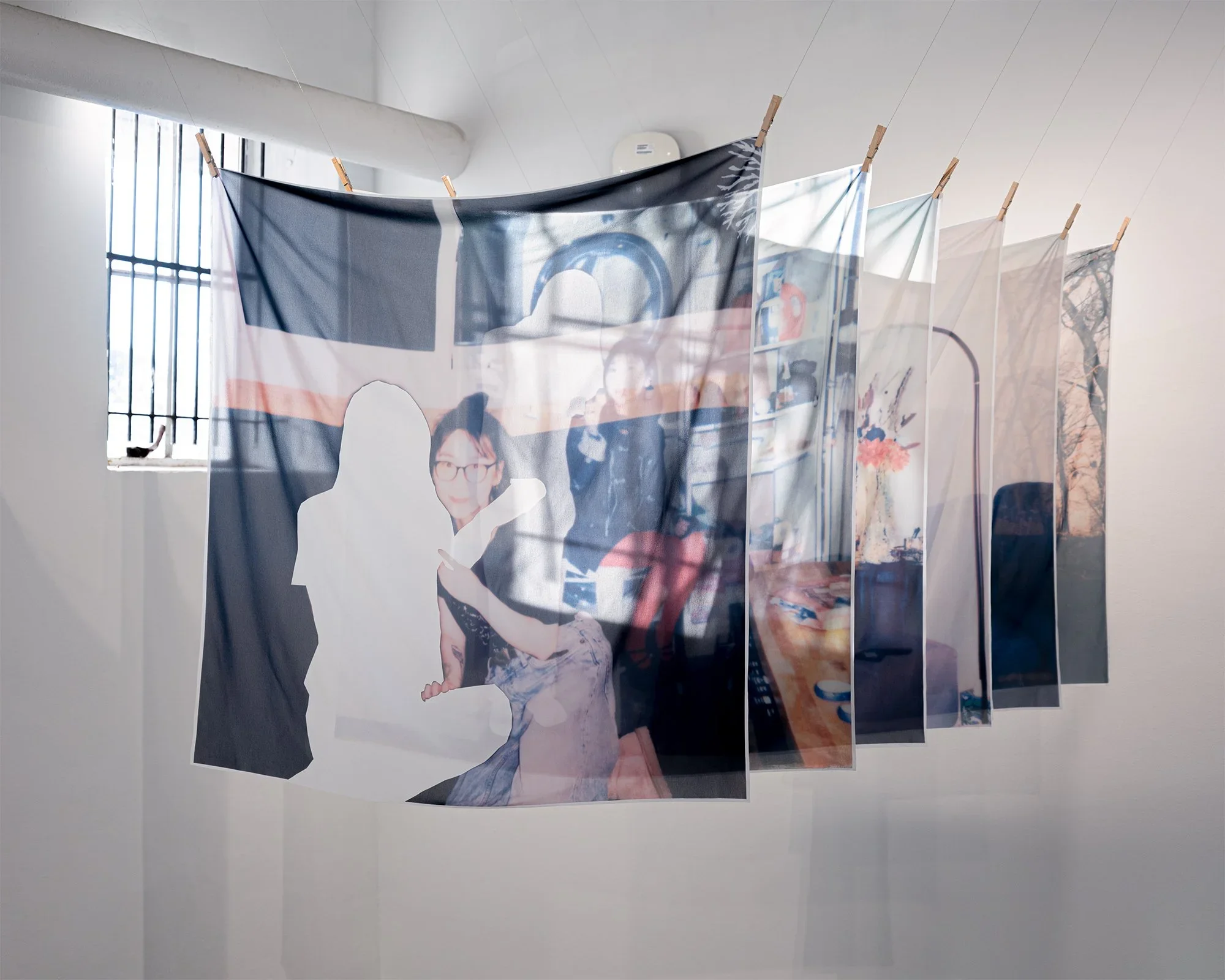

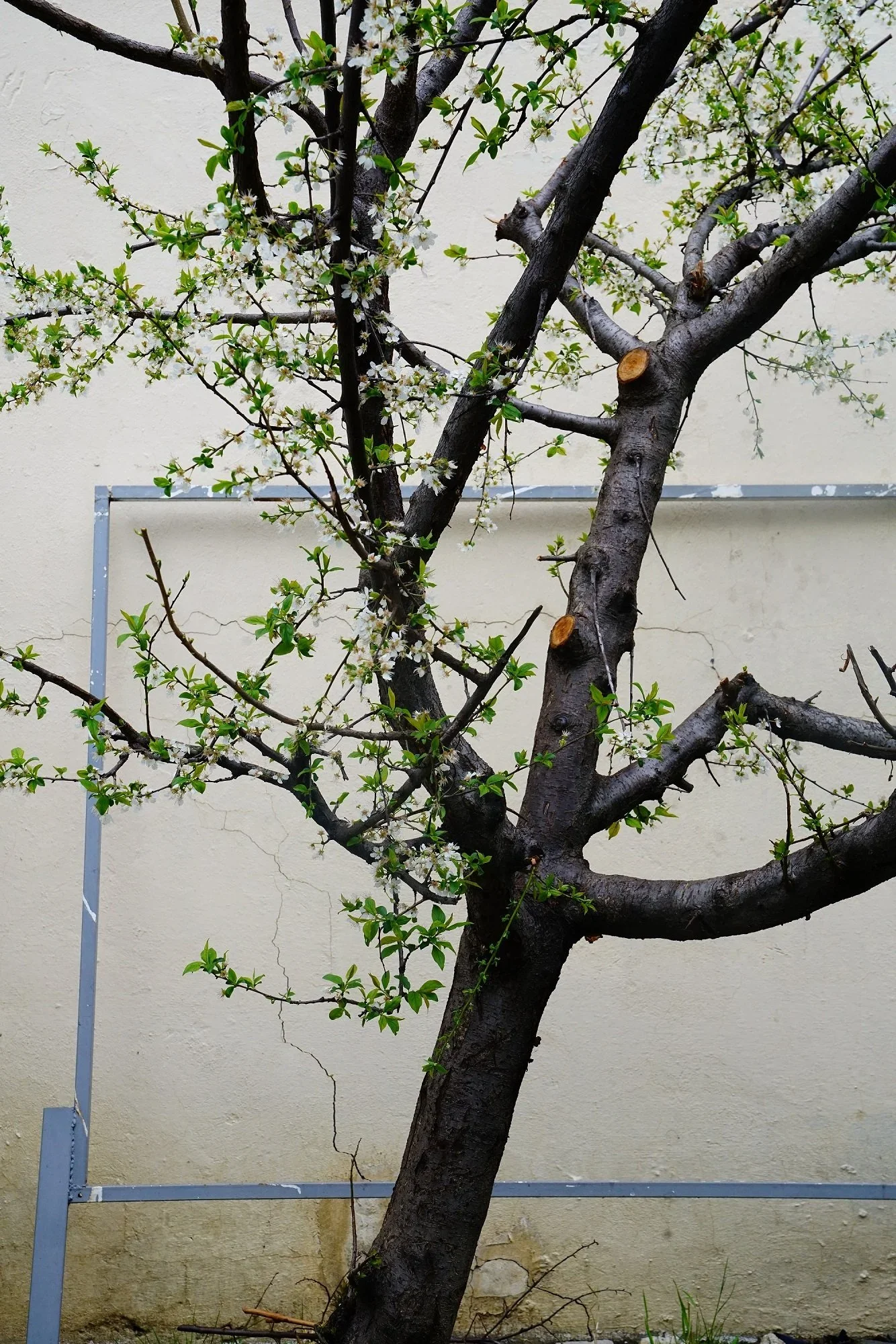


Bichen Liu is a Chinese lens-based visual artist working across fine art photography, black-and-white image-making, and experimental photographic practice. What Lies Beneath is a black-and-white photographic series focusing on exposed root systems and coastal residues, that transforms overlooked ecological fragments into visual records of support, erosion, and displacement.