
10 Questions with Lachlan Howard
Lachlan Howard is a multi-media sculptor and photographer from Ocracoke, North Carolina. His work examines the uncanny and the uncomfortable and how we can benefit from accepting and embracing discomfort. He is currently a Sculpture and Expanded Media major at the Cleveland Institute of Art, a recipient of the Gund scholarship, and has previously been a Teacher’s Assistant for various programs at the Cleveland Institute of Art.
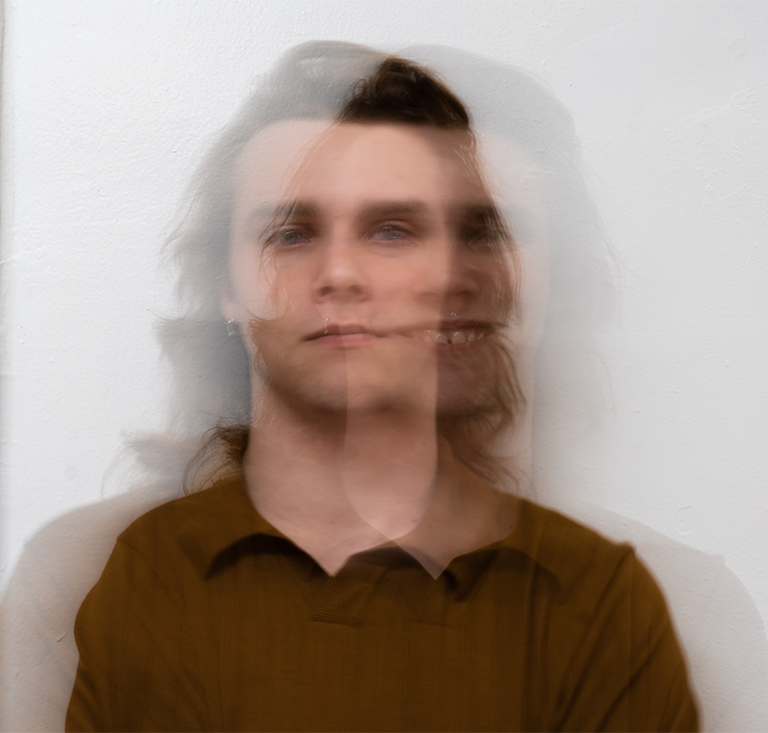
Lachlan Howard - Portrait
ARTIST STATEMENT
The works made by Lachlan Howard are a celebration of discomfort. Too often, discomfort is seen as a negative emotion, but he believes that there are no negative or positive emotions, only negative or positive circumstances. There is a reason for every feeling and emotion, and the less appealing ones should not be shied away from. Rather than trying to avoid these feelings, his art encourages the viewer to embrace the uncanny and grotesque, and in doing so, become at home in discomfort.
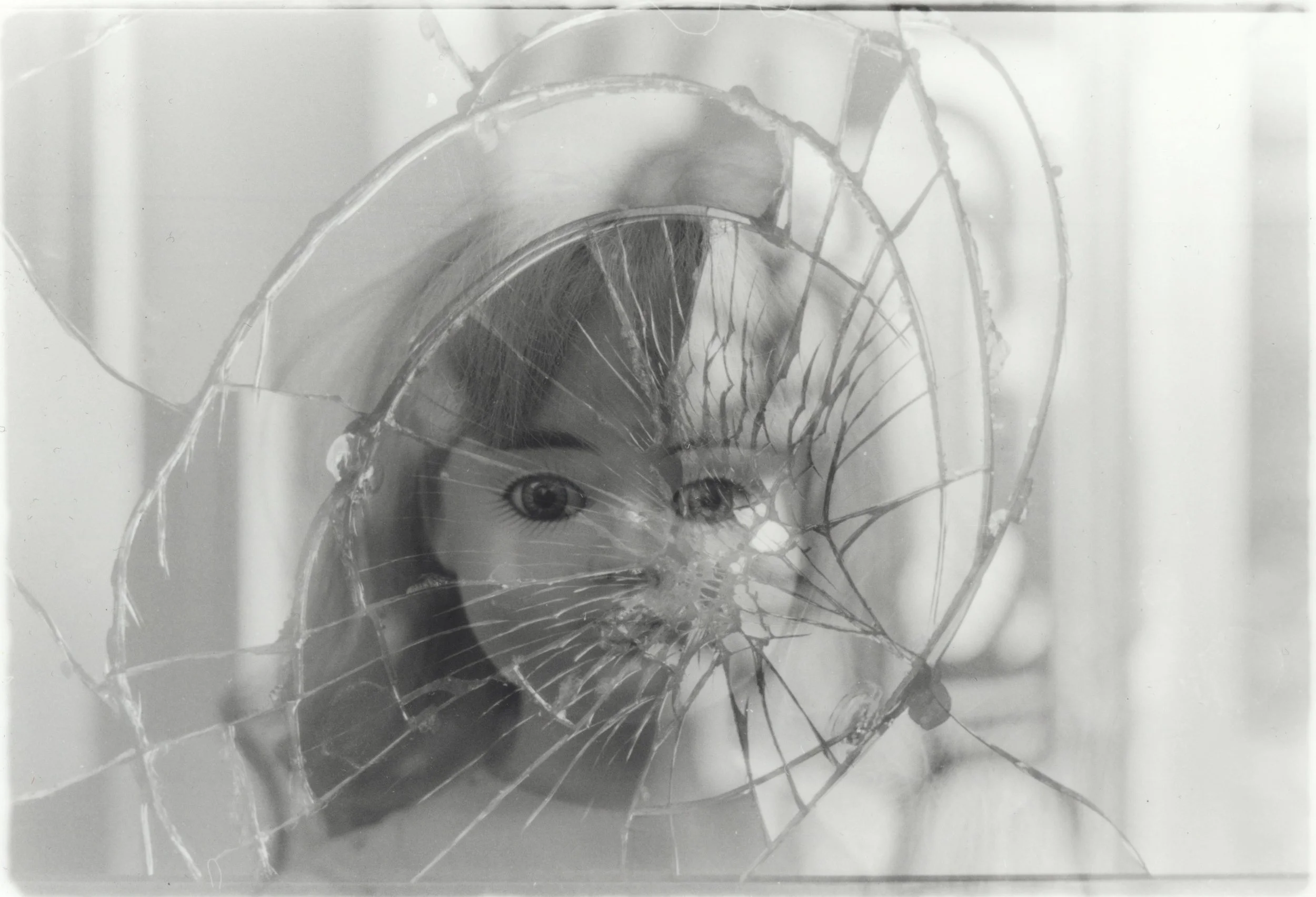
Howard’s art takes many forms, but he most commonly works in fibre art and photography. His fibre art takes the form of various strange alien creatures, with some being appealing and others taking on a more grotesque and abject nature. His photo work involves manipulating images to instil a sense of disorientation and mania, especially working with long exposure shots and analogue compositing to make impossible and otherworldly images.
Through exploring the surreal and uncanny, his body of work examines what is seen as strange and upsetting and asks the audience to, instead of running from that uncomfortable feeling, sit with it for a minute. Immerse themselves in it. Allow themselves to become comfortable with the uncomfortable and to feel at peace with the overwhelming.
Shattered, Film Photography, 2844x1938 px, 2025 © Lachlan Howard
INTERVIEW
First of all, can you tell us a bit about your background and how it shaped your artistic sensibility?
I grew up in a really small town, but it has this thriving and vibrant artistic community, full of some of the weirdest people you’ll ever meet. There’s an artist there named Susan Dodd who makes these beautiful assemblages out of old doll parts, and that embracing and repurposing of traditionally “creepy” and “disturbing” imagery had a tremendous impact on my practice. Another big influence for me was Calvin and Hobbes, and in the comics, Calvin would always make these grotesque and macabre snow sculptures, with snowmen getting cut in half, run over by cars, eaten by snow aliens, all sorts of grisly things. I always wanted to make stuff like Calvin, but being on the coast of North Carolina, snow was a rare occurrence, so I had to make do with clay. I remember one year, I made this horrid severed finger Christmas ornament out of oven-bake clay. My mom wouldn’t even let me put it on the tree.
You are currently studying Sculpture and Expanded Media at the Cleveland Institute of Art. How has this academic environment influenced your work so far?
Being at CIA has really been wonderful; for the first time in my life, I’m surrounded by people who are all constantly creating and evolving their respective practices, and we all are able to share techniques and inspirations. It’s a very collaborative environment. One of the things that I talk about a lot in my practice is having a fluid and iterative artistic process. One of the best things about being surrounded by your artistic peers is the ability to constantly bounce ideas off each other, and take that feedback and incorporate it into your practice. Honestly, I think iteration is one of the most valuable things in the artistic process. Most, if not all, of my favourite pieces have incorporated some amount of peer feedback.

Worms, Felted Wool, 7x15x4 in, 2025 © Lachlan Howard
You work across multiple media, especially fibre art and photography. How do you decide which medium is right for a specific idea?
With the type of surrealist photography I do in my practice, the process is very fluid and shifting, really going with the flow. I’m often not entirely sure what I want to use a photo for at the moment I take it. This is really different from my felt creatures, as I need to decide on the general shape of my creature before I even begin laying down the materials. That being said, there’s still room for improvisation, like for example in worms, the holes all throughout the body were a decision I made fairly late in the process, but at that point in the process, it would’ve been too late to add another arm onto the resist or something like that.
Discomfort is central to your practice. When did you first become interested in exploring the uncanny and the grotesque?
As I was talking about earlier, I grew up surrounded by a lot of really strange and wonderful artists who work in the surreal and uncanny, and I was super inspired by the macabre. I remember as a little kid I would draw a lot of stuff that I think concerned my parents a little bit. There was one time in first grade where the school called a parent-teacher conference because I had drawn this crayon drawing of a pegasus with a bunch of blood and gore on its horn. I didn’t really think about consciously incorporating the uncomfortable and disturbing into my practice until 2022, when I discovered the work of the Japanese horror artist Juni Ito. His art didn’t plant the seed of my interest in discomfort, but it was the water and the sunlight that helped it grow into a focus for my practice.

Chud Son, Felted Wool, 15x6x2.5 in, 2025 © Lachlan Howard
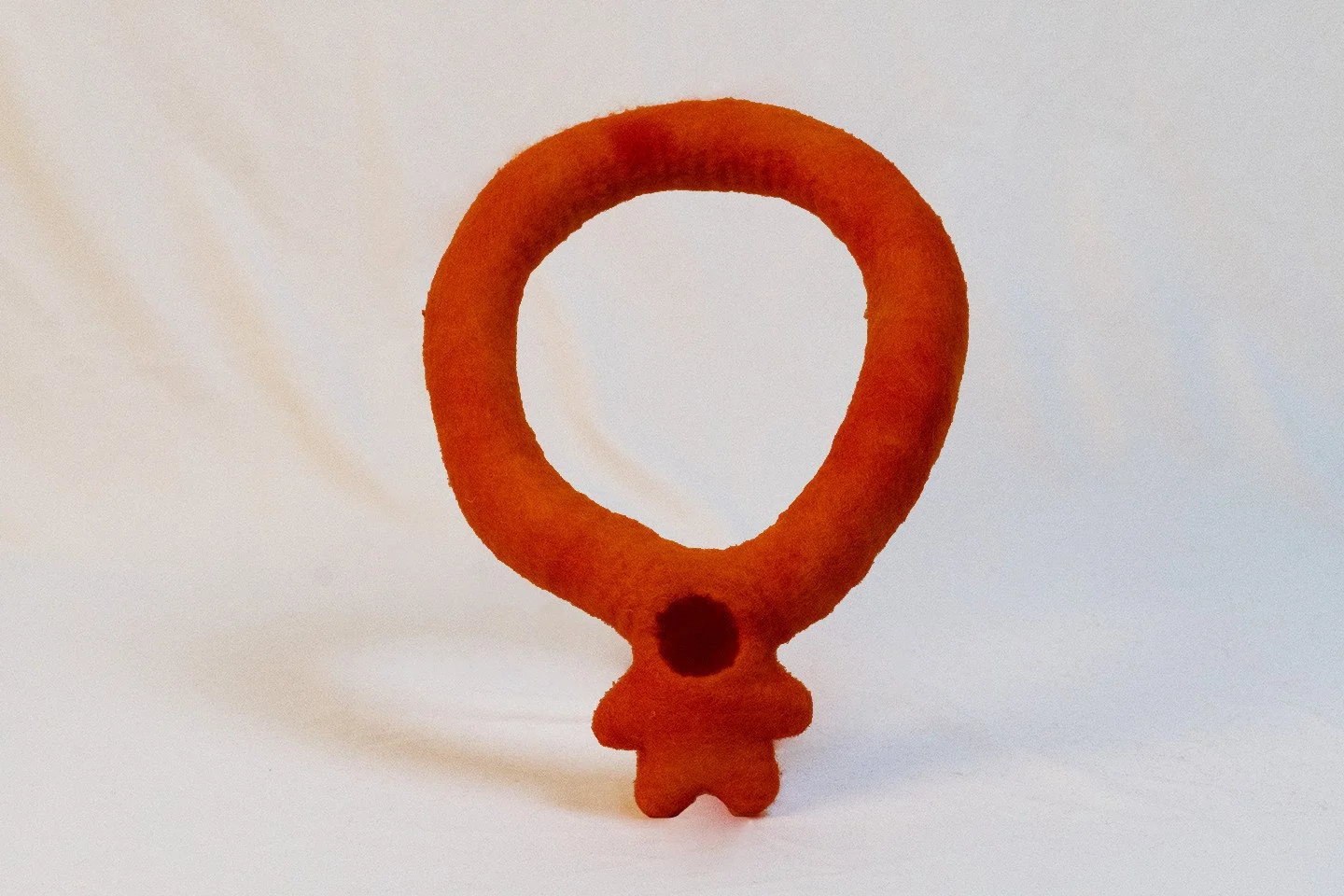
Donut Head, Felted Wool, 11x8x3 in, 2025 © Lachlan Howard
Your fibre sculptures often resemble strange or alien creatures. What draws you to these forms, and what do they represent for you?
Well, at the very base level, I’ve always been a huge Sci-Fi lover. Taking it back to Calvin and Hobbes for a moment, there were a few C&H comics where Calvin was a space explorer named “Spaceman Spiff,” and he would meet all these strange-looking aliens that usually represented his teacher, parents, or doctor. I personally like to name some of my creatures after famous figures in United States history. So far, I have Abraham Lincoln and Benjamin Franklin. I find that taking these monumental and often mythologised figures and giving their names to strange little creatures serves to de-mythologise them a little. These people were human, just like every one of us. And are we not the strangest little creatures of them all?
In your photography, you use long exposure and analogue compositing to create disorienting images. What attracts you to these techniques?
With long exposure, I really enjoy playing with light. It fascinates me because it’s a visualisation of time passing, but contained in one still frame. As for analogue compositing, I enjoy it mainly because of how much of an iterative process it is. There’s so much play you can do with multiple images, rearranging them, cutting paper filters to get different exposures on different parts of the images, letting different parts of the paper develop more. It really lets me be in control of every part of my image.
How do you hope viewers emotionally respond when encountering your work for the first time?
I hope viewers experience a bit of initial discomfort, and then choose to sit with that feeling instead of turning away from it, examining that discomfort. I believe that it’s impossible to learn and grow if you never engage with things that make you uncomfortable. I think something that happens a lot these days, especially with social media and algorithms, is that people are never forced to engage with anything that challenges them. If you see starving children and war crimes on your feed, you can just swipe them away, and you won’t have to think about it. No matter how blatant and obvious the truth, there’s always a part of the internet that’s ready to sell you a comfortable lie.

Missing, Digital Photography, 6000x4000 px, 2025 © Lachlan Howard

Lost, Digital Photography, 6000x4000 px, 2025 © Lachlan Howard
Have you noticed differences in how audiences react to your more “appealing” works versus the more unsettling ones?
It’s very interesting, I find that often the more appealing objects are admired as just things to look at. But when it comes to the more unsettling works, there’s often a larger conversation about the meanings and interpretations of the work that isn’t had with the more appealing ones. It sort of reflects what I was talking about with social media: there’s a lot of stuff that gets a lot of engagement because it’s entertaining to look at, but doesn’t spur a lot of discussion. Then there are the uncomfortable things that don’t necessarily get as much engagement or reach as many people, but there’s a deeper discussion surrounding them. I say this not to devalue my own aesthetically pleasing works, but rather, to shine a light on the interesting parallels that happen in the discussion of the works.
As someone who has also worked as a Teacher’s Assistant, has teaching influenced how you think about art-making or communication?
It definitely has. One of my favourite parts of being a Teacher’s Assistant is learning to look at someone’s work and help them figure out different directions they could take their work and their practice, and that also trains you to look at your own work through that critical lens. This also ties into the iterative process that I mentioned earlier. It’s not just the students who are learning in the classroom; it’s everyone. Actually, my favourite class I’ve TAed for, Digital Painting, is something that I’m knowledgeable about, but it’s totally separate from my normal field of study. I ended up learning a lot of different techniques from the students that I was teaching.

Decay, Film Photography, 2988x2166 px, 2025 © Lachlan Howard
Lastly, what are you currently working on, and what directions or projects are you excited to explore next?
I’m currently learning machine sewing and hoping to make some wearables soon. Next fall, of course, I start working on my BFA thesis, so I’m already thinking of a few different things I could do with that. I’m considering making a piece where I’m trapped somehow, embodying the discomfort that I display throughout my practice. I also want to start working more in video art, and I’m currently working on a script for a short horror film about a photographer who’s being stalked by a man that he can only see in photos. I’ve also been working on a series of digital collages inspired by early 2010s analogue horror. Y’know, for as much as horror has influenced and inspired my practice, I’ve never actually seen a horror movie. I really want to watch Weapons. I’ve also recently been watching Severance, and I really would like to make a series of works borrowing aesthetics and elements from a corporate office as a critique of 9-to-5 office labour. I’ve also been collecting old annotated books, journals, signed yearbooks, and the like, and I would love to do a project with them, but I’m not quite sure what I’d want to do yet. There’s something that I love about old books that people have written in, things that aren’t necessarily historically significant, but I see as anthropologically significant.
Artist’s Talk
Al-Tiba9 Interviews is a promotional platform for artists to articulate their vision and engage them with our diverse readership through a published art dialogue. The artists are interviewed by Mohamed Benhadj, the founder & curator of Al-Tiba9, to highlight their artistic careers and introduce them to the international contemporary art scene across our vast network of museums, galleries, art professionals, art dealers, collectors, and art lovers across the globe.




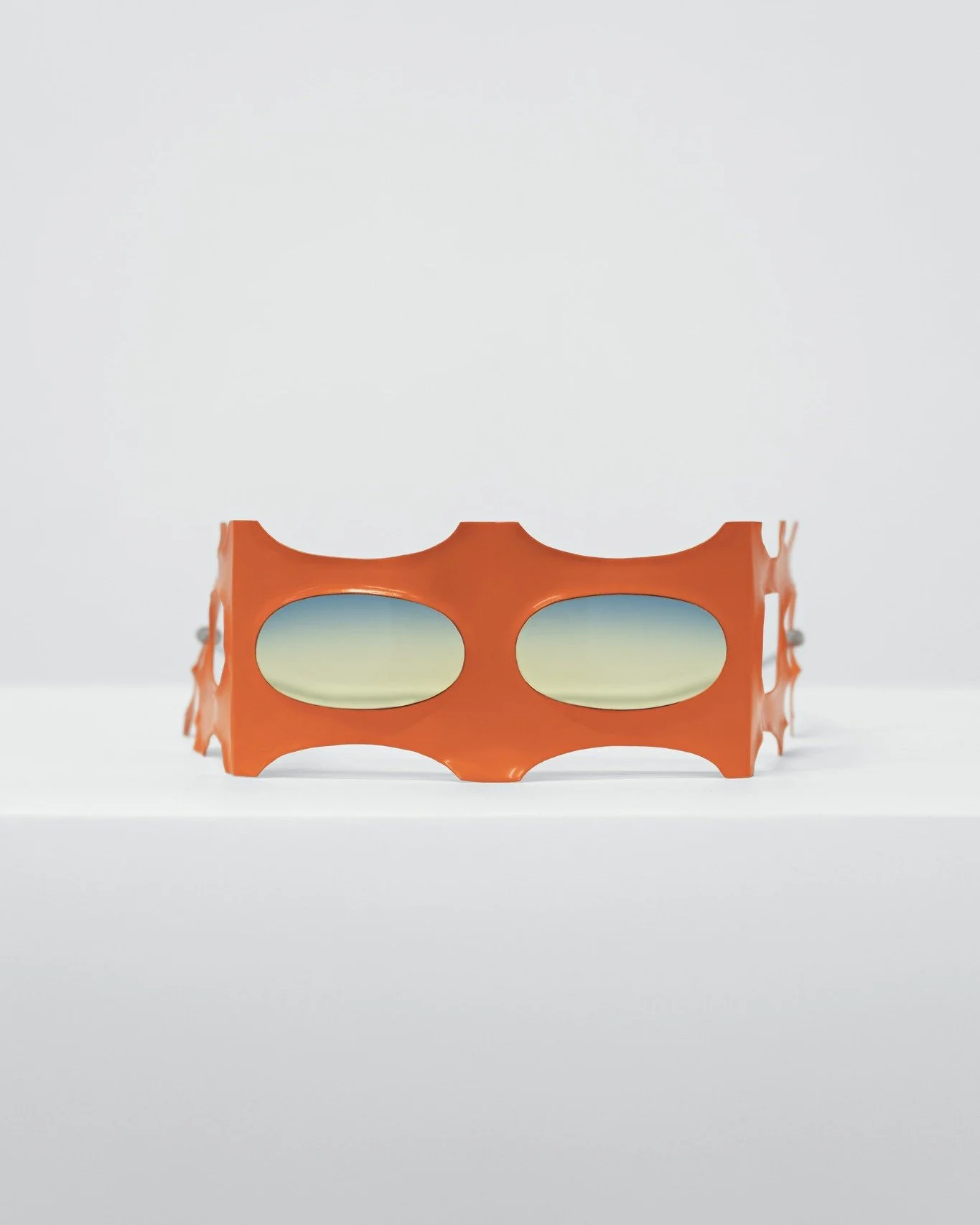
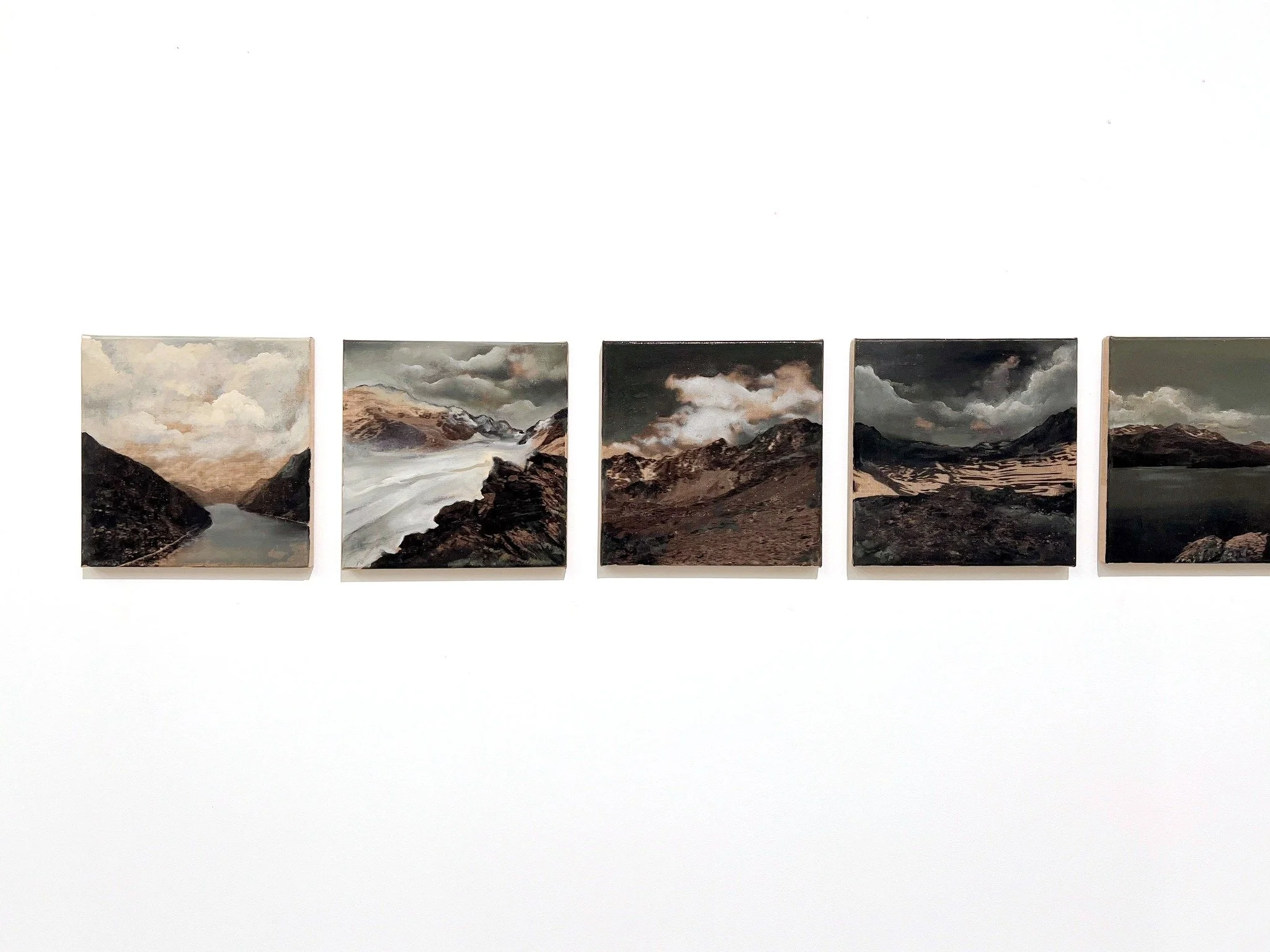
Kfir Galatia-Azulay Darash is an architect, engineer, multidisciplinary designer, and artist. In his practice, architecture defines the framework, scale, rhythm, and light; interior design addresses the body and the human experience; product design approaches detail, material, and physical contact; and art allows an idea to move beyond function and become emotion, memory, and interpretation.