
10 Questions with Yuying Herr
Yuying Herr is a multidisciplinary visual artist whose practice moves between digital worldbuilding, expanded illustration, and speculative image-making. Working at the intersection of technology, memory, and emotional perception, she constructs immersive visual architectures that question how human experience is reshaped in increasingly hybrid realities.
Herr has received international recognition from institutions such as The One Show, ADC The Young Ones, Communication Arts, the Society of Illustrators, and Collision Awards, among others. Her visual language has also extended into collaborations with global brands, including Ford, Dell, Sephora, and others, where she develops narrative-driven systems that merge technological precision with poetic sensibility.
Born in China and working in the United States, Herr’s practice reflects a shifting movement between cultural identities, emotional states, and digital landscapes. Her works have been published, exhibited, and circulated across international art and design contexts, contributing to contemporary dialogues on the aesthetics of the future and the evolving role of the artist within technologically mediated environments.
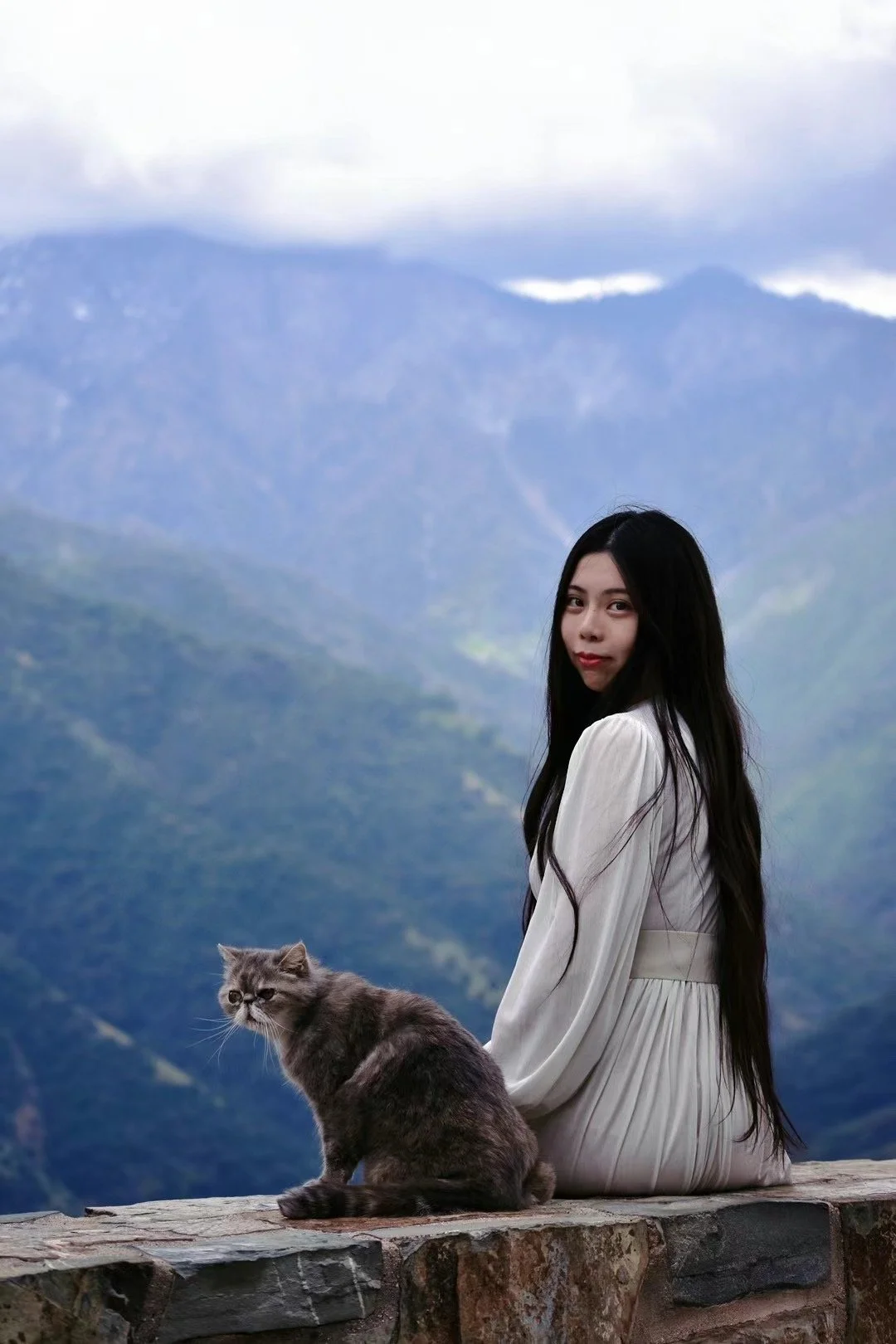
Yuying Herr - Portrait
ARTIST STATEMENT
Yuying Herr’s work investigates the fluid boundary between the emotional and the virtual. Her practice explores how memories mutate within digital space, and how emerging technologies can become instruments for reconstructing subjective perception. Through a hybrid methodology that includes 3D simulation, digital painting, hand-drawn notation, and AI-driven experimentation, she creates visual systems where architecture, myth, and psychological space converge.
Her environments often appear suspended between states, neither physical nor entirely synthetic, forming speculative habitats that challenge dominant notions of identity, matter, and temporal continuity. Liquid forms, mirrored structures, and translucent bodies recur throughout her work, functioning as metaphors for the instability and permeability of contemporary human experience. Herr’s imagery can be understood as an ongoing research process: an inquiry into how emotion can be spatialized, how memory can be treated as a sculptural material, and how the digital realm can serve as an extension of intimate interiority. Through her practice, she seeks to construct portals that invite viewers into spaces of transformation, contemplation, and expanded sensorial awareness.
Ultimately, Herr envisions the visual realm as a site where personal mythologies and future imaginaries can coexist, a space where the shifting textures of human feeling are rendered visible through the evolving languages of digital art.

Gates of Becoming, Digital Illustration, 3840x2160 px, 2025 © Yuying Herr
INTERVIEW
Please share a bit about your background and how you first became interested in visual art.
I am Yuying Herr, a multidisciplinary Motion Designer and Visual Artist based in Los Angeles. I hold a dual background with an MFA in Illustration and an MA in Motion Media Design. To be honest, my entry into the art world has a bit of a funny backstory. As a child, I struggled academically. My mother heard that art students required lower academic scores for university admission, so she sent me to art classes as a pragmatic solution. However, I unexpectedly discovered a genuine passion for it. What started as a backup plan became my life's calling. This led me to pursue art formally from middle school through high school, majoring in Animation for my undergraduate studies, and eventually brought me to the US to further specialize in Illustration and Motion Media Design.
What led you to develop a multidisciplinary practice between digital worldbuilding, illustration, and speculative imagery?
It stems from a desire to expand the boundaries of storytelling. With my MFA in Illustration, I loved crafting narratives and static aesthetics, but I often felt that the worlds I drew wanted to breathe and move. Pursuing my MA in Motion Media Design was the bridge. It allowed me to take the core sensibilities of illustration, color, composition, and emotion, and translate them into immersive, three-dimensional spaces. I realized that by combining these disciplines, I wasn't just creating an image; I was building a world. Digital tools became the medium that let me visualize 'speculative' ideas that couldn't exist in reality, blending the tactile feel of illustration with the limitless possibilities of digital environments.

Marble, Digital Illustration, 3840x2160 px, 2024 © Yuying Herr
Being born in China and working in the US, how did working across different cultures shape your artistic perspective?
I view my background as a dialogue between 'depth' and 'breadth.' China provided the depth. The culture is steeped in history and grand, intricate worldviews. It taught me the importance of substance and storytelling, even if the visual trends there can be more traditional or conservative. The US provided the breadth. Just like its culture of immigration, the American art scene is incredibly inclusive and eclectic. It encourages you to break rules. This cross-cultural experience shaped my practice by allowing me to be a hybrid. I don't just replicate traditional Chinese art, nor do I simply follow Western trends. Instead, I use the diverse digital tools and experimental styles I learned in the US to tell the rich, complex stories rooted in my heritage.
What initially drew you to digital tools and technology as core elements of your practice?
Actually, my roots are deeply planted in traditional media. Up until graduate school, I worked almost exclusively with hand-drawn techniques. The turning point came around 2017. I witnessed a massive shift in the Chinese advertising market where motion graphics began to dominate the landscape. I realized that dynamic art wasn't just a trend; it was the future of visual storytelling. This realization pushed me to transition from analog tools to digital software like Photoshop and Illustrator. My goal was specific: I wanted to prepare my assets for After Effects. Making this switch allowed me to bring my static drawings to life, unlocking a whole new realm of possibilities for my work that paper and pencil alone couldn't achieve.

Into the Metaverse, Digital Illustration, 2160x3142 px, 2021 © Yuying Herr

Reach out, Digital Illustration, 2160x3142 px, 2021 © Yuying Herr
Can you walk us through your creative process, from an initial idea to the construction of one of your immersive visual environments?
My creative process is a blend of traditional discipline and modern AI efficiency. In my 'traditional' workflow, I follow a linear path: brainstorming, sketching, coloring, and, crucially for motion, separating layers to prepare assets for After Effects. It's a method built on precise, manual control. Recently, however, I've shifted to an AI-augmented system to keep up with the industry's rapid evolution. Now, I use a unified workflow connecting tools like Midjourney, Jimeng, and Kling. I start by generating high-fidelity visuals, use AI video tools to simulate motion, and then return to my roots in Photoshop and After Effects to refine, composite, and polish the final result. This allows me to bypass the tedious parts of production, like manual layer separation, and focus purely on the creative direction and world-building.
You work with methods ranging from 3D simulation to hand-drawn marks. How do you choose which techniques to use for a particular project?
Ultimately, the client's preference sets the direction. But when I have room to maneuver, I prioritize techniques that can carry the maximum amount of visual information and texture. Take my background design work for the Dell G16 Gaming Laptop as an instance. Instead of using standard 3D rendering, I utilized a 'Faux 3D' technique, creating dimensional spaces entirely through 2D hand-drawing. I chose this because I wanted to retain the warmth and intricate details of the human touch. While 3D is powerful, it can sometimes feel too sterile. By painting the light and shadow manually, I achieved a depth that mimics 3D but retains the unique, illustrative quality that defines my style, all while keeping the production timeline manageable.
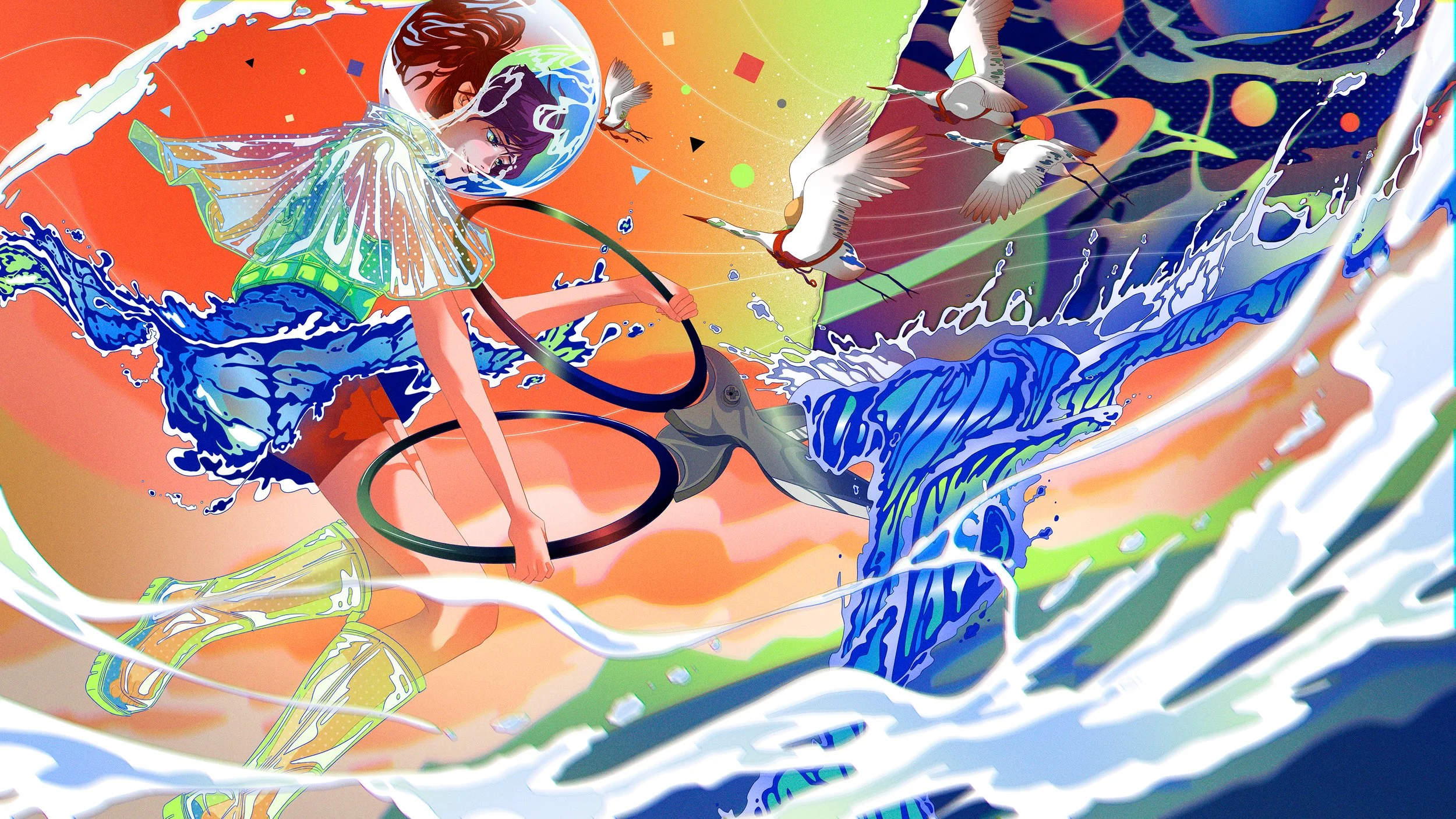
Rain, Digital Illustration, 3840x2160 px, 2024 © Yuying Herr
Memory and emotion play a big role in your work. How do these themes influence the imagery you create?
I believe human memory and emotion are singular because they are rooted in the accumulation of 'accidents' that make up a life. The entire process of existence is a sequence of improbabilities: the specific day my parents met, the single sperm among millions that formed the zygote, whether it snowed in my hometown the winter I was born, or the specific friends I’ve crossed paths with. Every choice is fraught with uncertainty; they are all distinct accidents. Yet, when strung together, these random accidents forge a path that is inevitable and utterly unique. This philosophy shapes how I approach every theme in my work. I oscillate from the macro to the micro, and back to the macro, searching through the chaos to find that one specific, unique narrative thread.
Your visuals often exist in hybrid, in-between states. What interests you about these liminal spaces?
I perceive the universe not as a solid whole, but as a construct made of spatiotemporal fragments. To me, every single instant at every specific location holds a unique significance, whether it’s the scenery of the moment, the temperature in the air, or the profound impact that second has on a person's life. These fragments, loaded with information, emotion, and imagery, interlace and coalesce to form the material universe we see. This is exactly what draws me to liminal, hybrid spaces. I believe the most beautiful state of existence is to drift among these fragments. It is a state filled with uncertainty, yet within that flux, one is still walking a path that is resolute and absolutely irreplaceable.

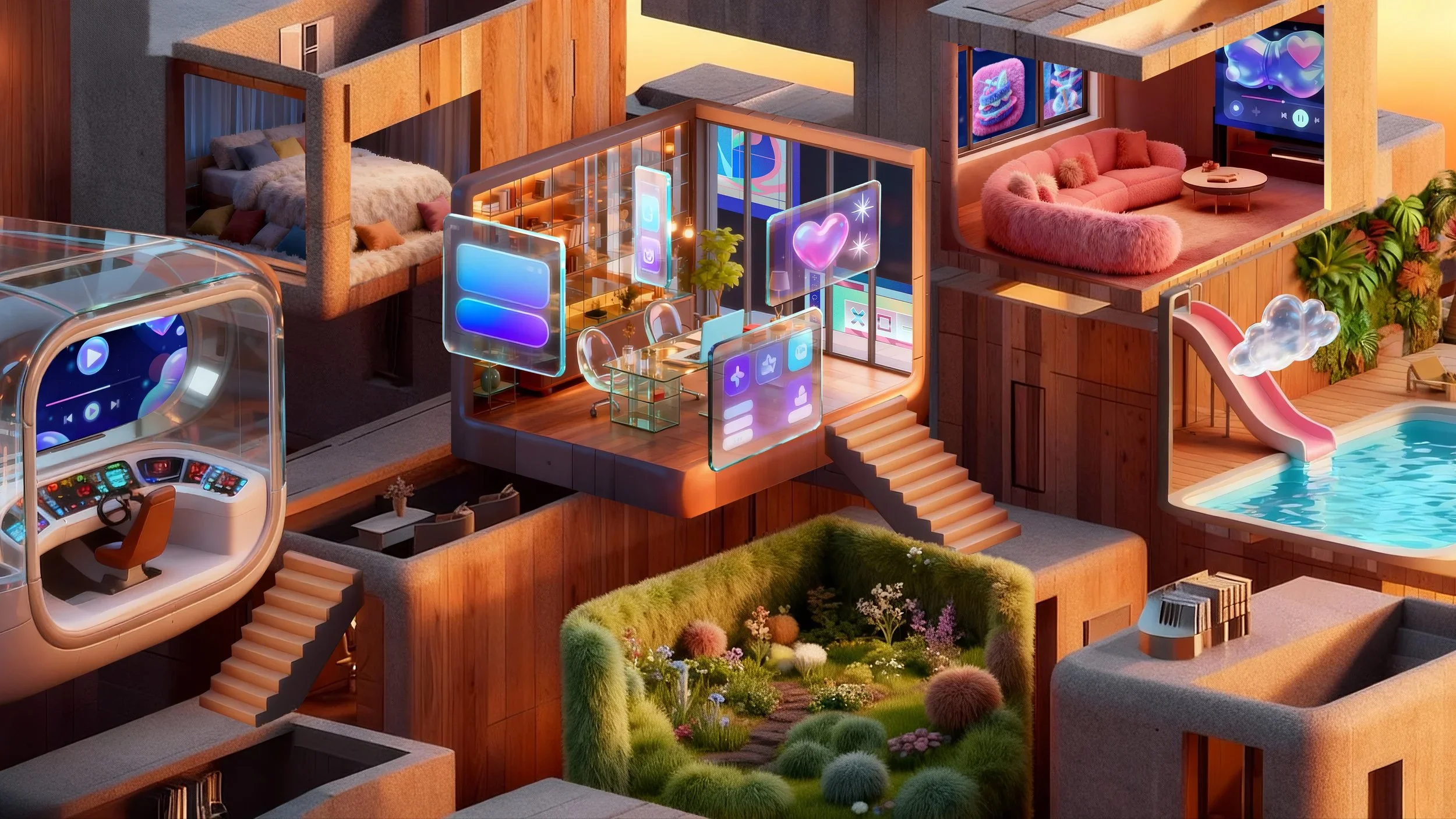
Rooms 1, AI-assisted Digital Image, 3840x2160 px, 2025 © Yuying Herr
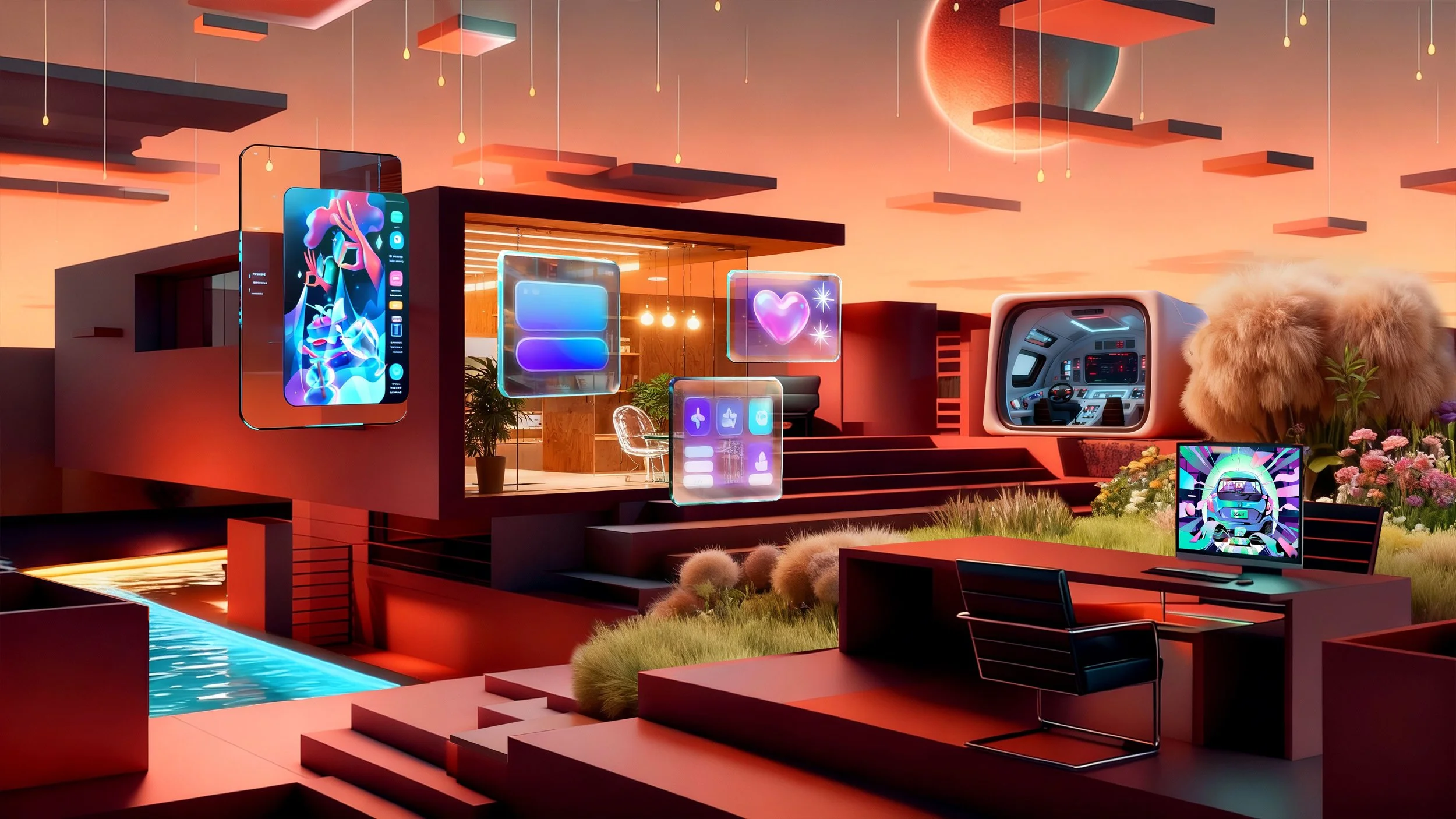
Rooms 2, AI-assisted Digital Image, 3840x2160 px, 2025 © Yuying Herr
How do collaborations with global brands influence or expand your artistic research?
Collaborating with global brands is like attending a masterclass in high-level design. Every major brand possesses a distinct and rigorously established Visual Identity (VI), often crafted by the world’s top agencies and artist teams. The biggest challenge, and the most rewarding part, is to create something fresh and innovative while staying strictly within their brand framework. I approach this by deconstructing their design systems. By analyzing their core philosophies and summarizing their aesthetic logic, I gain a deeper understanding of how top-tier visual languages are built. Working within these constraints doesn't limit me; instead, it forces me to find new inspiration inside the framework, which significantly expands my own artistic vocabulary.
Lastly, what future directions or projects are you excited to explore as digital technologies continue to evolve?
Frankly, I see AI becoming an inseparable part of the creative process. It is an inevitable shift, though I admit it feels bittersweet. Technological progress is undeniably compressing the survival space for artists, forcing us to find a way forward in an increasingly suffocating environment. But my response is not to retreat; it is to adapt. I recently challenged myself to create a full animated short in just six hours by unifying five AI tools into one workflow. Through this experiment, I realized that the future of art lies in agency. Artists must stop viewing AI as a competitor and start treating it as a complex instrument. The only way to survive is to become the director, mastering these tools to ensure that the human vision remains the guiding force behind the algorithm.
Artist’s Talk
Al-Tiba9 Interviews is a curated promotional platform that offers artists the opportunity to articulate their vision and engage with our diverse international readership through insightful, published dialogues. Conducted by Mohamed Benhadj, founder and curator of Al-Tiba9, these interviews spotlight the artists’ creative journeys and introduce their work to the global contemporary art scene.
Through our extensive network of museums, galleries, art professionals, collectors, and art enthusiasts worldwide, Al-Tiba9 Interviews provides a meaningful stage for artists to expand their reach and strengthen their presence in the international art discourse.


João Prosperi is a Brazilian editor and visual artist based in Los Angeles. His work is driven by an interest in images and the technologies used to create them. Drawing from a background in editing, photography, and post-production, he often works across different tools and formats, combining digital and analogue processes in search of unexpected visual results.