
10 Questions with Hao Wu

Hao Wu - Portrait
Hao Wu is a designer and artist with a background spanning architecture and interior design. Born in China, he has long been fascinated by diverse cultures and traditions, which deeply influence his work. After moving to the United States in 2016, Hao earned an MFA in Interior Design and began integrating a rich blend of skills, materials, and global inspirations into his practice. While he embraces digital media, he approaches it with a traditional mindset, ensuring that craftsmanship and artistic integrity remain central to both his art and interior design work.
In 2023, he returned to traditional watercolor painting, merging his experience and skills to create works that harmonize innovation with timeless beauty. Now working at one of the world’s leading architectural firms, his artistic practice is not separate from his design work but an essential component of his interior design approach. He continues to explore the intersection of design, art, and cultural narratives, bringing his passion for cities, buildings, and history into both his artistic creations and spatial designs.
sites.google.com/view/haowuarts | @haowu_design
ARTIST STATEMENT
Design is not only Hao Wu’s career but also his lifestyle. As a designer, he resists rigid definitions, choosing instead to explore whatever inspires him. When he draws through the lens of an interior designer, he reconstructs images in his mind and creates a dreamlike world shaped by imagination. Through this process, ordinary elements encountered in everyday life are transformed into objects that exist at the boundary between reality and illusion. He records this transformation using all the tools and skills at his disposal.
His goal is to capture both the physical reality of a building and the emotional experience it creates. By incorporating traditional calligraphy and storytelling, he adds depth to his work, connecting the past with the present. Regardless of how technology evolves, he believes true beauty comes from the time and effort an artist invests in their craft. Every stroke and every detail matters. For Hao, art is about honoring tradition while creating something new.
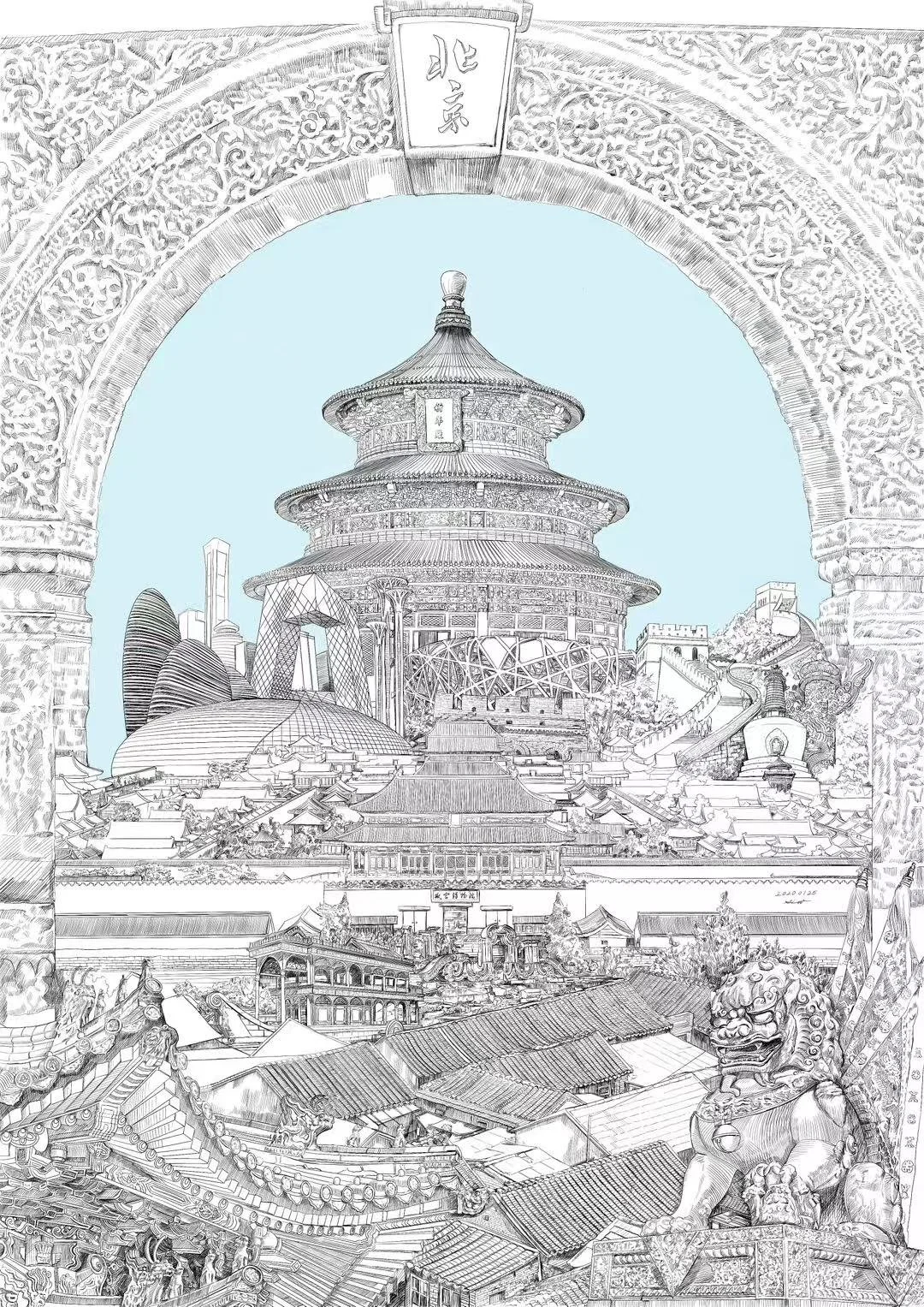
Beijing © Hao Wu
INTERVIEW
How did your training in architecture and interior design shape the way you approach art today?
My training in architecture and interior design has strongly shaped the way I approach art today. Unlike purely aesthetic disciplines, architectural education focuses heavily on mechanics, physics, psychology, and economics. It teaches you to understand real-world requirements and limitations, budget, materials, structure, and context, and to work creatively within them.
In architecture, a design choice is not just about what looks good; it must be supported by analysis and respond to the current situation. Rather than saying “I feel this is right,” a designer must be able to explain “why “it works. This mindset has stayed with me in my art practice.
Although I create art driven by passion, I almost always apply a logical check to my process. I consider multiple ways of working before arriving at a result, carefully placing objects and colors where they make the most sense. My work is informed by an understanding of physical space, material reality, economics, and society.
Because of this background, my artistic process is guided more by analysis and logic than by emotion alone. Passion is essential, but structure, reasoning, and awareness of the world give my work depth and intention.
Growing up in China and later moving to the United States, how have different cultures influenced your work?
Growing up in China and later moving to the United States has influenced my work in a very practical way. Chinese culture has a long history and big regional differences. For me, it works like a logic library for art. I can take many kinds of materials and references from it. Chinese culture is more focused on criticism than praise, which encourages modesty. Because of this, my work made in China is usually quiet, balanced, and controlled.
I’m glad that the first city I moved to in the U.S. was New York. It has a large and diverse population, with many cultures and ways of thinking existing together. They influence each other but still remain independent. This was the first time I understood that art doesn’t need to focus on what is “right,” because a single absolute right doesn’t exist. I visited many galleries and absorbed pop art, contemporary art, and work in different media. These experiences added new layers to my library and pushed my work to become bolder.
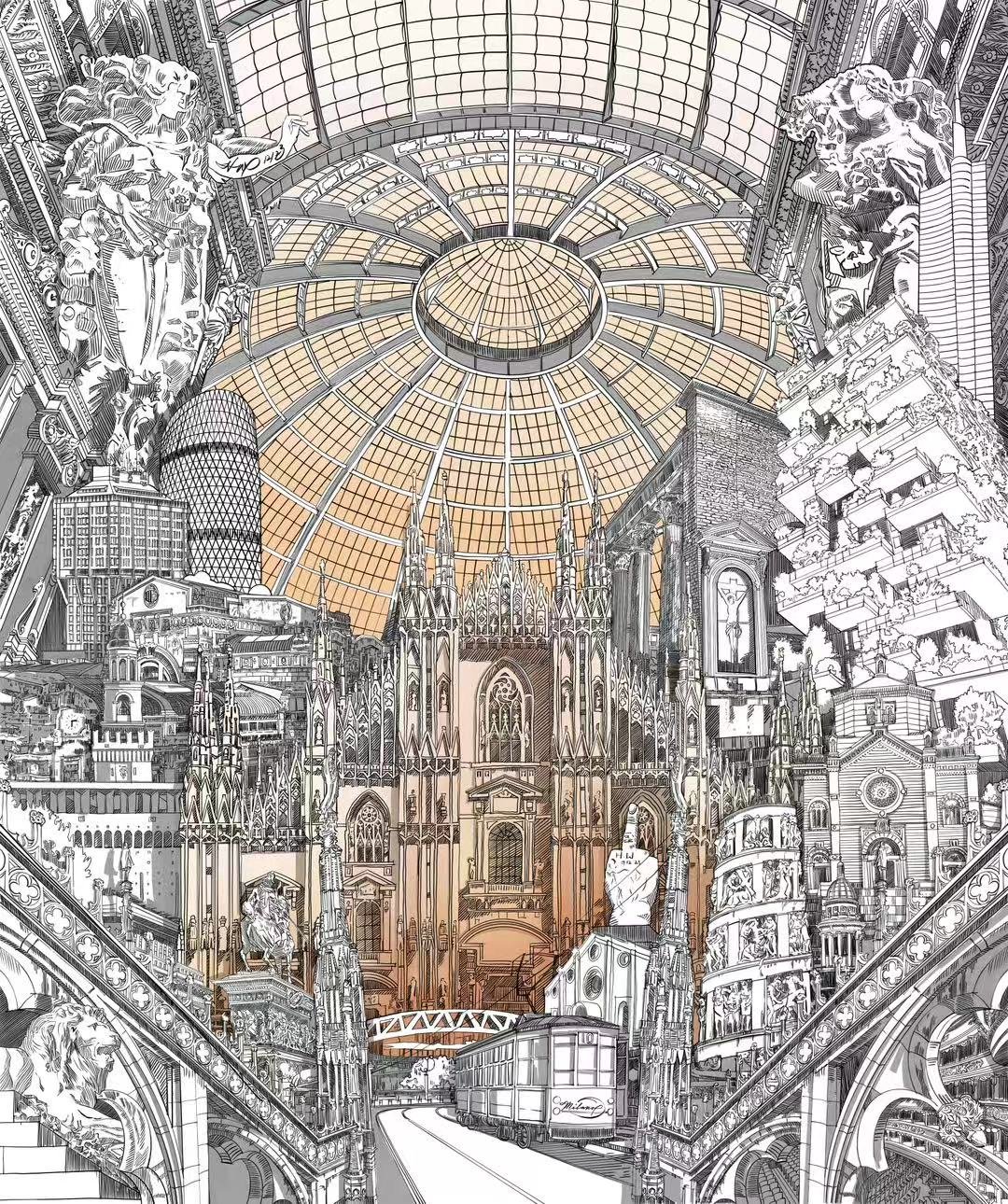
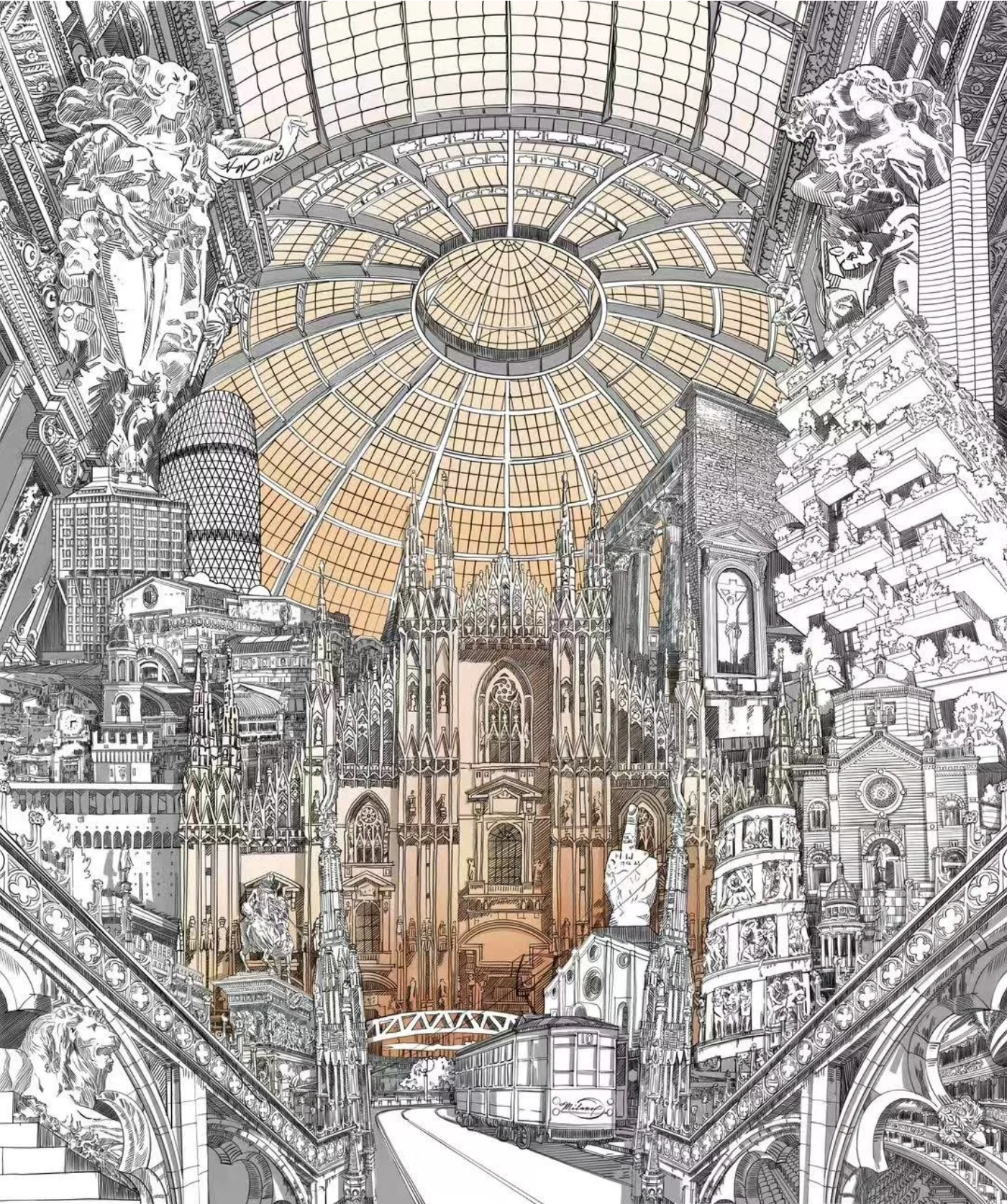
Milan © Hao Wu
You describe design as both your career and your lifestyle. What does that mean in your everyday practice?
I believe design is something you cannot separate from daily life. It is not only my career but also my lifestyle. The core of design is creativity. Creating a specific space for a client is my job. At the same time, we all live inside spaces designed by others every day.
When I go to a restaurant, I do not think about the food first. I think about the space. I imagine the layout, where the kitchen is, and where the restroom is. I notice how customers, food, and staff move through the space. Then I look at the design of the interior, the style, the materials, and what could be improved. This process only takes a few seconds, but I build the whole space in my mind.
After that, I even look at small details like the menu. I notice the layout, the fonts, the food photos, and the names of the dishes. I think about why certain names make me feel excited or not. I think about the purpose behind these choices.
I cannot stop doing this because design is already part of my life. I believe this happens to most designers. If someone likes to study building details or knock on walls and furniture, they are probably a designer.
What drew you back to traditional watercolor painting in 2023?
I learned watercolor briefly during my first year in architecture school, but I soon stopped and switched to digital media. I enjoy drawing digitally and often use watercolor-style effects. Digital tools have many advantages, such as unlimited canvas size, easy editing, and accurate color control.
In 2023, one of my friends, who illustrates architectural drawings in watercolor, encouraged me to return to traditional watercolor painting. He suggested that I try working with real materials instead of simulations and gave me a lot of support.
Traditional watercolor is very different from digital media. Pigments settle on the paper, and unexpected effects appear when layers mix. If the paper is not completely dry, unwanted patterns can form. Different pigments also react chemically and can create dull or gray areas. These limits can be difficult, but they are also what make traditional watercolor interesting.
I spent about three months learning to control this technique. During that time, I painted around 100 watercolor works and shared them with friends during a gallery night.
How do you balance digital tools with a traditional, craftsmanship-focused mindset?
I do not see digital tools and traditional craftsmanship as opposites. This may be because I started as a designer before becoming an artist. I do not focus on specific skills or media. I chose the most practical method to reach my goal. For me, the idea and what the work communicates are more important than technique.
Recently, I won a rug design competition. I started the project with traditional watercolor because that natural feeling is difficult to achieve with digital tools alone. After that, I scanned the painting and refined it on the computer. The watercolor created the organic quality, and the digital process helped turn it into a finished product. Neither approach alone could achieve the final result.
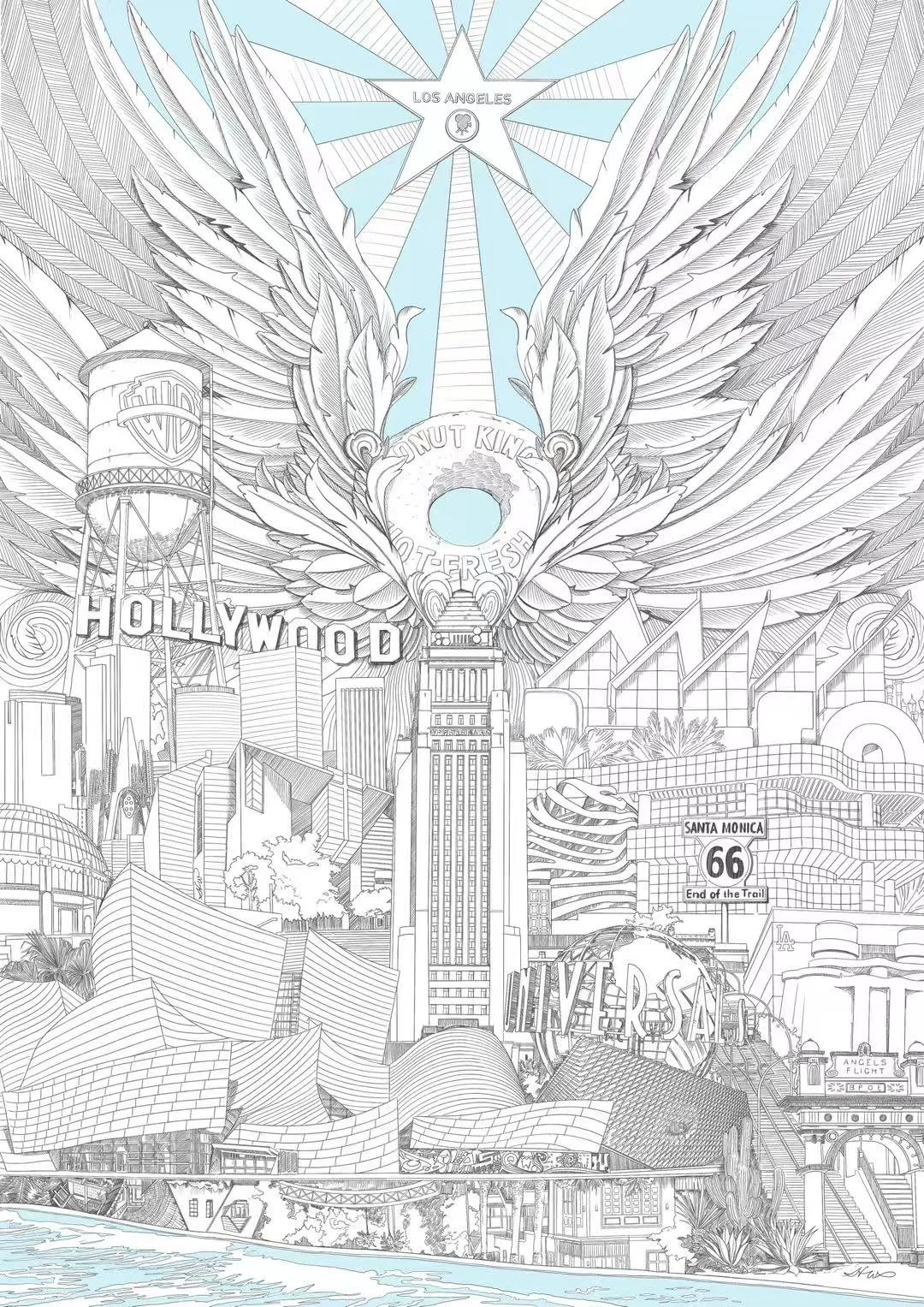
Los Angeles © Hao Wu
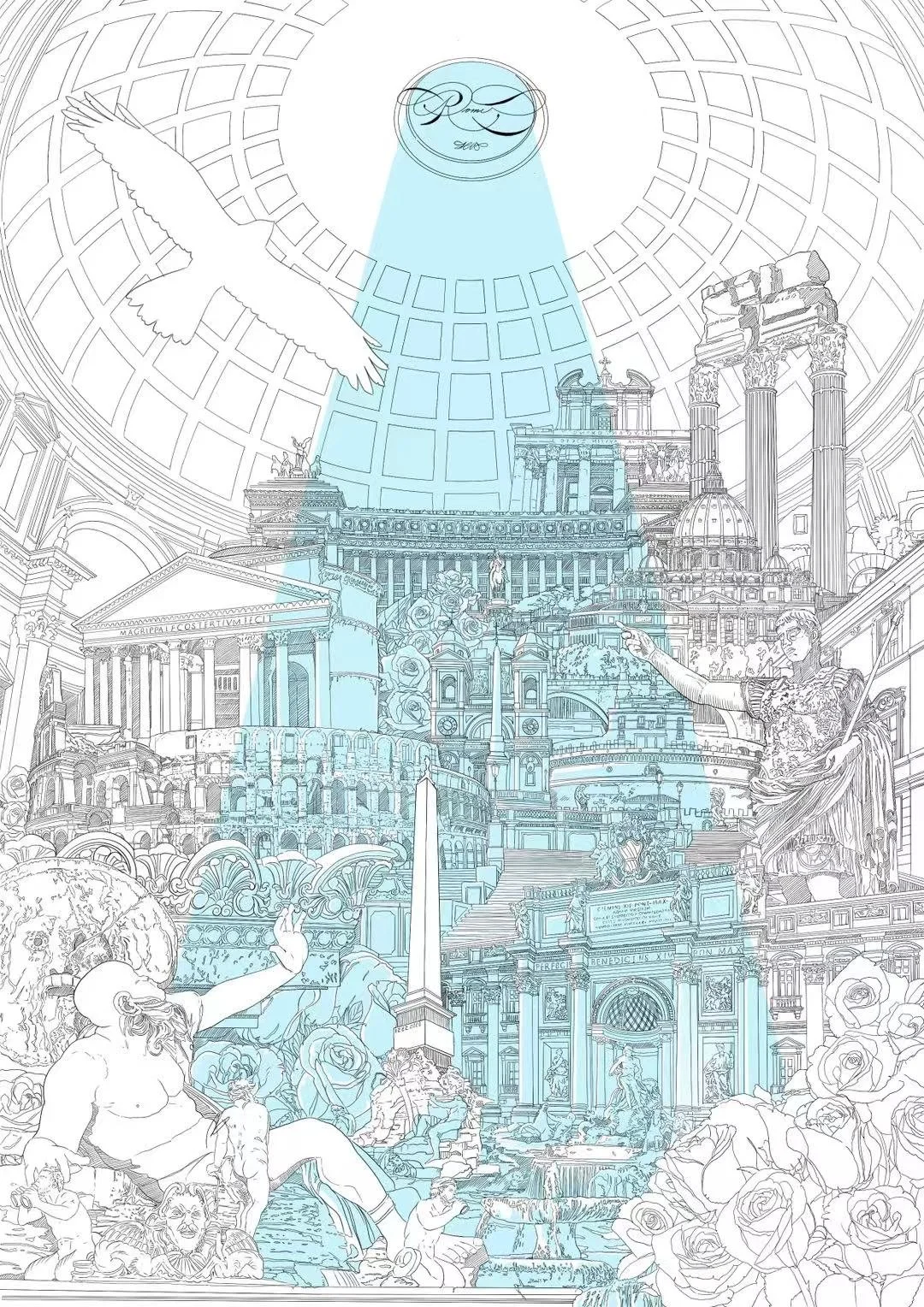
Rome © Hao Wu
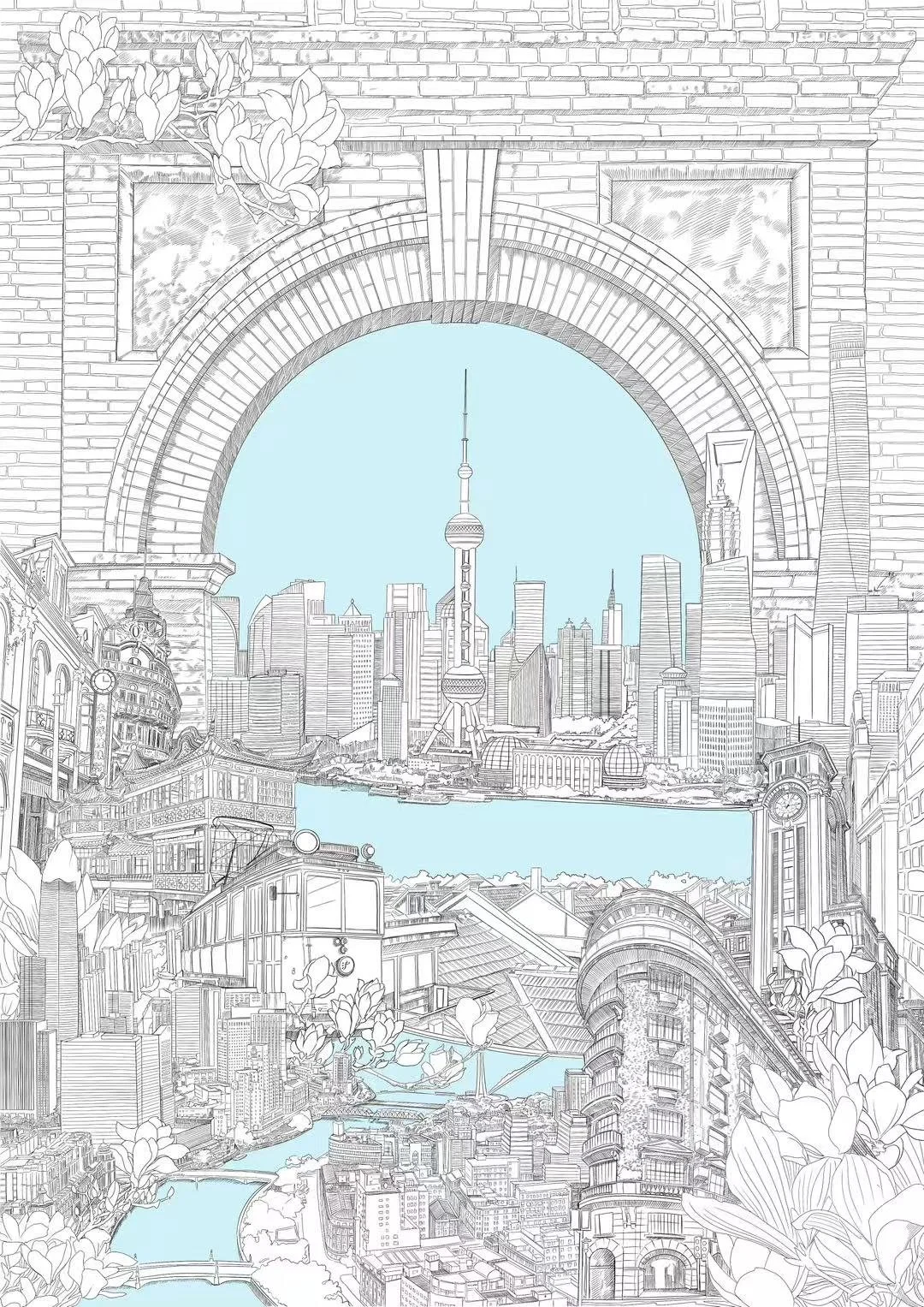
Shanghai © Hao Wu
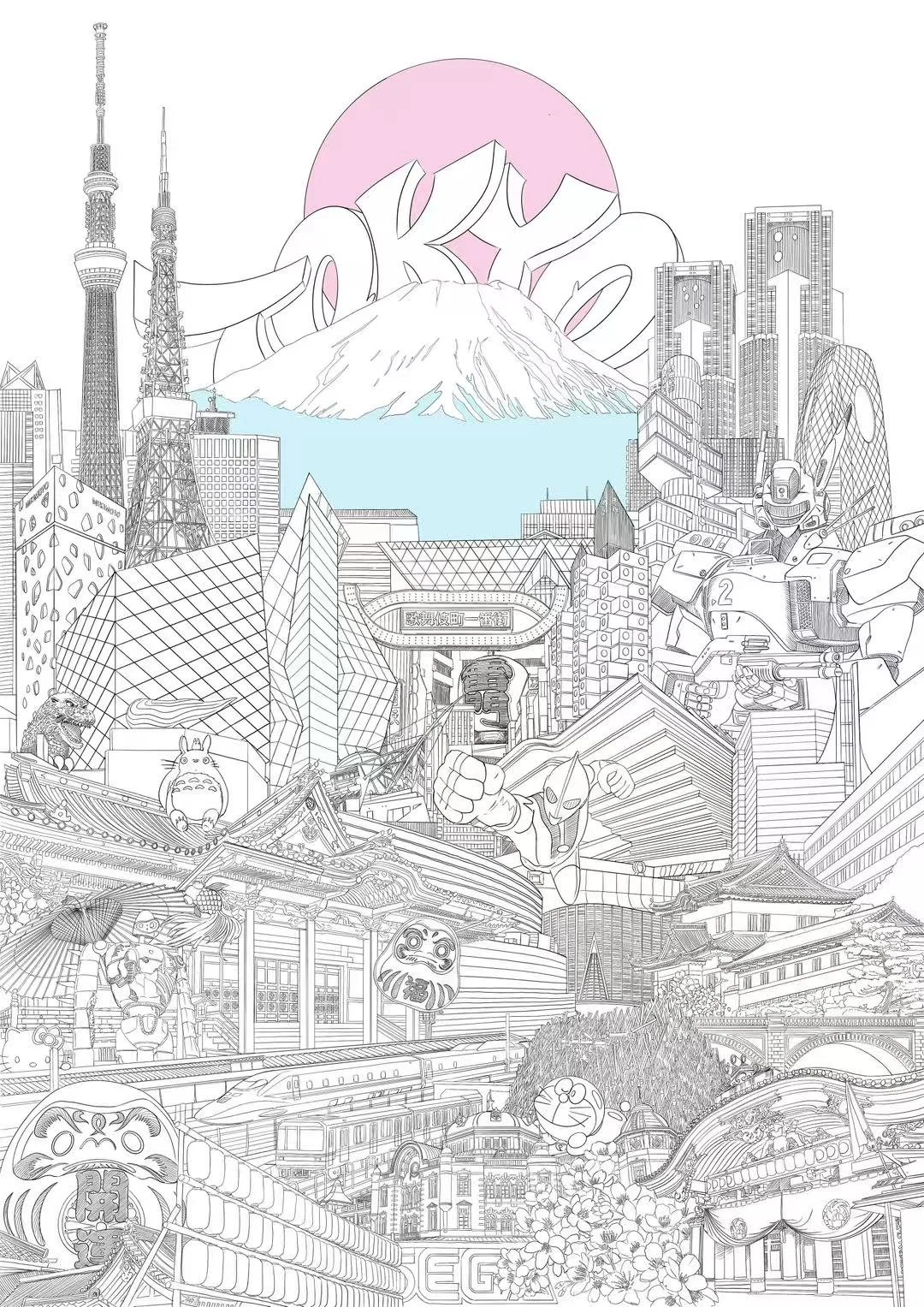
Tokyo © Hao Wu
When you say your work exists between reality and illusion, how do you translate that idea visually?
When I talk about my work existing between reality and illusion, I translate this idea through simplification and transformation. For one swimming center, I created an art mural when I designed the interior. The corridor was long and boring, so I used the theme of the sea to change the feeling of the space. Instead of painting realistic fish, I transformed them into geometric shapes. I focused on the feeling of the underwater world, such as the movement of water, waves, smooth sand, stones, and shipwrecks. I simplified these elements and combined them into one composition.
In my city series, most of the images are based on cities I have visited. However, when I change the scale, rebuild the space on paper, and add imagined elements and background colors, the result becomes unreal. The space feels like something that can only exist in a dream. The buildings themselves carry meaning, and placing them in specific locations allows me to express my personal feelings about each city.
Cities, buildings, and history appear often in your work. What attracts you to these subjects?
This may come from my background as an architectural designer. I believe a good building should be unique. It should respond to its site, history, society, environment, budget, and function. A building should be right for its specific location and not something that can be copied and placed somewhere else.
Because of this way of working, I spent a lot of time analyzing surrounding buildings and the history of local communities. Over time, I developed a strong interest in cities, buildings, and history, and these subjects naturally became part of my work.
How do calligraphy and storytelling help you connect the past with the present in your art?
For Chinese people, calligraphy is more than just beautiful writing. It carries the spirit of the calligrapher. Words are believed to have a mysterious power. For example, writing good wishes on red paper is thought to bring more luck than even praying in a temple.
By including these words in my art, I can create a stronger narrative. Calligraphy allows me to connect the past with the present, adding meaning and cultural depth beyond what a simple sentence could express.

Rijin Doujin, digital paint, 2021 © Hao Wu

Zhao cai jin bao, digital paint, 2021 © Hao Wu
We are witnessing the rise of revolutionary technologies. How do they impact and influence your practice as both an artist and an interior designer?
I call 2025 my “AI year” because I started using AI tools a lot and made them part of my design workflow. In my interior design work, AI helps me work more efficiently. Interior design is a business, so efficiency is important.
For art, I like to enjoy the process and take my time. I’m glad to be a designer who can use new technologies without fear of being replaced. Even when I use AI, I only use it to generate what I imagine, not to replace my thinking.
New tools help me cross skill barriers that would normally take a lot of time, money, or equipment to achieve. For example, AI can animate my renderings in just a few minutes.
I am always excited about new technologies because they help a designer or artist reach their goals more easily. They give me more time to think and to enjoy the creative process.
Looking ahead, how do you see your work evolving? Are there any upcoming projects or series you would like to share with our readers?
I am continuing my cities series, and right now I am working on Washington, D.C. In this series, I focus more on the symbolic and creative aspects of each city rather than just copying it. I also plan to explore new styles in my work. Will use some new techniques for the new collection.
When the weather gets warmer, I will return to more outdoor watercolor sketching as well. These projects will let me continue experimenting while staying connected to both cityscapes and the natural world.
Artist’s Talk
Al-Tiba9 Interviews is a curated promotional platform that offers artists the opportunity to articulate their vision and engage with our diverse international readership through insightful, published dialogues. Conducted by Mohamed Benhadj, founder and curator of Al-Tiba9, these interviews spotlight the artists’ creative journeys and introduce their work to the global contemporary art scene.
Through our extensive network of museums, galleries, art professionals, collectors, and art enthusiasts worldwide, Al-Tiba9 Interviews provides a meaningful stage for artists to expand their reach and strengthen their presence in the international art discourse.


Lumi Liu is a New York–based designer and visual artist working at the intersection of art, medical visualisation, and public expression. Her practice explores consciousness, hidden biological systems, and the multiple dimensions of life that exist beyond human awareness. Lumi transforms these invisible biological architectures into poetic artistic experiences.