

10 Questions with Francesca Busca
Francesca Busca is an eco-artivist by philosophy and mission, a rubbish artist by identity, and a waste mosaicist by technique. Her practice emerges from the undefined intersection of art, activism, and environmental urgency, where aesthetics meet ethics, and discarded materials become catalysts for change. A former City solicitor who transitioned to art in 2015, she abandoned conventional career paths to pioneer art made entirely from waste, her "trashure." Having lived and worked across Italy, England, France, and the USA, she draws on a rich tapestry of cultural experience to inform a practice rooted in global awareness and local engagement. Graduating with distinction in Mosaic and Fine Arts from the London School of Mosaic in 2019, Francesca sources her materials not from suppliers but through community engagement and activist missions, which she considers her most meaningful research residencies. As a member of Project One Wave, she retrieves ghost fishing gear and marine debris directly from the environment on activist missions, transforming them into urgent commentary on ecological collapse. Her 'trashure', ranging from hairdresser foils to medicine vials and fruit nets, is donated by local communities around the country and beyond. By collecting and recontextualising these everyday discards, she dismantles disposable culture and proves that refuse holds intrinsic value. Each collaborative artwork of deconstructed materialism becomes a vehicle for behavioural change, shifting perceptions of what waste and art can be.
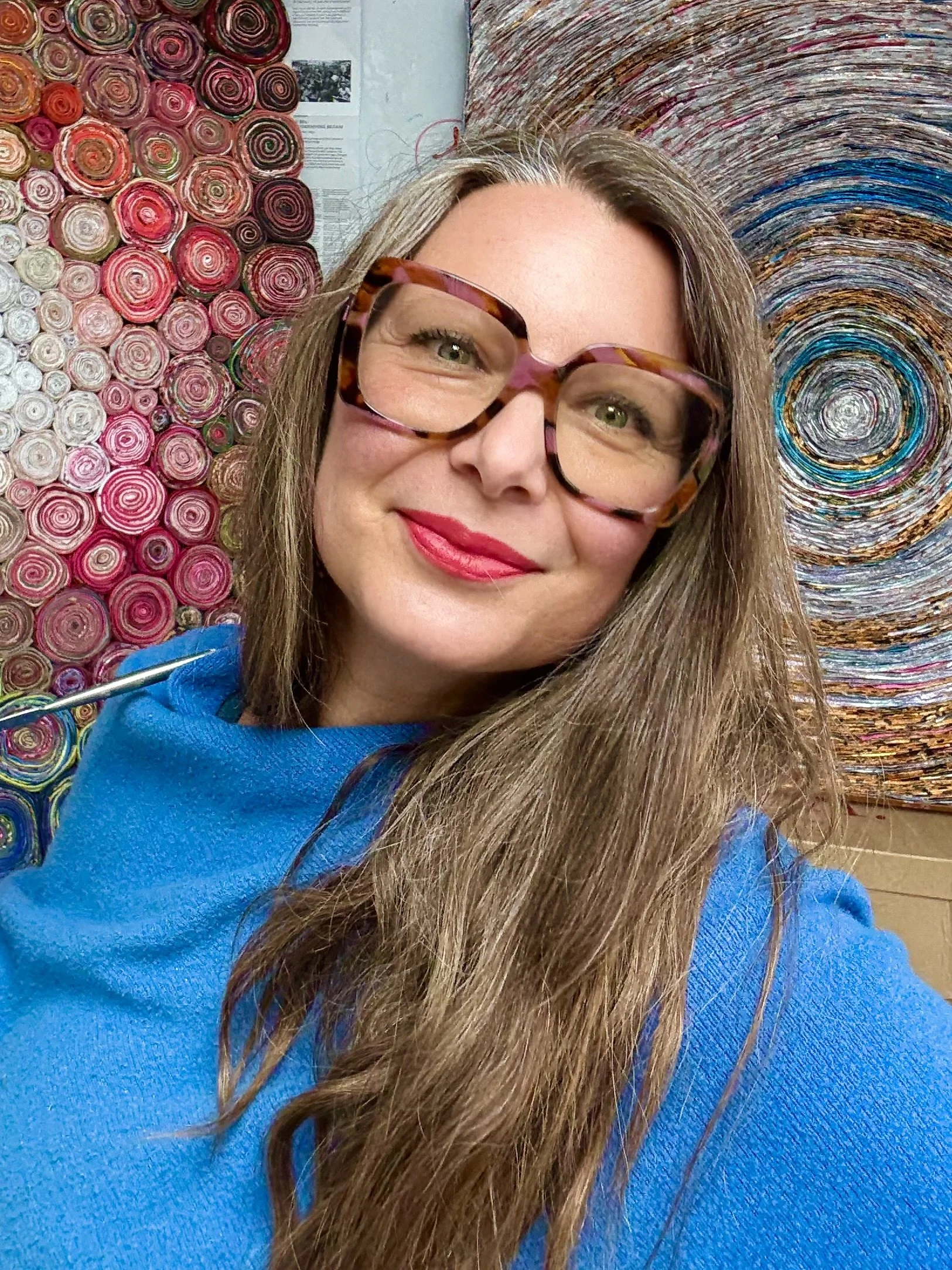
Francesca Busca - Portrait
Her quest is to explore the metamorphosis of materials and push the boundaries of mosaic and art, uncovering the value in pre-existing resources to achieve maximum social engagement with minimal environmental impact. Her unique visual language as a waste mosaicist transforms society's detritus into prime material, questioning who defines value, beauty, and artistic legitimacy. The more beautiful her creations, the clearer her message: from waste to wonder. Her hopeful artworks protest throwaway lifestyles and envision systemic rethinking, from anthropocentric values to the common good of the whole. She believes art is the closest thing to a universal language and the very fibre of empathy and connection. As such, she uses it as a means to spark dynamic conversations, build cross-sector networks, and complete the circle of resource reuse through both collection and visual materialisation into artworks. Most importantly, as a means to trigger the viewer's empathy towards all forms of consciousness, shifting perspective from anthropocentric to holistic.
Her eco-artivism is Gesamtkunstwerk, an all-encompassing life practice. She is vegan, avoids plastic, wears second-hand, uses renewable energy, sources local food, saves water, gardens, and hasn't flown in four years. These choices are not separate from her art, they are its foundation.
She works outside traditional art market structures, challenging aesthetic and economic hierarchies through alternative models like Payment in Kind(ness)© (accepting eco-actions as payment) and ArtforTrash© (creating art from clients' waste). Her practice embodies the tensions between industrial production and natural systems that define our era, offering a radical reimagining of how art can function in society.
A former teacher at the Italian School in London (where she also lectured in Fine Arts 2021-22), she regularly delivers eco-artivist talks across sectors - from classrooms to boardrooms - and continues to voice environmental concerns from positions often overlooked by mainstream institutions, creating new possibilities for art's relationship with reality. A contributor to periodicals in the US and Italy, Francesca is a member of Insights Of An Eco Artist, ActforEaling, BAMM, ArtCan, VAA, and Mensa. Her work has been exhibited internationally in hundreds of exhibitions and recognised with many awards, including, most recently, the 2025 Visual Art Open Art Educator Award. She donates 10% of her ArtforTrash income to ocean conservation organisations and is always open to eco collabs of all sorts.
Currently collaborating with the University of Birmingham, the London Transport Museum and CNR-ISMAR in Venice, Francesca is the founder of GREENy bastARTs - an international eco-artivist collective of artists, scientists and activists which bridges environmental understanding and transformative action across Europe. The platform offers tools, networks, and resources to educate and empower anyone to join the Change. Through the collective, she is developing a major 10-day eco-artivist exhibition during London Climate Action Week 2026, addressing six environmental urgencies through collaborative practice and various multidisciplinary, cross-sectoral events.
A Monument to Summer (Too), Waste Mosaic. 100% waste (discarded Actimel bottles, buttons, fruit nets, ring pulls, business cards and leftover strings on recycled fabric), 100x100 cm, 2025 © Francesca Busca
INTERVIEW
What first inspired you to transform waste into art, and how did that moment shape your path as an eco‑artivist?
Coming from an environmentally conscious family where guerrilla tree planting was a weekend hobby, my upbringing naturally re‑emerged stronger with time as I developed my artistic practice. After transitioning from City law to art in 2015 and graduating with distinction from the London School of Mosaic in 2019, my technique instinctively developed as a growing urge to replace precious new materials for my tesserae with pre‑existing objects that were otherwise destined for discarding. In times where nature is suffocating in plastic and resources are consumed in around half the sustainable period globally, I believe we should and can stop plundering Earth for new resources unnecessarily-that what we treat as disposable actually has value and should be given a chance to be useful, with the aim of not only reducing but preventing waste altogether.
How do you choose the materials you work with, and what draws you to a particular piece of “trashure”?
My creative process begins with community collaboration. I sort and clean my “trashure,” then arrange them in my studio by type and colour. I work intuitively, and most of the time the work is material-driven, so I have to make do, which I love because it requires constant adaptation while thinking on my feet.
I also choose materials based on what I am trying to represent. For Paraflornalia, which reimagines underwater worlds as thriving gardens, I transformed everyday items of waste, such as fruit nets and coffee pods, into marine‑inspired creations. The series represents marine life as precious gardens depicted in mythology or religion as the perfect place, be it paradise, the Elysian fields, or the Garden of Eden. For this vision, I chose specific items which best conveyed that concept: fruit nets for their coral‑like structure, Actimel bottles for their organic forms, buttons for texture and detail, and other materials that could capture both the abundance and delicacy of underwater ecosystems. I treasure the material limitations this process involves, always striving to find the most environmentally integral solution rather than the quickest or prettiest.

Ray, Waste Mosaic. 100% waste (fabric, plastic, paper, foil), 62x76 cm, 2025 © Francesca Busca
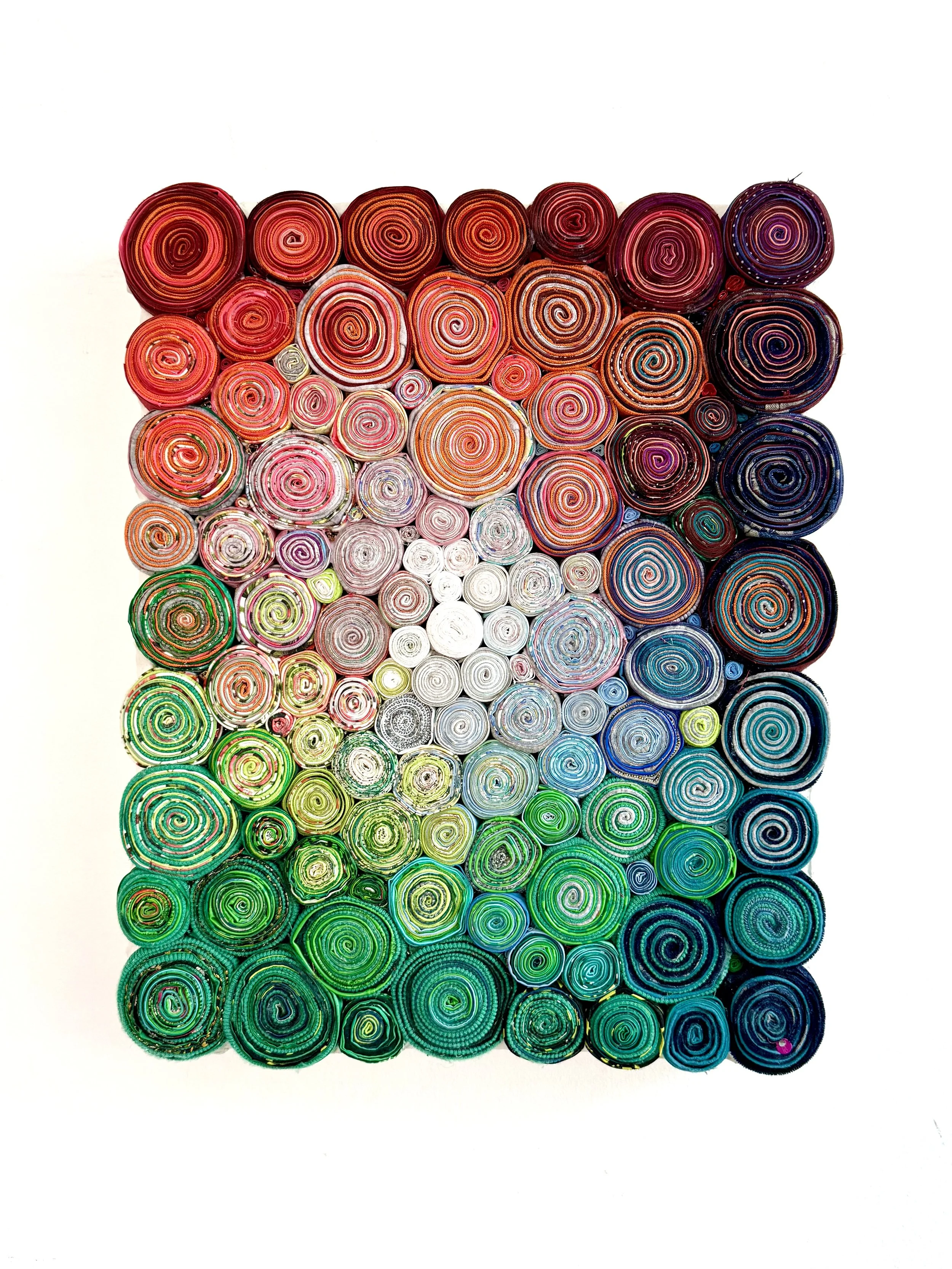
Sev, Waste Mosaic. 100% waste (fabric, plastic, paper, foil), 41x51 cm, 2025 © Francesca Busca
Can you describe what happens, artistically and emotionally, when a discarded object becomes part of your mosaics?
The process is meditative yet purposeful, transforming what most consider rubbish into intricate mosaics. The satisfaction I gather in transforming the discarded into something of use and of beauty is immense. Every tessera I create is in itself a protest against our disposable lifestyle, providing a different perspective on rubbish.
Each piece I make is emotionally charged, drenched in love and hope (with a few exceptions that are cathartically imbued with surrender). In my world, rubbish acquires new value and meanings, becoming the undisputed protagonist of my artworks, from waste to wonder, as I transform them into something as joyful and beautiful as I can master. The more beautiful the artworks become, the clearer the message.
What role does community play in your process of collecting materials and creating artworks?
Community collaboration is fundamental-friends, organisations, and partners collect waste materials that would otherwise reach landfills. The community collaboration element adds shared purpose, creating an “ecosystem of care.” There is nothing better than coming home and finding some bags of trashure waiting for me on the front porch, or receiving a message from Halcyon Interiors saying that they have a bag full of caps for me to collect (which they are collecting along the whole of Wigmore Street and its elegant kitchen showrooms).
With my ArtforTrash initiative, I use clients’ own waste to create artwork for corporate offices, institutional, and private settings. The staff is involved from the very beginning, as they are the ones who collect the rubbish for the artworks, in the hope that they will see value in those disposable objects.

Coral Greef, Waste Mosaic. 100% waste (1000+ fruit nets, collected over 6 yrs), 100x100 cm, 2024 © Francesca Busca
How does your activist work, especially retrieving marine debris, influence the way you approach your art?
Project One Wave, with the Captain Paul Watson Foundation network, focuses on marine clean‑up campaigns and inspires my mission to transform ocean waste into art. My ongoing relationships within Project One Wave, a remarkable and rapidly expanding network of extraordinary people from diverse backgrounds, all united by a shared commitment to saving our oceans, continue to shape my practice profoundly.
My experience as an activist is my most useful residency. Beach cleaning and helping the retrieval of ghost gear from the ocean are essential to understand how deeply plastic pollution has already infiltrated nature, and also how hard and resource‑demanding its retrieval is in all of its forms, from ghost gear to nurdles. I would suggest a similar experience should be a compulsory part of everyone’s work-I would seriously think it would make anyone think twice before discarding anything out of place, if not, hopefully even rethinking buying it in the first place. Everything we do, everything we dispose of, one way or another, ends up in our oceans.
My residency at CNR‑ISMAR in Venice deepened my understanding of marine science, bridging art and environmental research. During my ten‑day residency, I created a site‑specific installation, titled Sea it!, using trash collected by CNR‑ISMAR in its offices, laboratories, research vessel, and offshore research platform. For my latest series in the past couple of years, my primary inspiration comes from marine ecosystems, from the Pitter-Patters, to Metafauna, Paraflornalia and Ripples of Change. It is an ongoing research on ways to make the viewer empathise with our seas, developing around our familiarity with everyday objects and the immediate connection we instinctively feel with beauty, by exploiting the symbolism of flowers to express the beauty of life underwater as a thriving, precious garden.
You often speak about shifting perspectives from anthropocentric to holistic. How do you hope viewers feel or think differently after seeing your work?
My practice centres on expanding human empathy beyond our species to encompass all life forms and catalysing systemic shifts from anthropocentric to holistic thinking. I believe art is the closest form to a universal language; it has the power to bridge science and the public, helping viewers empathise with all of life’s forms and conveying the urgency to rethink our societal system, shifting from anthropocentric thinking to one focused on the common good of the entire ecosystem. Art has the power to create a network that spans all sectors of society, enabling efficient collective efforts towards planetary health.
I hope viewers experience wonder at the transformation-seeing beauty where they previously saw rubbish-then feel empowered to reconsider their own relationship with waste and consumption. I believe art can awaken the consciousness shift we desperately need, from a mindset of domination to one of kinship, from treating things as disposable to honouring them with reverence, from isolation to an awareness of our deep interconnection with all living forms.
What challenges do you face working outside traditional art market structures, and what freedoms does it offer?
The greatest challenge is balancing artistic integrity with environmental messaging without being preachy and staying true to my values. Creating compelling visual work that stands alone aesthetically while carrying deep ecological meaning requires constant refinement.
Another significant challenge is finding the right category to fit within the structure of the art world. I pioneered waste mosaic as a technique, creating true mosaic tesserae from waste materials rather than assemblage, and as far as I am aware, I am quite unique in this approach globally. This distinctiveness, while allowing my work to hold its own and gain recognition both within the broader art world and specifically within the international mosaic community, does not always align neatly with existing categories and exhibition frameworks.
There is also the ongoing challenge of helping the art world appreciate what I call “meaningful imperfection”, encouraging collectors and institutions to see imperfection as representing sustainability, which should be recognised as an added value of the greatest importance, rather than focusing solely on the smoothness of the end result, even when that smoothness comes at great cost to the environment and to ethical practice.
Practically, working exclusively with waste materials presents technical challenges-each piece demands innovative solutions since traditional art supplies are off‑limits. Financially, sustainable art practice is difficult; materials are free, but the time investment is enormous.
My alternative models-Payment in Kind(ness), whereby I accept environmentally friendly actions as payment towards my artwork, and ArtforTrash, whereby I use clients’ own waste to create artwork-offer freedom to redefine value beyond monetary exchange and create new possibilities for how art functions in society.

Scottish Palette, waste mosaic. 100% waste (ghosr nets recovered from the sea through the Project One Wave missions), 26x26 cm, 2025 © Francesca Busca

Scottish Palette (detail), waste mosaic, 26x26 cm, 2025 © Francesca Busca

Scottish Palette (detail), waste mosaic, 26x26 cm, 2025 © Francesca Busca
Can you explain how your eco‑lifestyle choices integrate with your art practice on a daily basis?
My eco‑artivism is Gesamtkunstwerk, extending beyond my work: I am vegan, use one hundred per cent renewable energy, wear second‑hand clothes, avoid plastic where possible, source local food, save water, have a vegetable and wildlife garden, and have not flown for the past four years as I strive to live as sustainably as possible. The choices I make every day are part of the same continuum as the mosaics I create; life and art are inseparable in my practice.
I have also turned down opportunities that involved either flying or sending heavy pieces across the globe, and I am focusing as much as possible on the United Kingdom and Europe, which I reach by hybrid electric car. This extends even to how I host exhibitions-I have been encouraging visitors to bring their own glass (BYOG) to opening receptions since 2017, with the goal of getting people into the habit of bringing a drinking vessel around with them everywhere. While at first it seemed eccentric and impractical to many, it is finally taking off. At my last private view, out of seventy‑five guests, only thirty used one of our spare glasses; everyone else brought and used their own. And I made sure they were all drinking. Every aspect of my practice, from studio to exhibition space, reflects the same commitment to minimising environmental impact while maximising engagement and connection.
Which project or collaboration has most changed the way you understand the relationship between art and environmental action?
My residency at CNR‑ISMAR in Venice profoundly deepened my understanding of marine science, bridging art and environmental research. My interaction with the scientists and staff members of ISMAR was so impactful that it led to further ongoing collaboration. My work fostered a sense of community and promoted a greater understanding of environmental issues.
My continuous collaborations with local communities, with the London Transport Museum, and now with the Business School at the University of Birmingham demonstrate how art can bridge different sectors and create meaningful dialogue.
And lastly, Project One Wave: funnily enough, I was introduced to it a mere week before we unveiled our GREENy bastARTs collective, a dream of mine for a long while. They are based on the same principle of collaboration across different sectors, to create an efficient network which would enable significant resource pooling and reach to make a real difference. Project One Wave has been transformative, connecting me with passionate activists, marine biologists, makers and conservationists dedicated to protecting our oceans. I feel extremely fortunate to be among such knowledgeable, caring, change‑making people. There is something liberating and thrilling about belonging to such a group, where conversations start a couple of levels further down the line where they normally do, and thoughts can take off, where idealism becomes the norm and the basis upon which we concoct new ideas on how to make the world a better place - in the real world.
We recently held the Project One Wave summit in Glasgow and, although it was too short and too quick, the batteries of hope were completely recharged. It was exhilarating.
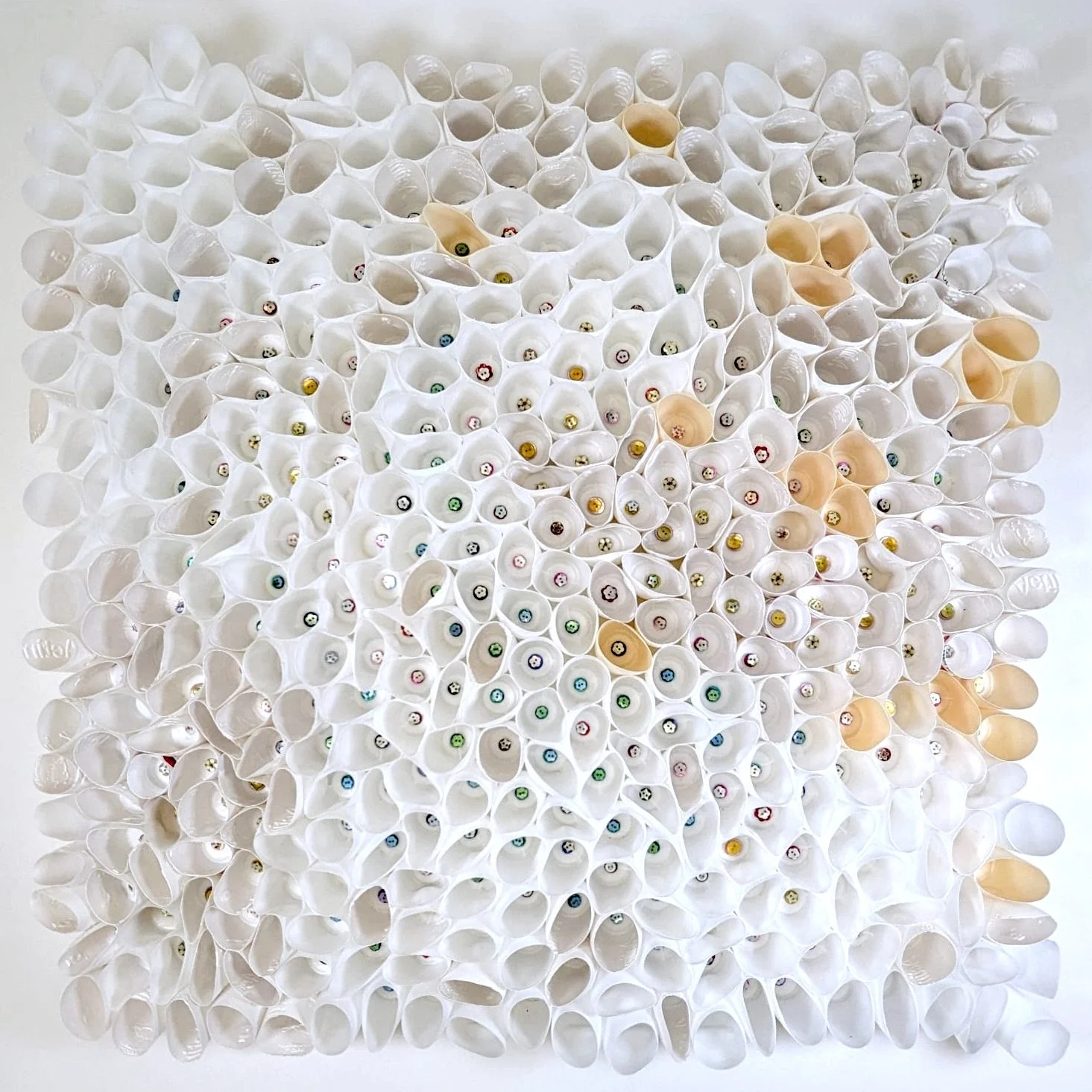
Metabarnacles, waste mosaic. 100% waste (actimel bottles and buttons), 76x76 cm, 2024 © Francesca Busca
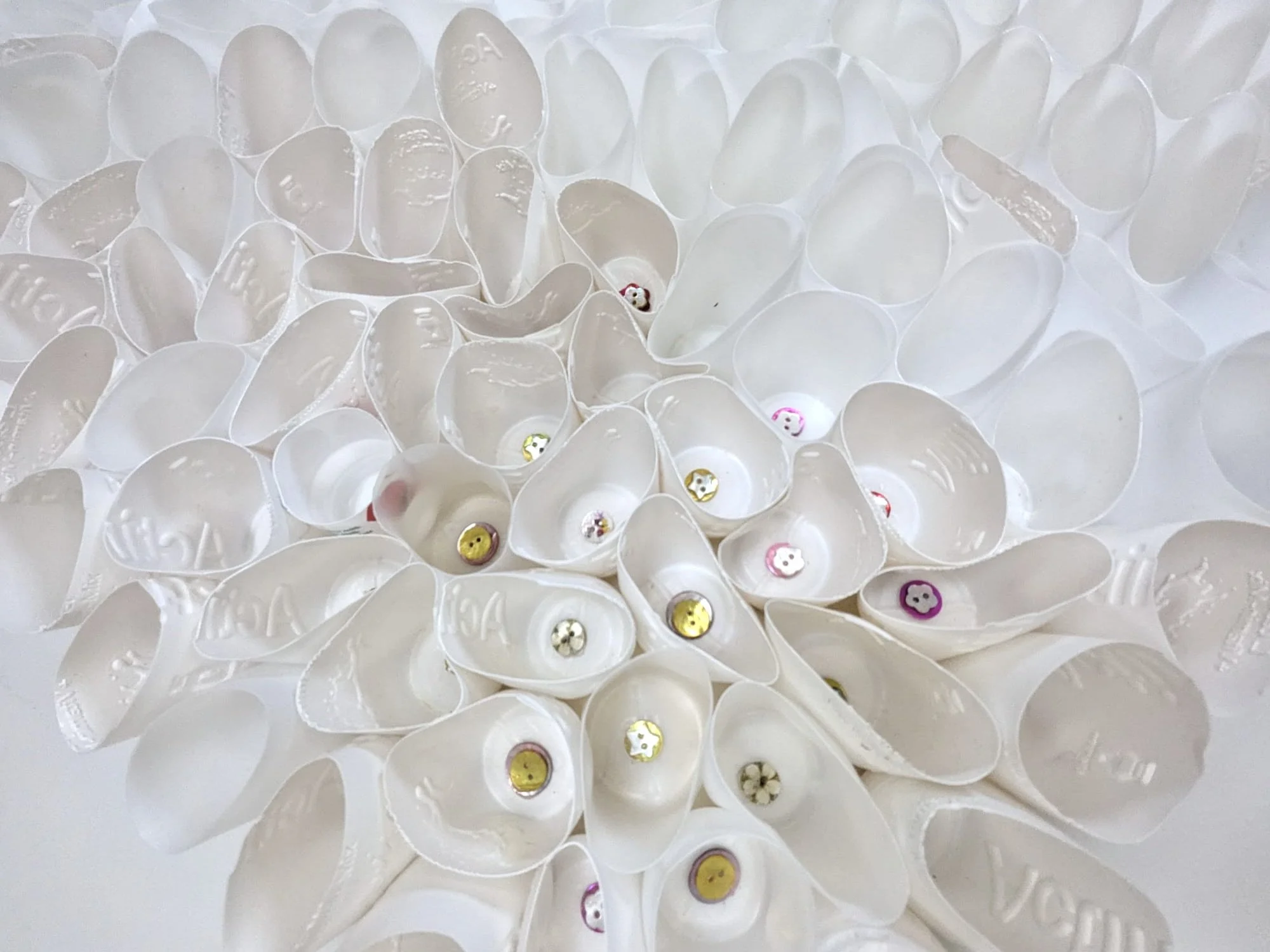
Metabarnacles (detail), waste mosaic, 76x76 cm, 2024 © Francesca Busca
Looking ahead to the eco‑artivist exhibition for London Climate Action Week 2026, what impact do you hope it will have on participants and audiences?
I am truly excited about KINDFIRE. This is what I am most thrilled about right now-it is the culmination of everything I believe art has the power to create cross‑sectoral networks and inspire meaningful change. KINDFIRE is a groundbreaking ten‑day eco‑artivist exhibition during London Climate Action Week 2026 (20–28 June) that will address six environmental urgencies through art, science, community engagement, and activism, with workshops, panel discussions with scientists and activists, and interactive sessions designed to turn abstract challenges into tangible, actionable steps.
I hope for many visitors to engage with art that changes their perception of environmental issues, with a majority leavingwith concrete action commitments that they actually implement as soon as they walk out the door. This is about demonstrating that environmental programming can be joyful, rigorous, beautiful, and transformative simultaneously. I want people to leave feeling empowered, connected, and equipped with real tools for change.
My vision is to establish GREENy bastARTs as an annual fixture in London’s cultural calendar, proving that we can build a movement that is both deeply serious about planetary health and a genuinely inspiring movement. This event represents everything I have been working towards. The wave is growing, and change is happening.
Artist’s Talk
Al-Tiba9 Interviews is a promotional platform for artists to articulate their vision and engage them with our diverse readership through a published art dialogue. The artists are interviewed by Mohamed Benhadj, the founder & curator of Al-Tiba9, to highlight their artistic careers and introduce them to the international contemporary art scene across our vast network of museums, galleries, art professionals, art dealers, collectors, and art lovers across the globe.





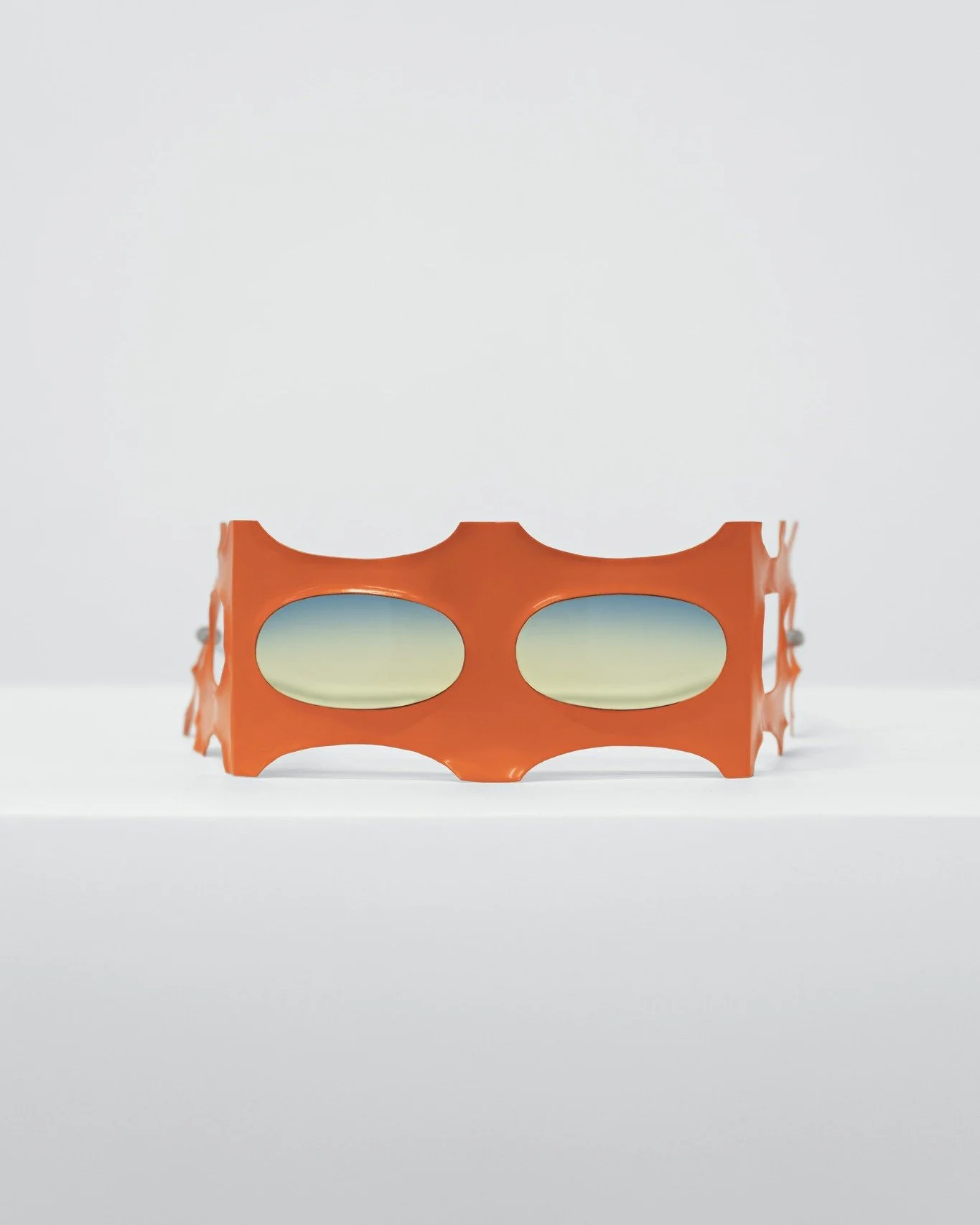
Yuhan Gu is a New York–based industrial designer whose work explores the intersection of function, emotion, and sculptural form. TACTO reflects Gu’s interest in the emotional relationship between people and the objects they keep close in their daily workspace. Designed as a cactus-shaped memo holder, the project transforms a familiar natural form into a playful and functional desktop object.