

10 Questions with Sergey Piskunov
Al-Tiba9 Art Magazine ISSUE20 | Featured Artist
Sergey Piskunov (b. 1989, Ukraine) is a hyperrealist painter based in the Netherlands. His large-scale figurative works merge classical oil painting with symbolic and gold elements, reflecting precision, depth and a meditative dedication to the craft. Each work unfolds through hundreds of hours of detailed execution, inviting the viewer into a quiet, intimate encounter. Sergey’s paintings have been exhibited internationally, including in the UK, Germany, the USA and other countries. His work has been featured in various magazines and media, including Beautiful Bizarre Magazine and the Dutch national TV project Sterren op het Doek. His paintings are held in private collections worldwide.
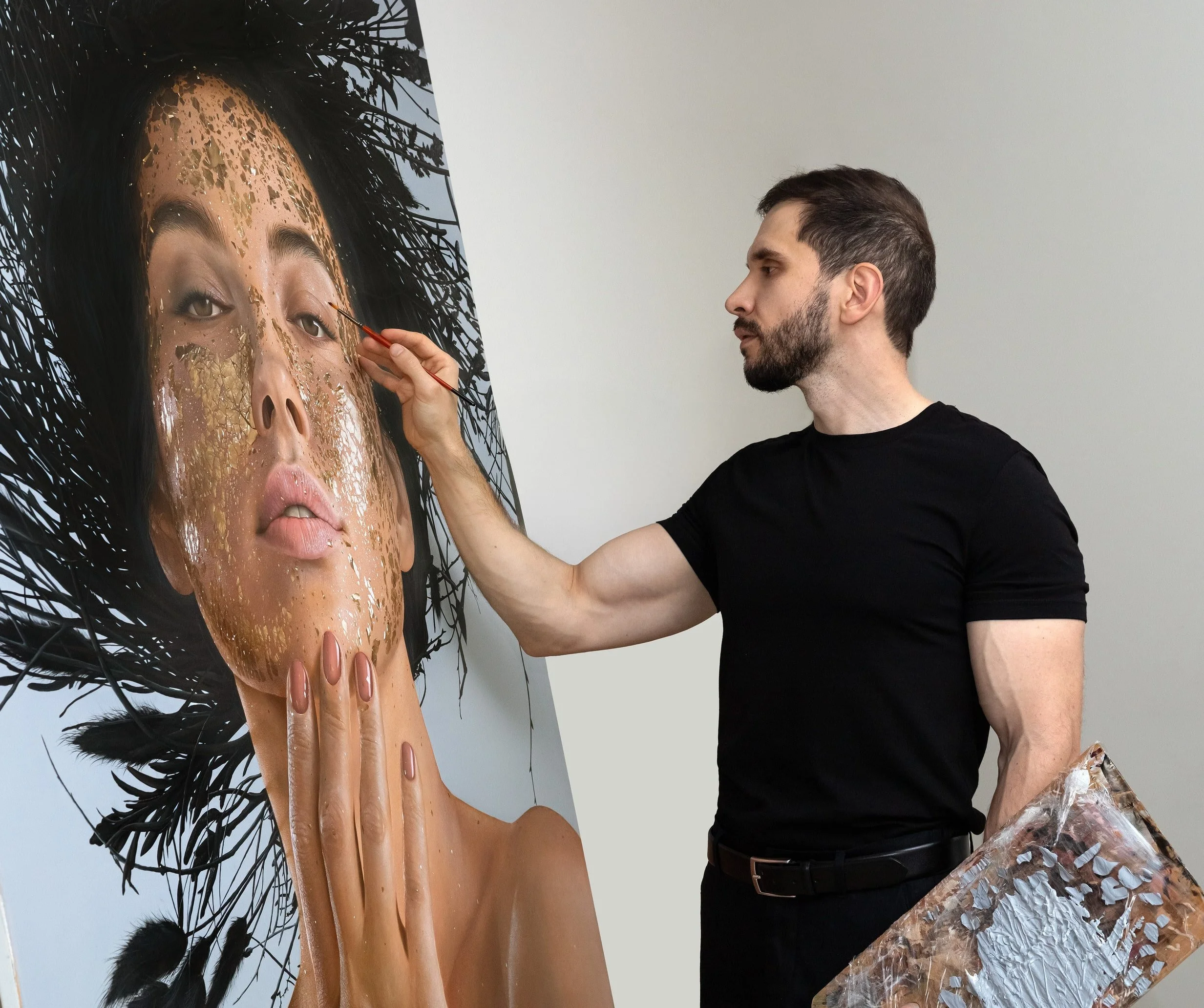
Sergey Piskunov - Portrait
ARTIST STATEMENT
Sergey Piskunov’s practice centres on the human presence, its beauty, vulnerability, and silent intensity. He works slowly and deliberately, building each painting through many layers of oil to capture not only physical form but emotional atmosphere. Detailed surfaces and gold elements serve as both symbolic and tactile components, heightening a sense of presence and stillness. Time is an essential material in his process: months of work distil into images meant to hold a viewer’s gaze and create a quiet space for reflection. Through realism, he seeks something beyond likeness, a feeling that lingers and invites contemplation.
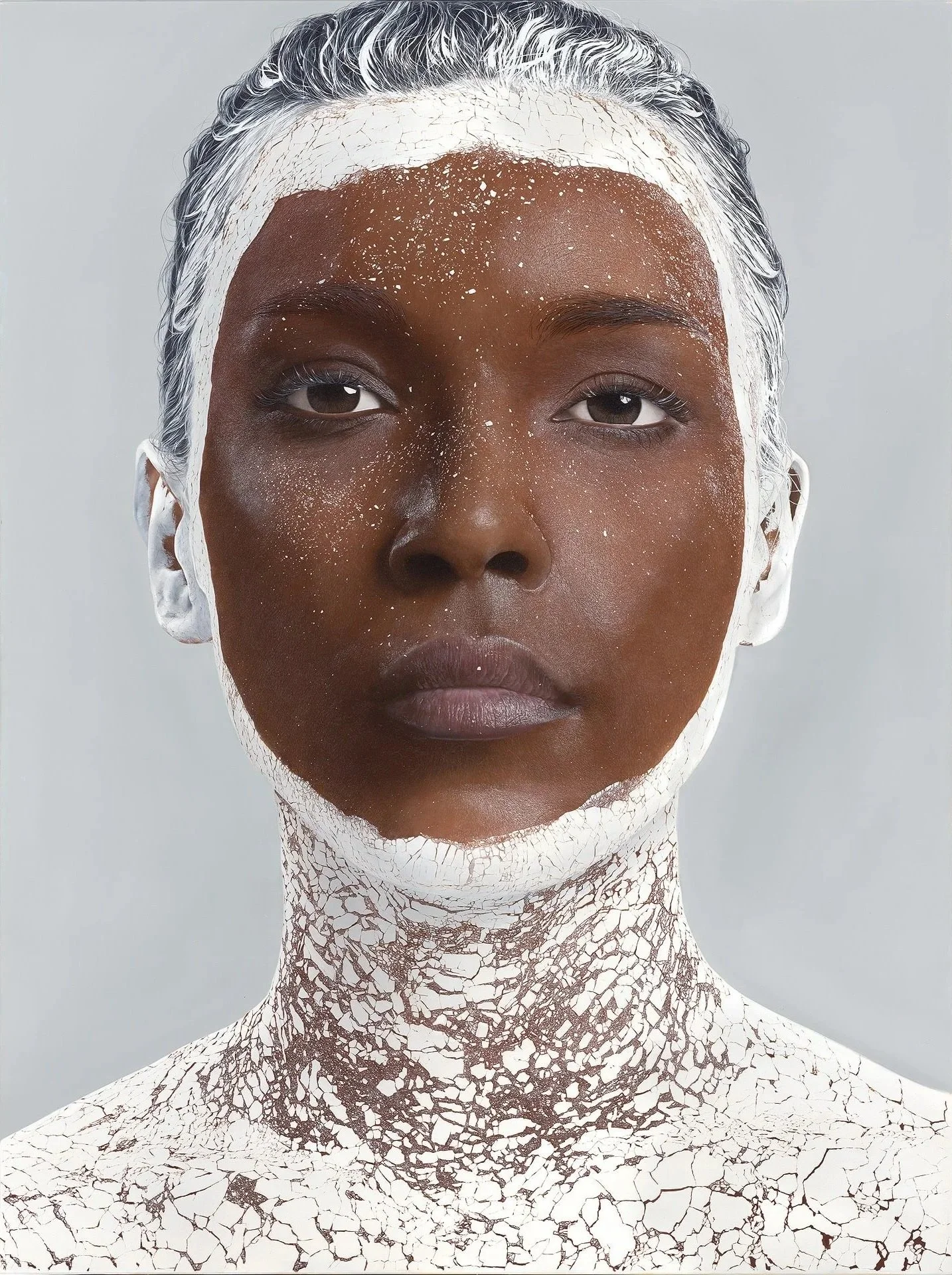
White mask 8, oil on canvas, 120x160 cm, 2024 © Sergey Piskunov
AL-TIBA9 ART MAGAZINE ISSUE20
DISCOVER THE INTERNATIONAL ART SCENE WITH AL-TIBA9
LIMITED EDITION | Shipping worldwide.
Premium museum art paper.
Printed in London.
Grab 3 or more prints and get your FREE digital magazine.
Get your limited edition copy now
INTERVIEW
Welcome back to Al-Tiba9! What have you been up to since we last had the pleasure of featuring your work?
Over the past couple of years, I’ve been quietly building the next chapter of my practice. I’ve spent long months in the studio, refining the language of my hyperrealistic portraits and pushing the “Masks” series into deeper, more textured territory. Living in the Netherlands has given me a sense of stability that has allowed me to work with more focus and patience. During this time, I completed some of my most intricate pieces, prepared for new exhibitions, and reflected on how my work can grow without losing its honesty. It has been a period of steady creation, slow expansion, and a deeper understanding of what I want my paintings to say.
How has your practice shifted in recent years, either in technique, subject, or mentality? And what new themes or subjects have you introduced in your painting?
In recent years, my practice has become slower, more deliberate, and more introspective. Technically, I’ve pushed my paintings toward even finer detail and more complex textures, especially through cracked clay surfaces, charred floral elements, and sculptural mask forms. These materials opened new ways for me to explore fragility, tension, and transformation within a hyperrealistic language. Mentally, I’ve moved away from thinking about “perfect beauty” and toward something more vulnerable and human. The newer works are quieter, but they carry more weight. They look polished on the surface, yet the themes underneath are increasingly about erosion, pressure, and what remains when a person tries to hold themselves together. The main new subjects I’ve introduced are large sculptural masks with fractured surfaces and burnt botanical wreaths. They let me speak about identity not as something fixed, but as something constantly reshaped by time, experience, and the desire to protect or reveal oneself.
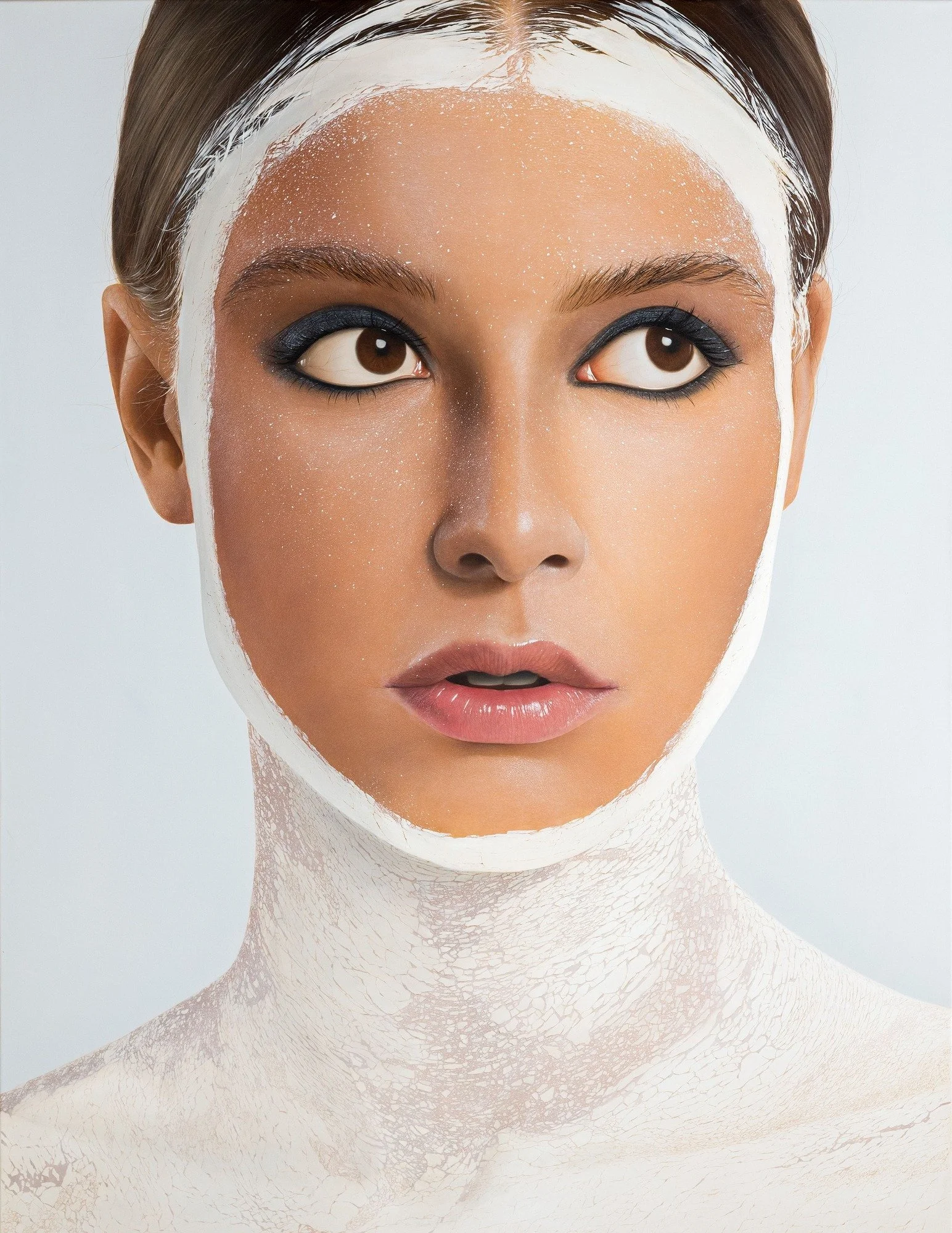
White mask X, oil on canvas, 120x160 cm, 2024 © Sergey Piskunov
Many of your paintings today incorporate gold as a symbolic and material element. Are you exploring new materials, textures, or symbolic languages in your latest works?
Gold has been an important part of my work for years, but lately I’ve been moving toward materials and textures that feel more raw and imperfect. The polished surface of gold creates a sense of clarity and presence, yet I’ve become more interested in what happens when that clarity is interrupted. In the recent paintings, I started using cracked clay textures, sculptural mask forms, and burned floral elements. These materials don’t just add realism; they create a different emotional temperature. The cracks, the roughness, the charred edges allow the portrait to carry a quiet sense of tension, as if something beautiful is under pressure. Symbolically, this shift takes the work away from pure aesthetics and into something more psychological. Gold still appears, but now it’s balanced by materials that speak about fragility, transformation, or the traces of time. This contrast has become the core of my new vocabulary.
Your portraits often feel quiet but emotionally charged. Have you found yourself drawn to new emotional states, psychological tensions, or narratives in your more recent subjects?
Yes, my recent works are drawn to quieter and more internal emotional states. Earlier portraits focused more on presence, clarity, and surface beauty. Now I’m more interested in subtle tensions, the moments when a person holds something inside, or when their calmness hides a fragile balance. I’ve been exploring states that are difficult to name but easy to feel: hesitation, pressure, resilience, the sense of holding one’s breath. These emotions don’t announce themselves loudly, but they leave marks on the face, in the posture, in the way the light touches the mask. The narratives have become more inward-looking. Instead of showing who someone is, the portraits hint at what they carry. This shift has made the paintings softer on the outside, but emotionally heavier underneath, which is the direction that feels the most honest to me right now.

Golden mask X, oil on canvas, 130x170 cm, 2025 © Sergey Piskunov
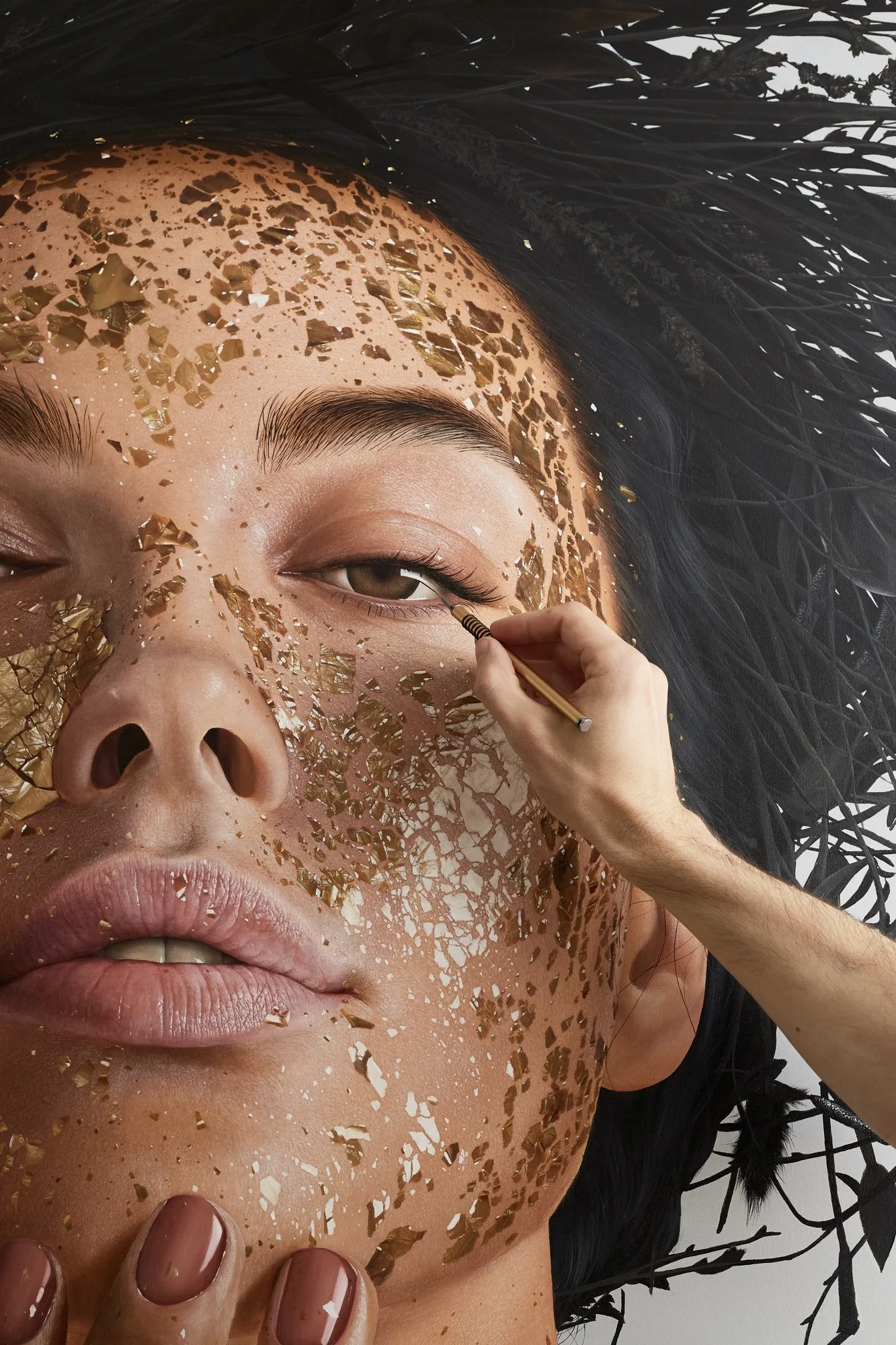
Golden mask X (detail), oil on canvas, 130x170 cm, 2025 © Sergey Piskunov
Hyperrealism demands intense observation. How has the way you observe the human presence evolved over the past couple of years?
Hyperrealism taught me to look at people almost microscopically, but in the last couple of years, my observation has shifted from the surface to the internal states behind it. I still study every detail of the face, every small reflection in the skin, but now I pay more attention to what those details suggest rather than how perfectly they can be replicated. I’ve become more focused on the quiet signals that reveal a person’s condition, a slight tension around the eyes, a softened gesture, the way light sits on a face when someone is tired or thoughtful. These small emotional traces have become more important to me than technical precision alone. So while the paintings remain hyperrealistic, the observation behind them has grown slower and more psychological. I no longer try to capture a moment; I try to understand the presence within it.
Your work is defined by time, patience, and precision. Can you walk us through the creation of one of your recent portraits? Where do you begin, and how do you know a painting is completed?
I usually begin long before the canvas. The process starts with shaping the concept, the mask, or the sculptural element that will define the emotional tone of the portrait. I build and photograph the model or the mask in controlled light, searching for a state that feels honest, not staged. When I finally move to the canvas, I already know the atmosphere I want to preserve. The painting itself grows slowly, layer by layer. I start with a monochrome underpainting to set the structure and the temperature of the light. Then I build the surface in thin glazes, adjusting tiny shifts in color and texture until the skin, the cracks, or the gold elements begin to feel alive. It becomes a long conversation with the work: some parts reveal themselves easily, others demand weeks of attention. I know a painting is finished when it stops arguing with me. When I can look at it and feel the balance between realism and emotion without wanting to adjust the smallest detail. It’s not a dramatic moment, more a quiet sense that the image has reached its own clarity and doesn’t need me anymore.

White mask XI, oil on canvas, 120x160 cm, 2025 © Sergey Piskunov
Shifting from a more pop imagery to hyperrealistic portraits, what reactions from viewers and collectors have surprised you lately? And how do viewers’ responses inform your current practice?
What surprised me most is that viewers often describe the new portraits as quieter but more intense. When I moved away from pop imagery, I expected people to focus primarily on technique, but instead they reacted to the emotional undercurrent of the stillness, the tension, the sense of holding something inside. Collectors often mention that the portraits feel almost “alive” in the room, not because of realism alone, but because the mood stays with them. These responses matter to me. They showed that subtle emotion can be just as powerful as loud visual statements, sometimes even more. It encouraged me to keep stripping the images down to fewer distractions, fewer decorative elements, and more focus on presence and atmosphere. I don’t try to follow reactions, but I do listen to what resonates. It helps me understand which direction feels authentic and worth pursuing further.
As your practice matures, has the message or intention behind your work become more defined, or do you see it becoming more open, ambiguous, or poetic?
As my practice matures, I feel the intention behind the work becoming both clearer and more open at the same time. I no longer try to deliver a fixed message or a clean interpretation. What matters to me now is creating a space where a viewer can sense a quiet emotional truth without having it explained. The portraits have become more ambiguous, more poetic in their silence. I’m less interested in direct symbolism and more in the subtle tension between clarity and uncertainty, the way a calm face can suggest something unresolved, or how a small shift in light can create a feeling that’s difficult to name. So the work is more defined in its atmosphere, but less defined in meaning. I want the viewer to meet the painting halfway, to recognize something of themselves in it. That openness feels more honest to the way people actually experience emotion.

Silver mask, oil on canvas, 120x160cm, 2024 © Sergey Piskunov

White mask 6, oil on canvas, 120x160cm, 2024 © Sergey Piskunov
Your paintings require months of consistency. What habits, rituals, or shifts in your daily process have emerged as your career expands and life changes?
Working on paintings that take months has forced me to build a slower, more stable routine. I learned to divide the process into small, steady steps so the work can keep moving even when life becomes demanding. My days are no longer about chasing inspiration but about creating the right conditions for focus: a quiet studio, controlled light, and a clear plan for each session. One shift is that I’ve become more protective of my time. I work in shorter, more concentrated blocks and try to leave the studio before I exhaust the image. Another is that I’ve grown comfortable with pauses; stepping away for a day or two often helps me return with more clarity. The biggest ritual is simply consistency. Even when everything around me changes, the act of coming back to the painting, layer after layer, stays the same. That rhythm has become the foundation of my practice and something I rely on both artistically and personally.
Lastly, are you currently working on any new series or directions that push your hyperrealism into unexpected territory? And how do you see your work evolving next?
Yes, I’m currently developing a new direction that pushes my hyperrealism toward a more sculptural and physical presence. The recent works with cracked clay, burned botanical elements, and heavier textures opened a path I want to explore further. I’m interested in portraits that feel almost like objects, something between a painting and a fragile artifact. The next step is to work with larger, more complex mask structures and to introduce materials that create a sense of tension or erosion within the image. Not as decoration, but as part of the psychological tone. I want the portraits to look calm at first glance, but to reveal a deeper internal pressure the longer you stay with them. I don’t know exactly where this path will lead, and I prefer it that way. What I do know is that the work is moving toward a more layered, tactile realism, something that still looks photographic, but feels more vulnerable and human.
Artist’s Talk
Al-Tiba9 Interviews is a curated promotional platform that offers artists the opportunity to articulate their vision and engage with our diverse international readership through insightful, published dialogues. Conducted by Mohamed Benhadj, founder and curator of Al-Tiba9, these interviews spotlight the artists’ creative journeys and introduce their work to the global contemporary art scene.
Through our extensive network of museums, galleries, art professionals, collectors, and art enthusiasts worldwide, Al-Tiba9 Interviews provides a meaningful stage for artists to expand their reach and strengthen their presence in the international art discourse.



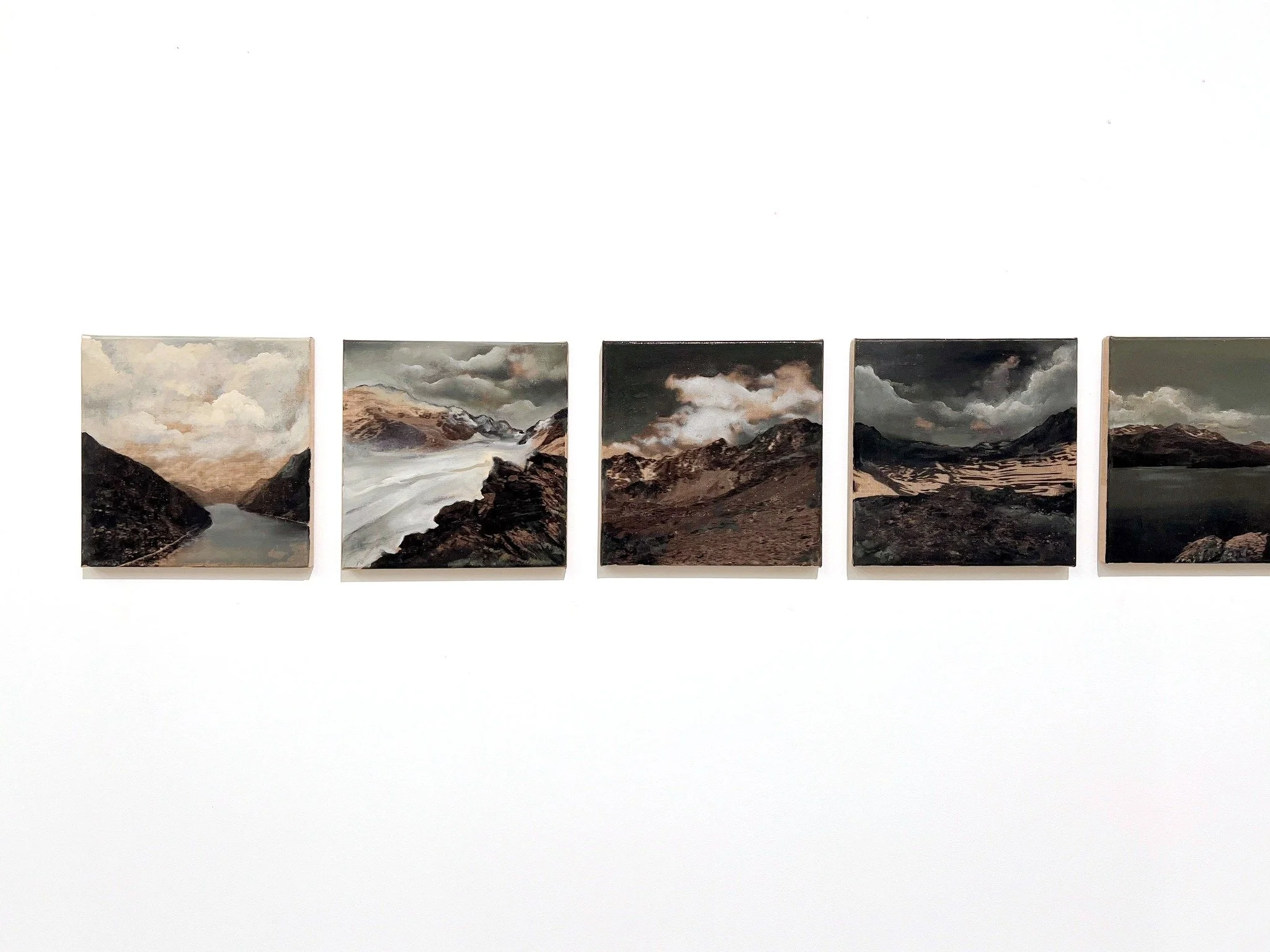
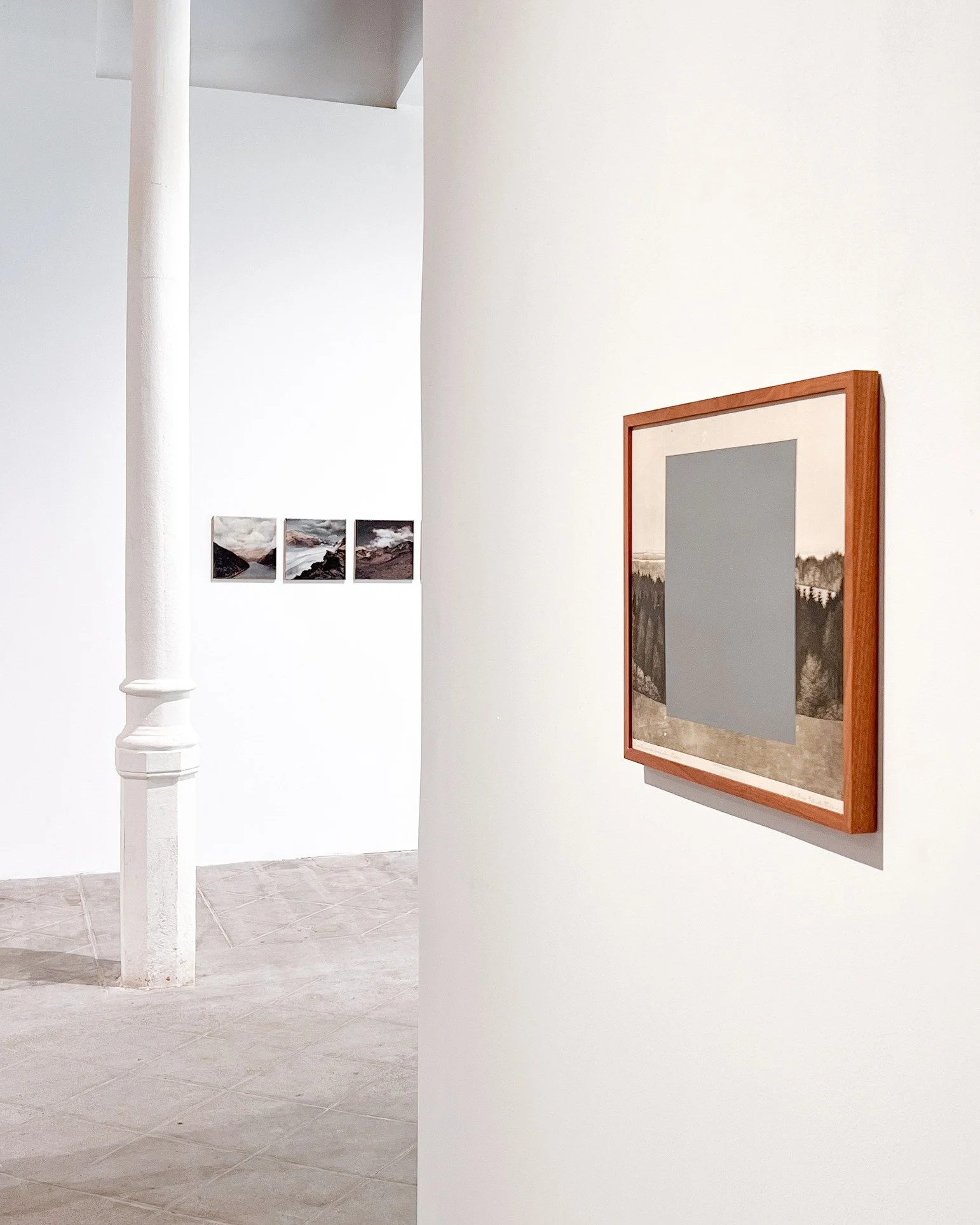
Nataraj von Allmen is a painter based in Switzerland. Often taking photographic material as a starting point, he weaves together landscapes, mythological archetypes, Christian symbolism, and contemporary socio-political themes into complex paintings. Oscillating between figuration and abstraction, his work investigates transformation, collective memory, and the human condition.