

10 Questions with Mariia Pavlyk
Al-Tiba9 Art Magazine ISSUE20 | COVER Artist
Mariia Pavlyk is a Ukrainian designer working across fashion through sculptural textiles and environment-driven narrative. Raised in Kyiv, she shaped her aesthetic through Ukrainian culture, nature, and regional crafts, forming pieces that feel both intimate and elemental. She co-founded the label ii in 2019, prior to any formal training, later completing a Graduate Diploma in 2022 and an MA in 2024 at the London College of Fashion. Her work has been presented at Ukrainian Fashion Week, Dutch Design Week, and Fashion Clash Festival. Torn between Kyiv and London, Mariia explores themes of protection, memory, and our evolving relationship with nature.
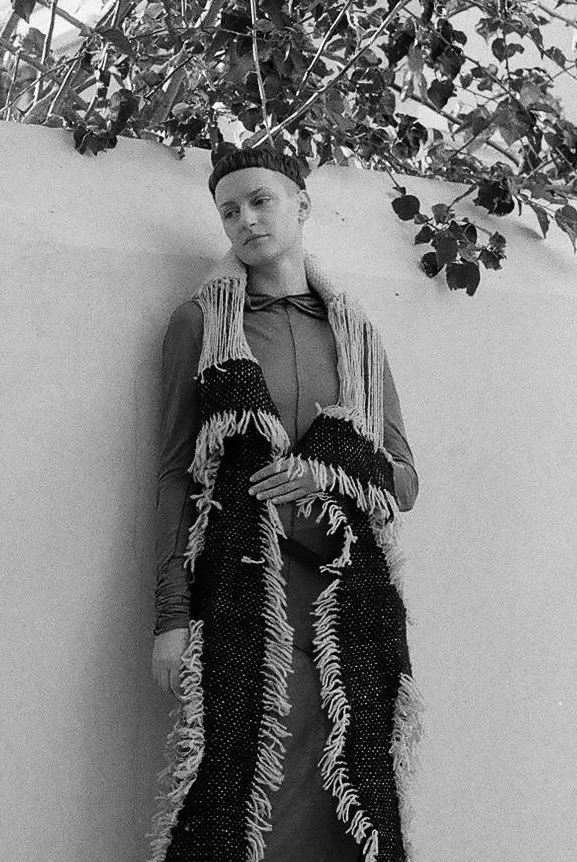
Mariia Pavlyk - Portrait
ARTIST STATEMENT
Mariia’s practice navigates memory, culture, and resilience. Born in Ukraine in the year of its independence, amid turbulent times and, later, war, she turns to fashion as a form of storytelling, weaving ancestral crafts, Trypillia–Cucuteni motifs, and Hutsul weaving into sculptural garments. Since founding ii, she has approached design as ritual: a bridge between past and present. Committed to sustainability, zero-waste pattern cutting, and eco-conscious materials, Mariia creates wearable artefacts that carry stories, inviting the wearer to sense history, identity, and regeneration through her work.
Untitled, Raw Carpatian wool, 120x60 cm, 2025 © Mariia Pavlyk
Artisanal sweater in soft, brushed Carpathian wool, meticulously hand-woven with traditional techniques and inspired by the ancient motifs of Trypillia-Cucuteni culture.
Model: Liza T.
Photo: Nikitina C.
AL-TIBA9 ART MAGAZINE ISSUE20
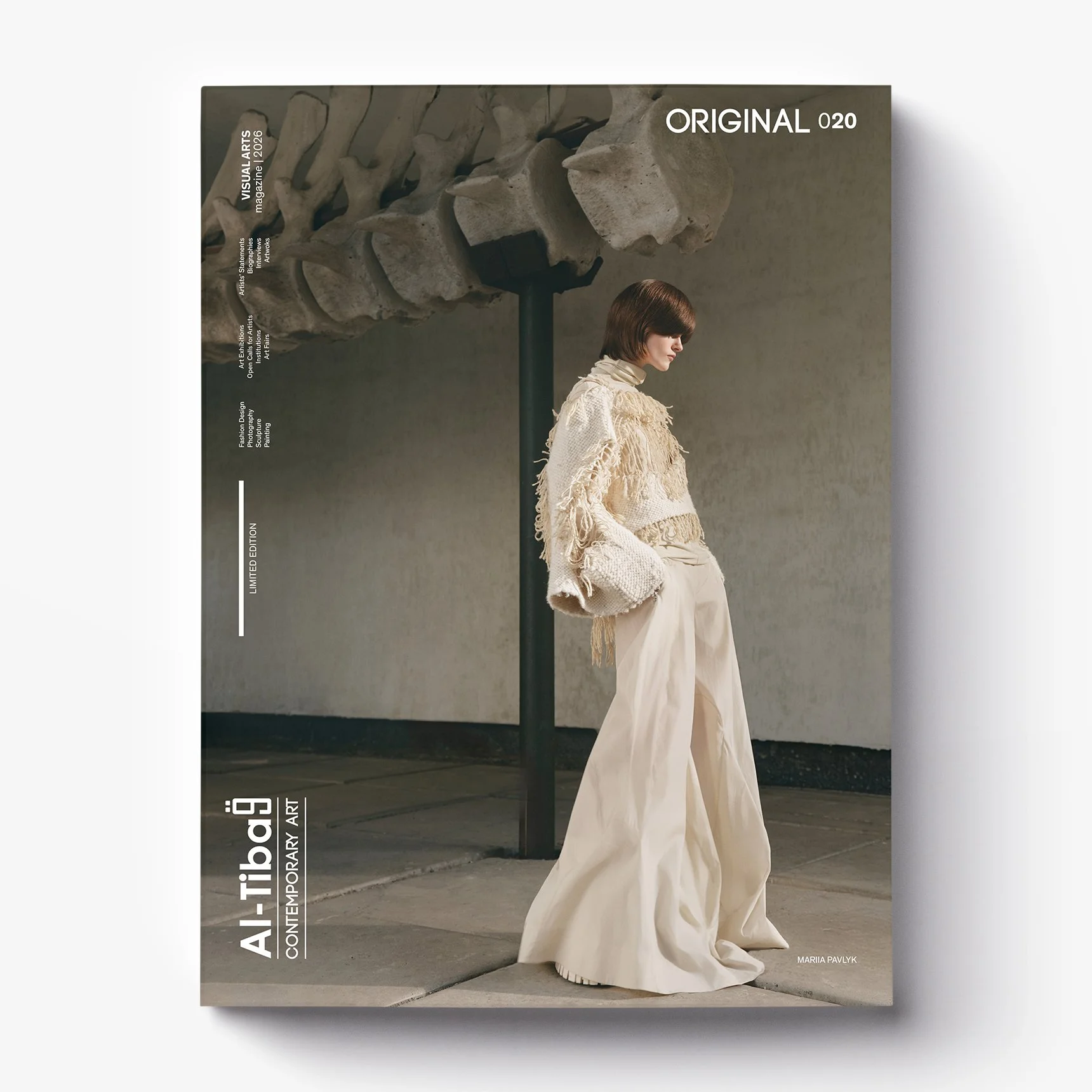
DISCOVER THE INTERNATIONAL ART SCENE WITH AL-TIBA9
LIMITED EDITION | Shipping worldwide.
Premium museum art paper.
Printed in London.
Grab 3 or more prints and get your FREE digital magazine.
Get your limited edition copy now
INTERVIEW
Let’s start with your background. Your upbringing in Kyiv and the broader Ukrainian cultural landscape clearly shape your visual language. How did your early experiences with nature, regional crafts, and local rituals influence the way you approach fashion today?
I was born in 1991, the year Ukraine became independent. Despite economic instability, my childhood felt rich in creativity. Raised largely by my grandmothers, I learned sewing, knitting, embroidery, and hand weaving early on: we repaired, reused, and transformed what we had, long before I heard about upcycling. Those times spent in the countryside, celebrating local traditions like Malanka and Ivana Kupala while making imaginative costumes with other children, deeply connected me to nature and craft. These experiences continue to shape my approach to narrative-driven fashion and have also rooted me in hands-on work, nurturing my love for craft.

Untitled, Cashmere fabric and woolen lace, 2025 © Mariia Pavlyk
Soft cashmere skirt with a half-cape, adorned in artisanal felted wool lace, merging texture and elegance.
Model: Yulia Z.
Photo: Nikitina C.
You often describe your practice as storytelling and cultural preservation. How do memory, protection, and resilience manifest in your design process, especially as you navigate life between Kyiv and London?
I am not exactly navigating between Kyiv and London; I would rather say I was forced to live between Kyiv and London by the Russian invasion of 2022. This has made memory, protection, and resilience central to my work. Fashion became my way of storytelling and cultural preservation. I began as a self-taught designer before studying at the London College of Fashion, where I gained the technical skills to fully realise my ideas. Designing from a distance intensified my responsibility to speak about Ukrainian culture beyond the headlines. Rather than depicting trauma directly, I have found myself translating experiences of loss and survival into sculptural silhouettes through a lens of beauty, balance, and composition, rather than raw horror, guided by the poetic belief that destruction is also a form of creation. This sense of hope is central to my collection Spero (Hope), reinterpreted through a contemporary lens to express Ukraine’s enduring creative spirit.
Your work draws heavily from ancestral crafts and ancient motifs such as Trypillia–Cucuteni symbology and Hutsul weaving. How do you reinterpret these traditions within a contemporary, sculptural fashion framework?
Being forced away from my homeland deepened my passion for Ukrainian history and traditions, which I see as pillars of my nation’s resilience. In my collection Spero, I explored narrative-driven pattern cutting inspired by the symbols and ornaments on Trypillia–Cucuteni ceramics. Although archaeologists found no trace of a written language, those symbols conveyed stories of everyday life, values, and beliefs. I translated these motifs into fabric, cutting ornaments in positive and negative space and using offcuts to create sculptural forms directly on the mannequin. Guided by a reduced-waste approach, this process merges ancient visual language with contemporary fashion techniques.
During my first visit to Ukraine after the war began, I travelled to the Carpathians, drawn to the beauty of local nature and the region’s traditional crafts. There, I discovered the Carpathian weaving technique: using thick, unspun, locally sourced wool from which artisans traditionally made blankets and coats. Once widespread across Ukraine, it is now only remains in a few villages, due to Soviet-era suppression of culture, reflecting challenges Ukraine still faces today. I spent weeks learning the craft before reinterpreting it for fashion: making the weave thinner and more wearable, exploring the voids between patterns, introducing new materials, and integrating Trypillia–Cucuteni motifs. The results were visually resonant: hung, the pieces resembled decorative panno; worn, they became tactile, sculptural art-wear.

Untitled, Raw Carpatian wool, 180x60 cm, 2025 © Mariia Pavlyk
Black woven scarf-hood, crafted as a decorative panno, featuring intricate motifs inspired by the symbolic ornaments of Trypillia culture.
Model: Sofia R.
Photo: Nikitina C.
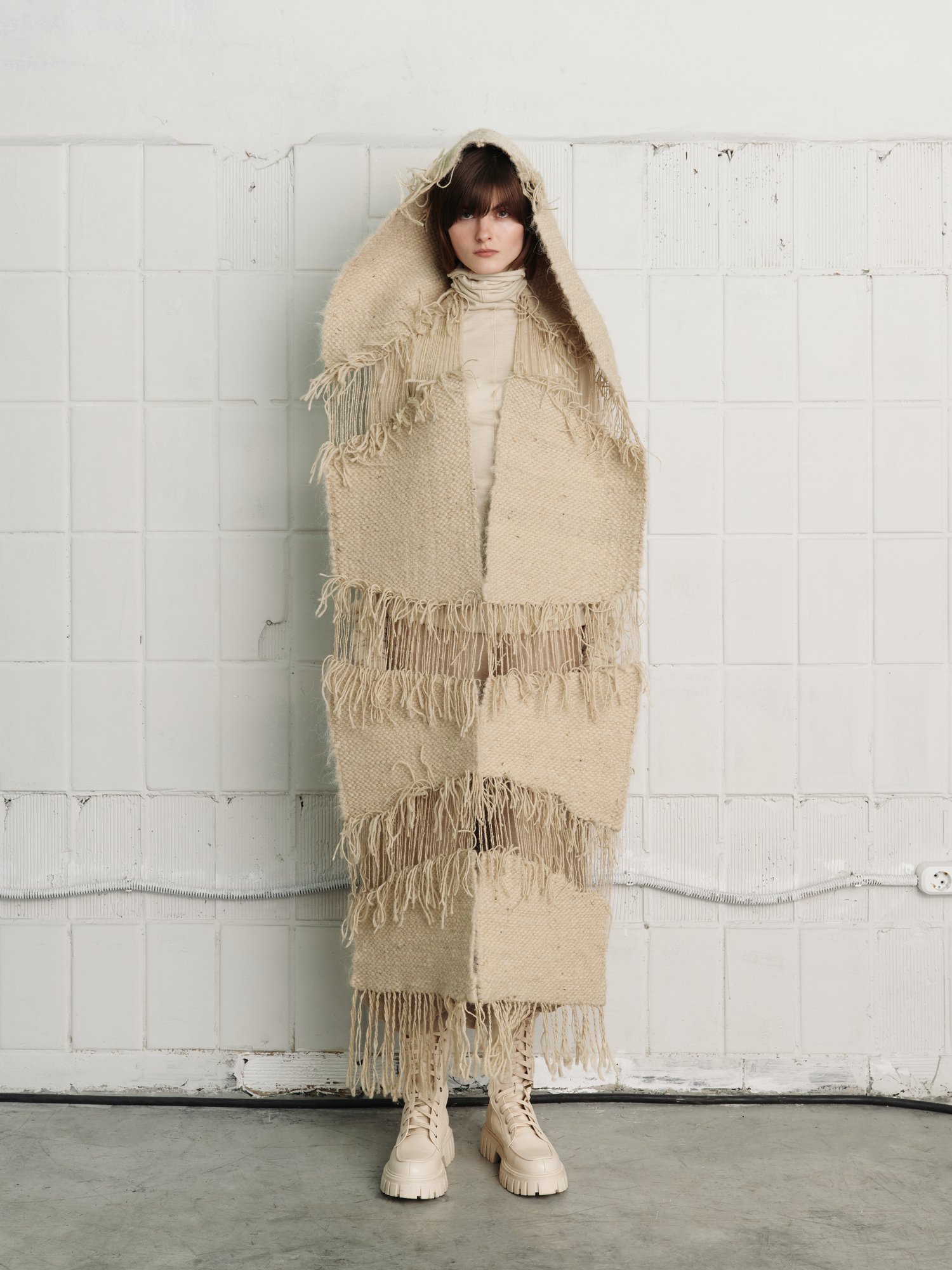
Untitled, Raw Carpatian wool, 180x60 cm, 2025 © Mariia Pavlyk

Untitled, Raw Carpatian wool, 180x60 cm, 2025 © Mariia Pavlyk
Handwoven hooded scarf-panno in textured Carpathian wool, sculptural in form and rooted in Carpathian highland heritage.
Model: Sofia R.
Photo: Nikitina C.
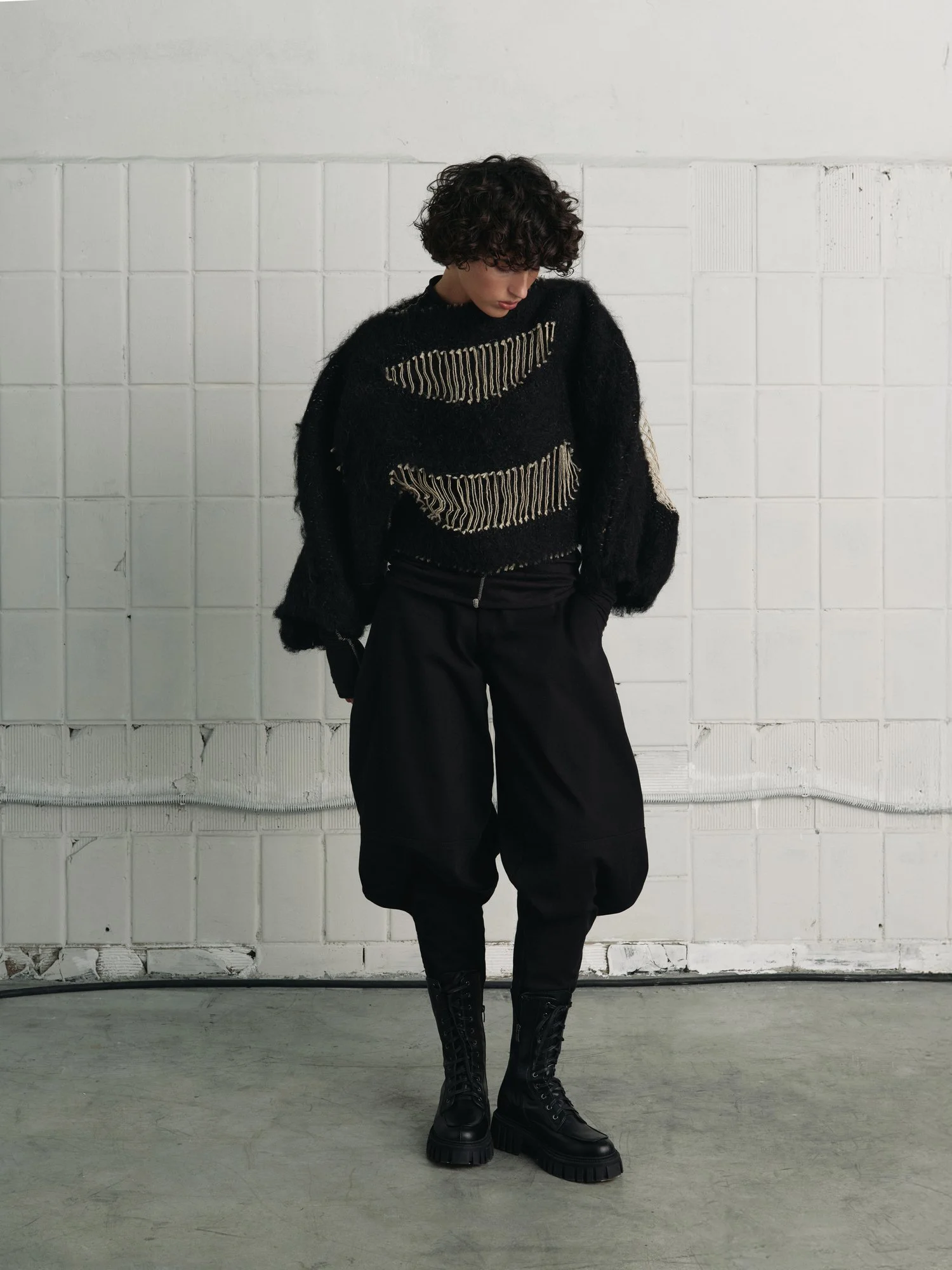
Untitled, Raw Carpatian wool, 120x60 cm, 2025 © Mariia Pavlyk
Before pursuing formal training, you co-founded your label, ii, in 2019. How did starting a brand before your studies shape your perspective on design, experimentation, and the realities of creative production?
Many of the events that led to the creation of the fashion brand ii began as coincidences but gradually evolved into a well-considered decision. With a background in marketing, I first gained experience as a brand manager for emerging labels and later as a manager of an art residency. I’ve never followed brands or trends, but I’ve always wanted to shape my own identity through fashion. Wearing my own creations and receiving consistent positive feedback encouraged me to continue developing and refining my ideas.
When I co-founded my label ii and presented our first collection at Ukrainian Fashion Week SS20, I was essentially running a three-person studio on my own, overseeing every stage of production and catwalk organisation. These experiences taught me that ambitious goals are achievable through determination, while also revealing the limitations of operating at a higher level without adequate structure and support.
Launching ii at the onset of the COVID-19 pandemic was challenging, but the unexpected pause allowed me to pursue formal fashion studies and refine a design language and skill set that now enable me to articulate and realise my ideas more fully.
Materials and processes are central to your narrative-building, particularly your use of sculptural textiles and zero-waste pattern cutting. Can you walk us through how material selection impacts the emotion, form, and intention behind each piece?
For me, narrative-driven pattern cutting begins with the fabric, not sketches. It’s a form of soft sculpture guided by rules I set for myself, like never cutting into ornamental patterns, both to preserve the narrative line and to reduce waste. This makes the process unpredictable: some designs take days, others weeks to fully resolve on the mannequin.
Most of my fabrics come from deadstock suppliers in Italy, and I bring them into my studio long before a collection begins. I need time to live with them, understand their character, and build a kind of trust before committing to a cut. It’s almost like a conversation with the fabric, where it actively shapes the final piece. Each material behaves differently: wool is soft and easy to shape, while silk organza is more challenging but rewards effort with structure and movement that feels alive. Material choice shapes the emotion, form, and intention behind every piece, making it central to my creative narrative.

Untitled, Pure unspun cashmere, 120×60 cm, 2025 © Mariia Pavlyk
Handmade sweater crafted from raw, unspun cashmere fiber, defined by the textures of traditional Hutsul weaving. Silk trousers shaped through narrative-driven pattern cutting, with motifs inspired by Trypillia-Cucuteni ornaments, merging ancestral symbolism with contemporary form.
Model: Sofia R.
Photo: Nikitina C.
Your garments often feel elemental, almost like wearable artefacts. What are your main references and how do they inform the structures and textures you create?
Beyond my inspiration from nature, I’m drawn to artists like Magdalena Abakanowicz, Neri Oxman, Olafur Eliasson, Claude and François-Xavier Lalanne, Jean Arp, and Camille Henrot… Many of them explore natural forms and emotional states, which resonate with my own approach. When I work with textiles, the process is often intuitive, almost accidental. My rule is not to control, but to guide, much like nature does. While the human brain seeks to impose strict structure, organic forms (while also providing a structure) shaped by principles like the Golden Ratio, Fibonacci sequences, or fractals tend to feel more harmonious. This balance between guidance and organic flow is central to the patterns, texture, and emotion I build into my garments.
Sustainability is a core pillar of your practice. What aspects of eco-conscious making, whether material innovation, waste reduction, or slow craft, are you most committed to, and why do they carry personal significance?
I see sustainability not as a trend from an individual perspective, but as part of our ecosystem, a strategic, long-term plan. For a small brand, adopting sustainable practices is a gradual process. For us, it begins with sourcing certified eco-materials: recycled threads and yarns, buttons from natural or recycled sources, deadstock fabrics, and locally sourced natural fibres... We carefully plan pattern cutting to minimise waste and reuse offcuts whenever possible. Production is limited, mostly handmade and follows a drop system, with everything made locally in Ukraine. Thoughtful branding, packaging, and fair working conditions for our team are also central, making sustainability an integral part of everything we do.
Fashion shapes how people understand themselves and the world they inhabit. In your view, what impact can designers have on consumer behaviour, particularly in encouraging more mindful, responsible, or emotionally connected forms of consumption?
Clothes were originally made to protect, before they became status symbols and fashion statements. Some people wear fashion to meet basic needs at a minimal cost, which makes it hard to challenge fast fashion, while others use it to express identity or status. I believe our consumption patterns are shaped by education and background, and while I can’t change everything, I aim to spark curiosity through my visual communication, garments, and the stories they carry. Most importantly, I hope to create an emotional bond between people and our pieces so they value not just the fashion, but also the craftsmanship, textiles, and narratives behind each garment. When design becomes art-wear, it has the power to shift perspectives and transform clothing into something truly meaningful.
But isn’t there more that a fashion brand can do to help people understand themselves and the world they inhabit? Perhaps the answer lies in creating a platform that gradually redirects part of fashion’s focus toward science and a deeper understanding of the world we live in, because fixing the world begins with understanding it.

Untitled, Cashmere fabric and woolen lace, 2025 © Mariia Pavlyk
Soft cashmere cape, adorned with artisanal felted wool lace, juxtaposing structured detailing against the fabric’s fluid drape.
Model: Liza T.
Photo: Nikitina C.
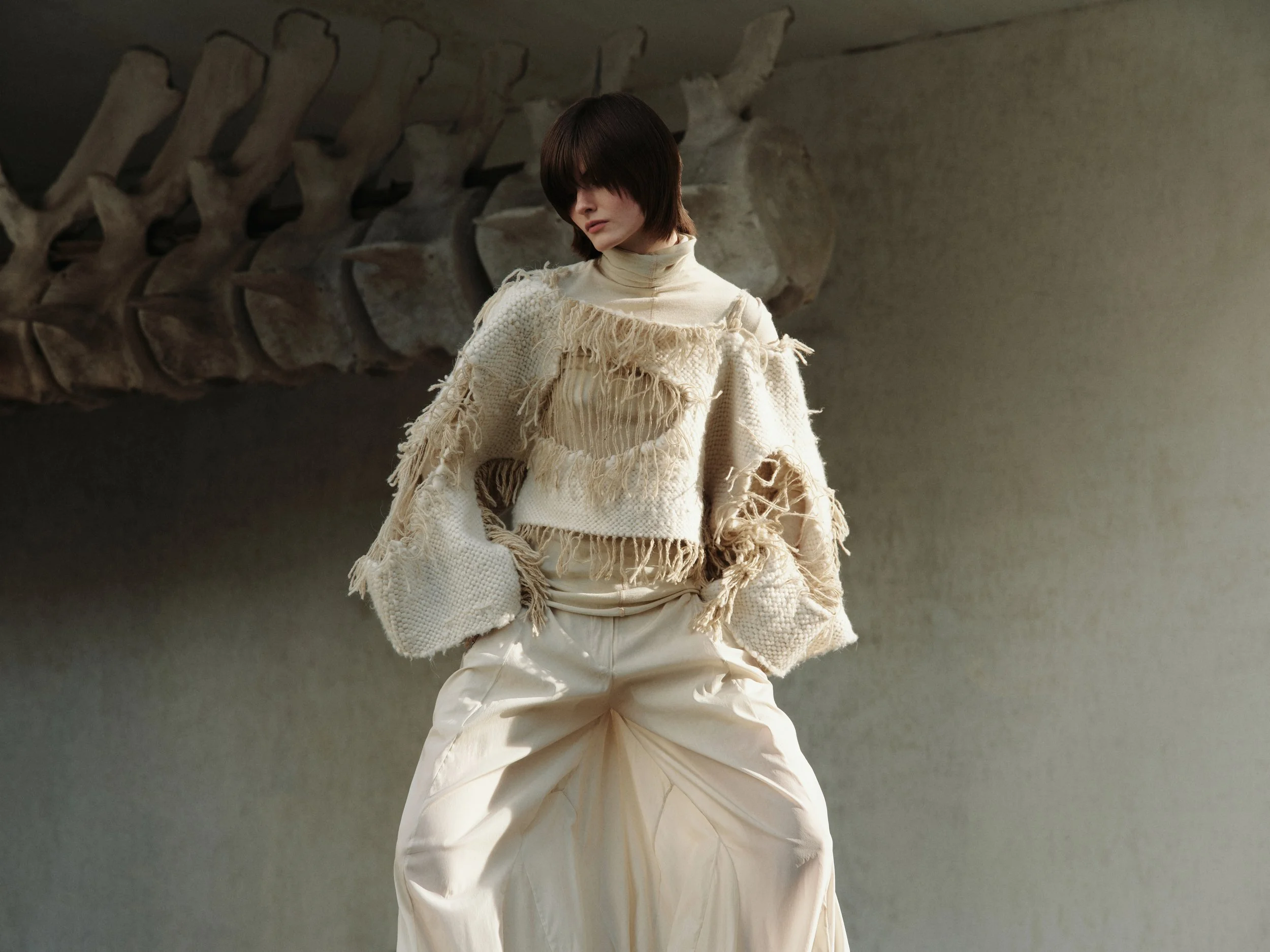
Untitled, Pure unspun cashmere, 120×60 cm, 2025 © Mariia Pavlyk
You’ve participated in platforms like Ukrainian Fashion Week, Dutch Design Week, and Fashion Clash Festival. How have these contexts influenced your creative evolution, and what dialogues do you hope your work sparks within the international fashion community?
Ukrainian Fashion Week has always been my home platform, and participating again in 2024 was especially meaningful; it was kind of an act of support to the local fashion industry during difficult times, despite air raids and blackouts. While many designers in Ukraine understandably focus on commercial fashion, I aim to show that aesthetics rooted in tradition and craft can be both appealing and meaningful, not just utilitarian.
Events like Dutch Design Week and Fashion Clash Festival extend this dialogue internationally, bringing together creative minds working at the intersection of art, craft, fashion, business and sustainability. These experiences are empowering and inspiring, allowing me to stay true to my principles while sharing the stories and culture of Ukraine with a wider audience.
Looking ahead, what new themes or experiments are you hoping to explore? Are there upcoming projects or collaborations that reflect where you envision your practice and label moving next?
I’m currently exploring several craft techniques that haven’t yet fully appeared in my work. In the next collection, I plan to focus on minimalistic, zero-waste pattern cutting, creating a kind of canvas for extensive textile experimentation. This approach will allow me to simplify form and structure while diving deeper into working with wool, exploring its unique possibilities and qualities. Having so far operated as an artisanal studio working primarily on private orders, we now plan on launching our website with an online store in early 2026, hopefully meeting people’s legitimate expectations in terms of pure fashion while secretly hoping to give them the desire to bring a touch of meaningful, beautiful Ukrainian art-wear into their daily lives.
Artist’s Talk
Al-Tiba9 Interviews is a curated promotional platform that offers artists the opportunity to articulate their vision and engage with our diverse international readership through insightful, published dialogues. Conducted by Mohamed Benhadj, founder and curator of Al-Tiba9, these interviews spotlight the artists’ creative journeys and introduce their work to the global contemporary art scene.
Through our extensive network of museums, galleries, art professionals, collectors, and art enthusiasts worldwide, Al-Tiba9 Interviews provides a meaningful stage for artists to expand their reach and strengthen their presence in the international art discourse.


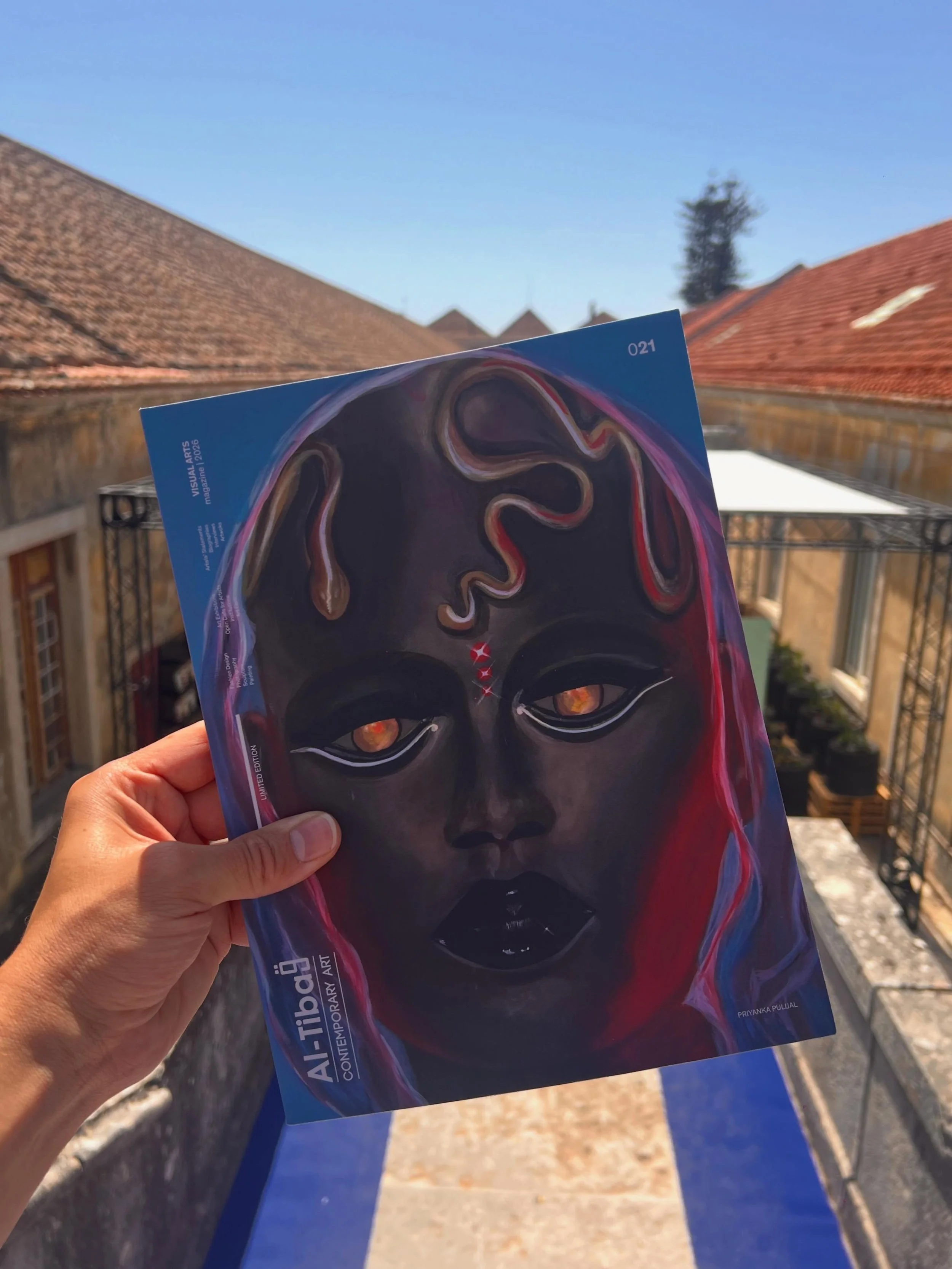
Mariia Pavlyk is a Ukrainian designer working across fashion through sculptural textiles and environment-driven narrative. Raised in Kyiv, she shaped her aesthetic through Ukrainian culture, nature, and regional crafts, forming pieces that feel both intimate and elemental. Her practice navigates memory, culture, and resilience, weaving ancestral crafts into sculptural garments.