

10 Questions with TANI TELAS
TANI TELAS, the pseudonym for French artist Stéphanie Navarro, was born in Oran, Algeria, and draws upon a rich Franco-Spanish heritage. While deeply rooted in her Mediterranean base in Corsica, Navarro cultivated a rigorous intellectual foundation, earning a Master's degree in Hispanic Literature, Languages, and Arts from the University of Toulouse in 2011. Artistic growth has been a constant thread throughout her professional life, maintained through continuous study and practice. Rather than a beginning, the years 2022–2023 represented a season of artistic fellowship with Jorel Sergio, providing a unique space for the mutual exploration of technique and creative exchange.
Tani Telas's vibrant and compelling body of work serves as a manifesto of progressive abstraction. The Mediterranean, far more than a geographical setting, is the fundamental source of her inspiration and the emotive heart of her expression.
The year 2025 has culminated in a significant achievement for her international career: On December 1, 2025, Tani Telas was awarded the coveted Certificate of Artistic Merit from the Luxembourg Art Prize (awarded by La Pinacothèque). This major distinction is the pinnacle of a rapidly accelerating career, which also includes multiple accolades, such as three Honorable Mention Awards from the TERAVARNA ART GALLERY.
Her commitment to exhibition is intense and consistent, featuring both solo and collective shows across Corsica and the Var region since 2018. The year 2025 will continue to be punctuated by the launch of a major solo exhibition series titled "Femme Med': Ancrage en Méditerranée" (Mediterranean Woman: Anchor in the Mediterranean), with confirmed dates on the French Riviera (Côte d'Azur) in Le Castellet, Six-Fours Le Brusc, and La Londe-les-Maures.
An active participant in key artistic networks (including ACN and La Cour Des Miracles Compagnie), Tani Telas continues to enrich the field of contemporary abstract art, offering a powerful synthesis of emotion, instinct, and profound cultural rootedness.
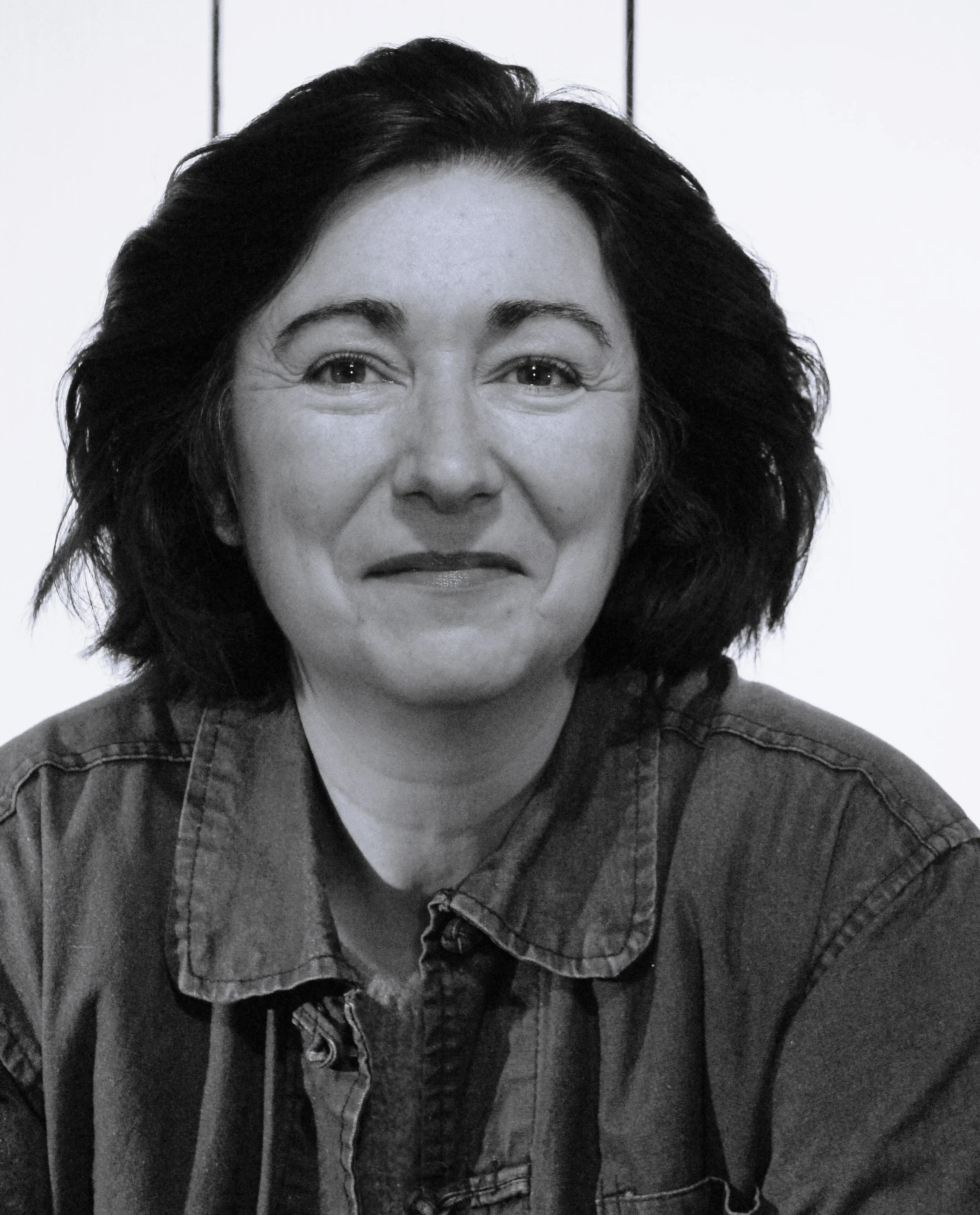
TANI TELAS - Portrait
ARTIST STATEMENT
Stéphanie Navarro, operating under the pseudonym TANI TELAS, is a major figure in contemporary progressive abstraction. Rooted in Corsica with French and Spanish heritage, Tani Telas draws profound inspiration from the Mediterranean, which remains the vibrant, thematic heart of her practice. Her work is defined by a rigorous and disciplined process that seeks constant emancipation from established conventions. This creative path is articulated in three distinct phases: first, an initial period of introspection, where she meticulously develops and calibrates colors to reflect her deepest, immediate emotions. This preparatory stage then gives way to instinct on canvas, where color is deployed with visceral force, taking spontaneous and dynamic shape. Finally, the completed work is anchored in its cultural bedrock, integrating the history, soul, and geological textures of the Mediterranean. TANI TELAS's powerful abstract vocabulary is thus a compelling combination of raw emotion, gestural instinct, and cultural resonance.
ROOFTOP BLUES, Oil, 33x41x2 cm, 2025 © TANI TELAS
INTERVIEW
Can you tell us a bit about your background and how you first became interested in painting?
After graduating in International Business at 21, I built a career focused on leadership, training, and team management. Yet, my creative pulse never faded; I continued to paint and write for the theater in parallel, bridging the gap between strategy and storytelling. My deep-seated passion for Art and History led me to complete a Master’s degree in Hispanic Arts, Literature, and Civilizations in 2011. Since then, every museum visit and exhibition has been a journey to decode the silent language of masterpieces. Painting was my first language, preceding speech itself. Even as a child, while my mother taught me the names of colors, I was already attuned to their emotional resonance. My formal initiation began in school, but my true breakthrough was unconventional: tasked with a project inspired by Gustav Klimt and frustrated by a limited palette, I turned to my sister’s makeup. Using eyeshadows, glitters, and fragrant, iridescent textures, I sought to capture the essence of femininity. The acclaim I received from that piece was a revelation; it confirmed that art was not just a hobby, but my core identity. Today, painting and writing are inseparable sisters in my practice, a dual medium through which I strive to reach the heart of the viewer.
How has your Mediterranean upbringing and connection to the area influenced your artistic style?
My father repaired boats, trawlers and sailboats alike. Between the scent of engine oil in the workshop and the briny tang of fishing nets, everything drew me back to the Mediterranean. Spanning from one shore to the other, it is my anchor, my deepest identity. The sea is a mirror of life: capricious and powerful, so iodine-rich it can overwhelm the senses, yet also merciful, generous, or tormented. This is my greatest inspiration, life itself. I am drawn to the people of the coastline in all their diversity, weathered by the waves of time and history. Even today, the Mediterranean teems with life; a flora and fauna that persist against all odds. Despite the human impact, the waste it washes back, and the warming climate, the sea remains. It is life in the depths, reflecting our daily existence in contemporary society. Whether my work on canvas or through installations is turbulent, calm, reflective, or impulsive, it seeks to bring this message to the surface: a message of Life and hope, malgré tout, in spite of everything.

COCKTAIL DE NUITS, Oil, 130x97×2,5 cm, 2025 © TANI TELAS
Your work follows a three-phase process. How would you describe this process in simple terms?
At its core, my process is defined by a desire to break free from convention. First, I prepare my canvases and supports. Even if they are already primed, I apply two additional layers of gesso, which I texture using a large palette knife. In doing so, I am already shaping the many moods of the Mediterranean directly into the base. The first phase focuses on creating the palette, the nuances, and the texture. I carefully record the 'equations' of my mixtures in color swatchbooks. The second phase opens a field of endless possibilities. I paint instinctively, applying the shades created on my palette to produce spontaneous movements. I arrange the composition and the areas of color and texture entirely by intuition. As soon as a narrative begins to emerge, I enter the third phase. This is where I clarify, refine, and retouch. A story is born.
Color seems central to your work. How do you choose and develop your color palettes?
For me, color is the vessel for emotion. No two people see exactly the same blue; this inherent subjectivity is what fascinates me about human nature, the fact that we are all unique. Developing my palette is the first 'gift' I offer in my work. I pay meticulous attention to the raw materials. I only use shades that I have crafted myself, either from natural pigments or from extra-fine oils. The composition of each tube is crucial: every tint is bound with a specific oil that possesses its own singular characteristics. One oil might react differently to the air, drying more or less quickly than another. Mixing certain shades is also a chemistry of oils, a blend that reacts in its own unique way upon the canvas. I can spend hours in my studio exploring the physical nature of these materials. The choice of colors remains paramount, with blues and corals serving as the recurring symbols of my creations.

LE BAIN DU SOUVENIR, Oil, 61x50x2 cm, 2024 © TANI TELAS

MARINE ARBORESCENCE, Oil, 85x61x2 cm, 2024 © TANI TELAS
Your new series, Femme Med, focuses on the Mediterranean woman. What inspired this theme?
First and foremost, it is because I am one. I grew up in a family of Spanish origin, born in Oran, Algeria, and later spent my youth on the French Riviera between Toulon and Marseille. The women I grew up with, those I have known or encountered, each with their own distinct accent, are my primary source of inspiration. This collection, Femme Med, is the result of the stories I’ve been told: the beauty of the Mediterranean temperament, sometimes weighed down by cultural expectations, the obligations tied to the condition of women in past eras, or even today, as well as themes of migration, adaptation, the gaze of others, and the spontaneous, impulsive dreams of youth. Every generation is represented here, from the great-grandmother to the great-granddaughter. I am deeply in love with cultures and life stories. Since my very first travels, I have been collecting testimonies and anecdotes from chance encounters, books, or moving documentaries. Viscerally, each canvas recalls one of these stories, which I rewrite in my own way through painting. It is my tribute to the women of yesterday, today, and tomorrow, all cradled by the inconstancy of the Mediterranean waves.
Your abstract language is emotionally charged. What feelings or ideas do you hope viewers take away from your work?
Despite the depths, the storms, the shipwrecks, and death itself, Life and hope endure. If we are standing, it is for a reason.
Who are some artists, movements, or cultural references that have influenced you the most?
To this day, I am still in awe of the Italian masters, from the Renaissance to the Baroque period. I am particularly fascinated by how they crafted their colors, especially considering the rarity and the difficulty of obtaining pigments at that time. Five 'Maestros' stand out in my personal pantheon: Salvador Dalí, Gustav Klimt, Antoni Gaudí, Diego Rivera, and Pedro Almodóvar. I am drawn to their audacity, their freedom, and their unconventional paths. I was also deeply marked by 1980s culture, British Pop, both visual and musical, as well as the Movida in Spain. The boldness of the colors, the interior design, and the striking associations in both fashion and set design found in Almodóvar’s films have left a lasting impression on me. These artists all had something vital to say. Whether they were denouncing societal issues, like Rivera’s social murals in Mexico, or delivering their traumatized yet transcended imaginations through a goldsmith’s precision on canvas, they each offered a singular vision of womanly beauty and aura.

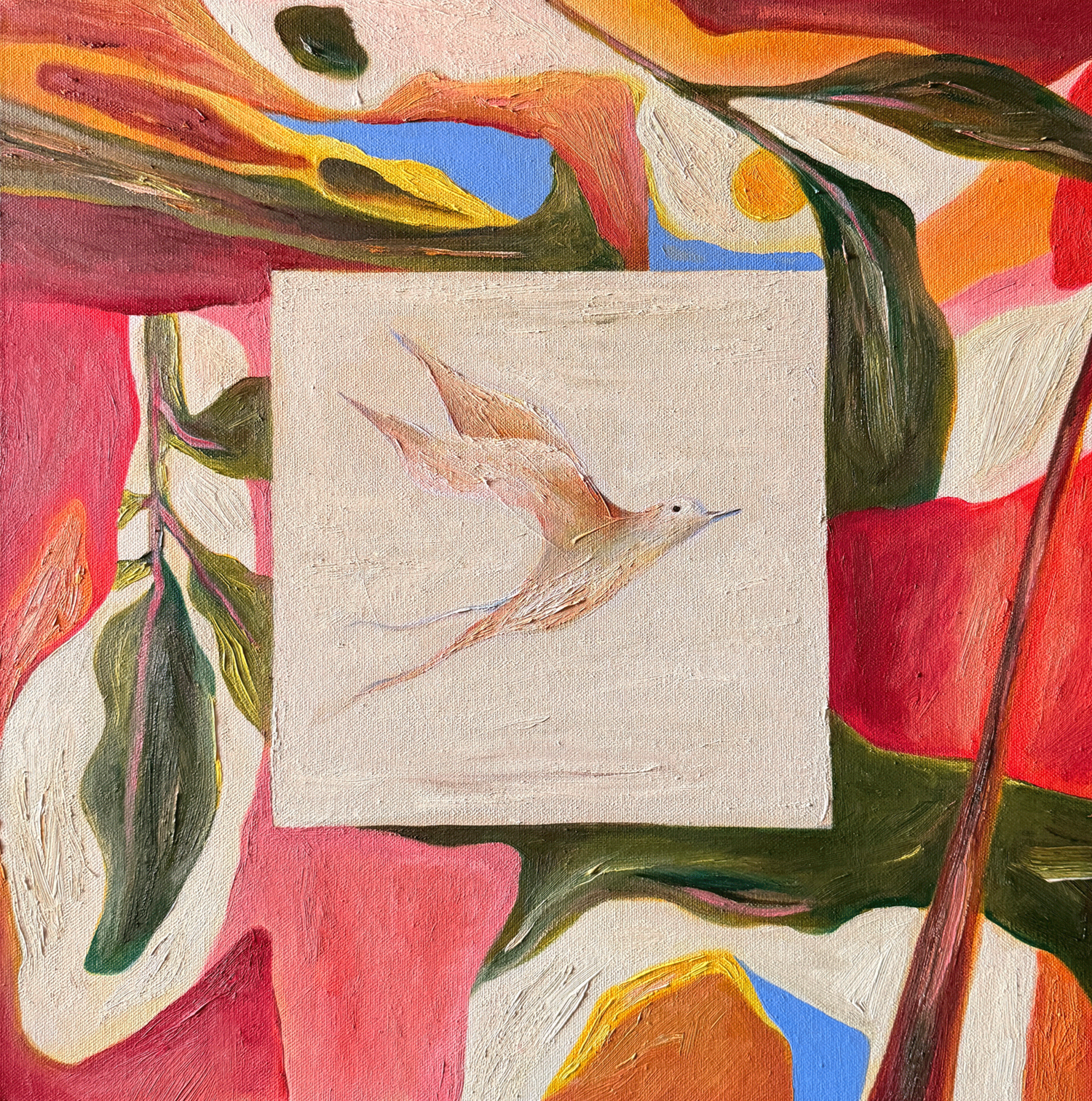
MESSAGERE, Oil, 61x50x2 cm, 2024 © TANI TELAS

OUBLIEES, Oil, 130x97x2.5 cm, 2024 © TANI TELAS
You’ve exhibited widely and recently received significant awards. How has this recognition impacted your practice?
To exhibit is to expose a part of myself, to share what influences me and what makes me feel alive. In my collections, the emotional element plays a vital role. Each exhibition is a reciprocal gift. Receiving the 2025 Certificate of Artistic Merit from the Pinacothèque as part of the Luxembourg Art Prize was a deeply meaningful recognition. It serves as a call to face even greater challenges and to embrace an even bolder sense of audacity. It pushes me back into the studio to explore, research, read, and document, but above all, to continue living: contemplating the sea, meeting people, engaging in dialogue, and constantly striving to evolve. There is a saying: 'When you are on stage, it is to say something.' Every gaze cast upon my canvases is an award in itself. I paint for you.
Looking ahead, what projects or directions are you excited to explore in the next year?
My upcoming projects are centered around outdoor installations and exhibitions in iconic Mediterranean locations. Writing will also take on a more prominent role with a book project in the works. Naturally, I will continue my Mediterranean exploration, experimenting with diverse supports and new materials.
And lastly, as we approach a new year, what goals have you set for 2026, and how do you envision your work evolving over the next 12 months?
My primary goal is to expand my artistic reach and share my universe with a global audience, with a clear focus on exhibiting in major cities across Europe and beyond. To exhibit in galleries, in private collections, even in my own garden, the aim is simply to exhibit! Working residencies alongside local environmental organizations and events dedicated to the preservation of the Mediterranean will also play a significant role. From unveiling new collections to exploring new collaborations, my focus remains constant: to create and to never stop creating stories on canvas.
Artist’s Talk
Al-Tiba9 Interviews is a promotional platform for artists to articulate their vision and engage them with our diverse readership through a published art dialogue. The artists are interviewed by Mohamed Benhadj, the founder & curator of Al-Tiba9, to highlight their artistic careers and introduce them to the international contemporary art scene across our vast network of museums, galleries, art professionals, art dealers, collectors, and art lovers across the globe.



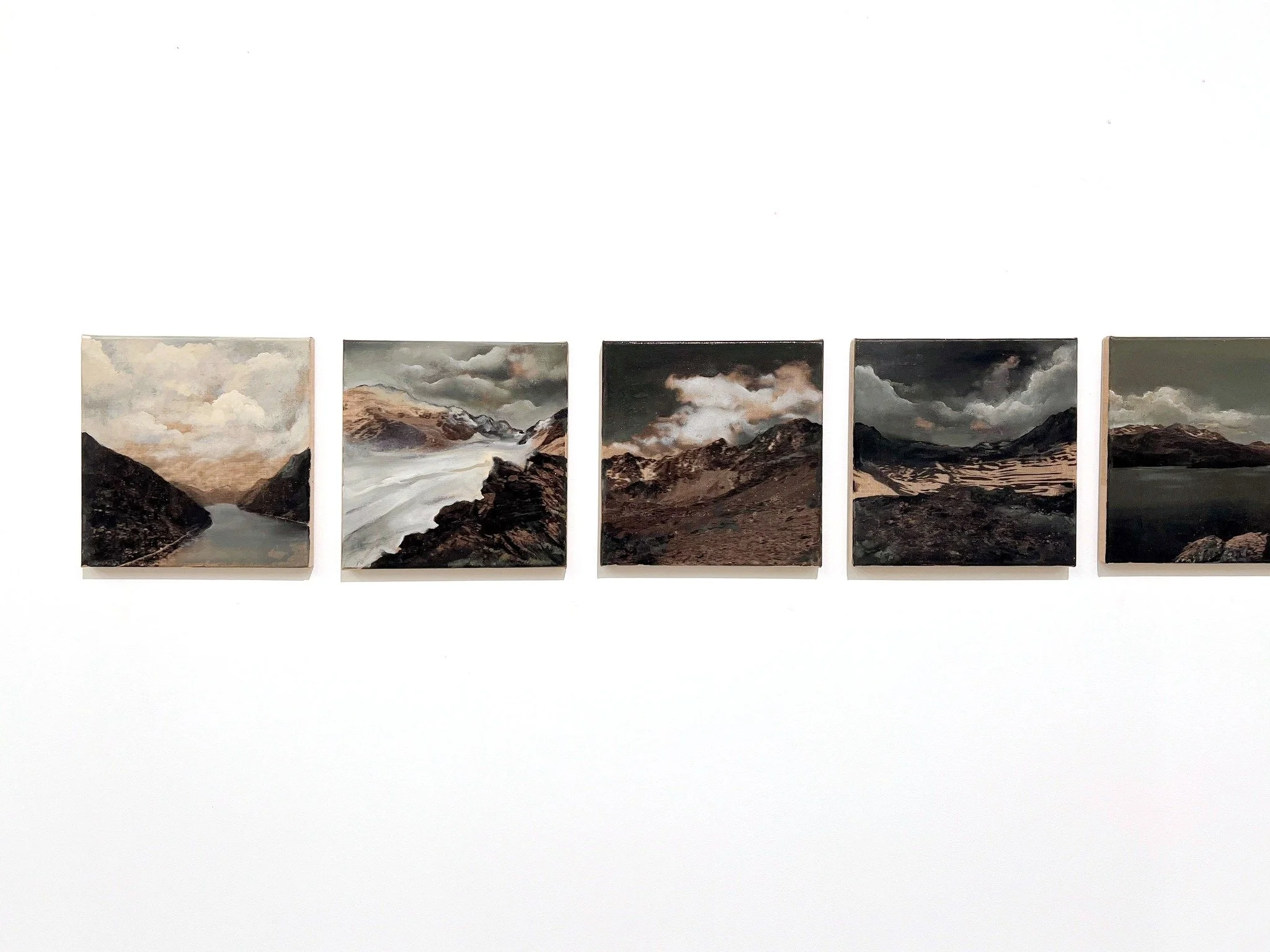
Nataraj von Allmen is a painter based in Switzerland. Often taking photographic material as a starting point, he weaves together landscapes, mythological archetypes, Christian symbolism, and contemporary socio-political themes into complex paintings. Oscillating between figuration and abstraction, his work investigates transformation, collective memory, and the human condition.