

10 Questions with Marta Ornelas Monteiro
Born in Lisboa and shaped by a global curiosity, Marta Ornelas Monteiro is an architect turned multidisciplinary artist whose creative journey is grounded in a profound dialogue with nature. While her formal training lies in architecture, her will has always followed the pulse of the natural world and art, drawing inspiration from organic forms, raw materials, and the unseen patterns that connect all life. Traveling, she collects not only visual and tactile references but also fragments of stories carried by landscapes. Her art practice transforms found natural materials into poetic compositions, giving these elements a second life beyond their original context. Each piece becomes a living testimony to nature's resilience, memory, and transformation.
Her latest work, Layers of Life, Layers of Body, Layers of Nature’s Reality, explores the unseen strata of existence. In this body of work, nature is both subject and medium. Using earth's textures as a canvas, she reveals the hidden narratives embedded in time: the rings of a tree, the folds of skin, the sediment of memory. The work speaks to the interconnectedness of all life, inviting viewers to consider how their own layers are mirrored in the natural world.
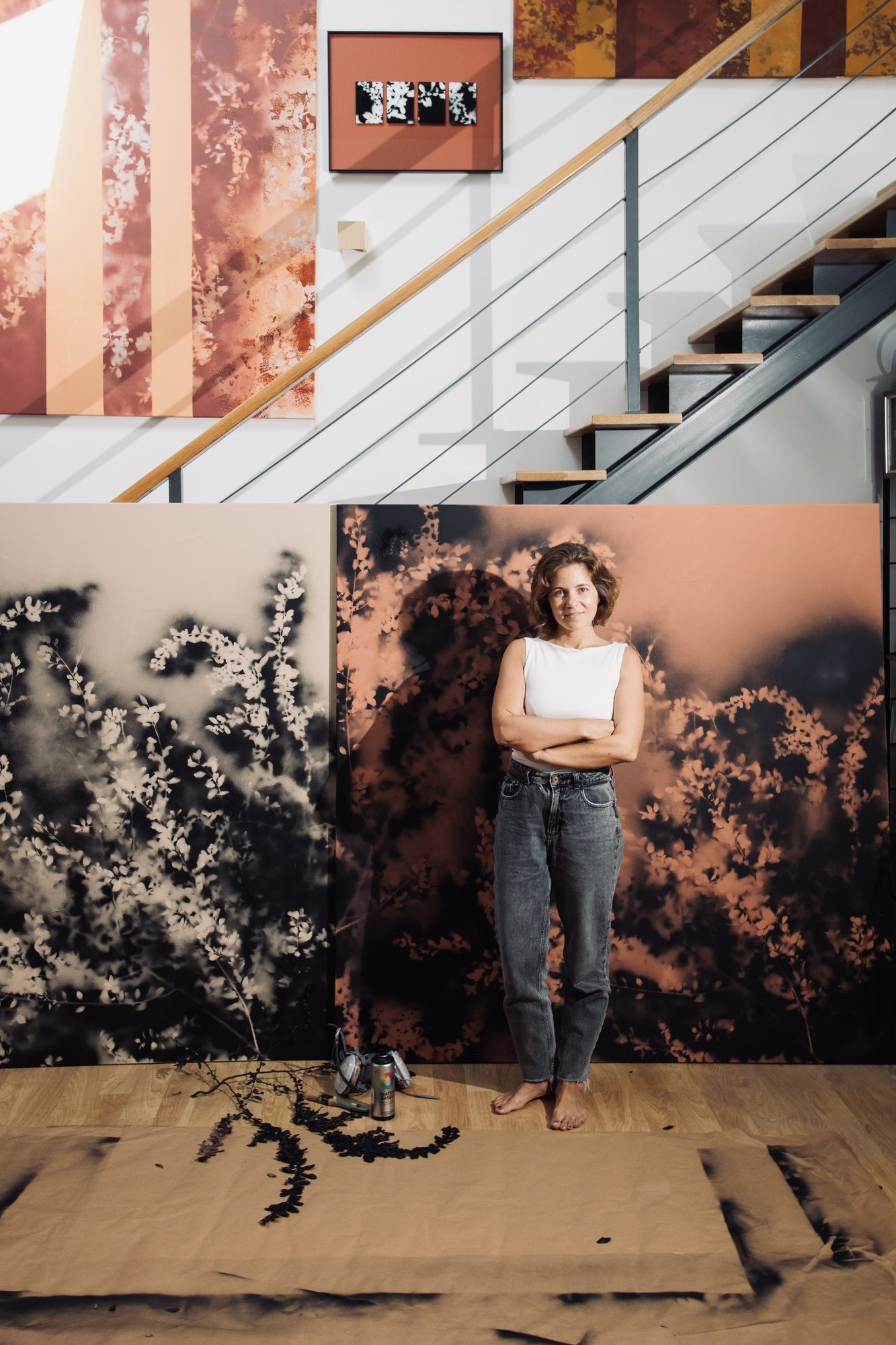
Marta Ornelas Monteiro - Portrait
ARTIST STATEMENT
In the quiet hum of nature, there exists a profound truth: life is not singular, but layered. The unfolding of existence, much like the intricate patterns in the soil, the bark of trees, or the petals of a flower, reveals itself in overlapping depths. These layers, though invisible at times, are always present, woven into the fabric of reality itself. Explore the layers of life, the delicate yet powerful interplay between existence and essence. Life, as it is experienced, is a series of interwoven moments, thoughts, and sensations that accumulate over time, leaving behind subtle traces of our journey. Each experience, like the rings of a tree or the sediment of an ancient riverbed, builds upon what has come before, shaping the contours of our being. Similarly, we are reminded that the layers of the body are not merely physical. Beneath the skin, our muscles and bones hold the stories of our actions, our choices, our growth. Each scar, each curve, each cell is a testament to a deeper truth: our bodies are not just vessels, but maps of our personal evolution, marked by the passage of time. And then, there is the layer of reality, the unseen forces that govern the universe, that bind us to the earth and to each other. What we see, what we touch, what we know, is but a small fraction of a far more complex and intricate reality. Like the atmosphere that encircles the planet, this layer envelops us, often invisible, but always present, shaping how we perceive and relate to the world. This collection of work invites you to explore these layers, to reflect on how they intertwine and shape our understanding of both self and nature. It is an invitation to pause, to look beyond the surface, and to delve into the quiet depths where life, body, and nature coexist in a delicate dance.
Euterpe oleracea, Mixed Media on Canvas, 160x160 cm, 2024 © Marta Ornelas Monteiro
INTERVIEW
You were trained as an architect before becoming a multidisciplinary artist. How does your architectural background influence the way you approach art making and the composition of your works?
Architecture has strongly influenced my path as a multidisciplinary artist. It introduced me to concrete formwork methods, to plaster and cement mixtures. This was when I began my first experiments, which led to my first collection of sculptures. Architecture also influences my painting practice, helping me explore the balance within each composition, form, colour, and light. Abstraction and geometry. Organic and regular structures.
You grew up in Lisbon and later traveled widely. How have these experiences shaped your sensitivity to natural forms and textures?
I grew up near Lisbon, by the sea, and was always closely connected to encounters with nature. Traveling offers me a shift in perspective and inspiration that feeds directly into my practice. When I travel, I collect not only ideas and inspiration, but also objects to incorporate into my artworks, often large plant leaves, especially from tropical landscapes, as well as tree branches or dried flowers.

Bacaba, Mixed Media on Canvas, 100x100 cm, 2024 © Marta Ornelas Monteiro
Your practice is deeply connected to nature. What usually sparks a new piece for you? Do you start from an object or an idea? And how do you get to the final piece?
My practice is deeply connected to forms found in nature. A new piece usually begins with a moment of curiosity, an observation that gradually translates into an idea. The object itself only comes into existence after a long process of consideration and testing.
What ultimately guides my choices is the silhouette and proportion of a natural element. I am drawn to forms with a strong presence: tree trunks reaching two meters in height, branches, leaves, and dried flowers. Back in the studio, these collected elements become the starting point for each piece.
You often incorporate natural materials, such as earth, wood, and foliage. What draws you to these elements, and how do you decide which materials belong in a particular work?
I have always been drawn and curious about nature. I am inspired by natural materials and by the way they transform over time. Captivated by their ephemeral beauty, I began incorporating natural elements into my work, across sculpture, cement-based mixed works, mixed media on canvas, and mixed media on paper.
The material choices emerge through an experimental process of testing my ideas. Each work develops through the interaction between form, scale, and purpose. My intuition guides me through each work, testing new ideas and forms.
Your recent series, Layers of Life, Layers of Body, Layers of Nature’s Reality, explores different strata of existence. How do you translate these conceptual “layers” into visual or tactile form?
I explore the concept of different strata of existence while giving nature an additional narrative. In my sculptures, a branch or tree is placed on top of a concrete base, creating a unique object that preserves that singular encounter with nature.
In my paintings, I aim to capture a fleeting narrative, the shadow moment, translating it onto canvas. The goal in both media is to express a new way to see and experience nature.

Calathea, Mixed Media on Canvas, 170x170 cm, 2025 © Marta Ornelas Monteiro

Pachira, Mixed Media on Canvas, 170x170 cm, 2025 © Marta Ornelas Monteiro
Architecture teaches precision, while nature brings unpredictability. How do you balance structure and organic intuition when creating a piece?
This parallel between the rigor of construction and the fragility of natural elements gradually became central to my practice. Architecture guides me in the rigour of technique, while nature explores artistic expression in different types of form and matter, exploring organicity in a static form. As the work develops, the proportions and shapes are transformed, creating a harmony between form and hue.
There is a strong sense of transformation and resilience in your work. What themes do you hope viewers connect with when they encounter your compositions?
I aim to draw the observer's gaze to the memory of Nature, adding a new narrative to it. Through different artistic processes and techniques, working with materials ranging from two-meter-high tree trunks to the smallest dried flowers allowed me to express new forms of existence, transforming natural matter into unique pieces and offering nature another narrative beyond its original context.
Your pieces often feel like they carry stories from the landscapes you collect from. How do memory and place factor into your creative process?
It always depends on the technique I choose. In painting, I work to capture a specific moment through the contrast between precise and blurred plant silhouettes. The compositions move between clarity and softness, layering defined forms with more subdued boundaries, almost like shadows, suggesting movement and the fleeting nature of a moment as it exists and then disappears.
In sculpture, the composition emerges directly from the dialogue between the natural material and the constructed structure. The piece evolves through balance, weight, and tension, allowing the material to retain traces of its original presence while being transformed into a new, autonomous form.

Estuário, sculpture, Ø12x90-120 cm, 2020 © Marta Ornelas Monteiro
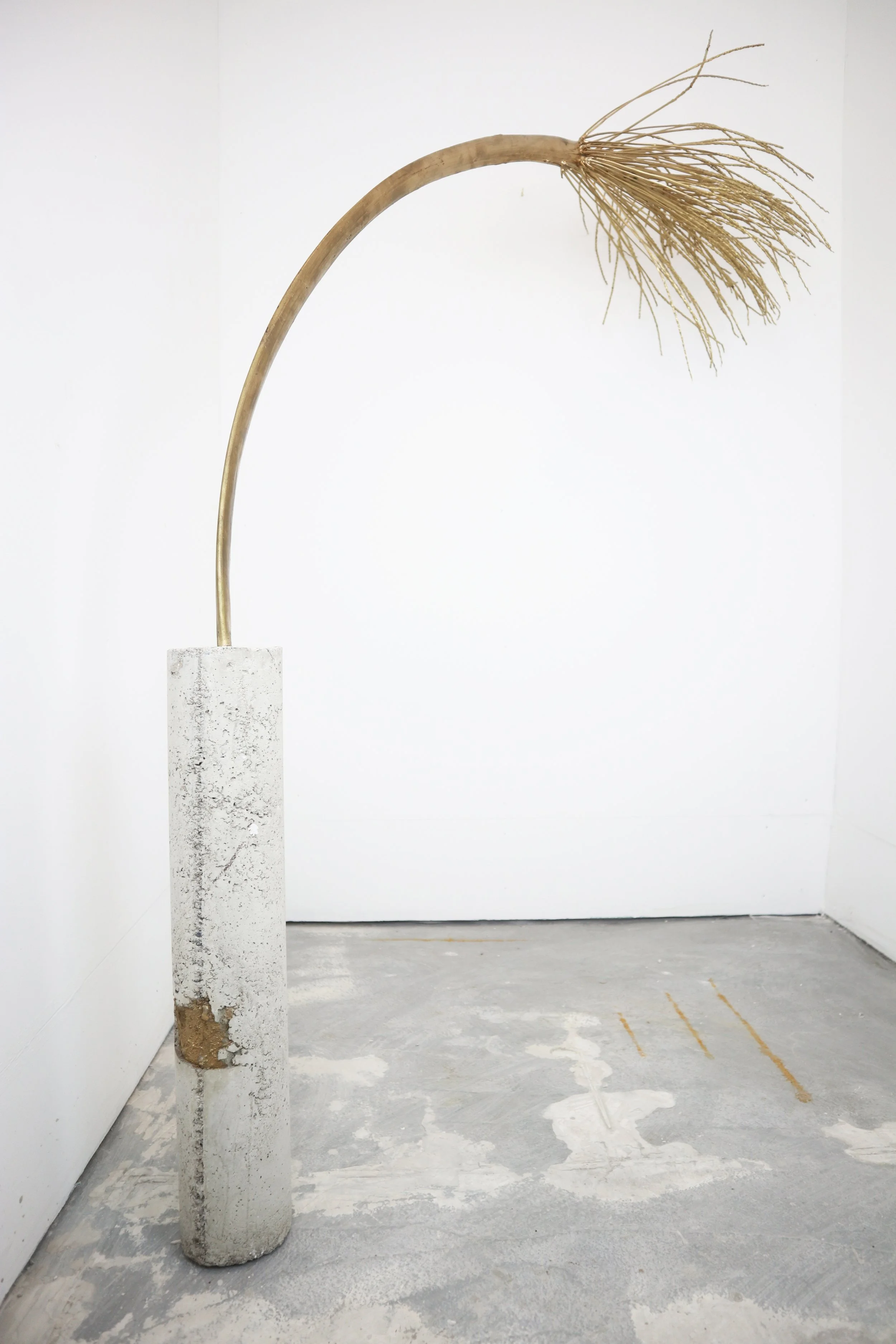
Sol, sculpture, Ø12×140-180 cm, 2020 © Marta Ornelas Monteiro
Looking ahead, what new directions or materials are you excited to explore? Are there projects or themes you’re preparing to develop next?
Looking ahead, I feel that sculpture represents my most challenging and distinctive work. I am eager to experiment with new forms and molding techniques, exploring how different approaches to casting and formwork can shape and transform the final piece.
I also envision integrating these sculptural techniques into functional objects, such as furniture and lighting, blurring the line between art and design.
Lastly, as we approach a new year, what goals have you set for 2026, and how do you envision your work evolving over the next 12 months?
This year, I plan to continue exploring the two-dimensional plane, seeking more complex compositions. Since I began this work of representing natural silhouettes, I see an infinite number of solutions. I feel representations are endless.
I will also invest time seeking opportunities in the world of urban art. I envision the work I do on murals, walls, or urban pavements. Increasing the scale of the work, in terms of size and vision.
Artist’s Talk
Al-Tiba9 Interviews is a curated promotional platform that offers artists the opportunity to articulate their vision and engage with our diverse international readership through insightful, published dialogues. Conducted by Mohamed Benhadj, founder and curator of Al-Tiba9, these interviews spotlight the artists’ creative journeys and introduce their work to the global contemporary art scene.
Through our extensive network of museums, galleries, art professionals, collectors, and art enthusiasts worldwide, Al-Tiba9 Interviews provides a meaningful stage for artists to expand their reach and strengthen their presence in the international art discourse.



Nataraj von Allmen is a painter based in Switzerland. Often taking photographic material as a starting point, he weaves together landscapes, mythological archetypes, Christian symbolism, and contemporary socio-political themes into complex paintings. Oscillating between figuration and abstraction, his work investigates transformation, collective memory, and the human condition.