

10 Questions with Ningxin Zhang
Ningxin Zhang is a composer and intermedia artist based in the San Francisco Bay Area. Her practice integrates sonic art, audiovisual interaction, and computational media, with a focus on algorithmic structures, real-time systems, and responsive environments. She holds an MA in Music, Science & Technology from Stanford University and a BM in Electronic Production & Design from Berklee College of Music. Her work spans installation, performance, and interactive media, and has been presented in academic and exhibition contexts in the United States and internationally.
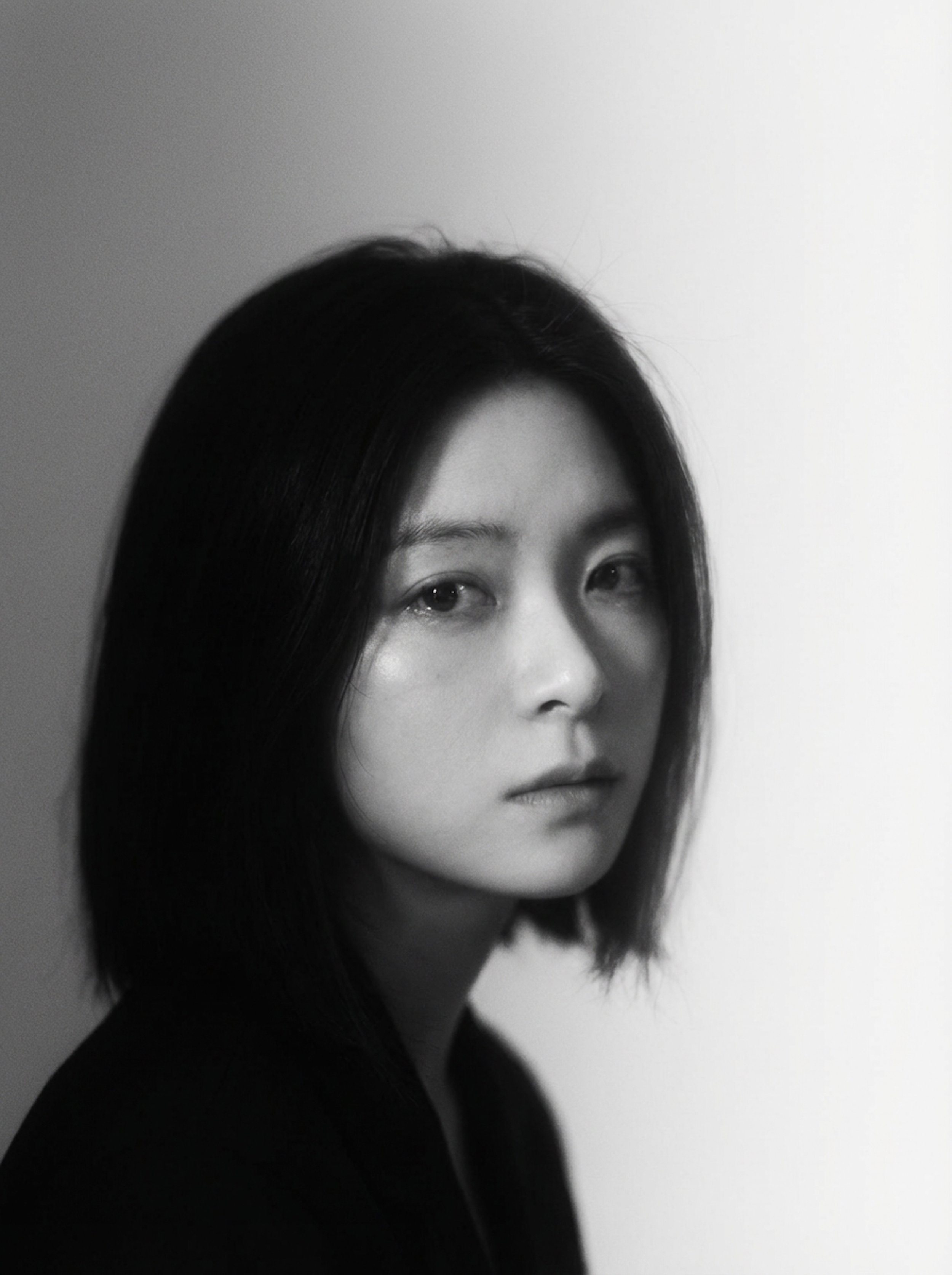
Ningxin Zhang - Portrait
ARTIST STATEMENT
Ningxin Zhang’s work explores the intersection of technology and human experience. Working with sound, generative processes, and systems that span physical and virtual space, her practice investigates how human–computer interaction shapes perception, emotion, memory, and imagination. Through multisensory and responsive media, she reimagines seeing and listening as embodied acts, transforming gestures, touches, signals, and spatial dynamics into expressive forms. Blending artistic intuition with computational design, her work creates poetic audiovisual environments that intertwine sound, vision, and movement, allowing machine intelligence to shape evolving sensory landscapes.

Palimpsest, Acrylic boxes, LED filaments, ultrasonic distance sensor, light sensor, sound sensor, multi-channel speakers, computer, 15 x 10 x 18 in, 2024 © Ningxin Zhang
This multimedia sculpture constructs an abstract urban landscape through overlapping acrylic cubes, each representing both cities and the individuals within them. Transparency and opacity are juxtaposed through clear structures, black acrylic panels, and suspended cotton clouds, reflecting the tension between visibility and privacy in contemporary urban life. The city emerges as a layered system shaped by accumulation, obstruction, and partial perspectives.
Drawing from community interviews, the audio component weaves together personal memories, imagined futures, dialogues, and urban soundscapes. These recordings are processed to blur distinctions between past, present, and future, forming a palimpsestic narrative of lived experience that murmurs through ten speakers surrounding the visitor. Ultrasonic sensors and FFT-based audio analysis synchronise sound, light, and audience presence, while LED filaments connect the acrylic cubes, visualising the dynamic networks between individuals, cities, and their constantly shifting relationships.
INTERVIEW
Let’s start with your background. You studied Music, Science & Technology at Stanford University and Electronic Production & Design at Berklee College of Music. How did these two educational environments shape the way you think about sound and technology today?
Berklee trained my ears and instincts. In Electronic Production and Design, I was immersed in sound as material, exploring texture, rhythm, synthesis, and spatiality. It was an environment that encouraged experimentation and genre fluidity, while maintaining a strong sensitivity to how sound feels in the body.
At CCRMA, the focus shifted from production to inquiry. I began thinking about sound not only as expression but also as data, as a signal, as a measurable phenomenon that can be analysed, modelled, and transformed. That experience deeply shaped how I approach technology today, not as a tool for polish but as a conceptual framework. I now understand sound as something that exists simultaneously as emotion, physical vibration, and computational structure. My practice lives precisely at that intersection.
Looking back at your early training, when did you begin to move from composing music to creating intermedia and installation-based works? Was there a decisive moment?
The shift was gradual rather than sudden. While composing electroacoustic pieces, I became increasingly aware that sound does not exist in isolation. It always interacts with space, bodies, architecture, and context.
A decisive shift occurred when I began exploring generative art alongside incorporating sensing systems into my work. Through generative visual systems and responsive sound, I became increasingly engaged with how image and audio could influence one another in real time. Once the audience’s presence could alter both the sonic and visual elements, composition stopped being linear and became relational. My focus expanded from delivering a fixed musical narrative to constructing conditions, systems in which sound, image, and interaction evolve together. That was when my work began moving toward intermedia and installation.
Your practice blends artistic intuition with computational design. How do you personally balance emotion and algorithm when developing a new piece?
For me, algorithms are not opposed to emotion; they are containers for it. An algorithm shapes behaviour, but it does not determine meaning. The emotional dimension comes from how a system behaves over time, through its unpredictability, its fragility, and its thresholds. In practice, I prototype systems early and listen carefully to how they respond. If the system feels too rigid, I introduce instability. If it feels chaotic, I constrain it. I treat code the way I would treat musical material, modulating density, rhythm, and tension. The balance emerges through iteration. I do not separate intuition and computation; I let them inform each other.
Can you walk us through your creative process? Do you begin with a conceptual question, a sound, a system, or a technological experiment?
Most projects begin with a conceptual question, often related to time, memory, or perception. From there, I ask what kind of system could embody that question. Sometimes I begin with a sound archive or field recording; other times I begin with a sensing mechanism or spatial structure. The conceptual question always guides the technological decisions. I sketch ideas visually, build small prototypes, test interactions, and refine the system’s behaviour. The process is cyclical rather than linear. Concept, system, and sensory output evolve together.
Much of your work explores human–computer interaction. What aspects of human experience, either memory, perception, intimacy, or alienation, feel most urgent for you to investigate right now?
I am particularly drawn to questions of mediated intimacy. In contemporary life, many of our interactions are filtered through technological systems, whether through screens, sensors, or invisible data infrastructures. I am interested in how subtle forms of presence, such as breath, gesture, and proximity, can be translated into computational language without losing their vulnerability. These micro signals carry emotional weight precisely because they are fragile and often unnoticed. When technology captures them, there is always a risk of flattening or abstracting that sensitivity. My work asks whether a system can register these traces while still preserving their delicacy and ambiguity.
Memory is also urgent to me, not as nostalgia but as accumulation. I think of memory as layers of experience that coexist rather than disappear, constantly overlapping and reshaping one another. Digital systems promise seamless continuity, yet they often fragment time into discrete units of data. I am fascinated by this tension between preservation and disruption, between archiving and distortion. That paradox feels central to our current condition, where we are surrounded by endless records of the past while simultaneously experiencing a sense of temporal dislocation.
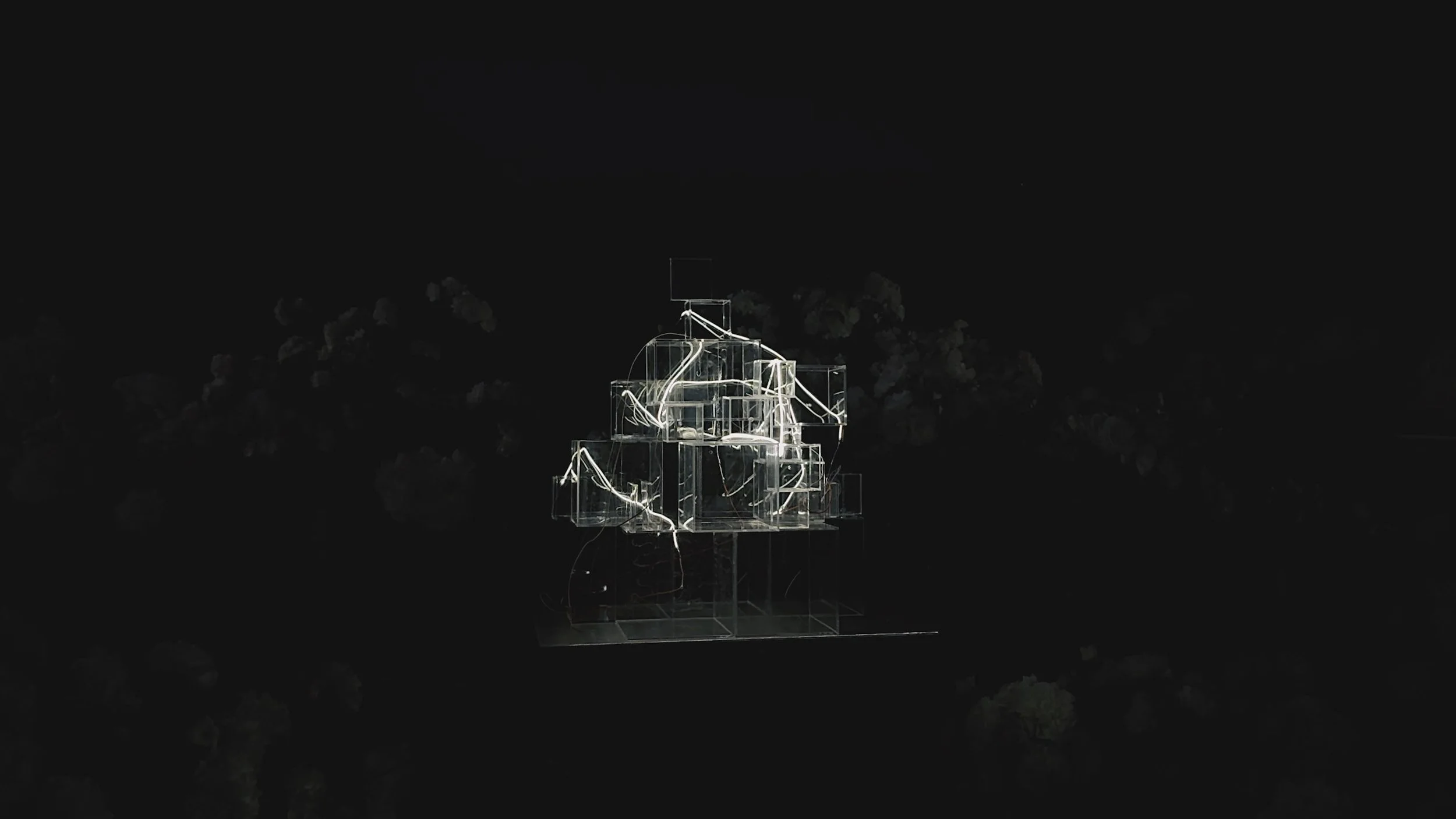
Palimpsest, Acrylic boxes, LED filaments, ultrasonic distance sensor, light sensor, sound sensor, multi-channel speakers, computer, 15 x 10 x 18 in, 2024 © Ningxin Zhang

Palimpsest, Acrylic boxes, LED filaments, ultrasonic distance sensor, light sensor, sound sensor, multi-channel speakers, computer, 15 x 10 x 18 in, 2024 © Ningxin Zhang
In Palimpsest, you construct an abstract urban landscape through transparency and opacity. How did the idea of the city as a layered and partially obscured system emerge in this project?
The idea came from observing how cities accumulate histories without fully revealing them. Urban spaces are built through layers, architectural, social, and personal, yet much of that history remains partially invisible. Buildings are constructed over former structures, communities shift, and memories linger in spaces that appear materially unchanged. I became interested in how a city can feel dense with memory while offering only fragments of what has been lived there. This perspective is also informed by ideas from sound anthropology, which considers how voices, stories, and everyday sonic traces reflect the lived experiences of communities.
The acrylic cubes in Palimpsest embody that layered condition. Transparency suggests visibility and connection, while black panels and cloud-like forms in the second iteration interrupt that clarity and create zones of opacity. Light travels through some structures and is blocked by others, echoing how narratives circulate unevenly in urban environments. The city becomes neither fully open nor fully closed, but suspended between exposure and concealment. I wanted to visualise the interplay between what is remembered and what is obscured, between collective structures and individual narratives, and between permanence and constant transformation.
The audio in Palimpsest draws from community interviews and blends temporal layers. How do you approach transforming real human voices into something both personal and computationally mediated?
I treat recorded voices as both documentary material and sonic texture. First, I listen for emotional contours, including intonation, pauses, breaths, hesitations, vocal grain, resonance, and rhythmic inflexions. I also pay attention to the material qualities of the voice, such as timbre, articulation, and the microscopic sounds that surround speech. These details reveal the physical presence of the speaker and often carry more meaning than the semantic content.
Then I process the recordings through time stretching, spectral filtering, and layering techniques. FFT-based analysis allows me to redistribute frequency components and spatialize them across multiple speakers. The goal is not to obscure identity but to create a temporal overlap in which past and present speak simultaneously. The voice remains recognisable, yet it exists within a computational architecture that reshapes its context.

Palimpsest, Acrylic boxes, LED filaments, ultrasonic distance sensor, light sensor, sound sensor, multi-channel speakers, computer, 15 x 10 x 18 in, 2024 © Ningxin Zhang
The work relies on sensors, FFT-based audio analysis, and responsive systems. How do you decide which technologies to use, and at what point does technology become conceptual rather than merely functional?
I choose technologies based on behavioural alignment with the concept. If a work is about accumulation, I design systems that layer data over time. If it is about thresholds, I use sensors that respond to proximity or intensity, allowing small shifts in presence to produce perceptible changes. The technical structure is always selected for the way it behaves, not simply for what it can do.
Technology becomes conceptual when its structure mirrors the underlying idea of the work. In Palimpsest, FFT analysis is not just a technical method; it reflects the decomposition and reassembly of memory into frequency layers. The sensor network echoes the relational structure of the city, registering movement and translating it into shifting sonic and visual states. At that point, technology is no longer invisible infrastructure; it becomes part of the conceptual argument, shaping how the audience understands the system as both material and metaphor.
As your practice evolves, are there new tools, such as machine learning, AI-driven systems, or immersive spatial technologies, that you feel drawn to explore more deeply?
I am interested in machine learning not as automation but as indeterminacy. ML systems introduce forms of pattern recognition and unpredictability that can complicate authorship and allow a work to evolve beyond a fixed structure. Rather than using machine learning simply to generate content, I am more interested in how it can create systems that respond, adapt, and develop their own internal behaviours over time. This opens the possibility for artworks that are not fully predetermined but continue to transform through interaction, data, or environmental input. In that sense, machine learning becomes less a production tool and more a medium for exploring emergence, uncertainty, and evolving relationships between human intention and computational processes.
Having composed several multichannel spatial works, I am now increasingly drawn to personal device-based spatial technologies. Head-tracked audio, individualised HRTF systems, and wearable platforms offer a different scale of immersion, and I am interested in experimenting creatively with these formats to explore how spatial sound can become more intimate, adaptive, and perceptually responsive. Instead of architectural space, the sound field becomes body-centred and internalised. I am curious how spatial perception can be personalised, and how a system might respond to a listener’s movement or memory. The question is always how these tools can deepen perception rather than distract from it.

Palimpsest, Acrylic boxes, LED filaments, ultrasonic distance sensor, light sensor, sound sensor, multi-channel speakers, computer, 15 x 10 x 18 in, 2024 © Ningxin Zhang
Lastly, looking ahead, how do you envision expanding your practice? Are you interested in larger-scale public environments, more intimate interactive works, or collaborations across disciplines?
I am interested in working at multiple scales. Large-scale public environments allow me to address collective memory and shared space. At the same time, I value intimate installations where subtle gestures such as breath and proximity become central. Collaboration is also essential. I am drawn to working with architects, scientists, and community groups because my practice thrives at intersections. Ultimately, I want to continue building systems that are perceptually sensitive, spaces in which technology does not dominate but quietly reveals the layered complexity of human experience.
Artist’s Talk
Al-Tiba9 Interviews is a curated promotional platform that offers artists the opportunity to articulate their vision and engage with our diverse international readership through insightful, published dialogues. Conducted by Mohamed Benhadj, founder and curator of Al-Tiba9, these interviews spotlight the artists’ creative journeys and introduce their work to the global contemporary art scene.
Through our extensive network of museums, galleries, art professionals, collectors, and art enthusiasts worldwide, Al-Tiba9 Interviews provides a meaningful stage for artists to expand their reach and strengthen their presence in the international art discourse.




David Moješčík - MojDa is a Czech sculptor. His work is centred on figurative sculpture, the human body, and the female figure. Modelling in clay and with digital tools, he ultimately prioritises manual engagement with materials. . He draws inspiration from yoga philosophy with the concepts of non-violence and human-centeredness, as well as from Egyptian, ancient, and European classical sculpture.