
10 Questions with Darina Komorowski
Darina Komorowski (b. 1995, Kazakhstan; lives and works in Dubai, UAE) is a painter working primarily with acrylic on canvas. Drawn to a medium that is fast, flexible, and clean in the studio, she values its ability to keep pace and retain the energy of the moment, the way “now” feels, without extra heaviness or delay. For Komorowski, a painting unfolds like a conversation: clarity of gesture and precision of decision guide the work toward meaning that can be followed through to its end.
Living between countries, languages, and cultures, and remaining in constant motion, has shaped her way of seeing. This experience trains her attention, strengthens her adaptability, and helps her gather differences into a single personal vocabulary. She often returns to Pasternak’s line, “In everything I want to reach the very essence,” not as a slogan but as a working method: to recognise choice in details, and within choice, a human story. She approaches painting almost as she would approach a person, observing, analysing, and listening for an inner voice and hidden motives that do not always lie on the surface.

Darina Komorowski - Portrait
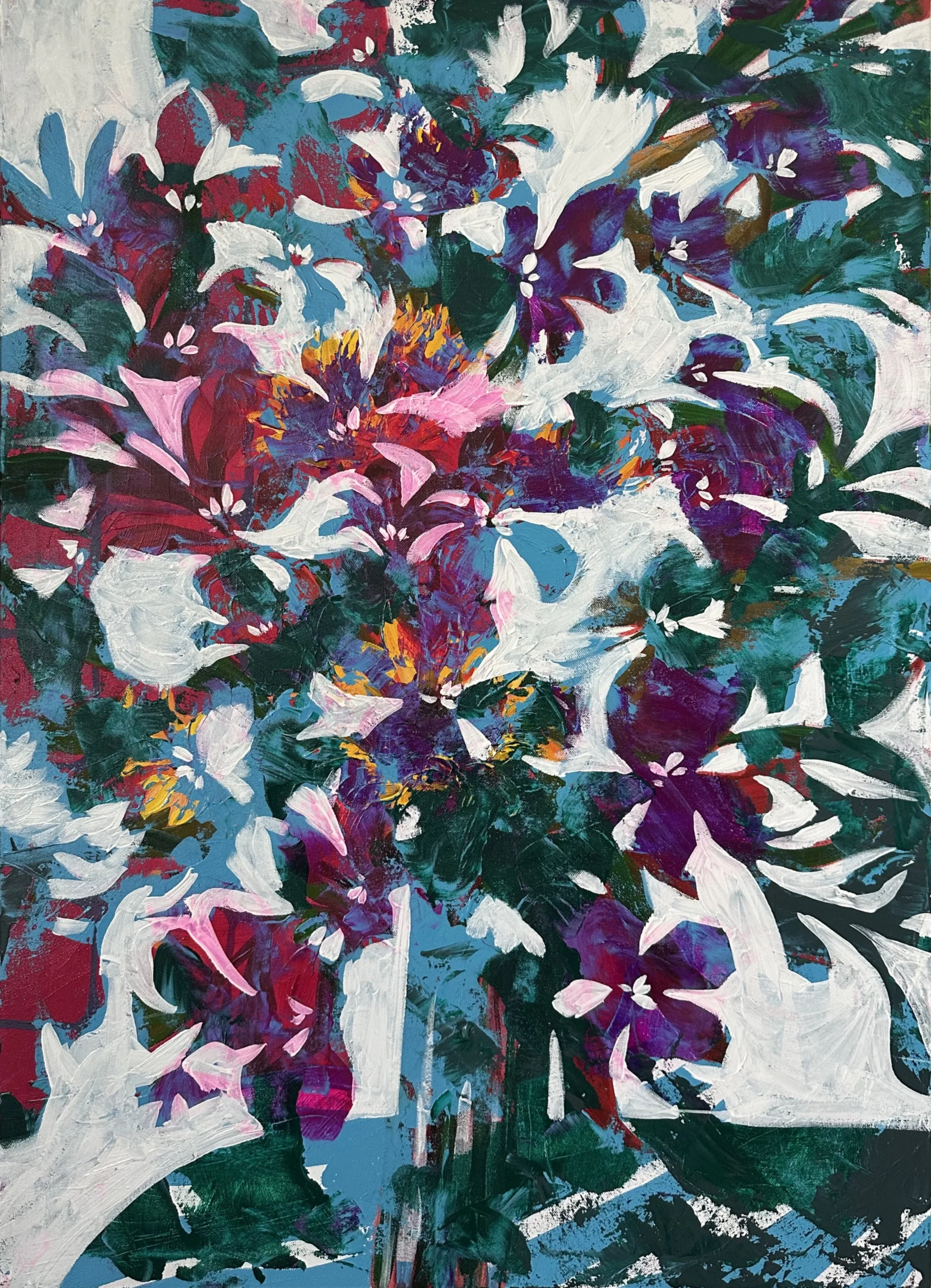
Her pictorial world is centred on flora, flowers, silhouettes of leaves and branches. This is the core of her practice. Her “floral vocabulary” includes poppies, anemones, sunflowers, gerberas, and anthuriums; at times, proteas, lilies, and strelitzias. For Komorowski, the flower is an image of fragility and the vulnerability of the human condition, and of life as a whole. At once natural and defenceless, untouched by human pain and the struggle of the ego, it points to what is fundamental: life and time, the urge to grow toward light, and simple yet decisive values. Through flowers, she speaks about human relationships gently and carefully, keeping a life-affirming tone, about the importance of feelings, the value of every life, and the capacity to remain sensitive and present.
Komorowski’s visual language is concise, fragmented, simplified, and intensified in colour. She works with open hues and friendly, joyful combinations; her paintings are bright and high-contrast because this is how inner life is often experienced. What happens inside is almost inevitably felt as stronger, more intense, “louder”, than it appears from the outside. Brightness in her work is not decoration; it is a way to register the force of emotion, its truth and vulnerability at once.
A key theme in Komorowski’s practice is the story hidden inside bouquets and human destinies, where outward beauty signals well-being while inner experiences remain unseen. For her, flowers are an ambivalent symbol of life and fragility: they hold a need for protection and the gesture of giving, tenderness and the irreversibility of time. She reflects on what is given and what remains ungiven; on what is left unsaid, on compromise, endurance, and the waiting for support. Through flowers, she also considers what stays out of frame in a broader sense: responsibility and maturity, excessive consumption and the lack of time for what matters, invisible labour, and lives concealed behind beautiful surfaces. Her paintings can be read as images through which questions emerge, about the price of things, attention, and choice, about what often lies beyond the visible field.
Standing before her work, viewers are invited to notice their own inner processes, thoughts, memories, and states, and to recognise a personal truth in them. Komorowski aims to create a space where one can pause, feel, and listen inward. For her, life is the primary measure, and painting becomes a careful conversation about what makes us human: fragility, care, time, and the capacity to love.
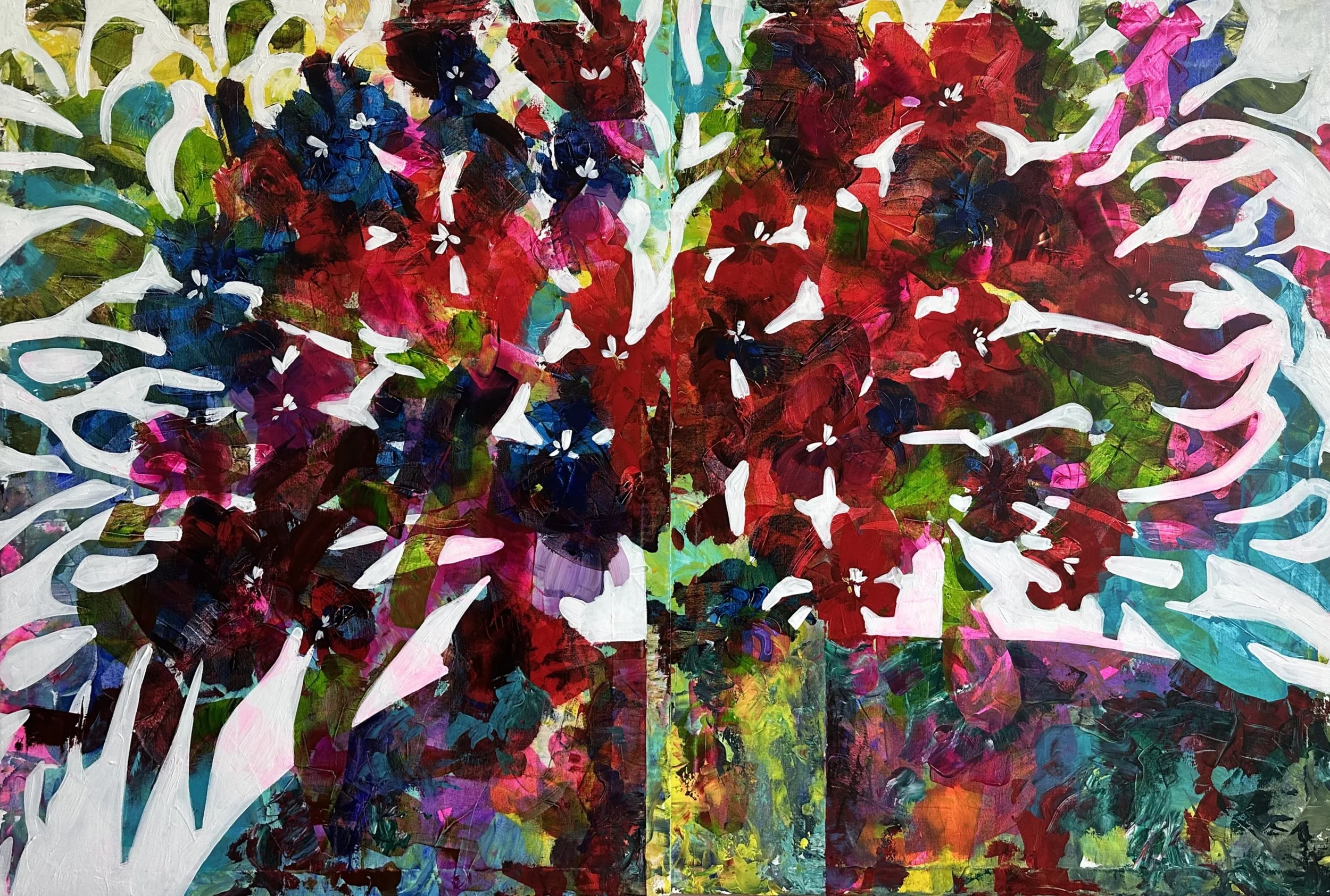
The presence of life, acrylic on canvas, 2 panel, 120x90 cm each, 2025 © Darina Komorowski
INTERVIEW
Let’s start from the basics. Can you tell us about your background and artistic studies, and how they shaped your approach to painting?
I am one of those artists who have painted for as long as they can remember, so long that I cannot imagine myself separate from painting. Looking back, two major forces have shaped my approach to art as a whole.
The first is my formal training: I received my higher art education in Kazakhstan at Abai Kazakh National University. Five years there taught me to respect technique and to understand the internal structure of an image, how a painting is built, how it holds together. It is also important to acknowledge that the art education tradition in Kazakhstan is fairly conservative: clarity of narrative, natural colour harmony, and cultural codes within imagery are deeply valued. That academic environment gave me rigorous skills, an attentive eye for craft, and an understanding of how an artist’s intention can be read through their manner of painting.
The second influence, one that has shaped my emotional understanding of art even more, came from my psychological education. Art is made by people and for people, and the deeper I learned to understand and respect the complexity of the human psyche, the more multifaceted the act of creating became for me.
As a result, when I work now, I am guided by meaning, by what I want the painting to carry. I allow myself to feel painting more than to analyse it purely through technique. What matters most to me is the emotional atmosphere an image creates: the thought processes it sets in motion, what it asks the viewer to contemplate, what it helps them re-experience inwardly, and what moments it brings back into presence.
You work primarily with acrylic on canvas. Why did you choose this medium, and what does it allow you to express?
I chose acrylic for its tempo and its range. It dries quickly, and that directly shapes the way I work: I can build a painting in layers without losing momentum, assembling the composition almost like an architectural structure, where each layer has a specific purpose.
I value the way acrylic holds colour intensity, and how freely it lets me shift between approaches within a single work. I use transparent glazes when I want lightness and an almost watercolour-like mood, and I use dense, impasto strokes when I need weight, texture, and physical presence. Acrylic allows me to cover, refine, reinforce, and construct contrast, while still maintaining control over the composition.
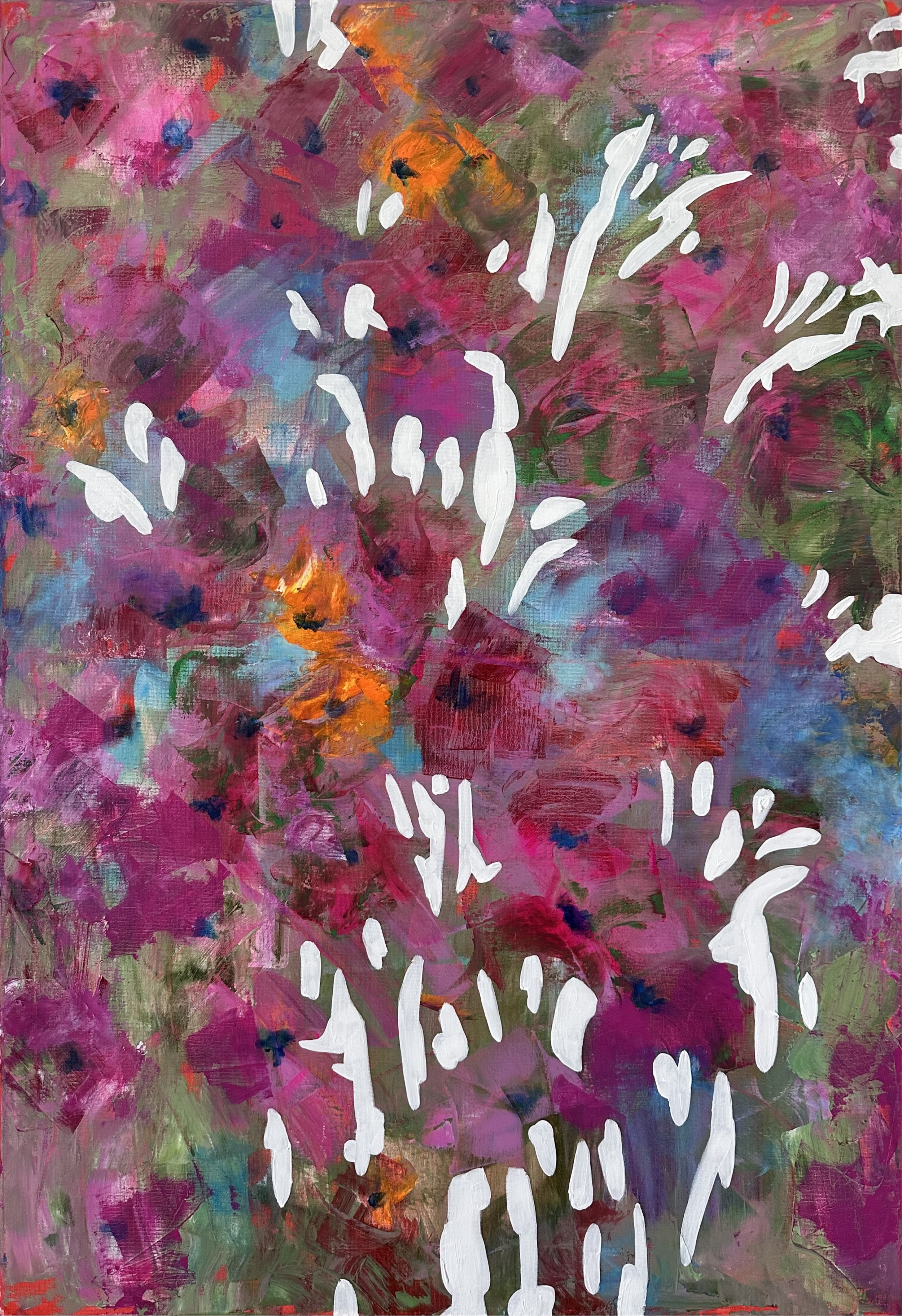
Gloaming roses, acrylic on canvas, 90x60 cm, 2026 © Darina Komorowski
You often describe painting as a conversation. Can you walk us through your creative process from the first gesture to the finished work?
For me, painting, culture, and any action I approach creatively is inseparable from the artist’s inner life. And that inner life is formed over an entire lifetime. So a conversation with a painting is always a conversation with myself in a specific moment, and with the states that live within me.
Some states are fleeting; others are long-lasting. That difference determines when the conversation begins. Sometimes a theme stays with me for years, slowly ripening. It returns, shifts its shape, gathers nuance, until it finally insists on entering the canvas. Other times, everything begins with a recent inner event, something fresh that immediately demands an outlet. In both cases, the work remains connected to everything I have lived through. Experience stays inside me and affects how I see, which colours I choose, where I leave a pause, and where I intensify tension.
The process itself feels like a dialogue in which reciprocity is essential. I set the foundation, and the painting starts to answer. It reveals where there is already enough, and where something still wants to unfold. Where it needs more air, where it needs density, where rhythm needs clarification. I listen closely to these responses and move forward step by step.
Ending the dialogue is about knowing how to place a final point. For me, it resembles a good conversation between people: it requires tact, a sense of measure, and respect for what has already emerged. I leave the painting space to resonate on its own. I finish when it holds together, clearly and wholly, and when any further intervention would begin to change its state rather than deepen it.
Flowers are central to your practice. What do they symbolise for you, and why do you continue to return to this imagery?
The subjects of my work keep returning to flora because, for me, living nature reflects the fragility and vulnerability of human life and the human soul. When I paint flowers, I am speaking first of all to people and reminding them of how similar we are.
A flower is an embodiment of life and naturalness, of something basic that exists in each of us. As part of nature, it reminds me of what is truly important and untouchable in a person: their life, their desire for warmth and love, their need to feel the ground under their feet and to have their own space. In nature, every being treats its needs with respect, and through this contrast, I want to emphasise that a person has more of them. It is endlessly important for people to respect not only their physical needs but to value their emotional needs equally and to remember the worth of their desires, feelings and meanings. It matters to me to remind the viewer of an inner reality, that feelings exist, thoughts exist, desire exists, and all of this is right and has a place.
When I work with this set of meanings, I also think about the cycle of life. A person remains part of a shared process. This sense of kinship with everything living gives rise to respect and care toward one’s own space, toward the people nearby and toward the world around. In the end, this motif is about a simple practice: to be yourself, to protect what is around you and to be attentive to the worlds of those close to you.

Sky blue flowers, acrylic on canvas, 90x60 cm, 2025 © Darina Komorowski

White and flowers, acrylic on canvas, 90x60 cm, 2025 © Darina Komorowski
Your use of bright colour is very distinctive. How do colour and emotion interact in your paintings?
I often work with bright and open colours because this is how I convey the intensity of inner experience. An emotion lived from the inside feels like an event. It takes up more space than is visible from the outside. Colour helps me make this inner magnitude tangible.
In my work, colour sets the temperature of a state. It strengthens the impression and brings the viewer closer to what is happening inside the painting. Joy sounds like saturation and fullness. Tenderness becomes light and air. Tension appears through contrast and density. It is important to me that colour works as a conduit so that emotion is read through the body and remains in the space as a sensation.
Living and working in Dubai, how has the city's rich cultural environment and rhythm influenced your work?
Dubai has given me a sense of scale and courage. There is a high quality of visual environment here, a strong rhythm and a lot of light and contrasts. The city constantly shows how reality can be composed on a large scale. This has strengthened the dynamism in my work and my love for saturated colour.
I also feel cultural intersections here. Different languages, aesthetics and speeds meet in one place. This kind of environment pushes you to think wider, to try new moves and to build a work in a more spacious and free way.
How has your work been received in Dubai, both by local audiences and the art community?
For me, Dubai is connected to courage and opportunities. I am genuinely fascinated by the UAE as an example of the power of intention. In a short history, a space has grown here that thinks globally and acts at scale, and this is felt in the attitude to culture and to the visual environment.
I feel close to how seriously people here take the idea that we should be surrounded by beautiful, interesting and conceptually large things. I see openness to new currents and, at the same time, respect for their own cultural value. Because of this, an intense atmosphere is created where something is always happening, and this expands your horizon.
In how my works are perceived in Dubai, I often pay attention to how a painting lives in space. Mood, energy, scale and expressiveness matter here. People look at how the work influences the environment right now.
There is also one personal detail that matters to me. The most precious thing in my life in Dubai is connected to rhythm. I live in a very quiet and calm neighbourhood, and this gives my nervous system time to recover, to process tension and to relax. This state directly affects my work. There is more focus, more clarity in decisions and a sense of inner quiet against which colour and dynamics sound more precise. In the Emirates, there are still places where solitude is possible, and for an artist, this becomes real support.

In the small hours, acrylic on canvas, 90x60 cm, 2026 © Darina Komorowski
Do you notice differences in how your paintings are understood or received internationally compared to Dubai?
Yes, the differences are very noticeable. Every country has its own habits of reading and painting, and the viewer assembles the work in a different way. I have lived in Kazakhstan, Turkey and Poland, and now I live in the UAE and in each context, the focus of perception shifts.
In Kazakhstan and Turkey, cultural code and history are especially important. Viewers look for recognisable motifs and a sense of continuity with tradition, heritage and symbols. In Europe, the audience more often asks about the artist as a person and about layers of meaning. There is a habit of reading the work like a text, looking for connections, context, symbolism and biographical and cultural references.
For me, the UAE sits between these approaches. There is respect for cultural value, and at the same time, a very sharp attention to how the work acts on space and mood. In my experience, people here are drawn to scale, dynamism, expressiveness and a clear visual magnetism. A painting is perceived as part of an environment that sets the tone of life around it.
What projects or directions are you currently developing, and what can we expect from your work in the near future?
Right now, I am especially interested in projects connected to my international visibility: art fairs in Europe and in Berlin and exhibition formats, primarily group shows. A separate direction I want to go deeper into is collaboration and exchange with other artists, curators and researchers when painting becomes part of a shared statement and expands its own language.
At the same time, I am keeping in focus a trajectory toward larger formats such as biennials, triennials and institutional programmes. I feel close to the way the centre of attention in the global art community is shifting. Major events and new art hubs are increasingly developing across the Global South, and I see my growth in this field. That is why I also work with media presence and a strategy of visibility as part of my artistic path.
In painting, I am continuing a series that is less focused on the experience of one person and more on states that extend beyond the personal. I am drawn to love, balance, importance and faith, a conversation about something wider than an individual story. It is still a story about feeling, but now I am shifting my attention to the state of the world around us, to harmony and equilibrium, to trust and gratitude, and I am searching for how to translate this into image and colour.

History, acrylic on canvas, 158x79 cm, 2026 © Darina Komorowski
Looking ahead, what are your main artistic goals for 2026?
In 2026, my first priority is to find a like-minded gallery partner with strong documentation and a confident position that can resonate equally in Europe and in Dubai. What matters to me is a collaboration where my painting is supported not only through exhibitions but through a clear system of presentation as well: texts, an archive, a strong articulation of the series and precise contextual framing.POSITIONS Berlin Art Fair is my point of appearance in 2026. It is where I want to be seen professionally. Another thread of 2026 is to remain consistently within the Art Basel field of vision as a visitor: to enter its rhythm, expand my network, learn how this international environment works and sense where my painting can belong organically.
I want this focus to turn into a confident presence in 2027 at Art Dubai and at Art Basel Qatar, grounded in partnership and in a body of work that holds together as a single statement.
Artist’s Talk
Al-Tiba9 Interviews is a promotional platform for artists to articulate their vision and engage them with our diverse readership through a published art dialogue. The artists are interviewed by Mohamed Benhadj, the founder & curator of Al-Tiba9, to highlight their artistic careers and introduce them to the international contemporary art scene across our vast network of museums, galleries, art professionals, art dealers, collectors, and art lovers across the globe.
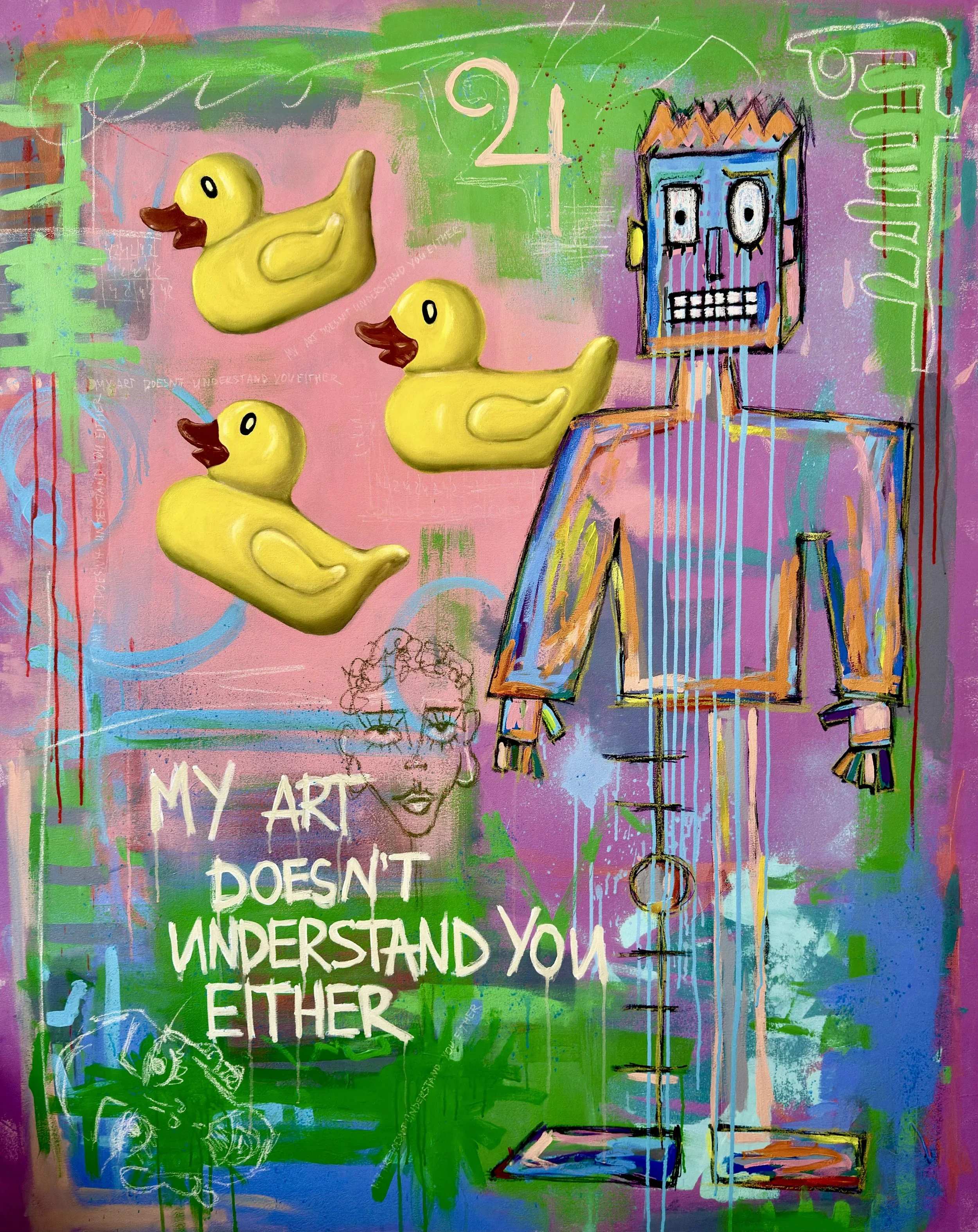



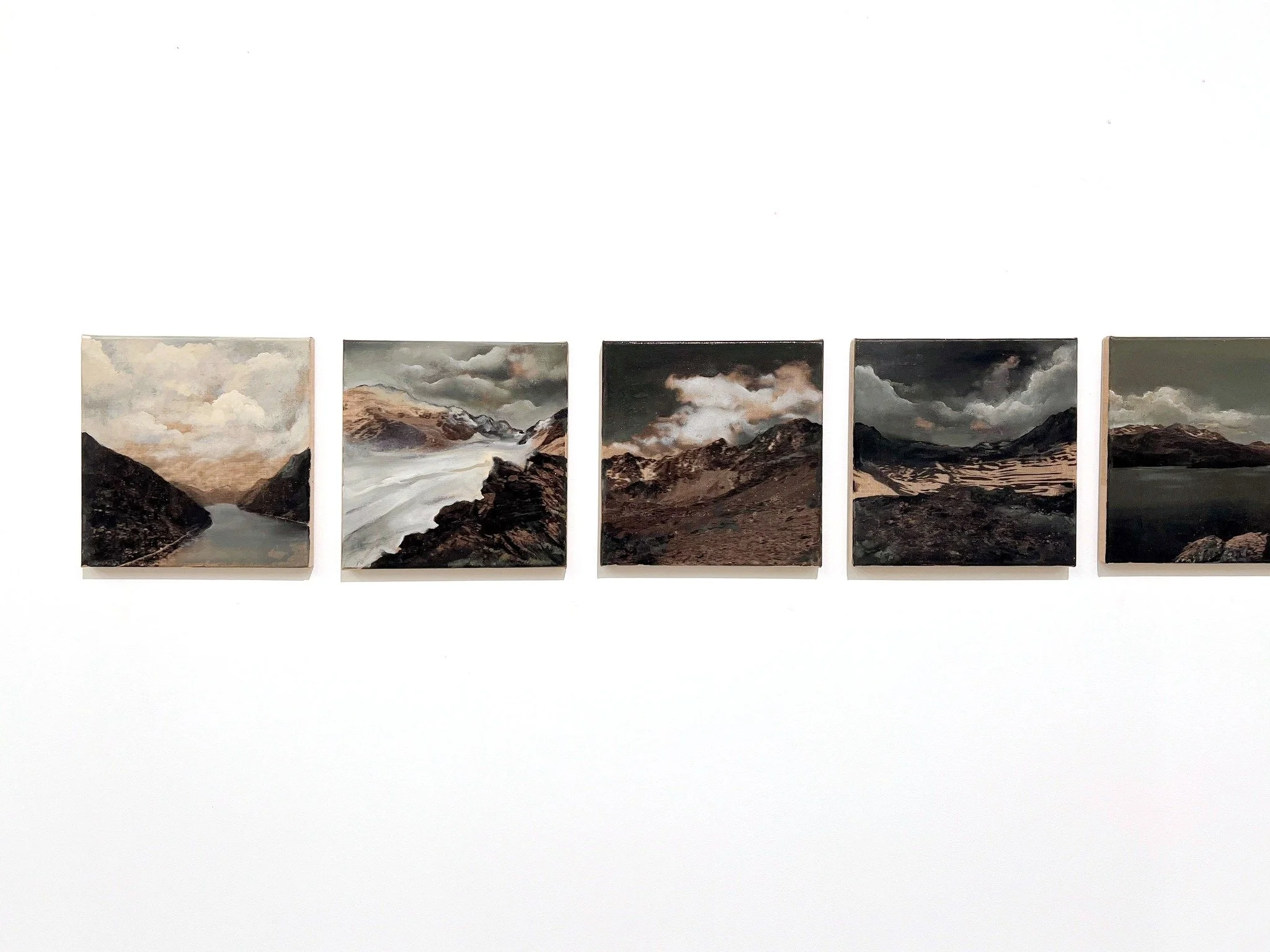
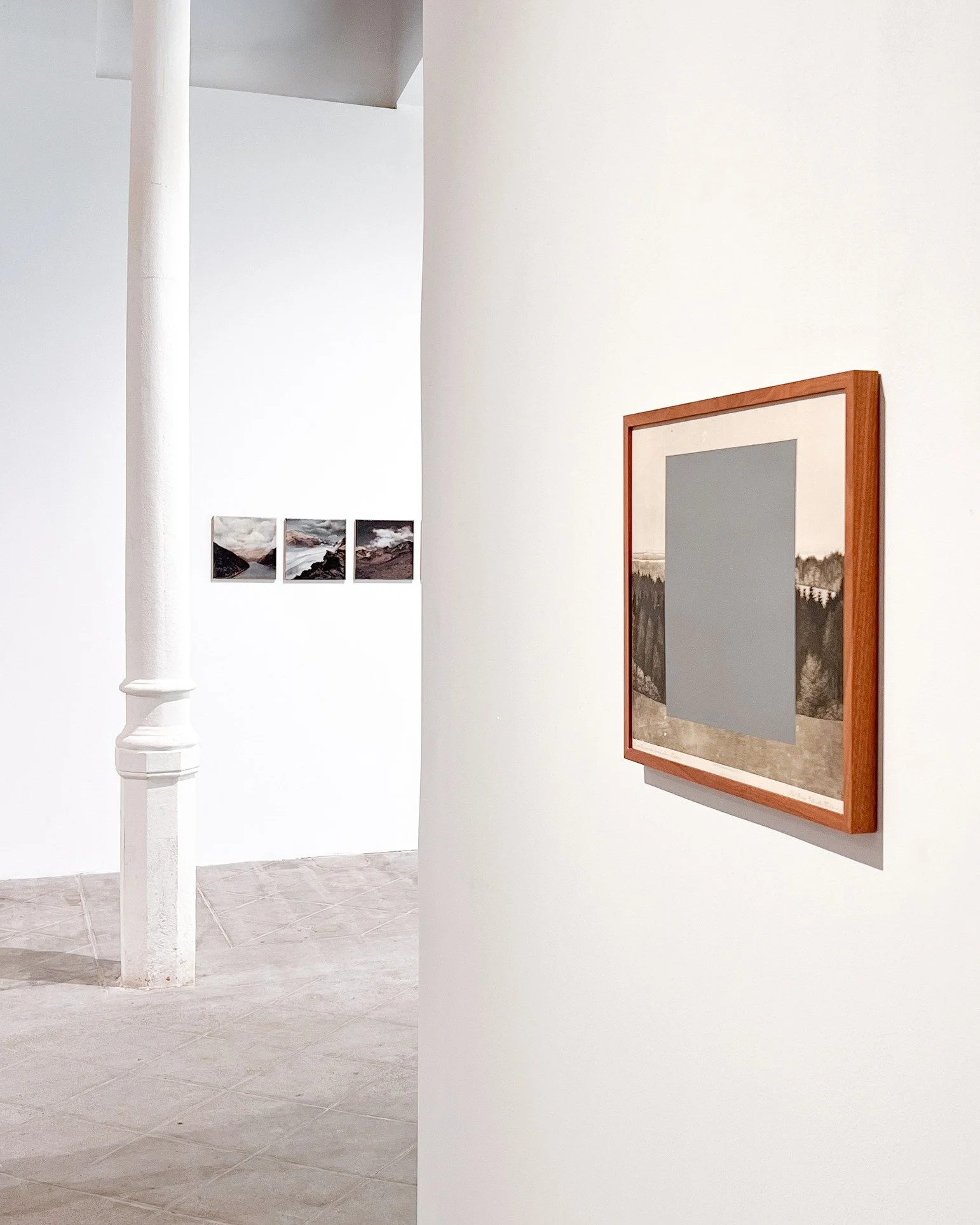
Nataraj von Allmen is a painter based in Switzerland. Often taking photographic material as a starting point, he weaves together landscapes, mythological archetypes, Christian symbolism, and contemporary socio-political themes into complex paintings. Oscillating between figuration and abstraction, his work investigates transformation, collective memory, and the human condition.