
10 Questions with Chan Alvarez
Chan Alvarez is a visual artist, art critic, and independent curator. He studied at the University of the Philippines Diliman and at the London School of Economics and Political Science (LSE), where his intellectual formation developed through engagements with critical theory, philosophy, and interdisciplinary inquiry. This academic grounding continues to inform the conceptual and methodological frameworks of his work.
Alvarez’s visual practice examines how identity, self-consciousness, and perception are shaped -and reshaped- across temporal and contextual conditions. Working across diverse media, his projects focus on the philosophical discourse between theoretical constructs and the phenomenological experience. His works have been presented in exhibitions internationally, creating spaces that invite his viewers to engage with the shifting boundaries of personhood.
Alongside his studio work, Alvarez also works with galleries, artist-run spaces, and institutional settings. His curatorial projects and critical writing foreground context, theory, and the lived experience of making. He is currently developing an upcoming curatorial collaboration at La Casa Encendida.
He lives and works between Manila and Madrid.
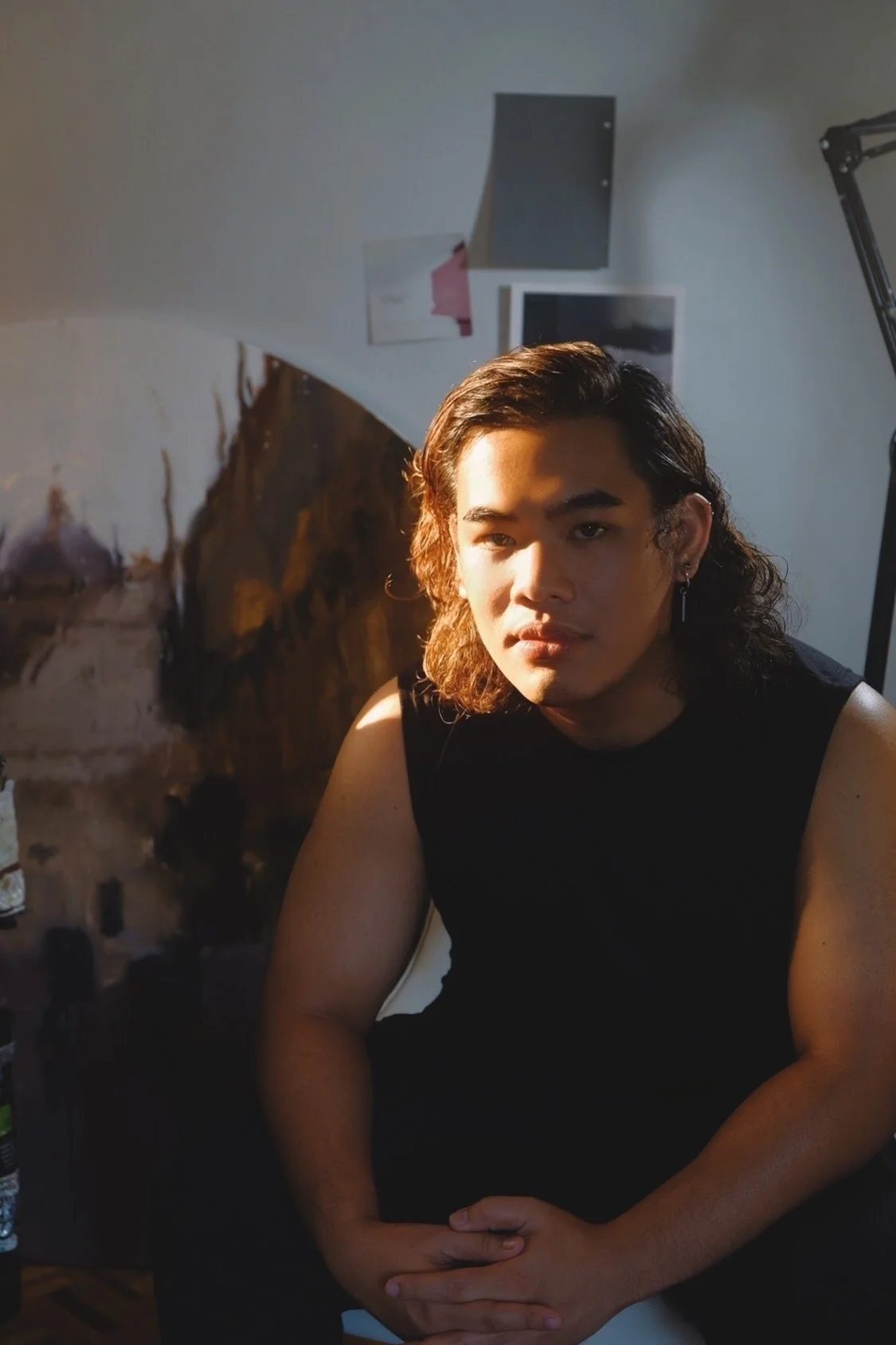
Chan Alvarez - Portrait
ARTIST STATEMENT
Chan Alvarez returns persistently to the question of the self, how it is sensed, staged, fractured, and reimagined. Each series he creates is structured through a distinct philosophical model of subjectivity, beginning with Kierkegaard’s articulation of inwardness and extending into psychoanalytic and philosophical investigations of consciousness, desire, and disintegration. These conceptual engagements shape not only the thematic direction of his projects but also their material presence.
Rather than presenting philosophy as content, his works mobilise it as a generative system. Within this framework, material decisions operate as a form of thinking. Colour becomes atmospheric, atmospheric and structural. Medium, likewise, is a conceptual partner: surface, texture, density, and resistance contribute to how ideas are metabolised into form.
Figuration appears as an interface rather than a stable representation. The figures act as reflective structures, mirrors through which the viewer’s gaze returns altered, destabilised, implicated. Looking becomes an event, an exchange in which perception is revealed as constantly negotiated.
His curatorial practice runs parallel to this investigation, foregrounding context as an active agent in the production of meaning and developing frameworks that balance individual practices while articulating discursive dynamics. Across both practices, his focus remains on perception, philosophy, and the shifting frameworks of identity formation.
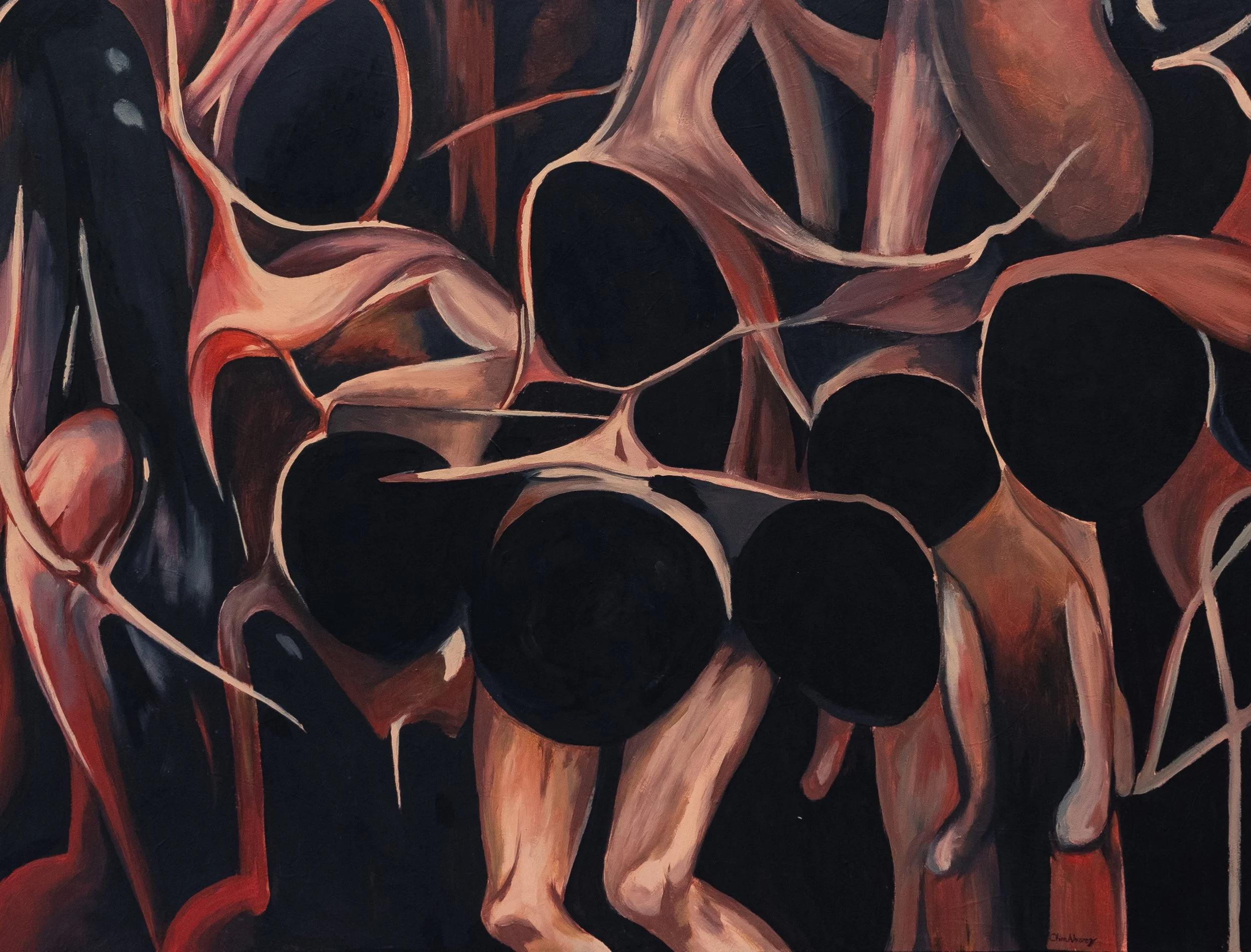
Six Degrees of Separation (Act I), Acrylic, 36x48 in, 2023 © Chan Alvarez
INTERVIEW
First of all, you studied at the University of the Philippines Diliman and later at the London School of Economics and Political Science. How did these two academic environments shape your thinking as both an artist and a writer?
I see my time at the University of the Philippines Diliman and at the London School of Economics as two different but complementary conversations. My studies in the Philippines were deeply rooted in social realities. There was a constant emphasis on historical awareness, political consciousness, and lived experience. That sharpened my sensitivity and made me realise that thinking is never neutral - it is always situated within a specific cultural and material context. When I pursued my postgraduate studies in London, this perspective expanded. My engagement with theory became more structural and interdisciplinary. I encountered broader intellectual discourses and different traditions of critical thought, which pushed me to situate myself and my work within a wider conversation about society, subjectivity, and power. It wasn’t about leaving my context behind, but about understanding how it connects to larger frameworks. Together, those environments shaped how I move between making, writing, and curating. For me, they’re not separate roles. Just different ways of staging inquiry.
Living and working between Manila and Madrid, how do shifts in geography and cultural context affect your understanding of identity and perception?
Living between Manila and Madrid makes me very aware that my identity is something in motion and is constantly shaped by circulation, by encounter, by translation. For many Filipino artists in the diaspora, there is this constant negotiation between rootedness and participation in a broader international discourse. We carry very specific histories, colonial legacies, social realities, and cultural memory, and yet we are also deeply engaged in global conversations in art. The challenge, and also the opportunity, is how to enter those conversations without flattening where we come from. In Manila, there’s a shared immediacy: a lived context that informs how work is read. In Madrid, the same work can become reframed through questions of migration, difference, or postcolonial identity. That shift makes perception visible. You begin to see how meaning is constructed differently depending on geography. I find that productive. Moving between these spaces creates a kind of expanded field. A space where Filipino artists are not peripheral but actively shaping international discourse. It’s less about representing a nation and more about contributing a perspective formed through multiple crossings.
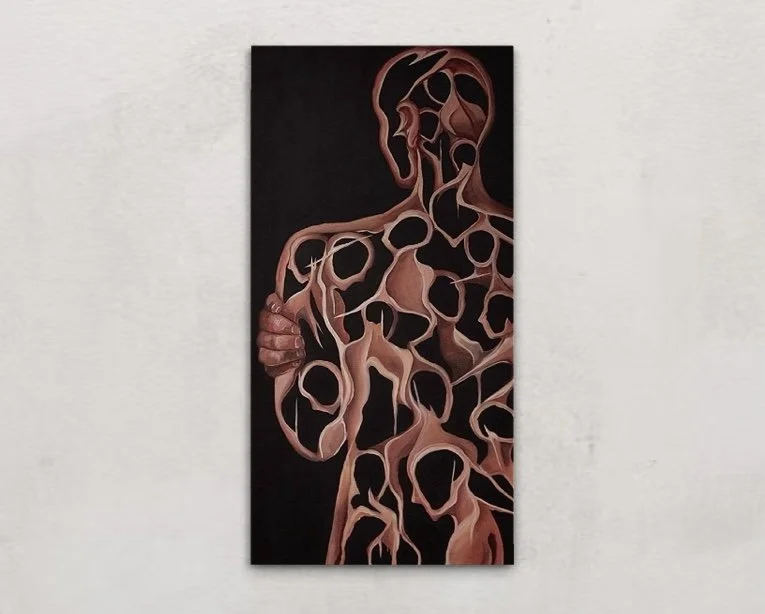
Six Degrees of Separation Act II (exhibited at BARCELONA CONTEMPORARY group exhibition at Hub_Art Barcelona, 2025), Acrylic, 48x24 in, 2023 © Chan Alvarez
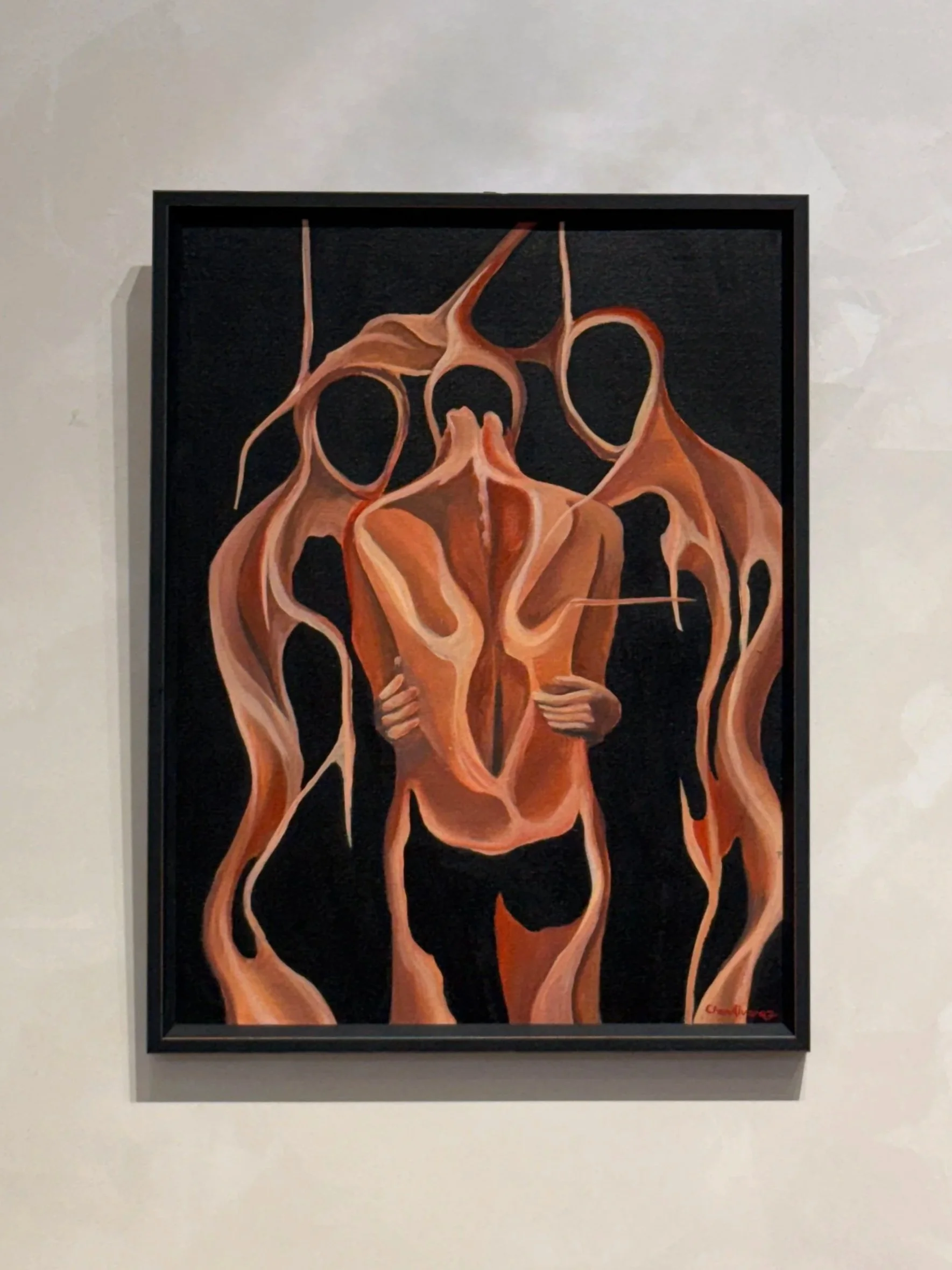
Six Degrees of Separation Act III (exhibited at HUMAN COSMOS group exhibition at Hub_Art Barcelona, 2026), Acrylic, 24x18 in, 2023 © Chan Alvarez
Philosophy plays a central role in your work. When did you first realise that theoretical inquiry would become part of your artistic language?
I think I’ve always been drawn to existential questions, even before I had the language for them. I’ve always had this early preoccupation with inwardness, with questions of being, freedom, anxiety, and responsibility. Even before I encountered these ideas formally, they were present in how I was looking at the world. Thus, it didn’t feel like I was importing theory into my art. It felt more like recognising a structure that was already there. Philosophy became part of my artistic language because it gave form to questions I was already living with.
You often return to the question of the self. What continues to draw you back to this theme?
As someone living in both Eastern and Western cultures, I’m constantly reminded that identity is never singular. It shifts depending on one’s geography, language, and context. In one place, you are read through familiarity; in another, through difference. That movement makes the self feel less like a stable core and more like something negotiated in real time.
As a diasporic artist moving between these spheres, that instability becomes very tangible. I am always translating. Not just language, but history, memory, and cultural codes. Therefore, what draws me back to this theme is that it remains unresolved. Each geography reframes who I am. Each audience reads me differently. That unrest is not something I try to correct; it’s something I want to examine.
Your projects engage thinkers such as Søren Kierkegaard. How do you translate philosophical models of subjectivity into visual form without simply illustrating them?
With Six Degrees of Separation, I wasn’t trying to illustrate Søren Kierkegaard. I was interested in mapping his idea of the self as something relational and in tension with itself. I began with his philosophical ideology as it resonated deeply with me. But he’s not a fixed reference point; he is the beginning of a longer inquiry. My broader practice examines how identity, self-consciousness, and perception are shaped and reshaped across time and context through philosophical frameworks. Each thinker offers a different architecture of the self, and each series becomes a way of mapping that model visually. So my work evolves alongside the inquiry. I don’t illustrate philosophy; I move through it. Each body of work becomes a cartography of a particular conception of subjectivity. In that sense, it is ongoing. The self is never exhausted, and neither is the philosophical investigation that accompanies it.
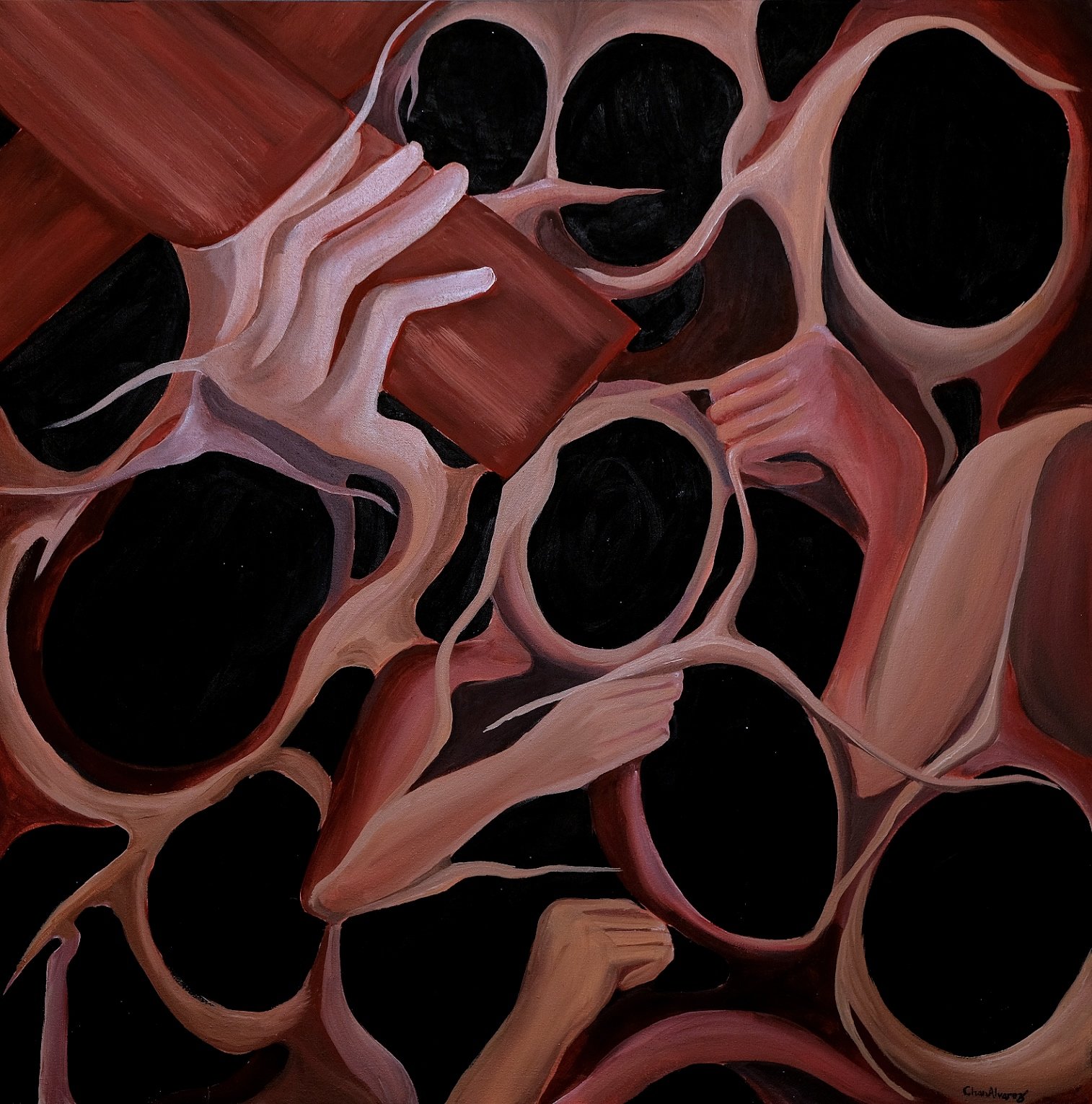
Six Degrees of Separation (Act IV), Acrylic, 24x18 in, 2023 © Chan Alvarez
You describe material decisions as a form of thinking. How do colour, texture, and surface help you process complex theoretical ideas?
I don’t separate thinking from making. Often, I understand an idea more clearly only after I’ve worked through it materially. Colour allows me to process mood and interior states that are difficult to articulate in language. A muted palette can hold restraint or introspection in the same way a stark contrast can create tension or fracture. Texture, on the other hand, introduces time. Layers accumulate, and surfaces are scraped back, erased, reworked. That process mirrors how theoretical ideas unfold. Surface is especially important. It’s where the viewer meets the work. It holds traces of hesitation, pressure, and revision. In that sense, it records thought as action. Rather than explaining a philosophical concept, the material carries its rhythm - its uncertainty, its density, and its openness.
So when I say material decisions are a form of thinking, I mean that they allow ideas to exist without being reduced to explanation. A void is not simply symbolic, but it is spatial. A fragmented body is not just conceptual but is physically disrupted on the canvas. The viewers don’t just read the theory, but rather, they encounter it. In that sense, making becomes a form of research. The studio is a space where ideas are metabolised through pigment, gesture, and spatial tension. Materiality is where these thoughts acquire presence.
Figuration in your work appears as an “interface” rather than a stable image. What do you want viewers to experience when they encounter these figures?
I’ve never been interested in the figure as a fixed image. What interests me is the figure as a site of encounter. In these works, the body is fragmented, its centre hollowed out, its contours intersecting with others. It resists completion. The absence of the face, which traditionally guarantees identity, is often replaced by a void. That void is important. It prevents the figure from becoming illustrative. Instead, it opens a field of projection. Meaning, then, doesn’t reside in the figure alone. It emerges in the confrontation. The body becomes a mirror, but an unstable one. It reflects back the viewer’s own negotiation with selfhood and their own sense of wholeness and fracture.
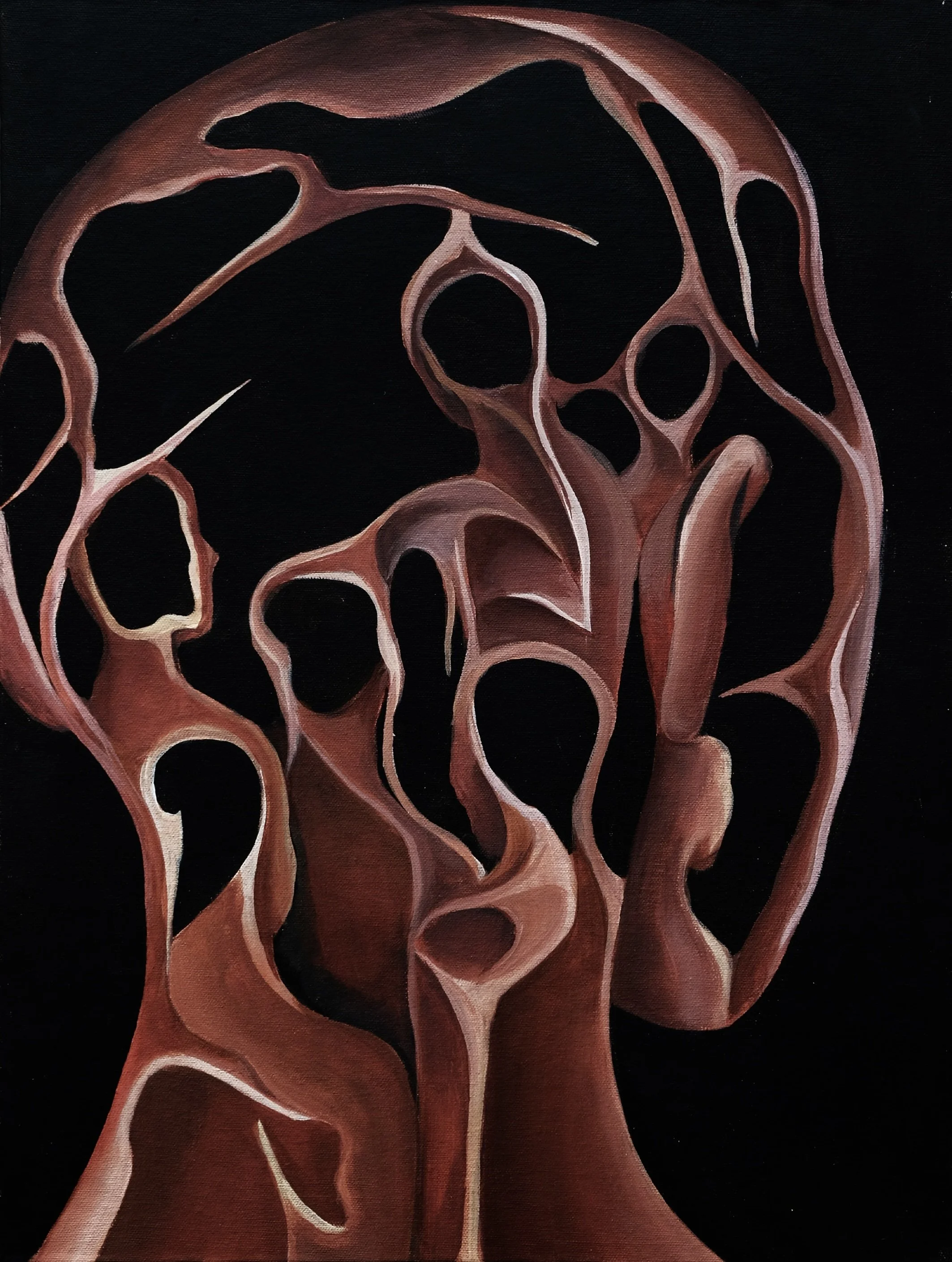
Six Degrees of Separation (VI), Acrylic, 24x18 in, 2023 © Chan Alvarez
Your practice spans painting, writing, and curating. Do these roles influence one another, or do you try to keep them distinct?
For me, these roles are not separate compartments. They form a kind of ecosystem. Painting is perhaps the most internal space; it’s where philosophical questions pass through the body, through gesture and material. Writing, on the other hand, is a different rhythm of attention. When I write for other artists, I try to enter their logic and their vocabulary. But inevitably, I interpret through the same questions that shape my own work. Hence, writing becomes a parallel inquiry. Curating expands that inquiry outward. It creates a space of dialogue. When I curate, I often return to my own philosophical concerns, particularly my position as a diasporic artist moving between East and West, but now those concerns are refracted through multiple practices. The exhibition then becomes a field of relations rather than a singular voice. So rather than distinct roles, I see a continuous conversation. Painting gives form to theory, writing articulates it, and curating situates it within dialogue. Each discipline refracts the same set of concerns through a different lens. And that dialogue keeps the practice alive.
As a curator, you emphasise context as an active agent in meaning-making. How do you build exhibitions that allow different artistic voices to coexist while sustaining a coherent discourse?
I’ve always thought of exhibitions as conversations rather than statements. The role of the curator is not to impose a singular thesis, but to construct a framework where different voices can resonate, intersect, even disagree, without collapsing into noise. When I say context is an active agent, I mean that meaning does not reside solely within the artwork. It emerges between works, between artists, between the exhibition and its historical moment. The curator’s task is not to stabilise that meaning, but to activate its conditions. I also don’t aim for coherence through similarity. I look for shared questions. Artists may differ radically in medium or aesthetic language, but if they are orbiting a common tension (around subjectivity, memory, politics, or perception), a discourse begins to form. The curator’s role is to make that field visible without overdetermining it. In that sense, curating is about constructing a discursive ecology. It is about creating a structure where multiple subjectivities can coexist, remain autonomous, and yet contribute to a larger, evolving conversation.
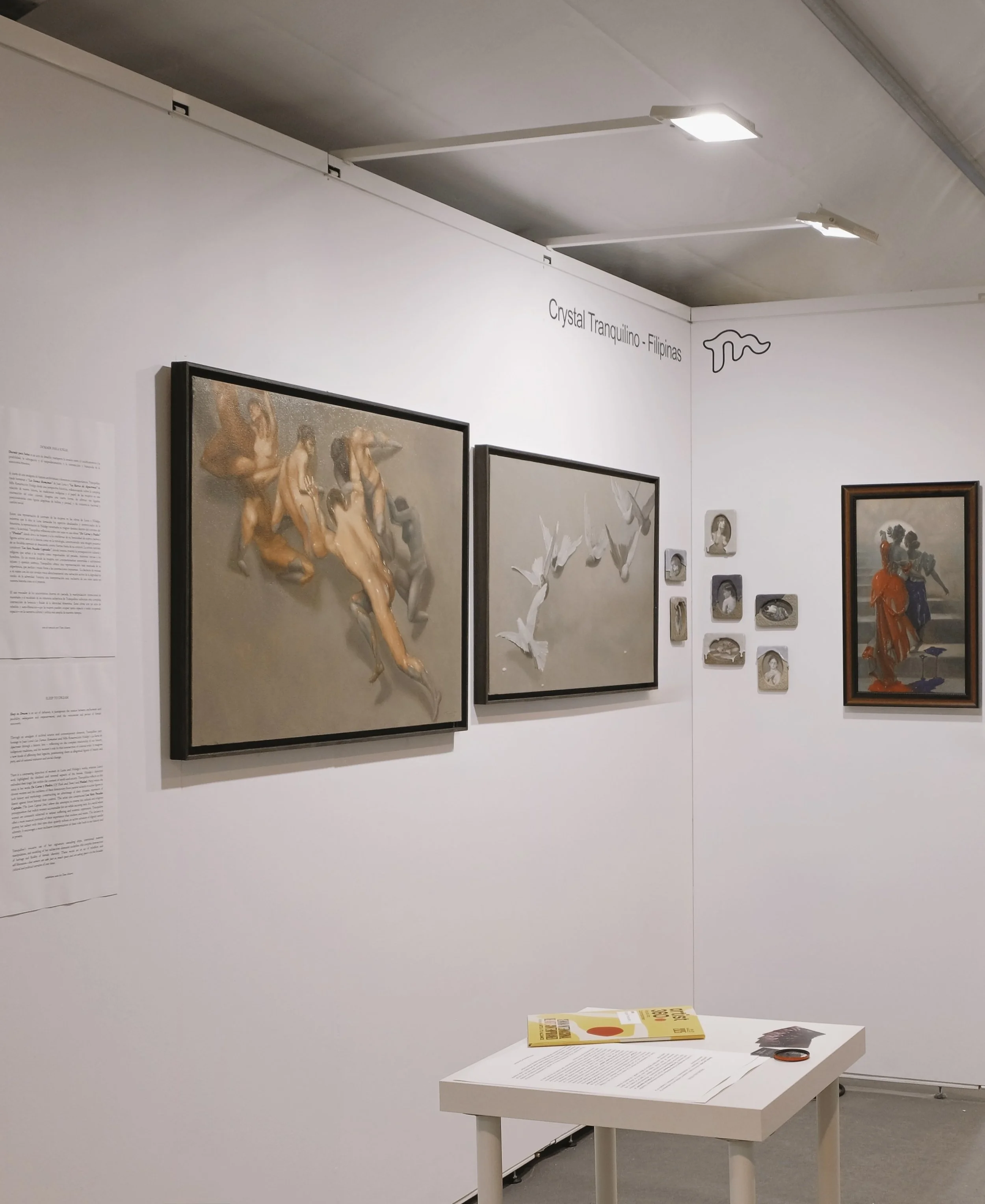
Curatorial Work for Crystal Tranquilino at Artist360 Fair Madrid, 2025 © Chan Alvarez
Lastly, you are currently developing a curatorial collaboration at La Casa Encendida. What excites you most about this project? And what other projects do you have for the future?
What excites me about the project at La Casa Encendida is its potential to situate Filipino artistic practice within a broader international conversation here in Spain. I was assigned as the primary curatorial collaborator by the Embassy of the Philippines in Spain, working alongside the principal curator to help shape the conceptual and structural direction of the exhibition that features established, contemporary Filipino artists. The project brings together Filipino perspectives across geographies, opening a space where cultural memory, migration, and identity can be examined in relation to Spain’s historical and contemporary context. It goes beyond display as it creates a space for dialogue between each culture and its audiences.
Alongside this project, I’m also developing a curatorial initiative in Barcelona and preparing for my solo exhibition early next year. In the studio, I continue expanding my philosophical investigation of the self, building from existential foundations toward other theoretical outlines. Across these projects, I remain committed to creating frameworks where subjectivity can remain dynamic and is continually negotiated through context and encounter.
Artist’s Talk
Al-Tiba9 Interviews is a curated promotional platform that offers artists the opportunity to articulate their vision and engage with our diverse international readership through insightful, published dialogues. Conducted by Mohamed Benhadj, founder and curator of Al-Tiba9, these interviews spotlight the artists’ creative journeys and introduce their work to the global contemporary art scene.
Through our extensive network of museums, galleries, art professionals, collectors, and art enthusiasts worldwide, Al-Tiba9 Interviews provides a meaningful stage for artists to expand their reach and strengthen their presence in the international art discourse.


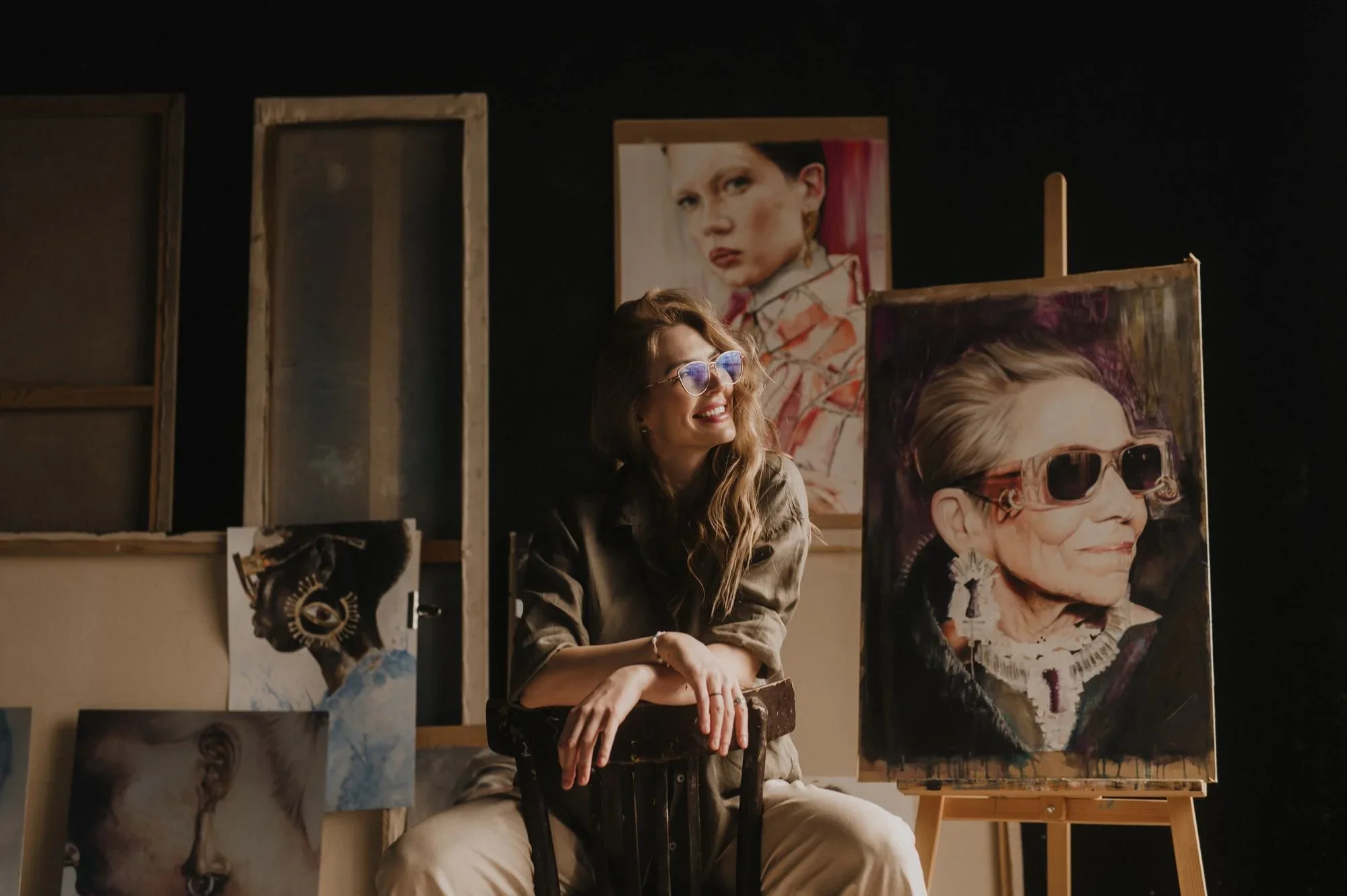

Brooklyn-Born Allan Gorman is a contemporary fine artist based in Jersey City, NJ, with a unique artistic vision cultivated by a distinguished commercial career that helped refine a sense of aesthetics and unwavering commitment to excellence that continues to define his artistic process to this day. His latest series of paintings is titled Imaginary Spaces.