
10 Questions with Devid Biscontini
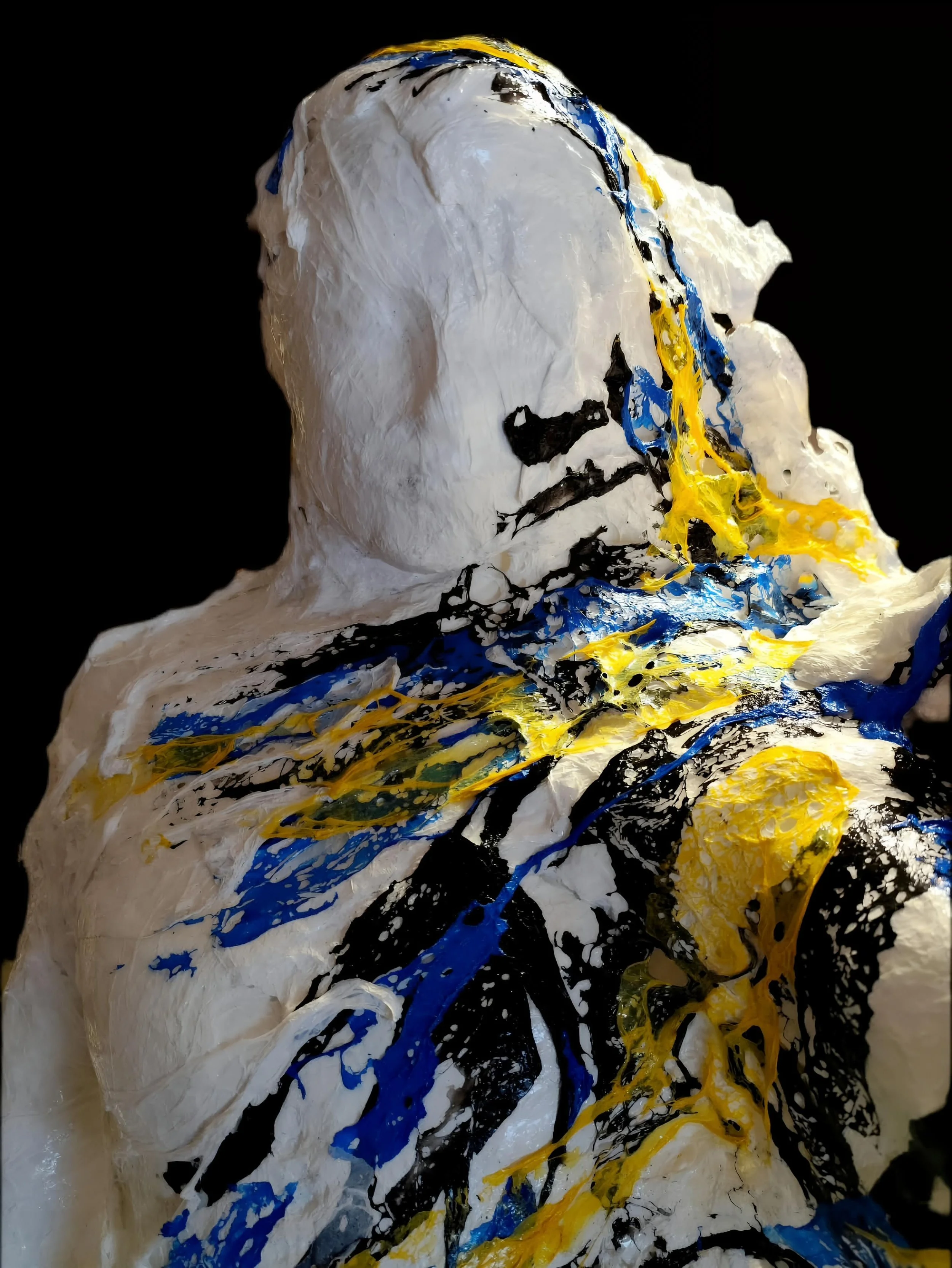
Devid Biscontini is an Italian contemporary artist who lives and works in Umbria. A self-taught artist, he has developed a distinctive research focused on the expressive potential of industrial plastic as the primary material of his artistic language.
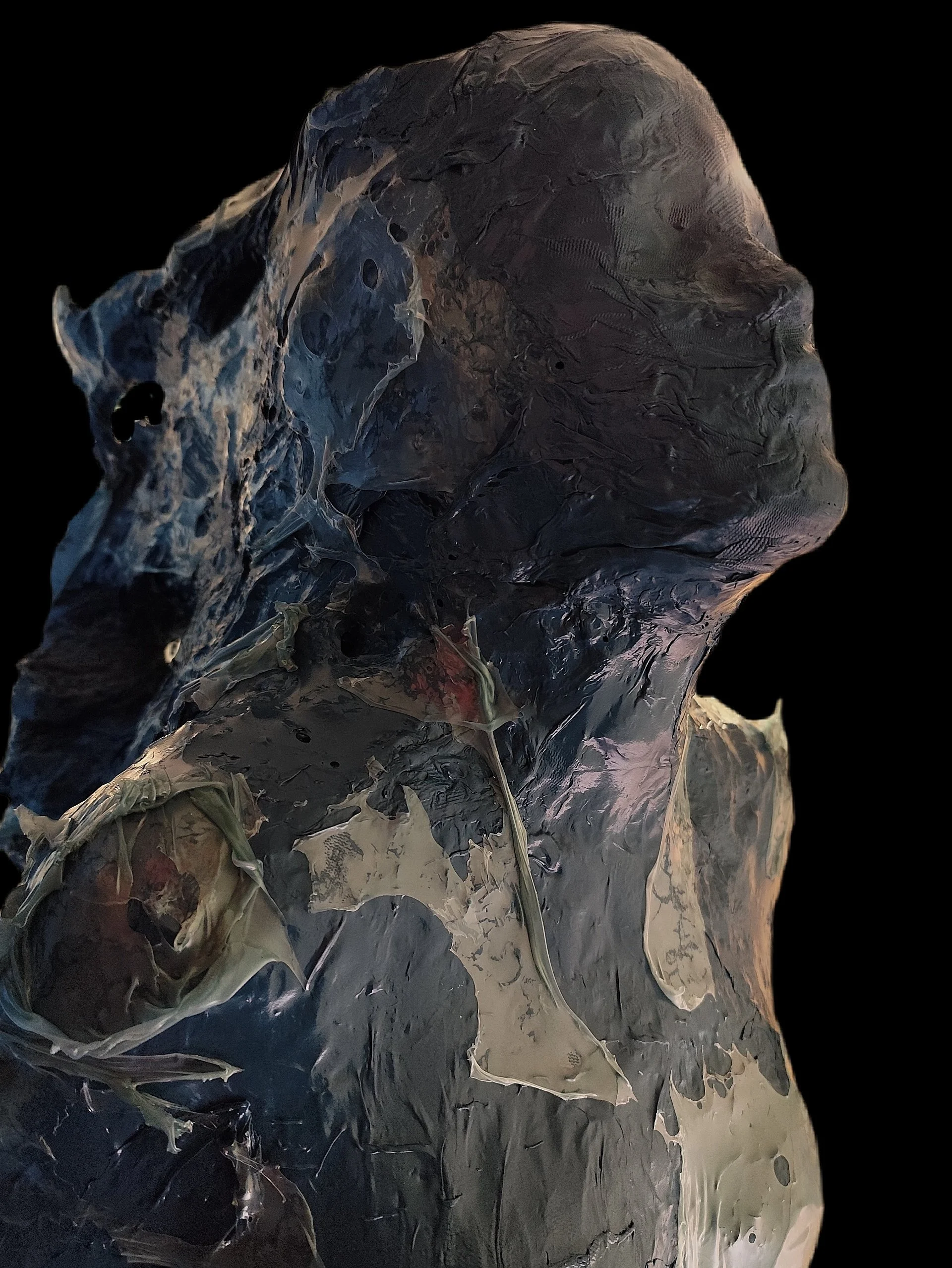
His practice is based on the thermoforming of coloured plastic films, which are heated and shaped with an open flame to create layered surfaces, chromatic fusions, and material tensions, placing his work at the boundary between painting and sculpture. Through this process, Biscontini achieves a unique trompe-l’œil effect, transforming an industrial material into a poetic, painterly visual experience.
His research explores the relationship between matter, perception, and transformation, often through dynamic compositions, intense colour fields, and symbolic imagery, particularly the female body. His works have been presented in contemporary art exhibitions and events, contributing to the development of a personal language that combines technical experimentation with instinctive gesture.
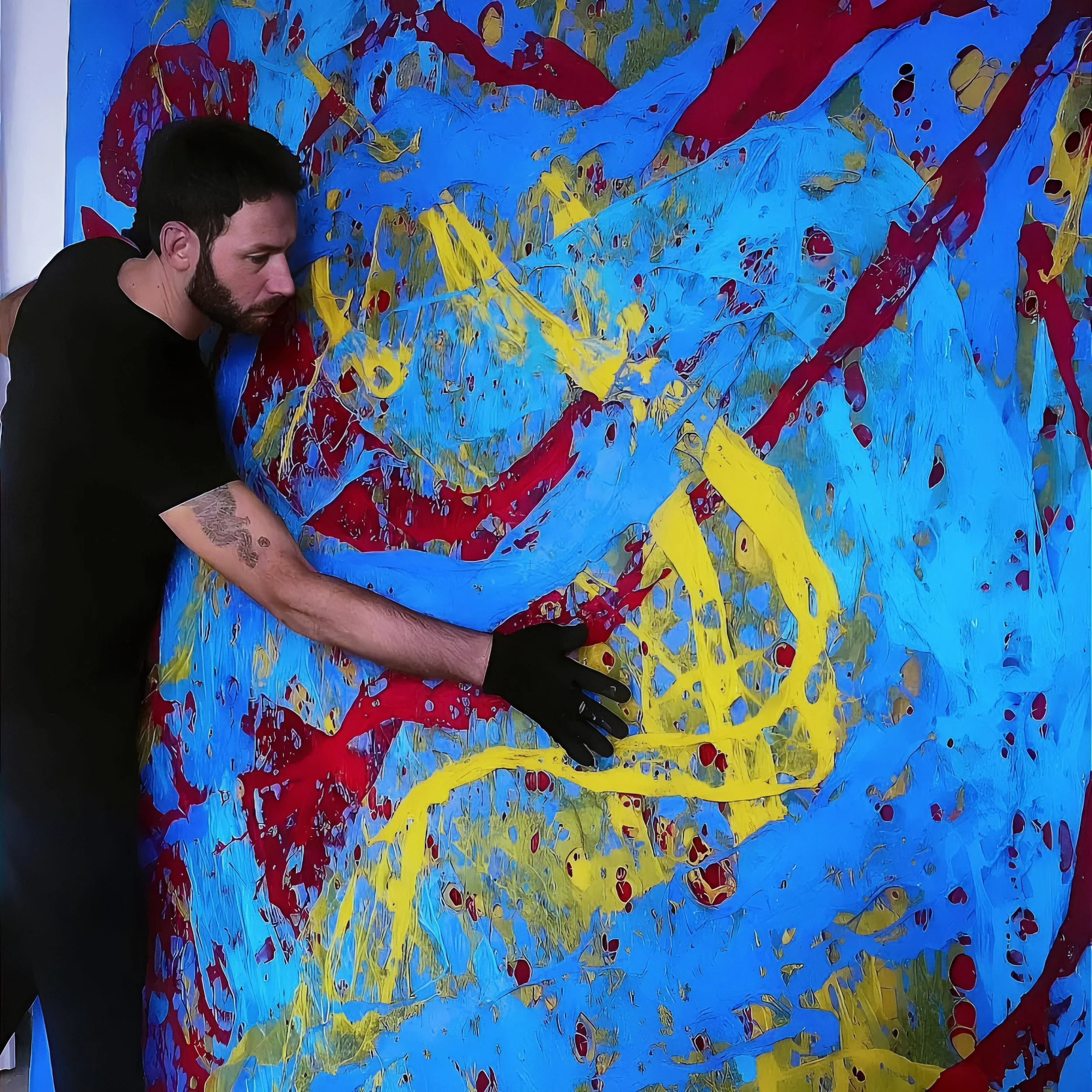
Devid Biscontini - Portrait
ARTIST STATEMENT
Devid Biscontini’s artistic practice explores the expressive potential of industrial plastic through processes of heat, transformation, and material tension. Working with co-extruded plastic films, he manipulates the surface using flame and hot air, allowing the material to bend, contract, and expand until it generates forms that exist between painting and sculpture.
Plastic, a material commonly associated with industrial production and disposability, becomes in his work a living surface capable of recording energy and movement. Through controlled thermal deformation, colour and matter interact to create layered compositions where light, depth, and chromatic intensity transform the material into a dynamic visual field.
His process is intuitive and experimental. Rather than imposing predetermined forms, Biscontini collaborates with the material itself, allowing heat, gravity, and tension to contribute to the work's creation. The resulting forms often suggest organic structures, bodies, or landscapes, oscillating between abstraction and figuration.
As a self-taught artist, he has developed his research outside traditional academic structures, guided by curiosity, experimentation, and a desire to discover new possibilities in unconventional materials. Each work becomes a record of transformation, an exploration of how industrial matter can be reimagined as a poetic and expressive medium.
Ultimately, his work seeks to reveal beauty within materials that are usually overlooked or considered purely functional. By transforming plastic through heat and colour, Biscontini aims to create forms that evoke vitality, tension, and continuous metamorphosis.
© Devid Biscontini
INTERVIEW
To start, how did you begin working with industrial plastic as your main artistic material?
I've always had a passion for art and crafts; since I was a child, I've worked with aluminium, iron, and wood. In my research, I've also experimented with other materials, such as polystyrene and plexiglass, but when I came across plastic film, I felt it would allow me to express myself fully, giving me the freedom to work with it in both painting and sculpture.
What attracted you to thermoforming and working with heat and flame?
Working with flame and heat attracts me because I really like the idea that with heat and my hands, I can transform a material into what I think.
Your works exist between painting and sculpture. How do you define them yourself?
I could define chromatic material transformations in both cases.
© Devid Biscontini
What challenges and surprises does plastic present during your creative process?
Creating an entire painting or sculpture is risky; the entire process is very quick: leaving the flame burning for a few seconds longer could compromise the outcome. The image I'm composing is pure irrational expression, incorporating a touch of technique acquired during the process.
As a self-taught artist, how did you develop your artistic language outside academic training?
It depends on what you mean... if we're referring to the need to create something as a form of expression, the gestures it entails, I'd say it interested and fascinated me from an early age; also thanks to the fact that my parents at the time both worked in craft firms, one in iron and the other in ceramics, so the idea of shaping material has always been very familiar to me. As I grew up, I began to explore and work with different materials, even acquiring some professional techniques from my youthful work, particularly as a blacksmith, where I devoted myself primarily to creating decorations that could be classified as artistic craftsmanship.
If, on the other hand, we're talking about a passion for art in terms of "studying" the classics and beyond, that came later in life, but in the form of personal study and research, not guided by academic circles. While I was developing and establishing my professional identity in a completely different field (I am a healthcare professional), driven by a personal interest, I visited exhibitions and museums, read or even collected material from the sector: art books, magazines... Every now and then, I created something with whatever I could find, but only on a personal level. At that time, there was no search for external comparison, which instead came a few years ago when I found what I call "my material": plastic.
You often collaborate with the material itself through heat and gravity, as you mention in your statement. How much control do you keep over the final result?
When the material responds unexpectedly, one must carefully evaluate the connection between the randomness of the image's formation and intention. I certainly take the random aspect into account during work, but it is not the cardinal principle that governs my work.
Light and colour play a strong role in your work. What emotions or sensations are you trying to evoke through them?
The most diverse sensations and emotions. The ones I particularly like are vitality, strength, beauty, and depth.

© Devid Biscontini
© Devid Biscontini
The female body appears as a recurring element in your compositions. What draws you to this subject?
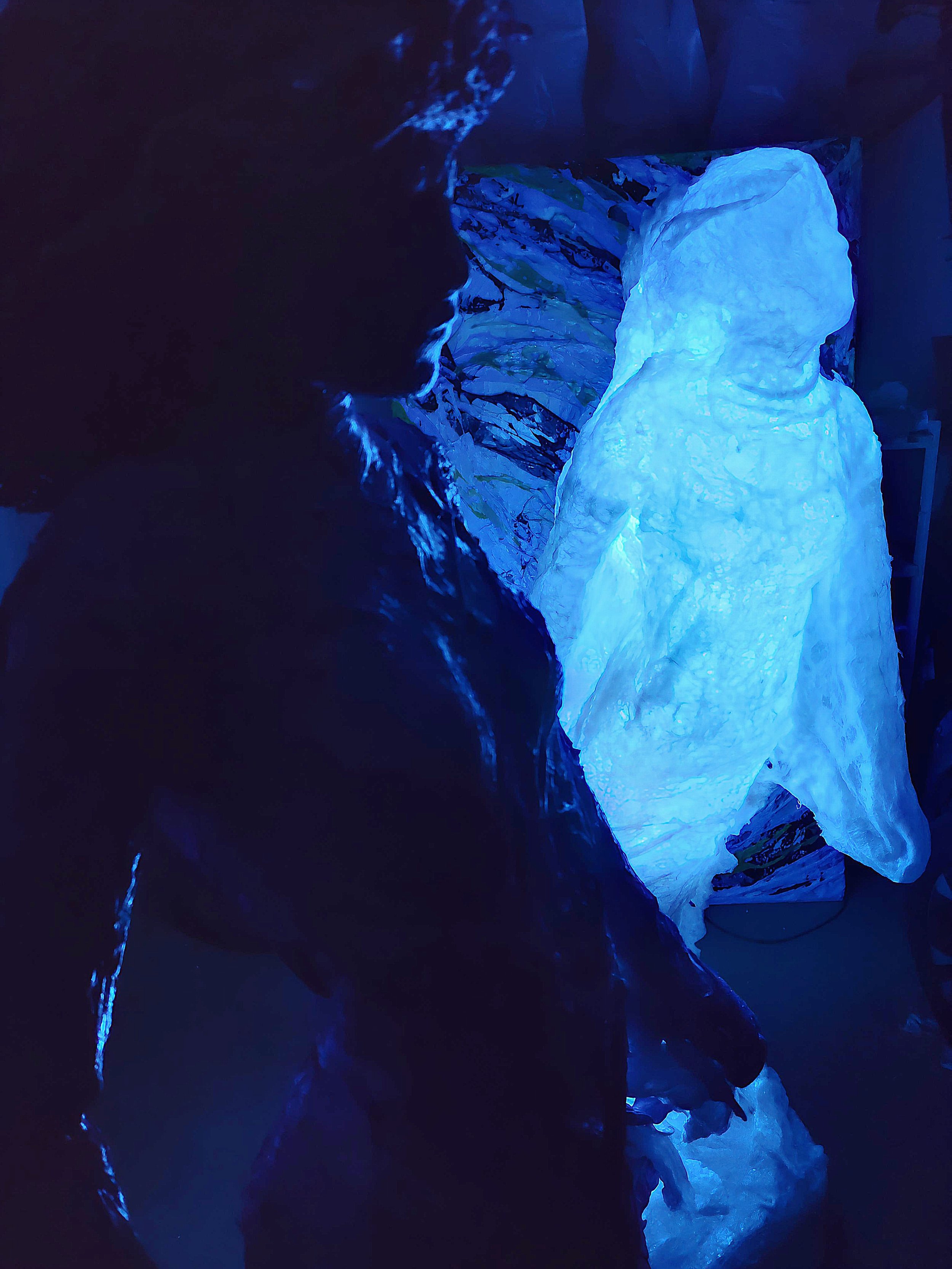
It's not so much the female body but its image. Representing the female image as an unconscious image, one that should be part of every human being. In my latest project, "Invisible Feminine," I emphasise this very thing. Thus, the "feminine" becomes a metaphor for birth and transformation, a symbol of that invisible force that shapes matter and which, through art, can be glimpsed as the common root of every human experience.
Your practice transforms an industrial material into something poetic. What does this transformation represent for you?
Transformation is a process of birth and rebirth. In my artistic practice, heat creates new pictorial images and female sculptural forms from industrial materials. These works are unique, unrepeatable. Creating these new images is part of my inner transformation, which I would like to share with everyone.
Lastly, what directions or experiments are you currently interested in exploring in your work?
I can't know. I'm a bit of a child of the present. Right now, it's like this: the material I'm working on hasn't yet exhausted its expressive possibilities. When I no longer feel it's mine, I'll continue my exploration.
Artist’s Talk
Al-Tiba9 Interviews is a promotional platform for artists to articulate their vision and engage them with our diverse readership through a published art dialogue. The artists are interviewed by Mohamed Benhadj, the founder & curator of Al-Tiba9, to highlight their artistic careers and introduce them to the international contemporary art scene across our vast network of museums, galleries, art professionals, art dealers, collectors, and art lovers across the globe.


David Moješčík - MojDa is a Czech sculptor. His work is centred on figurative sculpture, the human body, and the female figure. Modelling in clay and with digital tools, he ultimately prioritises manual engagement with materials. . He draws inspiration from yoga philosophy with the concepts of non-violence and human-centeredness, as well as from Egyptian, ancient, and European classical sculpture.