

10 Questions with Shu Wang
Shu Wang is an internationally renowned interdisciplinary artist specializing in jewelry design and wearable sculpture. Born in China, she is currently based between the United States and China. Her practice centers on the body as a site where emotion, structure, and social tension converge. Through interaction, movement, and physical proximity, she investigates how objects function as living media, activating sensory experience, mediating social expectations, and generating shared perception between wearer and viewer.
Wang’s academic training reflects a rare interdisciplinary trajectory that bridges engineering, material science, and fine art. She began her studies in Nonmetallic Inorganic Material Engineering at the University of Science and Technology Beijing before transferring to the Rochester Institute of Technology, where she earned a Bachelor of Fine Arts in Jewelry and Metal Design. She later received a Master of Fine Arts in Fashion, Body, and Garment from the School of the Art Institute of Chicago. This diverse educational background informs her distinctive approach, which integrates material experimentation, digital fabrication, and conceptual rigor with emotional and bodily resonance.
Her work has been exhibited internationally at institutions and platforms including Portal: Rockaway, presented by 4heads and Rockaway Artist Alliance (New York, 2025); Pause·Sip·Breathe at Flowing Space (New York, 2025); Dream Machine at UrbanGlass during New York City Jewelry Week (New York, 2024); The Morton, ArtPrize 2024 (Grand Rapids, 2024); By Degree III at the Project Space of Chicago Sculpture International (Chicago, 2024); Cluster Jewelry Fair (London, 2022); and Romanian Jewelry Week (Romania, 2022). Her work has also been presented and represented by ArtsThread.
In addition to exhibitions, Wang’s work has received international editorial recognition and has been featured in a range of established art, fashion, and design publications, including Current Obsession, FLANELLE Magazine, Moevir Magazine, Artells Magazine, Mob Journal, Artego Magazine, Goji Magazine, Ponny Magazine, and Selin Magazine. These features highlight her contribution to contemporary jewelry and wearable art as a practice that bridges sculpture, fashion, and embodied experience.
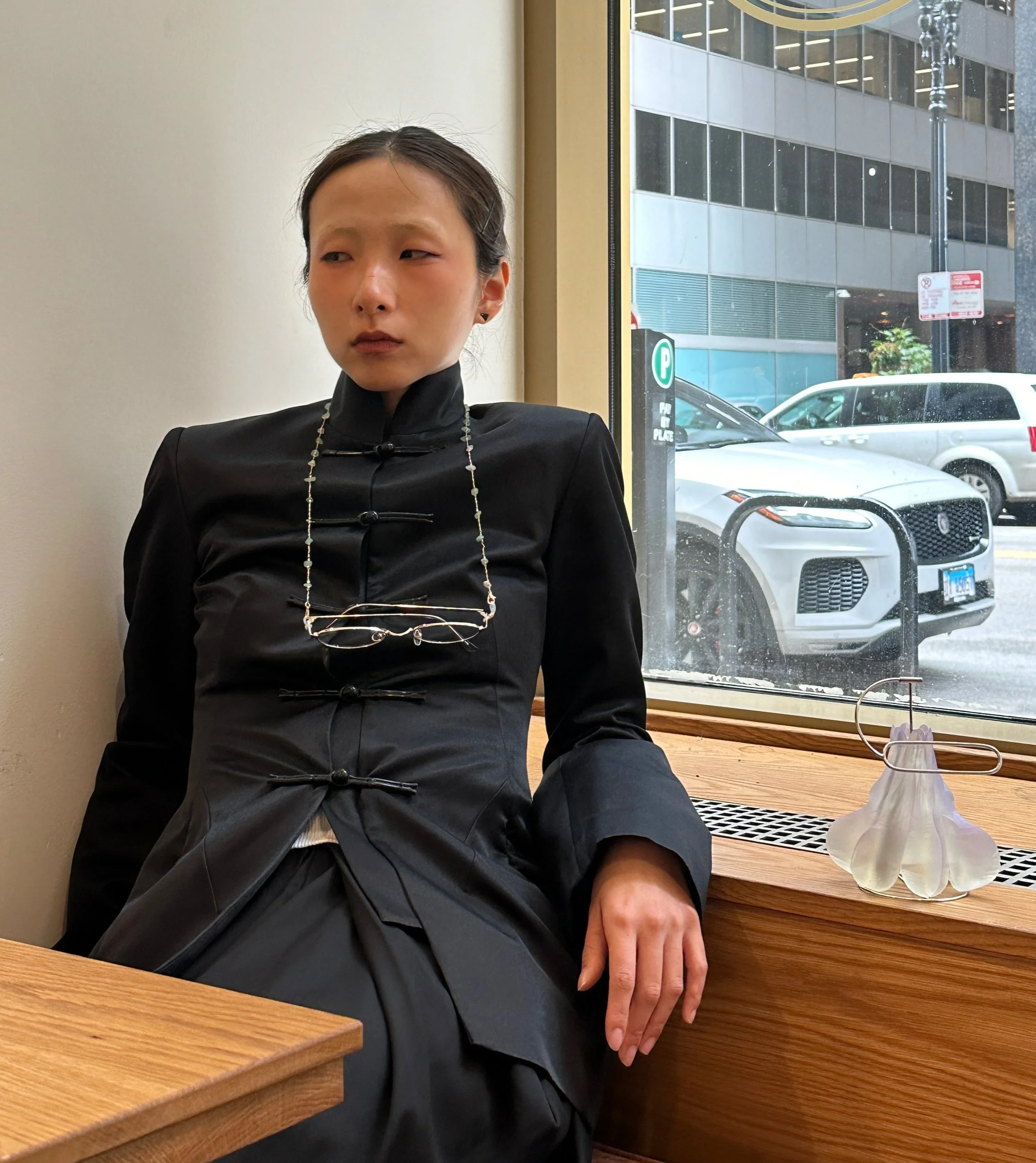
Shu Wang - Portrait
ARTIST STATEMENT
Shu Wang is an interdisciplinary artist working with wearable structures that move fluidly between scales, from large-scale wearable sculptures to intimate jewelry, because both investigate the same question: how does the body mediate between internal feeling and external structure? She translates social expectations, invisibility, and the emotional tension between expression and conformity into tactile experiences completed through the body.
Her work originates from reactions, emotions, and expectations, shaped by an early awareness of how one is asked to behave, and what it quietly costs to be perceived as good. When her personal shape does not align with the rigid forms around her, that friction becomes material. The body becomes both a vessel of emotion and evidence of presence, a site where what cannot be easily spoken can be felt through weight, touch, restriction, and movement.
Interaction is essential. A work begins when someone wears it, touches it, or approaches it, and the object enters a living relationship with the person. Wearable sculpture allows Wang to amplify structure and scenario at an architectural scale, testing how the body negotiates with larger systems of control. This research directly informs her jewelry practice: jewelry becomes a miniature wearable sculpture that compresses the same structural language into a daily scale, allowing the work to return to intimacy, repetition, and long-term bodily memory.
She is interested in how structure and emotion coexist, how materials and forms are activated through proximity and touch, and how a shared moment of perception can dissolve the boundary between maker and viewer, leaving something that lingers on the body and in memory.
Merge, wearable sculpture, variable dimensions, 2024, part of the multi year project 套 TÀO. © Shu Wang
INTERVIEW
Let’s start from the basics. Can you share a bit about your background and how your interdisciplinary practice developed?
I was born in China, and I wanted to work with contemporary jewelry and wearable forms from early on. But at the time, choosing an art path felt unrealistic. Entering an art program in China would have meant years of drawing training I didn’t have. With solid science grades and family pressure to choose something “stable,” I entered Nonmetallic Inorganic Material Engineering, partly as a practical choice, and partly because I hoped materials science could still connect back to jewelry.
In the program, I quickly realized how firmly it was oriented toward industrial problem solving, which was very different from the embodied, emotional questions I was drawn to. The longer I stayed, the clearer it became that the framework didn’t match the kind of work I wanted to make. Eventually, I convinced my parents and transferred to Rochester Institute of Technology to study Jewelry and Metal Design. At RIT, I learned to work at an intimate, body-related scale and to treat wearability as a form of negotiation rather than decoration. But I kept pushing against the boundaries of what “wearable” could mean, and that restlessness is what ultimately led me to the School of the Art Institute of Chicago (SAIC). My interdisciplinary approach was fully developed during my MFA in Fashion, Body, and Garment at SAIC. There, jewelry expanded into wearable sculpture, installation, and performance. I use digital fabrication for precision and repeatability, and hand processes for texture, vulnerability, and the traces of the body.
Across all media and scales, my work is built upon a foundation formed through sustained academic training and refined through professional practice. This background has enabled me to develop a distinctive approach to wearable forms in which structural systems operate both materially and conceptually. Rather than functioning as static objects, my works are activated through the body, where engineered structures translate invisible social, emotional, and psychological tensions into direct physical experience. This rigorously developed methodology has allowed my practice to expand from jewelry into wearable sculpture, installation, and performance, and has been recognized through exhibitions, institutional contexts, and critical engagement. The consistency of this structural logic across scales is central to my work’s impact, positioning the body as the site where form, meaning, and experience are fully realized.

Merge, wearable sculpture, variable dimensions, 2024, part of the multi year project 套 TÀO. © Shu Wang
Your work moves between large-scale sculpture and jewelry. How do you think about scale when developing a work?
Scale is not usually the first thing I decide. I start from a situation and a visual language I want to build, then size becomes a consequence of what the work needs to do on the body. Different scales create different modes of interaction with the body, and therefore different effects, physically and psychologically.
In large-scale wearable sculpture, scale allows the work to behave like a structure you enter. It can reorganize posture, movement, and proximity, and it makes social tension visible in how a body is constrained, protected, or staged. That expanded scale is essential when I want the form to shape a whole situation around the wearer and the viewer, creating an environment rather than remaining a standalone ornament.
Jewelry operates through a different logic. When I make jewelry, I often think of it as pigment and the body as canvas. The work is smaller not because the ideas are smaller, but because the intimacy of scale lets the piece sit on the skin like a mark, something that can be layered, repeated, and carried through daily time. In both cases, I’m working with the same questions, how structure and emotion are activated through the body, but scale determines whether that activation happens as an immersive situation or as a concentrated trace.
You often describe the body as a mediator between emotion and structure. How does this idea shape your making process?
For me, structure is the set of forces that are already there before you act: social norms, built environments, and even another person’s boundaries and habits. When bodies come into contact, these structures collide and get renegotiated.
The body is the mediator in this exchange. External structures act on the individual through the body, and emotion returns as bodily responses: tension, breath, posture, sensitivity, withdrawal, or approach. That response then feeds back into the structure through how we move, take space, negotiate distance, resist, or adapt.
This model shapes my making process. I begin by identifying the structure I’m responding to and the emotional state it produces. Then I create an object that stages their contact on the body, where it touches, where it holds, where it restricts or supports, and how it shifts posture, movement, and proximity to other bodies. I prototype through repeated wear tests, adjusting pressure points, balance, and range of motion until the piece generates a specific kind of bodily feedback. Digital fabrication helps me establish precise structural systems and controllable connections, while hand processes allow me to tune the sensory threshold of the work: edges, surface, and intensity of contact. I’m looking for a condition in which structure becomes physically legible, and the body’s emotional response becomes visible in space, so wearing the piece is both a physical fact and an emotional negotiation.
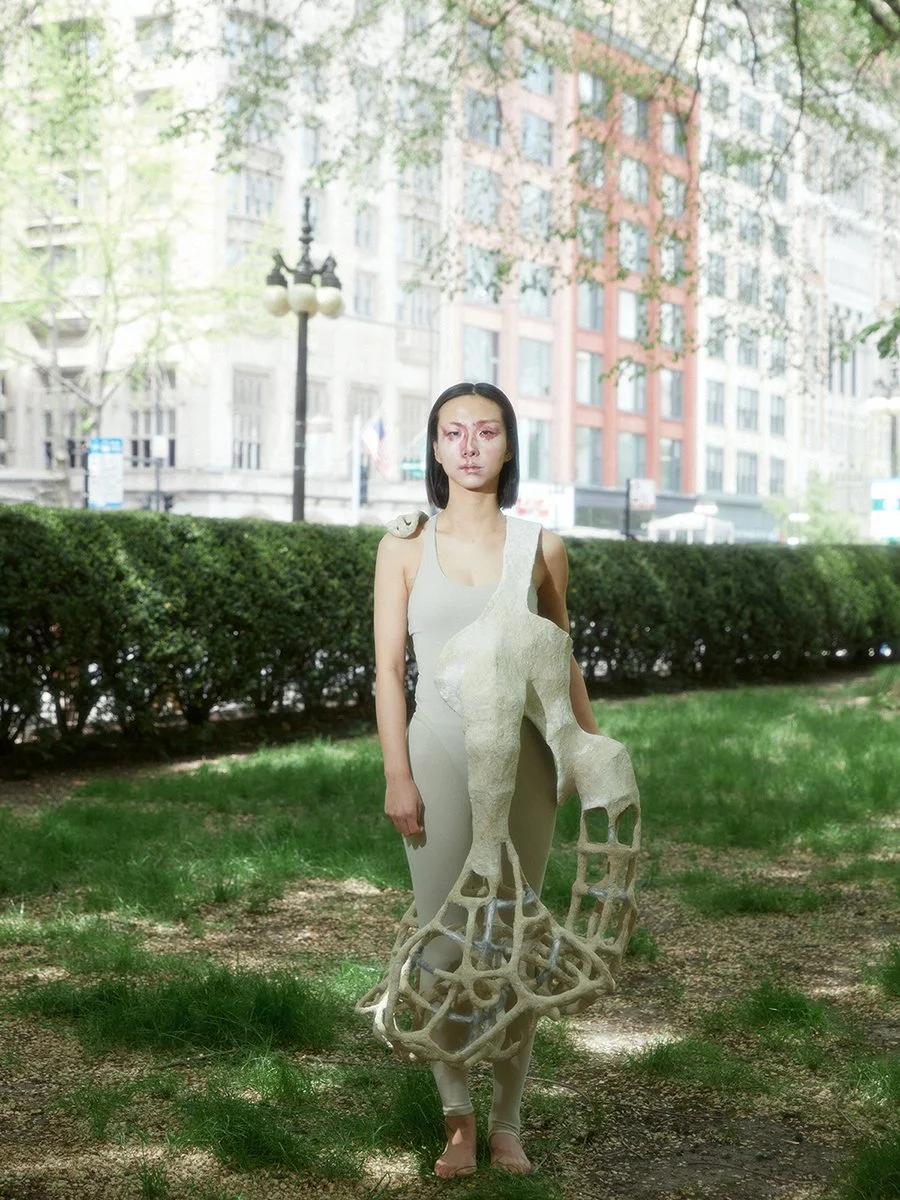
Humanization I, wearable sculpture, 60 × 50 × 125 cm, 2022 to 2023, part of the multi year project 套 TÀO. © Shu Wang

Humanization II, wearable sculpture, 150 × 80 × 100 cm, 2023, part of the multi year project 套 TÀO. © Shu Wang
Interaction is essential to your practice. What changes when a work is worn or physically engaged with?
Interaction is essential to my practice because the work is not complete as a static object. It becomes activated in the moment it is worn, touched, or approached, when the piece enters a direct relationship with a body, movement, and distance.
Through engagement, structure becomes legible through sensation. Weight, pressure, restriction, support, and proximity translate an unspoken internal state into a bodily experience. At the same time, the wearer’s response feeds back into the situation through posture, breath, movement, and how distance is negotiated with others. In this sense, interaction is not an additional layer; it is the condition that allows the work to operate.
What materials or structural elements do you return to most, and what draws you to them?
My material choices are intentionally mixed and often depend on the situation I’m trying to create. That said, I return to a few elements consistently. Clear 3D printed resin is one of them. I’m drawn to it because it allows me to invent precise structures and forms that don’t already exist, with a level of control over geometry, tolerance, and repetition that is difficult to achieve by hand. Its transparency also keeps the structure visible, and the internal logic of the piece can remain readable rather than hidden.
Alongside that digital precision, I return to fiber and metal as the handmade side of my practice. The fiber materials I use are often structural: papier-mâché constructions, rattan weaving, and, at times, fabric, depending on what kind of contact, tension, or movement the work requires. I treat these materials as sculptural frameworks rather than soft decoration, using folding, layering, weaving, or stitching to generate volume, stiffness, and resistance by hand. Metal is equally important when a form needs to sit on the body in a very specific way. It gives me precise, durable contact points and structural stability, so I can control exactly how the piece rests, balances, or tensions against the skin, and maintain that relationship through repeated wear.
Beyond materials, I return to geometric forms and modular systems. Geometry lets me establish clear rules and forces, while modularity supports assembly, reconfiguration, and interaction. Across materials, what I return to most is the combination of organic and inorganic languages. That contrast gives me a way to stage how a living body negotiates with structure, and how experience becomes legible through form.
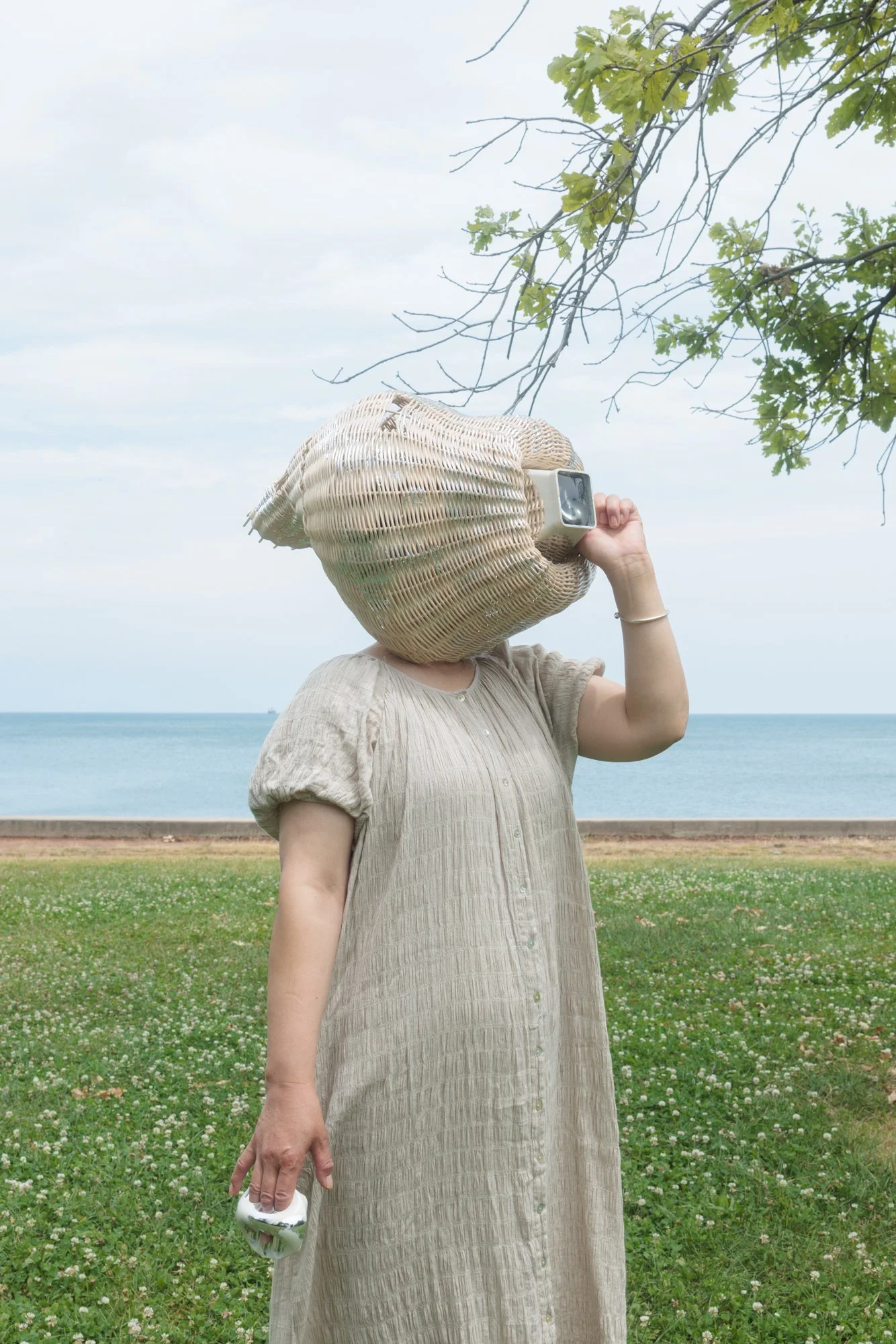
Hermit, wearable sculpture, 50 × 50 × 90 cm, 2024, part of the multi year project 套 TÀO. © Shu Wang
How does working at an architectural or sculptural scale inform the way you design jewelry?
Working at an architectural or sculptural scale is where I can test structure as a full situation around the body. At that scale, I can observe how a form reorganizes posture, movement, and proximity, and how it changes the wearer’s relationship to space and other bodies. Those observations become the foundation for my jewelry, not as a literal translation of shape, but as a translation of mechanism.
When I shift into jewelry, I compress the same structural language into a scale that can be carried through daily life. I pay attention to where a piece touches, how it distributes weight, how it creates tension or support, and how it holds its position on the body through movement and time.
In that sense, jewelry is a condensed form of the same research. Wearable sculpture allows me to expand structure until it becomes an environment, and jewelry allows me to concentrate it into a precise trace on the body. Both keep the same questions about emotion, structure, and activation through interaction. Jewelry is wearable sculpture under compression, while wearable sculpture is jewelry expanded into space.
Many of your works address social expectations, invisibility, and control. How do these ideas translate into form?
I translate social expectations, invisibility, and control into form by treating them as structural systems rather than narrative themes. Social expectations appear as predetermined rules, forms that feel decided in advance. I work with fixed geometries, repeated units, and regulated pathways that ask the body to adjust, so ‘fitting in’ shifts from concept to physical negotiation.
Invisibility translates into mechanisms of perception and access. I use transparency, concealment, reflection, and optical distortion to control what can be seen, from where, and under what conditions. I’m interested in the gap between visibility and presence; how something can be materially present yet partially inaccessible, and how perception itself can be shaped by structure.
Control becomes legible through contact, constraint, and distance. I pay close attention to where a structure touches the body, how it distributes pressure and weight, what it restricts or permits, and how it reorganizes posture, movement, and proximity. Modularity matters here because it introduces choice within a system. When a form can be assembled or reconfigured, control is no longer a single fixed force; it becomes something negotiated through repeated decisions and interactions.
Ultimately, these ideas translate into forms that operate like frameworks, rules, and thresholds. The goal is not to illustrate social forces, but to construct an experience where the body can register them directly, and where what is usually nonverbal becomes legible through structure.

Hazy - 气 QI, Wearable Sculpture, 16.5x23x24 cm, 2021 © Shu Wang

Incubate - 气 Qi, Ring, 7x7x10 cm, 2021 © Shu Wang
How do viewers or wearers typically respond when encountering your work for the first time?
Viewers and wearers often respond through curiosity that quickly turns into physical engagement. When a work is suspended, people tend to move closer rather than step back. They lean in, enter the woven space, and look through a lens to observe the outside world. The first encounter becomes an action, not only viewing an object, but testing how perception changes when the body approaches and participates.
In more object-based installations, people often register the body implicitly. When a form carries a human contour, viewers frequently ask whether it is wearable or imagine how it would sit on a body. Even without being instructed to interact, the work prompts questions about activation; how it would be experienced rather than only viewed.
In participatory situations, the response is immediate and social, especially when the interaction is clearly structured. In Shared Memories, I invite someone to toast with me using an object I made, then we document the encounter with a photo and a small printed record, one copy for me and one for them. Because the steps are simple and the outcome is tangible, the viewer shifts from spectator to collaborator, and the first encounter becomes something jointly produced rather than passively observed.
Are there artistic, theoretical, or personal references that have strongly influenced your practice?
I don’t have a single artistic or theoretical reference that I consistently return to as a foundation. My practice is primarily shaped by lived experience, the tension between how I feel and the structures that shape how I am expected to behave, appear, and relate. I use making as a way to convert that tension into conditions the body can register.
There are, however, a few recurring points of influence. I’m drawn to practices where the body becomes a site of meaning-making, and to approaches that examine how internal states externalize into physical form and behavior. On a personal and cultural level, 气(QI), often understood as a flow of vital energy, has shaped my interest in making invisible forces legible through material, geometry, and contact.
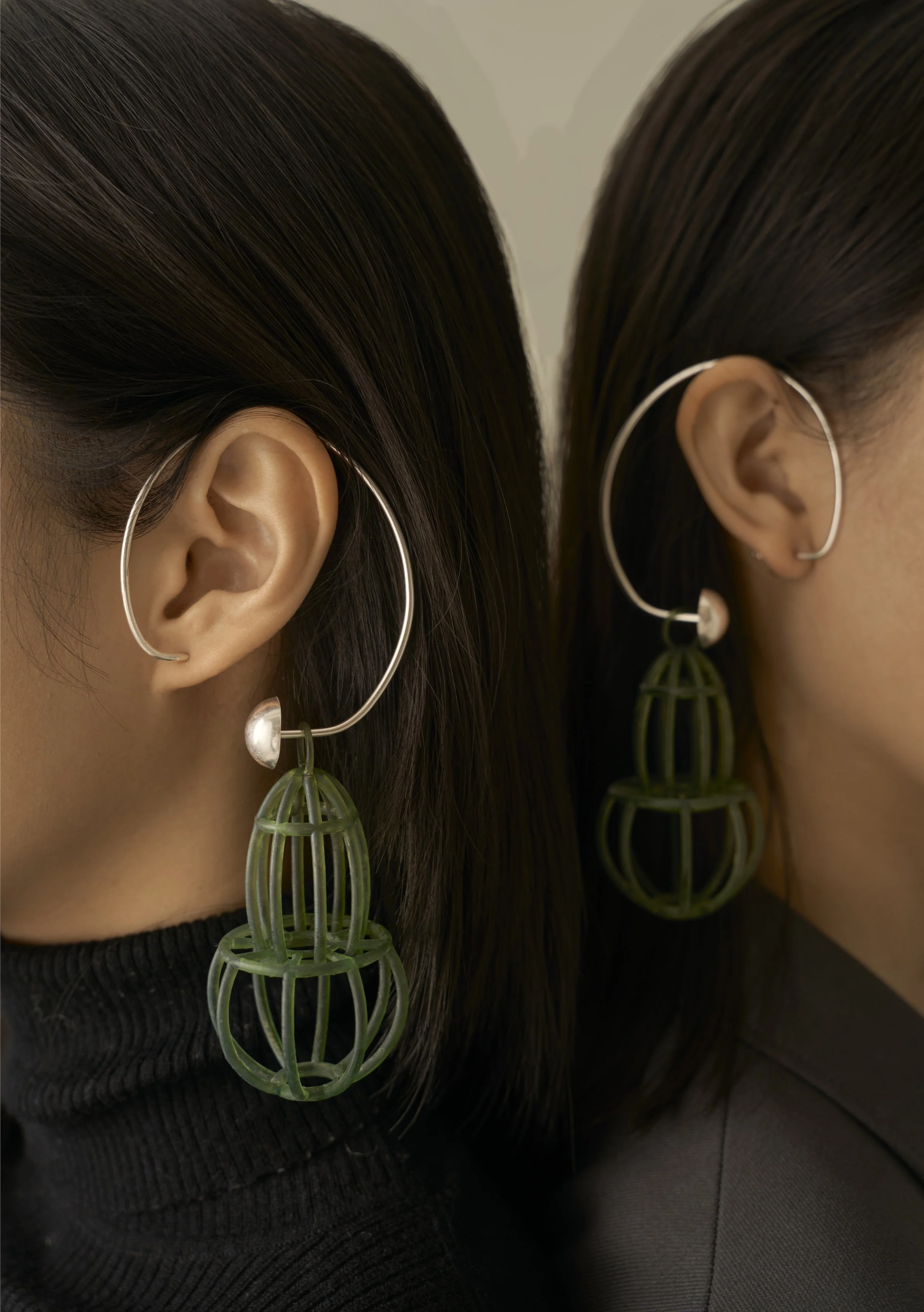
Extension - 气 QI, Earring, 3.5x3.5x13 cm, 2021 © Shu Wang
And finally, what directions or projects are you interested in exploring next? Do you have any new projects or concepts you would like to share with our readers?
For my next directions, I’m interested in how systems externalize internal states. I’m developing a more conceptual body of work around chance, rule-based decisions, and the way “randomness” can reveal preference, desire, or hesitation. I’m treating fate less as a narrative and more as a method, creating systems where chance and choice interact to make the negotiation between intention and uncertainty physically legible.
That research connects directly to my jewelry practice. In jewelry, I’m beginning a series built from a single modular unit I designed. The unit functions like a rule, a chosen constraint that organizes form, assembly, and variation. Freedom, for me, is not infinite choice, but sustained exploration within a structure. By committing to one unit and testing how far it can go, I can observe how small decisions accumulate, how repetition produces difference. The body registers these decisions through wear.
Across both the conceptual work and the jewelry series, I’m continuing the same question: how structure produces experience, and how constraints can generate new possibilities when they are treated as an active system rather than a limitation.
Artist’s Talk
Al-Tiba9 Interviews is a curated promotional platform that offers artists the opportunity to articulate their vision and engage with our diverse international readership through insightful, published dialogues. Conducted by Mohamed Benhadj, founder and curator of Al-Tiba9, these interviews spotlight the artists’ creative journeys and introduce their work to the global contemporary art scene.
Through our extensive network of museums, galleries, art professionals, collectors, and art enthusiasts worldwide, Al-Tiba9 Interviews provides a meaningful stage for artists to expand their reach and strengthen their presence in the international art discourse.



David Moješčík - MojDa is a Czech sculptor. His work is centred on figurative sculpture, the human body, and the female figure. Modelling in clay and with digital tools, he ultimately prioritises manual engagement with materials. . He draws inspiration from yoga philosophy with the concepts of non-violence and human-centeredness, as well as from Egyptian, ancient, and European classical sculpture.