

10 Questions with Wallace Woo
Wallace Woo is a Paris-based contemporary artist and the founder of Stalactite Aesthetics. His work established the movement of Geological Abstractionism, a philosophical inquiry into the dimension of time and material sedimentation.
Moving beyond his early mastery of fluid forms, Woo developed his signature "Stalactite" technique, a process he defines as "Acrylic with Ink Spirit." This method bridges the spontaneous elegance of Eastern ink traditions with the structural weight of Western mineral textures. Woo is the author of The Dimension of Sedimentation, a definitive theoretical manifesto that redefines the canvas as a site of "Inner Geology." His practice is a silent dialogue between gravity and presence, shaped by seventeen years of artistic evolution and contemplative discipline manifesto that redefines the canvas as a site of "Inner Geology."
His works are not merely paintings but visual records of time layered upon time, inviting viewers into a space of profound stillness and reflection.
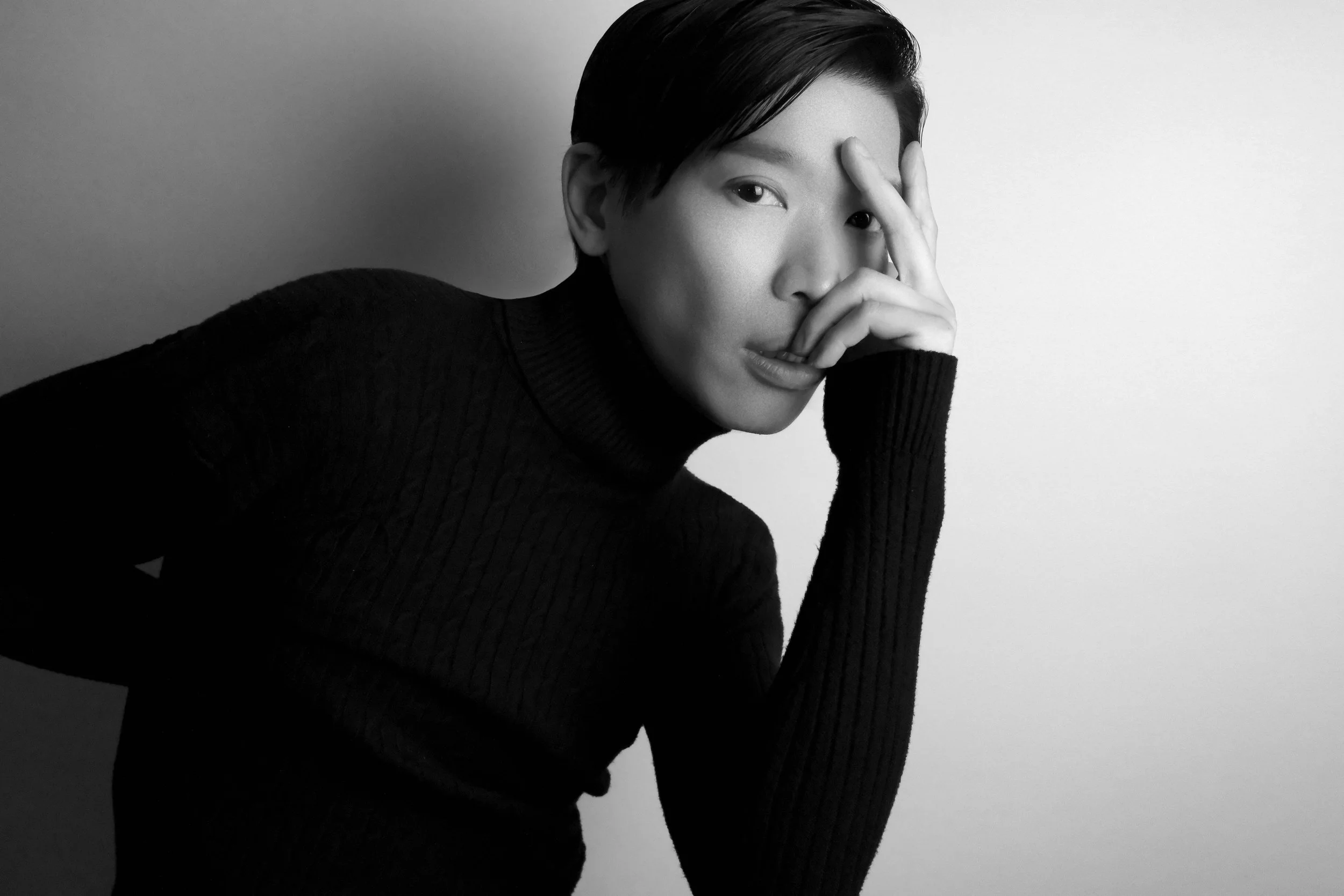
Wallace Woo - Portrait
ARTIST STATEMENT
“My work explores the intersection of gravity, time, and the silent breath of the earth. Through Stalactite Aesthetics, I seek to capture the "Cave Time", a state where the external world dissolves into a process of slow, deliberate sedimentation.
In Geological Abstractionism, the act of painting is not decorative; it is an act of deposition. Using "Acrylic with Ink Spirit," I navigate the tension between control and surrender, allowing pigments to settle like mineral strata over time.
This is what I call "Inner Geology", the visual manifestation of experience layered upon experience. My practice, rooted in the observations of Vipassana, is a rejection of the superficial in favour of the profound stillness found beneath the surface. Each piece is a fragment of a larger universe, inviting the viewer to witness the weight of silence and the clarity of restraint.”
— Wallace Woo
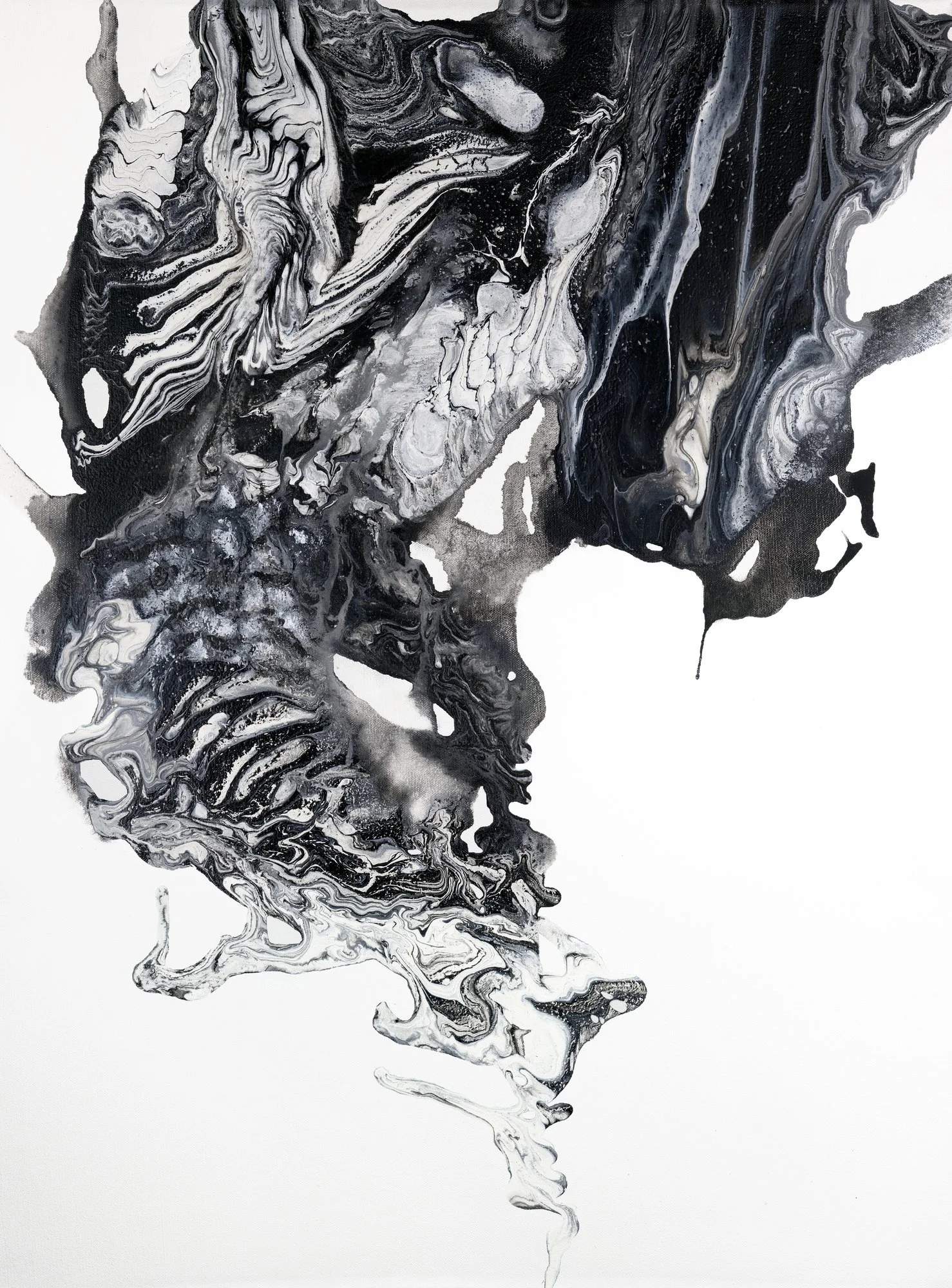
STA#39, 92x70 cm, 2025 © Wallace Woo
Geological Abstractionism
Paris-based artist Wallace Woo officially unveils his visual philosophical manifesto, The Dimension of Sedimentation. This seminal work establishes the foundational framework for Geological Abstractionism and Stalactite Aesthetics.
Registered under International Standard Book Number and formally archived via the Legal Deposit system, this movement officially enters the global academic and legal record of contemporary art history.
Inner Geology: A Lifetime of Vipassana Practice
At the heart of Wallace Woo’s art lies a rigorous practice of Vipassana meditation maintained since the age of twenty-four. Over decades of spiritual cultivation, Woo has translated internal perception into an "Inner Geology." His unique technique transcends traditional painting; it is a simulation of geological evolution on a two-dimensional canvas. Through the rhythms of "Slow Living" and "Wild Growth," he demonstrates how life accumulates irreproducible forms under the quiet constraints of gravity.
Entering "Cave Time": A Silent Force in a Noisy World
In Woo’s aesthetic system, each artwork serves as a portal to "Cave Time", a space-time continuum mirroring the millennium-long growth of stalactites. His work utilises the sedimentation of colour and negative space to construct a profound sense of temporal depth, offering a resilient and silent "Powerful Presence" against the cacophony of the modern world.
Upcoming Solo Exhibition in Paris
Following this formal theoretical launch, Wallace Woo will present a solo exhibition at Espace Temple Gallery in Paris (June 2026), marking the international debut of Geological Abstractionism on the global stage.
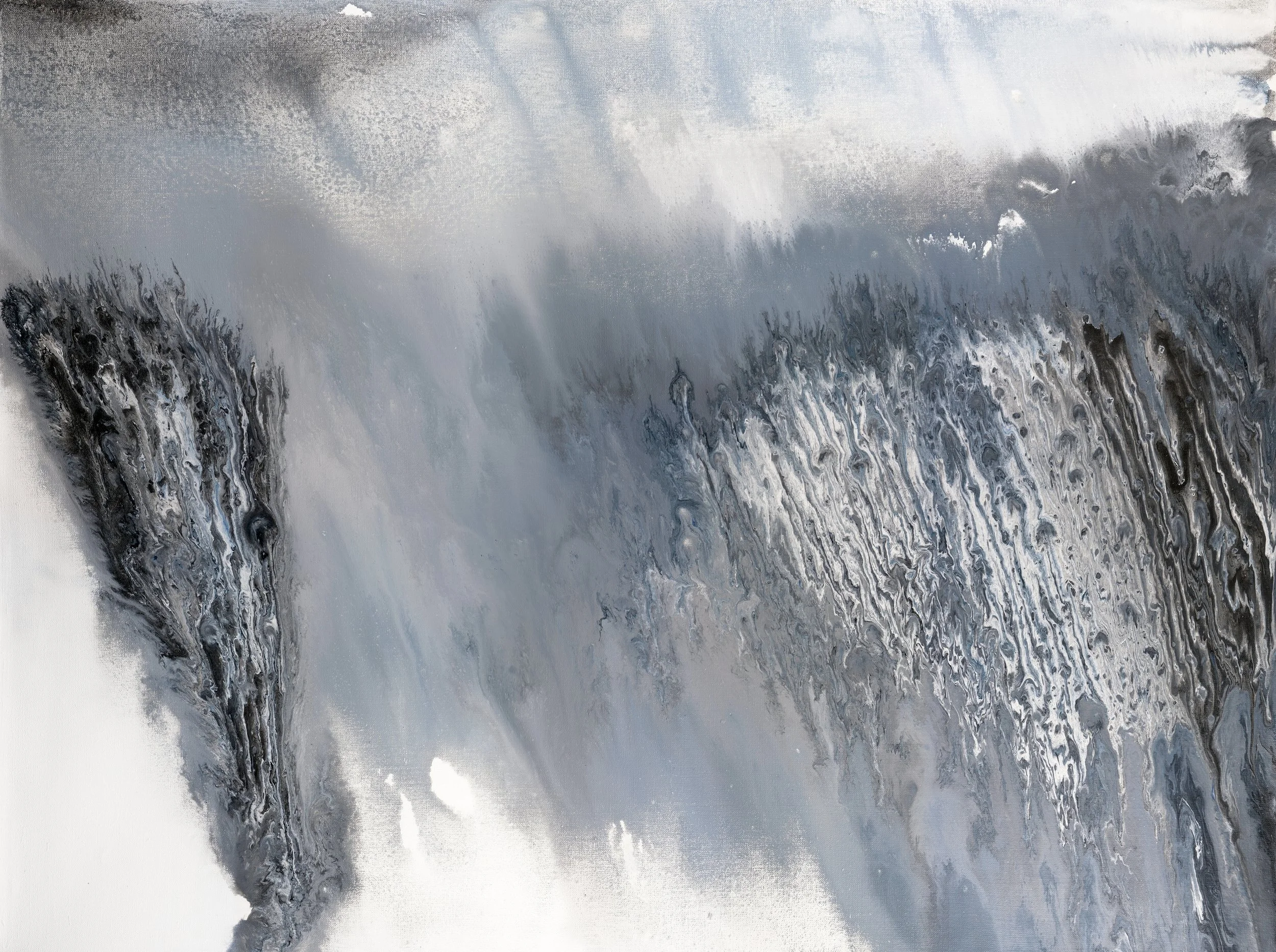
STA#98, 125x92 cm, 2025 © Wallace Woo
INTERVIEW
Your exhibition, Stalactite: Part I – The Silent Practitioner of Time, introduces the public to Geological Abstractionism. How did this body of work emerge, and what made this the right moment to present it in a physical exhibition?
Geological Abstractionism is a new term in the art world. It will take time for people to understand it. That's a risk. But I'm willing to take it.
In the 21st century, everyone knows the world is driven by speed. We know we're going too fast, faster than our brains can process. Some people even know they should stop. But the real question is: are they willing to stop? People don't want to stop. So they keep accelerating. But here's the irony: the faster we go, the more abstract art stays frozen in past frameworks, Pollock's drips, Rothko's fields, Kandinsky's compositions. Technologically, we're running. Aesthetically, we're standing still. AI can generate and remix any master's painting in seconds. But it can't sit with a single drop of paint for a thousand hours. It doesn't know what it means to wait. The machine moves faster than ever, but it only recycles the past. It has no memory. No duration. Only data. So I ask again: is this evolution, or is it just a faster way of staying in the same place?
That's the social experiment I want to run with this exhibition. You can't experience this on a screen. Scrolling is the opposite of stillness. That's why I need people to walk into a room, stand in front of a painting, and have nowhere else to go.
From my observation, when people stop accelerating, they feel sad, depressed, useless. They think something is wrong with them. So I stand with my art to say: Stopping is not a crime. It's not a big deal. It's okay to rest. This is not just about art. It's about a society that has turned rest into failure, and slowness into shame. We've been trained to believe that if you're not producing, you're not valuable. That's a lie. And it's a dangerous one.
Geological Abstractionism is how I materialise this idea on the canvas. But the larger system is called Stalactite Aesthetics. I want people to find their own rhythm in life, to see how quiet accumulation can change their own form, like a stalactite.
Some people may just take it as entertainment. That's fine. But for me, Stalactite Aesthetics means something deeper. I kept asking myself: if no one ever discovers them, would they still grow? Would they still shine? That question led me to a lot of research. And in the end, I felt I had enough evidence to support a new art movement, not just about art, but about how we choose to live in a world that never stops.
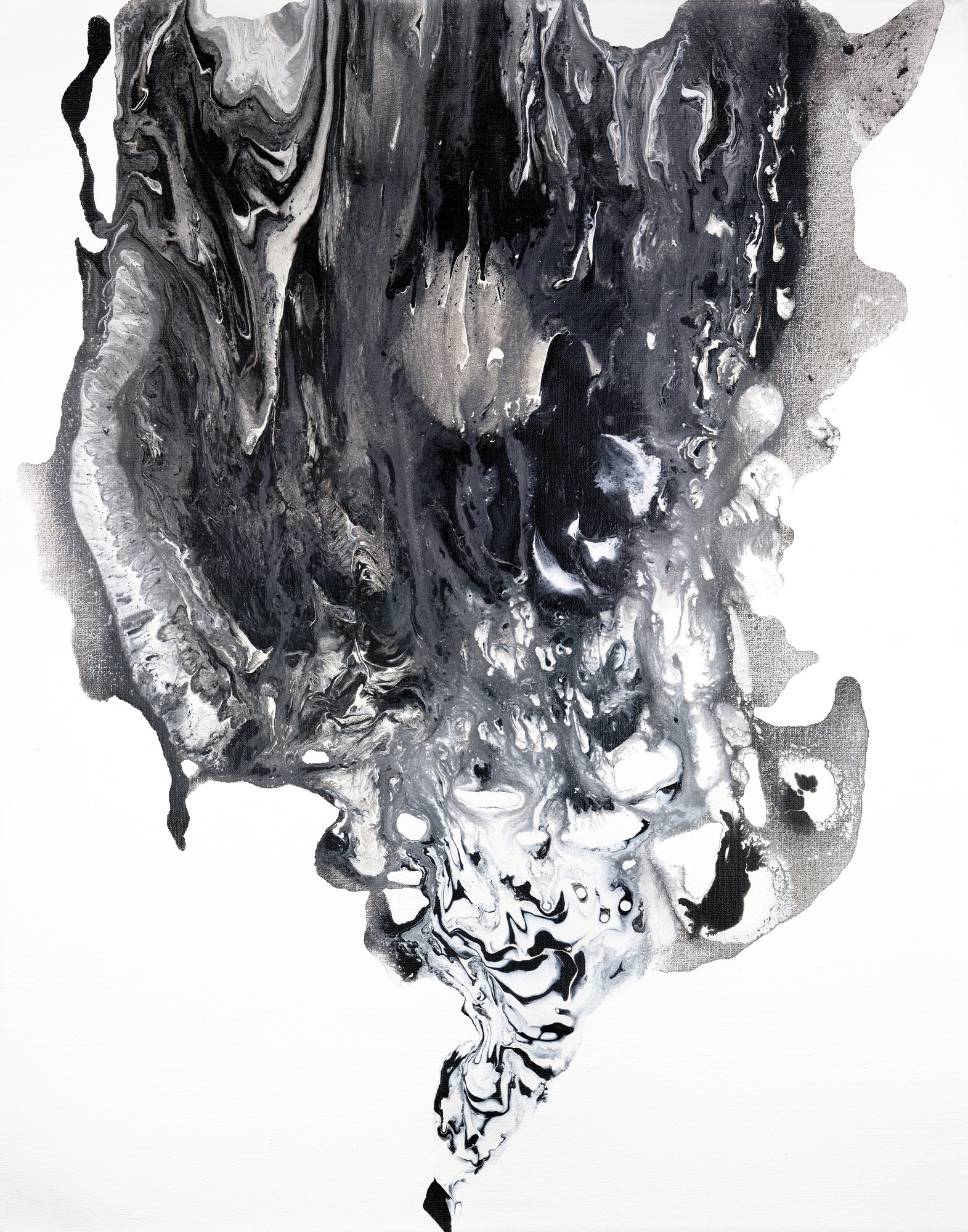
STA#40, 92x70 cm, 2025 © Wallace Woo
The title suggests both a geological process and a meditative attitude. What does “The Silent Practitioner of Time” refer to, and how does it encapsulate your approach to art-making?
Director Ang Lee once said, “Everyone has a Brokeback Mountain in their heart.” For me, everyone has a stalactite cave in their life. The tiny particles, minerals, water droplets, air; they are like the joys and sorrows we carry. And we are the practitioners inside that cave,shaping ourselves, bit by bit, in the dark, into the most resilient version of who we are.
“The Silent Practitioner of Time”,those three words say exactly this.
“Silent”, because true growth doesn‘t speak. A stalactite doesn’t shout. It just drips. “Practitioner”, because this is not a gift. It is discipline. It is walking into the studio every day, waiting for paint to dry, waiting for thoughts to settle, waiting for what needs to appear to appear. “of Time”, because I don‘t control time. I let time work.
That is my creative method: not expression, but sedimentation. Not inspiration, but discipline. Not the instant, but the continuous. Wind, Fire, Water, and Earth are not steps; they are practice. Every creation is another exercise in silence, in waiting, in letting time complete itself.
Whether you like the hidden self or not, whether others recognise it or not, this process of growth happens every day. Some may feel trapped in the cave, unable to see the light. That’s a pity. But the absence of light does not mean the absence of value. Even if you spend your whole life in practice and never get discovered, that doesn‘t mean you should give up.
Sometimes I think religion exists because there are too many things in this world that cannot be explained. We need a spiritual dimension to leap into higher thinking. I have no fixed religion, nor do I wish to be bound by one. But I deeply believe that Zen wisdom can help me resolve many uncertainties.
The ideas I’ve created, Stalactite Aesthetics, Geological Abstraction, Inner Geology, and Acrylic with Ink Spirit, all need time for the public to digest. So I want to offer a gentle entry point for people to enter what I call Cave Time.
In the everyday perception of three and four dimensions, words like “meditation” and “practice” feel familiar. So in my philosophical art book, Stalactite, The Clamorous Stillness (ISBN 97898871890-0-8), I start with the purest language to help lost readers understand Stalactite Aesthetics. I translate geological processes and meditative discipline into the everyday scenes they already know, because they are the same thing. I want to guide readers with the simplest possible approach.
When they feel ready to step into a higher dimension, they will realise that every small act in daily life can be a form of practice. Just like my creative process, every time, it goes through the four-element cycle of Wind, Fire, Water, and Earth. Wind is the intention of the acrylic flow. Fire is the decision to pull a line. Water is the memory of Eastern ink. Earth is the sedimentation of mineral texture after stabilisation.
This is not just a mental practice; it is the physical manifestation of the medium on the canvas.
I believe this is not just about my art. It is about the entire system of abstract art. Abstraction is no longer random splashing or emotional play. Abstraction can be made visible. It can be explained. It can be a disciplined creative act.
But no matter how it evolves, I want to share the last sentence of my art book: “The origin of all creation may simply be a smile, just like life itself.”
In your statement, you declare “the obsolescence of image-based painting.” What do you see as the limitations of contemporary painting today, and how does your practice propose an alternative?
When I say " the obsolescence of image-based painting," I am not exaggerating. I am simply pointing out the emperor's new clothes that everyone pretends not to see.
The greatest limitation of contemporary painting today is that it has become a slave to image production. In the 21st century, we are bombarded with thousands of images every single day. Our eyes have gone numb. Tragically, many contemporary painters are still doing the same thing, transferring photos, thoughts, and visual fragments from the internet onto the canvas with pigment. They are merely producing another image to be quickly scrolled past.
In the age of AI, what meaning is left for this kind of painting, painting made only to be scrolled past? Those hyper-realistic works that strive to be more accurate than a photograph. Those trompe l‘œil illusions make us marvel at the technical skill. Yes, they are impressive. But we are admiring technique, not soul. AI can generate ten thousand perfect images in a single second. It can replicate any visual trick you can imagine. If your painting exists only to add another beautiful picture to the world, then what do you have left to compete with the machine?
This is the blind spot of contemporary painting: technologically, we are sprinting forward; aesthetically, we are standing completely still. We hide behind the shadows of twentieth-century masters, reheating the leftovers of Pollock, Rothko, and Kandinsky, and dare to call it innovation. That is not inheritance. It is parasitism. This is precisely what I called a “hostile takeover of aesthetic narrative” in the press release, not to destroy, but to end this half-century-long act of parasitism.
This is why my Geological Abstractionism proposes a completely different path. I do not manufacture images. I manufacture sedimentation. I do not pursue instant visual stimulation. I pursue the thickness of time. As mentioned in the previous question, the four-element cycle of Wind, Fire, Water, and Earth. Wind as intention, Fire as decision, Water as memory, Earth as sedimentation is not a spiritual practice I invented. It is the physical manifestation of material working through time.
I let time and gravity do their own work. This requires hundreds, even thousands, of hours of waiting. AI can endlessly recycle the wreckage of the past, but it cannot sit with a single drop of paint for a thousand hours while it quietly dries and solidifies. The machine has no understanding of waiting.
My work is not meant to be “looked at” as an image. It forces you to enter the physical space of the exhibition. When you stand before a painting that has undergone countless layers of sedimentation, you cannot swipe it away with your finger. The restless, scrolling inertia of modern life is violently interrupted here. You have nowhere to escape. You are left alone with the silence of time.
This is my alternative: art does not need to move faster or become more dazzling. Art needs to go deeper and become more sedimented.
But what truly puzzles me is this: we all know we are running too fast. So why is no one willing to stop? It‘s not that we don’t know. It‘s that we are afraid. Stopping means facing a version of ourselves with no progress bar, no like counter, no KPI. We would rather keep running, keep exhausting ourselves, keep pretending we are moving forward.
My paintings are not an answer. They are only one question: you are running so fast, where exactly are you going? When you finally stop, will you still recognise yourself?

STA#53, 86x60 cm, 2025 © Wallace Woo
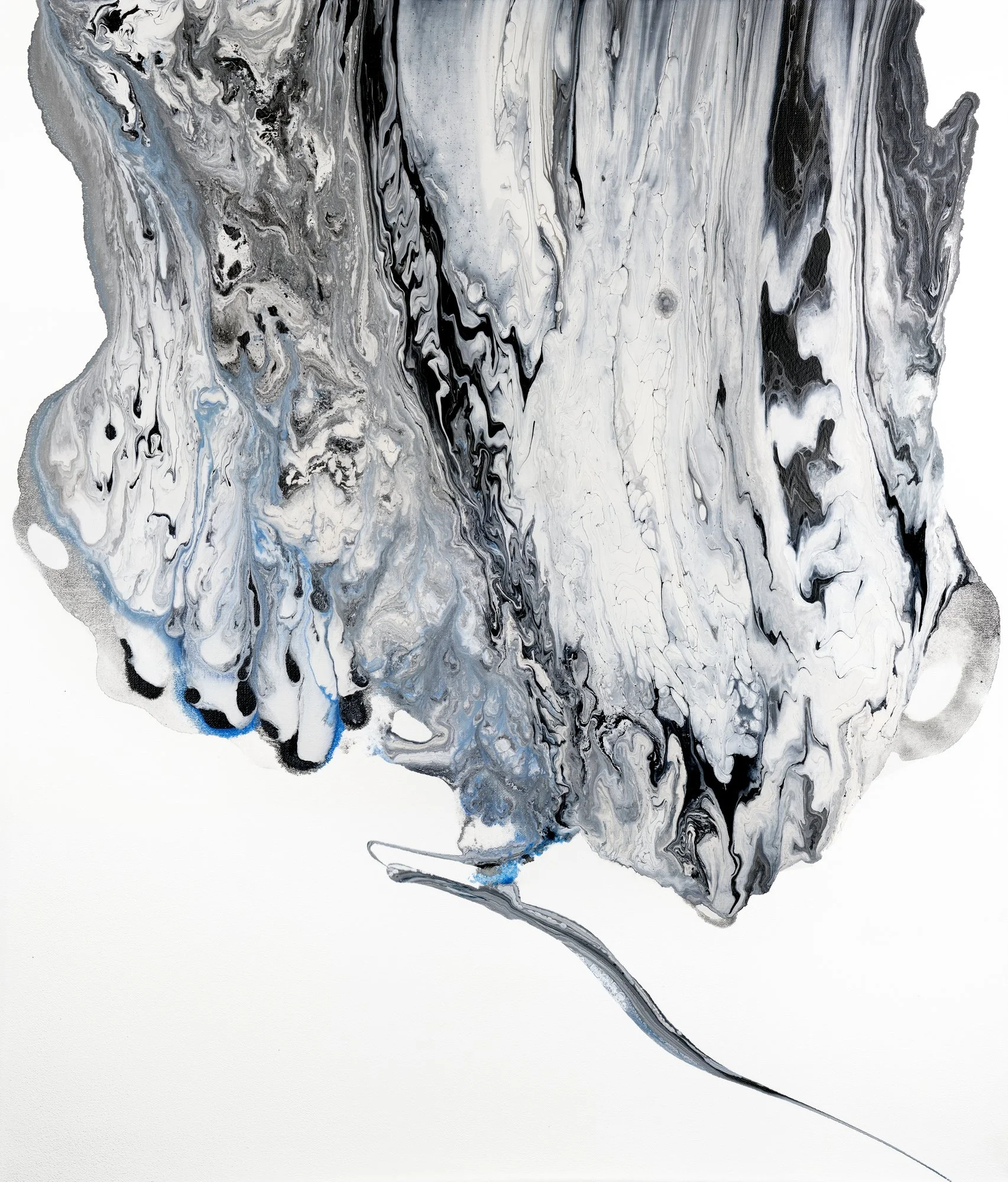
STA#71, 100x84 cm, 2025 © Wallace Woo
Your work is deeply connected to natural processes such as sedimentation, mineral accumulation, and gravity. How do these forces shape the visual and conceptual development of each painting?
This question leads me to a larger, deeper one: Where do we go after death? Does the soul truly exist? Will there really be a next life? Will we return as another version of ourselves, in another dimension, repeating or completing what we left unfinished?
It sounds abstract, but these questions are deeply connected to what you asked, sedimentation, mineral accumulation, and gravity. Physically, after we die, our bodies eventually return to the earth. The trace elements in our bones, the iron in our blood, drawn by gravity, they settle. Over millions of years, they become rock. They become minerals. Geology is not only the final destination of living matter — it is also the starting point of the next cycle.
When I let gravity sediment these minerals on the canvas, I am, in a sense, gazing ahead at the final destination we all share. And spiritually, gravity and sedimentation are how the Earth Mother preserves memory. Think of a stalactite. In complete darkness, deep underground, it silently compresses the memory of every single drop of water, for tens of thousands of years, into its own body. If the soul exists, it is that kind of energy too: accumulating and waiting beyond time, in another space.
These natural forces are how the Earth Mother answers these questions, without embellishment, without giving answers, simply continuing to function.
I return these questions to the earth. On the canvas, I simulate geological movement. Using the qualities of “Acrylic with Ink Spirit,” I let dense mineral textures merge with flowing ink under gravity. I let the paint accumulate, dry, crack, and sediment, layer by layer. From afar, it may look like an abstract, flat surface. But when you step closer, when you observe the dense stratification and the breath of the material, you will see time compressed inside.
This is what I want viewers to do: pause, observe, reflect. Not to search for “answers,” but to feel the process. In this hyper-artificial, hyper-accelerated age, this is what we most need to practice: returning to nature, returning to the Earth Mother, returning to that most primordial rhythm.
In creation, I am not a master. I am only a collaborator. I dance with the paint. I do not force emotion or fabricate a story. I strip away the noise of personal sentiment and return to the most tranquil self. This is not giving up expression, it is a dimensional shift: from “what I express” to “letting time speak for itself.”
Thus, sedimentation, mineral accumulation, and gravity are not just materials or techniques. They are the bridge between me and that great, unanswerable question.
Vipassana meditation appears to play a crucial role in your methodology. How does this discipline influence your creative process and your understanding of time, material, and authorship?
What is the ultimate purpose of spiritual practice? People in this generation think that paying for a meditation course can solve their suffering. But can you really buy your way out of suffering just because you paid the fee and attended the class? A healthy person doesn‘t go to the doctor. Many people start meditating only when they are already in pain, their subconscious tells them: it’s time to sit. At least they take action, and for that, I feel a momentary relief for them. But does the pain ever truly go away? That is the real question I leave for my readers.
Spiritual practice is not a painkiller. It does not work instantly. It is a long-term, permanent, lifelong mode of learning. In my previous interviews, I rarely praised Vipassana, even though I know it has profoundly shaped me. But I never saw the need to preach about it, to tell others how wonderful it is. When a person truly needs to stop and reflect on their own life, destiny will guide them to where they need to go. Time will prove everything.
This practice has taught me to reflect on things without being trapped inside the “I” alone. It allows me to leap from three‑dimensional and four‑dimensional thinking into a higher dimension. Sometimes I lower myself so much that I can no longer see myself. But that act of letting go has taught me how to tune my own frequency.
On Time: One thing meditation taught me is that time is not something you race against; it is something you wait with. Most people see time as a countdown: by what age you should succeed, by what age you should be famous. But in Vipassana, you simply sit. You wait for thoughts to come. You wait for them to leave. You cannot control them. You can only observe them. My creative process is the same — I wait for the paint to dry, for the layers to settle, for what needs to appear to appear. Like a true silent practitioner of time, I do not control time. I let time work.
On Material: Most people treat materials as tools; paint is just a means to achieve a certain image. But meditation taught me not to manipulate. You are not commanding the material. You are having a dialogue with it. It has its own character, its own rhythm, its own temperament. You cannot force it. You can only follow it. That is why I call it a “strategic partner,” not a “tool.”
I have poured this understanding into my Acrylic with Ink Spirit and Geological Abstraction. The material and I complement each other; it has its temperament, and I have my discipline. It is not merely a tool I use. We are one on the canvas. That is why the work comes out so pure.
Spiritual practice is not about making you a better person. It is about showing you that you were never the “you” you thought you were. And so is creation.
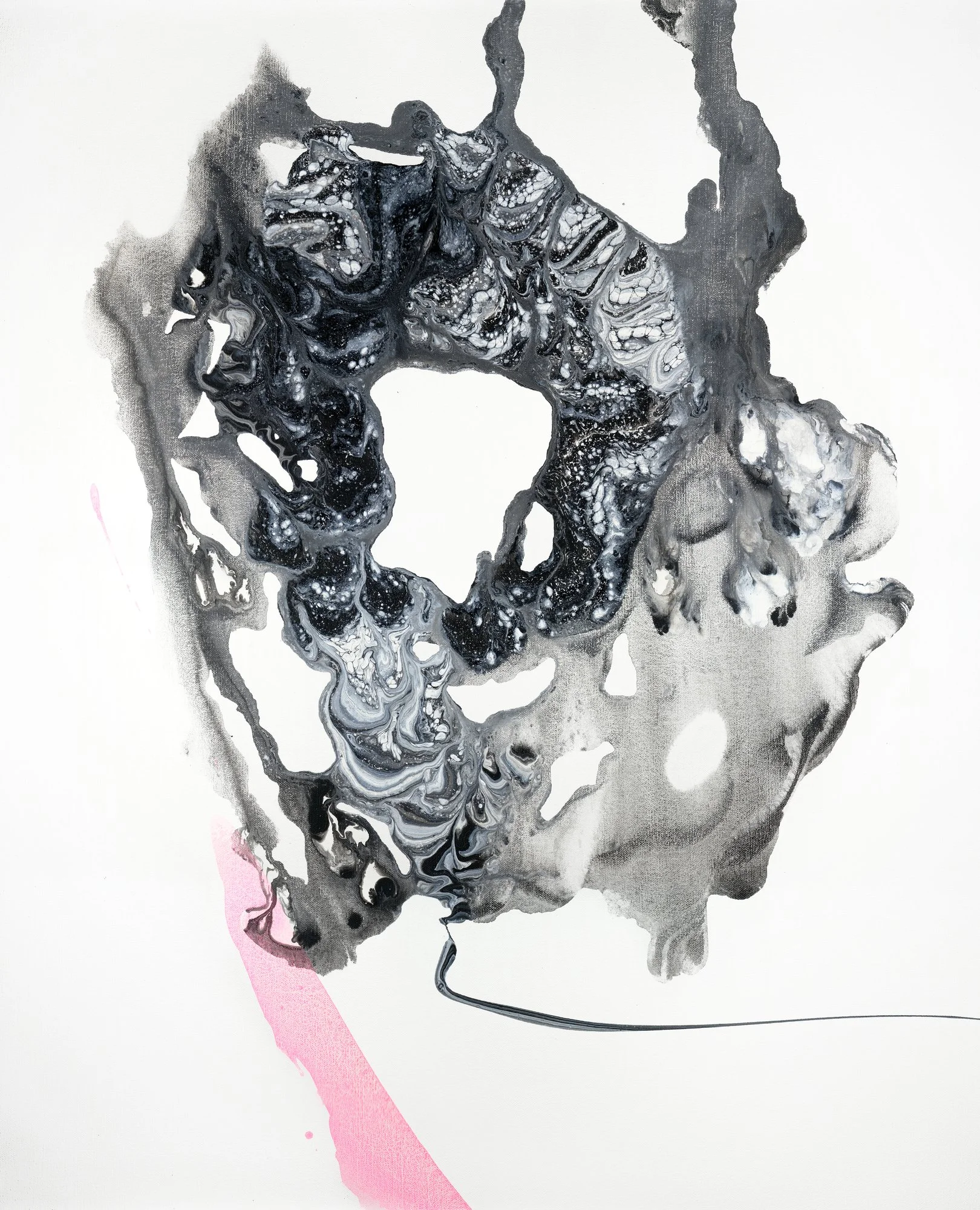
STA#72, 100x84 cm, 2025 © Wallace Woo
The exhibition includes works from your ongoing Stalactite series. Could you tell us more about this series and how the selected paintings represent the foundations of Geological Abstractionism?
My Stalactite series consists of 99 works, divided into two parts: Slow Living and Wild Growth. Slow Living is inward sedimentation. Wild Growth is an emergence within limitation. The final piece, Source, is a single drop of water, not an ending, but a comma.
Each of these 99 works is a fragment of the mind. Even exhibited alone, each one carries its own weight and meaning. But my greatest hope is to gather all of them together in 2028, to let their accumulated force produce a true shock.
This is my promise to myself. It is also my trust in this system. But to be honest, I have no background, no gallery support, no resources. I am only one person, in a studio in Paris, waiting layer by layer. The world is too fast. I choose slowness. But precisely because of that, no one is willing to stop, and no one dares to stop. Because the concept I bring up is too new. So new that this world is not yet ready to receive it. Or perhaps the world is afraid of this rupture, a rupture of the aesthetic system it has known. Or perhaps they can‘t believe that an Asian artist could break through the blind spot of abstraction. Or maybe this seemingly sophisticated art world simply wants to stay where it is, where the money already flows, where the names are already safe. They’d rather keep trading the same old ghosts than risk investing in a living one.
So they hesitate. They wait. They watch from a distance. And I understand. Because hesitation is also a form of waiting. But while they wait, I keep sedimenting. But my proposition is actually very simple: return everything to nature. Others paint landscapes. I guide nature. When colour becomes stratum, art arrives at the shore of the spirit. I will simply wait and see how far this theoretical experiment, this return to the Earth Mother, can go within my lifetime.
Thus, every work selected for this solo exhibition, whether from Slow Living or Wild Growth, is a cornerstone and a physical proof of Geological Abstraction. They stand there and tell the public: continuation is possible. The cornerstone of Geological Abstraction is the materialisation of the abstract vision. Because our lives are closer to geology than to an assembly line. Not efficiency, but sedimentation. Not speed, but depth.
You describe each painting as a “temporal anchor.” What do you hope viewers experience when standing in front of these works, and how do you want them to engage with the notion of deep time?
When viewers stand before a painting and gaze down at its layered textures, they have already stepped through the gate of practice. In that moment, what they experience is not my emotion, but their own feeling, a feeling that belongs to this world, and also to themselves.
They suddenly realise: how small we are on this planet. They begin to reflect on how precious everything they have at this moment truly is. They come to understand that we are always asking the future for meaning, yet we forget that existence itself is the greatest gift.
But perhaps, in the very next second, they will take out their phone. They will photograph the painting or pose in front of it for a selfie. This is not wrong. It is simply the sickness of our time. We are no longer accustomed to “pure feeling.” We need to turn experience into image, image into social capital, capital into: “Look, I‘m also in Paris, looking at such profound art.”
I do not mock them. Because I do the same. This is the collective anxiety of our generation, the fear of missing out, the fear of being forgotten, the fear of having no proof that we ever lived.
But this is precisely the best experiment for experiencing deep time: how long can you truly enjoy the work before you feel the urge to pick up your phone? One minute? Thirty seconds? Or were you already waiting for the „right moment to take a photo“ from the moment you walked into the exhibition? There is no right or wrong answer. It is only a mirror, reflecting our relationship with time. When you finally put down your phone and stand before the painting again, you may notice: the painting is still there. It is not in a hurry. It has already waited for you for hundreds of hours. It does not mind waiting a few more minutes.
This is what I call a “temporal anchor.” It pulls you back from virtual, digitised anxiety and nails you firmly into the reality of this very moment. This is deep time, not the ticking of a clock, but the silence of stone. Not you being in control, but you being held.
Alongside the exhibition, you are releasing your manifesto, The Dimension of Sedimentation. How do theory and studio practice inform one another in your work?
The Dimension of Sedimentation covers three levels: first, a response to the fast-food era; second, how to translate my theory into a practical technique; and third, the tipping point of abstract art. But recently, I discovered that my tipping point is not on the canvas; it is in my identity.
This social experiment has been quite interesting. It made me start thinking about a strange question: I am not French, so I will never be a "local artist" in Paris. But when I look back, the Hong Kong media tells me that they now only focus on so-called "local artists", as if once I leave that island, I no longer belong there.
In that moment, I felt not only confusion, but also a deep sadness and helplessness. The city that once nurtured me has, it seems, stopped its artistic understanding right here. They are too eager to label and categorise art by identity, and have lost the patience to truly look at an aesthetic movement. But this is also the chronic limitation of Hong Kong‘s art ecosystem: validation has become a currency of visibility, where the institution pre-approves the signature rather than confronting the canvas. That is why the contemporary landscape spends more energy manufacturing personal brands than engineering art with historical depth.
Does being a 'HK local artist' inherently require one to conform to the local icons of neon signs, the Lion Rock, and the imagery of Victoria Harbour? Must the vision of art be locked inside such a narrow dimension? Sometimes, I feel a strange sense of unfamiliarity toward my own hometown. This is a painful lesson: the world worships instant images and noisy froth, but lacks the vision and foresight to understand real sedimentation.
But I know that the passion, the soul, the desire I carry with me as I go international, this is also part of Hong Kong. It is like the invisible umbilical cord that stays with a child after it leaves the mother‘s womb. Does a child, once grown and far away, suddenly call someone else “mother”?
I was born in Hong Kong. My studio is in Paris. My sedimentation has been lived across different cities and cultural cracks.
The three-dimensional world needs symbols to comfort itself, but the five-dimensional universe only needs weight. As a Hong Kong artist, my roots are not defined by an ID card. They are defined by atmospheric pressure, the pressure that continues to sediment, that refuses to compromise, in the chaos, in the suffocating squeeze, in the vacuum where no one on either side sees you.
This is why my studio practice and my theory are not “informing” one another. They are the same thing: sedimentation. I have no background, no big gallery support, no resources. I have even been discarded by Hong Kong. I am only one person, in a studio in Paris, turning those days of rejection, erasure, and displacement, layer by layer, into theory, and then into artworks.
So, regarding the question of “how theory and practice inform each other”, I would say: they have never been two separate things. They are the only things that have not been taken or destroyed by the system, within the gap between two cities, two identities, two languages.
If you ask me where my tipping point is, I would say: when you realise that you belong neither here nor there, and the world is so ignorant and conservative, you either let the system drown you, or you start sedimenting like geology, building your own atmospheric pressure. I chose the latter.
And The Dimension of Sedimentation is the coordinate I have thrown at this numb world, and also written for myself, at this tipping point.

STA#48, 110x90 cm, 2025 © Wallace Woo

STA#36, 100x84 cm, 2025 © Wallace Woo

STA#43, 92x70 cm, 2025 © Wallace Woo

STA#93, 100x84 cm, 2025 © Wallace Woo
This exhibition is presented as the first chapter of a larger project, with a second part planned for 2027. What questions or directions introduced here will continue to evolve in the next phase?
My plan is to present Part One this year, Part Two at the end of 2027, and then merge both parts in 2028. That will require a much larger space, so that the audience can truly feel the accumulated impact of all 99 works together.
Beyond the exhibition, I am currently engaged in a series of cross-disciplinary dialogues with scientists and scholars, geologists, archaeologists, glaciologists, psychologists, and philosophers. The content of these conversations will be included in the second edition of my art book. I already have several promising lines of research in preparation.
But what will truly continue into the next phase, and what is most deeply personal to me, is a relatively intimate series called Afteralive. This series is not for the market, not for display. It is for my husband.
Looking back at all the series I have made, from Zentimeter to Stalactite collection, it seems I have been using cold art theory to ask the same grand question: after we lose something, what remains? I thought it was a philosophical question. But it turns out, I was lying to myself for all those years. It turns out that after all this time, after all this secluded practice, after searching for “sedimentation” for so long… I was only looking for one answer: if one day this life ends, and my soul returns to the Earth Mother, can I leave a mark deep enough on the canvas, so that in the next life, he can still recognise me?
This is Afteralive.
It is not religion. It is not an empty promise. It is simply a very selfish, very foolish, yet very tender thought: when everything in this world accelerates and falls apart, at the very least, my sedimentation will still be here with him. So, the direction for the next phase is not some profound aesthetic theory waiting to evolve. It is this: I will keep painting. I will keep waiting. I will keep sedimenting. Until the mark of love for him is so deep, deep into the stone, that the moment he walks into that next life, he will see it. For sure.
In a cultural moment defined by speed, constant image consumption, and digital overload, what impact do you hope Stalactite: Part I will have on audiences and on the broader conversation around contemporary art?
In a world running on speed, digital noise, and constant forgetting, Stalactite: Part I is not just an exhibition. It‘s a quiet ultimatum. Through 99 works, one book, and a physical space, I leave behind eight layers, one on top of another, into the consciousness of this era: First, the inception of Geological Abstraction. This is not about memorising a new art historical label; it is about remembering a fundamental truth: art does not have to be an image. It can be the physical shape of time itself.
Second, the elevation of human perception. It forces us to step outside the frantic countdown of minutes and hours, and to gaze at existence through the lens of deep time, through the sheer, monumental scale of mineral memory.
Third, the disruption of artistic inertia. It reignites a confrontation that the art market has long evaded: Has abstract art truly reached its dead end? Or have we simply lacked the courage, the discipline, and the absolute solitude to forge a path into its deepest strata?
Fourth, the practice of radical stillness. It acts as an uncompromising mirror for self-reflection. It does not ask the viewer to judge whether a painting is beautiful, but demands an answer to a far more jarring question: When was the last time you stood completely, utterly still before something?
Fifth, the emancipation of human vulnerability. It stands there to remind the world that weeping is not a crime. To break down before a canvas is not an admission of sorrow; it is the sudden, terrifying glimpse of your true self. There is no shame in being found.
Sixth, the manifestation of The Gravitational Vision. Unlike traditional abstraction that confines its narrative to a flat, planar space, my practice demands an absolute submission to weight. By stacking pigment like geological strata, I give weight back to the visual, creating a 'Visual Gravitational Pull' so heavy that your gaze is arrested, making it physically impossible to simply scroll past.
Seventh, the materialization of pain. In a society where suffering is either commercialized or swept away, Geological Abstraction transforms abstract trauma into a stalactite-like material existence, hard, slow, and crystalline. You do not need to speak, to scream, or to explain your wounds; you only need to look at these strata. Pain does not have to be dissolved. Through sedimentation, human hardship is granted a monumental permanence, transformed into a magnificent landscape that remembers for you.
Eighth, the resistance against digital nihilism. This is not a naive rejection of technology, but a fierce material evidence for future generations to look back on and understand how 21st-century humanity resisted digitization through art. It is a monument built from the volumetric mass of layered pigments and the raw traces of gravity, shouting a sovereign counter-narrative into the void: the screen is flat, but life is deep.
I hold no illusion of changing the world. My only hope is that while everyone else is rushing blindly toward the edge, someone will be willing to stop, stand a little longer, and finally realize: Slowness is not lagging behind. It is another dimension of depth."
Artist’s Talk
Al-Tiba9 Interviews is a curated promotional platform that offers artists the opportunity to articulate their vision and engage with our diverse international readership through insightful, published dialogues. Conducted by Mohamed Benhadj, founder and curator of Al-Tiba9, these interviews spotlight the artists’ creative journeys and introduce their work to the global contemporary art scene.
Through our extensive network of museums, galleries, art professionals, collectors, and art enthusiasts worldwide, Al-Tiba9 Interviews provides a meaningful stage for artists to expand their reach and strengthen their presence in the international art discourse.



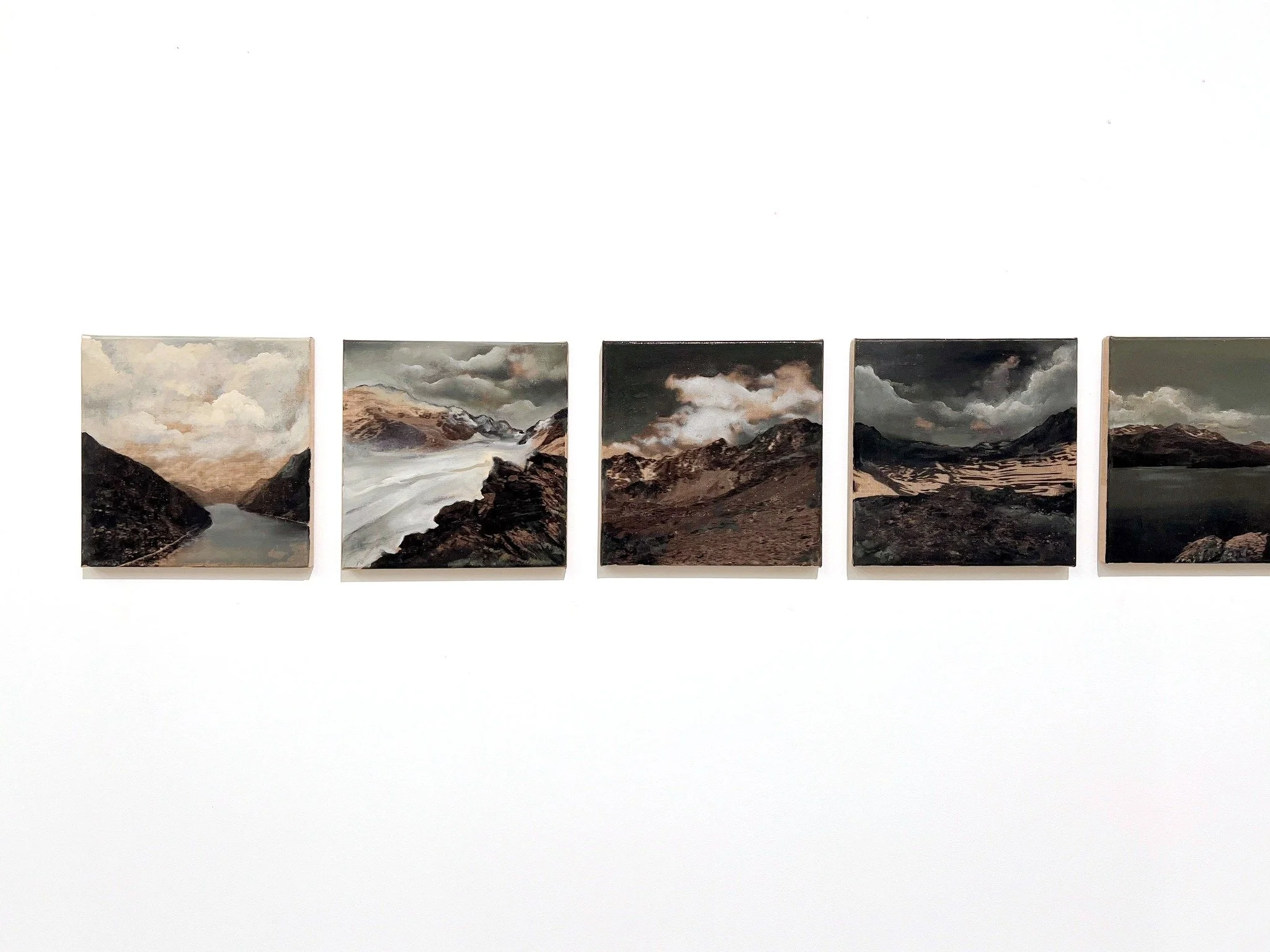
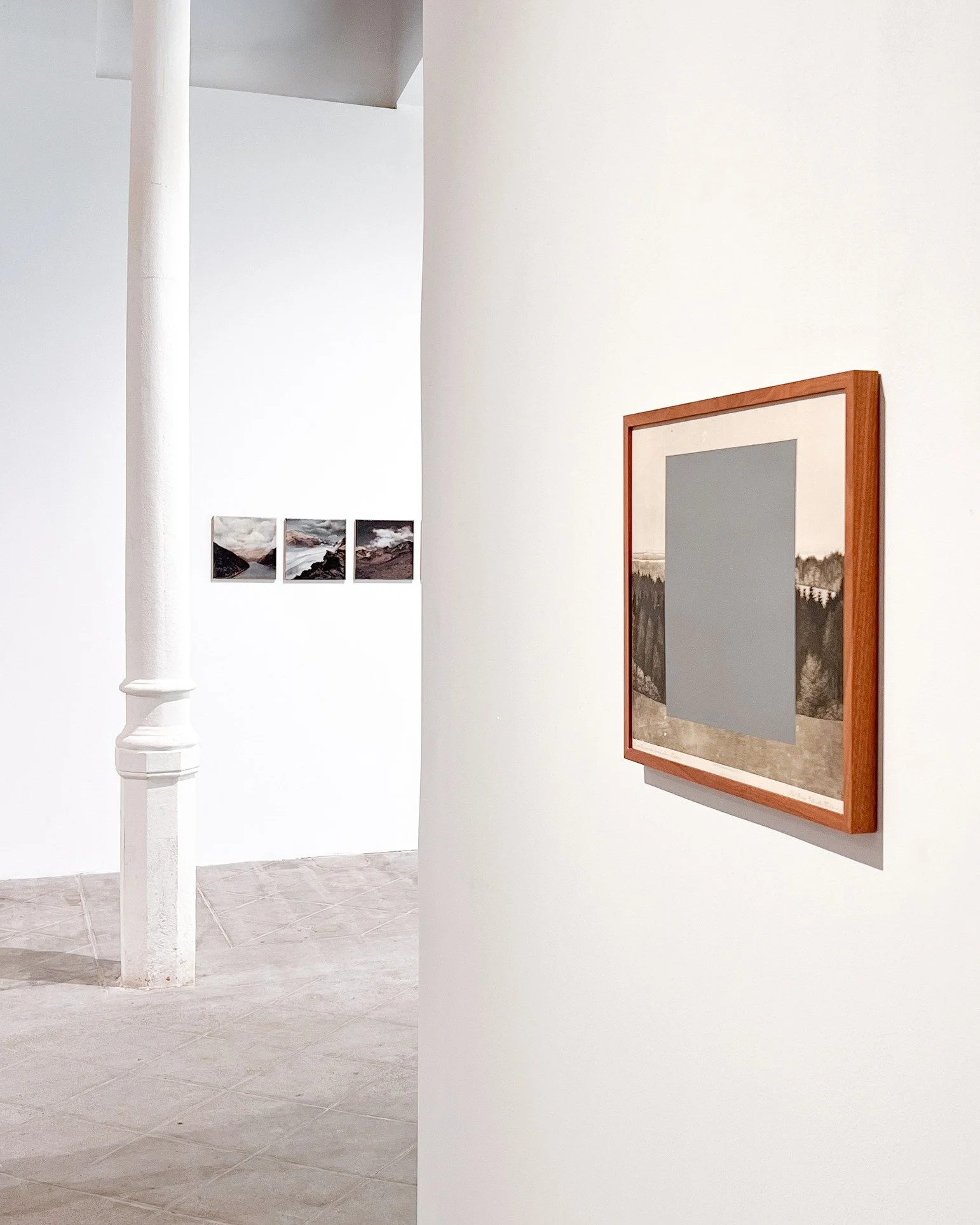
Nataraj von Allmen is a painter based in Switzerland. Often taking photographic material as a starting point, he weaves together landscapes, mythological archetypes, Christian symbolism, and contemporary socio-political themes into complex paintings. Oscillating between figuration and abstraction, his work investigates transformation, collective memory, and the human condition.