
10 Questions with Kinga Owczennikow
Kinga Owczennikow is a visual artist working with photography who navigates the space between documentary observation and conceptual inquiry. She was born in Lower Silesia, Poland and lived across the globe, having relocated to New York City in 2024. She received her BA (Hons) in Photography from the University for the Creative Arts and her Associate Distinction from the Royal Photographic Society in the UK.
Owczennikow had a solo exhibition, The Secret Paths of Hong Kong, at the Asia and Pacific Museum in Warsaw in 2011. Her photography has also been exhibited internationally, including the 2023 International Juried Exhibition in the historical Center for the Photographic Art in Carmel-by-the-Sea, curated by Shana Lopes, the Assistant Curator of Photography at the San Francisco Museum of Modern Art; in Language in Millepiani Exhibition Space (2021) in Rome, curated by Antonio Muratore; in Urban (2020) in PH21 Gallery & Valid World Hall Gallery; in Barcelona, curated by Zsolt Bátori and Borbála Jász; and in The Story of the Creative, at the Angel Orensanz Foundation for Contemporary Art (2013), in New York City.
Owczennikow’s work is often concerned with the conceptual role of internal frames within her photographs, and their profound impact on human perception and understanding. She also presents imagery of natural and urban scenes in seeming harmonious coexistence. The photographs, often appearing humble and direct, are intentionally layered with a subtly postmodern sensibility, engaging in self-referential and meta-photographic commentary that challenges traditional viewing patterns.
Her projects have been included in numerous magazines and online publications such as BBC Travel, The Eye of Photography, All About Photo, Noice Magazine, ARTDOC Photography Magazine, HK Magazine, F-Stop Magazine, Photo Vogue, and Quarterly Journal of Photography Issue 44. Her first photobook, “Framing the World”, was published by Ephemere in Tokyo in 2025.
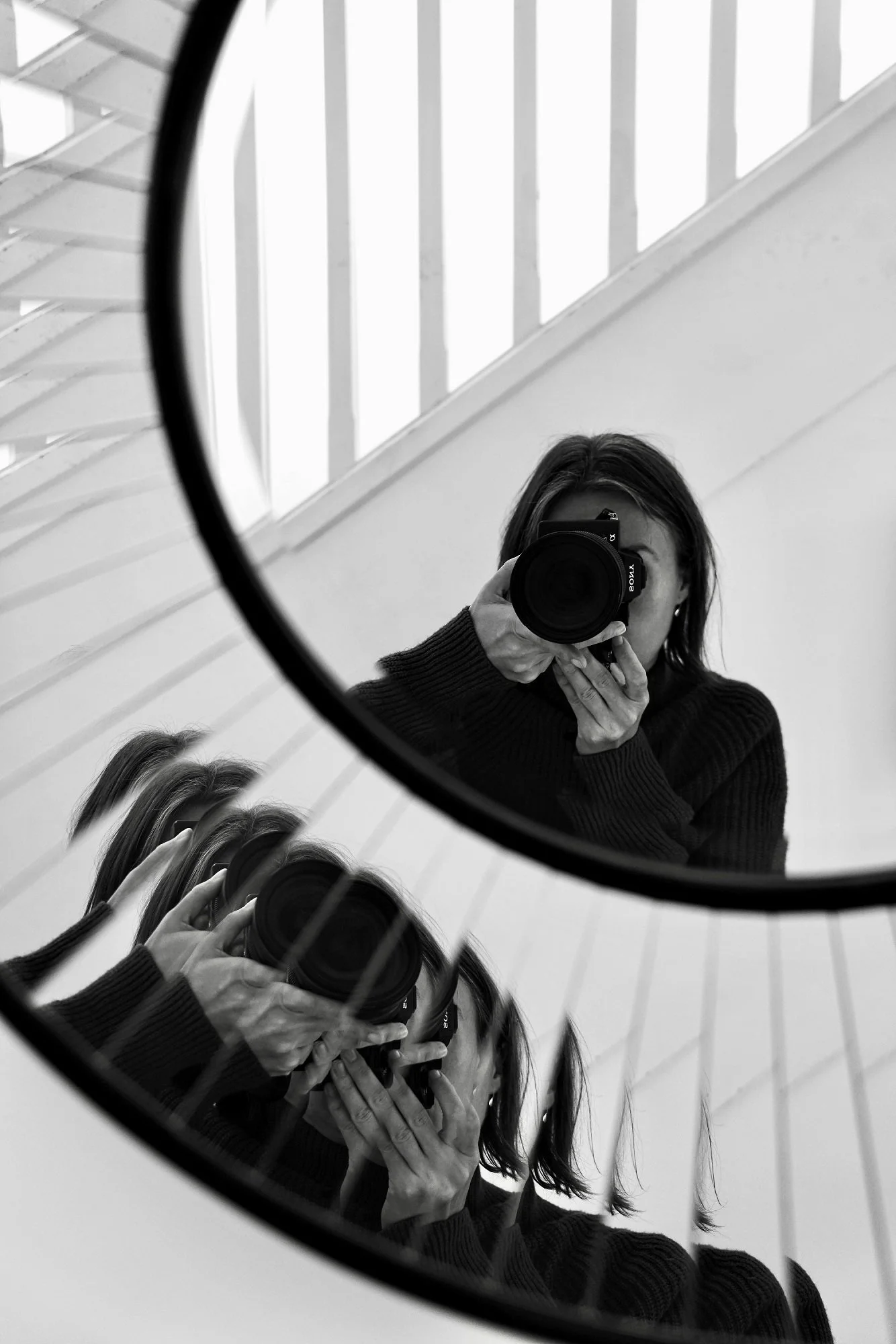
Kinga Owczennikow - Portrait
Framing the World | Project Description
"All photographs frame the world."
Framing the World is a book-length project which presents over fifty photographs with internal frames, how they sharpen focus on the world and refine viewers’ understanding of viewing, of both the world and photographs. Frames within the photograph’s frame suggest that the photograph self-consciously occupies art space, close viewing space, and these frames invite analysis, interpretation, and appreciation. Internal frames can attract and resist, reveal or deceive, imply their own limitations. Even implying viewers’ limitations, the cognitive frames through which they process the world. Framing the World was published by Ephemere, an independent press in Tokyo, in May, 2025.

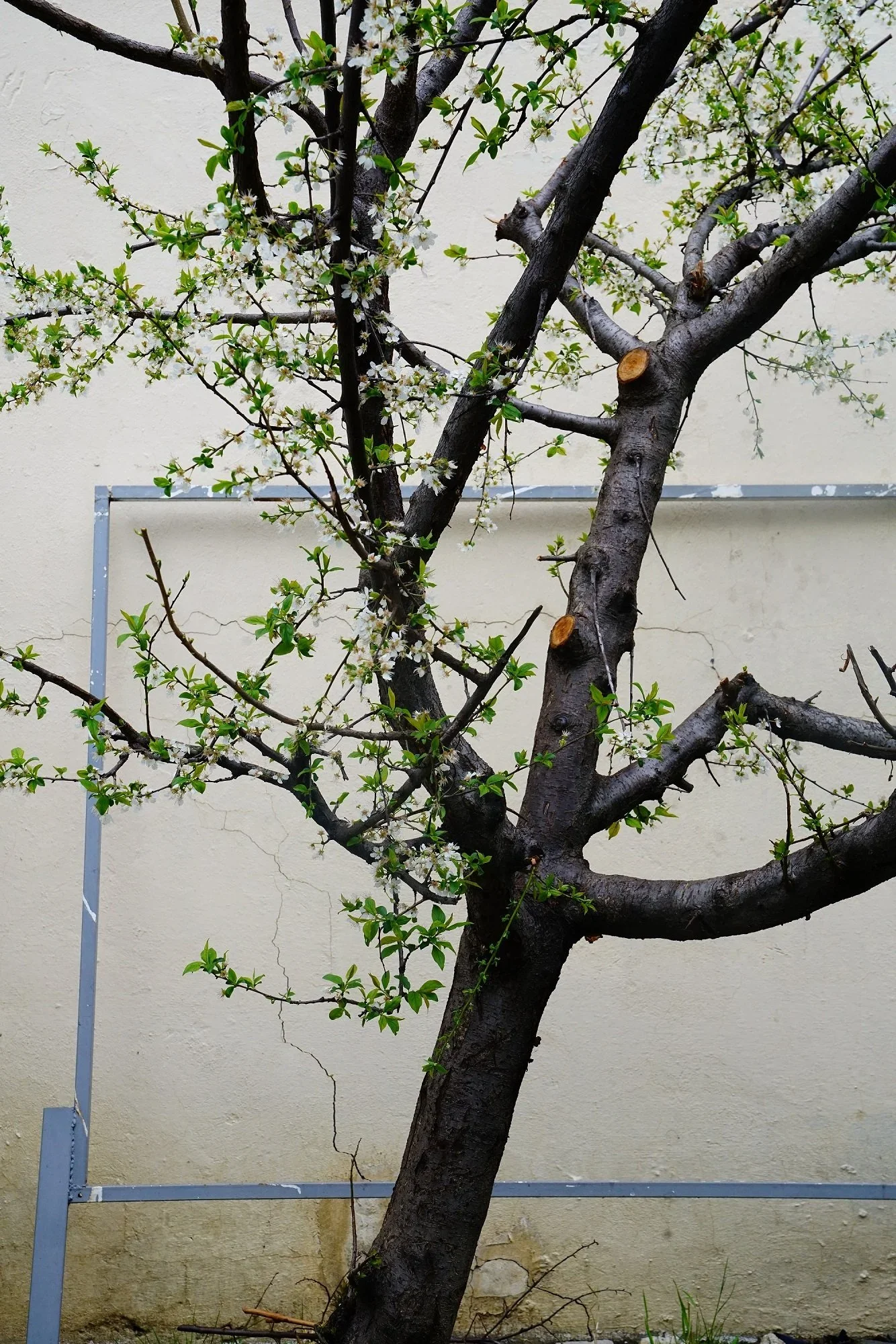
Gjirokastra, Archival pigment print, 50 × 40 cm, 2017 © Kinga Owczennikow
INTERVIEW
Please introduce yourself to our readers. Who are you, and how did you first become interested in photography?
My name is Kinga, and I am a practising, documentary-style photographer who explores both the natural and built environments. My photographs are mostly devoid of people as I am more interested in the hidden and often overlooked aspects of city life. I am naturally drawn to the quiet tension that lingers in empty spaces rather than seeking the attention-stealing sights of human interactions. Some of the recurring themes in my work are fragments of greenery in urban settings, internal frames within a frame of a photograph, and elements of darkness.
Growing up in the far southwestern corner of Poland, I have always wanted to explore the world. Like one of my favourite photographers, Luigi Ghirri, I used to spend a lot of time between our family albums and the maps or between my mother’s extensive collection of postcards and my grannie’s weekly lifestyle magazines. Perhaps this was my first encounter with photography, which led me to creating scrapbooks, cutting out images and making my first collections of objects. What followed was my first possession of a Polaroid camera, received from my father, who brought it from Germany. The experiences with it directly enriched my sensibility to recognise that daily perceptions could instantly become artefacts and how stories could be created, and memories recorded.
Formally speaking, I first studied photography theory and practice at the Warsaw School of Photography about 15 years ago, where I had the privilege to work in a darkroom and in a studio, learning about the history of photography and various genres. I also hold a BA (Hons) degree in Photography from the University for the Creative Arts in the UK.

Hong Kong, Archival pigment print, 50 × 40 cm, 2015 © Kinga Owczennikow
Why did you choose photography specifically as your preferred medium? What does it represent for you, and how does it help you communicate your messages with the rest of the world?
I could never draw or sketch, yet I have been interested in art since I can remember. I even managed to win a local art competition with a huge collage of the Earth. I had my cousin draw desired outlines for me, and I filled them in with hundreds of tiny, shredded pieces of coloured paper; the process was time-consuming, but the sense of satisfaction that came with completing the project made a lasting impact on me.
Photography is a true adventure in observing and thinking, but moreover, it is an intimate exercise of patience by which I can isolate moments of stillness in everyday urban settings, emphasising textures, spatial relationships, and traces of human presence. Photography allows me to explore the world’s enigmas, focusing on the mundane and the poetic, rather than merely documenting reality. I also see it as a way of translating the qualities engraved in myself into a form of photographic work which can be further shared with potential viewers.
You've lived in such diverse places, Hong Kong, Ho Chi Minh City, Paro, and now New York. How do these different environments influence your approach to photography?
Having lived across the globe has definitely enriched my visual vocabulary and helped me to retain a curious, inquisitive mind. From two decades of nomadic experiences emerged an outsider’s point of view, enabling me to recognize the extraordinary in what others might simply overlook, contributing to a detached yet highly perceptive engagement with the world. Metropolises offer a distillation of endless reflections, dense layering of infrastructure, cultural juxtapositions, and, most importantly, a constant contrast between architectural styles and social realms.

New York City, Archival pigment print, 50 × 40 cm, 2021 © Kinga Owczennikow
You describe your photographic practice as a "collaboration with the world." Can you elaborate on what that means to you, and how it informs your creative process?
I like to call my practice a collaboration with the world, where, through a process of close observations of my immediate surroundings, I become aware of the energy flow and what triggers a reaction in me to lift up my camera, look through the viewfinder and respond to the scene. Serendipity plays a significant role in my photographic process, but at the same time, I draw on things that I have seen, heard, or, generally speaking, experienced and took up as my private inspiration over the years.
My sources of influence have been artists not only from the photography field but also musicians and filmmakers such as Brian Eno, David Sylvian, Krzysztof Kieślowski and Wim Wenders, alongside photographers of the past like André Kertész, Luigi Ghirri, Walker Evans, and contemporary like Uta Barth, Joel Meyerowitz, Anita Andrzejewska or Teju Cole. Each of them has shaped my gaze a little bit differently, but having been consciously immersed in their ‘artistic waters’ helped me to sharpen my intuition as well as encouraged me to “think with images”.
The work of Uta Barth has been an important influence on my more experimental projects, where my attention focuses on the act of seeing itself within my home environment or self-portraiture. The sensibility of Luigi Ghirri and especially his Kodachrome series are very close to my skin during everyday city wanderings.
Most recently, I have come across the seminal book Meeting the Universe Halfway: Quantum Physics and the Entanglement of Matter and Meaning by Karen Barad, an American theoretical physicist and philosopher. Many of her findings intersect with photographic theory and remind me of my own sense of collaboration with the reality around me. She says: "We do not obtain knowledge by standing outside of the world; we know because we are of the world. We are part of the world in its differential becoming." Barad argues that the observer and the observed, or the camera and the subject, are not separate entities. Instead, they "intra-act" to co-create meaning and reality.

Tirana, Archival pigment print, 40 × 50 cm, 2020 © Kinga Owczennikow
Your newest project, Framing the World, explores the idea of internal frames within the photographic space. What drew you to this concept, and how does it change the viewer's engagement with the image?
My collaborator, Tom LeClair, has noticed that internal frames are often omnipresent in my photographs. Framing the World focuses on photographs where internal frames are incorporated within the larger photograph's frame. These internal frames create a layered visual experience, subtly suggesting that the photograph is not simply a window onto reality, but a self-aware piece of art. By using frames within the photograph, I invite viewers to consider the photograph's own space and to engage in a more analytical and interpretive viewing experience. Internal frames ask where the frame ends and what was left outside it. The repeated presence of internal frames can also introduce a postmodern sensibility, as they challenge our expectations about what a photograph is and what it can do.
Ultimately, Framing the World is about how we perceive the world and how photographs, through their framing, can shape our understanding of both the real and the artificial.
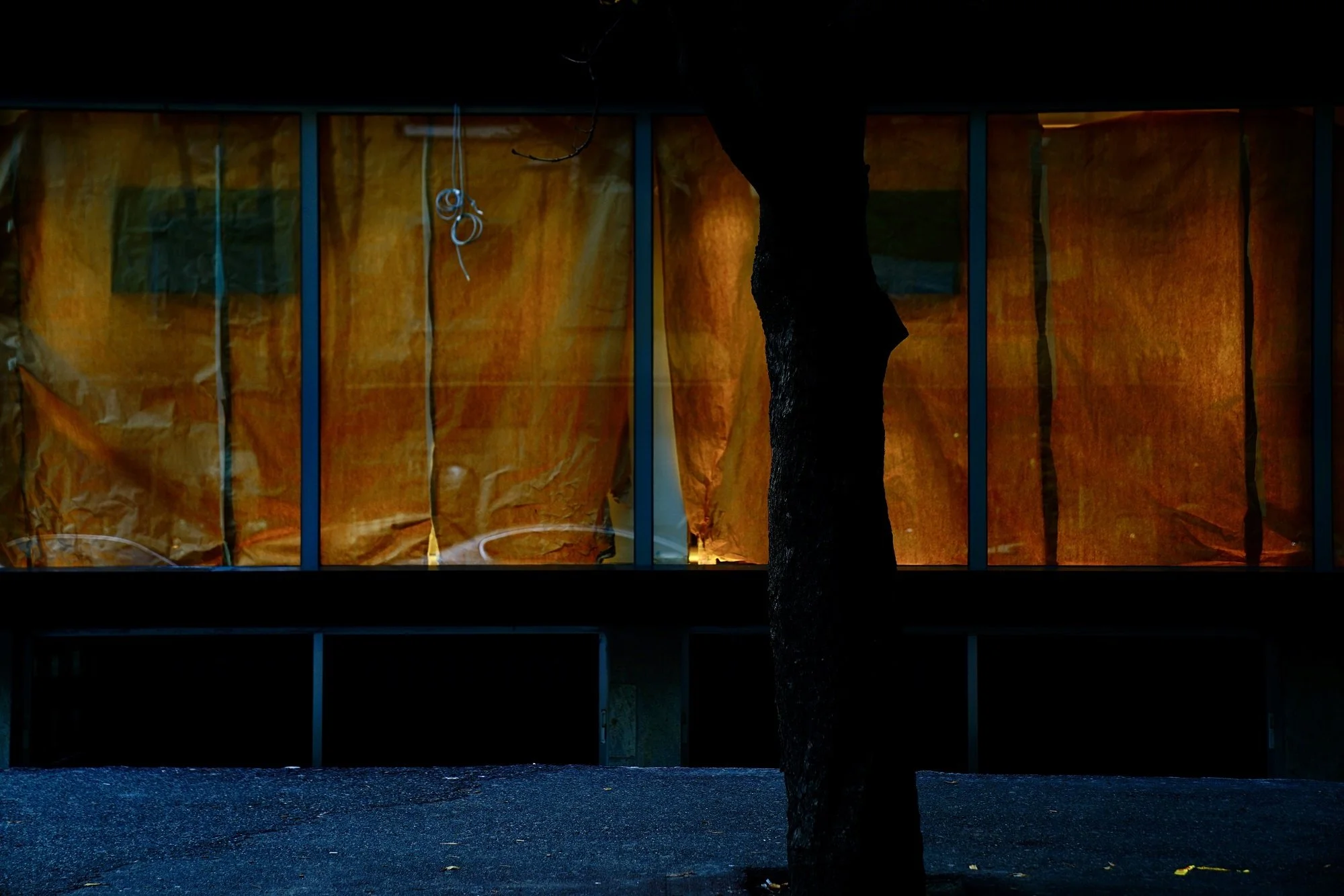
Tirana, Archival pigment print, 50 × 40 cm, 2019 © Kinga Owczennikow
Framing the World was published last year; what was the biggest challenge in translating your photographic ideas into a book format?
The biggest challenge was to find a publisher for a project that began as a collaboration between a word-man and an image-woman. Once I signed the contract with Ephemere, I was given a sense of openness and possibility when it came to size, edition, and paper choices. Working on the book proved to be another collaboration, which inspired me to make a few changes when it came to the final choices of photographs and the inclusion of texts.
Some difficulties arose gradually from having a truly international team of people working on the book: the photographer in New York City, the publisher in Tokyo and the designer in Sardinia. The time difference and being away geographically limited my chances to directly oversee the results, such as full proof printing or the type of cover.
Your work often plays with perception, inviting analysis while questioning the viewer's assumptions. How do you balance clarity with ambiguity in your compositions?
My photographs often give a sense of minimalism and simplicity that creates a visual clarity. I make a strategic use of negative space to allow the eye to rest while isolating desired elements; I also juxtapose contexts, for example, by choosing to photograph familiar objects in contradictory settings. This can be intriguing, as in the following image of four skewed frames (additionally casting shadows). The image is clear but ambiguous: why did the photographer shoot this scene? A frame within a frame can offer a sense of stable focus, but when viewers find emotionally unsettling detail (such as a possible noose in the photograph below, taken in Petrovac na Moru), viewers have to wonder: Is this dark landscape art or something even darker, a site of death?

Tirana, Archival pigment print, 52 × 28 cm, 2020 © Kinga Owczennikow

Petrovac na Moru, Archival pigment print, 50 × 40 cm, 2018 © Kinga Owczennikow
As someone who often works from the insider/outsider perspective, how do you navigate cultural sensitivity while capturing unfamiliar environments?
Since I have led a wandering lifestyle as an educator and artist, I often photograph in environments which over time become pretty familiar to me. I also became familiar with the people around me, like in my neighbourhood in Tirana, where I photographed a lot and was somewhat recognised and trusted. I avoid provocative situations and embrace each place of residence with an open mind and respect. I take pleasure in observing alone; I don’t have to photograph everything just because I have the camera with me. Also, it’s easier to “navigate cultural sensitivity” when not photographing people and simply using your common sense.
You're a member of several respected photographic institutions. How do these affiliations influence your practice or offer new opportunities for dialogue and visibility?
Affiliation with the Royal Photographic Society has opened the doors to a number of opportunities. For example, I have been invited to give a talk regarding my journey publishing Framing the World. It will take place in June. Being a member of photographic institutions allowed me to submit work to juried shows, which directly led to having my work seen by curators and sold, for example, at the historical Center for Photographic Art in Carmel-by-the-Sea. My affiliations do not directly influence my practice, but they offer multiple chances to connect with other members, building a wide circle of personal kinship, not just followers on Instagram.
By the way, and returning to the presence of ambiguity, the following photograph is one of my favourites because ambiguity seems to tip over into enigma. The person passing by wants nothing to do with the strange objects and odd perspectives in that room. One of my purposes is to tempt viewers to look into the sometimes ambiguous “rooms” of my photographs.
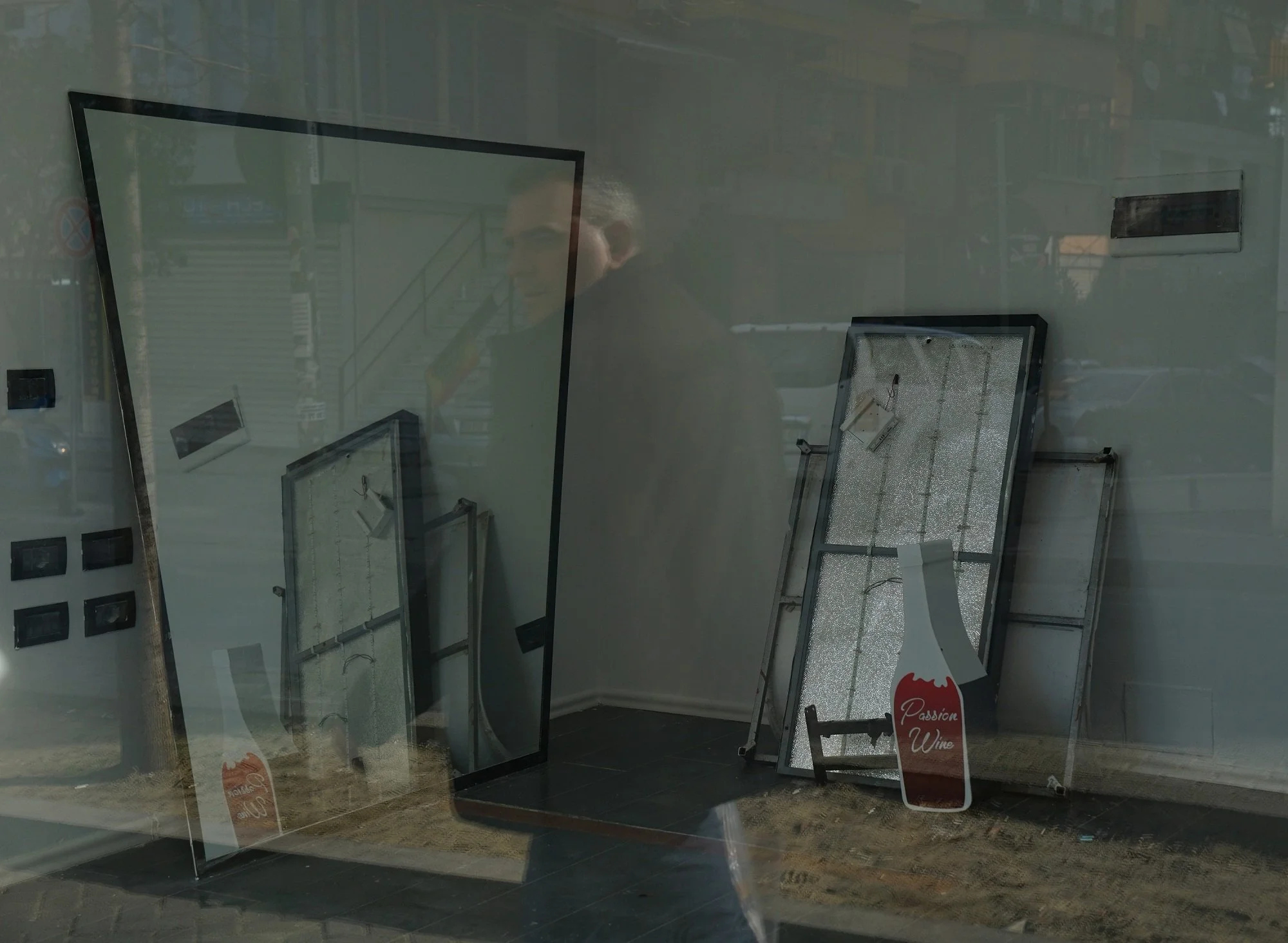
Tirana, Archival pigment print, 40 × 50 cm, 2020 © Kinga Owczennikow
Looking ahead, what themes or places are currently drawing your attention? Are you excited to explore any new projects or directions in 2026 and beyond?
I focus primarily on seeing the light and noticing textures, finding photographs wherever I go. I started working on a second volume of the collaborative zine Fragments with the German photographer Philipp Zechner. I am also searching for potential spaces to exhibit selected photographs from Framing the World. I have started talks with a couple of galleries.
In his first book in The New York Trilogy, City of Glass, Paul Auster wrote: "New York is an inexhaustible space, a labyrinth of infinite steps." For the first time, I am the most excited when given an open time frame to explore the streets of New York, discovering new places or concepts within this intriguing metropolis.
This year, I also wish to experiment more with printed matter and possibly create collages, as well as work on editing my narratives. I have returned to looking into self-portraiture and my exploration of what I call “More than self-portraits” or “Impermanent Identity”.
Artist’s Talk
Al-Tiba9 Interviews is a curated promotional platform that offers artists the opportunity to articulate their vision and engage with our diverse international readership through insightful, published dialogues. Conducted by Mohamed Benhadj, founder and curator of Al-Tiba9, these interviews spotlight the artists’ creative journeys and introduce their work to the global contemporary art scene.
Through our extensive network of museums, galleries, art professionals, collectors, and art enthusiasts worldwide, Al-Tiba9 Interviews provides a meaningful stage for artists to expand their reach and strengthen their presence in the international art discourse.



Shingo Ohta is a Japanese photographic artist based in Toyooka, Hyogo, near the Sea of Japan. After a long career in business and regional revitalization, he turned to photography as a primary artistic practice, developing an ongoing body of work centered on the sea as a living, volatile, and almost sacred force. His images transform waves, spray, light, and weather into abstract forms.