

10 Questions with Mimi Revencu
Mimi Revencu is a Romanian visual artist whose practice explores the relationship between image, perception, and the subtle structures of meaning. Although her artistic talent was recognized from an early age, her educational path initially followed a different direction: she graduated from a mathematics-physics high school and later from the “Alexandru Ioan Cuza” University of Iași, where she trained as an economist.
This intellectual formation, far from distancing her from art, cultivated her sense of rigor, structural awareness, and the ability to construct compositions with a clear internal logic. Over time, Mimi returned to the visual language as an inevitable vocation, transforming her interdisciplinary background into a foundation for her artistic practice.
Her works unfold in the liminal space between the visible and the invisible, exploring the tension between clarity and ambiguity, light and density. Her practice is distinguished by symbolic stratification, compositional balance, and an aesthetic of profound stillness.
Active in both national and international art contexts, Mimi is known as a mirabilist artist and is appreciated for her ability to transform perception into an act of introspection, creating images that function as interior maps of meaning.
She currently works from her studio in Piatra-Neamț, Romania, where she continues her research into the image as an instrument of clarification and inner orientation, developing a visual discourse that is mature, coherent, and deeply personal.
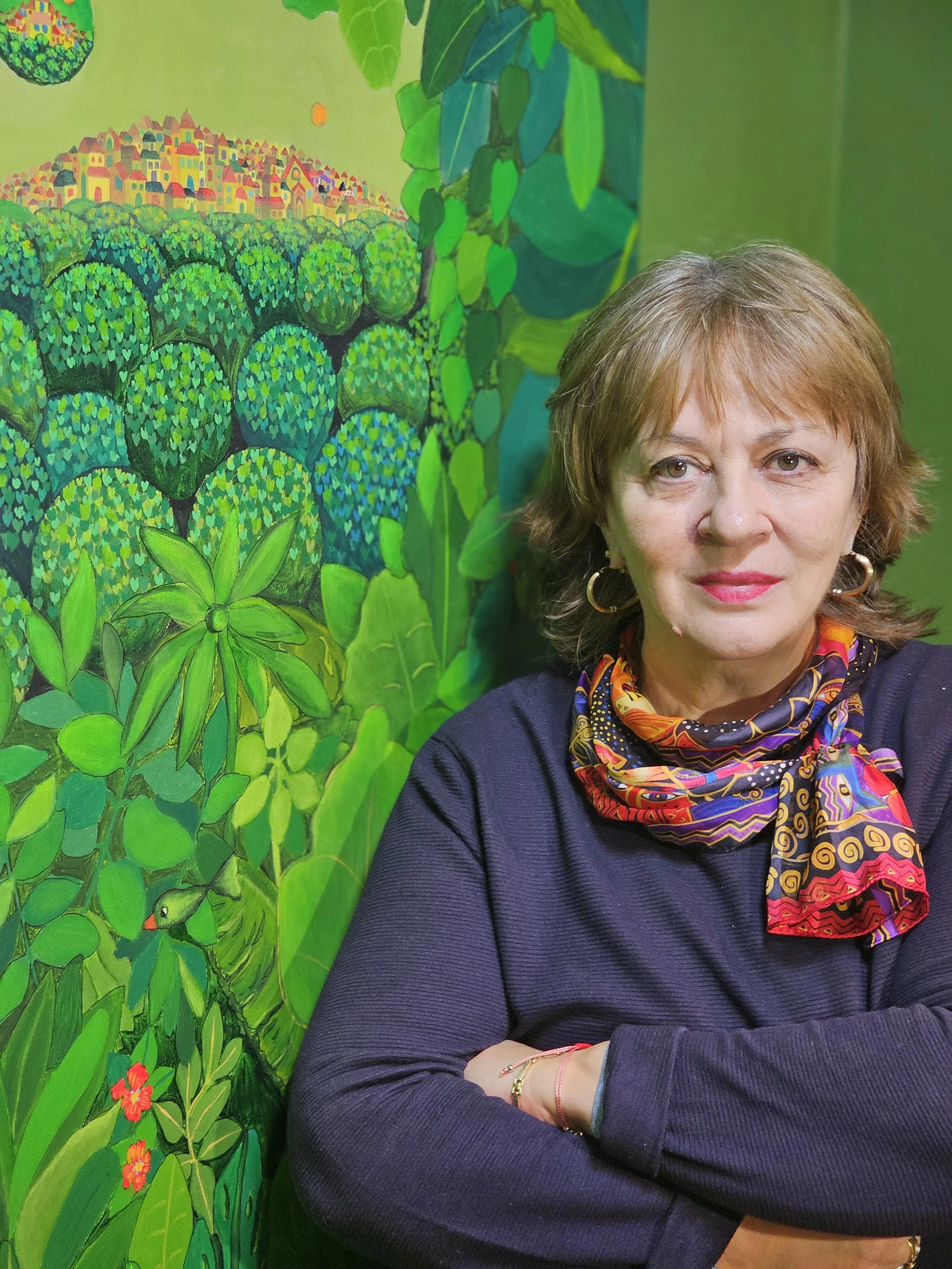
Mimi Revencu - Portrait
ARTIST STATEMENT
Mimi Revencu’s artistic practice is grounded in the idea that the image can function as a space of perceptual clarification. Her early formation in mathematics and economics shaped a particular relationship with structure, order, and the internal logic of composition, elements she reconfigures within a visual register. In her works, precision and intuition coexist, generating a subtle tension between control and emergence.
Mimi investigates the liminal zones of the visible, those moments in which the image does not explain but suggests; in which form does not delimit but opens; in which light and density become instruments of an expanded perception. The layers she constructs, of light, symbol, and memory, operate as fragments of an inner language oriented toward introspection and resonance.
Her visual discourse aligns with the sphere of mirabilism, an artistic direction that privileges the encounter between the real and the interior, the concrete and the subtle, perception and meaning. Within this context, her works are not merely objects but experiential spaces: territories in which the viewer is invited to slow down, observe, and enter into dialogue with their own perceptual layers.
For Mimi, art is a process of refining the gaze. Her practice does not seek spectacle but depth; not narrative but presence; not demonstration but openness.
Ultimately, her works propose a discipline of attention, an invitation to see more slowly, more attentively, more profoundly.
The Promised World, Acrylic on canvas, 160x140 cm, 2025 © Mimi Revencu
INTERVIEW
First off, can you tell us about your background and how you found your way back to art after studying mathematics, physics, and economics?
I was born in the north of Moldova (Romania), in the city of Roman, in a family where drawing was a natural presence, my father was a very skilled draftsman. I grew up with an instinctive inclination toward visual expression, something I recognized very early in life. For me, it felt natural, not like a “talent.” Only my painting teacher’s insistence, her certainty that I would pursue an art high school, made me realize that what I was doing carried another weight.
Still, my formal education took a different direction. I attended a mathematics–physics high school and later studied economics at the “Alexandru Ioan Cuza” University in Iași, but not before promising myself that I would return to painting.
This “detour” was not a departure from art, but a period that shaped the way I think. It trained my sense of structure, clarity, and internal logic. Returning to art felt inevitable, like reconnecting with a language that had always been mine. My interdisciplinary background became a foundation rather than a contradiction, allowing me to approach visual creation with both sensitivity and conceptual rigor.
In what ways does your academic training influence your artistic practice today?
The influence is subtle but essential. Mathematics taught me about structure, balance, and the elegance of internal coherence. Economics sharpened my analytical thinking and my ability to understand systems and dynamics. Mathematics gave me the unseen form. Economics gave me the rhythm. Painting transforms them into presence. My compositions are intuitive but never accidental; emotional but never chaotic. The precision of my early studies and the fluidity of artistic intuition coexist in my work, creating a productive tension that energizes the image.
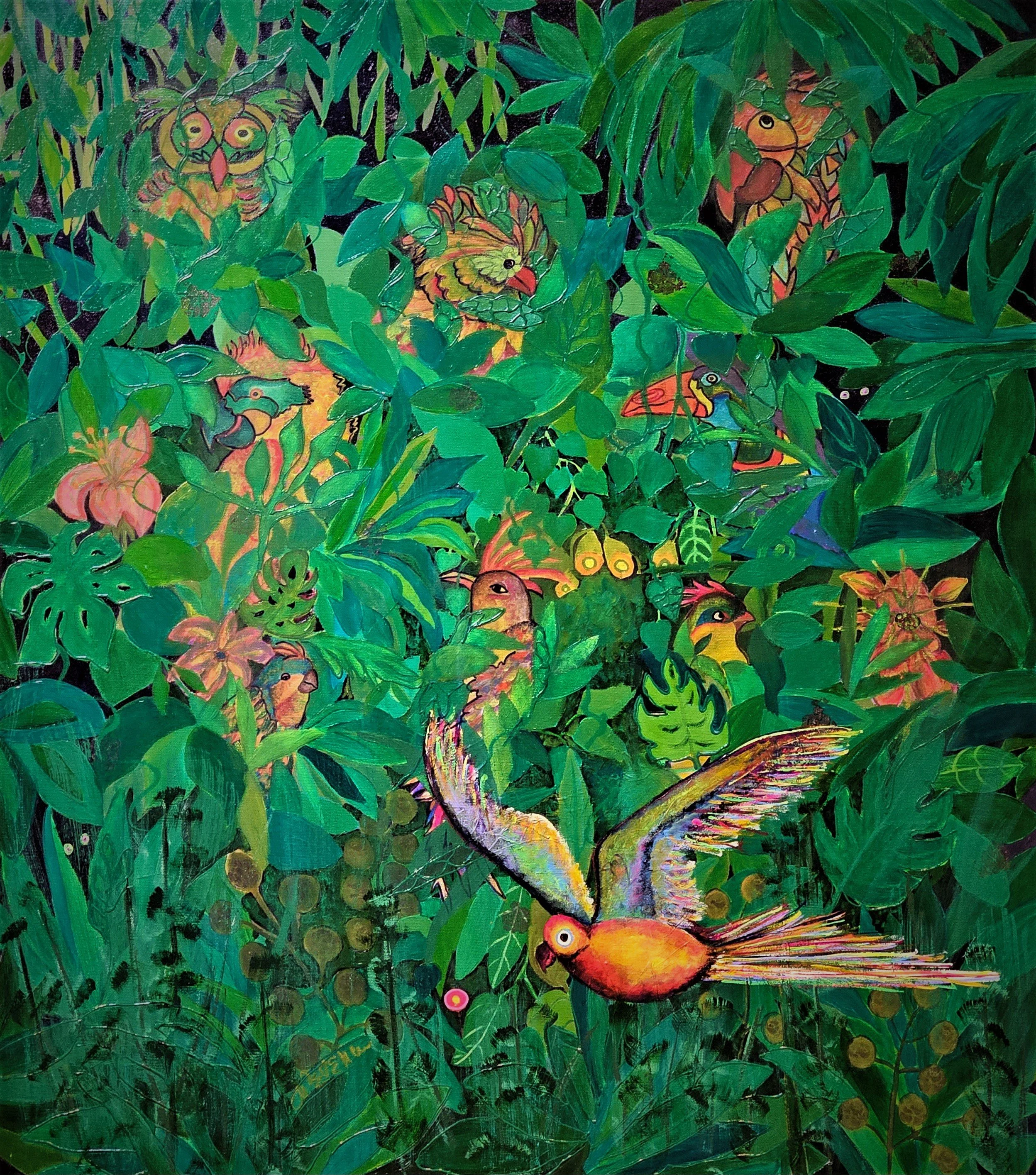
The Emerald Realm, Acrylic on canvas, 80x90 cm, 2023 © Mimi Revencu
How would you describe your creative process from the initial idea to the finished work?
My process often begins with a moment of stillness, a perceptual shift, a fragment of light, a symbolic resonance. I rarely start with a fully formed image, but I feel its vibration, the direction in which it wants to emerge. It is a strange and beautiful sensation to see, with the mind’s eye, a painting that does not yet exist but insists on being brought to life.
I work in layers. Each layer is a negotiation between my intention and what the work itself demands. I alternate between control and openness, between structure and intuition. A piece is finished when it reaches an inner coherence, when it becomes a space capable of holding silence, reflection, and meaning.
What mediums do you primarily work with, and why do they suit your vision?
I work mainly with acrylic on canvas and mixed media on canvas or cardboard. Acrylic suits my nature, it dries quickly and allows me to build layers of light, density, and symbolic presence.
I need mediums that can hold both precision and delicacy, both clarity and ambiguity. Mixed media allows me to create images that feel alive, layered, and open to interpretation.
Your work often explores the space between the visible and the invisible. What draws you to this theme?
I am drawn to the space between the visible and the invisible because it reflects the way I perceive the world: reality is never complete at the surface. There is always a second layer, a silent and deeper architecture of meaning beneath forms.
My images come from that place, from intuitive appearances that arrive whole, without explanation, like something that “lands” in front of me and asks to be translated. Painting allows me to approach that invisible layer without forcing it to reveal itself. The visible is the doorway. The invisible is the pulse. Painting is the bridge. In that liminal space, the image becomes alive and begins to resonate with the viewer’s inner landscape.

The Game That Never Ended, Acrylic on canvas, 50x60 cm, 2026 © Mimi Revencu

The Smile, Acrylic on canvas, 60x80 cm, 2022 © Mimi Revencu

In All That We Are, Acrylic on canvas, 50x60 cm, 2023 © Mimi Revencu

Princess Marcella Borghese, Acrylic on canvas, 60x80 cm, 2020 © Mimi Revencu
How do you approach the balance between structure and intuition in your compositions?
Intuition is always the beginning, the spark, the apparition, the moment of recognition. But intuition needs clarity, discipline, and inner order. My rational training taught me to respect proportion, structure, and coherence. The process becomes a dialogue: intuition proposes, structure refines. I never force the image; I let it reveal its own logic. The balance appears naturally when I trust both sides of myself.
What kind of experience or reflection do you hope to evoke in viewers encountering your work?
I hope my works create a moment of inner stillness, a pause in which the viewer feels something before understanding it. I do not want to guide interpretation; I want to open a space where each person meets their own depth. If someone feels a subtle recognition, a shift, a resonance that cannot be put into words, then the work has fulfilled its purpose. My paintings are not answers; they are invitations.
How has the reception of your work evolved in both Romanian and international contexts?
In Romania, the reaction is often one of familiarity, as if the symbolic and introspective dimension of my work touches something already known but rarely articulated. I am deeply grateful for this openness. Internationally, the response has been surprisingly immediate. I have been invited to biennials, art festivals, and gallery exhibitions, and my first sold painting was outside my home country. I frequently receive messages from art lovers and curators from around the world.
My works are often described as therapeutic, luminous, and carrying a kind of “good energy.” I have collaborated with therapists in the Netherlands, which confirms for me that the emotional and symbolic density of my images transcends cultural boundaries.

Dialogue With The Universe, Acrylic on canvas, 50x60 cm, 2025 © Mimi Revencu
Could you share what “mirabilism” means to you in your own practice?
For me, mirabilism is the art of revealing the extraordinary within the ordinary. It is not about fantasy, but about the subtle radiance that reality already contains.
In my practice, mirabilism means allowing the image to hold both clarity and mystery, both structure and breath. It is the space where the seen and the felt coexist. It is the quiet miracle of meaning emerging without being explained.
Lastly, what projects or directions are you currently working on, and what can we expect next?
In my artistic practice, I avoid plans, imposed themes, or predefined directions. I need to remain spontaneous. Each painting begins with a revelation, an image that appears only when I stand in front of the canvas, not before. If I were to decide in advance what I “should” create, I would lose the very source of life in my work: the freedom of the intuitive spark. My art needs space, not instructions. It needs trust, not control. I am currently working on a series that deepens my exploration of symbolic figures and inner architectures of light. I am preparing works for exhibitions and international collaborations, but I remain faithful to my way of creating: open, permeable, available to what wants to be born.
Artist’s Talk
Al-Tiba9 Interviews is a promotional platform for artists to articulate their vision and engage them with our diverse readership through a published art dialogue. The artists are interviewed by Mohamed Benhadj, the founder & curator of Al-Tiba9, to highlight their artistic careers and introduce them to the international contemporary art scene across our vast network of museums, galleries, art professionals, art dealers, collectors, and art lovers across the globe.
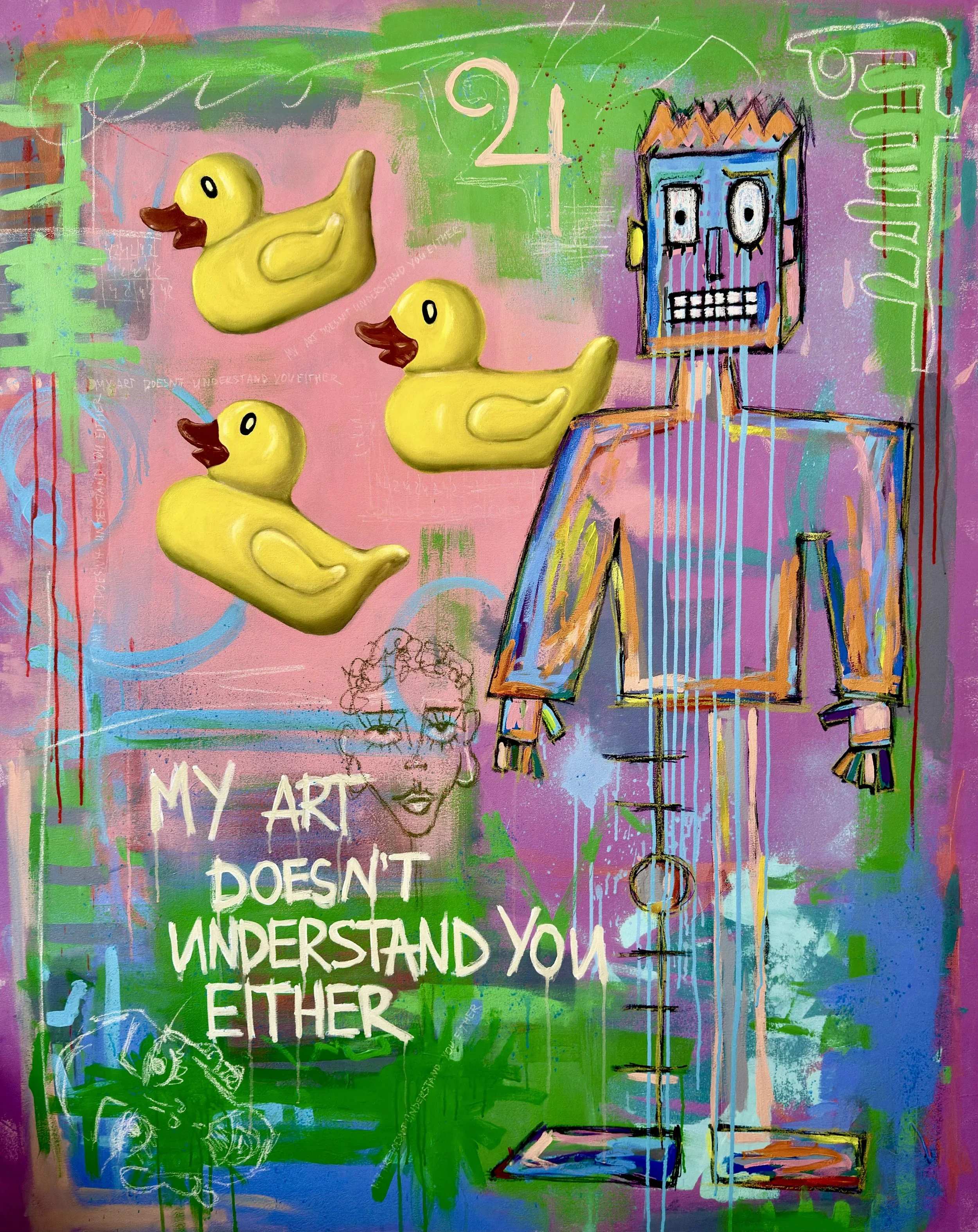
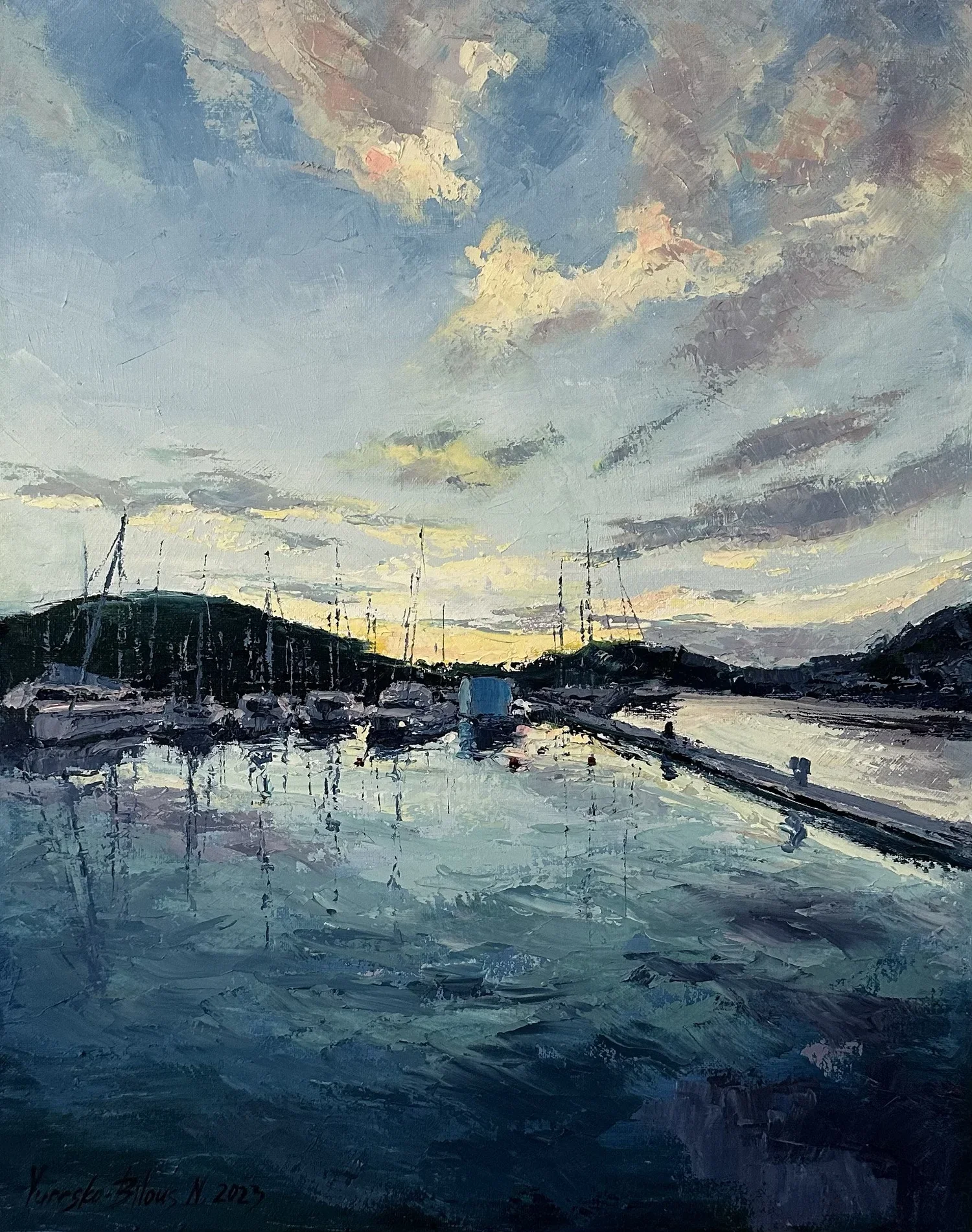



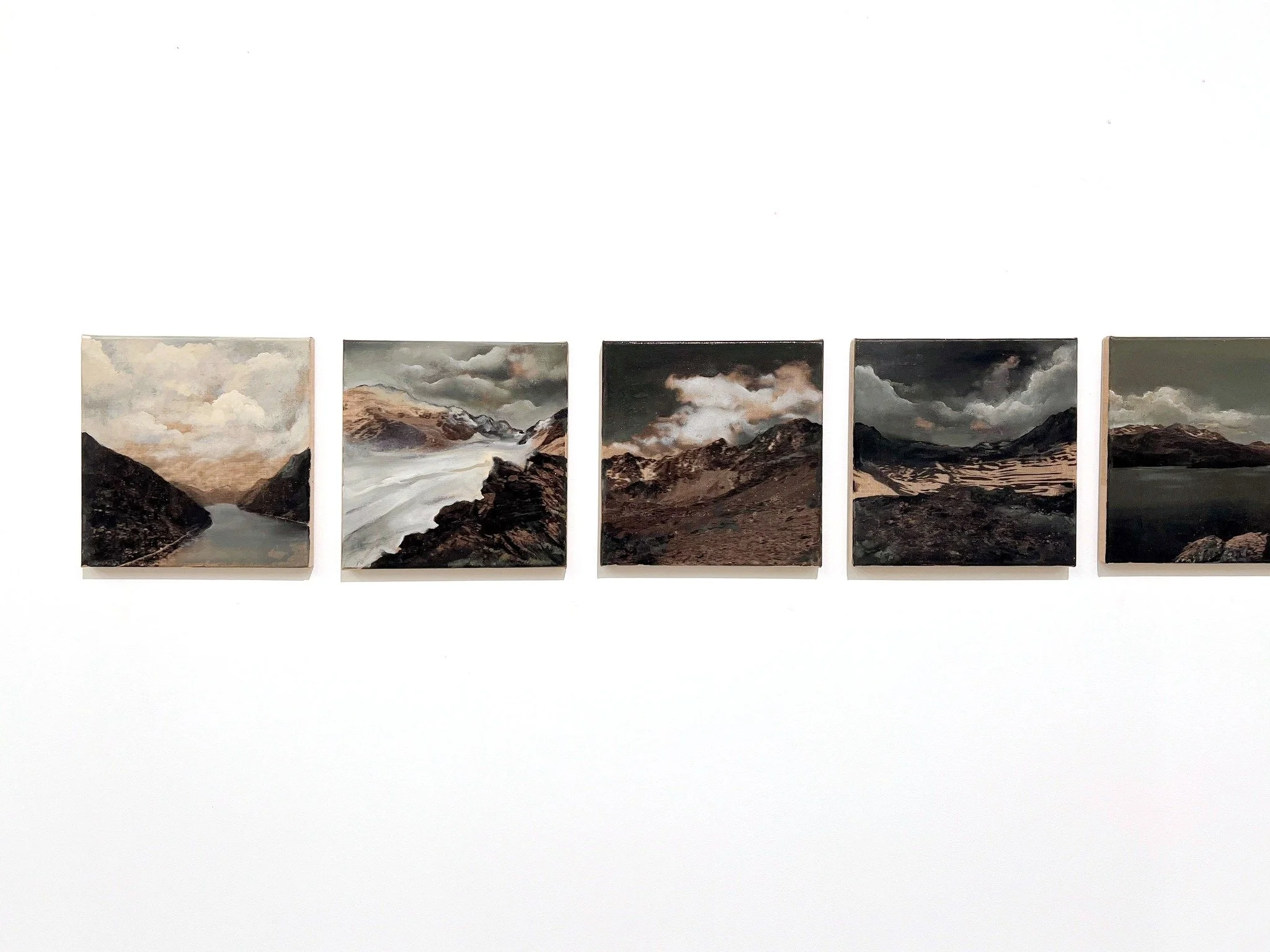
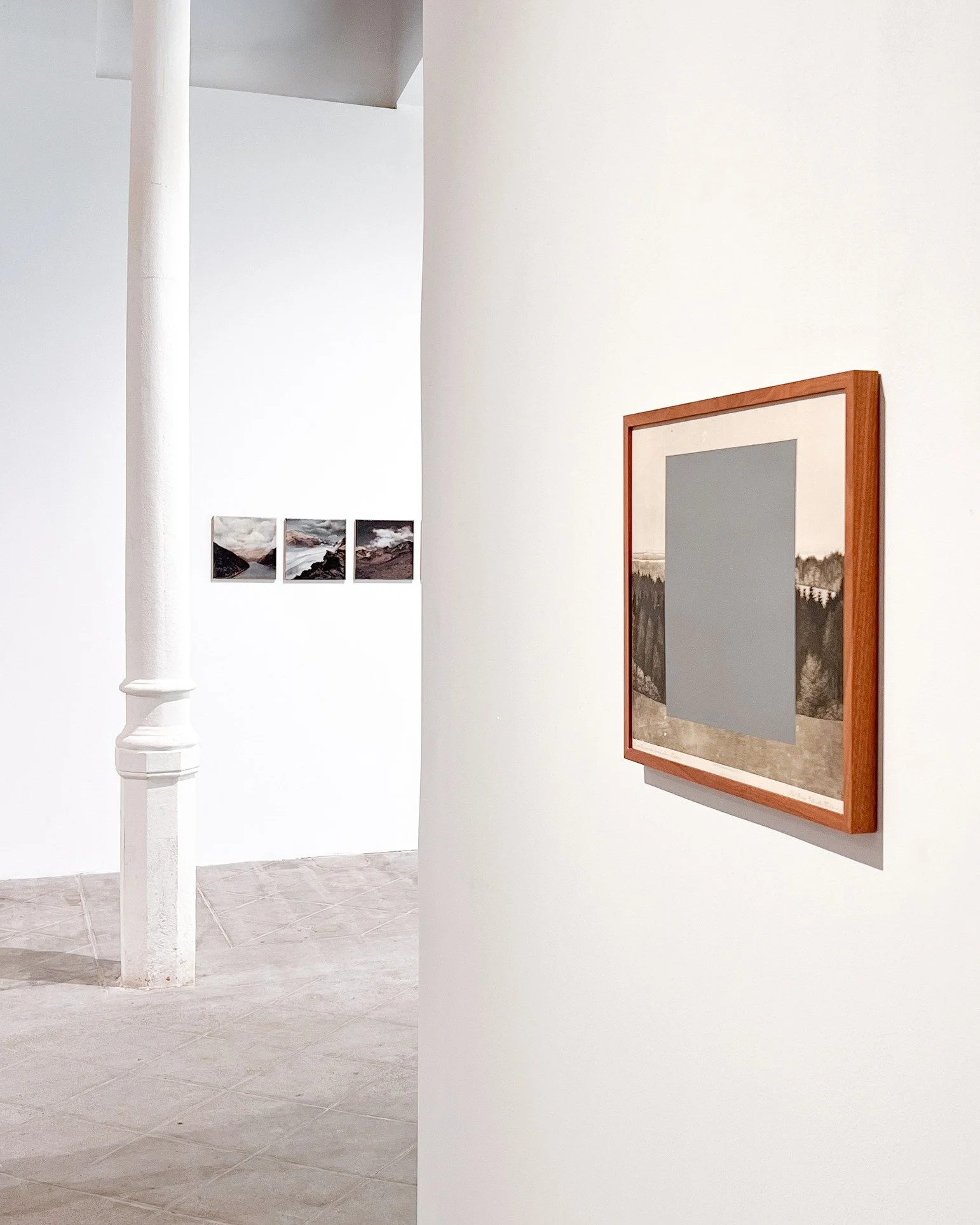
Nataraj von Allmen is a painter based in Switzerland. Often taking photographic material as a starting point, he weaves together landscapes, mythological archetypes, Christian symbolism, and contemporary socio-political themes into complex paintings. Oscillating between figuration and abstraction, his work investigates transformation, collective memory, and the human condition.