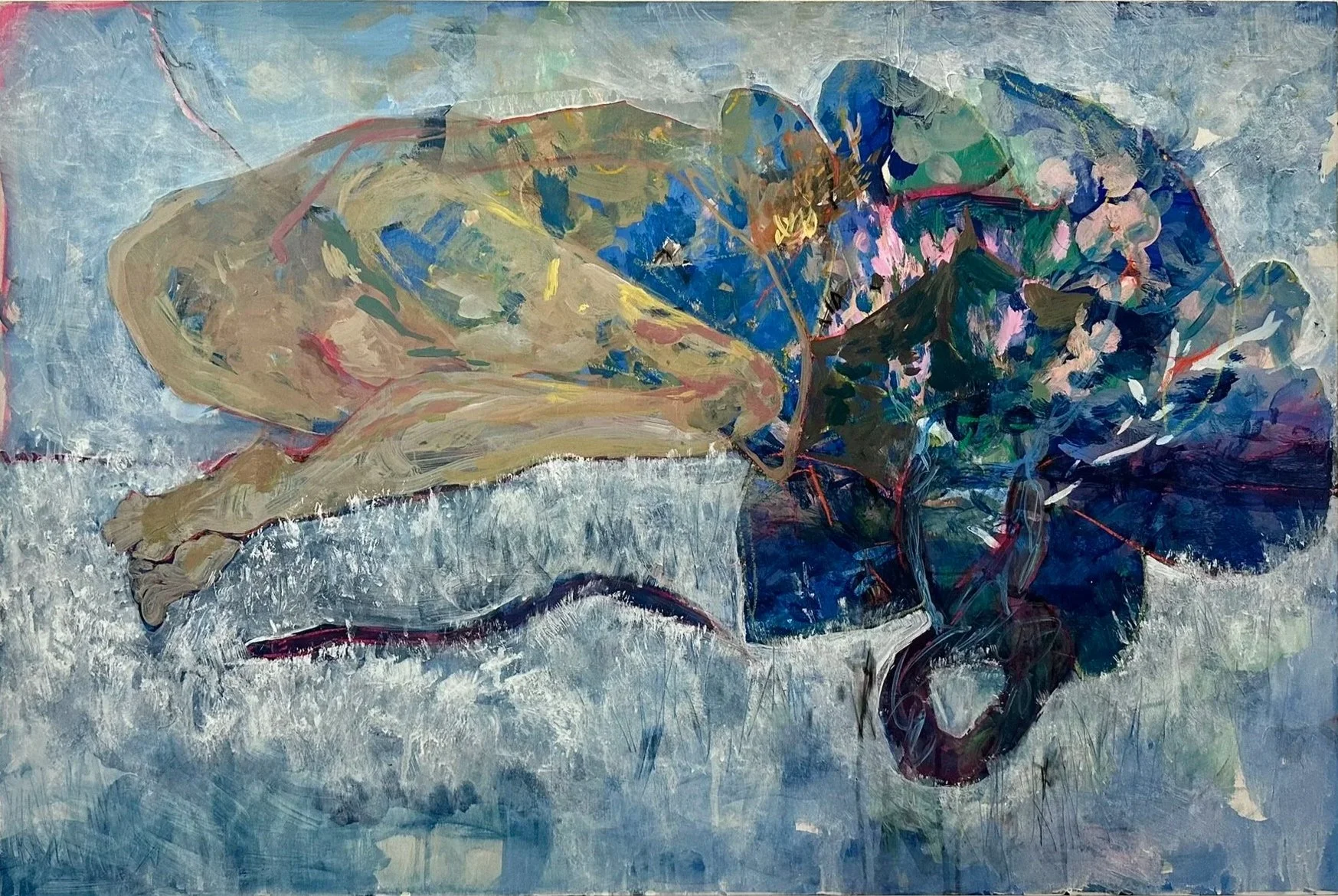
10 Questions with Mengqi Liu
Mengqi Liu (刘孟琦) is a multidisciplinary artist based in California, working across painting, printmaking, collage, and sculptural accumulation. Her practice investigates the invisible structures that shape human experience, the boundaries between self and society, the transformation of memory, and the shifting authority of symbols across contexts. She builds layered visual environments where fragmented meaning is not resolved but inhabited.
Liu holds a BFA in Illustration from the Rhode Island School of Design and an MA in Printmaking from the Royal College of Art, London. Her education grounded her in both rigorous conceptual research and hands-on material practice, forming the dual sensibility that defines her work.
Her exhibitions span three continents. Most recently, her work was presented at the Italian Pavilion of the Shanghai Expo Center as part of "自如 / Free Flow" (2025), and at BaseArt Art Fair in Bensberg, Germany (2026). Earlier exhibitions include graduate shows at the Royal College of Art and RISD, as well as group presentations at Gilston Gallery in London and AS220 in Providence, Rhode Island.
Fluent in both English and Mandarin, Liu moves fluidly between cultural contexts, an agility that is as present in her life as it is in her art. Alongside her studio practice, she works in international business development, coordinating cross-cultural operations across the US, China, and Malaysia. This dual existence, between the contemplative and the commercial, the personal and the global, quietly informs the tensions her work explores.
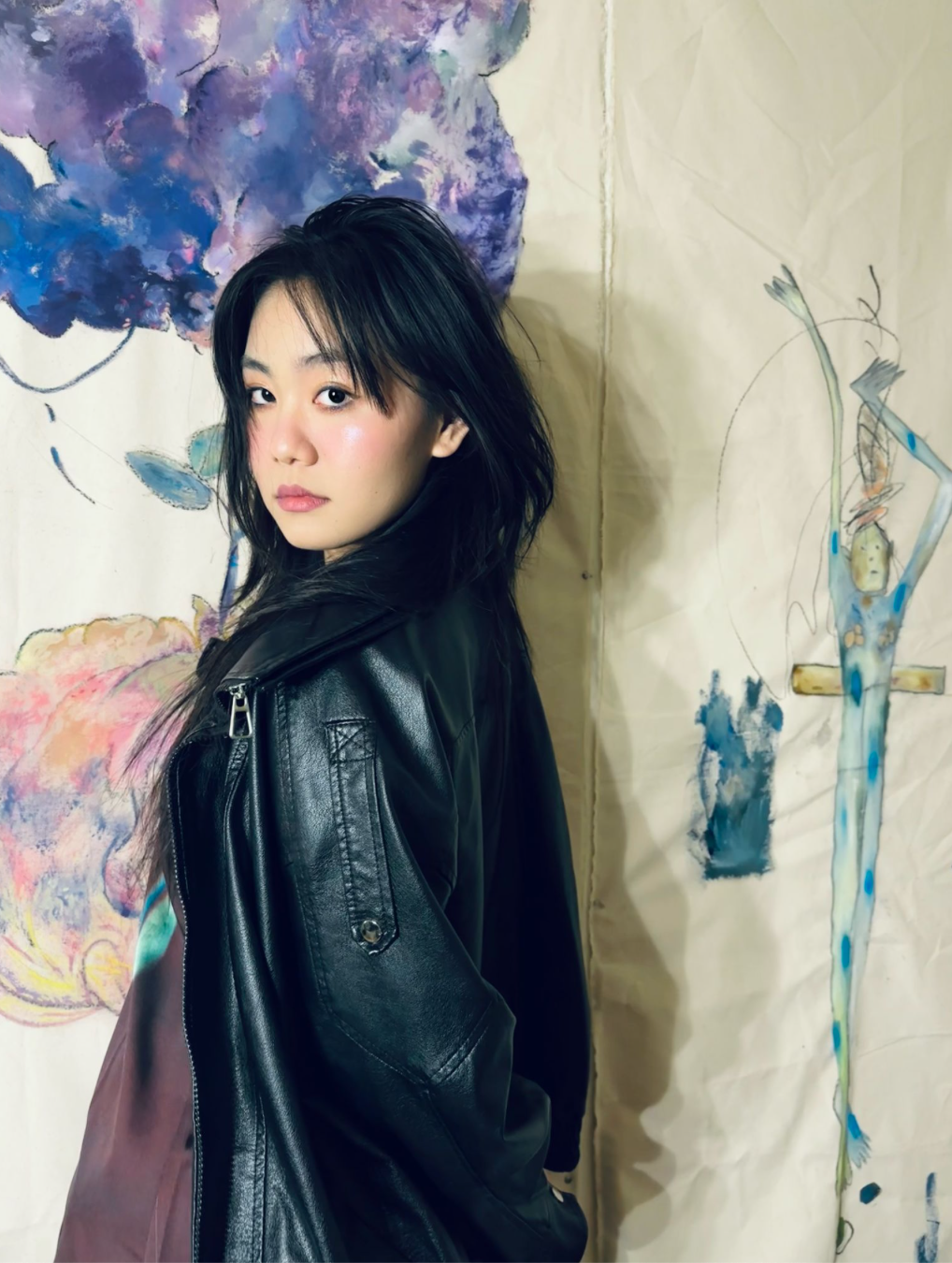
Mengqi Liu - Portrait
ARTIST STATEMENT
Mengqi Liu (刘孟琦) is a multidisciplinary artist. Her practice navigates the invisible architectures that shape the human experience. Working across painting, prints, collage, installations and short films, she constructs layered visual situations where unresolved, fragmented meanings inhabit and describe the thresholds between self and society, memory and present awareness, belief and interpretation.
At the core of her research lies the concept of boundary, and she has come to understand that boundaries exist everywhere a person turns: in the unspoken principles between two people who love each other; in the social codes embedded in the facades of buildings; in the strange distance between a person’s twenty years old self and their self that have since become, a distance that sentimentalizes either like a wound or like a doorway through which something necessary finally passed.
She has always collected things. Photographs, recorded observations, fragments of ordinary days treated with the seriousness of someone who suspects nothing is truly ordinary, and from these she builds her understanding of memory, not as a vault where the past is kept intact, but as a process of continuous rewriting, each revisitation changing the original meaning like water slowly alters stone, until what remains is not exactly what happened but something more honest, shaped by every moment that came after.
From these unconscious investigations emerges what she calls transcribed meanings. These negative spaces in life carry symbols as they acquire new weight through travelling across contexts through the ego and desire of each interpreter along the way, through the process of clarifying and distorting. In these gaps between intended and received meaning, Liu locates some of her urgent questions about a sense of belonging, power, and faith.
Cleansing also functions in Liu's practice as both a personal ritual and a philosophical position. Repeated acts of clearing, erasing, simplifying, and emptying physical and emotional space are her habitual gestures. These gestures of renewal paradoxically contain the acts of creation. Cleansing a canvas is not to destroy but to prepare. Liu thinks destruction and creation are inseparable yin and yang: the same act that removes also inaugurates, just as empowerment comes through de-powering, a sense of lightness arrives after destructive release.
Subtle religious connotations weave through her work without didacticism. Drawing from both Buddhist, Taoist and Christian frameworks, cycles of forgiveness, impermanence, and rebirth act as the educational backbone of her research. Liu does not illustrate doctrines; she just resonates with the underlying human desires these traditions describe: the desire to be forgiven, to shed what no longer serves, to stand at the beginning of something again.
Formally, her work moves freely across mediums, drawn by curiosity toward whatever form best describes the idea in her mind. She uses film-like images to distil the charged instants of lived experience; sculptural accumulations and material weight to describe the passage of time; collage to hold contradictory histories in productive tension; and colour to operate as emotional and spiritual precision. Across these surfaces and forms, she constructs environments in which the viewer is directed toward the experience of sitting with structured and meticulous, puzzling ambiguity, as an entrance to a possible new stage of acceptance.

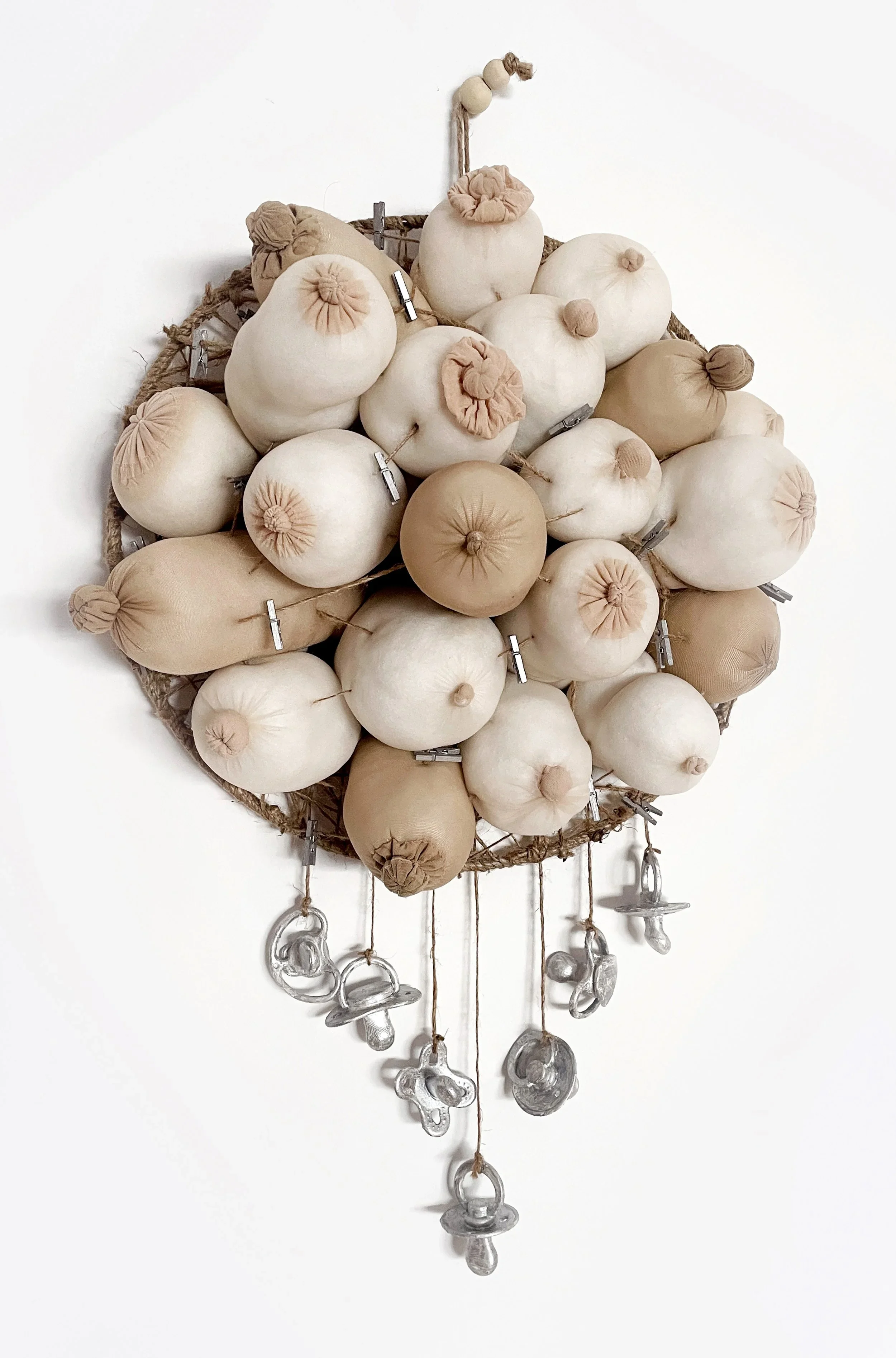
Let Her Grow, Ink on Paper, Sculptural Collage, 3 x 2 m, 2023 © Mengqi Liu
INTERVIEW
First of all, can you tell us about your background and how studying at the Rhode Island School of Design and the Royal College of Art shaped your artistic practice?
My name is Mengqi Liu (刘孟琦). I am a Chinese artist based in Los Angeles. I came to the United States at age 14 from Shenzhen, a city grand in its vitality and sense of expansion, where humidity lived as a breathing organism, and thunderstorms broke against sudden sunshines. I then lived in California, under the wide, dry blue skies and a silence that echoed in an agitated vacuum. I studied Illustration at RISD and Printmaking at the Royal College of Art. Rhode Island's damp air returned to me something I hadn't known I was carrying as an absence. Foreignness and familiarity folded into one another; through this, my professional practice began. London was cooler and more precise and grey, providing a sense of detachment. Moving between these atmospheres taught me to feel duality as sensation before I understood it as a concept: wetness and dryness, yin and yang, intimacy and distance, the known and the perpetually foreign. My practice grows parallel to these shifts, through adaptations. I weave narrative fragments, experience and experiment with the touches of various media, and construct symbolic structures to trace how meanings transform and carry through.

Above The Floating Sky, Etching on Patterned Paper, 6.5 x 4 in, 2023 © Mengqi Liu
You work across painting, printmaking, collage, and sculptural forms. How do you decide which medium best expresses a particular idea?
To me, each medium carries a different sensation and storytelling method within it. Printmaking elongates the spacetime of any inscribed meaning. Through the process of carvings and erosions, a sense of history and quiet surrender is imprinted into the images produced. Painting brings an immediate intimacy from the painter and their work. Collage compresses incompatible histories together, allowing various meanings to breathe and speak in united answers. 3D sculpture inhabits a space, and through this process, invites its audience to inhabit it with it. The choice is never intellectual. It arrives with a solid feeling that one material is honest enough to hold the answers I want to present. The artistic output and the medium attract each other. In this process, I follow their flow.
Your work often explores the boundaries between the self and society. What first drew you to this theme?
I grew up immersed in a sense of shift, moving through different countries, languages, and versions of myself. The questions accumulated in these displacements condense into a quiet worship of shifts: in societal structures, in the architectures of belief, in what one holds sacred and what one holds values in the secular. The things absorbed so early, we mistake them for our own nature. I believe every person carries a private universe. And yet the world works ceaselessly to press that universe into a recognisable shape. My work lives in the pressure between this interior wildness and the structures that seek to contain it. I am not interested in resolution. I am interested in the force of the pressure itself, the way it marks us, shapes us, and occasionally, breaks open.
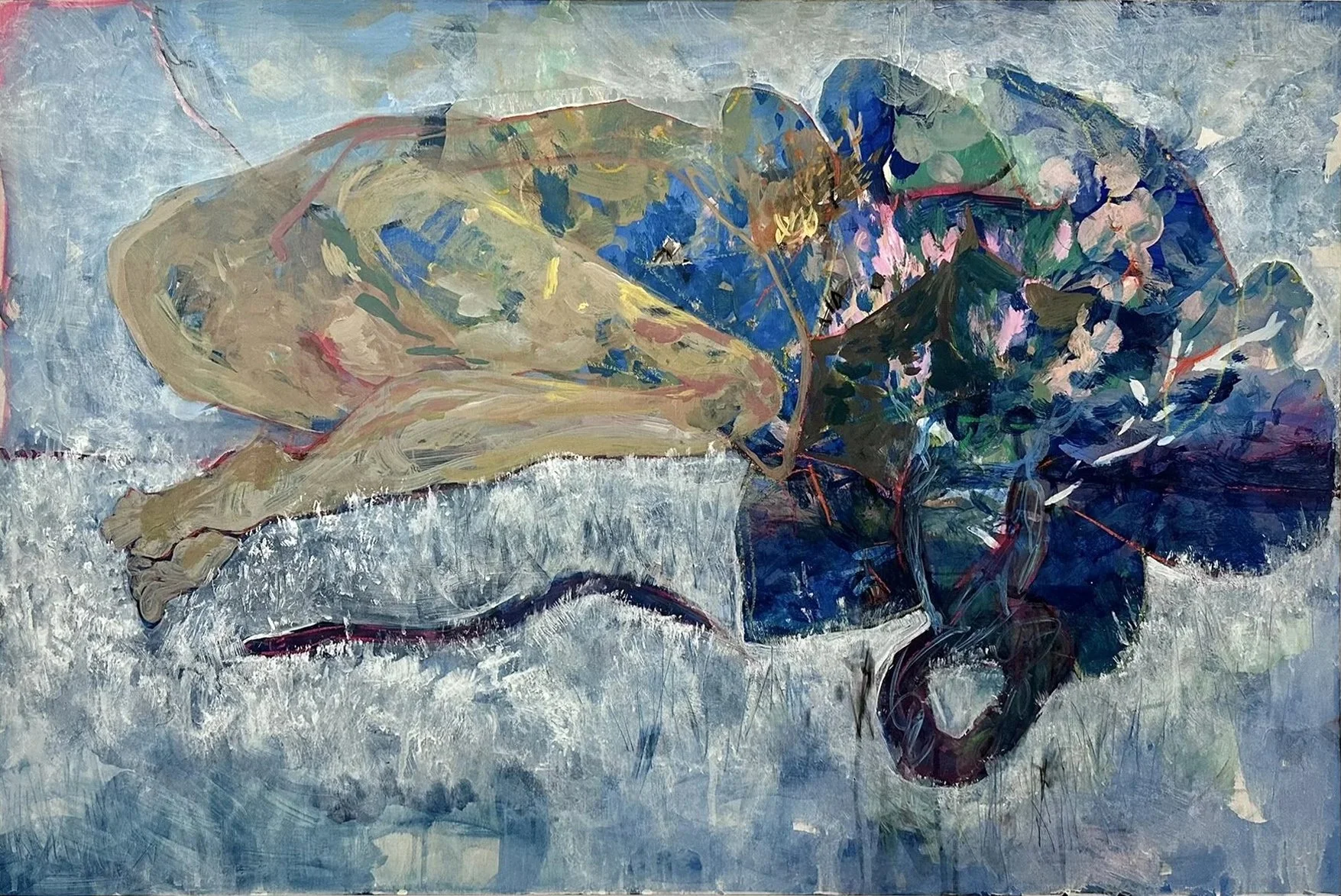
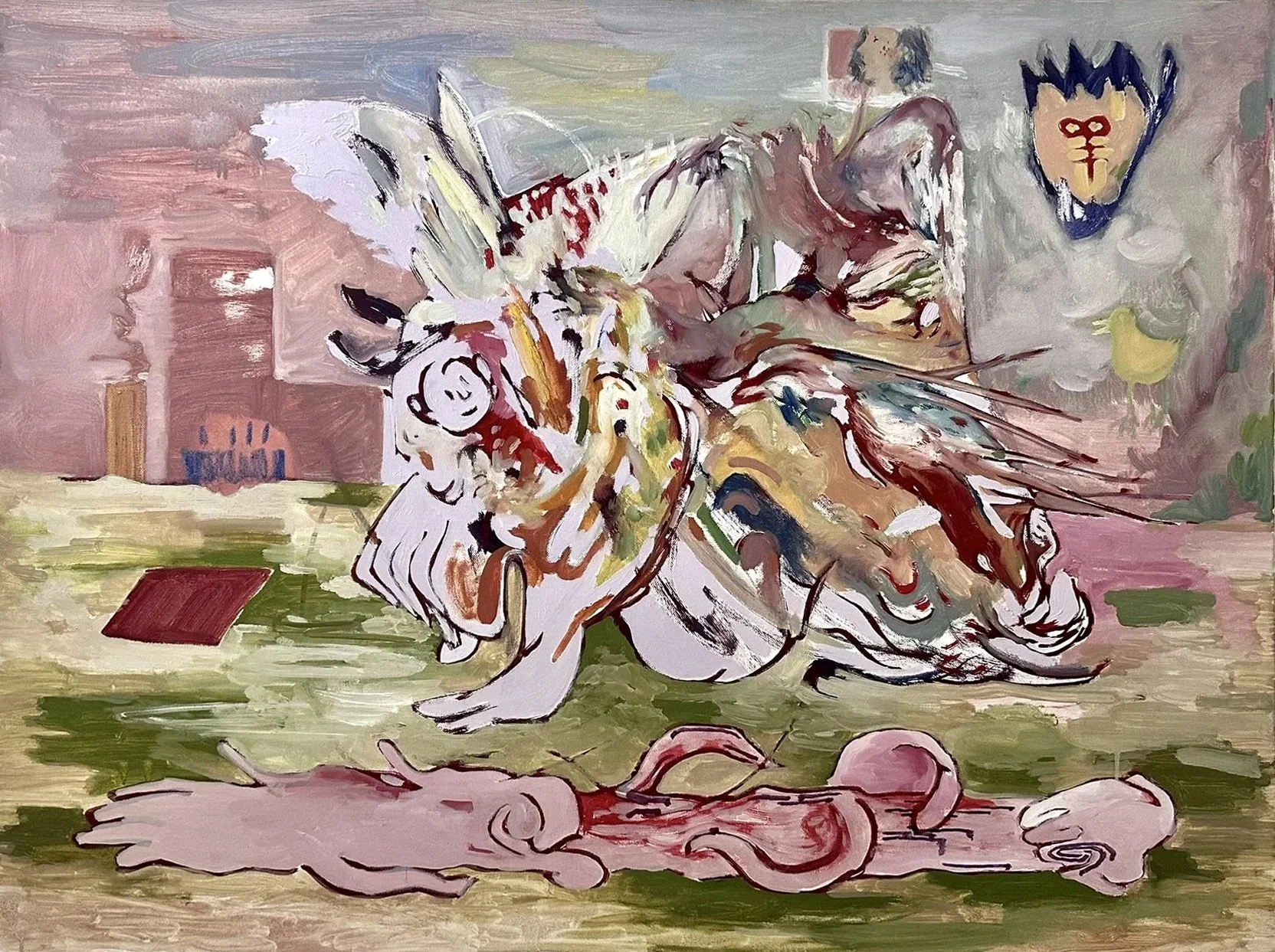
Crispy Fur, Oil on Wooden Panel, 24 x 36 in, 2025 © Mengqi Liu
For Whom the Trading Offers, oil on canvas, 30 x 40 in, 2025 © Mengqi Liu
Memory appears as an important element in your practice. How do personal memories and collected fragments influence your artworks?
I experience memory as two overlapping systems in constant, unresolved dialogue. The first is slow and deep: like a secondary consciousness, rooted in religious, cultural, and spiritual sediment, drawing from the vast and largely unknowable sea of the unconscious. The second is immediate and cinematic: creating a dense forest of edited impressions, daily encounters, and textures that accumulate and entangle in real time, without questions or permissions. Together they form a collective dictionary and explanatory system, layered with symbolism, animated by a pulse I follow more than directly. Memory filters through this system and emerges in my works with honest transformations.
Can you describe your creative process when developing a new project or series?
My art-making process is ritualistic. I believe artworks are physical manifestations of transcended ideas, and my body is an instrument used to receive and transmit them.
In the initial phase of my artistic creation, I establish an intentional framework for my product, such as spatial orientation, compositional direction, and the temporal conditions. I select the symbols to describe this construct, normally from my personal sketches or from related images. Then, through meditation and deliberate behavioural calibration, I regulate my cognitive and sensory states. This brings my bodily perceptions to the frequency the work requires, whether it be neutral, sacred, nostalgic, or something that resists naming entirely.
During my artistic production, I maintain heightened sensory awareness, monitoring my environment closely and translating it directly into visual decisions. The more accurately I can attune to the specific vibration of a given moment, the more precisely I can transform it into my works.
In the final phase, I evaluate what has been made through multiple frameworks simultaneously, as its maker, as a stranger, and as a student who is constantly learning.
I believe a resolved work must function as an open system. It shall be internally unified yet expansive, and it should generate for its viewer an encounter with dimensions beyond what they already know.
You often combine different materials and visual languages. What interests you about building layered or fragmented visual environments?
Fragmentation, as a sense of visual presentation, arrives naturally alongside the sense of honesty that serves as the foundation of my works. Truth, in my experience, never arrives as a single transparent statement. It accumulates in layers and expresses itself through intersecting images and ideas. A layered visual environment recreates this process honestly, as obscured meanings and symbols accumulate through velocities and a complicated form of unity. The truth then transforms as my audiences excavate it. This encounter reveals the human tendency to find answers, then propels unexpected and magical explanations shaped by each individual’s private universe, adding beautiful layers and completions to this map as a whole.
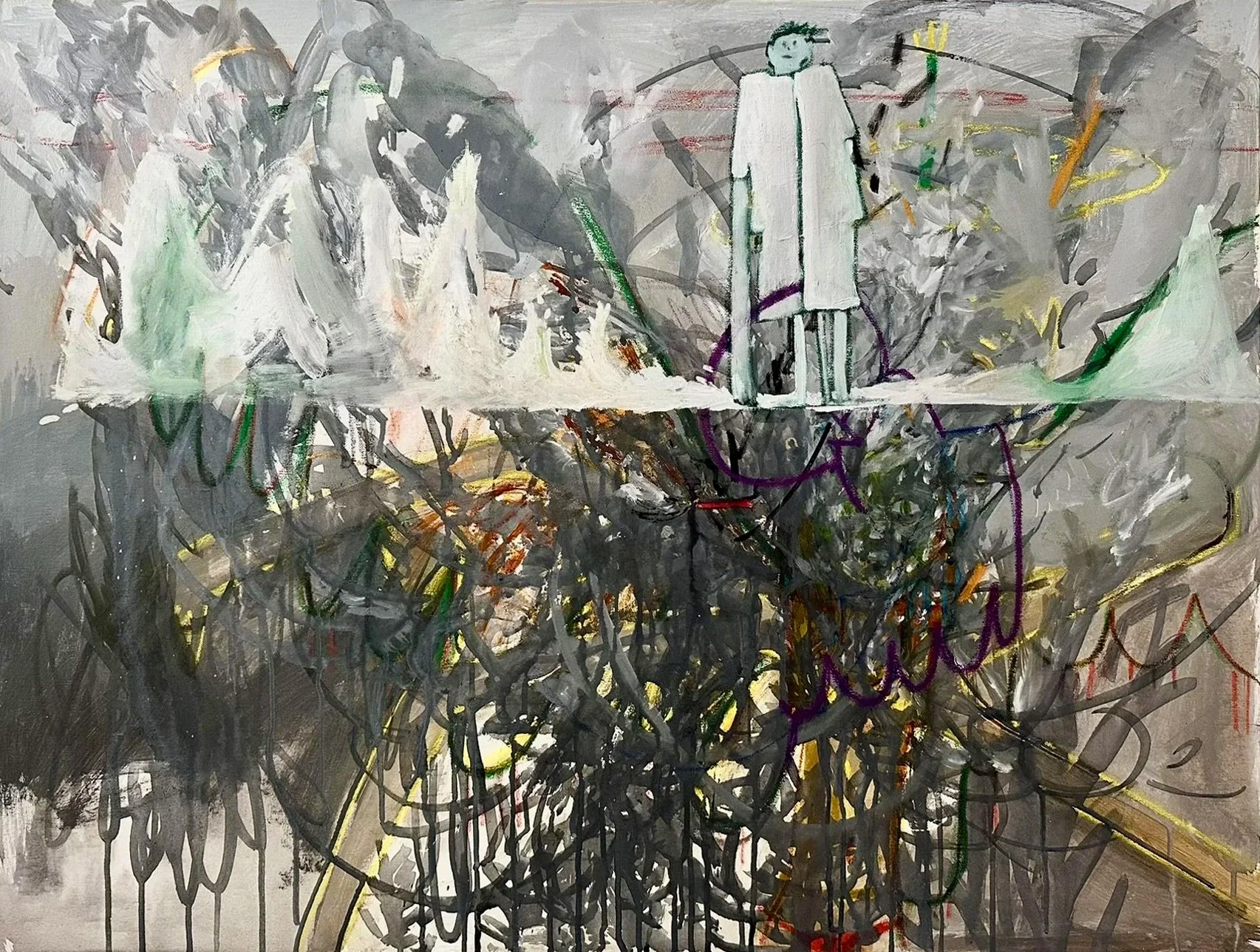
Immerse Emmerse Immerse, oil on canvas, 30 x 40 in, 2025 © Mengqi Liu
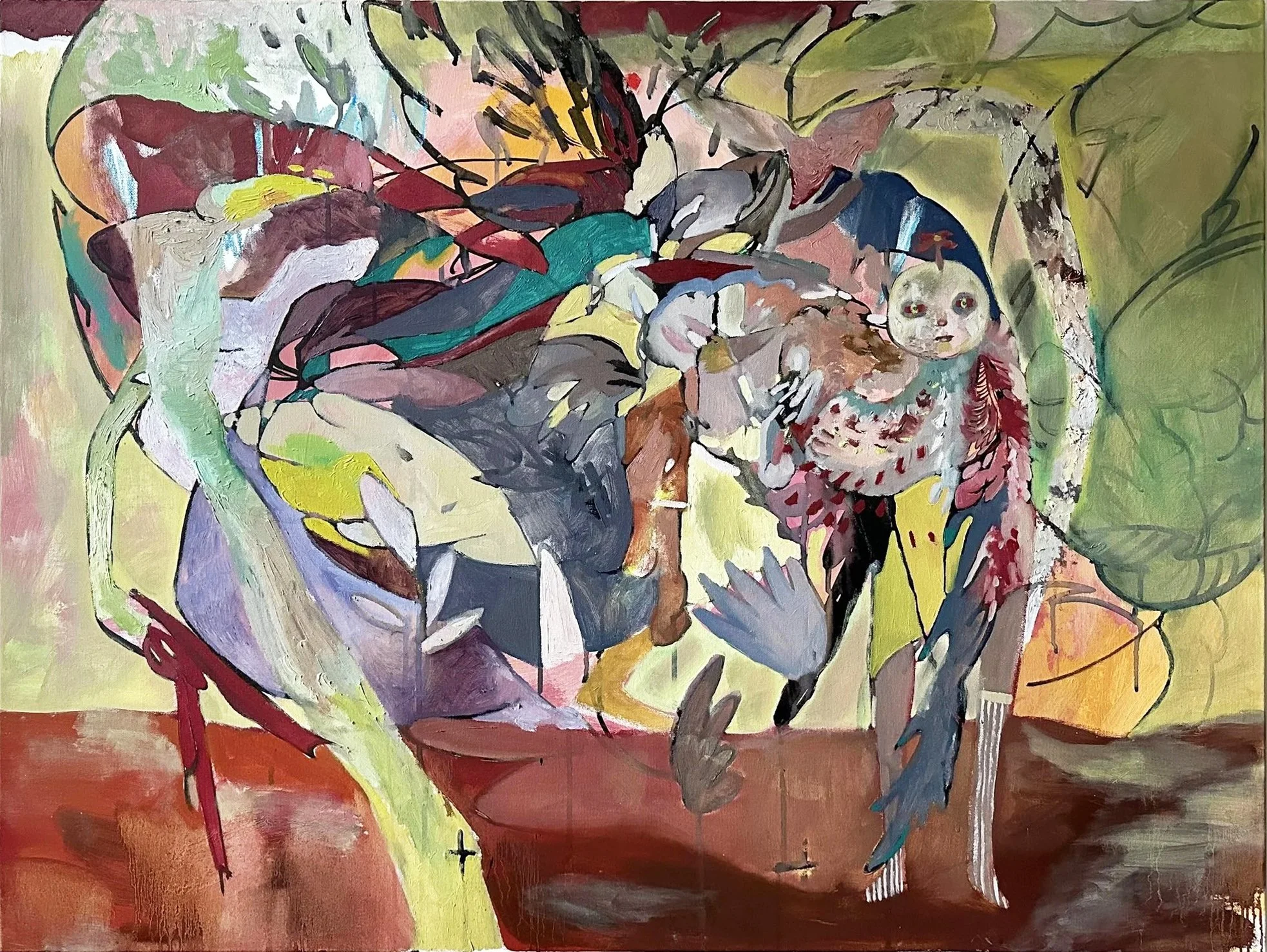
Thirty Three Trees, oil on canvas, 30 x 40 in, 2025 © Mengqi Liu
Subtle references to spiritual traditions appear in your work. How do these philosophical ideas shape your thinking as an artist?
Spirituality builds into my work in terms of method and ethics. Three things came through spiritual practice that I couldn't find elsewhere: 1.) a sense of sacredness while treating the act of art production, the understanding that the act of making asks for full and undivided presence; 2.) a sense of overflowing precision. like the way Buddhist sutras achieve their vastness through exactitude: every word and formal structure converging toward a unified purpose, one that could be interpreted through reading or chanting and through other formats ; 3.) a sense of responsibility: towards the artwork itself’s internal wholeness as well as how it transmits to whoever enters its universe
How do audiences usually respond to the ambiguity and open interpretation present in your work?
They ask questions or form personal understandings through the general energy a work emits. My audiences tend to speculate about what they need rather than what is strictly presented. In their eyes, twisted shape becomes a specific memory, an undefined space becomes a felt time. Ambiguous meanings face constant reconstruction in the audience's mind. I appreciate this process, whether it arrives gently or aggressively, curiously or with total self-assurance. To me, reinterpretation is evidence that a work breathes on this ground. It completes the journey of an art piece into this universe.

Sketchbook Piece#12, Ink on Paper A5, 2022 © Mengqi Liu
Your life moves between different cultural and professional contexts. How does this experience influence the themes you explore in your art?
This experience creates a constant act of translation, of values and forms of communication. It makes me sensitive to the invisible and directs my interests toward the social grammar of places, the structures of various systems, etc. This sensitivity moves directly into my work: I am attracted to the invisible architectures that shape human experience as well as the situations that subtly reflect them. This attention brings themes regarding the invisible architectures that shape the human experiences into my vicinity and land as my abstract concerns.
Lastly, what projects or directions are you currently developing for the future?
In the fine art area, I am trying to unify my existing and future works into one interconnected universe, a living system where existing symbolisms and figures exist together across time and medium. I am also developing a pet urn project, a business project that echoes my philosophy in internalising a sense of perpetual loss. I am designing the urns as objects meant to be hugged. I believe catharsis lives inside that gesture, in the intimacy of holding what cannot be held.
Artist’s Talk
Al-Tiba9 Interviews is a promotional platform for artists to articulate their vision and engage them with our diverse readership through a published art dialogue. The artists are interviewed by Mohamed Benhadj, the founder & curator of Al-Tiba9, to highlight their artistic careers and introduce them to the international contemporary art scene across our vast network of museums, galleries, art professionals, art dealers, collectors, and art lovers across the globe.


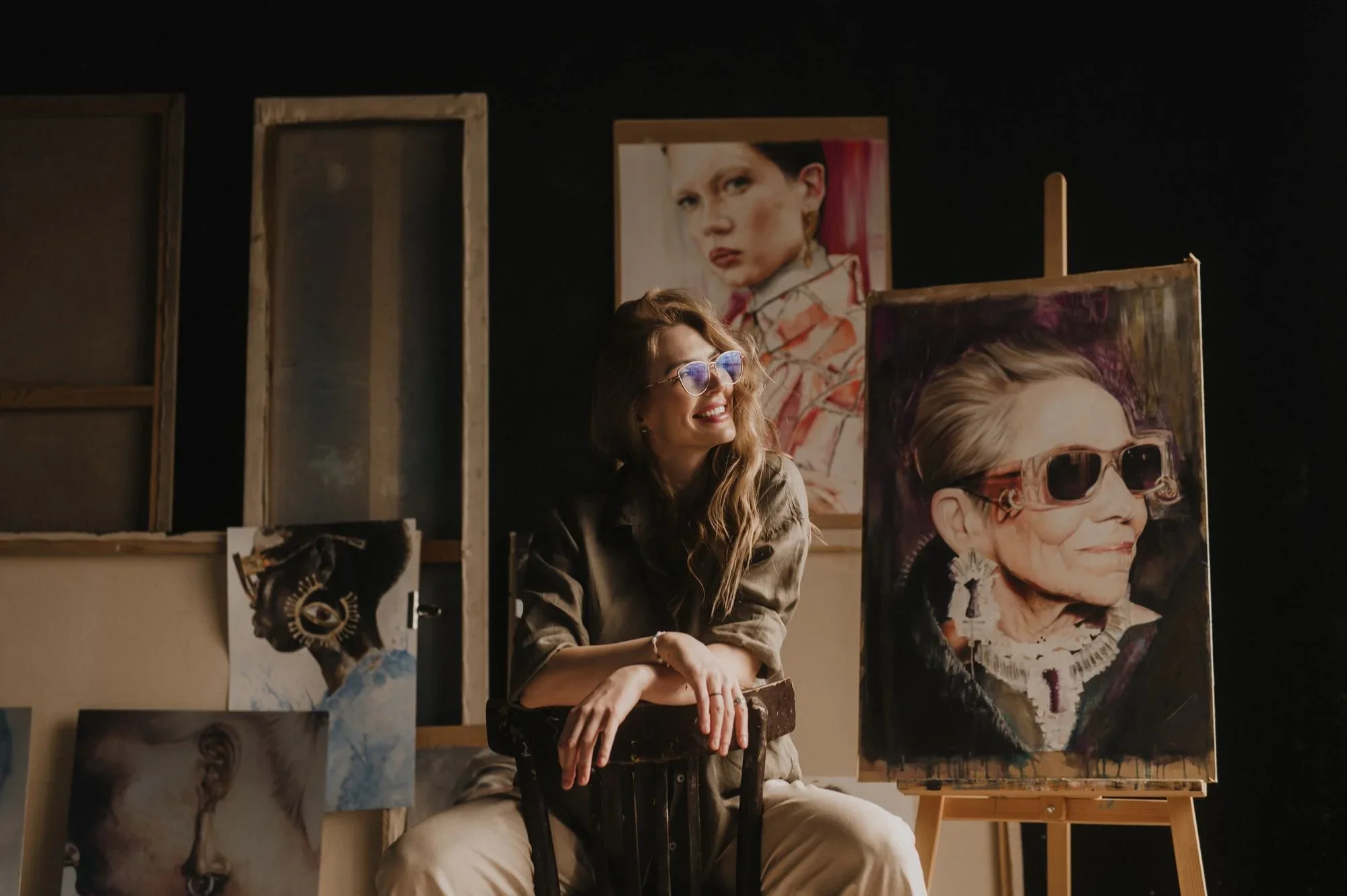

Brooklyn-Born Allan Gorman is a contemporary fine artist based in Jersey City, NJ, with a unique artistic vision cultivated by a distinguished commercial career that helped refine a sense of aesthetics and unwavering commitment to excellence that continues to define his artistic process to this day. His latest series of paintings is titled Imaginary Spaces.