

10 Questions with Julia Katolla
Julia Katolla is a mixed media artist, raised in Costa Rica and based in Bonn, Germany. She has worked illustrating for Kopfsalat magazine (2009–2011, Germany) and organising art projects as well as pursuing independent photographic work in Mexico (2011-2014).
She received artistic training at the University of Bonn (2015–2017), followed by fine art studies at the Arte Fact Academy in Bonn, Germany (2019–2021).
Katolla’s work has been featured in international publications, including SuboartMagazine, The Four Faced Liar, and Her Voices, as well as in exhibitions at venues such as Haze Gallery in Berlin, Brotfabrik and Fabrik 45 in Bonn, as well as The Holy Art Gallery and the London Art Biennale in London, UK, where she received the International Confederation of Art Critics Award. Her first solo exhibition, “Phantomschmerz” (Phantom Pain), opened in 2023 during the annual gallery and museum night in Bielefeld, Germany.

Julia Katolla - Portrait
ARTIST STATEMENT
“The question on the origins, the interconnections and the (sur)real madness of life, developed over time into the focus of my artistic practice. Moving between scientific illustration and psychedelic vision, I map psychological, social, and bodily processes as living tissues that split, scar and transform. My work searches for the beauty of life’s microscopic details and wondrous figments while uncovering its delicate vulnerability within the forces that shape our sociopolitical world.
It explores motherhood beyond idealisation, systemic aggression and the human urge to impose order on chaos.
By mixing different media with a slight obsession for intricate details, I turn the inside outward, meticulously dissecting emotions, violence, and ambivalence as fragile, pulsating systems. I create small universes where randomness and precision intertwine.”
— Julia Katolla
Collateral Damage - II, Mixed media on paper, 20 x 20 cm, 2024 © Julia Katolla
INTERVIEW
First off, can you tell us about your background and how growing up in Costa Rica and later moving to Germany influenced your artistic path?
I grew up in Costa Rica, where nature isn’t curated. It creeps, it grows, there are tangled roots and humming ecosystems. Moving to Germany meant that structure, precision, and a legacy of conceptual art became part of the tapestry. Probably the most prominent way in which this mixture of cultures manifests in my work is the tension between organic chaos and systemic precision. Not as a harsh contrast but as two merging forces. In my artistic process, I get lost in the play between letting the materials run wild and then wrestling them into shape and form, while keeping the organic nature of the painting’s origin visible underneath. Maybe Costa Rica taught me to trust organic emergence, and Germany taught me to respect frameworks.
You have worked with illustration, photography, ceramics, and painting. How did mixed media become central to your practice?
I like to think about my work as anatomical studies of inner states of being, both individual and collective. Life often feels layered, interrupted, and stitched together from incompatible moments. At the same time, the human mind is remarkably good at smoothing these fragments into something that feels like a coherent whole.
Yet these fragments never exist on their own. Experiences connect to memories, emotions, and broader social and political realities. My practice reflects this web of relations by moving between different media and building connections between them, mirroring the psyche’s attempt to create meaning from sensory chaos.
It’s also just really engaging to find new materials to merge into a piece. I recently discovered hand embroidery as another form of layering.
But lines, layers, montage, and embroidery are not simply decorative elements. They function as diagnostic tools that help me trace relationships between fragments and construct a layered understanding of the state I want to convey.

Collateral Damage - VI, mixed media on canvas, 140 x 105 cm, 2025 © Julia Katolla
Your work explores the origins and interconnections of life. When did these questions first become important for you?
The lens through which I’ve always seen the world is interconnectedness. Everything is linked: biologically, emotionally, socially. I consider acknowledging the complexity of a matter and the interconnection of everything as not only biologically important but also socio-politically. You should never “observe” a sociopolitical matter in a vacuum, without considering context, history, interconnections, and without trying to dissect all the layers that compose a matter in its complexity. Motherhood made the urge to explore life’s origins and these interconnections more visceral and unavoidable. Suddenly, creation, division, care, fear, responsibility, and a whole new system all lived in the same body. That’s hard to ignore.
You often focus on small, microscopic details. What draws you to these intimate scales of observation?
The textures of living matter have long fascinated me: plant surfaces, microscopic organisms, the architecture of the human body and the intricate structures that compose life itself. My interest is less about understanding the mechanics and more about admiring the staggering complexity. Somewhere along the way, I also developed a rather persistent obsession with tiny details. A cell dividing, a nerve firing, a tiny rupture in tissue, these moments contain entire universes. Zooming in feels more intimate and honest to me than grand gestures. Even if I zoom out and depict a human figure, I ultimately don’t depict a person, but a state. It is a contemplation of the soul, using biological metaphors to expose psychological layers. In “Collateral Damage”, for example, the black-and-white palette and radiographic aesthetic strip the moment of all romance. It feels more like a biological dissection of a collective state of mind.
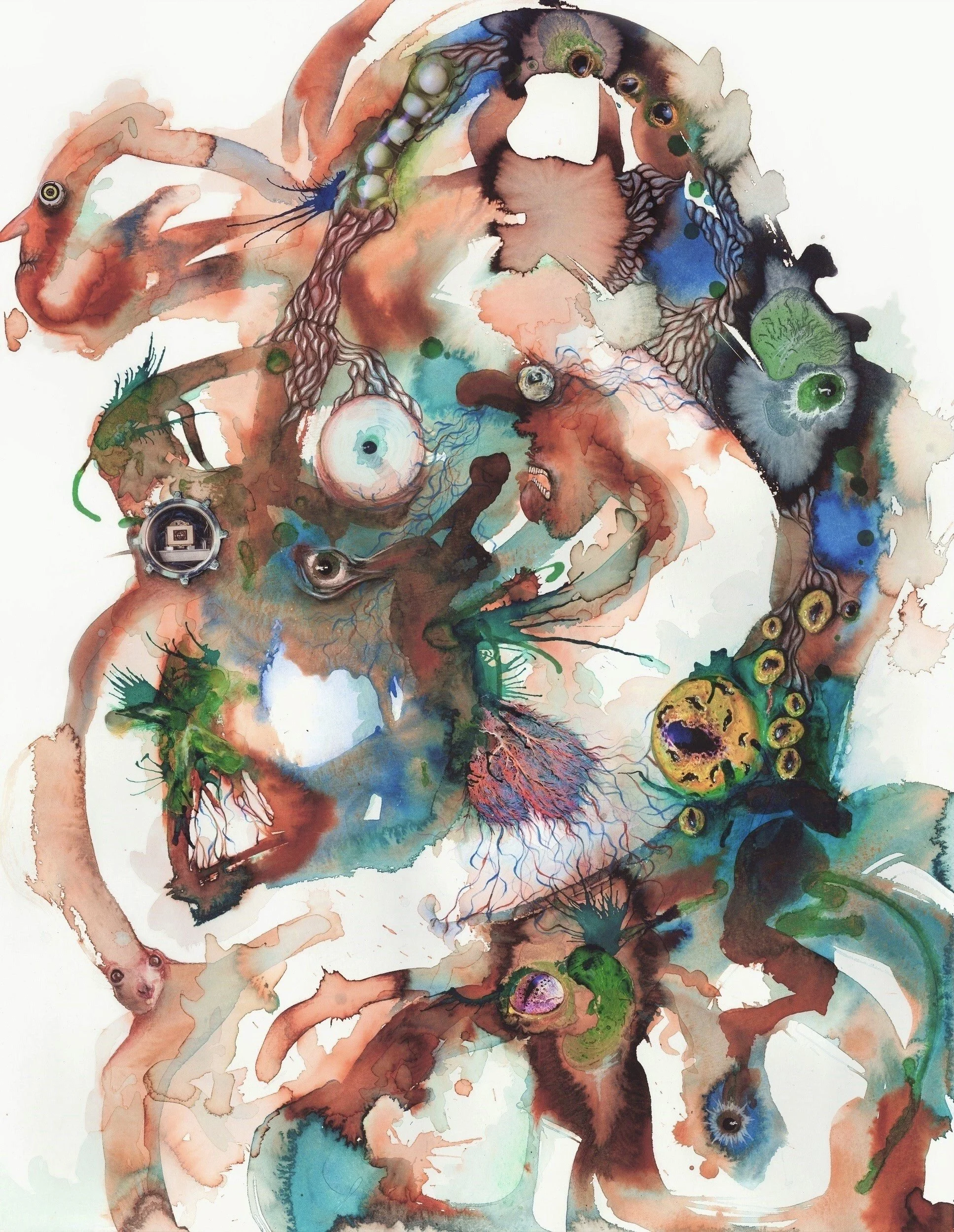
A Sense of Entitlement - I, Mixed media on paper, 65 x 50 cm, 2022 © Julia Katolla

A Sense of Entitlement - II, Mixed media on paper, 65 x 50 cm, 2022 © Julia Katolla
Ink and gouache play a key role in your work. What do these materials allow you to express that others might not?
On one hand, they allow me to initially relinquish control. The blank canvas first becomes a playground for the watered-down colours to spread and create patterns. These largely random patterns often dictate the outcome of the figurative portions of a piece. Almost as if my mind only needed to fill in the blanks to create a whole. On the other hand, I can build up traceable layers. Living organisms and consciousness are built up in layers. It creates depths that remind me of geological strata or layers of skin. What lies beneath remains visible, reinforcing the idea of some kind of psychogeography, where past experiences shimmer through the present surface.
Chance and unpredictability seem important in your process. How do you balance letting the materials “run wild” with control?
Most of the time, I start by letting things misbehave. Spilt ink, uncontrolled stains, accidental shapes. Then I step in like someone trying to make sense of a confusing situation. The balance comes from listening. Too much control kills the work, and too much chaos turns it into noise. A recurring thread in my work is the search for balance in a world that feels increasingly unhinged. My symmetries often are attempts to map “madness” and thereby render it manageable. Like in the series “White Noise”, for example, where intricate organic shapes convey the idea of distractions as a soothing blanket covering the noise of our world’s atrocities.
Your work embraces both beauty and discomfort. Why is it important for you to hold these opposites together?
I am not here to soothe and transmit beautiful décor. I don’t believe beauty exists without discomfort. Birth is beautiful, and it is violent. Care is loving, and it is exhausting. Societies are built on ideals and sustained by contradictions. Holding beauty and ugliness together is not a provocation; it’s a responsibility. Sanitised beauty lies.

Cohesion - I, Mixed media on paper, 20 x 20 cm, 2026 © Julia Katolla

Cohesion - II, Mixed media on paper, 20 x 20 cm, 2026 © Julia Katolla
In a digital world of perfect images, your work celebrates imperfection. What does imperfection mean to you as an artist?
Imperfection means life. It is evidence of presence. In our digital world, things are polished and glossed over to be made perfect, turning life into a flat, sterilised image instead of a lived experience. Perfection often masks erasure of process, struggle or context, thereby deeming mistakes, messiness, vulnerability and anything unfinished as unworthy. Imperfection refuses that. In imperfection, you see life negotiating itself in real time. By embracing imperfection, my work acknowledges that life is not seamless, that power is uneven, and that beauty and fragility coexist.
Your works often feel like small, self-contained worlds. How do you imagine viewers entering or exploring these universes?
I imagine viewers wandering rather than decoding. There’s no correct path. You can get lost, zoom in, pull back, or project your own internal maps onto mine. I often feel that I lure the viewer in from afar, with appealing lines and shapes, to then confront them with an anatomical view of our societal and personal abysses. Each viewer brings their own history and their own thresholds for discomfort and wonder. The work changes depending on who is looking. What’s much more interesting to me than what I process or convey with my work is to see how it resonates with others. If they can see themselves in some shape or form.

White Noise - I, Ink and pen on paper, 32 x 25 cm, 2023 © Julia Katolla
And lastly, what are you currently working on, and how do you see your practice evolving in the near future?
I am currently working on a large canvas piece exploring themes of love and the messiness of entanglements. My attachment to working on it varies heavily, though, which is why, on the side, I am working on a small series and pieces that have been lying around for ages, looking to be finished. In the future, I’d love to keep exploring my newfound fascination for textile interventions. I’d also like to expand on making more objects or trying to enter the world of installations that extend further than the frames of a canvas.
Artist’s Talk
Al-Tiba9 Interviews is a promotional platform for artists to articulate their vision and engage them with our diverse readership through a published art dialogue. The artists are interviewed by Mohamed Benhadj, the founder & curator of Al-Tiba9, to highlight their artistic careers and introduce them to the international contemporary art scene across our vast network of museums, galleries, art professionals, art dealers, collectors, and art lovers across the globe.



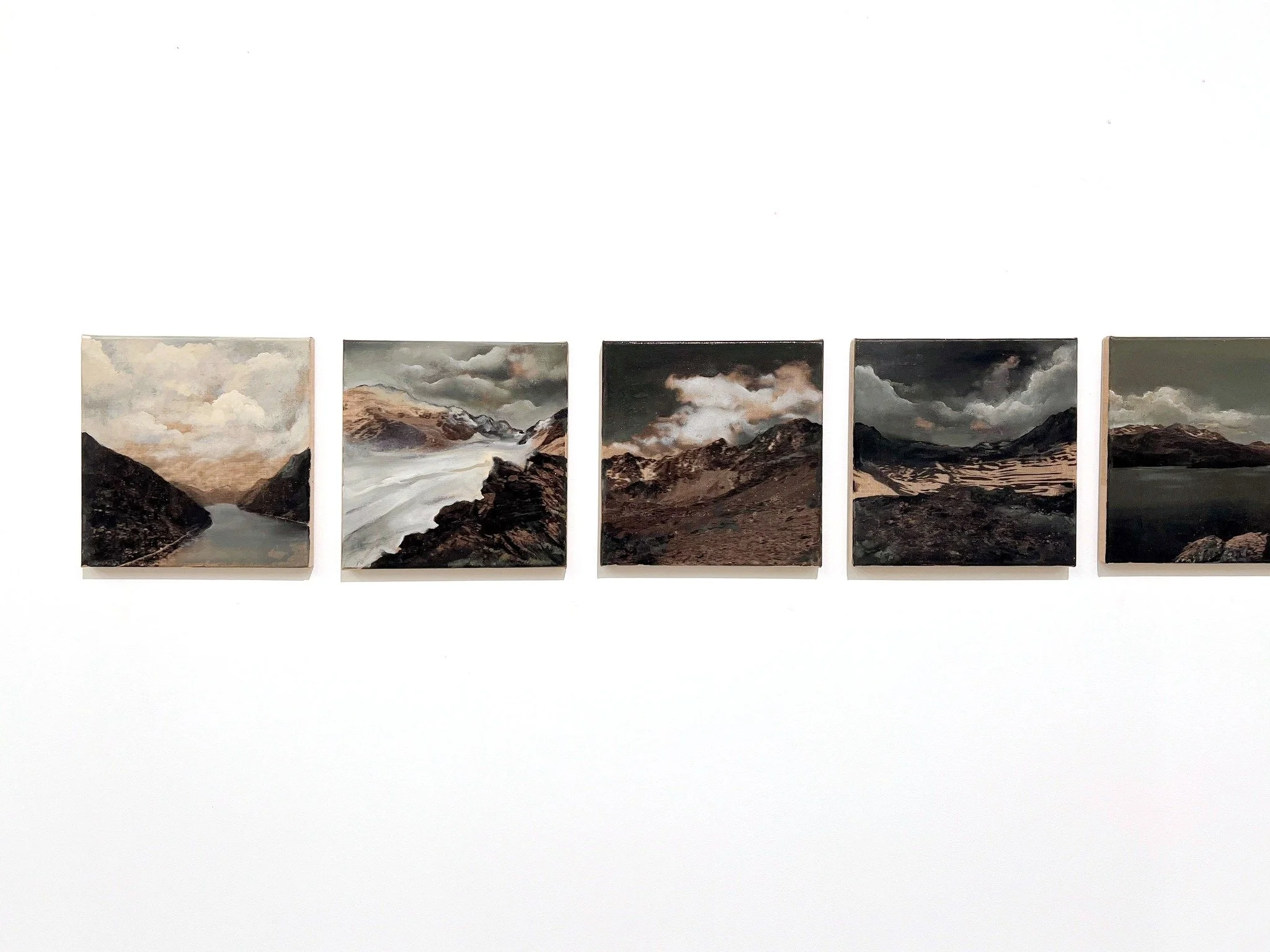
Nataraj von Allmen is a painter based in Switzerland. Often taking photographic material as a starting point, he weaves together landscapes, mythological archetypes, Christian symbolism, and contemporary socio-political themes into complex paintings. Oscillating between figuration and abstraction, his work investigates transformation, collective memory, and the human condition.