

10 Questions with Isabel Amado
Isabel Amado (known as Bel) was born in a small city in Brazil called Poços de Caldas, Minas Gerais, in 2003. A contemporary visual artist with a surrealist and illustrative touch to painting. The work reveals sensitivity to her culture and nature. Using paint and a brush, Bel works across different surfaces to create a look that blends lived elements with represented dreams. The paintings feature vibrant colours and expressive characters to represent her personal experience growing up in different parts of Brazil, a country where nature is essential to the population, culture, food, folklore, and the country's life.
Since childhood, she has been interested in painting and drawing. Making portraits as gifts and painting the walls of friends' and family's homes. Right after high school, she enrolled at NABA (Nuova Accademia di Belle Arti) in Milan, where she completed her bachelor's degree in Painting and Visual Arts. As an artist, Bel plans to return to Brazil one day, bringing her artistic background to represent her country in the best possible way and to show the world the beauty of her culture through her work.
The works presented are part of a collection series called “Carnes & Flores” (Meat & Flowers), which explores “How Nature Shapes Both the Creative Expression and the Viewer’s Connection to the Environment.” The paintings contain intimate meanings explored within the subconscious and an indirect communication with the viewer. The work is a combination of inspirations, like azulejos (tiles) on the walls, which complement each other to create a complex and beautiful pattern. An infinite process, combining experiments from the past/present and reflections on the constant development of a unique language and symbolism.
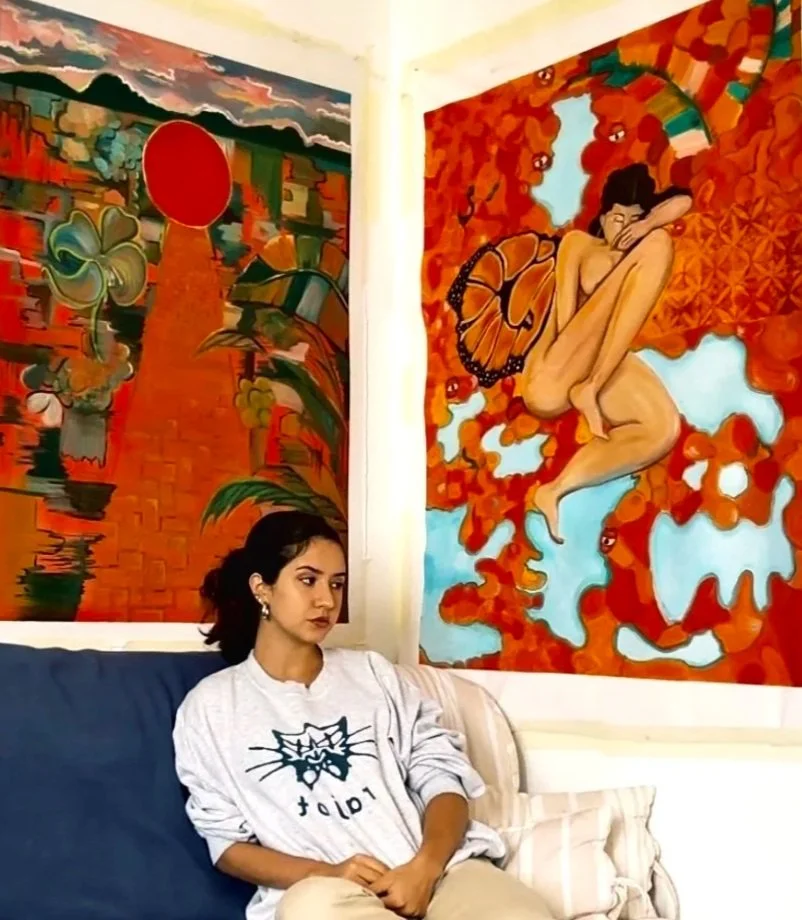
Isabel Amado - Portrait
INTERVIEW
Let’s start with your background. You were born in Poços de Caldas and grew up in different parts of Brazil. How did these places shape your imagination as a child?
Poços de Caldas and Itajubá are small cities in the state of Minas Gerais, places that shaped the first years of my life and where my mother is from. A place that is full of poetry, tradition, and simplicity, like one of my favourite painters said: “I found in Minas the colours I used to love as a child” (Tarsila do Amaral). I completely relate to that. Minas is a place that is a classic child drawing: the big hills, the blue sky, a small farm, and the sun in the corner.
Also, at the beginning of my childhood, I lived for a while in the famous Rio de Janeiro, where the vague memory of culture, carnival, and tropical nature is still in my subconscious, shaping the lines of my work.
Now, for most of my life, I grew up in São Luís, located in the Northeast of the country. Also known as the Island of Love, it is a place that shapes my vision of folklore and the sea breeze into the colonial tiles (azulejos). The place itself blends tradition with beautiful, rich landscapes. Also living through the pandemic years in Salvador (Bahia), also in the Northeast, deepened my connection to the city's contrasts and rhythm, and helped me visualise this sense of "magic” within the environment surrounding me.
And for my teenage years and early adulthood, I grew up in Brasília, the capital, where my father's family is from. The planned, dry city and the artistic touch of Niemeyer are a real-life canvas for how architecture contributes to the city's beauty and values its natural features.
I apologise if I was not able to be brief; there's so much to talk about these places. My childhood imagination was shaped by the different aspects of each one of them. Moving made my imagination flow. The nostalgia and rural aspects of Minas, the cultural vibrancy and tropical movement of Rio, the folkloric richness and coastal vibe of São Luís, the emotional contrast and rhythm in Salvador in an extremely difficult time, and the architectural clarity and space composition of Brasília. All of it, combined, creates the elements, symbolism, and experience within my subconscious and my story.
Pelas Dunas do meu Refúgio, Acrylic on Canvas, 30 x 30 cm, 2024 © Isabel Amado
You have been painting since childhood. When did you realise that art could become your life path?
I was always in love with drawing and painting, but also appreciating artworks. As a teenager, I did some work painting people's walls and creating illustrations based on what they wanted, but nothing professional. It was mostly a hobby. I feel like I realised it would be a path very soon in my life. I always had support from my parents, but neither of them is at all familiar with the art world/market, so I had to make it happen somehow. I believe it's with practice, inspiration, and experiencing most of life that makes a person a (good) artist.
You studied at NABA – Nuova Accademia di Belle Arti. How did moving to Milan influence your style and way of working?
Moving to Milan really helped me define my sense of style in my work. Being away from home made me appreciate my culture and bring out its beauty in my paintings. I wanted to show people where I am from without saying it. Moving to Europe made me come into contact with more classical art, different techniques I was unfamiliar with, a mix of different cultures, which inspired me even more, the way the art market works, and many other essential experiences. But unfortunately, I did not have much access to nature, which was distant from my previous reality in Brazil. The feeling that an essential element was missing from my creation made me desire to portray it.
Your paintings blend reality and dreams. How do you balance personal memories with imagined elements?
I explore past dreams, places I’ve visited, symbolism, and build my narratives primarily through painting. What captures my attention are vibrant colours, culture, natural elements, people, history, and the soul of the Brazilian territory. Every tone, scale, and painted fragment was built from a creative pulse rooted in the subconscious. But that’s how art works: in the moment of creation, every detail holds meaning for the artist, and it becomes their role to reveal to the public all of these elements, processes, research, inspirations, and impulses, unified in a single “result.”

Curupira, Oil on Wood Panel, 70,5 x 51 cm (2 panels), 2025 © Isabel Amado

Me dê uma Flor, Oil on Canvas, 85 x 62 cm, 2025 © Isabel Amado
Nature plays a strong role in your work. What does nature represent for you on a personal level?
I believe that the greater the complexity of the natural environment, the sexier it seems for an artist to create based on their surroundings. Nature inspires artists, which inspires people to take care of it; it is a cycle in which artists play a big role in contributing to and, in a sense, preserving it.
The series Carnes & Flores explores the relationship between nature and the viewer. What inspired this project?
The very start of the project was analysing what all of my work had in common: nature and the human body. As mentioned, I believe nature should be preserved and glorified as it is. This was the main theme for my Bachelor's thesis. When I paused to reflect on the main subject I wanted to explore in this research and project, I realised what all my works had in common: Brazilian cultural references, tropical natural elements, and the emotional expressiveness of the human body.
Your works are full of vibrant colours and expressive characters. How do you choose your colour palette?
By bringing together different media to portray the central theme: the human connection with nature. It weaves together diverse practices, refined techniques, and deep emotions. I choose my palette based on the colours of my reality or on what I want to express. An extraordinarily diverse and vivid ecosystem, and my own inspirations emerge around this theme, resulting in works that demonstrate the country's natural aspect and culture. Brazil is vibrant and expressive, as seen in the people, nature, Carnaval parties, music, rhythm, and soul. That's why I want to portray it; it's just a mirror reflection of my reality and subconscious.
You mention subconscious meanings in your paintings. Do you plan your symbolism carefully, or does it appear naturally during the process?
For the symbolism, it is a natural thing. It appears that my creation evolves in the work. I choose what best fits the piece and what I want to represent and transmit to myself and the public.

O Garoto e a Flor de Maracujá, Oil on Canvas, 122 x 78 cm, 2024 © Isabel Amado

Oráculo do Passado, Oil on Canvas, 120 x 88 cm, 2025 © Isabel Amado
Brazilian elements, such as azulejo-like patterns, appear in your work. How important is cultural identity in your artistic language?
Cultural identity is like the soul of an artist, the base. It gave singularity to the work. It is not only what represents me but also what guides me in my creative journey, my techniques, and the colours/elements I use. Art reflects narratives of the environment you come from; as an artist, you should embrace it. Embrace the diversity, the resistance, and the tradition of the place you come from.
Lastly, you hope to return to Brazil one day. What would you like your art to contribute to your country and its cultural scene?
As said in the previous questions, growing up in Brazil gives me a sense of belonging and identity; its complexity and beauty shape my creation and inspiration. My artistic mission is to embrace it, my spiritual connection with the natural environment of my country. In a contemporary mission in which the minimalistic and simple are valued, representing my culture is impossible in my vision. Nature is not minimalistic, so why represent it in that way? Nature, in art, is more than just a setting: it is the living matter of the soul, a mirror of existence, a symbolic womb where history and the sensitive connect and intertwine. I seek to represent nature not as something outside of the body, but as an extension of human life. I want my work to amplify my vision into the Brazilian identity while also connecting our cultural narratives to global conversations. I also want Brazilians to value and inspire themselves with what our beautiful country offers in the natural world, and to seek art within ourselves and our surroundings.
Artist’s Talk
Al-Tiba9 Interviews is a promotional platform for artists to articulate their vision and engage them with our diverse readership through a published art dialogue. The artists are interviewed by Mohamed Benhadj, the founder & curator of Al-Tiba9, to highlight their artistic careers and introduce them to the international contemporary art scene across our vast network of museums, galleries, art professionals, art dealers, collectors, and art lovers across the globe.



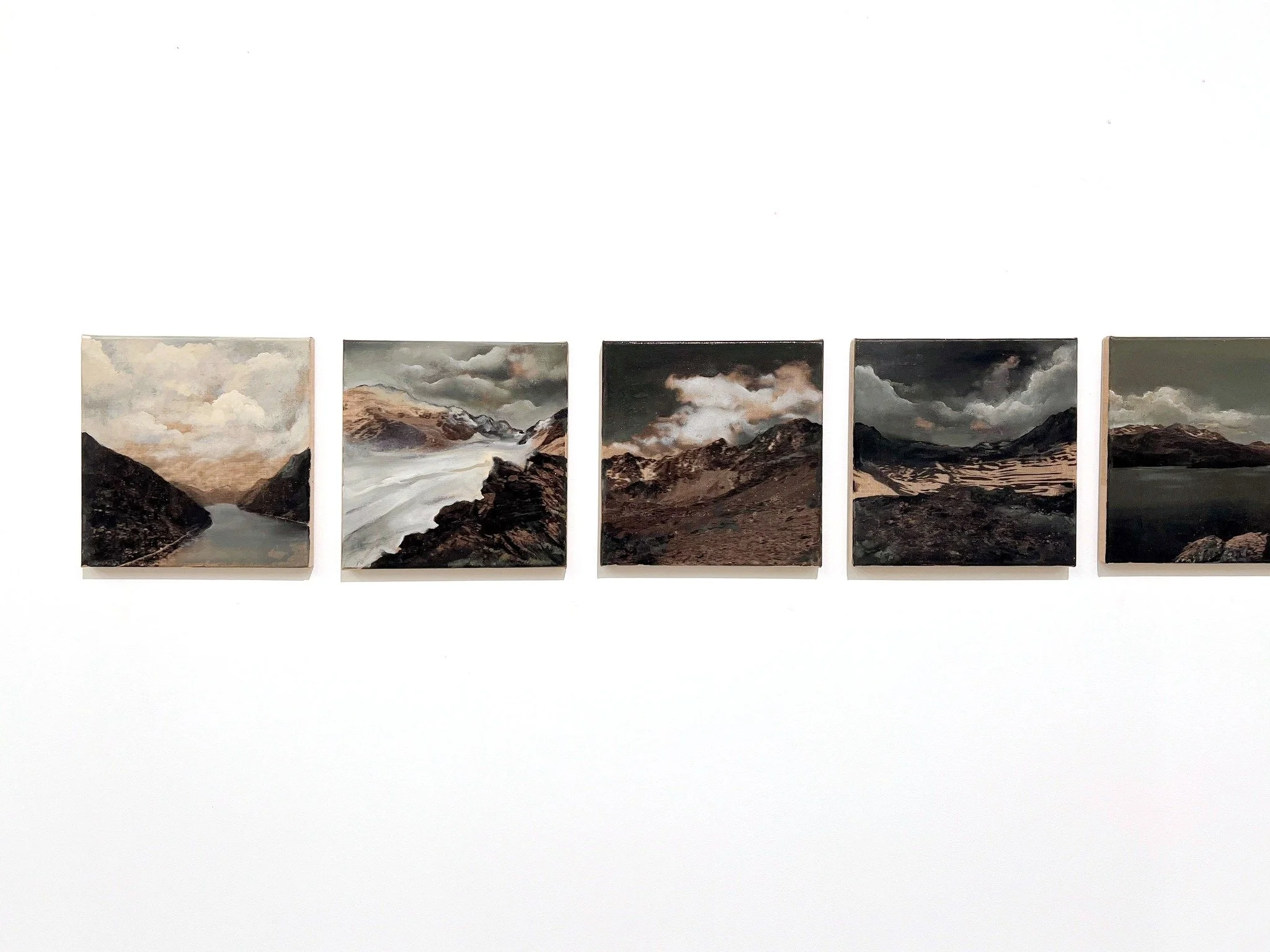
Brooklyn-Born Allan Gorman is a contemporary fine artist based in Jersey City, NJ, with a unique artistic vision cultivated by a distinguished commercial career that helped refine a sense of aesthetics and unwavering commitment to excellence that continues to define his artistic process to this day. His latest series of paintings is titled Imaginary Spaces.