
10 Questions with Haïfa Melliti
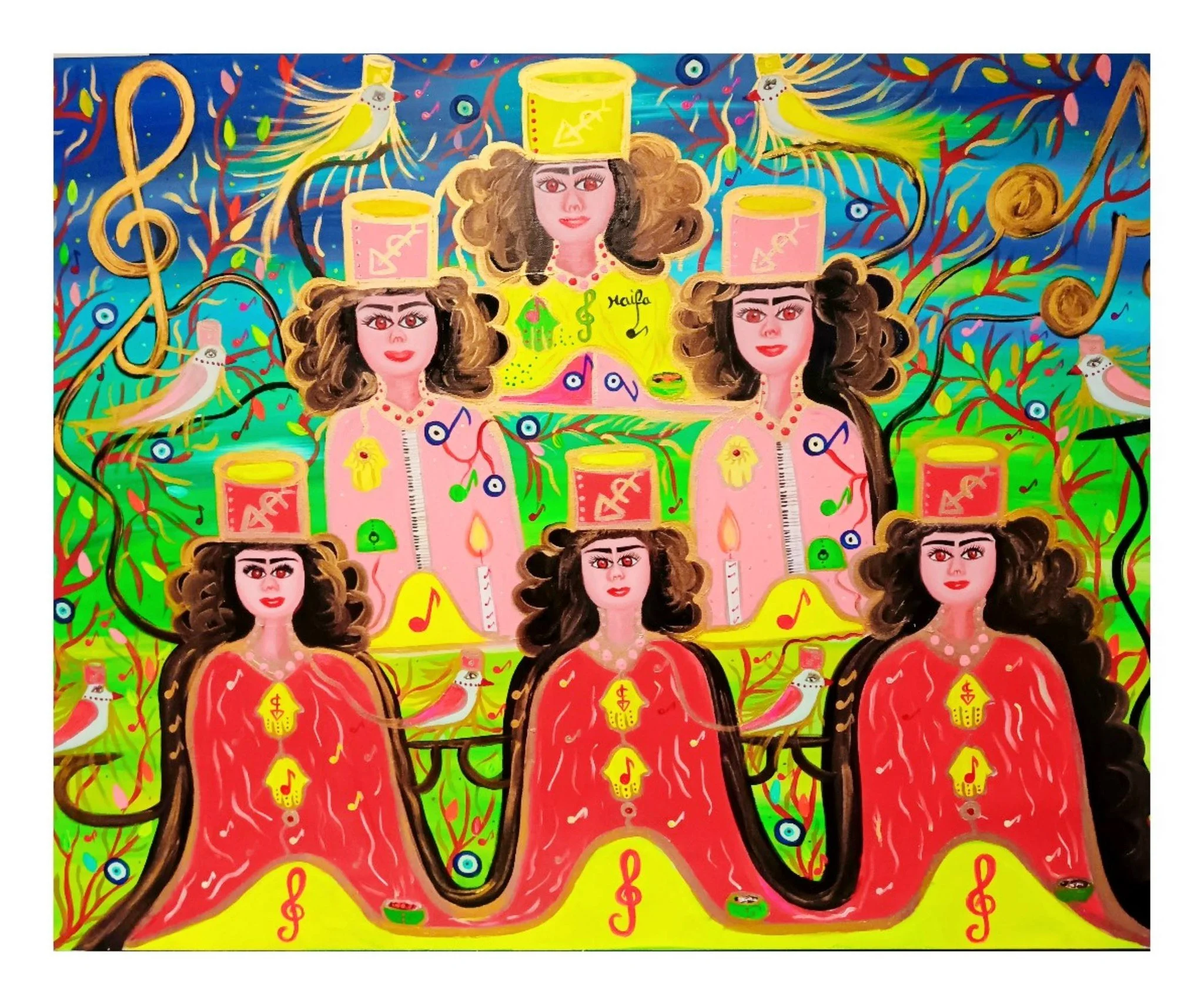
Haïfa Melliti is a visual artist and intuitive pianist based between France and the Mediterranean. Her work explores the sacred feminine, emotional memory, and inner healing through symbolic female portraits she refers to as Déesses (Goddesses), Presences, and Guardians.
Her visual language is defined by recurring symbols, moons, birds, protective hands, musical keys, and gold used not as decorative elements but as carriers of meaning and intention. Each artwork functions as a visual talisman, inviting contemplation, reconnection, and a return to inner truth.
Alongside her painting practice, Haïfa Melliti develops a multidisciplinary approach that weaves together painting, improvised piano music, and holistic well-being. Sound and colour are inseparable in her creative process: many of her works emerge from piano improvisations, translating emotion and vibration into form.
Through her art, she celebrates an ancestral, intuitive, and resilient vision of femininity. Her work positions art as a space of care, presence, and transmission, where softness becomes strength and silence becomes language.
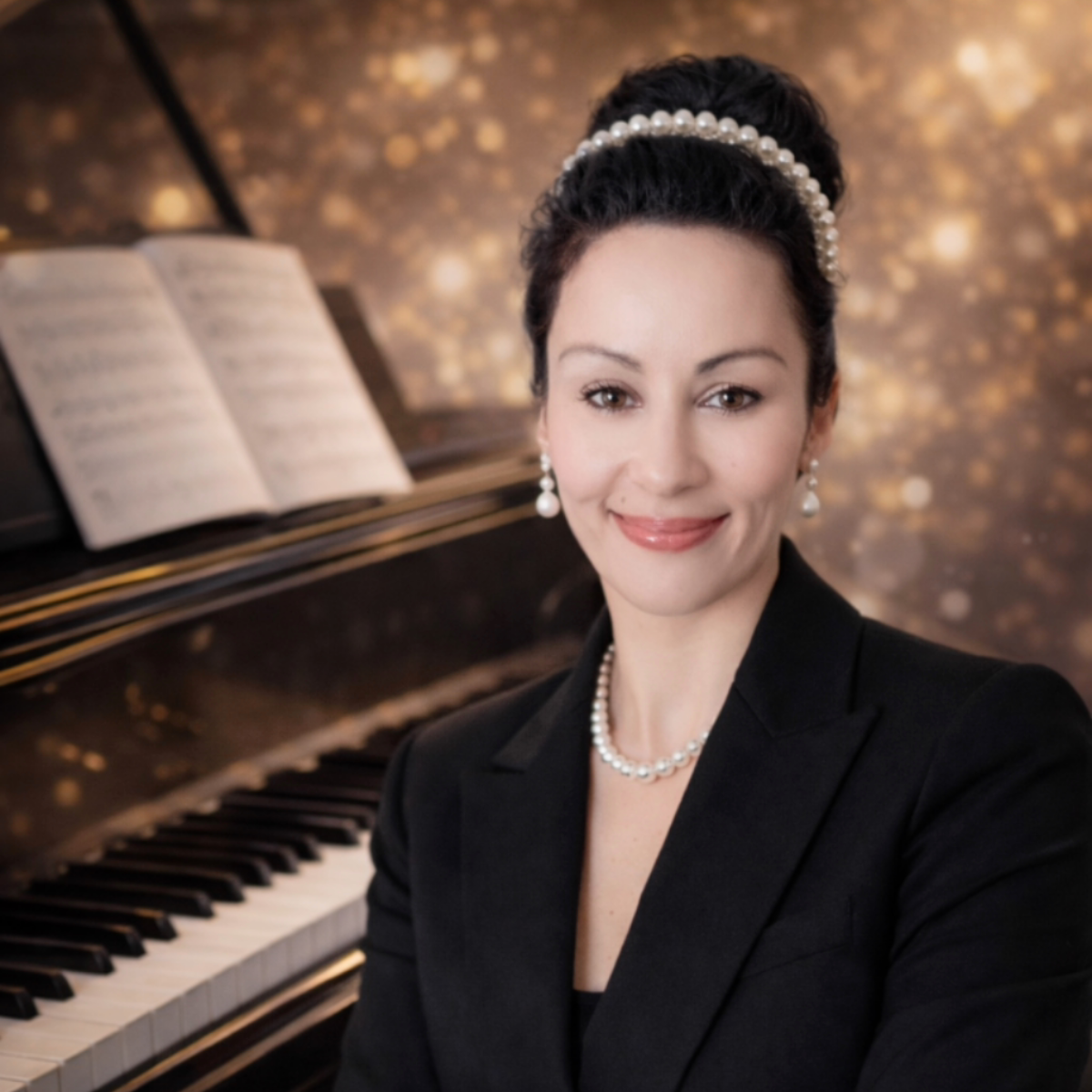
Haïfa Melliti - Portrait
ARTIST STATEMENT
Haïfa Melliti’s artistic practice is rooted in intuition, presence, and emotional truth. She does not seek to represent reality, but to reveal inner states, what is felt, remembered, or carried beneath the surface. Her paintings are not illustrative; they are experiential.
At the heart of her work lies the sacred feminine, understood not as an aesthetic concept, but as an ancestral force of resilience, intuition, and remembrance. The women she paints are not portraits of individuals, but embodiments of shared emotional landscapes. They are guardians of silence, memory, and inner light.
Her creative process is deeply connected to music. As an intuitive pianist, she often begins by improvising at the piano, allowing emotion to guide rhythm and tone. These musical moments inform her painting, creating a dialogue between sound and colour. Improvisation plays a central role in her philosophy: there is no correction, only presence.
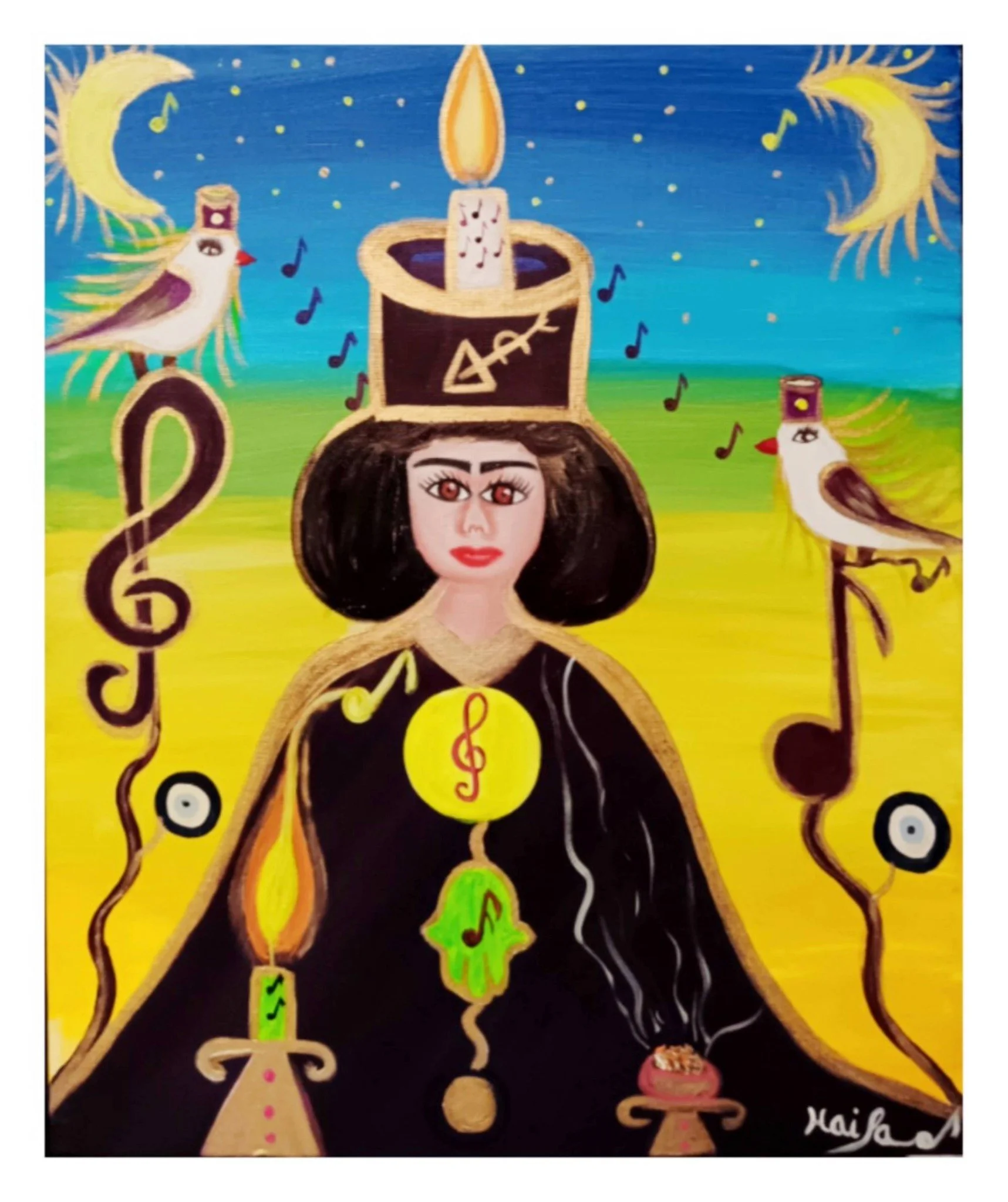
Symbols such as gold, moons, birds, musical keys, and protective hands recur throughout her work. These elements act as visual talismans, carriers of intention, protection, and continuity. Through them, her paintings become spaces of pause and resonance.
Ultimately, Haïfa Melliti conceives art as a place of reconnection to the body, to intuition, and to an inner voice often silenced by the external world. Her work invites viewers not to interpret, but to feel, and to recognise themselves within the quiet strength of the image.
© Haïfa Melliti
INTERVIEW
Let’s start from the basics. What first led you to explore the sacred feminine in your work?
My exploration of the sacred feminine did not begin as a concept. It began as an inner call. Before I had words for it, I was already feeling it: a silent presence, a deep and ancient energy that seemed to move through me whenever I painted, listened inwardly, or entered a space of creation.
Over time, I understood that what I was seeking to express was not simply “womanhood” in a social or external sense, but a more subtle and universal dimension of being, one connected to intuition, receptivity, inner strength, mystery, healing, and remembrance. The sacred feminine, for me, is not an idea limited to gender. It is a spiritual force, a way of inhabiting the world with depth, softness, awareness, and light.
My own life journey also guided me toward this path. Through care, beauty rituals, motherhood, contemplation, music, and painting, I gradually discovered that creation itself could become a form of prayer. In that space, female figures began to appear naturally in my work, not as invented characters, but almost as presences revealing themselves. They came with silence in their eyes, symbols in their hands, and stories that seemed older than language.
So the sacred feminine became the heart of my artistic universe because it is the place where my soul feels most truthful. It is where fragility and power meet. Where beauty becomes healing. Where the invisible becomes visible.
You describe your female figures as Déesses, Presences, and Guardians. How do these different titles shape the way you approach each painting?
These titles are very important to me because they are not decorative names. They reflect the energetic identity of each figure and help me understand how I must meet her on the canvas.
When I paint a Déesse, I am often entering a field of sovereignty, radiance, and sacred embodiment. A Déesse carries a powerful aura. She is connected to majesty, inner beauty, elevation, and the remembrance of feminine divinity. In these works, I often feel called toward richer ornamentation, symbolic density, and a sense of luminous presence that fills the space.
When a figure appears more as a Presence, the approach becomes quieter, more subtle, more contemplative. A Presence does not always reveal herself fully. She may be there as a vibration, a breath, a silence, an emotional atmosphere. These works are often more intimate, more interior. I allow more mystery, more openness, more space for the unseen.
A Guardian, on the other hand, carries protection. She watches. She stands between vulnerability and danger. She holds a threshold. When I paint a Guardian, I feel a different responsibility. Her symbols often become stronger, more intentional, more anchored in shielding, blessing, or vigilance. She may carry protective hands, eyes, moons, birds, or sacred marks that reinforce her role as keeper of an inner sanctuary.
So these titles guide not only the visual language of the painting, but also my emotional and spiritual posture as I create. Each one asks something different of me. Each one teaches me another face of the feminine.

© Haïfa Melliti
Your work includes recurring symbols such as moons, birds, gold, and protective hands. How do you decide which symbols belong in a particular piece?
I do not begin by rationally choosing symbols as though I were assembling a code. Most of the time, the symbols emerge through listening. They reveal themselves gradually, in the same way a melody reveals its next note.
Each painting has its own frequency, and the symbols belong to that inner frequency. Sometimes the figure arrives first, and the symbols gather around her naturally. Other times, a symbol comes before the figure, almost like an opening or a message. I trust that process deeply.
The moon often enters when the painting carries intuition, cyclicality, mystery, feminine time, or inner transformation. It is linked to hidden wisdom, to what grows in silence, to the sacred rhythm of becoming.
Birds enter when there is a movement of breath, freedom, ascension, prayer, or spiritual transmission. For me, birds are messengers. They can represent the soul, the invisible, or the bridge between earth and sky.
Gold is not simply aesthetic in my work. It carries light, dignity, sacred value, and a form of spiritual illumination. Gold appears when the piece asks for revelation, blessing, or a remembrance of inner nobility.
The protective hand, especially in resonance with ancestral and sacred traditions, often appears when the figure carries a role of protection, healing, or warding. It becomes a sign of blessing, protection, and spiritual vigilance.
So I do not impose symbols onto a painting. I receive them. I allow them to come when they are needed. In that sense, every symbol is relational. It belongs not only to my visual language, but to the soul of the work itself.
You speak of your paintings as visual talismans. What does that idea mean to you?
When I describe my paintings as visual talismans, I mean that I do not see them as purely decorative objects or simply as images to be looked at. I see them as carriers of energy, intention, memory, and presence.
A talisman is something that holds a force. It protects, accompanies, reminds, or elevates. In my artistic practice, a painting becomes talismanic when it is created through deep attention, inner listening, and symbolic truth. It then begins to carry more than form and colour. It carries vibration.
I want my works to offer people more than visual pleasure. I want them to feel that a painting can watch over a space, soften an atmosphere, awaken something forgotten, or invite a person back into contact with their own inner light. In that sense, the canvas becomes a companion. A silent guardian. A mirror of the sacred.
This does not mean that I control exactly what each viewer will feel. The talismanic dimension remains mysterious. It depends on the openness of the person, the energy of the space, and the life of the work itself. But I do believe that when a piece is created with sincerity and spiritual concentration, it can continue to radiate something beyond the moment of its making.
So a visual talisman, for me, is a painting that does not end at the frame. It continues to act. It continues to breathe. It continues to accompany.

© Haïfa Melliti
As both a visual artist and an intuitive pianist, how do music and painting influence each other in your creative process?
For me, music and painting are two languages of the same inner world. One moves through sound, the other through form and colour, but both come from the same sacred source within me.
When I play the piano intuitively, I enter a state of receptivity that is very close to the state in which I paint. I am not trying to demonstrate technique or control every movement. I am listening for what wants to emerge. In that space, music becomes a current. It opens emotion, memory, atmosphere, and presence. Very often, after improvising, I feel as though a visual world has already been born inside me.
Painting, in turn, teaches me things about music. It teaches me layering, silence, texture, contrast, pauses, and depth. A canvas shows me that intensity does not always need to be loud. A soft tone can hold immense power. A single line can carry the same weight as a sustained musical note.
There is also a spiritual dialogue between them. Sometimes a painting calls for a melody. Sometimes a melody calls for an image. They nourish one another continuously. Together, they allow me to create immersive worlds where the feminine can be felt not only through vision, but through vibration.
This is why I do not separate these disciplines in my heart. They are sisters. They belong to the same prayer.
When you begin with piano improvisation, how does a sound or rhythm transform into colour or form on the canvas?
The transformation is not literal. I do not hear one note and assign it one exact colour. It is more atmospheric, more intuitive, more embodied than that.
When I improvise on the piano, I enter emotional landscapes. A rhythm may create a sense of movement, an opening, a pulse, or a tension. A melodic phrase may evoke tenderness, elevation, solitude, longing, or peace. These sensations stay in my body, and from there they begin to translate themselves visually.
Sometimes a slow, spacious improvisation calls forth deep blues, whites, moon tones, or floating compositions with open space. Sometimes a more rhythmic or luminous passage brings gold, reds, stronger contours, or layered symbolic density. It is as if sound prepares the emotional climate in which the image can appear.
There are also moments when the gesture of music directly influences the gesture of painting. A fluid musical line may lead to a softer brushstroke. A sudden accent in sound may inspire a sharper visual contrast. A repetitive motif may become a pattern, ornament, or symbolic repetition on the canvas.
So the movement from sound to image happens through sensation, vibration, and memory. The painting becomes the visible echo of something first felt through listening.
© Haïfa Melliti

© Haïfa Melliti
Improvisation seems central to your philosophy. How do you balance intuition with decision-making while working?
Improvisation is indeed central to my way of creating, because it allows truth to arrive before the mind tries to organise it. It keeps the work alive, porous, and honest. But intuition does not mean absence of discernment. On the contrary, it requires a very refined quality of listening.
At the beginning of a piece, I often let intuition lead very freely. I welcome colours, gestures, symbols, and forms without overexplaining them. This stage is about openness and trust. It is where the soul of the work announces itself.
Then comes another phase, where I begin to respond more consciously. I step back. I observe. I ask what the painting needs, what is too much, what is missing, what must remain unresolved, and what must be clarified. This is where decision-making enters, not as domination, but as dialogue.
For me, balance comes from knowing when to surrender and when to refine. If there is only instinct, the work may remain incomplete. If there is only control, it may lose its living essence. I try to stay between those two movements: receiving and shaping, hearing and choosing, trusting and composing.
That balance is delicate, but it is also beautiful. It reminds me that art is not about forcing an image into existence. It is about entering into a relationship with what wants to be born.
You describe your paintings as experiential rather than illustrative. What kind of experience do you hope viewers have when standing in front of your work?
I hope that when someone stands before my work, they do not feel that they are merely looking at an image, but that they are entering a space. A space of pause, resonance, and encounter.
I am not trying to illustrate a fixed story with one clear message. I want the viewer to feel invited into a more interior experience, one that unfolds slowly and personally. Perhaps they feel soothed. Perhaps protected. Perhaps seen. Perhaps stirred by something they cannot immediately name. That mystery is important to me.
I would like my paintings to create a threshold where the viewer can leave the ordinary rhythm of the world for a moment and reconnect with silence, beauty, symbolism, and inner listening. In front of a work, I hope they can breathe differently. Feel differently. Remember something essential.
For some, the experience may be spiritual. For others, emotional. For others, it is simply sensorial. What matters to me is that the work opens something alive. Not explanation, but presence. Not consumption, but contemplation.
If a painting can become a moment of return to oneself, then it has fulfilled something very precious.

© Haïfa Melliti
Softness, silence, and care are recurring ideas in your practice. Why are these qualities important to you today?
They are important to me because I feel we are living in a time of great noise, acceleration, fragmentation, and inner exhaustion. In such a world, softness is not weakness. Silence is not emptiness. Care is not secondary. They are essential forces of restoration.
Softness, in my work, is a strength that does not need violence in order to exist. It is a way of approaching beauty, the body, the soul, and creation with tenderness and respect. I believe softness can heal what hardness cannot.
Silence is the place where I hear what is true. It is where images come, where melodies arrive, where intuition becomes audible. Without silence, I cannot create from depth. Silence is not absence for me. It is a sacred field of listening.
And care is at the heart of everything I do, whether in painting, music, beauty rituals, or the spaces I create for others. Care means presence. Attention. Reverence. It means treating creation not as production, but as a relationship.
These qualities matter to me today because I believe they are deeply needed, both artistically and humanly. They allow us to return to what is essential. They remind us that gentleness can also be transformative, and that beauty can still be a form of healing.
Lastly, as your multidisciplinary approach continues to evolve, are there new forms, collaborations, or directions you would like to explore in the future?
Yes, very much. I feel that my multidisciplinary path is still unfolding, and I am deeply open to new forms that allow painting, music, space, ritual, and presence to speak together more fully.
One direction that calls me strongly is the creation of immersive experiences where my paintings and intuitive piano compositions exist in direct dialogue. I would love to develop exhibitions in which visitors not only view the canvases, but also enter a sonic and spiritual atmosphere shaped by live or recorded music. In this way, the works could be experienced as living environments rather than isolated objects.
I am also very drawn to collaboration with dancers, poets, sacred voice artists, curators, and scenographers who are sensitive to the spiritual and symbolic dimensions of creation. I would love to create spaces where the sacred feminine is not only represented, but embodied through movement, sound, light, and collective presence.
On another level, I am interested in expanding my work internationally through exhibitions, books, musical projects, and educational or healing initiatives that connect women, art, and inner transformation across cultures. I believe deeply in art as a bridge, especially when it is rooted in authenticity and spiritual depth.
At the same time, I want to remain faithful to intimacy. No matter how much the form expands, I want the source to remain pure: inner listening, sincerity, beauty, and the invisible thread that connects my work to something greater than myself. So yes, the future feels open, vibrant, and full of possibility. But always guided by the same light.
Artist’s Talk
Al-Tiba9 Interviews is a promotional platform for artists to articulate their vision and engage them with our diverse readership through a published art dialogue. The artists are interviewed by Mohamed Benhadj, the founder & curator of Al-Tiba9, to highlight their artistic careers and introduce them to the international contemporary art scene across our vast network of museums, galleries, art professionals, art dealers, collectors, and art lovers across the globe.



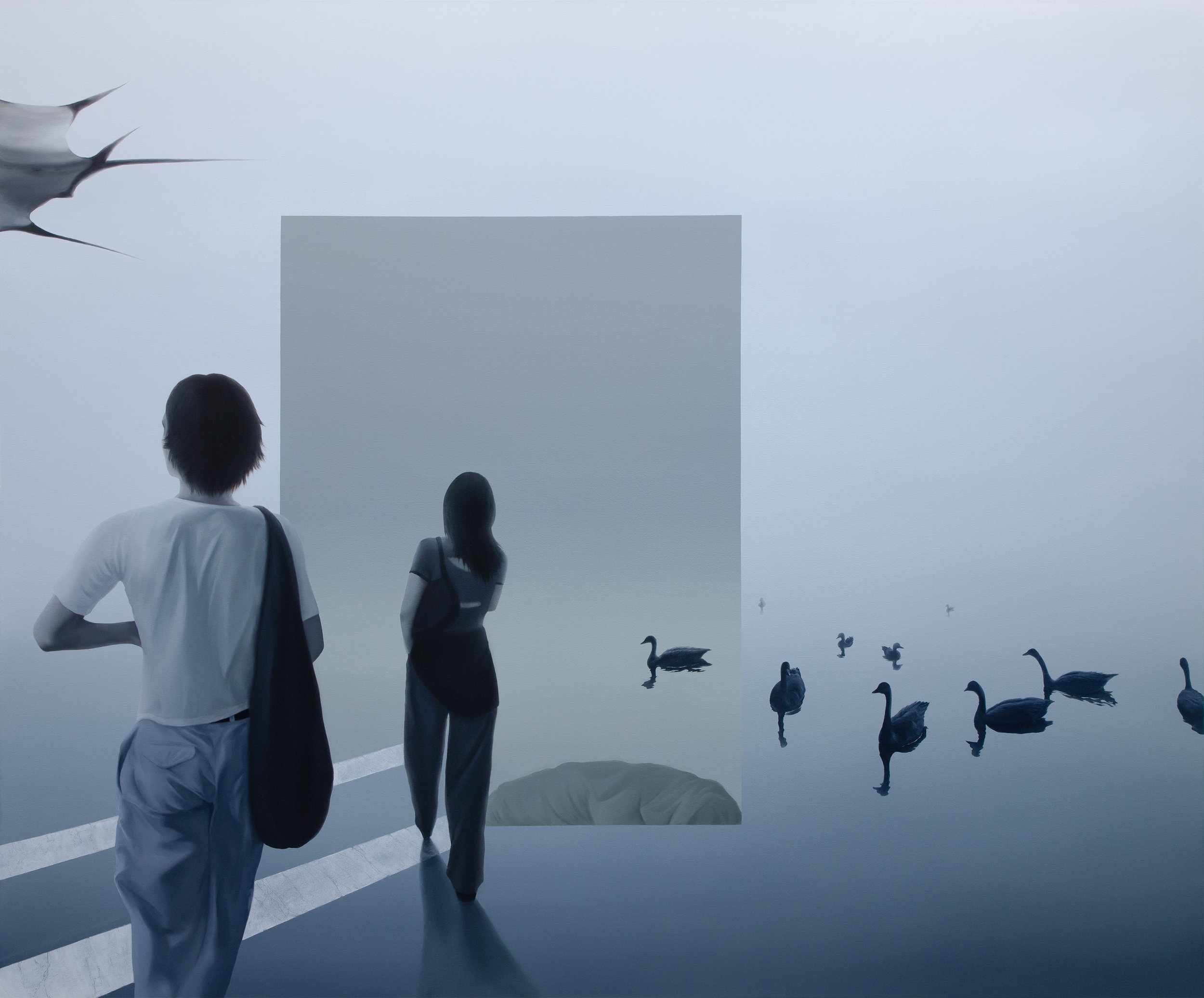
Brooklyn-Born Allan Gorman is a contemporary fine artist based in Jersey City, NJ, with a unique artistic vision cultivated by a distinguished commercial career that helped refine a sense of aesthetics and unwavering commitment to excellence that continues to define his artistic process to this day. His latest series of paintings is titled Imaginary Spaces.