

10 Questions with Coraline Mengdie Zhou
Coraline Zhou has worked across universities, art education agencies, galleries, and NGO contexts, spaces where she witnessed how people articulate, or struggle to articulate, their inner worlds. This observation anchors her practice: that we are all attempting to translate the untranslatable. Her work uses drawing and writing as tools for excavation. Through asemic writing, abstraction, and drawings that map emotion and consciousness, she traces the pre-verbal: marks that behave like thoughts before they acquire words. These forms become archaeological evidence of the nervous system's search for coherence, suspended between comprehension and dissolution.
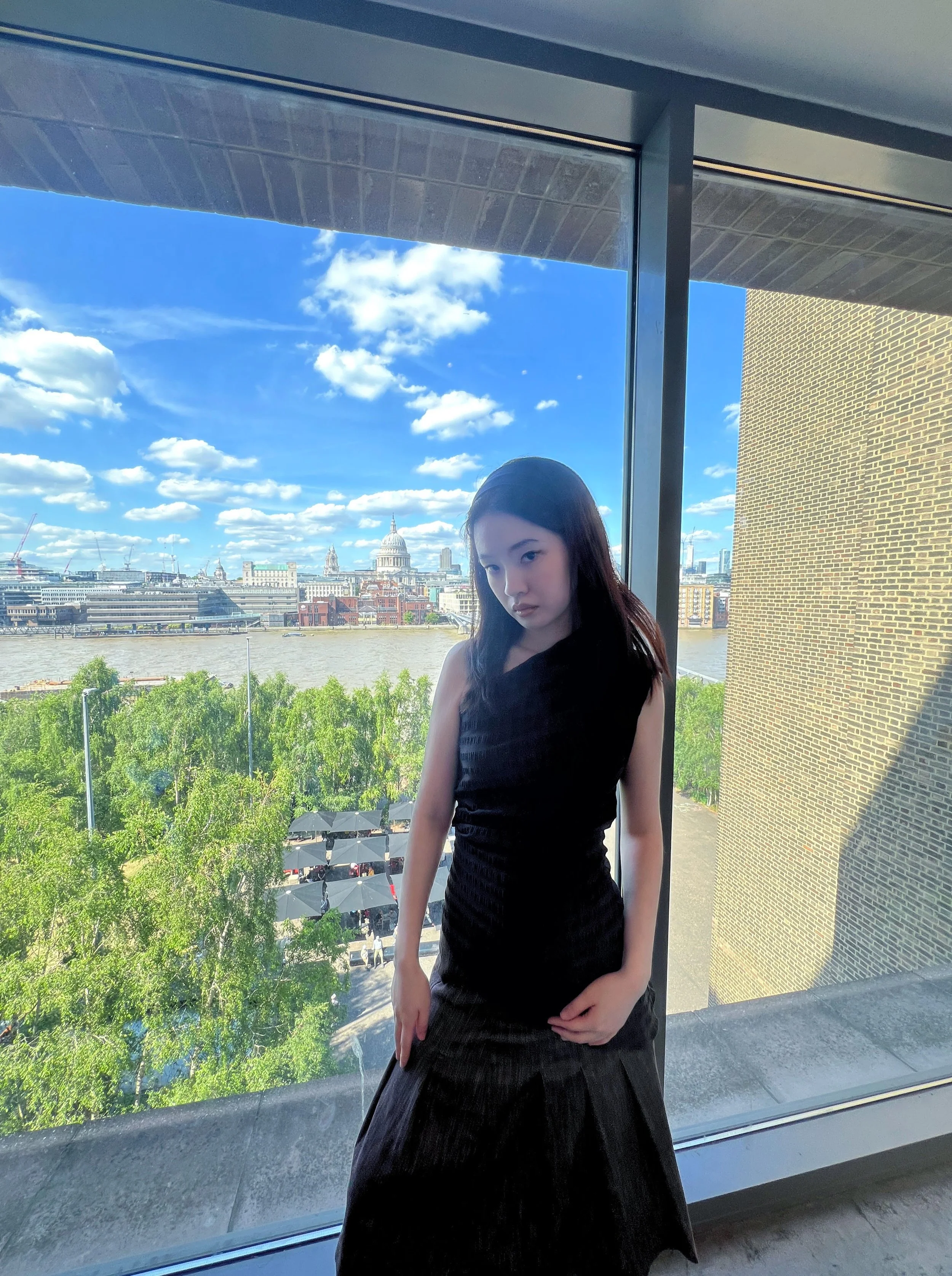
Coraline Mengdie Zhou - Portrait
ARTIST STATEMENT
“I think of my artwork as a live experience of writing, just like in the spirit of Roland Barthes, not its content, not even its structure, but the abrasions I impose upon a fine surface: I read on, I skip, I look up, I dip in again.
Asemic Ghost (2025) listens to the moment before language arrives, when thought exists only as tremor, as pre-verbal trace within the body's wiring. These asemic marks hover at the threshold of perception: neither fully present nor absent, suspended between materiality and dissolution, between ascent and descent. Each piece captures consciousness in a distinct state of ontological flux. Signal attempts containment, a vortex pulling scattered impulses toward coherence before they fade. Wave registers failed translation, voice arriving distorted through invisible barriers. Divine Peak gathers toward monumental density, consciousness reaching its apex before dissolution begins. What emerges is not communication but its residue, the soft gesture of a nervous system groping for pattern within disorientation. These are not abstractions but body-prints of psychic states: marks left when selfhood moves between elevation and collapse, between the mountain and the abyss.
Backrooms (2026) extends this inquiry into architectural unease. Here, spaghetti becomes a structural material, its tangled, accumulative logic used to build the physical emergence of anxious thought. The camera does not document but arrests: it captures the exact moment anxiety surfaces into form.
Dream Birth (2025) labors under the weight of its own emergence, dense black marks bear down upon buried color, teal and red and yellow surfacing only as glimpses, half-swallowed by darkness, as if consciousness itself is being pressed into form before it is ready.
Terrified (2026) moves differently: a centrifugal spiral of orange and green, warm and cold pulling against each other, the body's alarm system rendered not as stillness but as pure rotational force, fear not frozen but spinning, unable to stop or land.
Across all of this, the ghost persists, neither dead nor alive, suspended in perpetual transformation, leaving behind only whispered evidence of its passage.”
— Coraline Mengdie Zhou
Dream birth, Watercolor on paper, 8.27 x 11.69 in, 2025 © Coraline Mengdie Zhou
INTERVIEW
First of all, how did your experiences working in education, galleries, and NGOs influence your artistic practice?
Working across education, galleries, and NGOs, I found myself occupying a dual role: part observer, part coordinator, and that position became a deep source of inspiration. What clicked me most was a pattern that kept emerging across all these spaces: people struggling to articulate their inner worlds using language that never quite fits what they're actually feeling. That gap ( the space between what we feel and what we can say) became the central preoccupation of my artistic practice. I wanted to capture that subtle but very human tension.
Your work explores what exists before language. What draws you to this pre-verbal space?
Writing has been a constant in my life since childhood, something I've always been drawn to and genuinely enjoyed. But as I grew older, I began to notice something: writing, for me, is also an act of selection and control. My analytical mind is always searching for the most accurate word, the most precise phrase, constantly editing and shaping a narrative. And that very process made me aware of everything it leaves out.
The pre-verbal space interests me precisely because it holds more than language can manage, more than emotion, more than logic, more than any single word can carry. It's what exists before the mind steps in to organise and name things. There's a fullness there that I find myself wanting to honour.
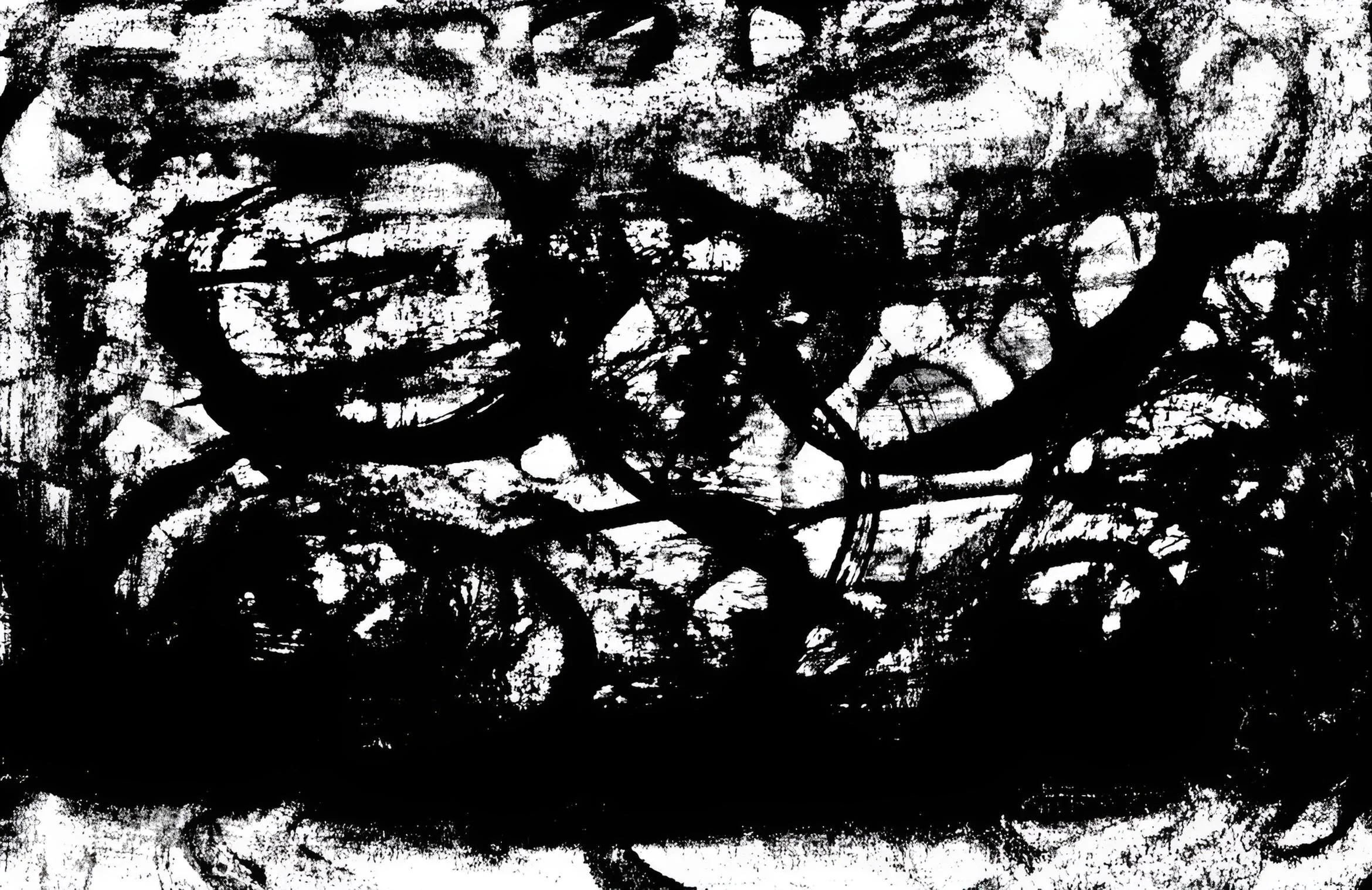
Asemic Ghost - Wave, Digital print of watercolour, 8.27 x 11.69 in, 2025 © Coraline Mengdie Zhou
Can you explain what asemic writing means within your work?
Asemic writing is, for me, how the pre-verbal space continues to live on the page. Through my practice, I became fascinated by how language itself, writing, words, symbols, is something humans constantly construct and deconstruct, evolving it into ever-new forms of interpretation and communication. Asemic writing felt like the most honest channel for that. It carries the texture and gesture of language without fixing itself into meaning, which leaves room for the viewer to interpret, to rewire, to bring their own inner world to it. In that sense, it mirrors how the mind itself works: not in straight lines or settled definitions, but in flux, in feeling, in things that resist being named.
You describe drawing and writing as tools for excavation. What are you searching for through this process?
Honestly, these are the ways I know how to dive into my own mind, and eventually into other people's. There's always been something in me that's drawn to the question of what makes a person who they are, what runs beneath the surface of someone's behaviour, their choices, the particular way they move through the world. As a kid, I was deeply interior, lost in imagination, constantly constructing parallel versions of myself (I still am): bolder ones, freer ones, versions who weren't held back by their own edges. I wasn't just daydreaming to escape. I was rehearsing. Testing out what it might feel like to inhabit a different self.
I won't claim to know exactly what I'm searching for, but I can sense patterns. One thing I've come to recognise about myself is that I carry insecurity easily. Drawing and writing were, at first, ways of trying to understand that, to excavate what was underneath it. But I learned quickly that you can't think your way to that understanding. Rumination keeps everything stuck. The harder you grip, the less you find.
What I sensed instead was that there was a braver version of me living somewhere in the shadow, not unreachable, just unmet. And the way to meet that person wasn't to sit alone with my thoughts. It was to walk outward. To work, to take on commissions, to sit with other people and their inner worlds.
And yes, it sounds like something you've heard before, but it's true, in getting closer to other people, I got closer to myself. The excavation turns out to be less about digging inward in isolation and more about the unexpected mirrors that other people hold up without even knowing it.

Asemic Ghost - Signal, Digital print of watercolour, 8.27 x 11.69 in, 2025 © Coraline Mengdie Zhou
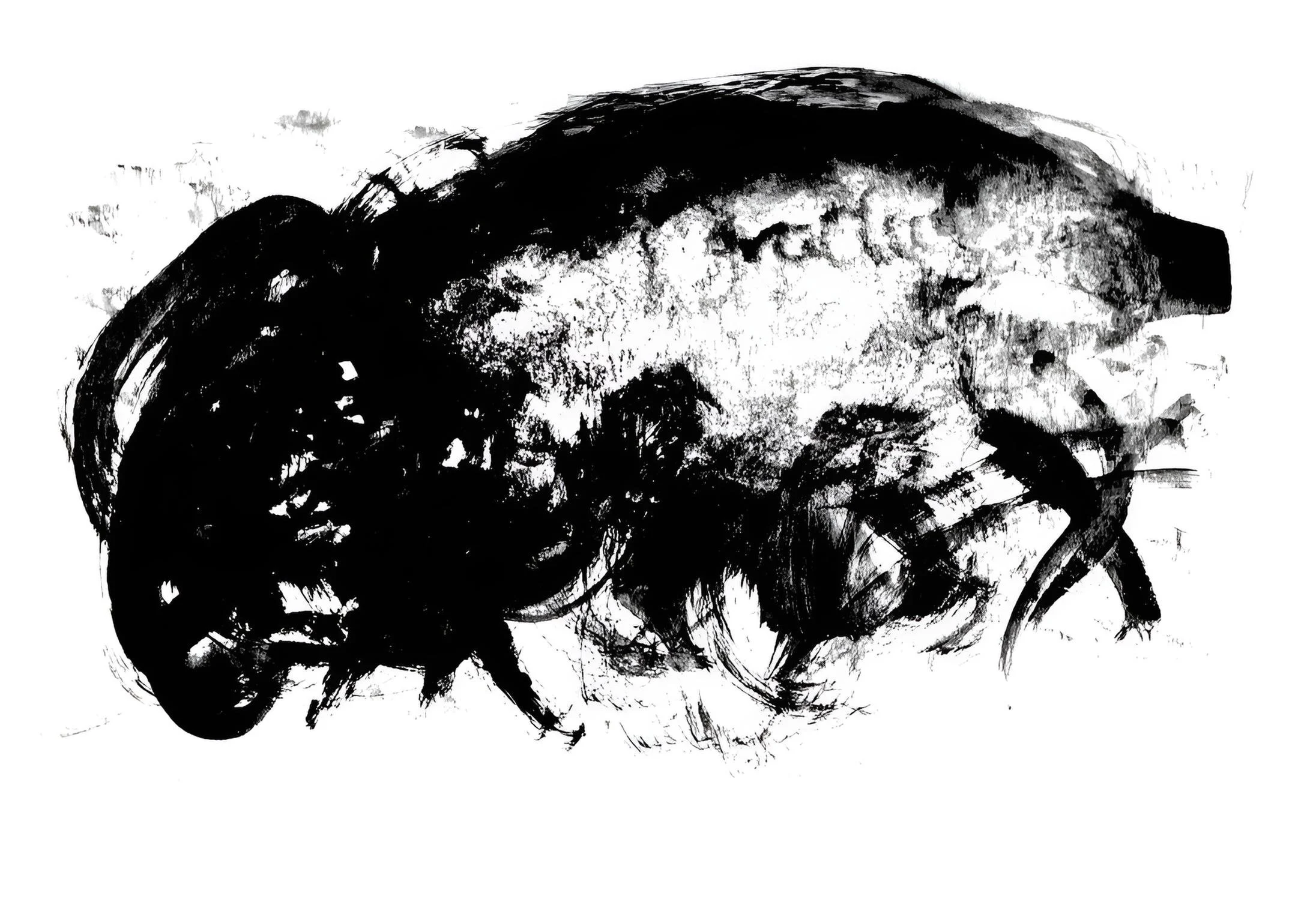
Asemic Ghost - Divine Peak, Digital print of watercolour, 8.27 x 11.69 in, 2025 © Coraline Mengdie Zhou
Many of your works feel connected to psychological or inner states. Do you begin with a specific feeling in mind?
I never push myself toward a feeling. I wait for the feeling to find me. That distinction matters a great deal to my process. This comes partly from a deep love of certain filmmakers. With Bergman and Lynch, what their work gave me was permission, permission to feel fully, to simply exist within a moment without forcing it toward resolution. There's a deep trust in their storytelling, a willingness to sit with something unresolved, something interior, something to feel rather than understand. But Cronenberg works on me differently. His films unsettled something more physical in my thinking, the way the body itself becomes a site of psychological transformation, the way flesh and feeling are inseparable. He reminded me that our inner world can be uncanny and deeply corporeal. Together, they taught me to pay attention to dreams, to the thoughts that pass through without announcing themselves, to the signals that are easy to dismiss. I've come to believe that what you're searching for is already living inside you. It simply asks for awareness rather than effort. My role as an artist isn't to manufacture an emotional state, but to remain present and receptive enough to catch what's already there.
The idea of translation appears often in your practice. What do you think cannot be translated into words?
So much. But if I try to point toward it. There's the body first. The physical states that exist before the mind has a chance to name them are pain, unease, and a particular kind of stillness. The inner world is also a bodily world, and the body knows things that language arrives too late to catch. Then there's the threshold moment, that is, that split second before a feeling becomes a thought. Something shifts, something stirs, and for just an instant, it hasn't yet become an emotion with a name or a narrative with a shape. That interval is where I feel most alive as an artist, and it's precisely what language collapses the moment it touches it.
And then there are dreams. Not the plot of a dream, which you can retell, but the logic of it, the way it makes complete and total sense while you're inside it, the atmosphere of it, the feeling of its world. The moment you try to translate that into words, it starts dissolving. What remains is just a faint outline of something that was once whole.
Underneath all of this, I think what truly resists translation is simply the feeling of being alive in a particular moment, consciousness itself, presence, the texture of a specific instant that belongs entirely to itself. Language can point toward it. But it always arrives after.

Backrooms, Installation art by Photography, 8.27 x 11.69 in, 2026 © Coraline Mengdie Zhou
In works like Asemic Ghost, communication seems to dissolve rather than clarify. What role does ambiguity play in your art?
Personally? I hate ambiguity. There's something in me that moves compulsively toward certainty. I want to know, to understand, to pin things down. Loose ends unsettle me. So it's strange, even to me, that my work does the opposite. I think that's precisely why, though. Art became the one space where I could release that grip, where I didn't have to resolve anything, where I could let something exist in its incompleteness without it threatening me. Ambiguity in my work isn't a philosophy I arrived at intellectually. It was more like a relief I stumbled into.
In something like Asemic Ghost, what dissolves isn't meaning. It's the demand for meaning. And I've come to believe that's where something more honest lives. The need to clarify, to translate, to make legible, that's control. What sits underneath, before that impulse kicks in, is something rawer and truer. Ambiguity protects that. It keeps the work open in a way that certainty would immediately close. In that sense, my art and I are in constant negotiation. It keeps teaching me what I keep resisting.
Your recent projects introduce materials and spatial elements, such as architecture and installation. How has your practice evolved through these experiments?
There's something about architecture that is inherently authoritative; it organises space, it dictates movement, it imposes a kind of visual and structural logic onto the world. It patterns. It insists. In that sense, it reminded me of language itself, a system built to contain and communicate, yet always housing something that exceeds it. But stand inside a great building and something else happens entirely. The imagination activates. Shadows fall in ways that weren't designed. A corridor holds a feeling no architect wrote into the blueprint. The structure becomes a body, and the body starts to breathe.
That contradiction is what fascinates me: the coexistence of the rigid and the alive, the calculated and the felt. Moving into installation and spatial work allowed me to make that tension physical and inhabitable rather than something only visible on paper. I wanted the viewer to be inside the contradiction. In many ways, it felt like a natural evolution, the same questions I'd been asking on a page, I was now asking with space itself.

Terrified, watercolor on paper, 8.27 x 11.69 in, 2026 © Coraline Mengdie Zhou
What do you hope viewers experience when encountering your work for the first time?
I don't hope they understand it. I hope they feel something move in them before they know why. What I want is for the encounter to be genuinely theirs, not a passive reception of something I've already finished, but an active, restless, deeply personal negotiation. Barthes once described his experience of reading not as absorption into content or structure, but as a kind of productive friction, skipping, dipping, pausing, drifting, returning. That restlessness resonated with me deeply, because it describes exactly the kind of aliveness I want my work to trigger. Not understanding. Not resolution. Just that feeling of being pulled somewhere without quite knowing what's pulling. I want the viewer to bring their own unspoken things to the work, the feelings they've never found words for, the interior landscapes they've never been given permission to acknowledge. If the work becomes a surface against which they feel that friction, that private recognition, then it has done what I hoped. The work was never meant to speak clearly. It was meant to make space for what the viewer already carries but hasn't yet said.
Looking ahead, how do you see your practice evolving in the coming years?
I can't foresee it. And I've made a kind of peace with that. I want to keep doing work that I love, with materials that genuinely call to me, following the excavation wherever it leads without deciding in advance what I'll find. That openness feels more faithful to the practice than any roadmap I could draw. But beyond the work itself, what I'm really moving toward is presence. I've spent enough time wandering through the past and negotiating with a future that hasn't arrived. What I want now (at work and in my life) is to be here. To hold love for what I'm making, for the people around me, for the world as it actually is rather than as I'm anxious it might become. There's something almost political about that as an artist. In a world that constantly demands projection, ambition, the next thing, choosing presence feels like its own quiet act of resistance. So I suppose that's where I'm headed. Not somewhere I can point to on a map, but toward something I can feel. Which, when I think about it, is exactly where my work has always been trying to go.
Artist’s Talk
Al-Tiba9 Interviews is a promotional platform for artists to articulate their vision and engage them with our diverse readership through a published art dialogue. The artists are interviewed by Mr. Mohamed Benhadj, the founder & curator of Al-Tiba9 Contemporary, to highlight their artistic careers and introduce them to the international contemporary art scene across our vast network of museums, galleries, art professionals, art dealers, collectors, and art lovers across the globe.


David Moješčík - MojDa is a Czech sculptor. His work is centred on figurative sculpture, the human body, and the female figure. Modelling in clay and with digital tools, he ultimately prioritises manual engagement with materials. . He draws inspiration from yoga philosophy with the concepts of non-violence and human-centeredness, as well as from Egyptian, ancient, and European classical sculpture.