
10 Questions with Katya Shkolnik
Katya Shkolnik (b. USSR; lives and works in Milan) is a multidisciplinary artist working across photography, sound, and installation. Trained as a Nuclear Engineer (MSc), she approaches the camera and the exhibition space as experimental instruments, controlled environments in which a single variable can be isolated, sustained, and observed.
Her work has been the subject of solo exhibitions at the Abylkhan Kasteyev National Museum of Arts (Almaty), included in group exhibitions at MMOMA (Moscow), shown at art fairs including START at Saatchi Gallery (London) and SCOPE Miami Beach, and presented at the CONTACT Photography Festival in Toronto.
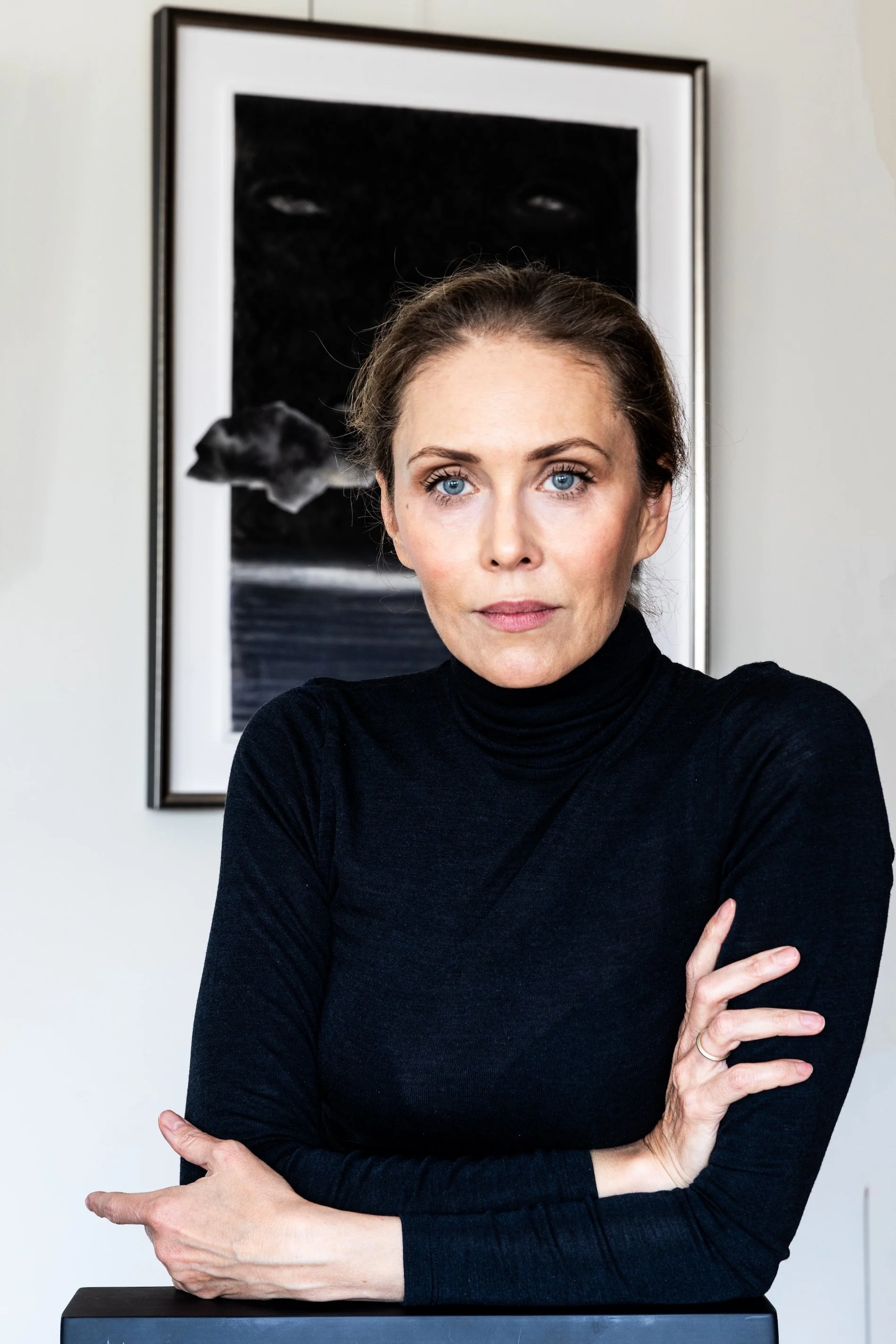
Katya Shkolnik - Portrait
ARTIST STATEMENT
Katya Shkolnik’s work explores perception, time, and the unseen structures that shape reality. A background in nuclear physics informs her interest in the relationship between the known and the unknown, and in how invisible forces can become sensory experience.
Katya works across photography, installation, sculpture, AI, 3D video art, and performance. Photography forms the basis of the practice. The images do not capture a single moment. They hold duration, movement, and traces of what has passed through the frame. Light and sound function as raw material and data, revealing rhythms and vibrations beyond direct vision.
The work asks the viewer to slow down and stay present. Space, scale, image, and sound work together to create immersive environments that shift perception and question our place within time and consciousness.
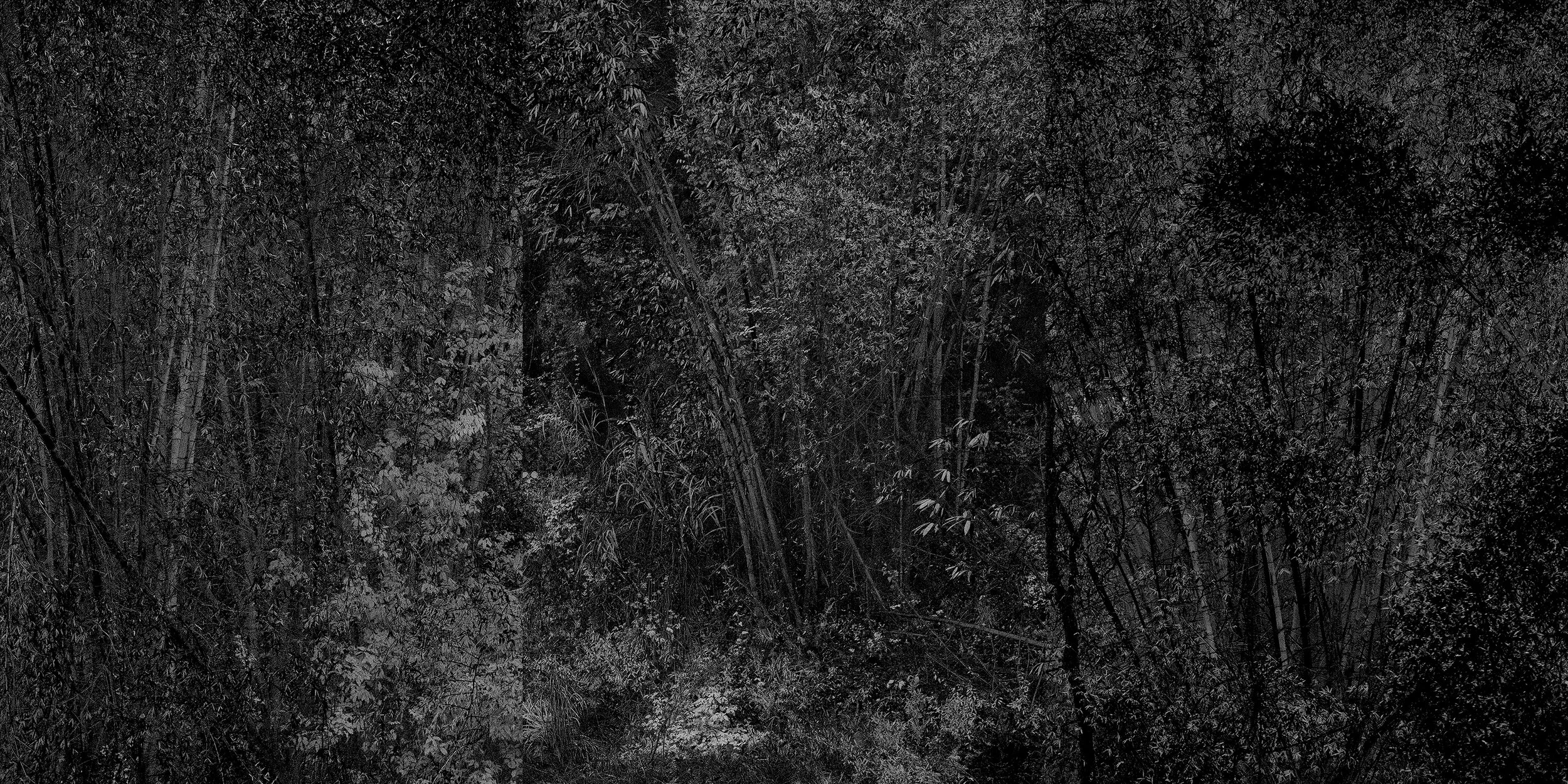
White Noise, Multimedia Installation, 2017 © Katya Shkolnik
White Noise | Project Description
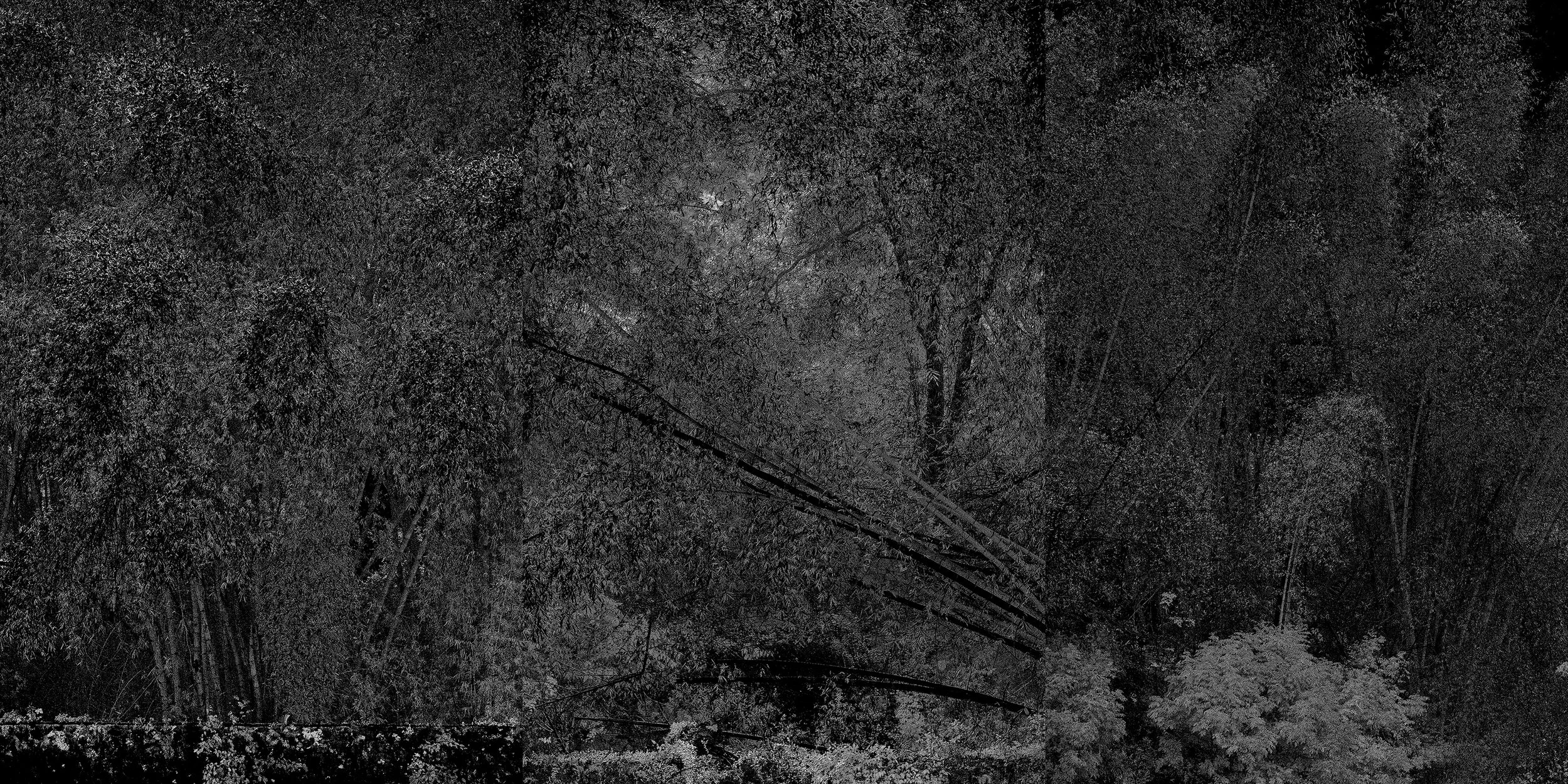
White Noise is a series of black-and-white photographs I made in 2017 in a bamboo forest in the Guilin mountains of southern China. The series asks how to photograph sound, specifically, the constant rustle of wind through dense bamboo. The forest’s repetitive light and foliage become a visual translation of an acoustic phenomenon: the white noise of the wind rendered as the white light of the day.
Standing in the forest, the eye cannot single out one trunk, one leaf, one path. The repetition of bamboo absorbs attention completely. Each photograph holds equal information across the frame, the way white noise as a signal holds equal power across all frequencies. The image functions as a transcription, not a record, a visual analogue of what the forest sounded like.
The title carries two references: the physics definition of white noise (a signal with equal power across all frequencies, used in audio engineering and acoustic research) and Don DeLillo’s White Noise (1985), the novel of media saturation and consumer anxiety. Both meanings hold simultaneously in the work.
The series consists of 25 single images and 6 polyptychs, in editions of 3 + AP. Polyptych dimensions range from 150 × 300 cm to 450 × 200 cm and 150 × 600 cm. Prints are Giclée Fine Art on paper or ChromaLuxe Fine Art mounted on aluminium, Diasec. A video exists alongside a sound composition Shola Miller wrote for the work, both parts of an intended installation form.
INTERVIEW
Let’s start with your background. You originally trained as a nuclear engineer. How did you make the transition from science to art, and what still connects the two fields for you today?
I wouldn't call it a transition. It's an evolution, and it is ongoing. I was born and grew up in the USSR, where the most common career paths were engineering, medicine, and teaching. I was very good at math and physics at school, and both of my parents were engineers, so I was destined to become one too. Hence, it is no surprise I graduated as a nuclear engineer from MEPhI, the leading nuclear-engineering university in the country. Then the Soviet Union collapsed, and while it was a turbulent moment, it also opened other paths for me.
I didn’t discover art until much later, but since my first degree was such a rigorous training, I still carry that approach to every project I make. The instruments change, but the discipline doesn't. What art brought was a domain that engineering didn't operate in: sensation, presence, attention. I still work with controlled variables. Yet, the questions are different now.

White Noise, Multimedia Installation, 2017 © Katya Shkolnik

White Noise, Multimedia Installation, 2017 © Katya Shkolnik
How has your scientific background shaped the way you observe and structure your artistic practice?
Honestly, my process always begins either with curiosity or pure intuition. Intuition is the compass that tells me to look closer. Once it does, my scientific training takes over: I define the variable, I set the conditions, and I observe what happens. Each project becomes a small experiment with its own protocol. Intuition does not leave the room; it tells me when something worth keeping has happened.
Was there a specific moment or shift when you realized photography and installation could become your main form of research and expression?
I love thought experiments. When I was making a photographic series, I was always picturing the image not on a printed page but on a wall, a very big wall and a very big image. I challenged myself to make work that could carry that scale.
The next step was organic: take over the space. How could I transform the room to deliver a specific idea, duration, and conditions of attention? At that point, the wall was no longer enough; the thought experiment extended to other variables: volume, light, and sound.
I was lucky to start letting the thought experiments come out of my head. My first institutional solo, Genetic Code of the Lost Time, which was featured at the Abylkhan Kasteyev National Museum of Arts of the Republic of Kazakhstan in Almaty in 2015, transformed the exhibition hall into a labyrinth of large prints and partitions that staged the experience of failed dreams. That was the pivot. It helped me prove to myself that these thought experiments were more than just mental exercises.
Your work often treats the camera and exhibition space as experimental instruments. How does this way of thinking change the way you create an artwork?
What you put into the photograph at the exact moment you press the button is what matters: the state you are in, and the thoughts or ideas holding you. That internal state is the beacon for the future installation, it already holds the components, and the work afterwards is to materialise them in the exhibition space.
The camera is an internal experiment. The exhibition space is the natural extension of that experiment. In that regard, the exhibition space is a special kind of challenge; it always turns out to be exactly the space the work needed, even if you do not see that at the beginning.
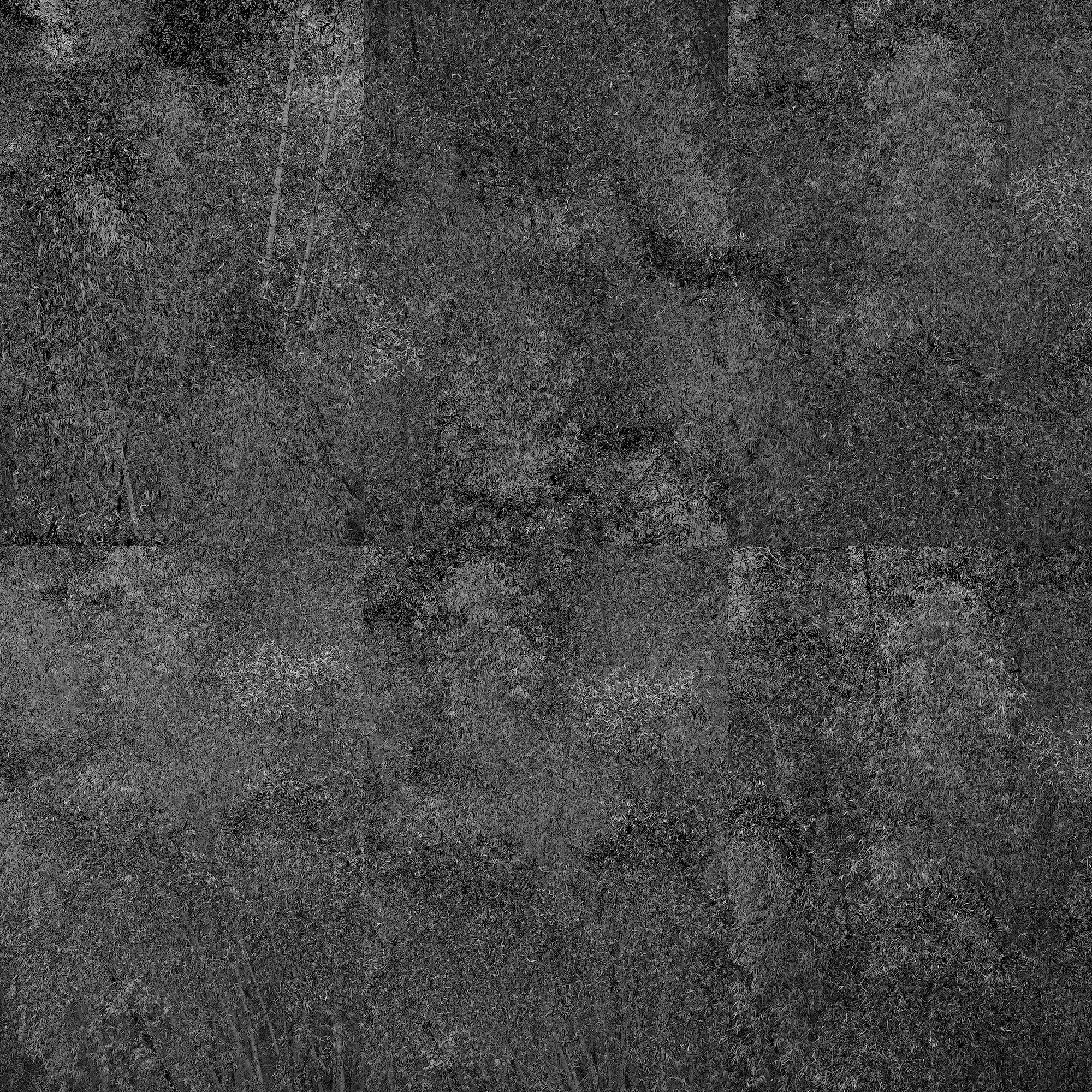
White Noise, Multimedia Installation, 2017 © Katya Shkolnik
You explore perception, time, and invisible structures. What draws you to these “unseen” dimensions of reality?
I think I inherited the curiosity from my engineering degree. I have always wanted to know how things work. But I would not call perception and time "unseen dimensions of reality." They are concrete subjects: perception can be tested, time can be measured, and both can be held inside one photograph or one room. The work treats them as material, not as mystery. And on top of that, thinking about big things does make everyday problems lighter. Call it self-therapy if you want.
In your practice, light and sound are treated as material. How do you work with them in a practical and intuitive way?
Light and sound are always present in any exhibition space. The choice is to take that as a given or to treat both of them as a form of material. Working with light and sound this way gives the experience dimensions it would not otherwise have.
In practice, this means commissioning a composition rather than placing background music. I love working with composers. I brief them on the idea, share the visuals and the mood I am seeking to attain, and what comes back enters the work in a way the visual alone cannot reach.
For Manifesto on Time, Alla Zagaikevich wrote a continuous 7.1 spatial composition for the mirror chamber, and Milo McKinon scored the antechamber.
Light is its own variable. I always photograph in daylight, it gives the full spectrum and records the maximum amount of information. The exhibition space is never well-lit, so light becomes another variable to optimise: selecting the right amount, spectrum, and places where there is no light at all are deliberate choices.

White Noise, Multimedia Installation, 2017 © Katya Shkolnik
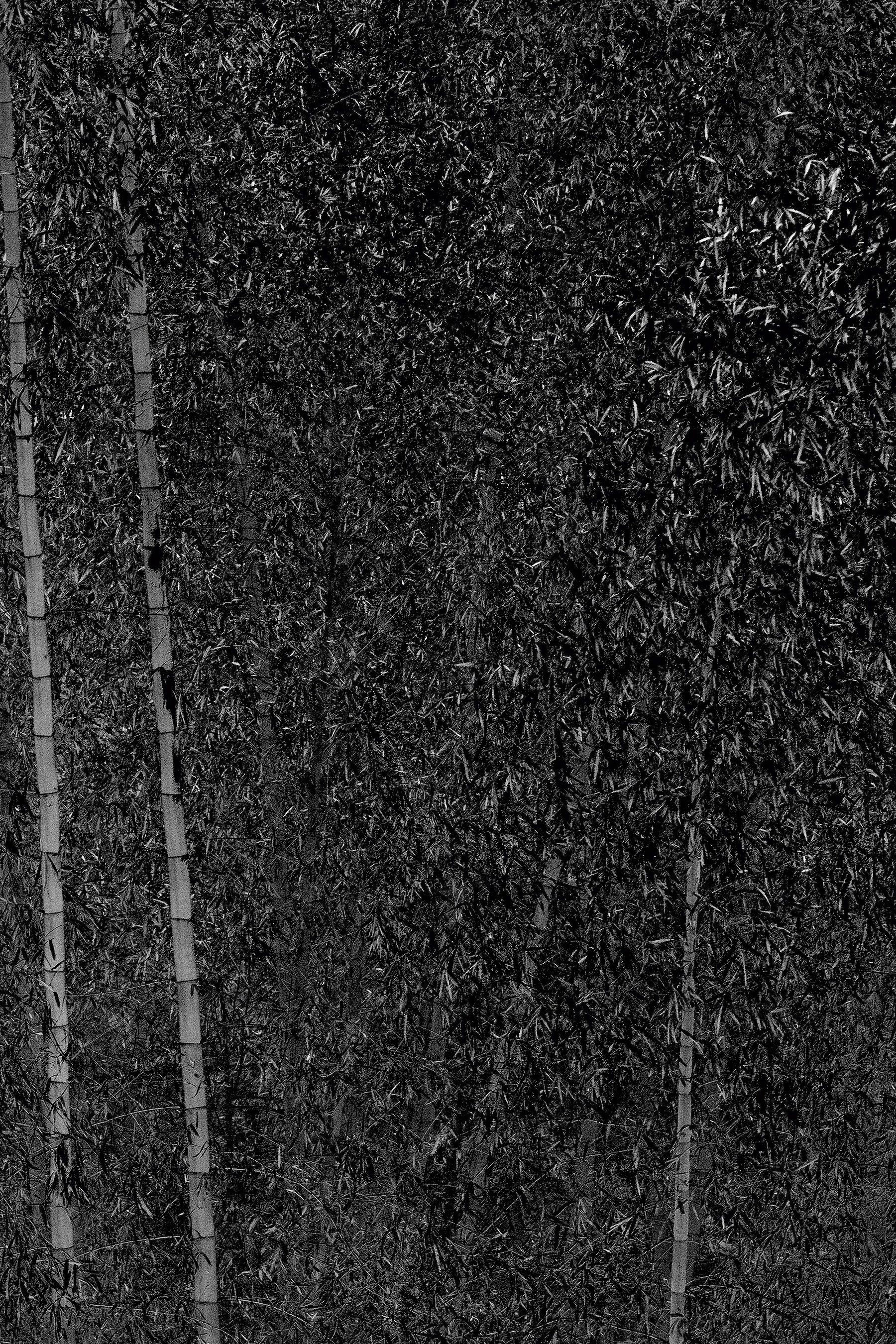
White Noise, Multimedia Installation, 2017 © Katya Shkolnik
Your photographs often feel less like captured moments and more like extended states of time. How do you approach this idea of duration in your images?
Every photograph captures a state at a specific point in time, the exposure. There is no such thing as a single, isolated moment; any fraction of time is still duration. If you think about it from a physical standpoint, you are by definition recording the extension of an object's existence when you photograph it.
I don't use the camera to freeze a snapshot. I use it to accumulate data over that exposure period. The image becomes an archive of a state of being, where everything that moved or stayed still leaves its structural residue. The duration isn't just in the shutter; it is built into the density of the final print, which requires the viewer to spend their own time unpacking it.
In White Noise, you translate sound into visual form. Can you walk us through how you arrived at that idea in the bamboo forest in Guilin?
I made White Noise in 2017 in a bamboo forest in the Guilin mountains of southern China. Most people picture a bamboo forest as a visual cliché of tranquillity. In reality, a bamboo forest in the wind is an acoustic wall, thousands of hollow trunks and leaves colliding to create a literal, physical drone.
There was no other sound at all. Normally, in nature, you hear birds, insects, and something. This time, nothing was there. Everything was hidden behind the white noise. I almost fell asleep until a thought interrupted me: I might be missing something important, something dangerous, the way you would be aware of it in Africa. The white noise had masked it.
Then, I looked at the forest itself, and the same condition was visible. The eye could not single out one trunk, one leaf, one path. The frame held equal information across its whole surface. The visual structure of the forest was the same as the acoustic structure of the sound it produces, and the same as the experience of any oversaturated signal; the volume of what is on top masks what is underneath. That is what the white noise of the media does to us, too.
White noise, in physics, is a signal with equal power across all frequencies. The bamboo forest is the same proposition rendered as light. The title carries two references at once: the physics definition and Don DeLillo's novel of media saturation. Both meanings hold.
Your installations often require viewers to slow down and adjust their perception. What role do you think attention plays in your work?
Attention does the same thing as in life: it opens meaning and gives access. It reveals what is built into the work and brings it to the viewer's attention.
Attention and time are often used interchangeably, and they are. But attention is one level up; it is conscious time. I am not asking the visitor only for time. I am asking for time consciously spent, so that my work can give them something in return.
The ability to pay attention and sustain it for an extended period will be the most defining factor in people's lives. It already is.
White Noise, Multimedia Installation, 2017 © Katya Shkolnik
Lastly, what are you currently working on, and are there any upcoming exhibitions, installations, or collaborations you can share with us?
My current project is Manifesto on Time: Séance, a multimedia immersive installation in three chambers. It builds on Manifesto on Time, which was exhibited at the Abylkhan Kasteyev National Museum of Arts of the Republic of Kazakhstan in Almaty in 2025. The séance version introduces a measurement system: the audience's collective presence over a thirty-minute reading is read in real time by cameras, processed in TouchDesigner, and translated into a master time signal that conditions the playback in all three chambers. The work does not respond to a single visitor's intent. It responds to the group's collective decision to stay or to leave. I am developing it with the support of Tatiana Iaksina for technical design and integration, Boris Misharin for 3D production, Alla Zagaikevich for the spatial composition, and Milo McKinon for the antechamber score.
In parallel, I am working on a line of work that substitutes water for time. Waters of Time, an installation in development, is built around a single inverted image of a mountain river in Bhutan, fragmented and spatially arranged. Time as an Aqueous Medium, a photographic series I started in New Zealand in early 2026, photographs the surface of dark water from a small boat, leaves, dust, and the residue of currents that moved them, and is now being extended into video. Both works rest on the same substitution: time has no shape and water does. Water reads the way time would if we could see it.
I am also returning to Nepal this year to continue a series of photographs of a Tibetan monastery, which will eventually be transformed into a book.
Artist’s Talk
Al-Tiba9 Interviews is a curated promotional platform that offers artists the opportunity to articulate their vision and engage with our diverse international readership through insightful, published dialogues. Conducted by Mohamed Benhadj, founder and curator of Al-Tiba9, these interviews spotlight the artists’ creative journeys and introduce their work to the global contemporary art scene.
Through our extensive network of museums, galleries, art professionals, collectors, and art enthusiasts worldwide, Al-Tiba9 Interviews provides a meaningful stage for artists to expand their reach and strengthen their presence in the international art discourse.




Lim Won Ji (Oneg) is a South Korean artist based in Chicago. Working across sculpture, installation, performance, and process-based experimentation, Lim investigates hypervigilance as a bodily condition shaped by anxiety, uncertainty, anticipation, and the desire for control, constructing unstable situations in which order is continually negotiated through gravity, time, repetition, and chance.