
10 Questions with Saman Zahawi
Saman Zahawi is an Iraqi-Canadian artist and architect born in Baghdad in 1967. His practice is rooted in Arab culture, philosophy, and identity - expressed through ‘Silent Art’, his signature form of contemporary Arabic calligraphy that transforms words into a visual and spiritual experience. Zahawi's minimalist work is shaped by the contrasts of the human experience. His architectural training provides the underlying geometry; his freehand approach prioritizes freedom over perfection, each stroke carrying meaning beyond what the eyes can understand and what language alone can hold. In recent years, this practice has extended into marble, wood, glass, and light, custom installations and sculptural works created with local artists and craftspeople. Zahawi's work has been exhibited across the Middle East and Europe, including Abu Dhabi, Cairo, Dubai, Milan, and Amman, and featured in Emarat Elyoum and on Al Arabiya television.
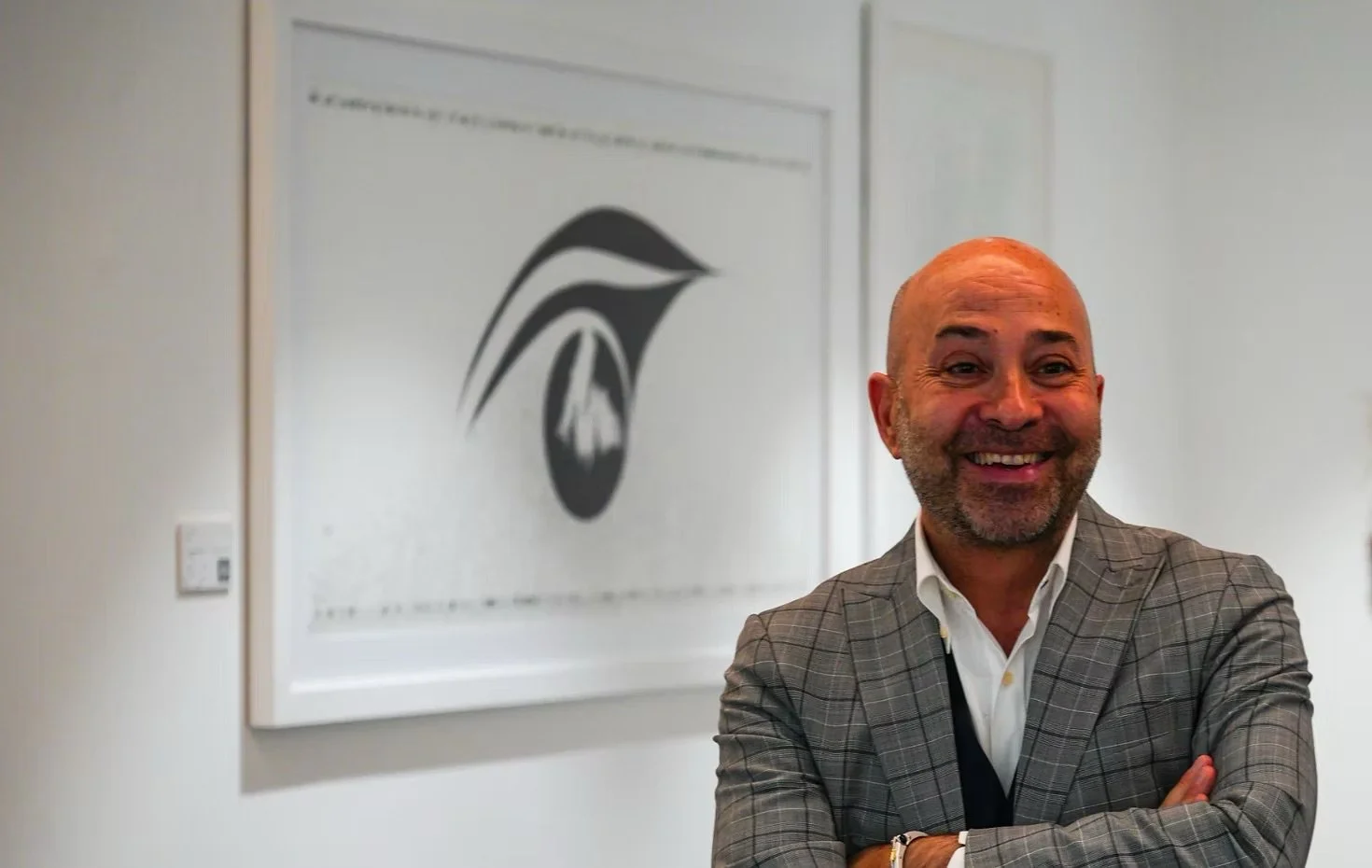
Saman Zahawi - Portrait
ARTIST STATEMENT
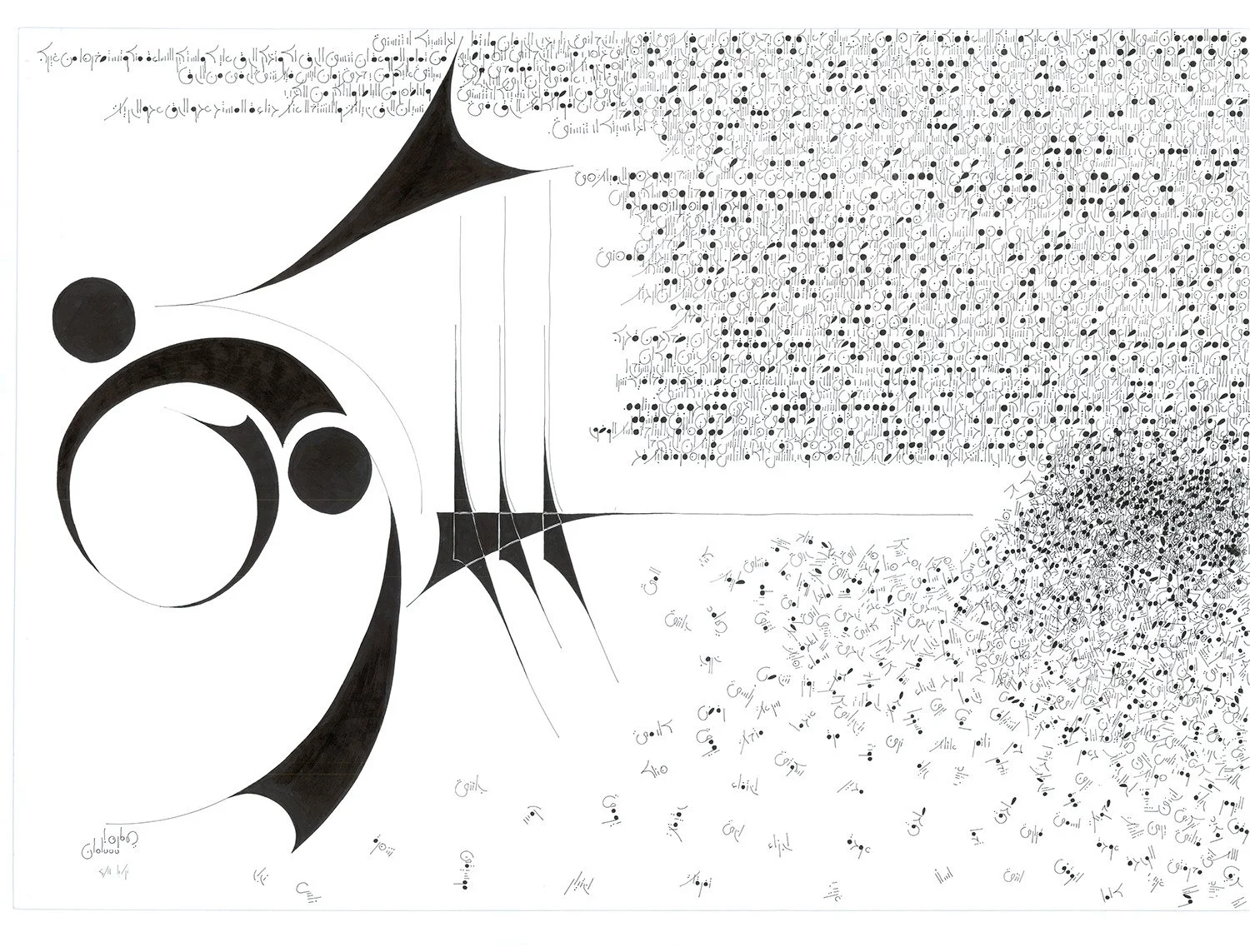
"Silence" is not the absence of words, but a profound presence of the self, a shield safeguarding the soul amidst the world's chaos and contradiction. From this essence emerges 'Silent Art': a visual language that speaks in unheard tones, concealing deep meaning behind a mask of simplicity and geometric mystery.
Saman's architectural training brings structural intention to free expression, each line free and fluid, moving with grace and imperfection, to mirror human freedom and individuality. Within each piece, philosophical depth merges seamlessly with artistic form, where the seen and the unseen, the said and the unsaid, coexist within every line.
sukoon / silence, Black ink on white paper, 100 x 70 cm, 2020 © Saman Zahawi
INTERVIEW
You were born in Baghdad and later moved to Canada. How have your cultural background and personal experiences influenced your artistic journey?
To be born in Baghdad is to be born into an environment where art is not a luxury - it is a cellular part of the culture. You grow up breathing in centuries of poetry, monumental architecture, and a history spanning millennia. That grounding shapes your eye and your soul long before you ever pick up a pen. Moving to Canada introduced a profound shift. When you are displaced from the physical surroundings of your culture, you stop looking at its surface and start searching for its essence. A later period spent in the quiet of Turkey deepened this. Surrounded by nature and isolation, I slowed down completely and immersed myself in the work. That stillness became part of the practice itself.
My artistic journey became a process of distillation. These years of quiet let me strip away the noise until I realized the spiritual weight of my background did not need color or literal representation to exist. Using a strict monochrome palette, I found a way to translate the soul of Baghdad into a universal language of pure, silent form.
You studied architecture before becoming a full-time artist. How does your architectural training continue to shape the way you think about form, space, and composition
Architecture alters your perception of reality; it trains you to understand that space is never an empty void, it is a living volume to be sculpted. I do not approach a blank page as a surface to be filled, but as a structural environment to explore. My training dictates a rigorous internal logic, an awareness of scale, and a respect for the relationship between mass and void. There is always a hidden structural integrity governing the lines, a balance between weight and weightlessness. Whether I am drafting an ink drawing, engraving stone, or designing furniture, the philosophy holds: true artistic freedom cannot exist without a disciplined foundation.

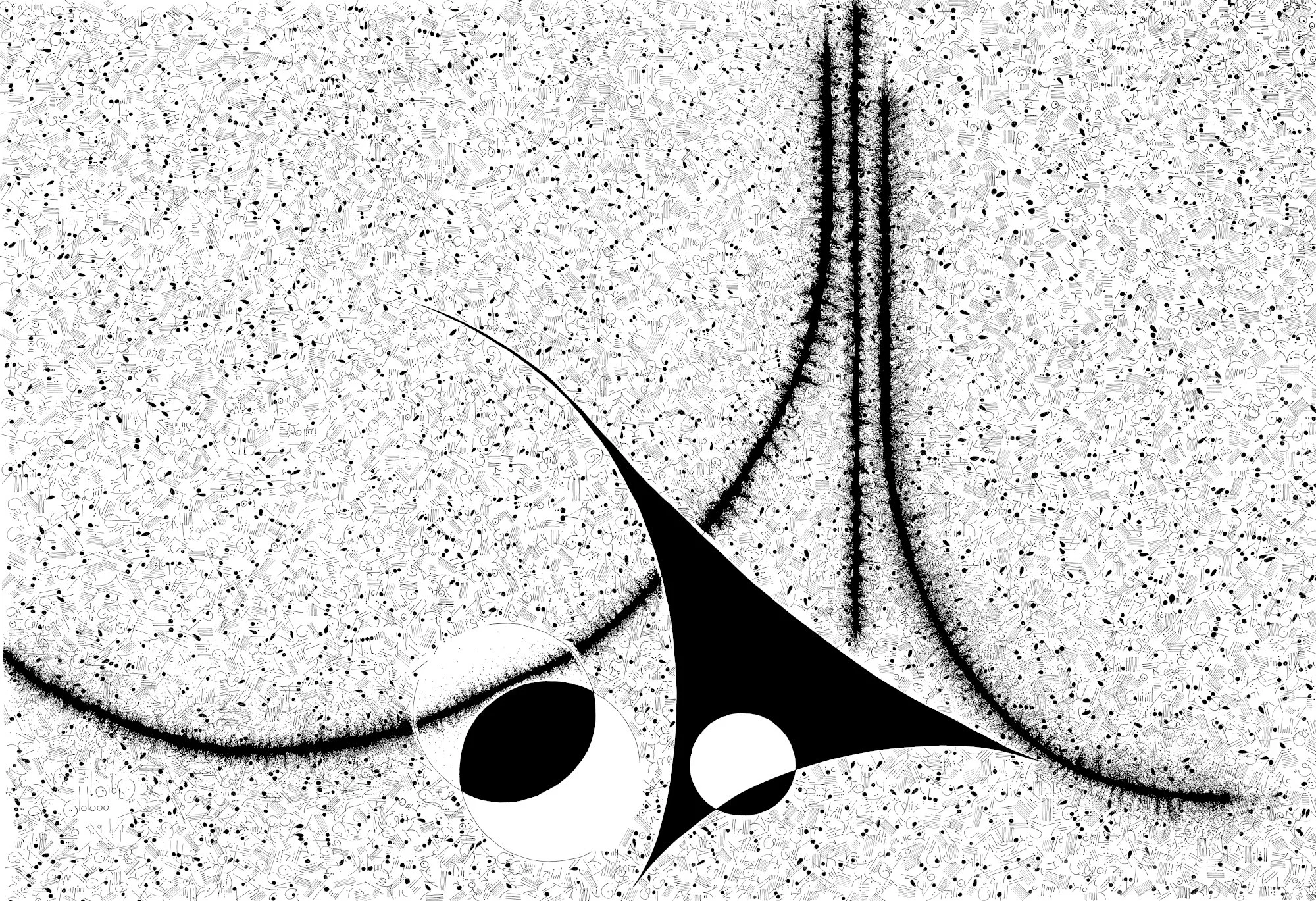
suqoot / the fall, Black ink on white paper, 100 x 70 cm, 2020 © Saman Zahawi
Your signature practice is called “Silent Art.” Could you explain how this concept was born and what silence means within your artistic language?
‘Silent Art' was born from a desire to create a contemplative experience that unfolds across two dimensions. The first is immediate: a high-contrast, monochrome palette of black and white. By removing color, the composition becomes a single focused territory, a visual stillness that captures the viewer, slows them down, and invites them into the details. The second emerges only after time is spent. As the viewer reflects, they discover the work is not truly silent. Beneath the surface lies a deeper narrative seeped in meaning, contradiction, rhythm, and heritage. The first dimension holds the attention, but it is the meaning beneath the composition that ultimately touches the soul.
Your works transform Arabic calligraphy into abstract visual forms. What interests you about moving beyond the written meaning of words into a more spiritual and visual experience?
When a viewer encounters a written word, the mind closes a loop, it assigns a definition and stops exploring. I am interested in breaking that loop. By moving beyond literal meaning, I liberate Arabic calligraphy from its traditional constraints, deconstructing letters into their architectural anatomy, rhythm and imperfection. Stripped of definition, these forms are reborn as pure energy and movement.
But the meaning is never abandoned, it is layered underneath. Each work is built on spiritual phrases drawn from Arab poets, philosophers and thinkers. A single piece may hold several of these sayings, each tied to the central theme, woven invisibly into the composition. The viewer does not need to read Arabic to feel the weight in the strokes. The meaning lies within the universal human experience, the work simply stops telling them what to read and invites them to feel.

mushtaq | مشتاق | "yearning", ink on paper, 85 × 60 cm, 2019 © Saman Zahawi

kalimat | كلمات | "words", ink on paper, 100 × 70 cm, 2019 © Saman Zahawi
Can you describe your creative process? How does an artwork begin, and how do you balance the structure of geometry with the freedom of your hand-drawn lines?
An artwork begins as a silent moment of thought - a philosophical inquiry seeking a physical home. I never sketch or make preparatory drawings; to do so would limit the idea before it can breathe. I approach the blank surface with only the weight of the thought, stepping directly into the unedited flow of creation.
The balance between geometry and freedom is executed entirely by freehand - no rulers, no compasses, no straightedges. The precision comes not from instruments but from an internal architectural compass: a deeply embedded sense of scale, mass, and spatial logic guiding my hand from within. This is where the true tension of my work lies - the illusion of mechanical order, born entirely from the organic imperfection and movement of the human hand.
You work with different materials, including marble, wood, glass, and light. How does your choice of medium influence the message and feeling of each artwork?
I do not define myself by a single medium; I see materials as different languages expressing the same philosophy. The thought stays constant - the medium is the body I give it. Each material has its own soul, and dictates how the silence manifests. On paper, the silence is intimate and immediate. In marble, it becomes permanent and monumental - the same freehand line now carrying the weight of stone. In glass and light, the work turns translucent, and the contrast becomes a play between shadow and illumination. In furniture, it steps off the wall and into the center of gathering - a piece you do not simply observe, but live alongside. Each is a one-of-a-kind exploration of a single question: how does stillness take form in this particular body?
Many of your works explore identity, human experience, and the relationship between the visible and invisible. What themes or questions do you return to most often in your practice?
The inquiry I return to most is the fragile relationship between the visible and the invisible. The most defining elements of human experience, memory, identity, spiritual yearning, and heritage, are entirely unseen, yet carry the most weight in our lives. My practice attempts to give these invisible dimensions a physical, structured home. To do this, the work often navigates opposing dualities: presence and absence, structure and freedom, the transience of life and the permanence of the marks we leave behind. In pure black and white, I map these in their rawest form. The shapes are visible, but the connection between them and the empty space is where the invisible story comes to life.
al-jahl | الجهل | "ignorance", ink on paper, 100 × 70 cm, 2020 © Saman Zahawi

fine line | المنطق واللا منطق | "logic and illogic", ink on paper, 100 × 70 cm, 2019 © Saman Zahawi
How has the public responded to Silent Art, especially across different cultures and countries where your work has been exhibited?
The most consistent thing I have witnessed across every border is that 'Silent Art' requires no translation. People from entirely different backgrounds share a remarkably similar experience. In a world saturated with noise, viewers first approach the monochrome contrast out of curiosity. But standing before the work, something happens: they slow down. The absence of color acts as a rare visual sanctuary, asking for their presence and their time. They are first captivated by the quiet geometry, the extreme detail, then begin to connect with the narrative beneath - the rhythm, the heritage, the emotional weight. When you strip away the noise, you open a doorway where the artwork becomes a mirror for the viewer's soul.
What is also incredibly interesting to observe is how different viewers respond to different pieces - each drawn in by a different part of themselves. Whether pulled by the artwork’s meaning, rhythm or flow, viewers are invited into a deeply personal experience.
Your works combine elements of Arab heritage with contemporary artistic expression. How do you see your practice contributing to conversations around cultural identity today?
Cultural identity should never be a static artifact trapped in the past. For heritage to stay alive, it must breathe, evolve, and move forward. This is at the heart of my practice. The phrases I build my work upon are deeply rooted in Arab tradition, history and language. The words then come to life through Arabic calligraphy, which itself is one of the most beautiful visual languages of humanity. By reshaping these inherited words and this inherited script into contemporary form, I keep them in motion. The heritage does not sit behind glass; it lives. It shows that our legacy is fluid and universally resonant, speaking to the modern soul while remaining fiercely connected to its roots.
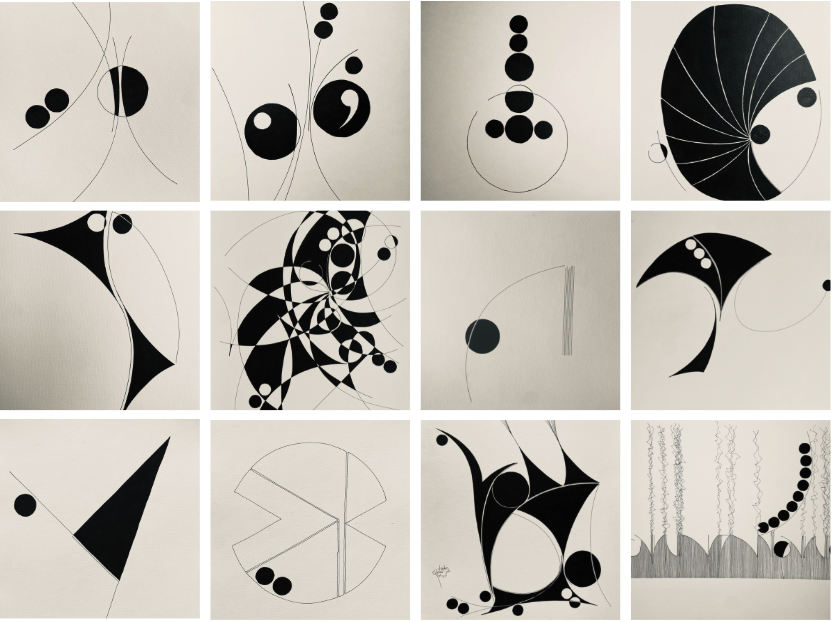
Selection of reflections, ink on paper, 29.5 x 21 cm, on going © Saman Zahawi
And lastly, what are you currently working on, and what future projects, collaborations, or exhibitions would you like to share with your audience?
It has been a very fertile period. The milestone closest to me is a project unlike anything else in my practice: a philosophical art book titled 'Silent Art'. It is not a catalogue - it is a single, original work in its own right. Every page is hand-drawn, moving through different sizes, textures, and meanings. There is only one. I am still considering how something so singular should live in the world, a masterpiece I am in no rush to define.
Looking forward, I am expanding how 'Silent Art' occupies the spaces we live in, while staying committed to my signature black-and-white language. My work in marble continues to excite me, and I am deepening a collection of bespoke furniture, each piece unique, made to be lived with rather than only looked at. The future is about weaving this visual silence into the spaces we inhabit: not only the gallery wall, but the textures we touch and the rooms we move through every day.
Artist’s Talk
Al-Tiba9 Interviews is a promotional platform for artists to articulate their vision and engage them with our diverse readership through a published art dialogue. The artists are interviewed by Mr. Mohamed Benhadj, the founder & curator of Al-Tiba9 Contemporary, to highlight their artistic careers and introduce them to the international contemporary art scene across our vast network of museums, galleries, art professionals, art dealers, collectors, and art lovers across the globe.



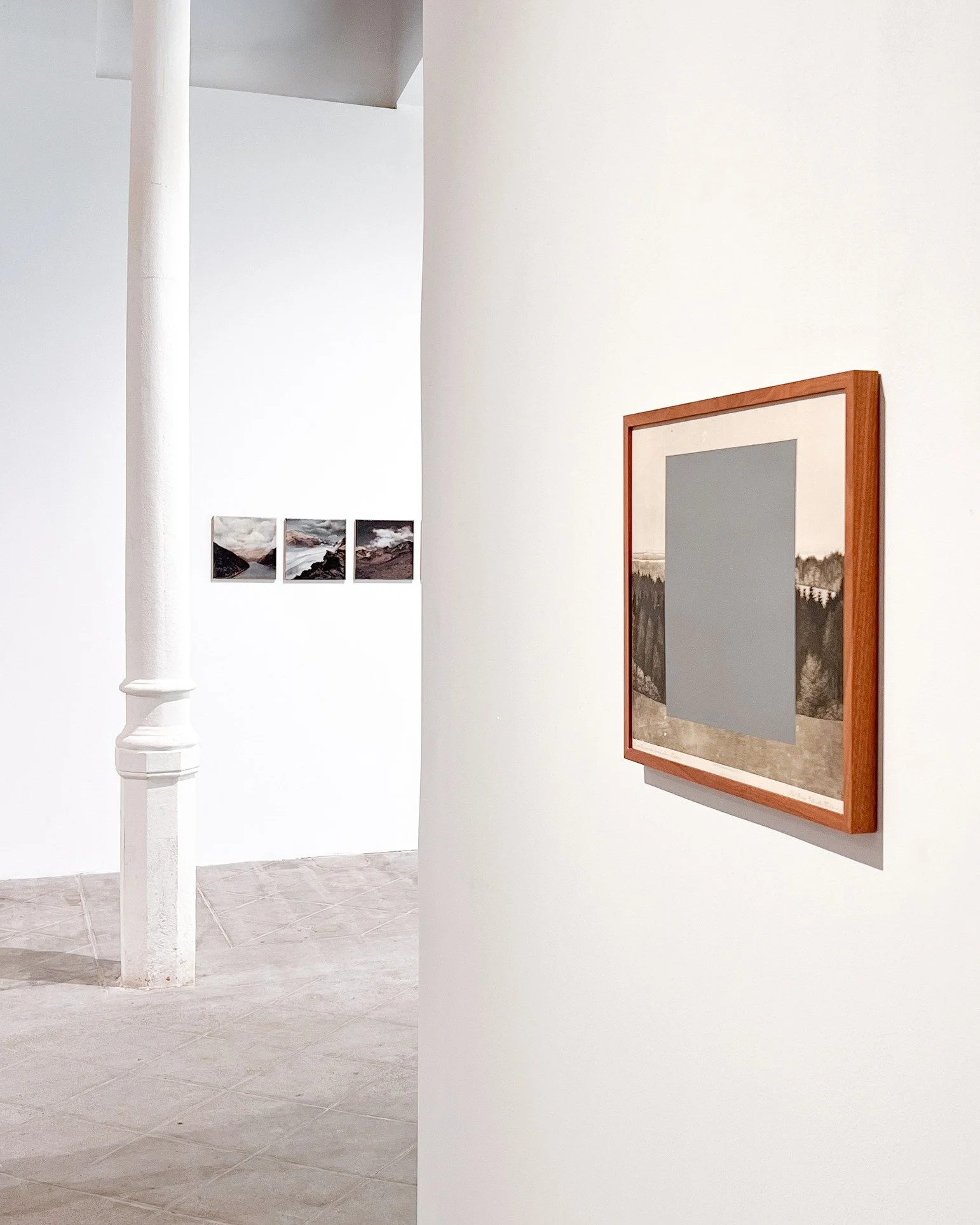
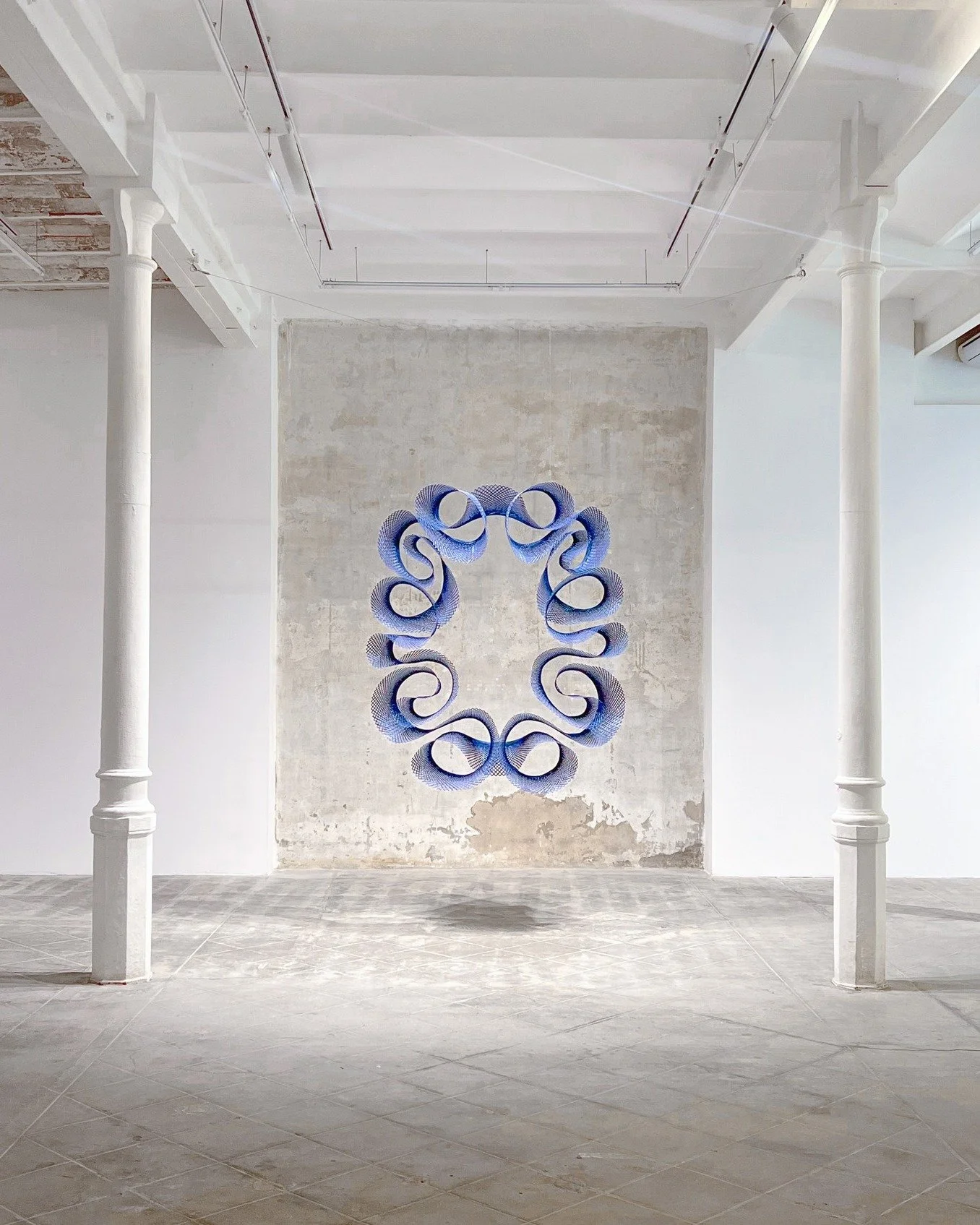
Carla D'Amato's work grew from a close observation of life’s contrasts and the human condition. With an architectural foundation and European training that expanded her technical range, she refined a disciplined craft while continuously pushing the boundaries of image, material, and meaning. Through an intense, ongoing exploration, Carla developed her own authored technique: Performance Painting.