

10 Questions with Wenwei Chen
Wenwei Chen (b. 1999) is a Toronto-based interdisciplinary artist whose practice explores themes of identity, impermanence, and the intertwining of personal and collective histories. Originally from China, Chen holds a Bachelor of Media Arts (Honours) from the University of New South Wales in Sydney, Australia, and a Master’s in Art, Design and Media from the Ontario College of Art and Design University in Toronto.
Chen’s work has been exhibited internationally, with recent shows including the Moordn Art Fair in Guangzhou, Photofair Shanghai, and the RBSA Photography Award Prize exhibition in Birmingham. In Canada, her projects, such as "Embracing the Inexplicable" and collaborative work "Embodiment of the Intertwined," have been featured at the OCADU Graduate Gallery. Her innovative approach has earned her recognition as a finalist for the Artiver AI Awards, and her works are archived by the Powerhouse Museum in Sydney.
Wenwei Chen is represented collaboratively by Art On Space Gallery in Foshan, China (2025–2028) and has been featured in international publications including BlogTO, Sydney Contemporary, and 17:23 Magazine. Through her diverse artistic output, Chen continues to investigate the boundaries of media arts, making her a rising voice in contemporary art.

Wenwei Chen - Portrait
ARTIST STATEMENT
Chen Wenwei approaches photography as a speculative language rather than a mere annotative reproduction of reality. Influenced by her background in editorial design, she utilises photography as a structural tool to investigate how memory, materiality, and power structures intertwine within built spaces, revealing themselves through light, circulation, signage, boundaries, and the nuanced weathering of materials.
Brutalism serves as both the critical context and the fundamental ethics of her practice. Drawing from the movement’s pursuit of formal clarity and structural honesty, she establishes a verifiable method of inquiry: transforming intuitive doubts into visible contradictions and juxtapositions. For Chen, the act of photographing is not a simple capture; it is a construction of an auditable visual system. Grounded in architectural references and spatial logic, and integrated with the relational dynamics of generative prompts, her work relies on fixed lighting scales, repeated site visits, and rigorous arrangement.
Rather than rushing toward conclusions, Chen traces how these conclusions are formed. She continuously identifies judgments often mistaken as “natural,” exposing the latent habits and distributions of attention behind them. To her, photography is both methodology and ethics: it demands restraint, repetition, and prolonged presence, refusing to dilute the complexity of reality with simplified narratives. Acknowledging that the act of seeing is an act of intervention, she recognises that every framing alters the meaning of the image and recalibrates her distance from the world. Through disciplined composition and a scrutinizable visual order, she transforms each image into a speculative site for perpetual revisit.
Embracing the inexplicable - Act 2, photography, 40x30 in, 2024 © Wenwei Chen
INTERVIEW
You were born in Guangzhou and are now based between Toronto and Montreal, with formative studies in Australia. How has this geographically layered background shaped your way of seeing and working?
For me, a cross-regional background is a process of prolonged environmental shock and sensory restructuring. The cities of Guangzhou, Sydney, and Toronto differ vastly in latitude, climate, and historical texture. They are not abstract backdrops but forces that act directly upon material and bodily experience. I’ve felt how humidity inhabits concrete, making surfaces damp and swollen in Guangzhou, and contrasted that with the parched light and granular endurance of brick and timber in Sydney. What one touches is not merely a style, but a way of life co-authored by climate and systemic structures.
My early photography was an erratic form of archiving, glimpsing cultural fragments without a cohesive logic to bind them. This changed in Toronto. Walking through the downtown core in winter, I was struck by a profound sense of estrangement: the remnants of European colonialism, the starkness of the scale, and the relentless efficiency of public spaces. It occurred to me then that documenting architecture as a physical entity is futile.
The real interrogation lies in how architecture, under the guise of neutrality, organises human action, emotion, and judgment; how its underlying ideologies become naturalised; and how it renders certain existences self-evident while quietly marginalising others. I realised then that I have never been photographing buildings as such, but rather that which architecture exceeds in itself, the spiritual tremors and the boundaries of power that persist beyond the structure.

Embracing the inexplicable - Act 3 (The Lone Scene 2), photography, 20x15 in, 2024 © Wenwei Chen
You originally trained in editorial and visual communication design before moving fully into photography. What led you to choose photography as your primary medium?
Long before my formal training in editorial design, the iPhone was already my primary tool for photography. Back then, the medium served as a form of self-salvation. The turbulence of adolescence was often beyond words, yet the flow state I found while photographing allowed the external noise to dissipate. My early work was a product of subconscious impulse, saturated with memory and emotion. I sought no explanation, only a space where those feelings could be contained.
My education in editorial and visual communication granted me a different capacity: I learned not just to feel, but to organise; not just to immerse myself, but to translate that immersion into a legible structure. Photography became my primary medium because it permits these two states to coexist. It preserves the velocity of intuition while accommodating a sense of rigorous restraint.
Today, I still pursue that flow state, but it no longer functions as an escape. Instead, it is my method of engaging with the world. By wandering through unfamiliar neighbourhoods and establishing connections, I constantly recalibrate the distance between myself and the space. Photography has become a way of drawing near. It is not an act of possession, but an opportunity to form a relationship with the site.
You often describe photography as a speculative language rather than a tool for documentation. When did this shift in understanding occur in your practice?
My realisation of photography as a speculative language began the moment I acknowledged that the medium can never be neutral. Even in the most direct imagery, the framing, exposure, and timing, the choice of what is illuminated and what is eclipsed, dictate which version of reality emerges. Consequently, I have moved away from the obsession with proof. I am now more concerned with how seeing is manufactured: how an image induces belief, how it hides, and how it eventually forms a judgment.
In my series Embracing the Inexplicable, I allow photography to inhabit the ambiguous space between originality and authenticity. What we see is not necessarily true; even personal hallucinations and desires can masquerade as facts. To speculate is not to escape reality. Rather, it is to bring reality back to a perceptible level while acknowledging that visibility itself is forever fractured by gaps.
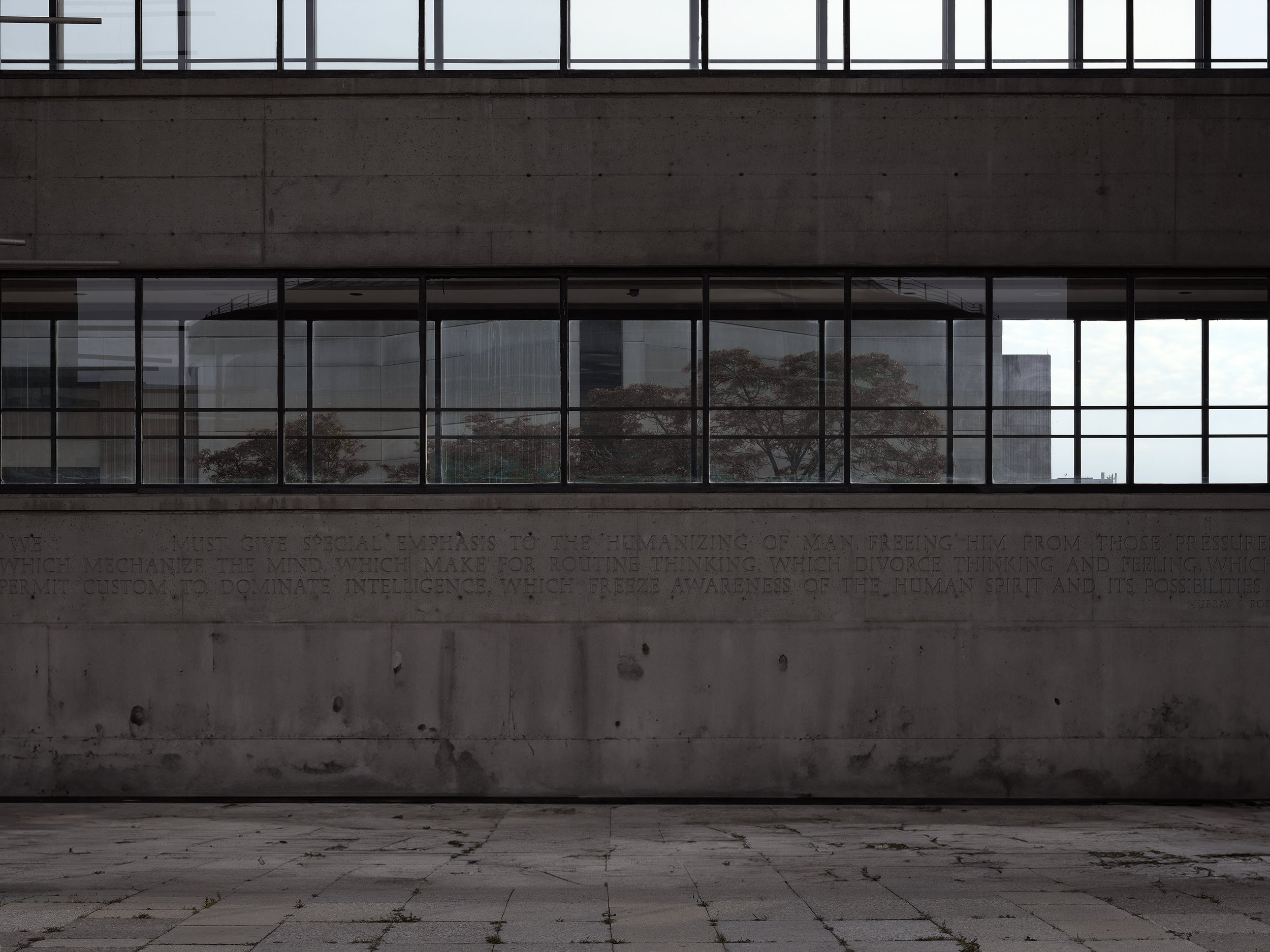
Embracing the inexplicable - Act 3 (The Lone Scene 1), photography, 20x15 in, 2024 © Wenwei Chen

Embracing the inexplicable - Act 4 (The Leviathan Scene 4), photography, 20x15 in, 2024 © Wenwei Chen
Architecture, particularly postmodern and Brutalist structures, plays a central role in your work. What draws you to this imagery?
This transition occurred when I realised that photography is not inherently synonymous with evidence. On the contrary, photography is often the very mechanism that manufactures a sense of evidence. The credibility of documentary work frequently stems from a familiar set of visual rhetorics: clarity, order, a seemingly neutral perspective, and lighting that appears devoid of emotion. These elements induce a psychological state of belief, prompting the viewer to lower their guard and accept the image as truth.
As I began to consciously observe this mechanism, photography shifted from an act of bringing back reality to an act of testing how reality is believed. I now establish a trustworthy tone within the image while embedding subtle contradictions. These do not rely on overt drama; instead, they function through slight incongruities that force the viewer to pause between belief and doubt, ultimately reclaiming the responsibility of judgment.
For me, this represents the essence of speculation. It is not about fictionalising reality, but about making the process of looking visible. Photography thus becomes a language used to discuss how attention is distributed, how a sense of factuality is constructed, and how authorship moves within the image.
Your images explore memory, perception, and the politics of space. How do these themes emerge during your research and site visits?
Architecture is where ideology becomes inhabitable. It organises the body before it influences the mind. Circulation, thresholds, signage, and the weathering of materials quietly dictate how we move, where we belong, and who is granted entry. I am drawn to Brutalism because it amplifies this mechanism to the point of being unavoidable. It does not offer a consumable facade; instead, it confronts the gaze through sheer mass, traces of labour, and the weight of consequence.
Juhani Pallasmaa noted that the task of architecture is to structure our being-in-the-world through embodied metaphors, placing the individual back into the continuum of culture and history. For me, Brutalism achieves this with a sharper edge. It insists on the exposure of raw materials and the visible marks of construction. This anti-aesthetic stance does not hinder memory. On the contrary, it possesses the power to activate the collective subconscious precisely because it refuses to please the eye.

Embracing the inexplicable - Act 3 (The Lone Scene 3), photography, 20x15 in, 2024 © Wenwei Chen
Your process involves repetition, fixed lighting conditions, and prolonged observation. How important is time in shaping the final image?
These themes are rarely motifs I bring into the site; rather, they emerge actively from the environment itself. Often, architecture is experienced through use rather than sight. You find yourself forced to accelerate in a corridor, compelled to pause at an entrance, or feeling an inexplicable sense of trespass in certain corners. The politics of space manifests in minute details: the tone of signage, the density of surveillance, the layers of access control, or even why a bench is designed to discourage lingering and why a floor makes footsteps uncomfortably clear. These elements quietly embed the logic of who belongs and who must depart into the fabric of the everyday.
Memory functions as a subterranean current. It is not necessarily personal recollection but often a residual collective emotion. Weathering, repairs, rust, and overlapping layers of coating act as the editorial marks of time. Through repeated visits, I have discovered that the meaning of a space shifts according to the duration and manner of one's presence. If you move quickly, it functions as a utility. If you linger, it evolves into a narrative. Upon returning, it stands as a form of testimony. The purpose of research and revisiting is not to gather more comprehensive facts, but to allow the space to exert a counter-force upon the gaze, compelling an acknowledgement that perception is not a passive reception but an active participation.
Brutalism is not only an aesthetic reference but also an ethical framework in your practice. How does this influence the decisions you make while photographing?
In my work, time holds two distinct meanings that ultimately converge into a singular weight. The first is the time inherent within the architecture itself. Brutalism often presents itself as permanent, yet it continually betrays its own vulnerability in reality. Water stains, cracks, corrosion, the absence of maintenance, and abrupt repairs all etch history into the material. Though seemingly silent, these structures offer a continuous narrative of shifting systems, urban amnesia, and the transition of futuristic visions into the lived experience of decay. A surface is never just a surface; it is history compressed.
The second is the time I invest on-site. For me, waiting is not an interval between shots but the very price of seeing. Returning to a location repeatedly under fixed conditions is not an attempt to manufacture a uniform style, but rather to grant change an evidentiary quality. I seek to verify what persists stubbornly across different moments and which details only permit themselves to surface after a prolonged presence. Many so-called 'obvious' elements become suspicious under sustained scrutiny, while faint, low-contrast existences gradually gain form through the act of waiting.
When I say time shapes the image, I mean that the final photograph is not the result of a momentary capture but the intersection of these two timelines. The historical time of the architecture provides an irreplaceable deposition, while the time I spend waiting renders that deposition accessible. Consequently, the image is no longer a mere act of seeing; it is a confirmed presence.

Embracing the inexplicable - Act 3 (The Lone Scene 4), photography, 20x15 in, 2024 © Wenwei Chen

Embracing the inexplicable - Act 3 (The Lone Scene 5), photography, 20x15 in, 2024 © Wenwei Chen
You emphasise restraint and rigour over narrative clarity. How do you navigate the tension between complexity and readability in your work?
I do not equate legibility with explanation, nor do I view complexity as deliberate obscurity. For me, legibility is a mode of entry. It provides a path into the image without promising a definitive conclusion. Complexity is not an obstacle; it is the inherent density of reality. The balance I seek is not between the complex and the accessible, but rather between control and openness.
I strive to grant my images a rigorous, steadfast structure, an accessible form capable of sustaining prolonged contemplation. Yet, within this structure, I retain elements that cannot be immediately digested, ensuring that the act of looking transcends mere recognition. As viewers navigate the frame, they undergo a cognitive shift: from 'I understand' to 'I am no longer certain,' and finally to 'I realise why I am so anxious to understand.' This trajectory transforms viewing from an act of consumption back into a lived experience.
Brutalism has taught me the value of this resistance. While anti-aesthetic, it activates profound collective emotions precisely by refusing to offer immediate visual gratification. In my photography, I aim to establish a similar order; one that is disciplined but not closed. I want the composition to be a site one can return to repeatedly, rather than a puzzle to be solved and discarded. Subtle disturbances, such as the rare emergence of red, are vital here. It attracts the eye but offers no reward, leaving only a lingering tension. It is within this discomfort that viewers confront their own habits of seeing. Clarity, then, ceases to be a service and becomes a question of ethical weight. We must ask ourselves whether we are willing to acknowledge that some existences refuse to become submissive simply to be understood.
Are you currently developing any new series or body of work, and what questions are guiding it?
I am currently developing a series titled Thresholds. While it utilises Brutalist architecture as a primary context, my interest lies not in its stylistic identity but in how it externalises the very conditions of seeing. Mass, texture, shadow, and circulation collectively dictate which information is swiftly validated and which is delayed or suppressed, remaining suspended between the visible and the invisible. In this work, Brutalism functions as an ethical medium. It refuses to simplify space into an instantly consumable image, instead forcing the act of looking back into the realms of the body, time, and physical position.
The series advances an observer-dependent view of reality. Facticity is not uniformly granted; rather, it is temporarily generated through the interplay of light scale, vantage point, duration of presence, and the commitment of attention. Photography, therefore, ceases to be a mere collection of spatial data and becomes a verifiable method of inquiry. By employing fixed viewing conditions and repeated visits, I transform seeing into a deliberate process of confirmation and choice. This process holds more significance for me than the final result. It reveals how visibility is manufactured and distributed, bringing a concrete dimension to the empirical proposition that existence does not automatically equate to visibility.

Embracing the inexplicable - Act 3 (The Lone Scene 6), photography, 20x15 in, 2024 © Wenwei Chen
Looking ahead, what are your main artistic goals for 2026, both conceptually and professionally?
Conceptually, I am working to push the inquiry into the manufacturing mechanisms of photographic credibility to a sharper dimension. Rather than addressing technology through grand narratives, I aim to reveal the subtle touchpoints of how we are induced to believe and how we quietly surrender our judgment within the seemingly natural act of looking. I want my new work to deliver a definitive realisation that looking is itself an action which constantly recalibrates our distance from the world.
Professionally, I aspire to steer my work into higher-quality discursive spaces. This includes participating in publications with greater academic depth, site-specific spatial presentations, and deep collaborations with curators and writers who are experts in relevant fields. I do not seek explosive exposure. Instead, I prioritise whether my work can be accurately decoded within a global context and whether it can generate a lasting resonance.
Ultimately, I hope to elevate my practice from the level of stylistic recognition to that of methodology and ethics. I am not satisfied with my work merely being seen. I want it to be rigorously used and discussed, functioning as a speculative tool that remains active and effective over time.
Artist’s Talk
Al-Tiba9 Interviews is a curated promotional platform that offers artists the opportunity to articulate their vision and engage with our diverse international readership through insightful, published dialogues. Conducted by Mohamed Benhadj, founder and curator of Al-Tiba9, these interviews spotlight the artists’ creative journeys and introduce their work to the global contemporary art scene.
Through our extensive network of museums, galleries, art professionals, collectors, and art enthusiasts worldwide, Al-Tiba9 Interviews provides a meaningful stage for artists to expand their reach and strengthen their presence in the international art discourse.



Shingo Ohta is a Japanese photographic artist based in Toyooka, Hyogo, near the Sea of Japan. After a long career in business and regional revitalization, he turned to photography as a primary artistic practice, developing an ongoing body of work centered on the sea as a living, volatile, and almost sacred force. His images transform waves, spray, light, and weather into abstract forms.