

10 Questions with Kjersti Ochsner
Kjersti Ochsner is a Seattle-based artist working in wall-mounted sculptural abstraction. Using recycled paper, she creates tactile, dimensional works focused on repetition, process, and visual rhythm. She holds a Master’s degree in Art History from the University of St Andrews.

Kjersti Ochsner - Portrait
ARTIST STATEMENT
“My wall-mounted sculptural work explores abstraction through repetition, texture, and visual rhythm. Each piece is constructed from thousands of tightly rolled strips of recycled magazines and discarded paper, adhered to wood panels through a labour-intensive, intuitive process. Rather than beginning with a predetermined composition, the work develops organically over time, allowing patterns, density, and form to emerge through making. The repetitive act of rolling and placing paper becomes central to the work itself. Accumulation functions both structurally and visually, creating dense surfaces that emphasise depth, shadow, and subtle shifts in colour. As light moves across the three-dimensional forms, the sculptures change with distance and viewpoint, rewarding slow, sustained looking. What initially appears uniform reveals variation upon closer inspection; irregularities in texture, compression, and spacing that reflect the physical process behind each piece. While fully abstract, the works often evoke natural, architectural, or cellular structures, inviting viewers to project their own associations onto the forms. This openness resists fixed interpretation and instead emphasises visual experience over narrative. My practice is rooted in an interest in process, repetition, and transformation, specifically how everyday, overlooked materials can be reconfigured into contemplative objects. By foregrounding material presence and labour, the work asks for quiet engagement and attentiveness. These pieces are not meant to be quickly consumed but slowly encountered, offering moments of stillness through accumulation, pattern, and form.”
— Kjersti Ochsner
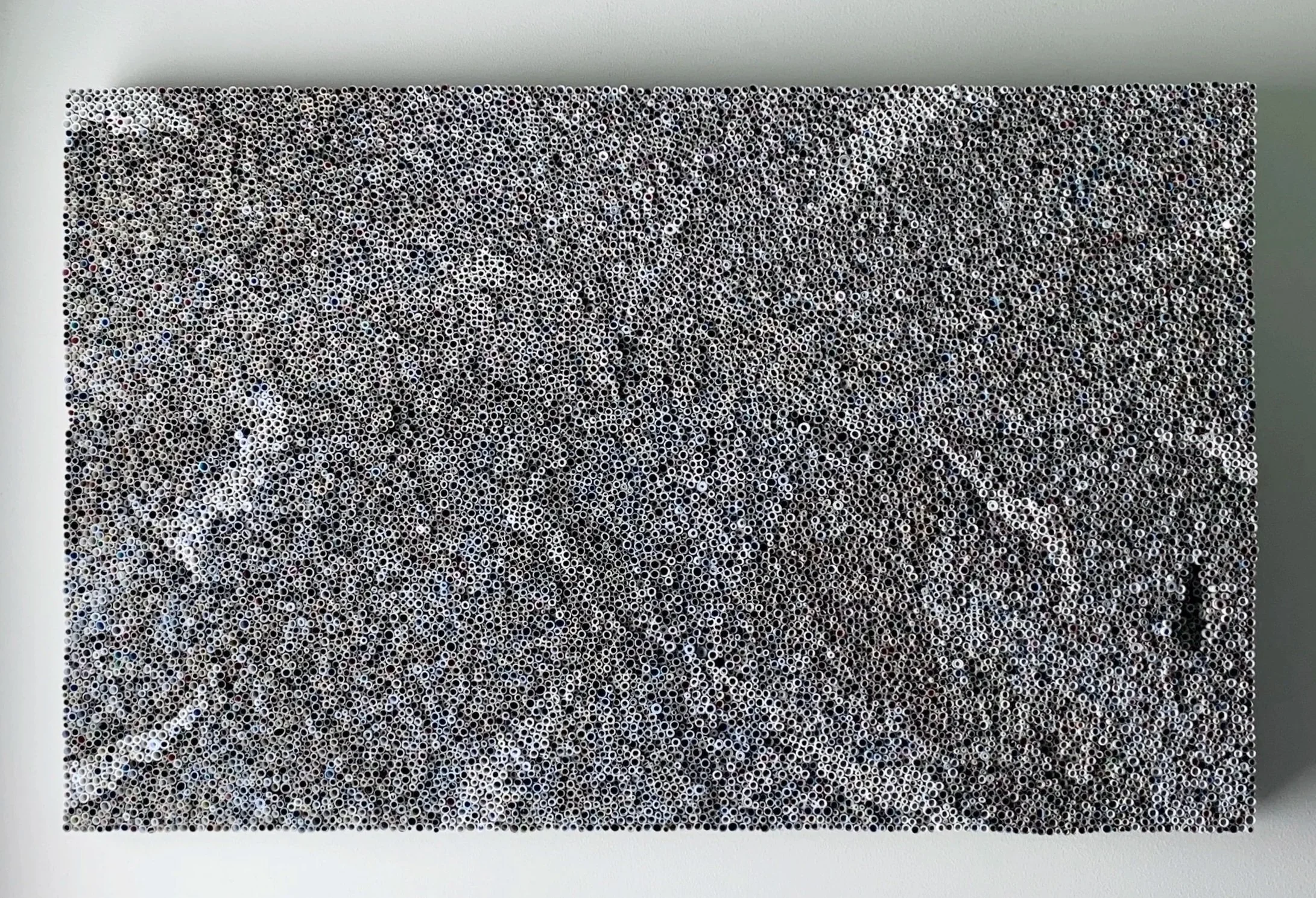
Loop Hole, Paper Relief, 38x24x2 cm, 2023 © Kjersti Ochsner
INTERVIEW
Let’s start from the basics. How and when did you begin working with recycled paper as your primary material?
I began working with recycled paper during university while trying to complete an assignment without purchasing additional materials. I had a stack of magazines and catalogues on hand, so I started experimenting with how I could use them to create something three-dimensional.
What began as a practical decision quickly became central to my practice. I was interested in how a material that is typically discarded could be reworked into something structured and deliberate. That initial experimentation led me to continue developing the process.
What interests you about repetition as a central element in your artistic process?
I’m interested in how repetition creates structure, rhythm, and variation at the same time. It allows the surface to shift depending on light and perspective. The process is consistent, but the outcome is never exactly predictable, which keeps it engaging for me. Each individual element may be simple, but together they create something more complex.

Loop Hole, Paper Relief, 38x24x2 cm, 2023 © Kjersti Ochsner
Your work develops without a fixed plan. How do you know when a piece is finished?
Because the process is intuitive, I rely on a sense of visual resolution rather than a predetermined endpoint. As the piece develops, I’m constantly evaluating balance, density, and movement across the surface. The materials also shape that decision. Once the elements are adhered, they’re not easily removed, so each stage involves a level of commitment. As the surface develops, the work reaches a natural endpoint. When it feels cohesive and fully built out, I stop.
Can you describe the physical and mental experience of creating thousands of paper rolls for one artwork?
The process is both physically and mentally repetitive. Rolling thousands of pieces requires consistency and patience, but over time, the movement becomes meditative. Mentally, it creates a kind of rhythm. The repetition gives me space to concentrate without overthinking, while the larger structure of the piece continues to develop. Even though each individual action is simple, the accumulation of those actions gradually builds something much more complex.

Crevice, Paper Relief, 38x24x2 cm, 2022 © Kjersti Ochsner
How does light influence the way your sculptures are perceived?
The sculptures are highly responsive to light. The variation in height across the surface creates subtle shifts in shadow, which change depending on both the light source and the viewer’s position. Shadows deepen or soften depending on the angle. Light also affects how colour is perceived. As the angle changes, different parts of the paper become more visible, altering the overall appearance of the piece. The surface isn’t static; it responds to its environment.
Your works are abstract but often evoke natural or architectural forms. Are these associations intentional?
The references are emergent rather than planned. As more pieces are added, it can begin to suggest natural, architectural, or cellular forms, but those connections aren’t the starting point.
I think it’s natural for viewers to look for familiar patterns within abstraction. The eye tries to organise what it’s seeing, especially in work that doesn’t offer a single focal point. I’m interested in allowing that process to happen without directing it. Different viewers often see different things, and that openness is important to me. The work doesn’t point to one interpretation, but instead creates space for multiple readings to exist at the same time.
What role do slowness and sustained looking play in how you hope viewers experience your work?
That slower engagement allows the structure of the piece to become clearer. Changes in light, shadow, and colour aren’t always visible at first glance. They develop as the viewer spends more time with the work. As a result, the work asks for sustained looking. The longer someone spends with it, the more subtle changes they notice: how light shifts across the surface, how colour appears differently at different angles, and how the structure softens or sharpens with distance.

DejaVu, Paper Relief, 38x24x2 cm, 2022 © Kjersti Ochsner

Cluster, Paper Relief, 38x24x2 cm, 2020 © Kjersti Ochsner
How does your background in art history inform your artistic practice today?
My background in art history has given me a perspective on how art functions within different historical and cultural contexts, how movements develop, how ideas shift over time, and how work is experienced rather than just interpreted.
It also clarified what I’m interested in as an artist. Studying art history made me realise that I wanted to make work, not just study it. I’m drawn to art that is experienced physically and perceptually, rather than something that relies on a fixed meaning. That idea, that different viewers can have different responses to the same piece, has stayed with me and continues to inform how I approach my own work.
Why is it important for you to work with discarded or everyday materials?
The use of discarded materials began as a practical choice, but it has become central to my work. I was using materials I already had access to, and that led me to continue working with them.
I like that I’m able to use something that would otherwise be discarded or recycled and turn it into something more intentional. I’m also drawn to the tactile quality of the material and how it contributes to the surface and structure of the work.

Excavation, Paper Relief, 38x24x2 cm, 2019 © Kjersti Ochsner
And lastly, what are you currently exploring or developing in your practice?
I’m currently interested in expanding the range of the work in terms of scale, both smaller and larger pieces. I’m also exploring how colour can play a more active role, rather than being something that emerges incidentally through the material.
At the same time, I’m thinking about how the work might begin to more strongly suggest topographical or geological structures. Those references have appeared in the work before, but I’m interested in developing them further while still maintaining an abstract approach.
Artist’s Talk
Al-Tiba9 Interviews is a promotional platform for artists to articulate their vision and engage them with our diverse readership through a published art dialogue. The artists are interviewed by Mohamed Benhadj, the founder & curator of Al-Tiba9, to highlight their artistic careers and introduce them to the international contemporary art scene across our vast network of museums, galleries, art professionals, art dealers, collectors, and art lovers across the globe.


David Moješčík - MojDa is a Czech sculptor. His work is centred on figurative sculpture, the human body, and the female figure. Modelling in clay and with digital tools, he ultimately prioritises manual engagement with materials. . He draws inspiration from yoga philosophy with the concepts of non-violence and human-centeredness, as well as from Egyptian, ancient, and European classical sculpture.