

10 Questions with Zihua Mo
Zihua Mo is an architectural designer and visual artist based in Philadelphia, holding a Master of Architecture from the University of Pennsylvania. He came to architecture through urban planning, drawn away by the desire for something he could actually sculpt: form that resists, material that has temperature, space that can be inhabited rather than only administered. That cross-scalar training never left him; it shapes how he moves between the scale of a city and the detail of a surface, between the systemic and the sensory.
His work is grounded in the concept of synthetic nature. His projects have been exhibited internationally, including at the Venice Architecture Biennale, and have received recognition from numerous global design awards.
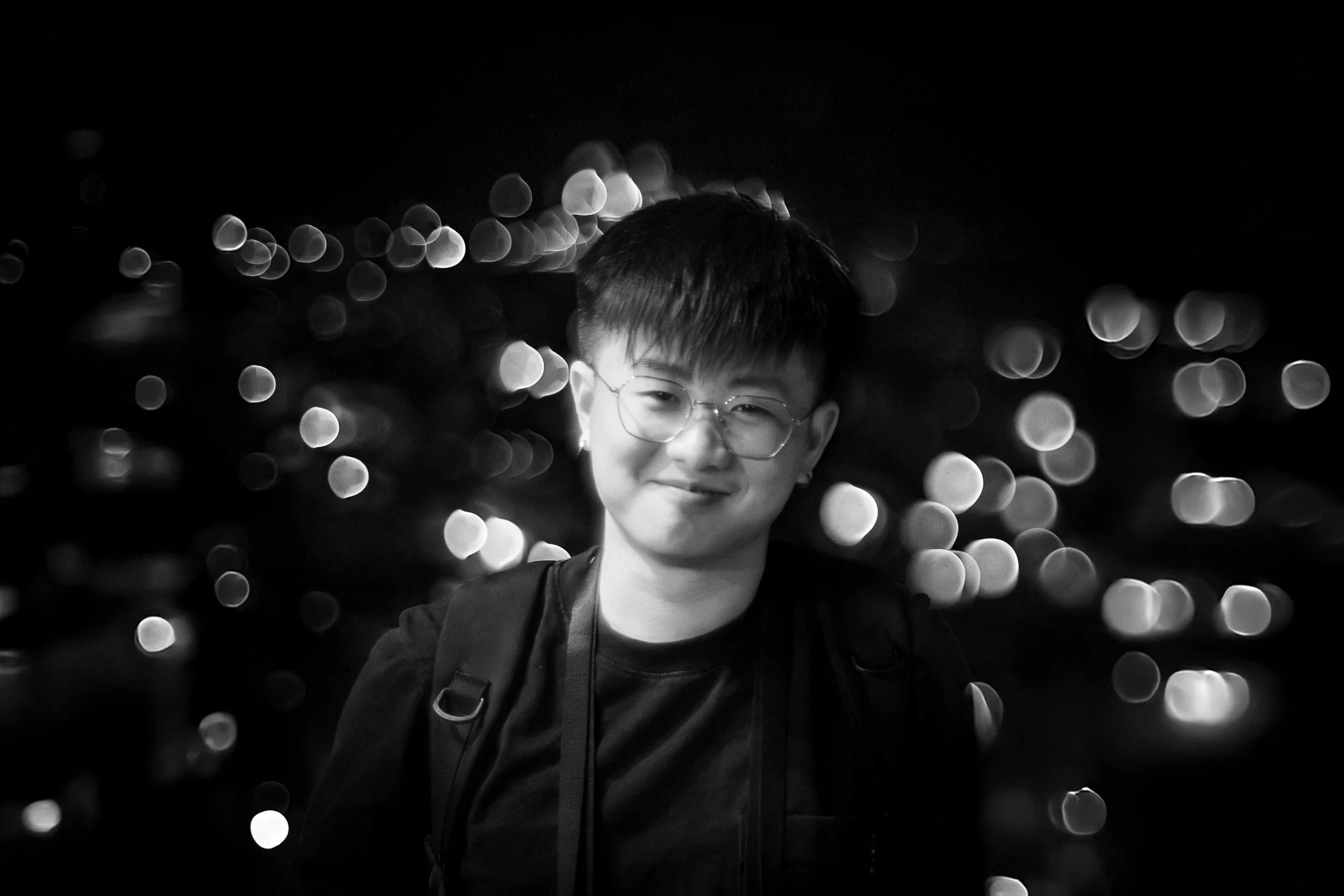
Zihua Mo - Portrait
ARTIST STATEMENT
Zihua Mo's practice begins with a question he does not expect to answer: where does the artificial end and the natural begin?
Working across architecture, urban speculation, and digital imagery, Mo operates at a scale that resists easy categorisation. Trained first in urban planning before pursuing architecture, he thinks in systems as much as in forms, attentive not only to what a thing is, but to what it does to everything around it, beneath it, and after it.
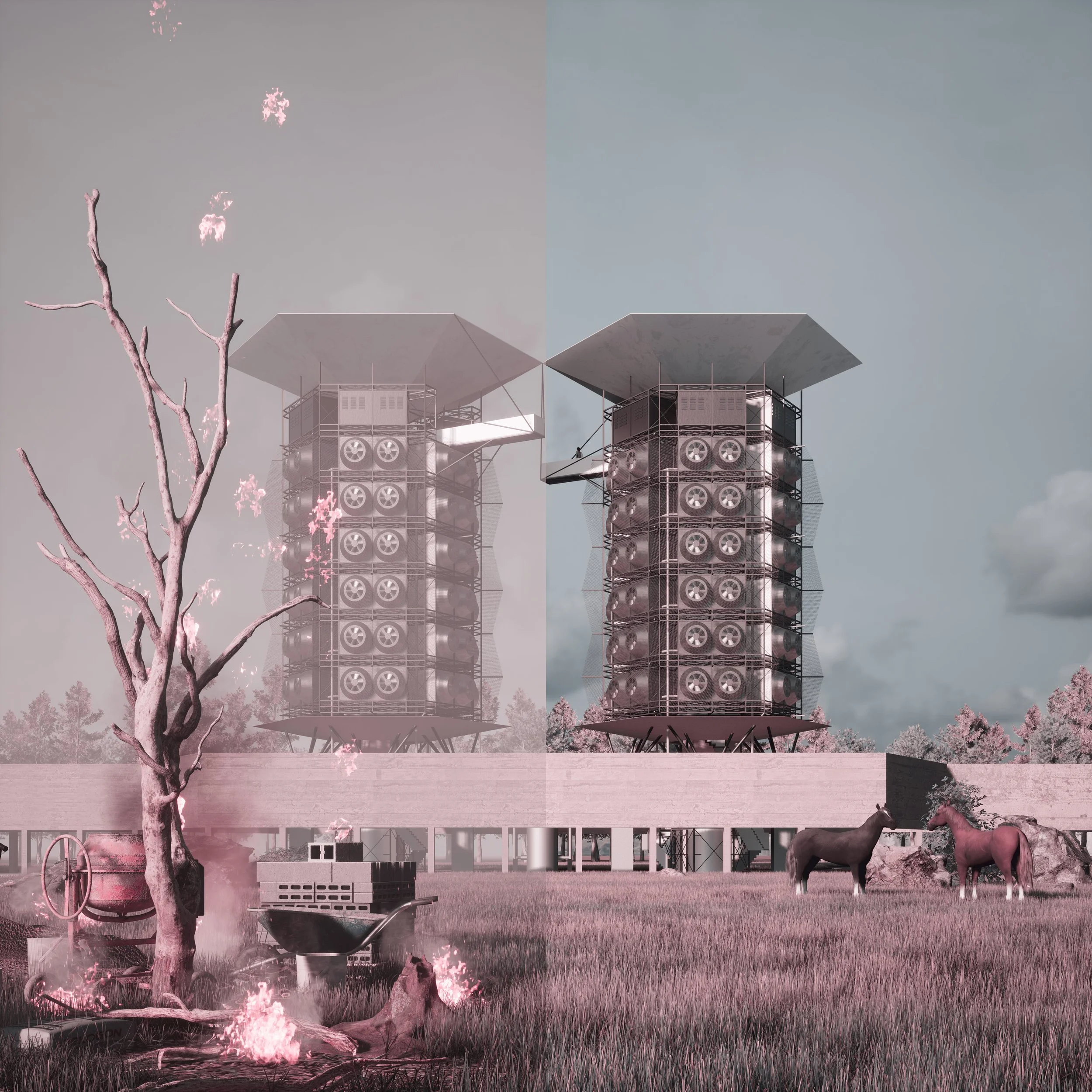
At the core of his work is the concept of synthetic nature: the condition in which the designed and the evolved become genuinely indistinguishable. Mo does not treat this as a problem to be solved, but as a tension to be inhabited. His images construct environments where the man-made and the organic are locked in a pull that produces neither winner nor resolution, surfaces that appear simultaneously grown and engineered, structures that seem to have always belonged to the landscape that now reclaims them.
This sensibility extends into his working method. Precise geometric control and biological intuition are not opposites in his practice, one enables the other. The more surgically rigorous the intervention, the more organic the result feels.
Was this made, or did it grow? The question, left unanswered, is the point.
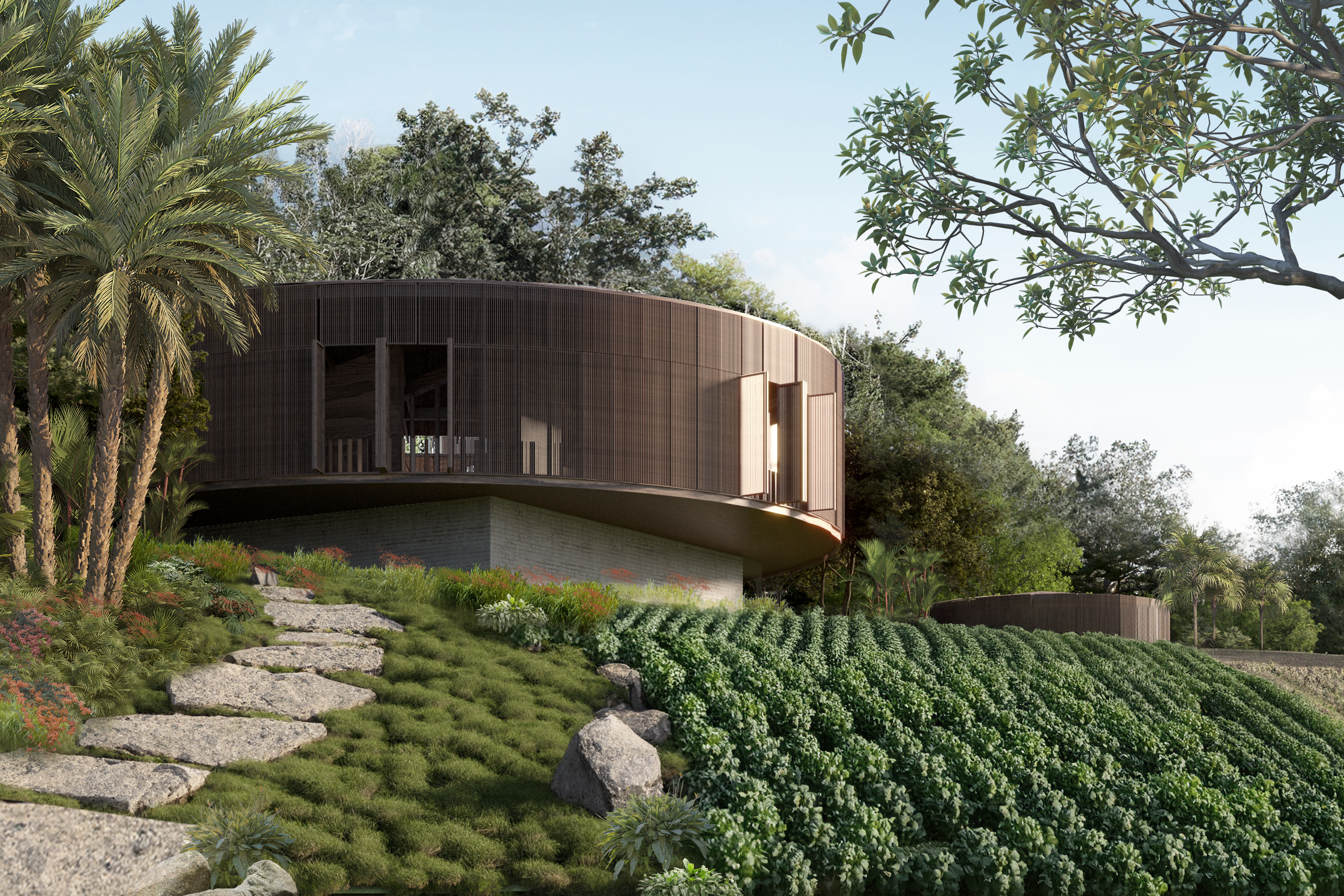
Micro Ecologies, Beach View, Digital Rendering, 2023 © Zihua Mo
INTERVIEW
Let's start with your background. You began in urban planning before moving into architecture. What pushed you toward working with form and material more directly?
Architecture has the power to directly change the world, even if it's just a small corner of it. Urban planning, for me, was too macro, too abstract, too indirect. It deals mostly with invisible "power structures" and "networks". To give you a concrete picture: during my studies, a typical project would involve researching a small town's current conditions, its industries, demographics, and land use, then conducting on-site interviews with local government officials, business owners, and village representatives. From all of that, you'd produce a five- or ten-year development plan. That plan also had to nest within larger-scale frameworks, where the town sits within the city, where the city sits within the province, ultimately reconciling competing interests into a single planning scheme. And what it all comes down to is cold data: land-use designations, floor area ratios, building footprints.
What drew me to architecture is its tangible physicality and the fact that it also defines a void, the negative space a building creates. Architecture is a rare balance of art and engineering. I can feel the warmth of a material, the tension of a form, while also working through the rationality of plans and sections. It involves aesthetics, but also commercial and political logic. Realising a building means managing engineering and coordinating teams. In short, it's more human.

Micro Ecologies, Beach View, Digital Rendering, 2023 © Zihua Mo
How does your cross-scalar thinking, from city systems to surface details, shape the way you approach a project?
The way I see it, regardless of scale, it's all fundamentally one discipline, shaping the surface of this planet, the environment where we and every other species live. The modern industry fragments a project into urban planning, landscape, architecture, interiors, and so on. But if you can think across scales and disciplines, your mind becomes its own multidisciplinary team, and every aspect of a project gets considered. That way, a single concept can run through the entire design, from the macro down to the micro; every layer is coordinated, collectively building one coherent world.
Take "dissolving" as an example. If that's the driving concept, then at the urban scale, the building's program and spaces should interpenetrate with its surroundings, blurring where one ends and the other begins. At the mid-scale of form, different surfaces should meet softly, radiating outward from a point. At the micro scale of materials, transitions between finishes should feel equally seamless. I don't "switch" between scales; I think about the same question at all of them simultaneously.
Your work revolves around the idea of "synthetic nature," as you mention in your statement. When did this concept first become central to your practice?
It started at Penn. Studying under professors who refused to stay within the boundaries of conventional architecture, my thinking got rewired. I gradually came to feel that the old binary, artificial versus natural, was outdated. Most of us spend the majority of our lives inside buildings and cities. So I began asking: between "pure nature" and "pure machine," is there a hybrid state? Should architecture and cities become a new kind of synthetic nature? Can the design and construction of the built environment take on some of the characteristics of natural systems and living organisms? Over time, when I looked back at my own work, I found that "synthetic nature" was already the thread running through all of it.
You often blur the boundary between what feels grown and what feels constructed. What interests you about this ambiguity?
I'm wary of clarity, because clarity often means total domestication. What I'm after is something I'd call an "uncanny intimacy." When a building looks like a living organism in the middle of growing, yet carries the cold precision of mechanical fabrication, that ambiguity forces people to stop and ask: Does this thing have a life of its own?

Dissolving Corbin Building, 3D Section, Digital Rendering, 2025 © Zihua Mo

Dissolving Corbin Building, Street View, Digital Rendering, 2025 © Zihua Mo
How do architecture and visual art inform each other within your practice?
Architecture often begins with a concept, a process full of thinking about colour, proportion, light, atmosphere, all in the abstract. But architecture usually ends up landing in physical reality. Visual art can serve as a simple bridge between concept and built form, but more importantly, it can create another world, one that belongs to the architecture yet exists outside of reality. Architecture demands discipline around space, structure, and scale. Visual art gives architecture freedom. Architecture provides the real; visual art provides the imagined. One tangible, one ethereal, they complete each other.
In my own practice, this plays out most directly through rendering. My images are not illustrations of a design; they are design decisions in themselves. The weather I choose, the wear on a surface, the density of people in a scene, the angle of light, none of that comes from the architectural drawing. It comes from a separate set of instincts about mood and narrative. Sometimes those image-level decisions feed back and reshape the architecture itself.
Your projects balance geometric precision with organic intuition. How do you negotiate control and unpredictability while working?
Different phases call for different tools. The early conceptual stage always starts with sketching, collage, even AI-assisted image blending, open, divergent forms of making, full of uncontrollable sparks of intuition. But control is what ultimately reveals a designer's command of form. I move into 3D digital modelling, essentially forcing myself to reconstruct the previous stage's outcomes with deliberate points, lines, and surfaces, layering rational logic onto what was instinctive and unruly.
For example, the façade of my Dissolving Corbin Building drew its formal inspiration from the growth patterns of natural plants. But in the elevation drawings, those organic forms are disciplined into varying combinations of straight lines and arcs that approximate and present them. That tension is what gives the final work both mathematical rigour and something primal, a kind of wild vitality.

Rock and Roll, The Manimal, Digital Rendering, 2022 © Zihua Mo
Many of your environments feel speculative or unresolved. Do you see your work as proposing futures or questioning the present?
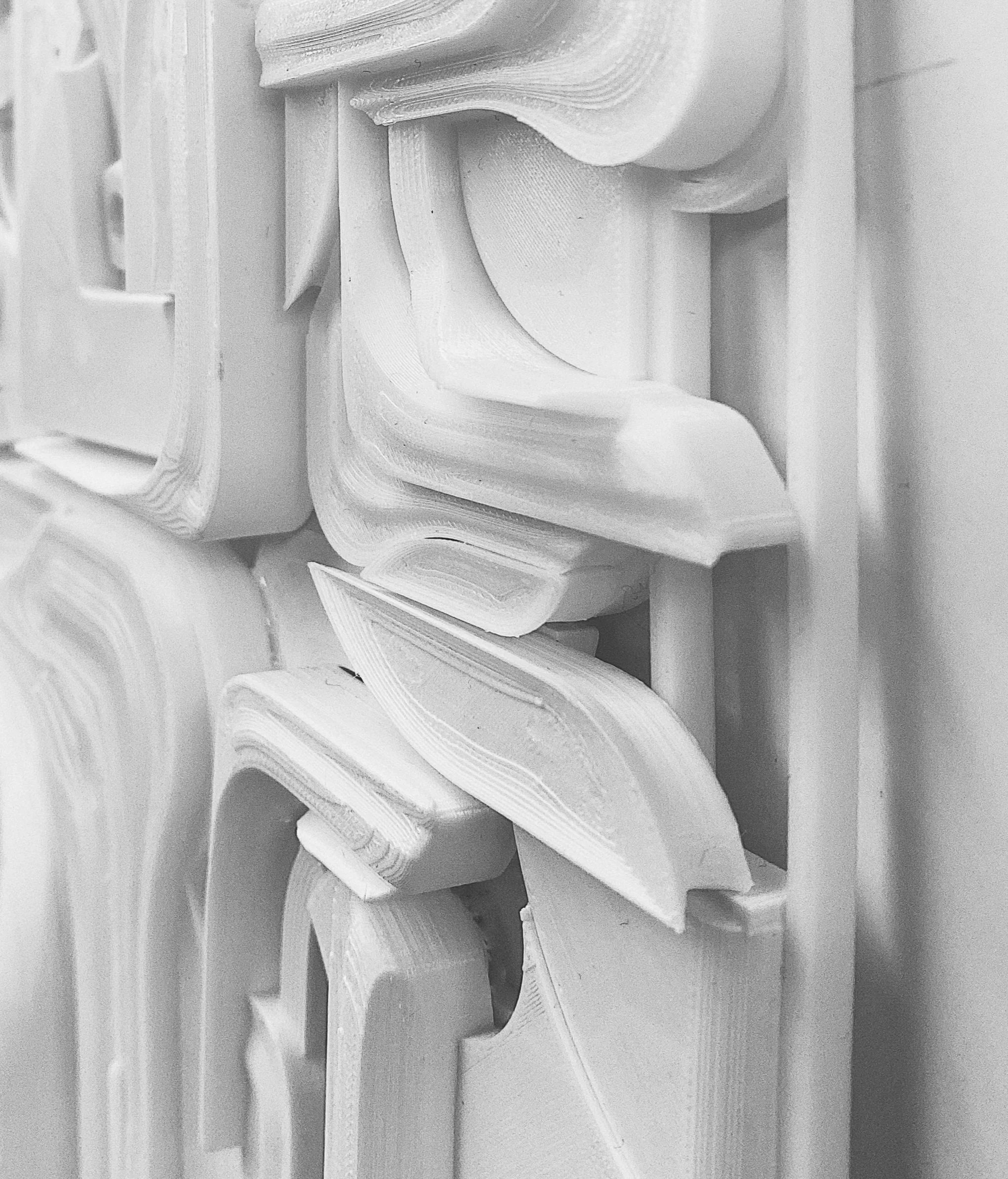
I'd call what I do "extrapolative realism." I'm not fabricating some unreachable utopia. I'm taking an existing tendency in the present and pushing it to its extreme, making what's hidden visible. Adaptive reuse of landmark buildings, ceramic 3D printing, vertical farming, shared living, and food culture, none of these concepts is new. My Dissolving Corbin Building essentially assembles these scattered, already-existing ideas and drives them to their limit. Rather than predicting the future, I'm giving the contradictions and latent potential of the present a physical container you can see.
Materiality and atmosphere seem important in your thinking. How do you imagine the physical experience of spaces that may exist only as images?
An image is not a substitute for architecture, it is a spatial experience in its own right. In the same way, a powerful story doesn't require the reader to have lived through it. Even when a space exists only in pixels, I can still "touch" it with my eyes. Congestion, humidity, grime, haze, darkness, dense buildings, brick material, put those together and you can feel New York without being there. I usually work with cinematic digital rendering, grounding scenes in real, everyday settings so that the viewer and I can be immersed, generating sensory and emotional resonance. The image, in the end, is a reality that transcends reality.

Wonder-trash-land, Digital Rendering, 2022 © Zihua Mo
Having exhibited internationally, including at the Venice Architecture Biennale, how has audience reception influenced your perspective on your work?
Feedback is more like a mirror for me, it reveals details or dimensions I couldn't see from my own vantage point. I neither ignore it nor follow it blindly. For instance, after exhibiting my Micro Ecologies project, an architect commented that the project was essentially 3D printing. And he was right, using the natural principle of stalactite formation to reshape a cliff face, isn't that a kind of synthetic-natural 3D printing? That was an angle I'd never considered.
Another well-known architect remarked that young designers tend to overcomplicate things, that if it were up to him, he'd just keep one small building and call it done. I can see his point; that approach would make the scheme extremely pure, very artful. But "publicness" and "complexity" are vital topics I keep returning to, so I wouldn't choose to design aloof objects; I prefer architecture that engages with the complexity of its context.
Lastly, what questions are currently driving your research and shaping the next phase of your practice?
My next pursuit is what I'd call "radical mundanity." I know many architects gravitate toward cultural architecture as vehicles for free expression, museums, galleries, pavilions. But I'm interested in reshaping the kinds of urban spaces and building types people pass through every day without noticing: dull, purely transitional streets; car-dominated neighborhoods stripped of human-scale detail; scattered, decaying infrastructure; cookie-cutter housing and office blocks. I want to see what happens when rigorously functional space meets radically sensory artistic intervention.
Artist’s Talk
Al-Tiba9 Interviews is a curated promotional platform that offers artists the opportunity to articulate their vision and engage with our diverse international readership through insightful, published dialogues. Conducted by Mohamed Benhadj, founder and curator of Al-Tiba9, these interviews spotlight the artists’ creative journeys and introduce their work to the global contemporary art scene.
Through our extensive network of museums, galleries, art professionals, collectors, and art enthusiasts worldwide, Al-Tiba9 Interviews provides a meaningful stage for artists to expand their reach and strengthen their presence in the international art discourse.




Zihua Mo is an architectural designer and visual artist based in Philadelphia. Working across architecture, urban speculation, and digital imagery, Mo operates at a scale that resists easy categorisation. At the core of his work is the concept of synthetic nature: the condition in which the designed and the evolved become genuinely indistinguishable.