
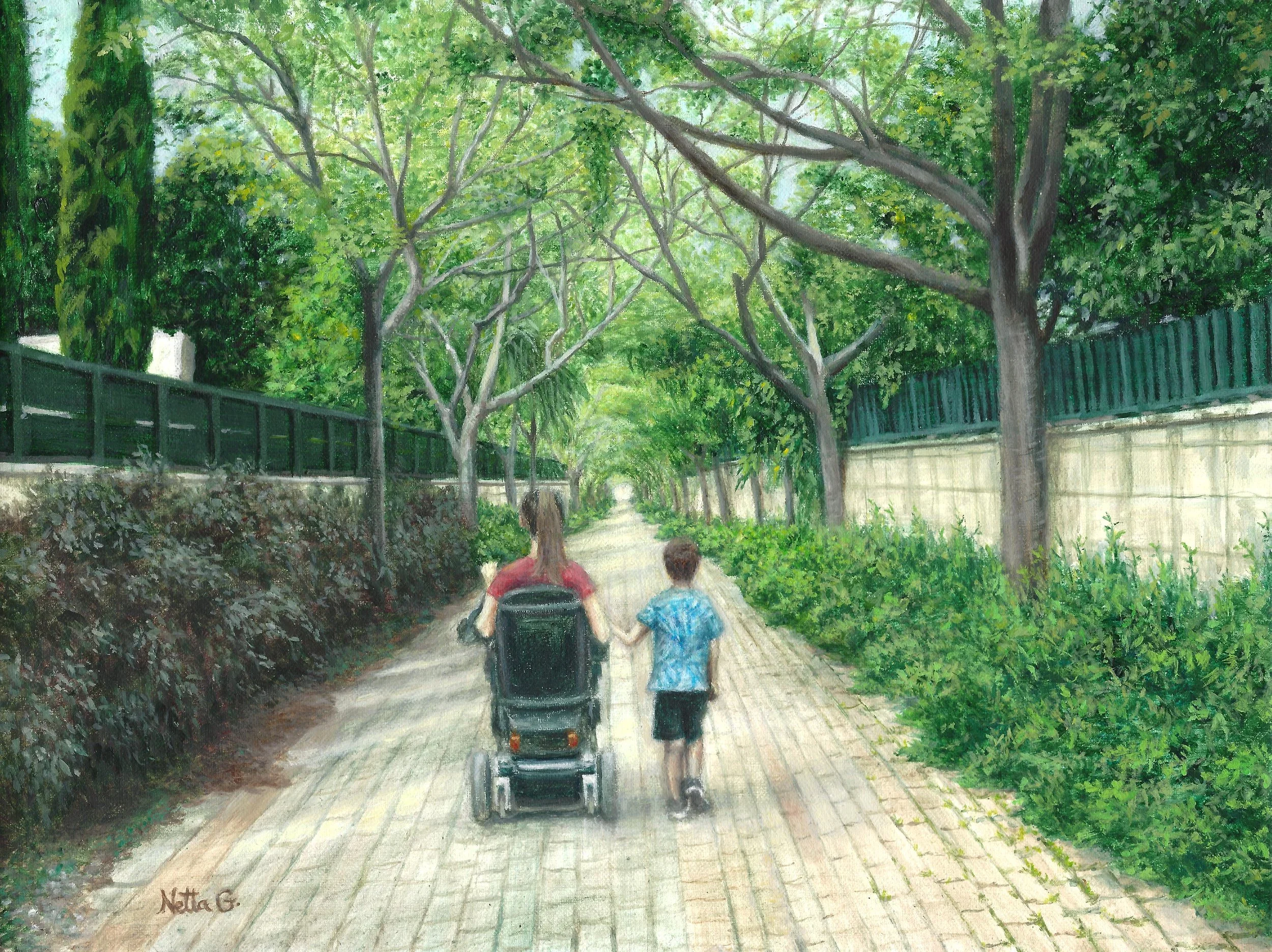
10 Questions with Netta Ganor
Netta was born on 28 October 1979 in Jerusalem, Israel. As a child, she was always keen on art and enjoyed making art crafts and working with different materials.
On 25 November 1994, at 15 years of age, her life was completely turned upside down. One Friday afternoon, like a thunder strike, she became paralysed from her neck down within less than an hour due to a very rare syndrome named Transverse Myelitis - a neurological phenomenon with no known cure or cause.
During a long period in a rehabilitation hospital and after weaning off the ventilator to which she was connected for 18 months, she taught herself how to paint with her mouth. It is through practice and hard work that she realised she could do anything; her body may be limited, but what she could do and achieve was limited only by her mind.
In 2003, she was accepted to the International Association of the Mouth and Foot Painting Artists (AMFPA), which turned her painting hobby into a profession. The MFPA, which has over 800 artists worldwide, supports disabled artists who cannot paint with their hands by selling reproductions and prints of their artworks on various products. Netta’s work has been recognised and published on the association’s products in countries like the US, Canada, New Zealand, Japan, Norway, Finland and France.
In 2012, Netta authored and illustrated her first children’s book, “Who is Wooly?”, which was published by the MFPA and dedicated to her firstborn son, Itai. In 2017, the MFPA published her second children’s book, “Sniffy the Shrew”, and in February 2021, her third book, “Secret Door”, was out. All of her books have been selling widely in Israel.
In 2015, Netta became a Member of the MFPA. Her work has been displayed in numerous group exhibitions in Israel and abroad. In early 2018, she held her first solo exhibition at the city hall of her hometown, Rishon Letziyyon, and ever since, she has conducted over 30 more solo shows.
Netta navigates her artistic career in parallel to being a mother of two and a wife, working in Israel’s high tech industry (she has a Bachelor’s degree in Computer Science and an MBA in Information Systems) and being an inspirational speaker & promoter of awareness to people with disabilities. She is trying to expose as many people as possible to her work and to the MFPA, and is constantly participating in art exhibitions in Israel and abroad.
She sees her art as a medium that allows her tremendous freedom in being creative and conveying a message to the world, that, regardless of her physical disability, she is "high on life", full of hope and optimism and always trying to see the glass half full. She wants to inspire people to believe that almost everything is possible if you only put your heart and mind to it.
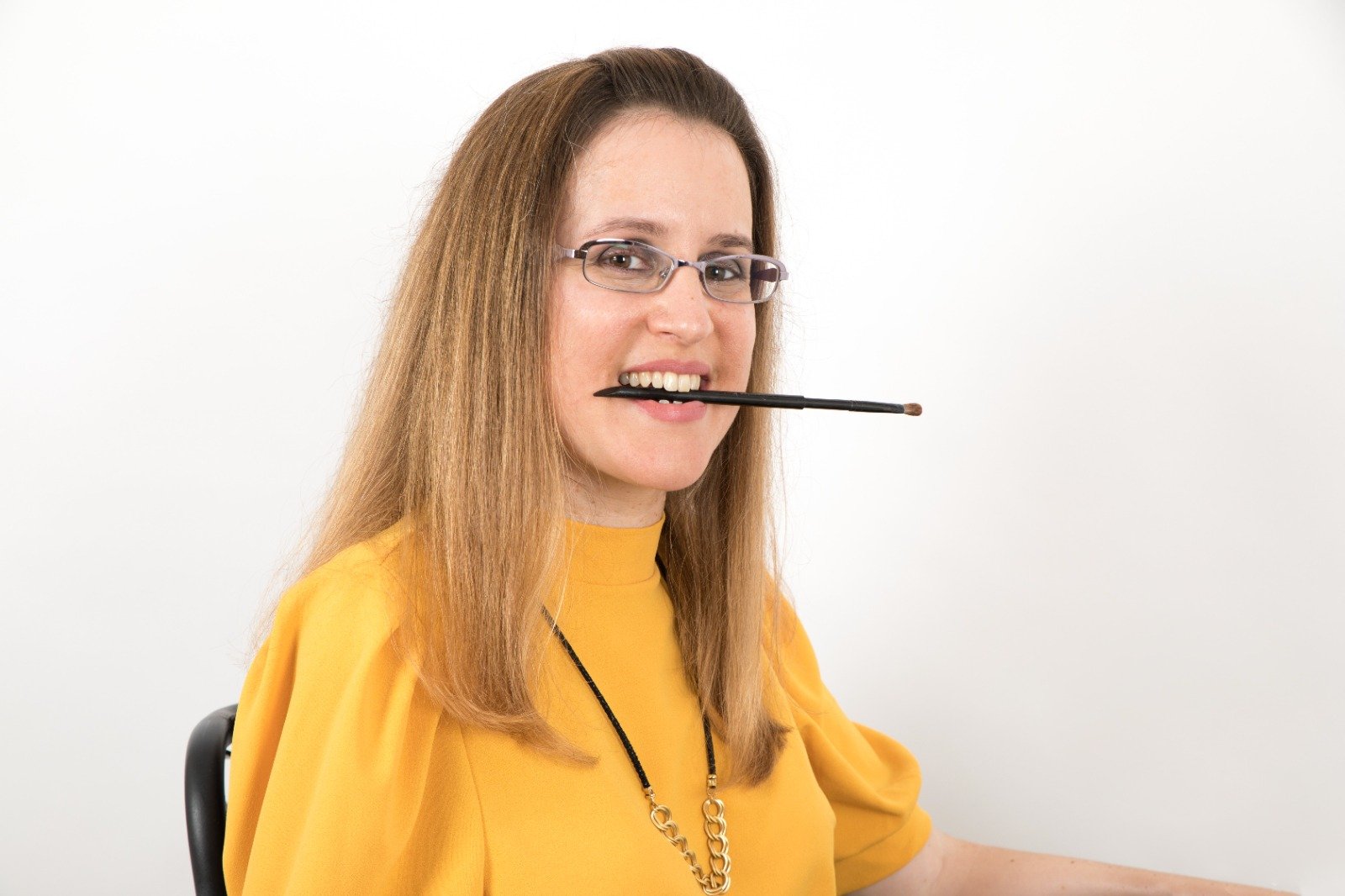
Netta Ganor - Portrait
ARTIST STATEMENT
“Painting is where I find my independence. Without the use of my hands due to my physical disability, the brush in my mouth becomes an extension of myself, allowing me to transcend my physical confines. My paintings are rooted in realism, yet I use colour, light and mood to carry emotion and meaning; images that are both true to life and personally interpretive.
I'm drawn to painting my children growing up, and the experiences of motherhood and living with a physical challenge. I often use bold, saturated hues to reflect an optimistic outlook and a belief in living fully despite limitations.
Although I am especially drawn to figurative work, I also create still lifes, landscapes, and scenes of urban nature that help me study composition and atmosphere. Whether depicting human connection, natural surroundings, or the quiet significance of objects, my goal is to create paintings that are faithful yet personal, challenging perceptions of disability and showing that life with limitations can be full, rich, and meaningful.” - Netta Ganor
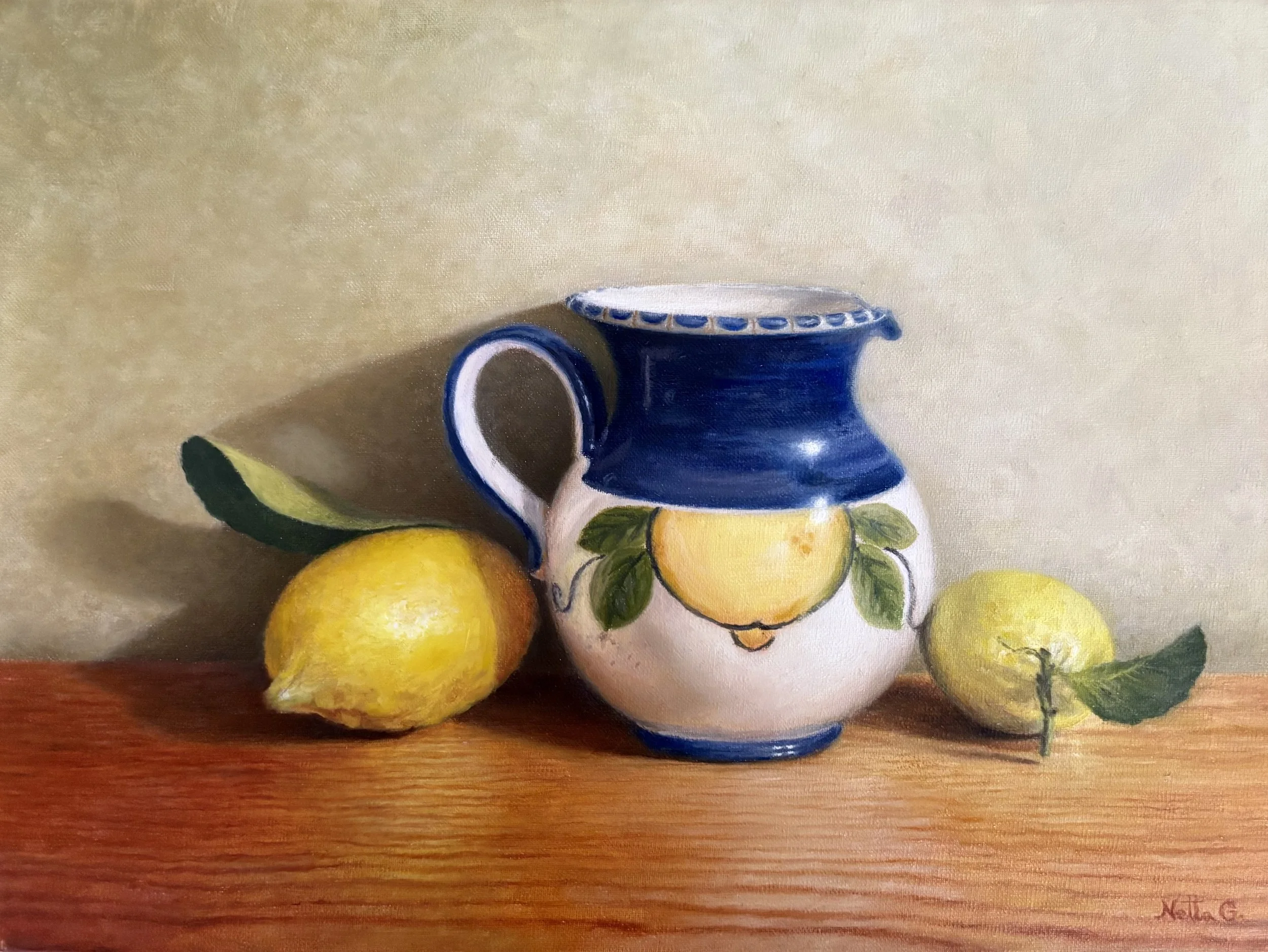
Three Lemons © Netta Ganor - Courtesy of the Association of Mouth & Foot Painting Artists worldwide
INTERVIEW
Let’s start from the beginning. Can you tell us about your early relationship with art before your life changed at 15?
I grew up in a family where creativity was always present. My great-grandfather was a master carpenter, my grandfather worked in metalwork, and my aunt painted and sculpted. So there was always something in the air.
As a kid, I loved making crafts with my hands. I could sit until the late hours of the night just creating. There wasn’t a material I hadn’t worked with; whether it was polymeric clay, fabric, paper, wood, stones or wool, my hands were always busy with something.
Painting, actually, was less interesting to me back then. It wasn’t really my thing, and honestly, I wasn’t particularly good at it either. It was more the making, the crafting, the physical act of building something from nothing. I never thought of any of it as a career or even a calling. It was just part of who I was.
How did you first learn to paint with your mouth, and what were those early experiences like?
In November 1994, when I was fifteen, I came back from school one Friday afternoon, and in less than one hour, I couldn’t move or feel my body. I was diagnosed with Transverse Myelitis- a rare syndrome that inflamed my spinal cord and left me paralysed from the shoulders down. For 18 months, I was even dependent on a ventilator because my breathing muscles were initially paralysed, too.
During rehabilitation, I met a mouth and foot painter. When I saw her painting with her mouth, something just clicked. Having no hand & finger function, my passion for making handicrafts was taken away from me, but suddenly, when I saw that painter, I knew that mouth painting was my only chance at making art again, so I decided to try it. The first attempt was a complete disaster- not even a doodle, more like something a toddler might produce. That was deeply frustrating, and I basically threw the pen out of my mouth and wanted nothing more to do with it.
But something kept nagging at me. The urge to try again wouldn’t go away. So I did, and this time I decided I wasn’t going to give up. It took enormous patience and physical effort, but after a few months, I was technically able to paint with my mouth the way I used to paint with my hand. Once I had the technical foundation, I could actually focus on learning to paint properly. My aunt taught me here and there when she came to visit me in rehabilitation, but mostly I learned by trial and error.
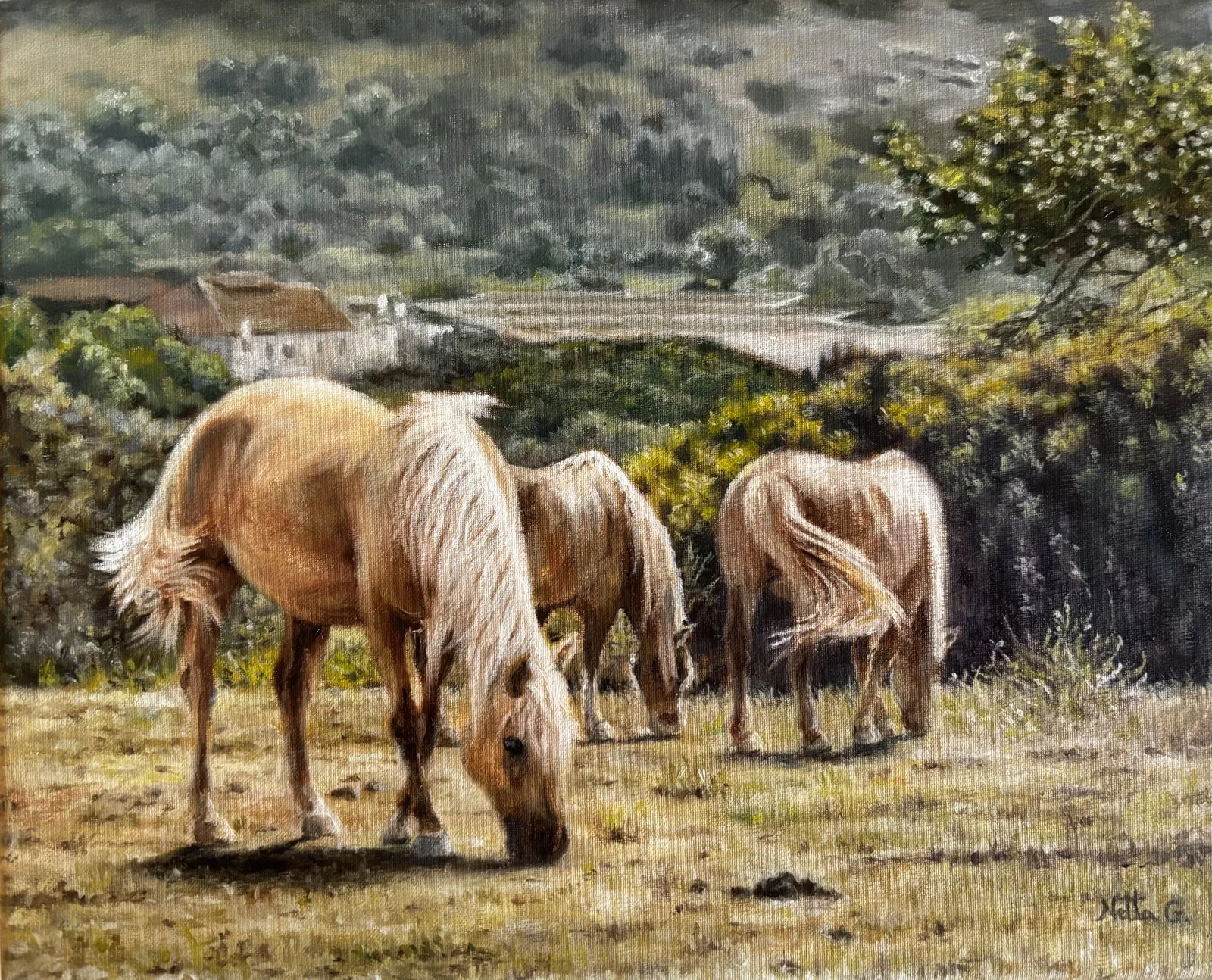
Wild Horses © Netta Ganor - Courtesy of the Association of Mouth & Foot Painting Artists worldwide
What does painting give you today that you don’t find in other parts of your life?
Independence. That’s the clearest word for it. I work in high-tech, I’m a mother, I give lectures, and in all of those roles, there are always logistics, accommodations, and things I need significant help with. However, when I’m painting, the only thing between my mind and the canvas is the brush. My creativity has no physical limits, really. Yes, my scope is more limited, and yes, I do need my custom-made painting device and paintbrush holder, but otherwise I’m almost completely independent. That’s something I can’t fully replicate anywhere else.
There’s also something deeply therapeutic about painting that I don’t find anywhere else. Painting is my mental home, a place I go to that belongs entirely to me. The satisfaction of creating something from nothing, of watching a blank canvas become a world, is unlike anything I’ve experienced in any other part of my life. It restores me.
Your work is rooted in realism. What draws you to representing the world in a realistic way?
I’d call my style romantic realism rather than strict realism. I’m drawn to it because I’m interested in emotion and real-life detail simultaneously. I want to capture something true about a moment, a scene, or even an object, but I also want the viewer to feel something, not just recognise what they’re looking at. Realism gives me the vocabulary to do that. When I paint a horse, or my child’s face, or a field of flowers, I want the painting to hold the viewer long enough so that they stop just seeing the subject and start feeling the atmosphere and the emotion. That’s the goal.
How do you translate emotion into colour, light, and mood when you are painting?
Colour is where it starts for me. My palette is quite bold and saturated. I’m not afraid of strong colour, and I think that naturally reflects something about how I see the world. There’s an optimism in it that I don’t try to suppress.
Mood, for me, comes from something more layered than colour alone. It’s about the combination of precision and freedom: knowing when to be exact and when to let the brush move more loosely, more intuitively. And it’s about the scene itself. I’m drawn to painting moments that tell a story, where the surroundings have meaningfulness. Light plays into that, too. How it falls, what it picks up and what it leaves in shadow can completely change the emotional temperature of a painting. A painting comes alive when all of those things work together: the colour, the looseness, the narrative weight of the setting and the light.
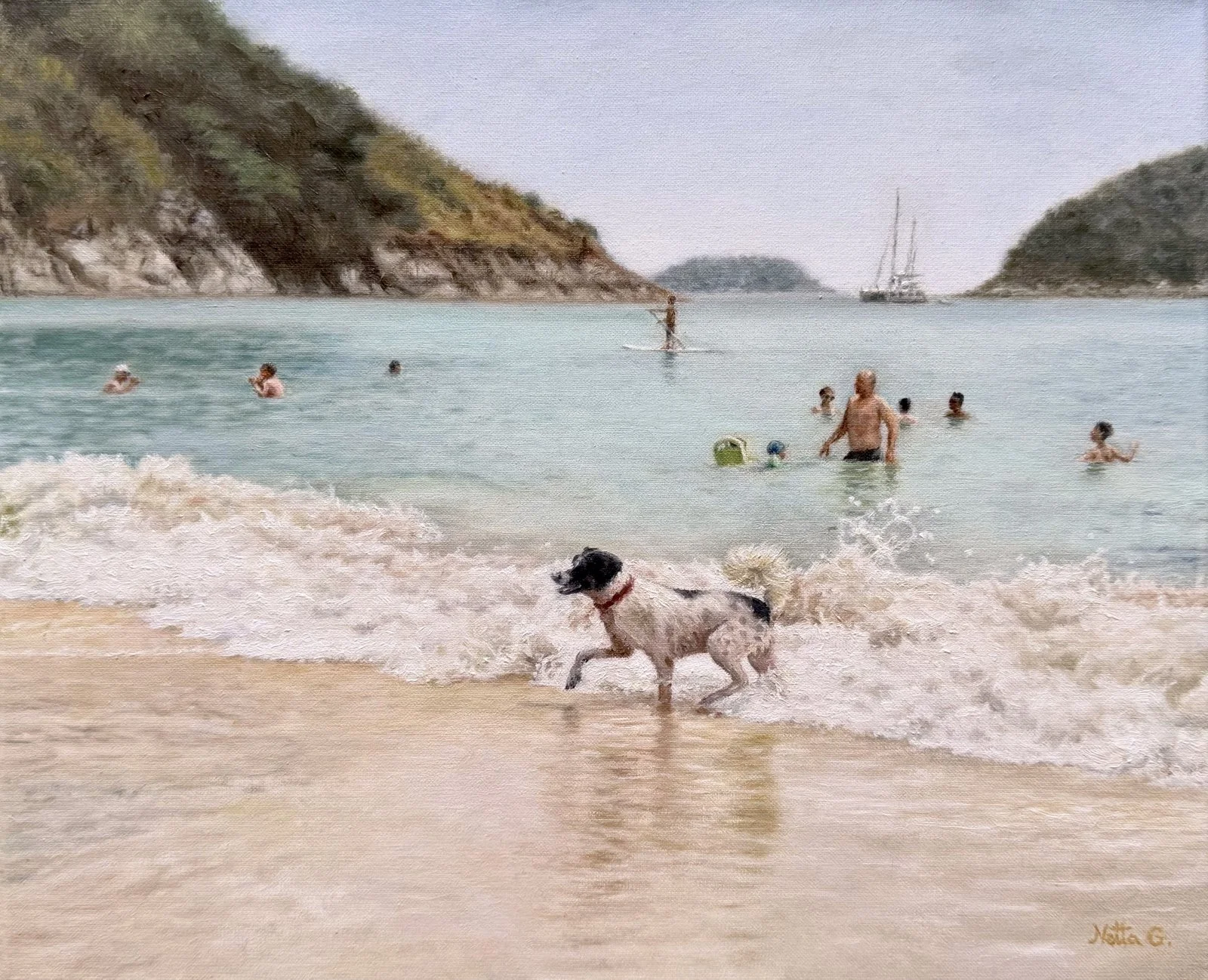
Land of the Free © Netta Ganor - Courtesy of the Association of Mouth & Foot Painting Artists worldwide
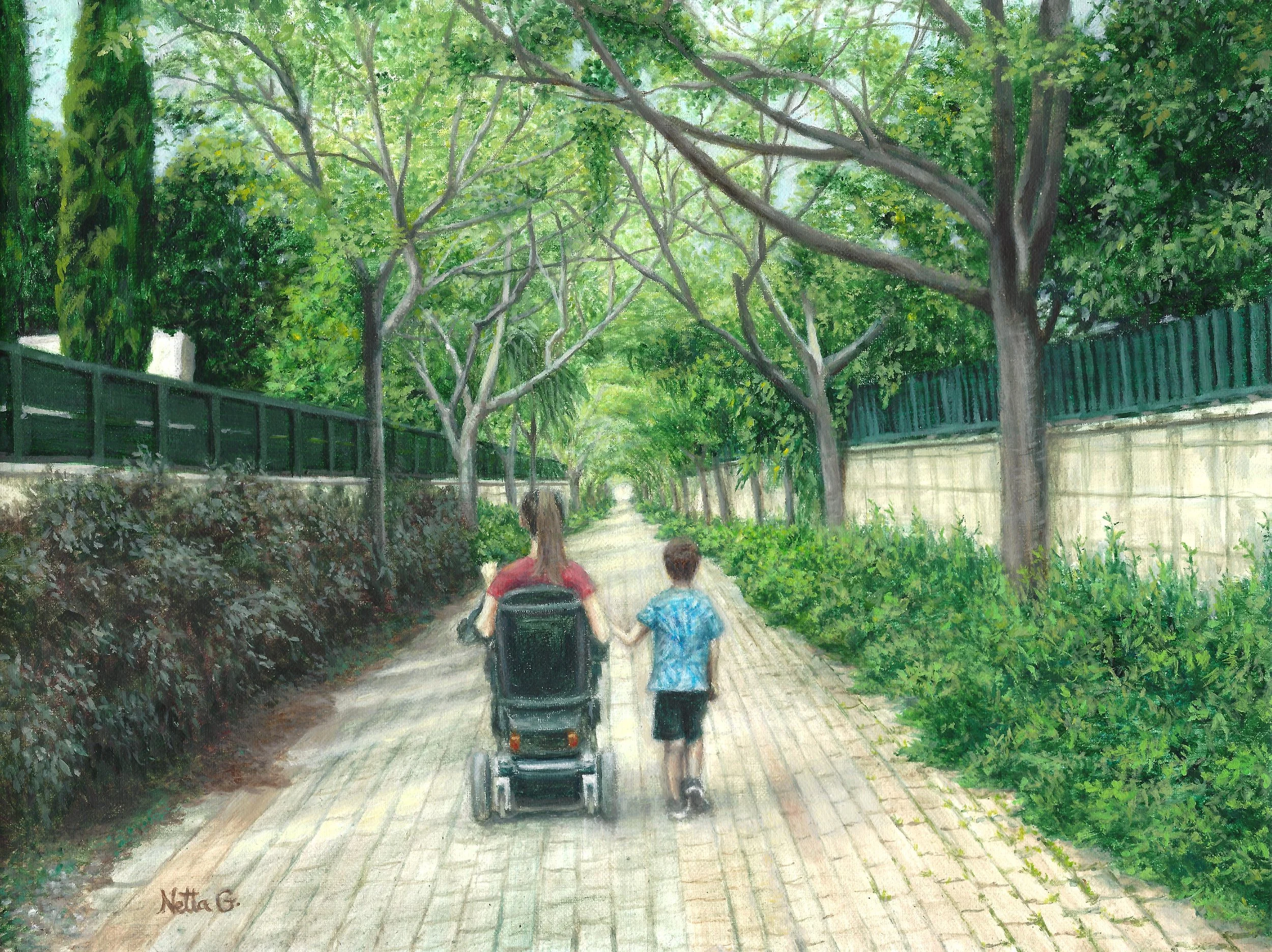
Light at the End of the Trail © Netta Ganor - Courtesy of the Association of Mouth & Foot Painting Artists worldwide
You often paint your children and scenes of motherhood. How does this subject shape your artistic voice?
Motherhood with a physical disability is its own particular experience, and it’s one I haven’t seen painted very much. My children are my primary inspiration, not just as subjects but as a kind of emotional anchor. When I paint them, I’m painting joy and vulnerability, and also something about the gap between what my body can do and what I feel inside as a parent. That tension gives my work honesty, I think.
The road to becoming a mother wasn’t simple at all. It was full of challenges and setbacks. So somewhere in the paintings of my children, there’s also a quiet celebration of the fact that I made it. That I got here. That this life, which could have looked so different, contains them.
Can you describe your creative process from the first idea to the finished painting?
It usually starts with a photograph (often something my husband has shot, because he has a good eye for the kinds of references I work from). I bring the image into Photoshop, apply a grid for proportional accuracy, and transfer it to canvas by observing the photo and painting what I see and interpret. The first layer is always a sketch in pencil, and then comes the oil colour. Sometimes I use just two layers of colour, but sometimes the painting requires more than that. However, that’s just the structural/technical part. The real decisions happen at the easel: where to push the colour, where to let something stay loose, when to stop. I’ve been actively working on painting more expressively, trying to let brushstrokes show and resisting the urge to overwork a surface. That’s an ongoing discipline. A finished painting for me is one that evokes emotion and does something beyond just rendering.
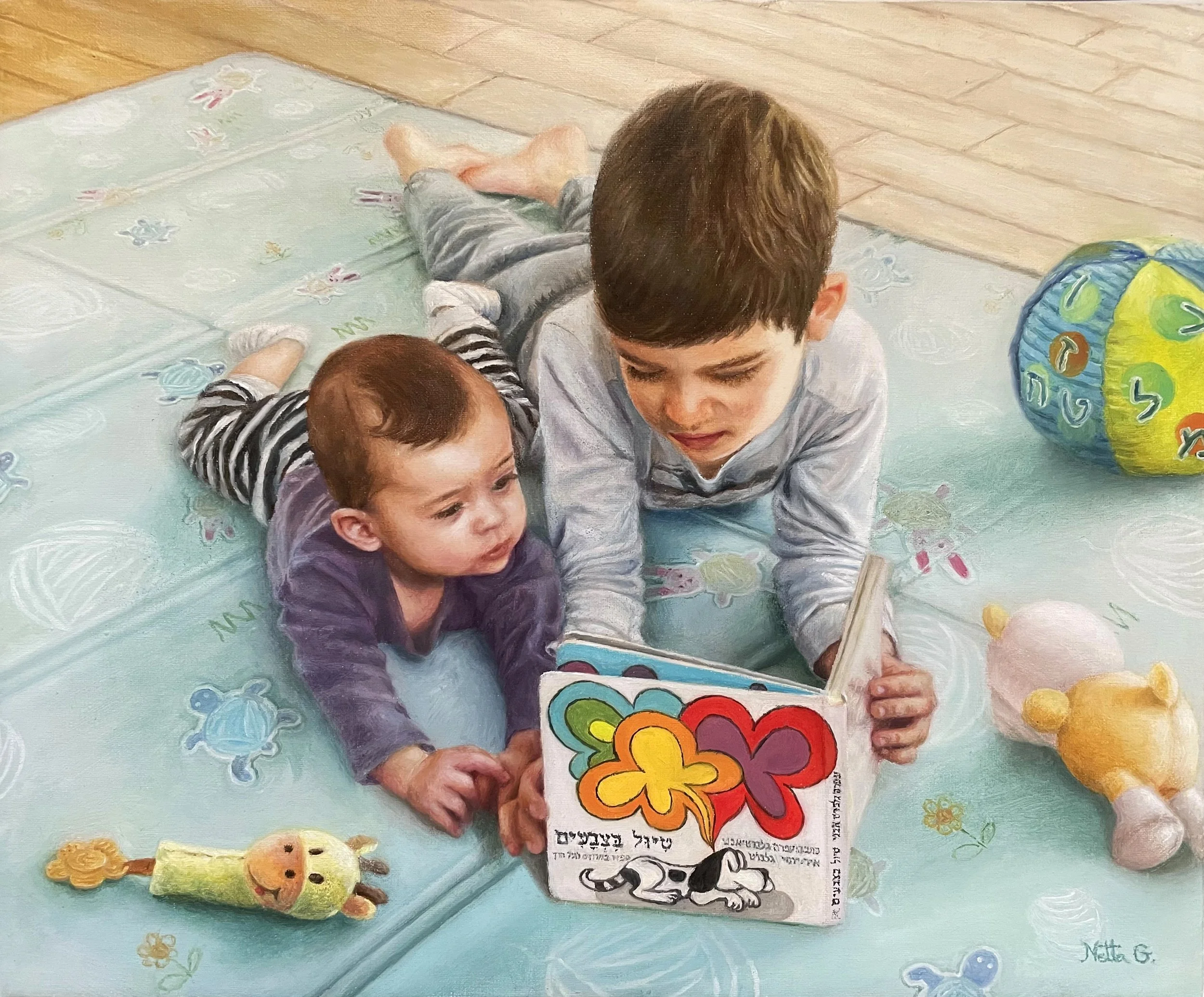
Brothers © Netta Ganor - Courtesy of the Association of Mouth & Foot Painting Artists worldwide
How has becoming part of the Association of Mouth & Foot Painting Artists influenced your career and visibility as an artist?
It’s been foundational. I joined AMFPA in 2003, and it’s what transformed painting from a therapy and hobby into an actual profession. The association publishes reproductions of members’ work on prints, greeting cards, calendars, t-shirts, and other products, sold worldwide. That kind of reach would be almost impossible to build independently.
One of the things I’m most proud of is my three children’s books published by the AMFPA. The first, “Who’s Wooly?”, came out in 2012, then “Sniffy the Shrew” in 2017, and “Secret Door” in 2021. Each one is a project I carried from idea to finished book, and seeing them reach readers across Israel has meant a great deal to me. Right now, one of the books is being translated into English, which is very exciting as it opens up a whole new audience.
The association also connected me to a community of artists who understand, practically, what it means to paint without your hands, and to an international network of exhibitions and contacts that would have taken decades to build on my own. If you’re curious about the work we do or want to order products, you can find everything on the MFPA website.
What do you hope viewers understand about disability when they look at your work?
I hope they forget about it, actually, at least for a moment. I want them to be inside the painting first, and then if the story of how it was made adds something to their experience, that’s fine. What I don’t want is for the disability to be the subject (unless it’s actually the subject, e.g. when I paint myself in a wheelchair). The painting is the subject. What I do want people to take away is that creativity is not a physical function- it starts in the mind. The brush is just a conduit. That’s true whether you hold it with your hand or in your mouth.
When people do start thinking about the person behind the paintings, I hope they understand that people with disabilities have full, rich lives, and that a disability doesn’t define who you are as a human being. We have the same depth, the same complexity, the same capacity for joy as anyone else. And somewhere in my work, I also want to show that you can live with a disability and still be genuinely optimistic. That it doesn’t end your life. In many ways, it can be the beginning of an entirely new one.
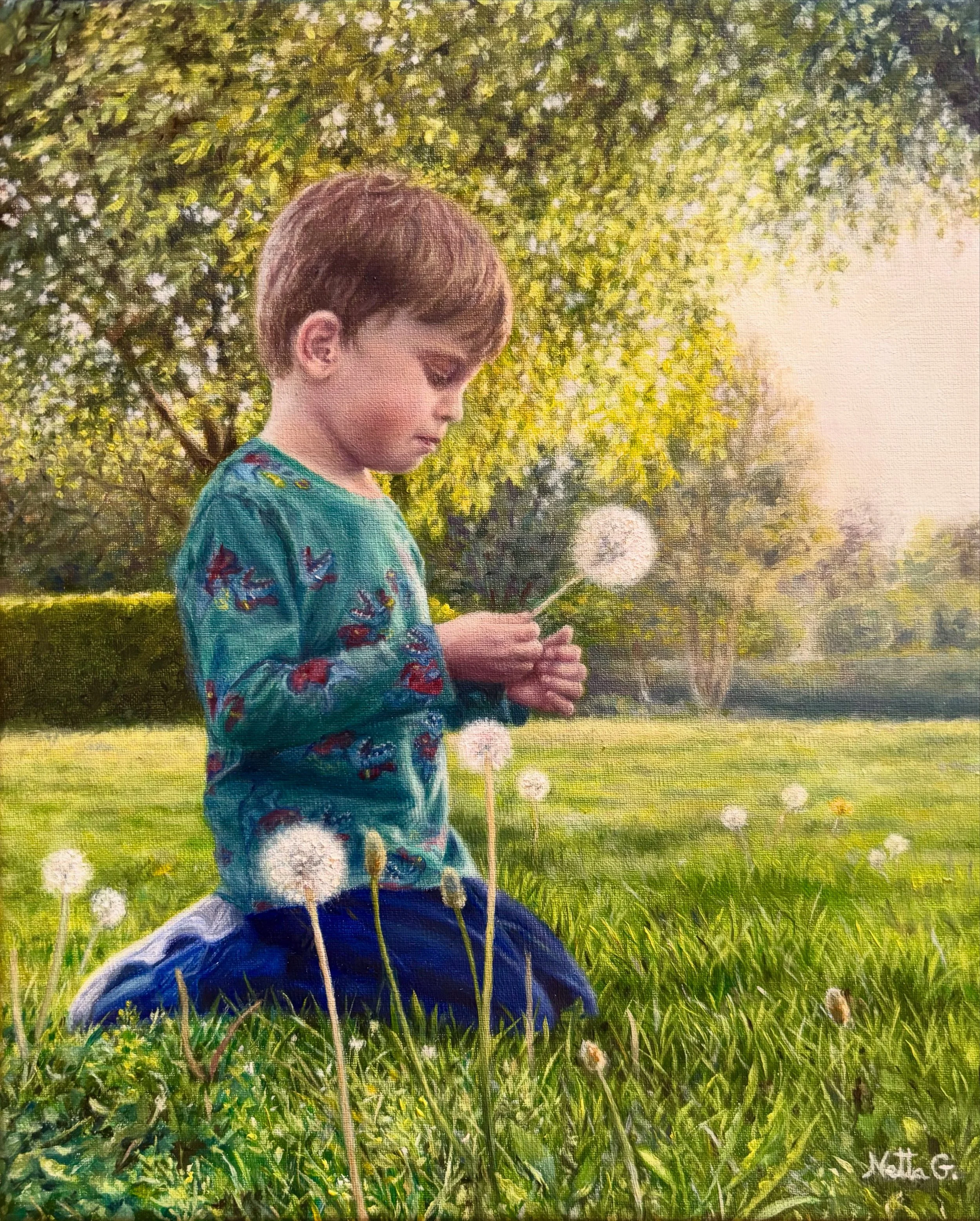
Moment of Reflection © Netta Ganor - Courtesy of the Association of Mouth & Foot Painting Artists worldwide

The Return of Color © Netta Ganor - Courtesy of the Association of Mouth & Foot Painting Artists worldwide
Lastly, looking ahead, what themes or projects do you still want to explore in your painting?
I want to keep pushing into expressiveness and finding a better balance between the realistic foundation I have and something looser, more gestural and alive. Thematically, what pulls me most strongly is continuing to paint my specific experience of motherhood, the emotional connection I have with my children, despite the physical limitations. They’re growing up now, and I find that transition fascinating and moving to document. There’s so much in the gap between what my body can do and what I feel as a mother, and I don’t think I’ve come close to exhausting that territory.
I’m also drawn to more complex figurative compositions, especially scenes with many people and characters, the kind of paintings where you keep finding something new each time you look. That’s a challenge I want to take on more seriously.
And beyond the work itself, I’d love to see my paintings in museum spaces one day, both here in Israel and internationally. That feels like the next frontier.
Artist’s Talk
Al-Tiba9 Interviews is a promotional platform for artists to articulate their vision and engage them with our diverse readership through a published art dialogue. The artists are interviewed by Mr. Mohamed Benhadj, the founder & curator of Al-Tiba9 Contemporary, to highlight their artistic careers and introduce them to the international contemporary art scene across our vast network of museums, galleries, art professionals, art dealers, collectors, and art lovers across the globe.



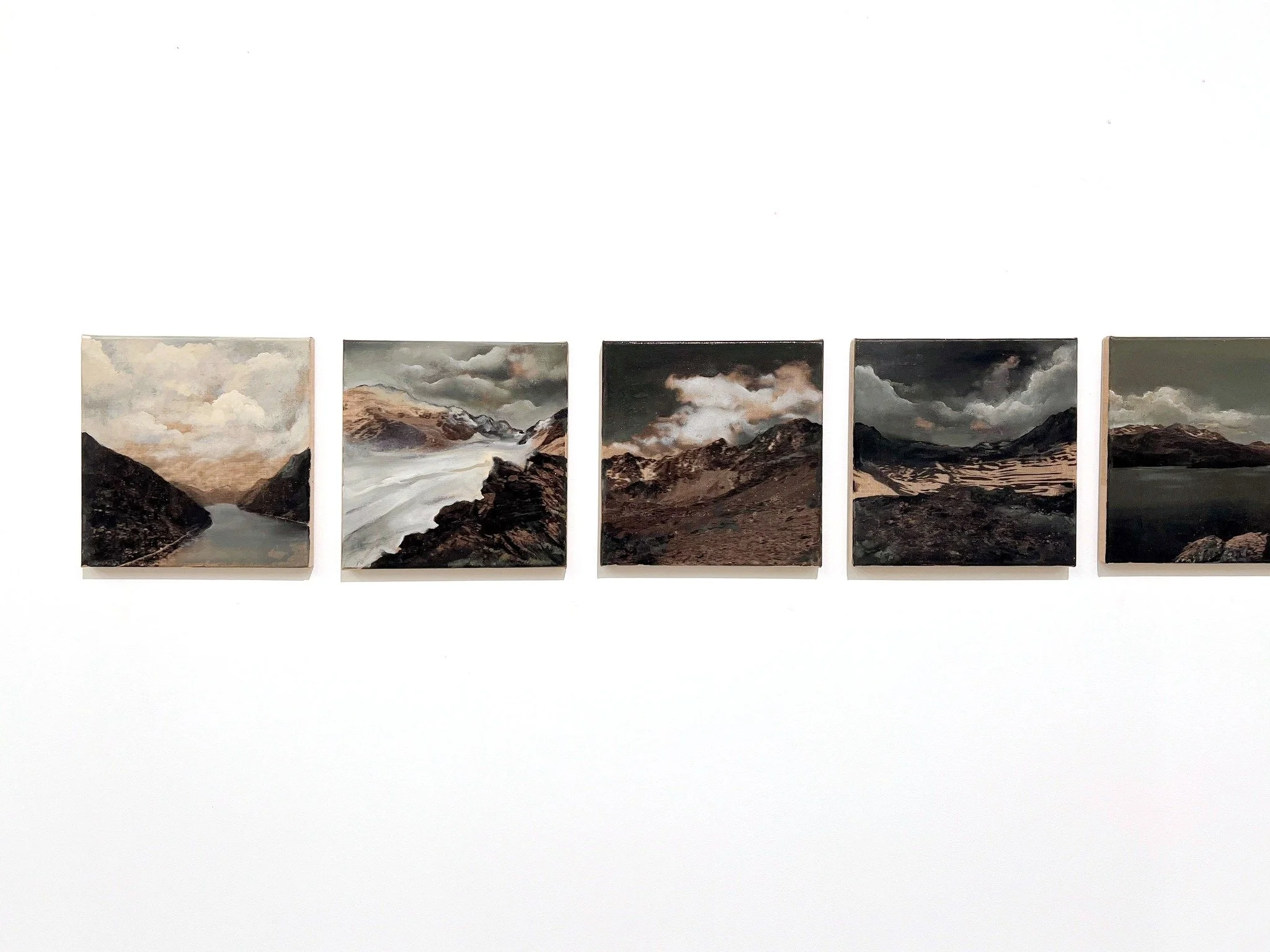
Nataraj von Allmen is a painter based in Switzerland. Often taking photographic material as a starting point, he weaves together landscapes, mythological archetypes, Christian symbolism, and contemporary socio-political themes into complex paintings. Oscillating between figuration and abstraction, his work investigates transformation, collective memory, and the human condition.