

10 Questions with Charlotte Sapene
Charlotte Sapene is a Venezuelan artist living and working between Mexico and Nicaragua. Her work grows from a lived experience of displacement and the ongoing attempt to feel at home. She paints narrative landscapes where human figures move through emotional and psychological terrains shaped by memory, distance, and uncertainty. Her series Kavanayén stems from a formative childhood experience in the Pemón territory of Canaima National Park, where surviving a small plane accident left a lasting awareness of fragility and transformation. Sapene’s work has been featured in Create Magazine, British Vogue, and Revista Mirada Ecléctica, and presented in solo and group exhibitions internationally.
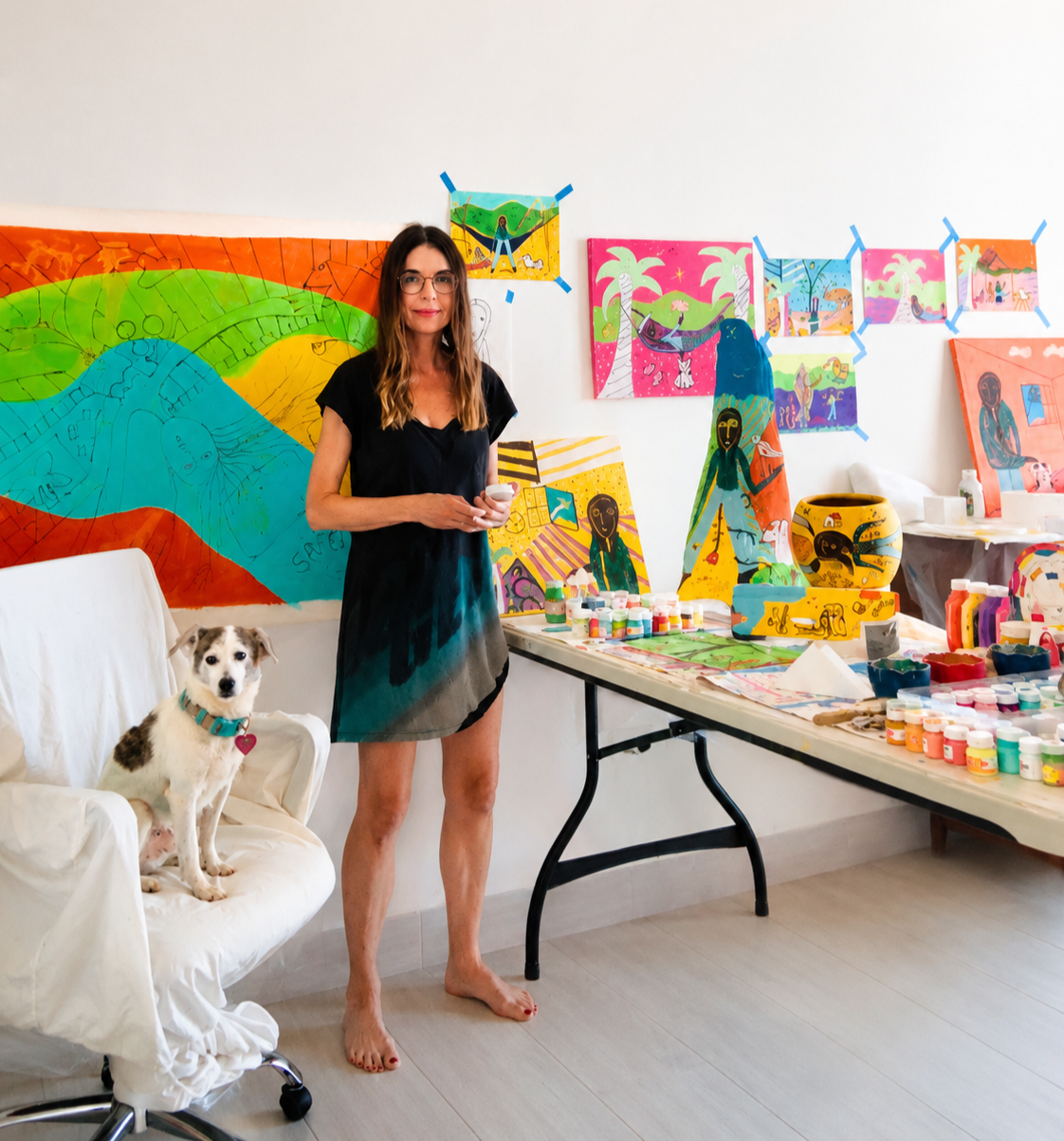
Charlotte Sapene - Portrait
ARTIST STATEMENT
“I paint because I don’t fully know where I stand. Displacement isn’t just a theme in my work, it’s the condition I live from. Landscape stops being scenery and turns into a mental space I carry with me, whether I like it or not. Figures wander through these paintings trying to orient themselves. Sometimes they look calmer than I feel while painting them. I keep making images as a way to stay inside the confusion, testing what belonging might look like without pretending I’ve figured it out.”
— Charlotte Sapene
Kavanayén. Zara en su cascada. Río Orinoco, Acrylic on paper, 29.7 × 21 cm, 2026 © Charlotte Sapene
INTERVIEW
Your work often explores displacement and belonging. How have your own experiences shaped these themes?
Displacement and belonging are at the core of my work because they are at the core of my life. I was born in Caracas, Venezuela, but have lived away from my birthplace for most of my life. This experience of migration has shaped the way I understand home, not as a fixed location, but as something that is constantly being constructed through memory, relationships, and imagination.
My paintings often emerge from the tension between remembering and rebuilding. They explore what it means to carry a sense of place within yourself, even when you are physically elsewhere. Through color, symbolism, and narrative landscapes, I try to create spaces where loss, longing, resilience, and belonging can coexist.

Kavanayén. Dream Home. Río Orinoco, Gouache on canvas, 28 × 20 in 50 × 70 cm, 2026 © Charlotte Sapene
You live and work between Mexico and Nicaragua. How do these places influence your artistic practice?
Both Mexico and Nicaragua have become deeply influential in my practice. Mexico introduced me to a rich visual culture where mythology, craft, and everyday life coexist naturally. Nicaragua has given me something different: space, silence, and a close relationship with nature.
Many of my recent works have been developed while living near the Pacific coast in Nicaragua. Daily walks along the beach have become an important part of my process. I collect branches, pieces of wood, and discarded objects that later find their way into my work. The landscapes, colors, and rhythms of these places continually shape the visual language of Kavanayén.
Can you tell us about the childhood experience in Kavanayén that inspired your recent series?
Kavanayén is a small village in the Gran Sabana region of Venezuela, and it holds a special place in my memory. When I was a child, I experienced an emergency landing there after the small plane my family was travelling in encountered difficulties. We spent several days in the village waiting for help.
Although the experience was frightening, it became a defining memory. The vast landscape, the feeling of vulnerability, and the kindness of the local community remained with me for decades. Over time, Kavanayén transformed from a real place into a symbolic territory within my imagination, a place connected to survival, orientation, memory, and the search for home.

Kavanayén. Imaginary Home. Río Orinoco, Gouache on canvas, 14 × 10 in 35 × 25 cm, 2025 © Charlotte Sapene

Kavanayén. Baile A La Lluvia. Río Orinoco, Gouache on paper, 11.6 × 8.2 in 29.7 × 21 cm, 2026 © Charlotte Sapene
Landscape plays a central role in your paintings. What attracts you to this subject?
I am interested in landscape because it allows me to talk about emotional and psychological states without being limited by literal representation. For me, landscapes are not simply depictions of nature; they are containers for memory, dreams, and personal narratives.
Rivers, mountains, moons, trees, and pathways function as symbols that help me explore themes such as belonging, transformation, and connection. Landscape becomes a language through which I can tell stories that are both deeply personal and universally recognizable.
How do memory and personal history influence the places you create on canvas?
Memory is the foundation of the places I create. Rather than documenting specific locations, I combine fragments from different places, experiences, and moments in time. A river from Venezuela may coexist with a beach in Nicaragua or a memory from childhood.
These landscapes become emotional territories where past and present intersect. They are shaped as much by feeling as by observation, allowing me to explore how memory continuously transforms the way we understand place.
The figures in your paintings often appear to be searching or wandering. Who are these characters?
The figures are often extensions of myself, but they are not self-portraits in a traditional sense. They represent states of being rather than specific individuals. They are travelers, observers, seekers, and dreamers.
Many of them are navigating unfamiliar landscapes, searching for connection, safety, or belonging. In that sense, they reflect a universal human experience while also drawing from my own journey through migration and personal transformation.
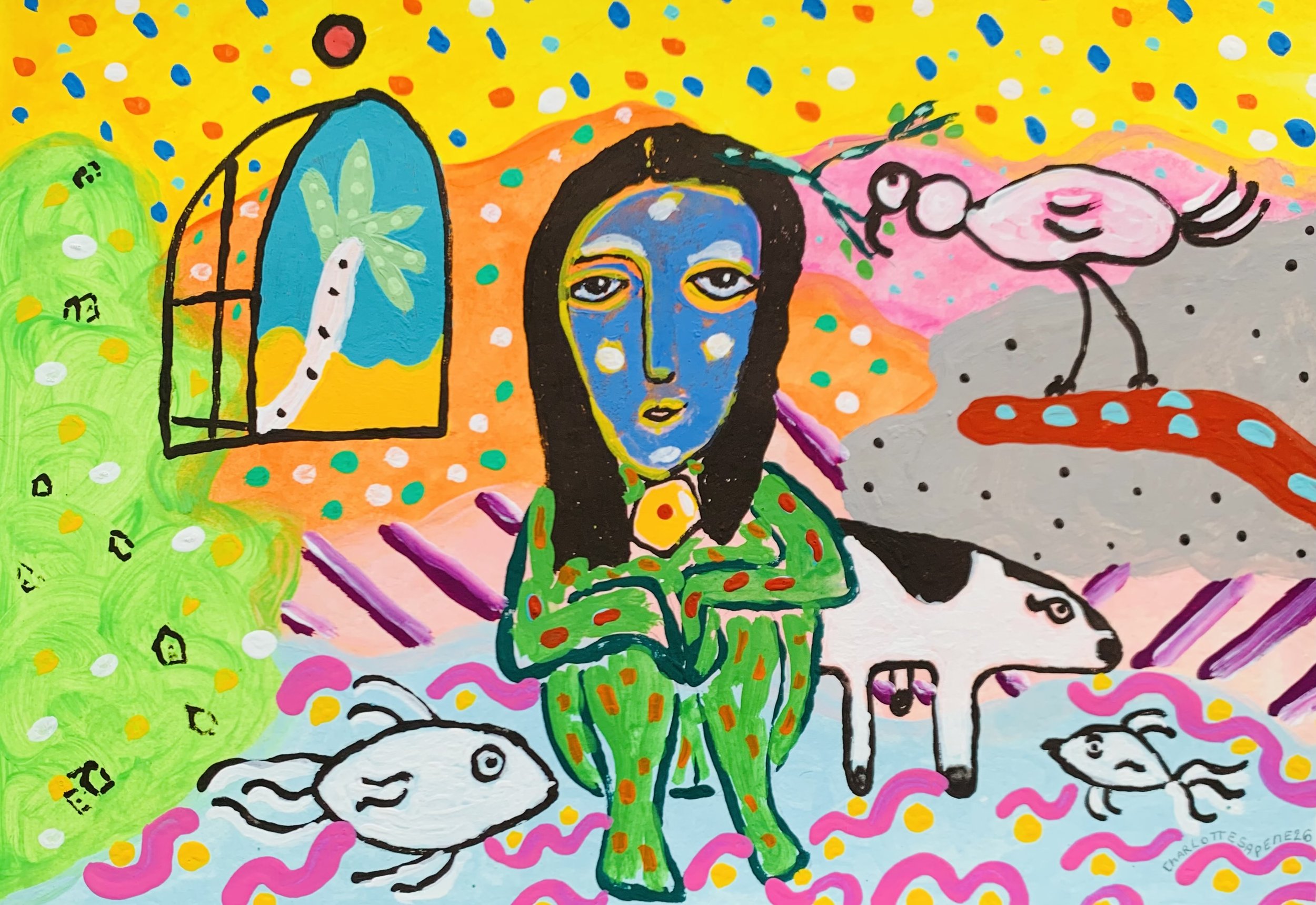
Kavanayén. Pensando En Mi Prado Home, Gouache on paper, 11.6 × 8.2 in 29.7 × 21 cm, 2026 © Charlotte Sapene
When starting a new painting, do you begin with a specific story or emotion in mind?
I usually begin with an emotion rather than a story. Sometimes it is a feeling of nostalgia, uncertainty, hope, tenderness, or curiosity. I rarely know exactly where the painting will lead.
As I work, symbols, characters, and landscapes begin to emerge. The narrative reveals itself gradually through the process of painting, allowing intuition to play an important role.
Your landscapes feel both real and imagined. How do you balance observation and invention in your work?
Observation provides the starting point, while imagination allows the work to expand beyond reality. I spend a lot of time walking, looking, collecting, and sketching. These observations become raw material.
Once I begin painting, I give myself permission to alter scale, color, perspective, and narrative. Real places merge with remembered places and imagined places. The result is a landscape that feels familiar but cannot be located on a map.
What do you hope viewers take away from your paintings after spending time with them?
I hope viewers find space for reflection and connection. Although the work is rooted in my personal experiences, I want people to see their own stories within it.
If someone leaves a painting feeling slightly less alone, more connected to their memories, or more open to the idea that home can exist in many forms, then the work has done its job.

Kavanayén. Niña Buena, Niña Mala, Found tree trunk, acrylic 27 × 8 × 13 in 68 × 20 × 34 cm, 2026 © Charlotte Sapene

Kavanayén. Territorio Fértil. Río Orinoco, Acrylic on adobe, 7 × 7 x 5 in 17 × 17 x 13 cm, 2026 © Charlotte Sapene
Lastly, what are you working on at the moment? Do you have any upcoming exhibitions, collaborations, or projects that you can share with us?
At the moment, I am continuing to develop Kavanayén, expanding the series beyond painting into sculptural works and interventions using found objects collected during walks in Nicaragua. This body of work, titled Becoming Tangible, explores how memory, displacement, and belonging can inhabit physical materials.
I am also actively applying for residencies and exhibitions that will allow me to further develop this project. Recently, I was selected to participate in the Green & Stone Summer Exhibition in London, and I continue to build new works that explore the relationship between landscape, diaspora, memory, and home.
Artist’s Talk
Al-Tiba9 Interviews is a promotional platform for artists to articulate their vision and engage them with our diverse readership through a published art dialogue. The artists are interviewed by Mr. Mohamed Benhadj, the founder & curator of Al-Tiba9 Contemporary, to highlight their artistic careers and introduce them to the international contemporary art scene across our vast network of museums, galleries, art professionals, art dealers, collectors, and art lovers across the globe.


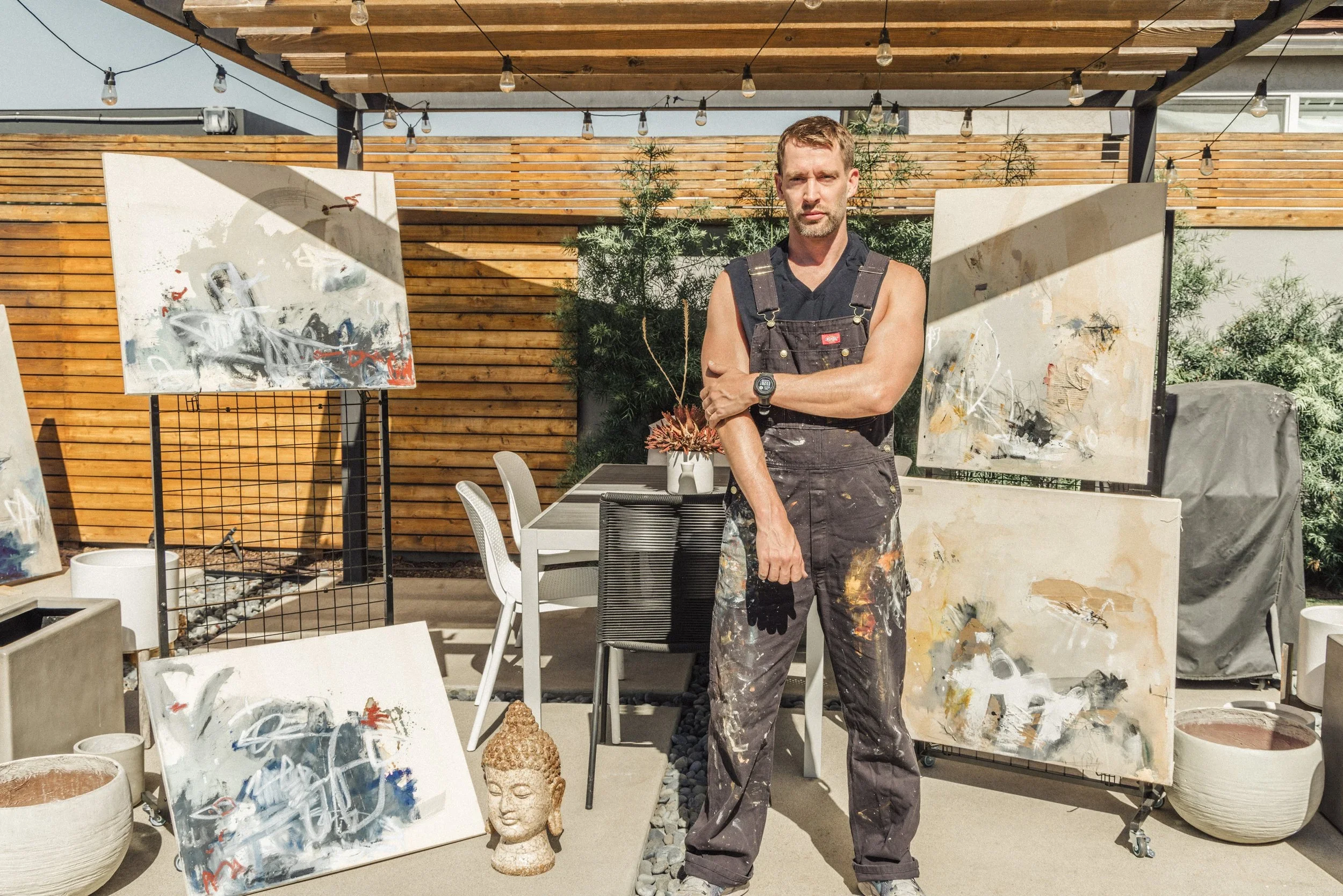

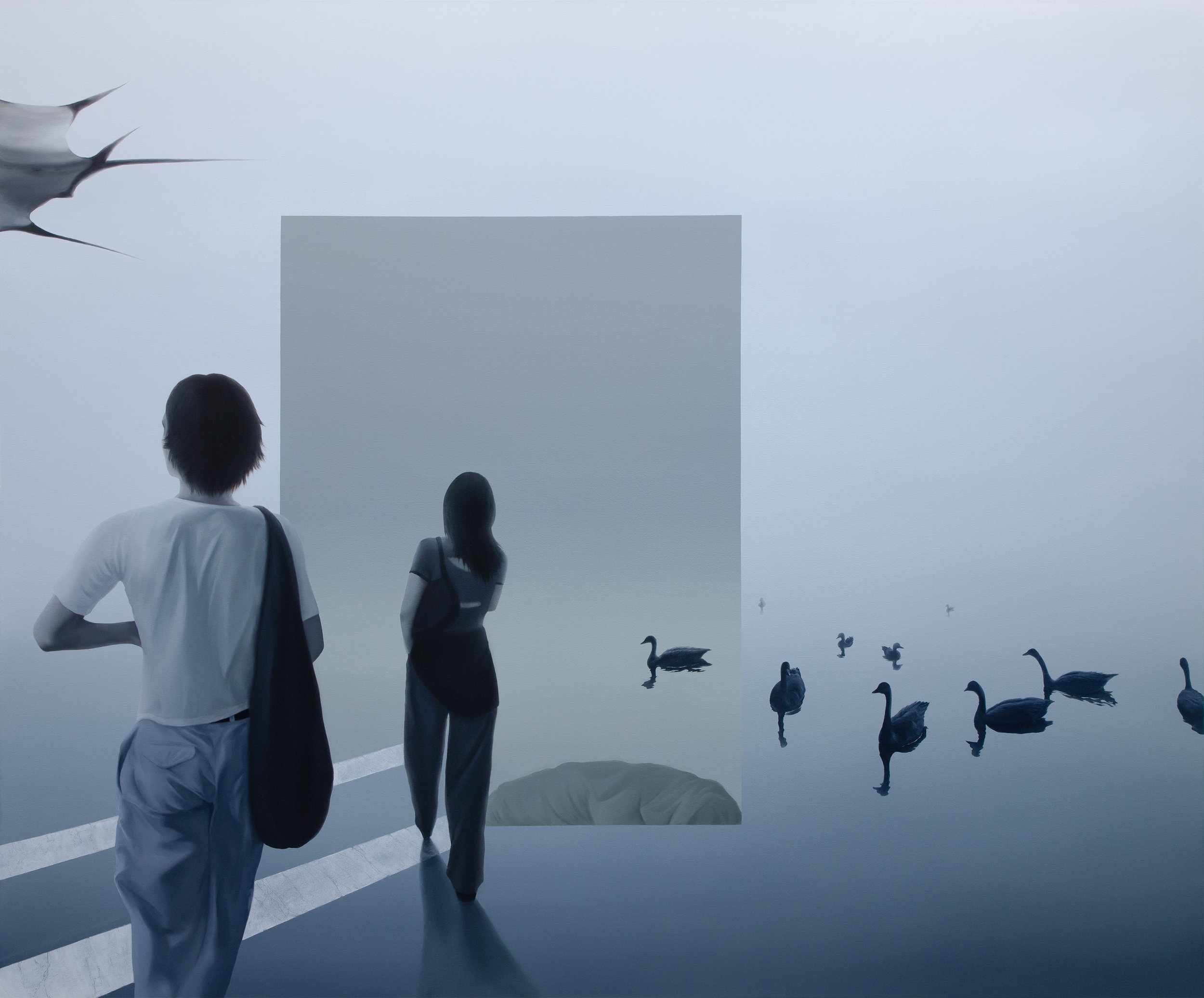
Brooklyn-Born Allan Gorman is a contemporary fine artist based in Jersey City, NJ, with a unique artistic vision cultivated by a distinguished commercial career that helped refine a sense of aesthetics and unwavering commitment to excellence that continues to define his artistic process to this day. His latest series of paintings is titled Imaginary Spaces.