

10 Questions with Artist Name
Lim Won Ji (Oneg) is a South Korean artist based in Chicago. She received her BFA in Ceramics and Glass from Hongik University and is currently pursuing an MFA in Sculpture at the School of the Art Institute of Chicago. Working across sculpture, installation, performance, and process-based experimentation, Lim investigates hypervigilance as a bodily condition shaped by anxiety, uncertainty, anticipation, and the desire for control. Her practice often begins with systems that appear ordered or stable, frames, containers, suspended structures, knots, and repeated arrangements, but gradually reveal their vulnerability through material change. Using materials that stretch, sag, dry, decay, knot, deteriorate, or resist containment, she constructs unstable situations in which order is continually negotiated through gravity, time, repetition, and chance. Rather than treating materials as passive media, Lim approaches them as active participants that interrupt, reshape, and transform the structures intended to regulate them. Through these ongoing processes, her work examines how bodies respond to uncertainty and how attempts to maintain control can produce new forms of tension and instability.
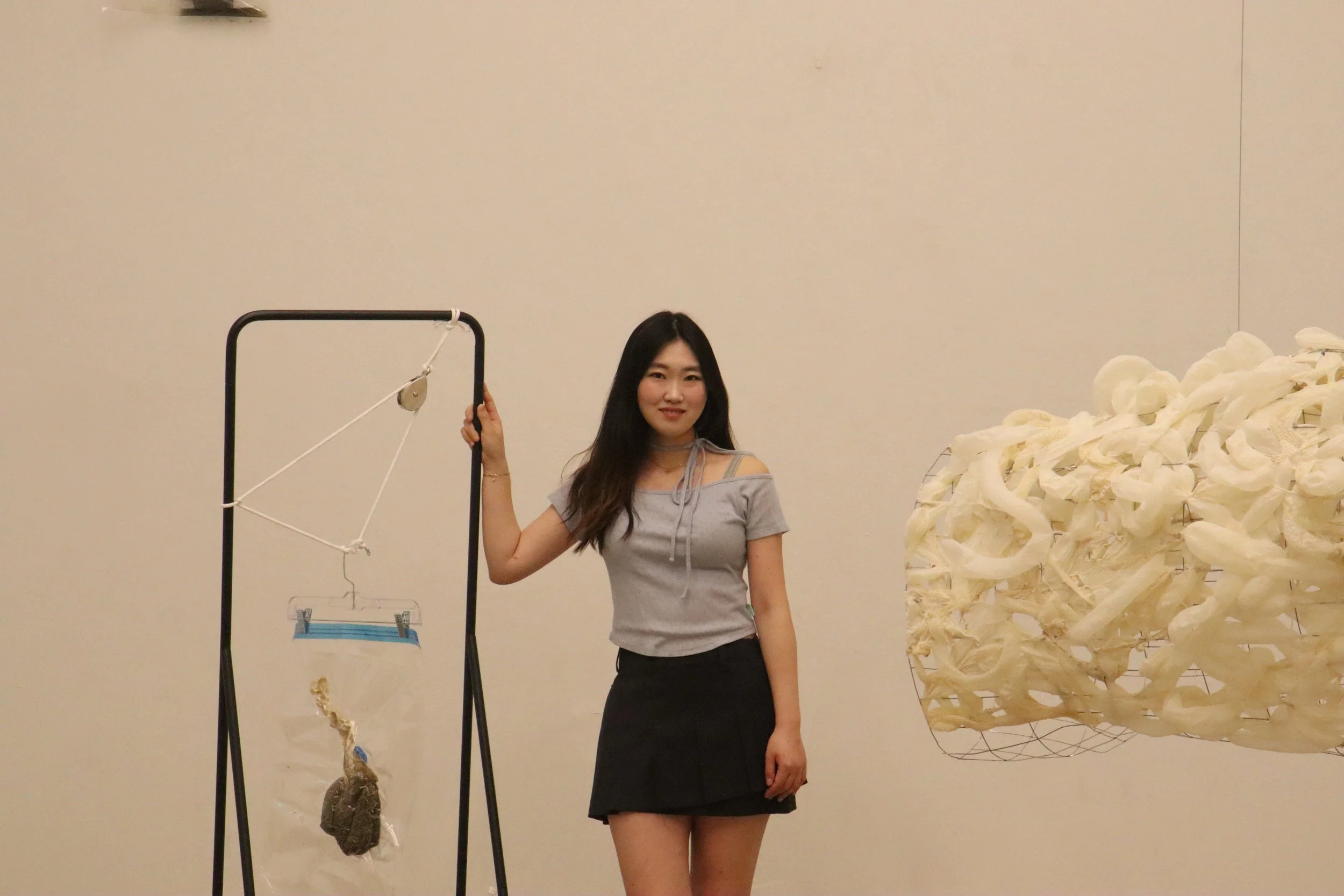
Won Ji Lim - Portrait
ARTIST STATEMENT
“I have long felt compelled to organize my surroundings, to align objects precisely, rewrite a page because of a single mistake, and repeat small acts of correction until they appear temporarily resolved. Only later did I recognize these habits as manifestations of anxiety and a persistent desire for control. Rather than understanding hypervigilance simply as an intensified emotional state, I approach it as a sustained bodily condition shaped by anticipation: the repeated imagining of what might happen, what could go wrong, and what must be prevented before it occurs. My work investigates this condition through sculpture, installation, performance, and process-based experimentation. It often begins with structures that suggest rational order, grids, frames, supports, containers, knots, suspended systems, and repeated arrangements. These systems appear stable, yet their stability depends on continual acts of maintenance, adjustment, tightening, and control. Repetitive actions such as securing, knotting, aligning, and regulating become temporary attempts to contain uncertainty. The more these actions are repeated, however, the more clearly they reveal the impossibility of complete control. I work with materials that stretch, sag, dry, decay, knot, deteriorate, or resist containment over time. Organic matter, hog casing, rope, soil, wood, and flexible membranes allow change to emerge from within structures that initially appear ordered. Rather than treating material as a passive medium, I approach it as an active agent that resists, interrupts, and transforms the systems designed to regulate it. Gravity pulls, membranes contract, organic substances decay, and ropes loosen, allowing instability to unfold rather than simply represent it. While rooted in personal experiences of anxiety, my practice extends beyond autobiography to consider broader social and spatial conditions. Hypervigilance emerges not only from individual psychology but also from environments shaped by surveillance, uncertainty, productivity, and continuous self-regulation. These pressures become embedded in gestures, spatial arrangements, and material behavior, quietly shaping how bodies occupy and negotiate space. Rather than treating repetition as a means of resolving anxiety, I approach it as both a symptom and a structure that sustains it. My installations invite viewers to inhabit environments where stability remains provisional and material transformation continually reshapes the systems intended to contain it. Through these unstable conditions, I examine how the desire for control is continuously negotiated through the body, material, and space.”
— Won Ji Lim

Held at the Edge, Casing, wire mesh, 27 × 27 × 58 in, 13 × 13 × 62 in, 2026 © Won Ji Lim
INTERVIEW
First, could you tell us a little about your background and what first led you to study art?
From an early age, I was always drawn to making things. I enjoyed drawing, creating my own books, and building small forms out of clay. That interest eventually led me to attend an arts middle school and later an arts high school, where I became increasingly interested in working directly with materials and constructing physical forms. I was especially fascinated by the process of ceramics. I was struck by the way a relatively simple material like clay could endure intense heat over a long period of time and emerge from the kiln with completely different colors, textures, and surfaces. I became interested not only in the finished object, but also in the duration, transformation, and physical processes that produced it. That fascination eventually led me to study Ceramics and Glass at Hongik University. Looking back, I think I was already interested in material transformation at that time, the way materials can change through time, pressure, heat, and environmental conditions rather than remaining fixed.
You studied Ceramics and Glass at Hongik University and are now pursuing an MFA in Sculpture at SAIC. How have these different experiences shaped your practice?
Studying ceramics and glass gave me a strong technical foundation. I learned how to fabricate large-scale works, build complex molds, and work with both ceramic and glass casting processes. That technical training continues to support my practice today. When I develop a new work, I feel confident designing structures, researching fabrication methods, and finding practical ways to realize an idea physically. At the same time, even during my undergraduate studies, I was more interested in works that collapsed, cracked, changed color, or transformed over time than in objects that remained completely fixed and stable. I often found greater possibility in moments when uncontrollable change entered the work. At SAIC, I have been able to expand those interests beyond the boundaries of particular materials or craft traditions. I now move between sculpture, installation, performance, organic materials, video, and mechanical systems. This has also changed the way I think about material itself. Rather than treating material simply as a medium for expressing an idea, I increasingly see it as an active participant capable of altering the direction and outcome of the work.

Held at the Edge, Casing, wire mesh, 27 × 27 × 58 in, 13 × 13 × 62 in, 2026 © Won Ji Lim

Held at the Edge (detail), Casing, wire mesh, 27 × 27 × 58 in, 13 × 13 × 62 in, 2026 © Won Ji Lim
What led you to move from South Korea to the United States, and how has living in Chicago influenced your work?
A major turning point came in 2023, when I had the opportunity to participate in a summer program at Alfred University in New York through support from my university. What impressed me most was how fluid the boundaries between disciplines were. Artists would build their own equipment if that was what their work required, and people from ceramics, sculpture, painting, and other fields freely shared techniques and ideas with one another. For the first time, I strongly felt that the material and disciplinary limitations I had previously experienced did not have to be permanent boundaries. That experience made me want to place myself in a more experimental environment where I could expand my practice without being restricted by medium. At the same time, moving to the United States and living abroad for the first time was an intensely uncertain experience. Language, a new environment, and uncertainty about the future made my anxiety much more visible to me. I began noticing my own habits of repeatedly checking, organizing, anticipating problems, and preparing for things that had not yet happened. This led me to reconsider those behaviors through the idea of hypervigilance. In that sense, moving to the United States was not simply a change in artistic environment. It became an important catalyst for recognizing the questions of anxiety, uncertainty, and control that now form the foundation of my current practice.
You work across sculpture, installation, performance, and process-based experimentation. How do you choose the medium or form for each work?
The most important question for me is how an idea can be experienced most directly. I usually begin with a concept or a particular condition, and then choose the materials and format that can communicate it most effectively. In my current work, I am particularly interested in the relationship between two opposing conditions. One is a system that appears organized, controlled, and stable. The other is an element that continuously disturbs or transforms that system. Frames, knots, supports, and grids can suggest order and regulation, while organic materials, gravity, humidity, and time gradually interfere with the stability those structures seem to promise. Because of this, some works need to take the form of installations, while others depend more heavily on repetitive actions or on materials that decay, stretch, contract, or transform over time. I do not begin by choosing a medium and then fitting an idea into it. Instead, I allow the concept to determine the form the work needs to take.

Held at the Edge, Casing, wire mesh, 27 × 27 × 58 in, 13 × 13 × 62 in, 2026 © Won Ji Lim
Your works often begin with structures that suggest order and stability. What draws you to these systems?
My experience of hypervigilance often appears through behaviors of organizing, creating rules, checking, and monitoring myself. Aligning something precisely, checking it repeatedly, or establishing a set of rules can create a temporary feeling that uncertainty is under control. Over time, however, I began to recognize that these behaviors do not necessarily resolve anxiety. Instead, they can produce another form of anxiety. Once a system of order has been created, it must continually be maintained, and even a small disruption can create the urge to correct it again. For this reason, the systems in my work are not simply symbols of stability or order. They are conditions that require constant checking, adjustment, and maintenance in order to remain stable. I am interested in that contradiction, the way an action intended to create security can ultimately generate further tension and anxiety.
How does your creative process usually develop, from the first idea to the final work?
Most of my works begin with writing. I record emotions, repetitive behaviors, observations, or short sentences about particular experiences, and then look for words and images that continue to reappear. From there, I begin thinking about how those ideas can become physical situations. If I am working with concepts such as control, repetition, restriction, or maintenance, I might translate them into sculptural actions such as framing, knotting, compressing, pulling, supporting, or suspending. Once the basic structure of an idea is established, I research materials and fabrication methods. I design the necessary structures or mechanisms and conduct repeated tests to determine how the work can function physically. I think of this stage as constructing a system. After that system is built, however, I do not attempt to control everything that happens within it. Organic materials encounter air, moisture evaporates, gravity acts on the structure, and forms begin to stretch, contract, dry, or decay. The work continues to change. In that sense, I am often less interested in producing a fixed final form than in creating the conditions in which transformation can take place.

Something Takes Space, Metal rack, wood blocks, rope, casing, vacuum bag, soil, pulley, 20 × 17.7 × 63 in, Vacuum bag, 8 × 14 in, 2026 © Won Ji Lim

Something Takes Space, Metal rack, wood blocks, rope, casing, vacuum bag, soil, pulley, 20 × 17.7 × 63 in, Vacuum bag, 8 × 14 in, 2026 © Won Ji Lim
You work with materials that stretch, sag, dry, decay, or resist containment. What interests you about allowing materials to change and behave on their own?
For me, anxiety does not have a fixed image. It feels more like a condition that continues to shift precisely when I try to control it. We create rules, make plans, and place limits around situations in an attempt to reduce uncertainty, but uncertainty never completely disappears. Materials that stretch, sag, dry, decay, or contract make that condition visible in a very direct way. They may initially exist within a structure that I have carefully designed, but over time they begin to move away from the form that structure was intended to maintain. What interests me is that these materials do not simply symbolize anxiety. They turn an invisible emotional condition into an actual material event. The instability in the work is not only an image that I construct; it emerges through real conditions such as time, gravity, moisture, drying, and decomposition. Through that process, the material stops functioning as something I can completely control. It becomes an active participant capable of redirecting the work.
Hypervigilance and the desire for control are central to your practice. How do these ideas translate into physical and spatial experiences?
I am interested in transforming hypervigilance from an internal psychological state into a condition that viewers can experience physically through space. For example, in Something Takes Space, I suspend organic material containing banana and my own saliva at a high position so that viewers must pass underneath it. Even if nothing actually falls, simply knowing that something exists above the body creates a heightened awareness of that object. Viewers may become more conscious of where they are standing, look upward, or adjust the way they move through the space. I am interested in creating this awareness of possibility rather than presenting an actual danger. Hypervigilance is closely connected to anticipating what might happen before anything has occurred, and continuously preparing for that possibility. For this reason, space in my installations is not simply a neutral background for displaying objects. It becomes an active element that changes the viewer’s movement and decision-making. The moment a viewer turns slightly, looks upward, slows down, or adjusts the position of their body becomes part of the work itself.

Between Knots, Wood, black rope, 20 × 20 x 48 in, 2026 © Won Ji Lim
What would you like viewers to take away from encountering your work, particularly when thinking about uncertainty and the limits of control?
I believe everyone lives with anxiety in different ways. Particularly within contemporary society, where surveillance, competition, pressure to remain productive, and expectations of success are so pervasive, we often find ourselves continuously monitoring and regulating our own behavior without fully realizing it. I do not want my work to communicate a single fixed meaning. Instead, I hope it creates a moment in which viewers become more aware of their own bodies, habits, and responses. By approaching the work, smelling materials, observing changes in their surfaces, moving around the installation, and in some cases touching or physically interacting with it, each viewer may encounter their own memories and anxieties differently. I am also not interested in suggesting that anxiety is something that can simply be overcome through the work. Rather, I hope viewers might briefly recognize how often we try to eliminate uncertainty, and how many rules, restrictions, and systems of control we create for ourselves in that process.
Lastly, what are you currently exploring, and are there any new directions or projects you are looking forward to?
I am currently interested in moving beyond the position of the viewer as someone who simply looks at an artwork. I want to create situations in which viewers physically enter the system of the work itself. The project I am currently developing is closer to an interactive environment. Viewers will be able to walk through the structure, pass between different spatial conditions, listen to sounds, pull or move elements, and physically alter aspects of the space through their own actions. I am also experimenting with mirrors, surveillance devices, and structures that restrict movement or subtly direct the body along particular paths. In my earlier works, I explored anxiety and control through individual sculptures and installation structures. I am now interested in expanding those ideas into a more immersive environment in which the viewer is not simply observing the work, but is continually adjusting their own movement in response to it. Ultimately, I want to move toward creating spaces where the mechanisms of anxiety and control are not only represented visually, but experienced through the viewer’s own body.
Artist’s Talk
Al-Tiba9 Interviews is a curated promotional platform that offers artists the opportunity to articulate their vision and engage with our diverse international readership through insightful, published dialogues. Conducted by Mohamed Benhadj, founder and curator of Al-Tiba9, these interviews spotlight the artists’ creative journeys and introduce their work to the global contemporary art scene.
Through our extensive network of museums, galleries, art professionals, collectors, and art enthusiasts worldwide, Al-Tiba9 Interviews provides a meaningful stage for artists to expand their reach and strengthen their presence in the international art discourse.



David Moješčík - MojDa is a Czech sculptor. His work is centred on figurative sculpture, the human body, and the female figure. Modelling in clay and with digital tools, he ultimately prioritises manual engagement with materials. . He draws inspiration from yoga philosophy with the concepts of non-violence and human-centeredness, as well as from Egyptian, ancient, and European classical sculpture.