

10 Questions with Galina Bleikh
Galina Bleikh is a multidisciplinary artist. Her artistic expertise spans a rich spectrum of art fields, including AI art, 3D art, AR and VR, bio art, video art, generative art, and more. Galina Bleikh's artistic practice is aimed at creating an artistic language through which a person can interact with the new technological reality, forming a unified, synergistic creative potential with it.
Galina's experiences in different creative forms brought her closer to the field of collaborative projects. Since 2011, Galina, together with the artist Elena Serebryakova, has created a visual idea of the "Simulacro-centric World" as an expression of a unique creative approach known as "Hybrid Neural Network Art".
Galina completed her master's degree in art and industry at the Stieglitz Academy of Art, St. Petersburg. Since 1993, she has lived in Jerusalem. Galina Bleikh hosts the international platform ISAST/LEONARDO LASER TALKS JERUSALEM, a meeting place and dialogue between artists and scientists.
Galina takes part in many solo and group exhibitions and contemporary art conferences worldwide. Among them: The CICA Museum of Contemporary Art, The Republic of Korea (2025, 2024, 2021), The Jerusalem Biennale (2024), ArtPlatform On, The Republic of Korea (2022), KZ Gallery for VR, Russia, (solo, 1920), NordArt, Germany (2019), Xposed Gallery, New York (solo, 2019), Haifa Museum of Art, Israel (2018), Street Art Museum, St. Petersburg, Russia (2018), LA Art Show USA (2013), Artco France Gallery, Paris, France (solo, 2012), Art Asia Miami, USA (2011), etc.
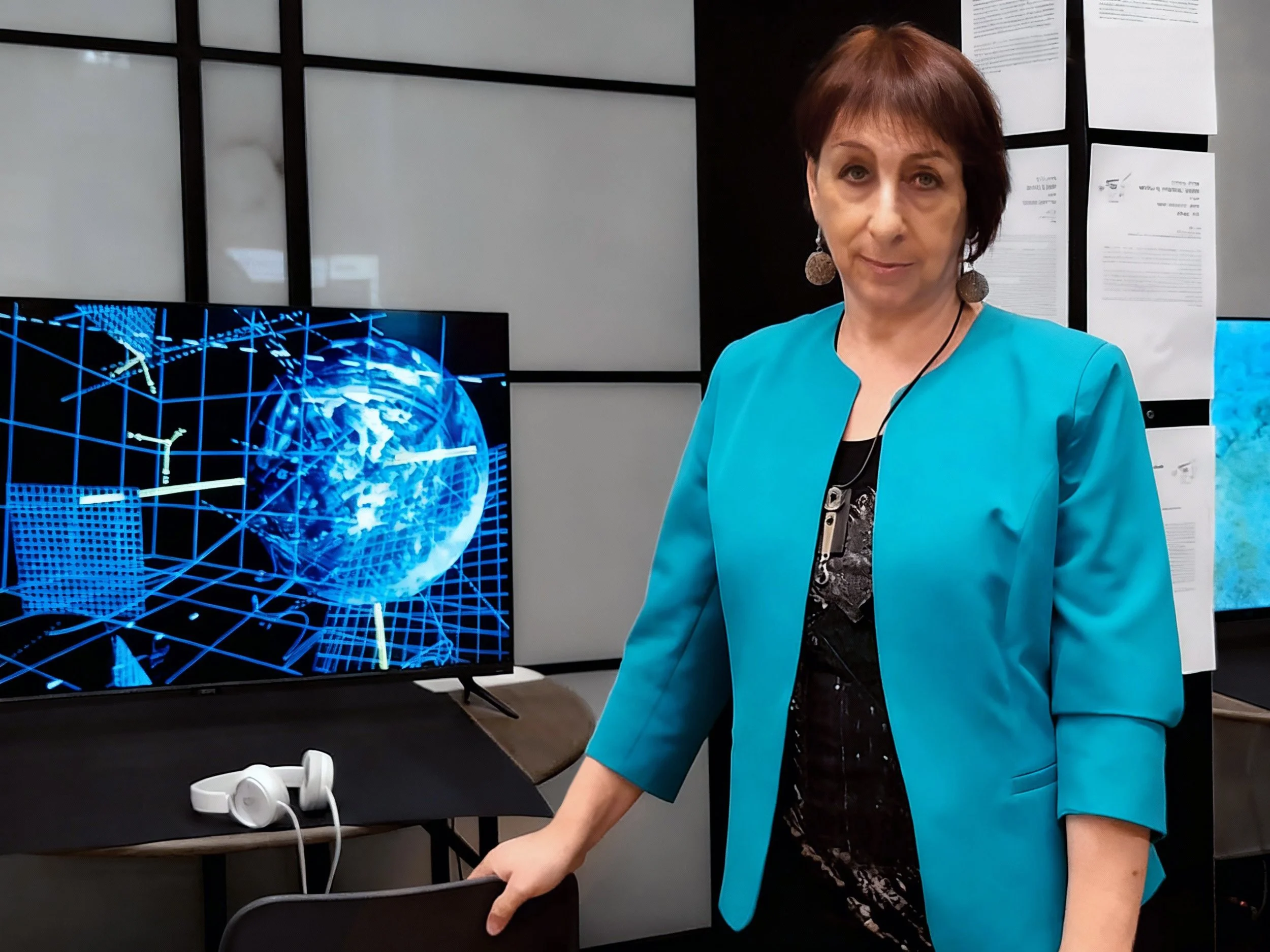
Galina Bleikh - Portrait
ARTIST STATEMENT
Galina Bleikh is a contemporary multimedia artist working at the intersection of art, technology, and science. Her practice explores the relationships between human perception, artificial intelligence, and visual representation, challenging traditional boundaries between artistic creation and technological innovation. Her work has been exhibited internationally and engages with themes of perception, identity, and the evolving dialogue between human creativity and computational systems. At the core of Bleikh's work is a rethinking of authorship in the age of AI.
She does not treat technology as a tool, but as a collaborator and conceptual partner. Her creative process can be understood as a hybrid state - where human intuition and emotion merge with algorithmic logic. In this shared space, the boundaries between artist and system dissolve, giving rise to forms that are neither fully human nor fully machine.
Bleikh is among the first artists to define Hybrid Neural Network Art - a framework that examines the co-evolution of human cognition and computational systems. Her work investigates the porous boundaries between the organic and the synthetic, raising questions about agency, perception, and creativity. Through immersive installations and generative media, she employs processes of translation, recursion, and algorithmic unpredictability. For Bleikh, the "black box" of Al becomes a creative force, mirroring the uncertainty inherent in human imagination.
Positioned within a broader historical shift, her practice reflects how Al is transforming visual culture. Her work functions as both laboratory and mirror, inviting viewers to reconsider what it means to create - and to be human - in an age of intelligent machines.
I, EYE, AND AI, Generative AI video, 7min, 2025 © Galina Bleikh
INTERVIEW
First of all, can you tell us about your background and how you first became interested in art?
As far as I remember, I have always been drawn to visual self-expression. At certain moments, I would have very intense emotional responses to such stimuli – and these formative experiences have become etched in my memory as intrusions of the miraculous. One of my earliest memories of this kind is connected with the coloring book I received as a gift at the age of five: I then took up a yellow crayon and applied it vigorously to a page that depicted a table upon which “stood” a painted basket with mushrooms; I colored most of the page bright yellow. Suddenly, the air around my yellow drawing grew warm and began to glow, as though the overcast sky were being pierced by the rays of the sun. My childish imagination was stunned by this transformative power of light.
Later, I attended an evening art school for children, where several excellent teachers taught me drawing, painting, composition, sculpture, and art history. I fell in love with this magical world of art, which was so different from the ordinary formal routine of my regular school.
Naturally, these childhood experiences predetermined my subsequent career path: I was able to realize my dream and enroll in the Saint Petersburg Stieglitz State Academy of Art and Design (formerly known as the Leningrad Vera Mukhina Higher School of Art and Design), from which I graduated five years later, in 1981, with an honors diploma and an MA degree. It was an outstanding school, teaching its students the basics of artistic skills, technical knowledge, and proficiency – but, more importantly, it cultivated the atmosphere of a ceaseless creative quest and love of art.
From the early 1980s, I belonged to a group of non-conformist artists, and took part in most exhibitions of the so-called “unofficial art,” which stood in opposition to the official cultural policy of the USSR. We struggled against the regime, fighting for the freedom of artistic expression and the right to hold our exhibitions. In those years, I produced large-format prints and dabbled in body art and performative practices. Since 1993, I have lived and worked in Israel.
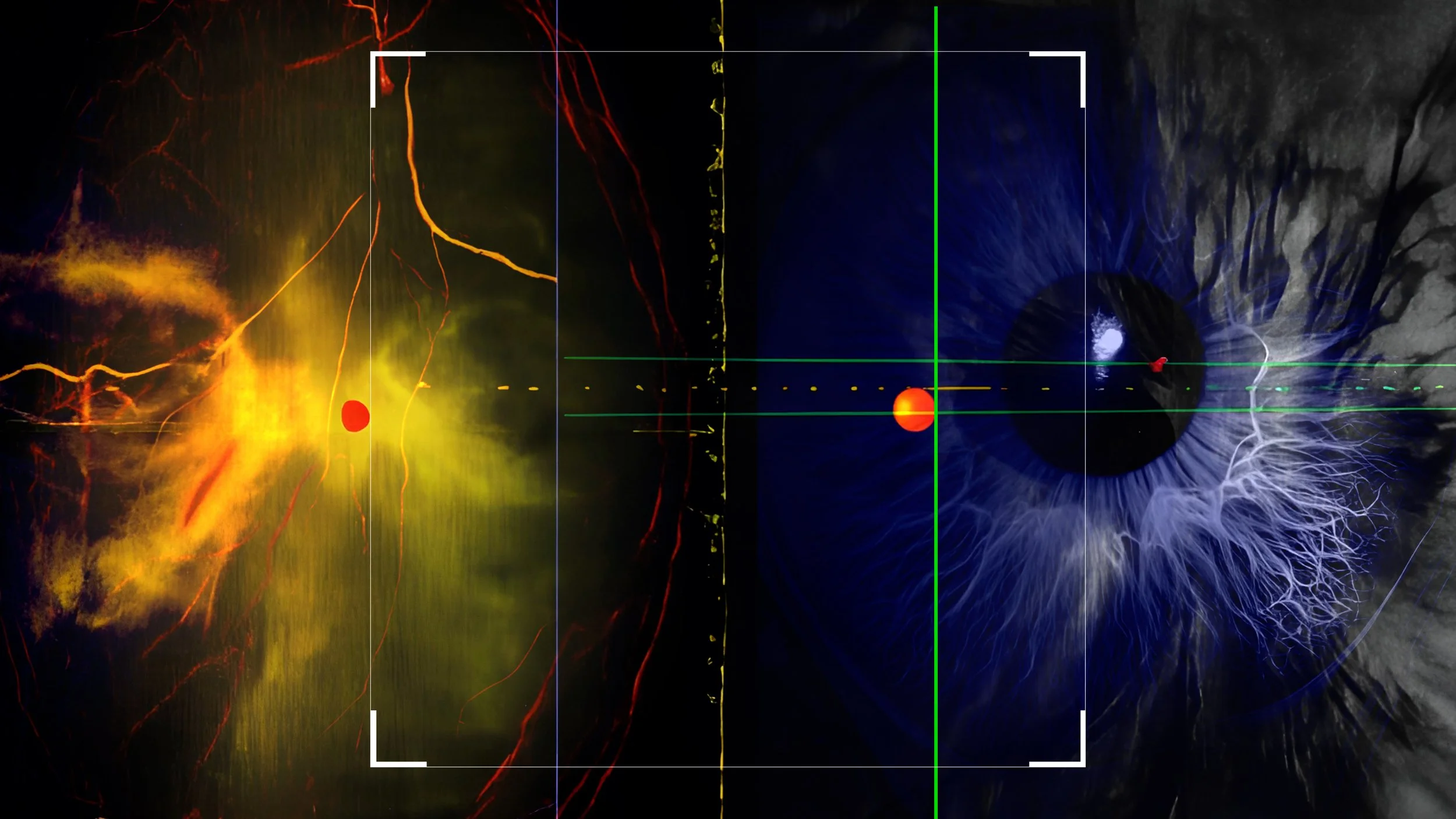
I, EYE, AND AI, Generative AI video, 7min, 2025 © Galina Bleikh

I, EYE, AND AI, Generative AI video, 7min, 2025 © Galina Bleikh
When did technology begin to play an important role in your artistic practice?
I first encountered computer technologies in the late 1980s. Back then, the first black-and-white scanners had just made their appearance in the Soviet Union. I was trying to come up with an art concept for an advertising campaign for a factory that produced thread, and I contacted the lucky owners of one of these scanners (a rarity in those days). I brought a skein of thread to the programmers and put it in the scanner. And then, line by line, veeery slowly, on its own, the stunningly beautiful black-and-white graphics of the greatly magnified, confused tangle of threads began to take shape upon the computer screen. It was a bewitching, meditative process. From that moment, I fell in love with the digital world.
After moving to Israel, I immediately completed a course in computer graphics. In the early 1990s, these were still the early versions of the graphic programs. I then mastered 3D computer modeling, the first versions of 3dStudio, the precursor of 3dMax. I worked with various startups as an artist and designer, cooperating with programmers in the development of new technologies – parameter-oriented models, compression interactive 3D models in the online environment, laser technology for the recreation of 3D models, 3D scanning, 3D printing, etc. At a certain point, I felt fully in command of this entire arsenal, and in the late 1990s, quite naturally, I increasingly began to emphasize the digital environment in my artworks. At the same time, my earlier experience (traditional artistic practices, working with space, organizing my environment, and performance art) proved very helpful in this new field.
You work with many digital tools and media. How do you choose which technologies to use in a project?
I do not use technologies to illustrate my ideas. Au contraire, I meditate upon technologies, their nature, and their impact upon humanity by using these same technologies. Hence, one could say that I do not choose the media; it is the media that chooses me. Thus, those projects of mine that have to do with three-dimensionality were born of my excitement at the newfound ability to become the creator of worlds that are so similar to our material world, yet possess some novel attributes – e.g., the freedom of surfaces to pass through each other, meeting no resistance; or the freedom to move the zero point of the coordinate system (the pivot) to any point in space, whereupon the entire world begins to revolve around this new center, etc. An object may cast a shadow, or it may have none. A surface may have only one side, without an underside, which can be turned on and off at will, making the object alternatively invisible from the inside and from the outside. Mapping can change our conception of the surface beyond recognition. The world exists only in potentiality, as a mathematical algorithm, a mesh; yet we can render it at will, in the presence of an observer, making it reveal itself in its fullness – its shape, color, light, texture, movement, and reflections. All this makes me rethink our physical world, redefine its boundaries, and transcend its limitations. These questions touch on the very essence of human experience, and give rise to intense emotional responses within me, which call for new forms of artistic expression.
This was the genesis of my projects “Thinking Spherically”, “In the 4D, Knots Are Left behind!”, “Perelmania. Topology of Bagel”, and “Interface of Infinity”, in which I ponder the essence of generative algorithms, the degree of freedom and un-freedom that is inherent in their nature, and the way all this correlates with human consciousness. Incidentally, I even wrote a philosophical novel on this subject, titled Lessons of Three-Dimensionality, which is structured as a collection of emails from a teacher to a student.
Hence, I perceived the emergence of neural networks and artificial intelligence as the natural development of my ideas of this total “algorithmization.” AI seems miraculous to me, thanks to its supernatural abilities and unpredictability: It is almost the subject, the actor, and the co-author of my works, in which the two of us are thinking together about ourselves, about it and about me, and trying to come to know each other. Perhaps, after all, it was AI that selected me as the medium for creating its artworks, and not the other way around?

A IS FOR ADAM, AI, ARTIST, Generative AI video, 15min, 33sec, 2026 © Galina Bleikh
How would you describe your collaboration with artificial intelligence as an artist?
Obviously, each artist has their own particular way of interacting with AI, which must be developed individually. This is exactly what makes the process so fascinating, since the common palette becomes so diverse. My slogan combines the two concepts of Аrtist and AI with a multiplication sign: “АrtistxAI.”
As for my own collaboration with AI, I consider it a form of symbiotic co-creation. I am convinced that, in the future, we will merge with AI and form a new civilization, and, in my opinion, this development poses no threat whatsoever to the artist’s individuality. On the contrary, it will expand our artistic resources and broaden the field of creative possibilities. Despite the prevailing pessimistic mood, according to which humanity now has to deal with a civilizational competitor, a new creative actor, a non-carbon-based subject, I hold a more optimistic attitude toward this challenge: I look forward to our future merger through constructive action, in which human beings will be able to exponentially increase their creative potential. This is true of all spheres of human activity, since the cognitive abilities, the information-processing speed, and the scale of the output; multiplied by human thinking, emotionality, sensuality, creative drive, and the ability to separate the “chaff” from the “wheat” in order to build the search vector – all this opens up a mind-blowing vista of our mighty future. The only threat to this glorious prospect is the (equally human) capacity for self-destruction.
For myself, I have come up with the following definition of my merger with AI: The two of us form a “centaur” of sorts, with my creative energy serving as the human head, and AI’s generative energy constituting the horse’s brawn. Thus, we may be said to be a single organism, which multiplies the potential of both the horse and the human being. This metaphor fairly accurately captures my impressions of working with AI.
This creative process represents the harmonious fusion of human emotional intelligence and the algorithms of machine learning, which transcend individual human limitations. This inclusive engagement through digital interaction enables the artist to transcend the boundaries of their individuality. This is a rather powerful practice – and, I would say, an utterly unprecedented artistic experience.
What usually comes first in your work, an idea, an image, or an experiment with technology?
This question has given me some pause. Indeed, how does every new project of mine begin? Let me try to describe it. Since I am constantly “locked” within my own creative superstructures, they keep generating diverse questions and ideas, which are rooted in my experience and in the information coming in from outside. And, eventually, there comes a moment when things suddenly “click” into place in my head. This phenomenon is commonly described as a spark of inspiration. It is a very exciting moment, I suddenly realize what my next project is going to be. In other words, the idea, the concept, and the visual solution come to me together. Afterward, my work with the media begins, and it can occasionally be very painstaking. Thus, I spent five months working on my most recent project, “A for Adam, AI, Artist” (2026), an homage of sorts to Peter Greenaway’s famous piece M Is for Man, Music, Mozart (1991). In the process of subsequent work, my conception of the project is corrected and clarified, taking on its final form – yet its original essence remains unchanged.

A IS FOR ADAM, AI, ARTIST, Generative AI video, 15min, 33sec, 2026 © Galina Bleikh
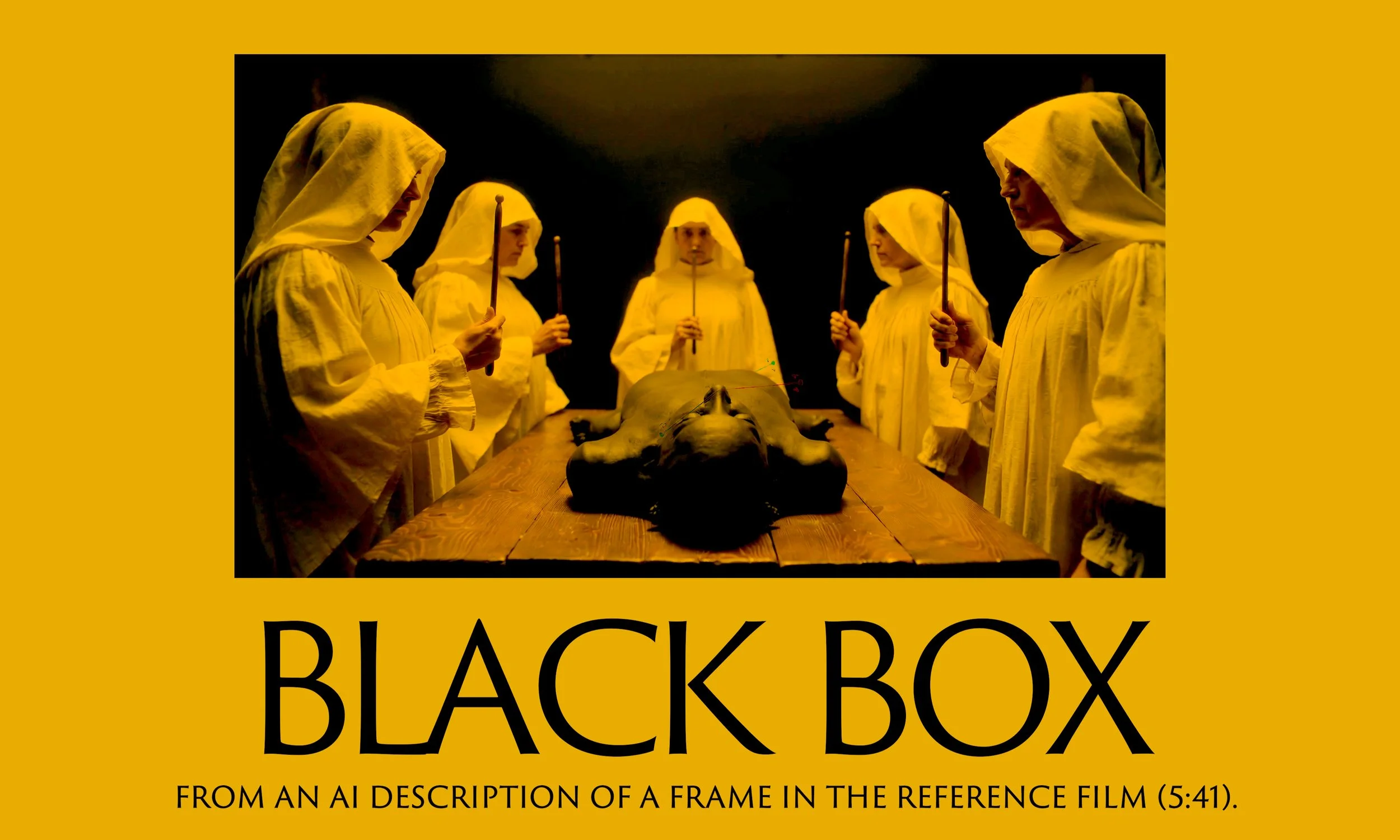
A IS FOR ADAM, AI, ARTIST, Generative AI video, 15min, 33sec, 2026 © Galina Bleikh
Your projects often explore the relationship between humans and machines. What draws you to this theme?
I have been drawn to this theme by my personal experience of interacting with the new technological reality. Back in 2011, my partner and I formed an artistic duo under the common name Galina Bleikh & Elena Serebryakova. Over this time, interacting with each other only via Zoom, we have created, and presented at multiple exhibitions, an entire world that is populated by simulacra derived from the diverse identities of a single 3D character named Miki, which is a digital ready-made (in the Duchamp sense of the term) from the library of models of the Poser program. We gave our global project the prescient name “Simulacra-Centric World,” setting this paradigm of the future in opposition to the anthropocentric worldview, and we defined our artistic method, which involves the hybrid interaction of the artist with the network, as Hybrid Neural Network Art (HNNArt).
This is how we described HNNArt back in 2012, long before the penetration of artificial intelligence into mass-consciousness: “The hybrid creative system enables the artists to attain a synergetic combination of neural and symbolic models, thereby realizing the possibility of transcending the stifling boundaries of individuality and one’s own self. The bio-neurons of the project artists are nodes in a neural network, which determine the direction of the vector connections circulating within the HNN. The artificial computer nodes supply the neural network with ready-made net content and process it. This content exists in the form of images, 3D models, templates, temporal frequency, communicative codes, semantic significations, signs and symbols, color schemes, hypertext, current references, the “garbage” of media and blogs. This method enables them to obtain results that are shaped with the help of the hidden part of the neural network, which is a system capable of self-learning. Thanks to this, the results of the Hybrid Neural Network are unpredictable, which is a key principle of all creative activity as such. The Hybrid Neural Network described above integrates itself into global biological and artificial neural networks via special nodes that transmit signal from a specific HNN to related sectors of the global network (art communities, art structures, social networks, etc.)”
In her PhD thesis, which was dedicated to the project launched by Е. Serebryakova and myself, Anna Emelin wrote: “Virtual simulacrums in the art projects of Bleikh and Serebryakova act as a prism through which one can explore how social aesthetic standards evolve in response to the growing dependency of humans on technology.
The simulacrums by Bleikh and Serebryakova are examined in accordance with Deleuze and Guattari’s concept of the “body without organs.” The virtual reality model represents a Platonic world of Ideas and Perfect Forms, composed solely of ideal objects. Virtual reality signifies the end of human dependence on their natural limitations, and the virtualization of the body implies acquiring multiple rhizomatic identities, dispersing into many simulacrums. The fluid and hybrid identity of the virtual avatar Miki is an artistic view of the future of the human body proposed by Bleikh and Serebryakova.”
Given all this, one can clearly see that my present interest in generative and AI-based art is not accidental; rather, it is the natural outcome of my long-term creative quest, investigation, and attempt to develop my own conceptions in this field.
In general, the New Media Artist serves as a sort of guide (“stalker,” as in Andrei Tarkovsky’s famous film) into the unknown world of the future. Human consciousness remains fairly inert, despite the fact that humanity is outpacing itself in technological and scientific progress; hence, the great mass of humanity is unable to “catch up” to its own achievements. And it is precisely the artist who can help bridge this gap between the inertness of the mass-consciousness and the new technological reality. I believe that this is one of the social functions that the figure of the artist is called upon to discharge in the contemporary world. By working with AI, they can activate all the codes of perception, the mental, the sensual, the visual, the verbal, the auditory, and the spatial ones, and thereby plunge the audience into a totally new subjective reality (or an “immersive environment,” as it is commonly termed nowadays), letting them experience the amazing sensations of this qualitatively new interaction with the technological reality. And, from this point of view, I believe that the modern artist has a unique mission: helping the collective consciousness cross the abyss of distrust vis-à-vis the new and the unfamiliar. As we are well aware, the first steam locomotives, too, gave rise to plenty of fears and myths.

A IS FOR ADAM, AI, ARTIST, Generative AI video, 15min, 33sec, 2026 © Galina Bleikh
How do audiences typically react to works created with AI and generative systems?
In the course of my career, I have presented my works to the most diverse audiences at exhibitions, conferences, and lectures. The “public” is an ambiguous term. I would divide it into two categories: those who have an “open consciousness,” and those who remain prisoners of stubborn stereotypes.
When I show my works to people who are receptive to new and complex ideas, and have retained a sense of wonder, I meet with admiration and gratitude, as though I were opening a door into the world of the future for them.
The second category is rather militant, and it balks at the very notion of artistic creation that is based on contact with AI (or is delegated to AI). Typically, these people are haunted by fears of the “dehumanization,” “depersonalization,” and “vulgarization” of all living things.
By way of response, I usually tell them that, for the first time in history, human beings have acquired an interlocutor created in their own “image and likeness”, who is, nevertheless, not a human being. Thanks to this, we now have the ability to enter into an “I – You” and “I – Other” relationship, i.e., to look at ourselves through the eyes of an outside observer, thereby gaining a deeper understanding of the “human” element within us and redefining it, which is exactly what I am doing.
Incidentally, many traditional artists are fiercely opposed to the former point of view, trying to defend their established artistic model; apparently, they sense that the new reality is leaving them behind.
Fortunately, I have the ability to organize international conferences on my own, setting their agendas and inviting the participants, since I serve as the host of Leonardo/ISAST Laser Talks in Jerusalem. The Leonardo/ISAST LASERs are a program of international gatherings that bring artists, scientists, humanists, and technologists together for informal presentations, performances, and conversations with the wider public. Our conferences are watched all over the world, and in this way a large international community is formed, consisting of individuals who are interested in Art&Science and technological art.
Incidentally, here is a trend I have noticed: Whereas only a few years ago all the open calls for exhibitions stated: “We accept only works produced without the use of AI,” nowadays pieces produced in collaboration with AI are highly sought after, being singled into a separate nomination. This sea-change has been so rapid: I now see galleries that used to work only with traditional media (graphics, painting, sculpture, etc.) attempt to arrange exhibitions with AI. And the art market, too, responds to this change. I think these changes are connected to the fact that we all need a kind of prophetic vision of the current situation.
That said, I also believe that our wide world has enough room for everyone, and that each artist knows, whether consciously or intuitively, the niche that they are occupying.
Do you see technology more as a tool, a partner, or something else entirely?
I would provisionally single out two possible methods of interacting with AI. The first is purely utilitarian – i.e., when AI is relegated to the role of helper or assistant, whose job is to replace the human being for some particular operations. This is the method adopted by most users at present. Moreover, they commonly scold AI for errors, and mock it for being unable to carry out certain tasks. I, too, constantly use AI as a tool and an assistant, whenever I require some particular images, texts, or information; however, I consider it the least creative part of my interaction with AI.
The second method is when we study each other in depth: It studies me, I study it, and together we come up with some kind of common conception. Artificial intelligence can give unexpected answers, and this unpredictability of its output is, in my view, analogous to creativity. Everyone is afraid to acknowledge AI as a creator, yet, human creativity, too, is an unpredictable process, the single most mysterious human activity. Just as an artistic impulse arises in my consciousness and leads, in some manner incomprehensible to me, to an enlightenment of sorts, resulting in an unexpected, non-linear result; so, too, does AI give diametrically opposite “outputs” in response to one and the same “prompt,” and these outputs are often so unpredictable as to make me jump out of my chair in surprise. However, it is still up to you to decide how to use this result, how to incorporate it in your art. After all, AI does not generate anything without your prompt; it stays silent – until the moment when you strike up a conversation with it. Only by interacting with a human being does it wake up. And this is an important point to keep in mind, at least for now: AI does not begin to create anything by itself. And if you engage it in dialogue, regard it as your co-author; if you are flexible enough, then, inevitably, you get sucked up into a fascinating, all-absorbing process! Moreover, never before has the individual artist been able to function as an entire film studio! For instance, I have always sought to make use of a larger palette of expressive means within a single artwork. Since my earliest works, I have been interested in the movement of the visual artistic form through time. I am not talking here of animation, but specifically of a method of developing the concept. Hence, I now feel elated at having a modern, fully furnished movie studio at my fingertips, as I sit in front of my computer at home: I can generate any sound, any image, any video... And all this is just the beginning of the journey! After all, our child prodigy, our “cute” little AI, has only just been born! For now, it cannot truly speak, only babble – and yet it can already accomplish so much!
Our interaction with it is more than merely instrumental; nor can it be described as a partnership, rather, it is a true symbiotic union. I can actually feel some segments of my brain expand exponentially, as though a new processor has been plugged into my consciousness.
Hence, all my latest works have been rooted in the principle of a common conceptual creative experience with AI. This is, at present, my major driver.

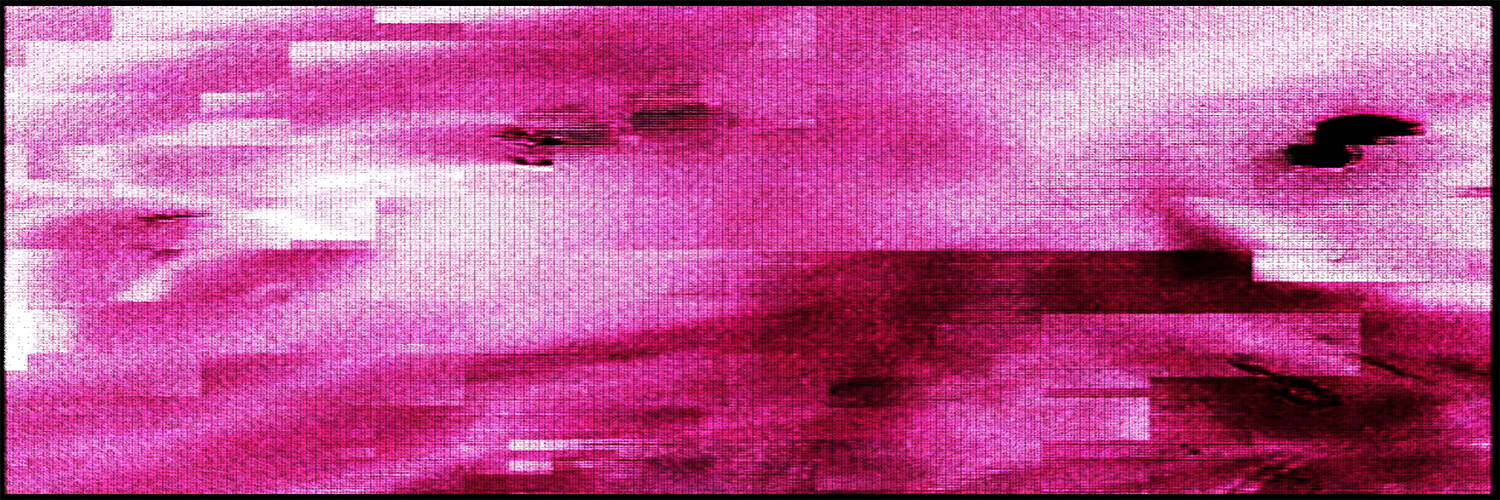
THE SLEEP OF REASON PRODUCES MONSTERS, Generative AI video, 7min, 20sec, 2025 © Galina Bleikh

THE SLEEP OF REASON PRODUCES MONSTERS, Generative AI video, 7min, 20sec, 2025 © Galina Bleikh
What challenges or surprises do you encounter when working with AI systems?
Most of all, I am amazed at the speed with which artificial intelligence expands its abilities, its speed of learning. Thus, only recently Suno, the AI music generator, was limited to composing very traditional music, staying within the boundaries of established genres, and I was unable to create truly cutting-edge sound effects. At the time, this came as somewhat of a disappointment, especially since I and my partner, Elena Serebryakova, were planning to compose an opera in a hybrid format. Nowadays, this generator can produce music of a quite acceptable experimental level, and you can even set the percentage of originality, unconventionality, and “wildness,” as well as the degree of influence of the desired style. This has enabled me to work with an aesthetics for which I have an affinity.
Being an artist engaged in a dialogue with AI, during the generation of texts, images, sounds, and video, I do not “lock” myself into an expected, pre-programmed outcome. Rather, the opposite is true: I follow the versions offered up by AI and modify my prompt in response to them (and the number of versions can be infinite), getting surprised each time and being able to make a selection, so as to build my line of inquiry. Very often, AI really stuns me with its unexpected solutions, and this is my most intense experience in the collaboration between the two of us. As I have already remarked, it is a mutual process of getting to know each other.
Speaking now of the challenges: the dynamic development of this field, the need to keep up with current trends (both in technology and in AI-based Art), the constant emergence of ever-new AI generators, and the need to become acquainted with them and test them – all this takes an awful lot of time.
Another challenge is the methods of representation of AI-based Art. However, this is a subject for another lengthy conversation.
Lastly, what are you currently working on, and what directions would you like to explore in the future?
Yes, future plans are a traditional question, which many are reluctant to answer. However, let me start with a recent event, my personal exhibition at the CICA Institute for Contemporary Art (the Republic of Korea). There, I presented my project “I, Eye, and AI,” which consisted of a large-format video, a video installation (object), and a series of prints.
The exhibition was successful, and, as a result, I was invited to make a personal exhibition at the Lee Lee Nam Media Art Museum (M.A.M.) in Gwangju in October this year.
Structurally, the project is designed as an infinite sequence of segments following the scheme “image > description > image > description...,” exploring the transformation of the visual into the verbal and vice versa, and how far from the original image AI can diverge using its unpredictable “black box” algorithms. The project and its title were inspired by a personal experience. Several years ago, I started having vision problems, the world appeared distorted, prompting medical consultations. Optical Coherence Tomography (OCT) became a crucial diagnostic tool, creating highly precise 3D images of my retina, scanning light to reveal microscopic details of the retina’s layers and the optic nerve connecting the eye to the brain. I requested my doctor’s OCT eye images and engaged AI in describing its interpretation of these images. Thus, in collaboration with the neural network, a series of descriptions and images based on them were created.
This collaborative exploration challenges traditional boundaries between creator and tool, suggesting a new paradigm of artistic creation, where technology becomes a sentient, responsive partner.
My two latest projects, “The Sleep of Reason Produces Monsters” and “A for Adam, AI and Artist”, are essentially AI ballet productions. Choreography created with the help of AI is a potent metaphor for the system of algorithmic control, which forces us to rethink the notions of autonomy and individuality.
I intend to develop these works and convert them into a hybrid form, i.e., by combining AI-generated and live choreography in a single space (e.g., a museum), thereby establishing a relationship between a machine algorithm and a living human being. I am currently looking for partners for such a project.
Also, in partnership with Lilia Chak, I intend to publish a book of sonnets. This book is part of our project “The Last Poet,” which includes a video installation, an interactive quiz, a series of prints, and an illustrated collection of poetry. The project comprises a “crown” of fifteen sonnets, including the original magistral sonnet by the poet Alexander Altshuler (1938–2014), and fourteen AI-generated sonnets, each corresponding to a distinct cosmological model. At present, we are negotiating with several publishing houses.
Finally, our largest and most ambitious project is staging a hybrid opera. My partner Elena Serebryakova and I have developed a truly innovative format, different from the traditional opera, which reflects the parameters of the new technological reality, into which we are all rushing headlong.
Artist’s Talk
Al-Tiba9 Interviews is a promotional platform for artists to articulate their vision and engage them with our diverse readership through a published art dialogue. The artists are interviewed by Mohamed Benhadj, the founder & curator of Al-Tiba9, to highlight their artistic careers and introduce them to the international contemporary art scene across our vast network of museums, galleries, art professionals, art dealers, collectors, and art lovers across the globe.


Lumi Liu is a New York–based designer and visual artist working at the intersection of art, medical visualisation, and public expression. Her practice explores consciousness, hidden biological systems, and the multiple dimensions of life that exist beyond human awareness. Lumi transforms these invisible biological architectures into poetic artistic experiences.