
10 Questions with Albert Deak
Albert Deak is a UK-based visual artist. He bridges traditional ceramic techniques with digital abstraction and acrylic painting on canvas. A graduate of the University of Art and Design in Cluj-Napoca (1989), he specialized in industrial and artistic ceramics. This training gave him a foundation of structural clarity and symbolic precision.
His early career included designing fine porcelain and figurative objects for mass production. However, his creative trajectory soon expanded into independent artistic expression. Over the decades, Deak has cultivated a distinctive style. He fuses metaphysical symbolism, chromatic rhythm, and geometric resonance. His portfolio spans digital painting, canvas works, figurines, graphic design, and experimental projects. These projects intertwine traditional modeling with contemporary digital practice.
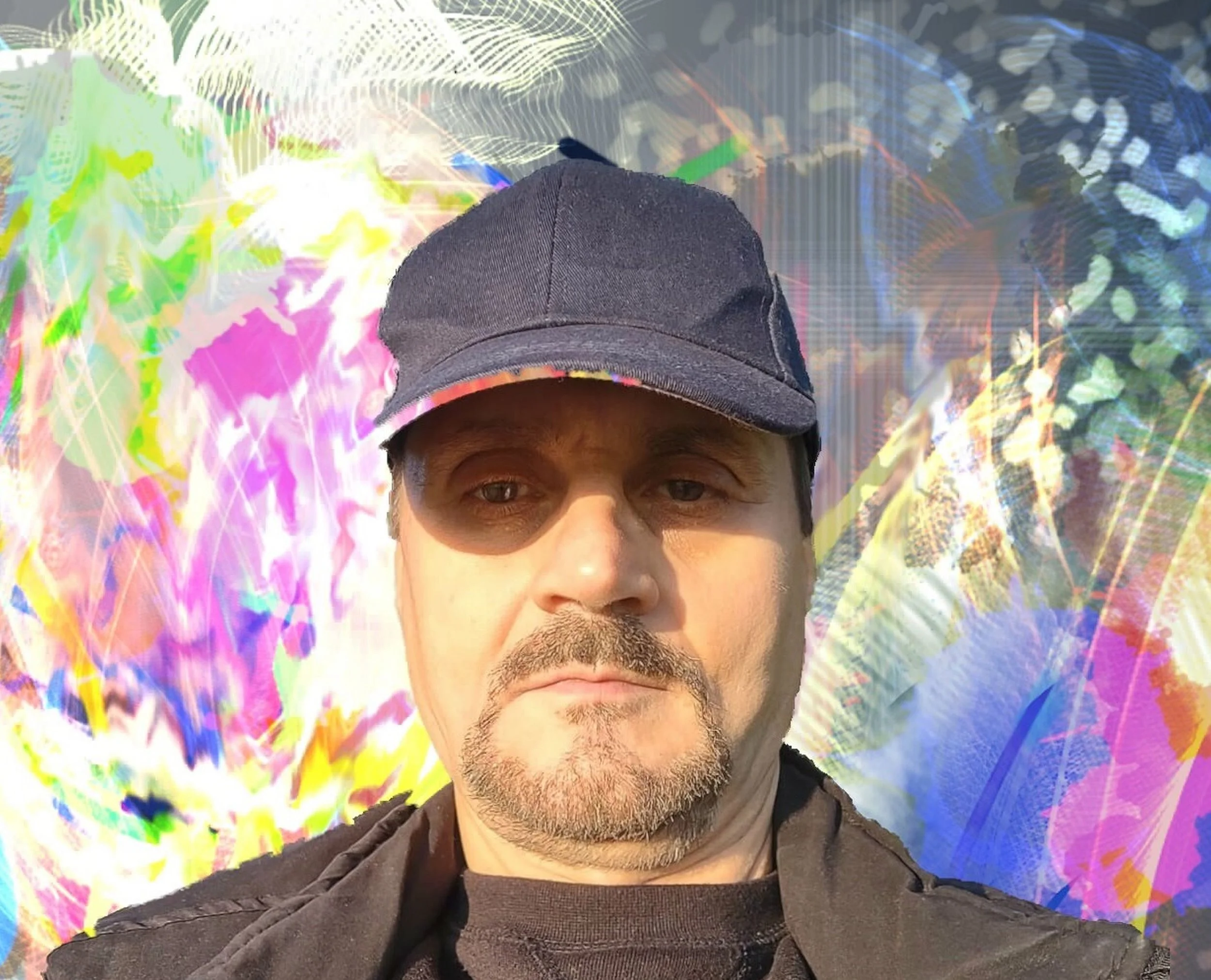
Albert Deak - Portrait
Deak’s artistic journey has been enriched by his participation in international exhibitions and festivals. He has presented works across Europe and beyond. He is a member of the British Art Club and the Visual Artists Association in the UK. These memberships affirm his presence within professional networks.
Influenced by Jackson Pollock, Gerhard Richter, and Wassily Kandinsky, Deak’s creations explore duality, vibration, and cosmic resonance. His works are not mere objects but visual meditations,windows into symbolic landscapes that invite viewers to engage with depth, sincerity, and philosophical reflection.
Albert Deak has participated in numerous exhibitions, salons, and international art festivals, with both solo and group presentations in physical and virtual formats. His current focus lies in authentic digital art and acrylic painting on canvas, while continuing to expand his symbolic archive and historical projects.
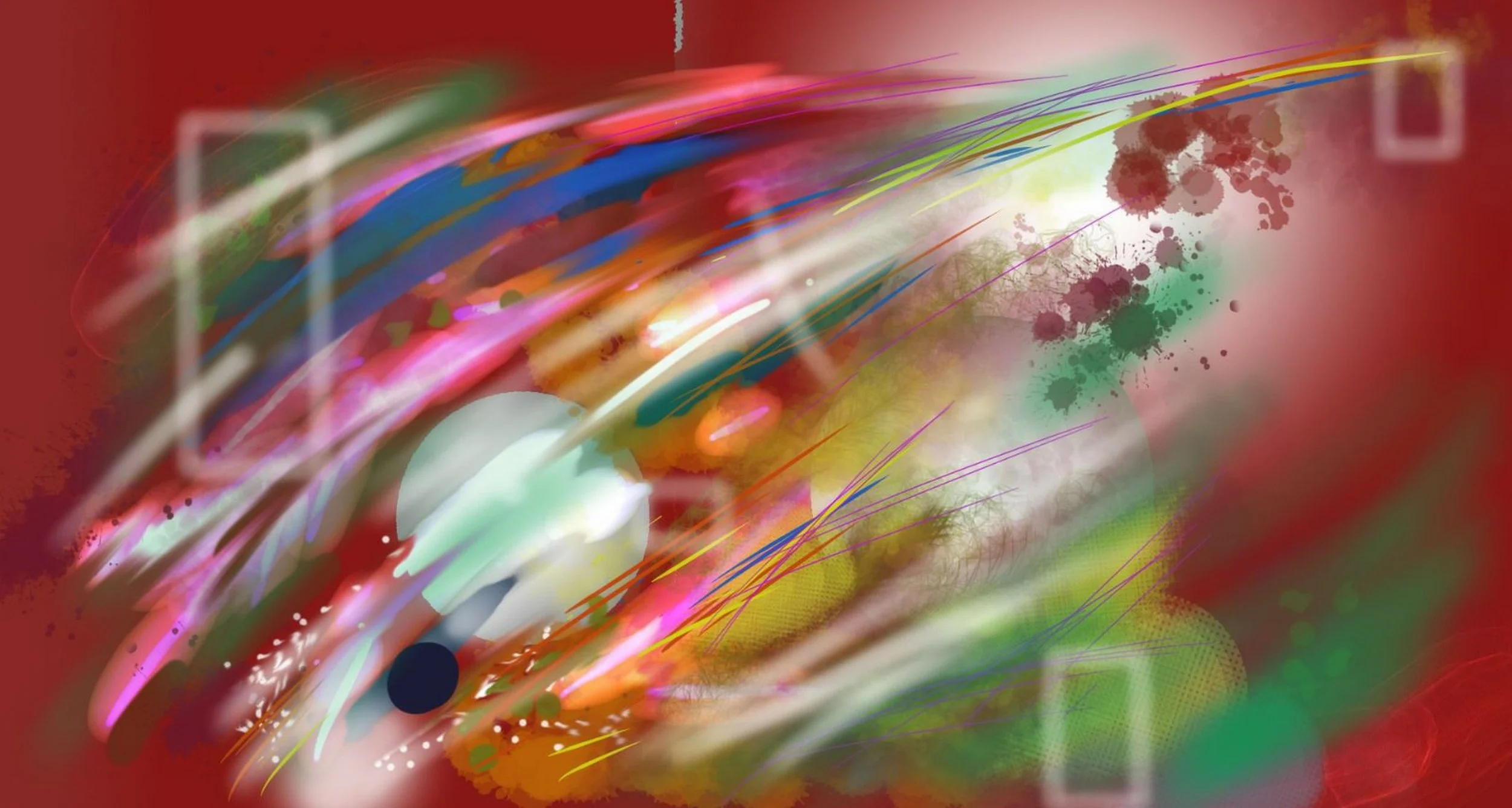
Dynamics, force, light in space © Albert Deak
INTERVIEW
First of all, can you tell us a bit about your artistic background and how you first became interested in visual art?
My artistic journey began in childhood, when drawing and coloring were my constant focus. Even though I enjoyed sports and reading, drawing always came first. I spent countless hours observing nature, everyday objects, people’s faces and movements, and each discovery felt like a revelation. I tried to capture not only what I saw but also what I felt, translating those impressions onto paper. My parents were often amazed and delighted by the intensity of this passion.
A decisive role was played by my early drawing teacher, who recognized my talent and spoke with my parents about the possibility of continuing my studies at a specialized art high school. Her encouragement opened the path toward formal artistic education and gave me the confidence to pursue this vocation.
Later, I studied at the “Marin Sorescu” Art High School in Craiova, specializing in graphic arts. This was an intensive period that gave me solid foundations in drawing, composition, and visual language. I graduated with both a diploma in Fine Arts and a professional qualification as a draughtsman, decorator, and restorer. This rigorous training provided me with discipline and technical mastery that continue to shape my work today.
I then continued my studies at the University of Art and Design in Cluj-Napoca, specializing in Ceramics. There, I discovered the fascinating balance between art and science, learning about material chemistry, firing techniques, and the aesthetics of three-dimensional form. This experience taught me to view creation as a complex process where intuition and rigor coexist.
Over time, I have explored both canvas painting and digital media, considering art as a portal into the mysteries of the universe. Before beginning a new work, I practice meditation to connect with a higher source of inspiration. Each creation becomes, for me, a form of knowledge, a dialogue between tradition and innovation, between the material and the immaterial.
In essence, my interest in visual art was born from an intense childhood passion, nurtured by family and teachers, and consolidated through rigorous academic training. Today, I define myself as an artist working at the intersection of traditional techniques and digital explorations, guided by the desire to transform intuitions and universal mysteries into visual language.

War galaxy © Albert Deak
How did your early training in ceramics shape the way you work today?
My early training in ceramics had a profound impact on the way I work today. Studying at the University of Art and Design in Cluj-Napoca, specializing in Ceramics, was a transformative experience. There I discovered the fascinating balance between art and science: I learned about the chemistry of materials, the composition of ceramic masses, the technology of glazes and pigments, and the complexity of firing processes. This knowledge gave me a structured way of thinking and a discipline that continues to shape every stage of my creative process.
In the ceramics workshop, I experienced firsthand the transition from idea to object, from concept to three-dimensional form. I worked on both functional pieces and sculptural or decorative projects, which taught me to treat the material as a partner in dialogue. Ceramics developed my patience, attention to detail, and ability to manage complex processes, while also teaching me to embrace unpredictability, since each firing could bring surprises, sometimes errors, but often revelations.
This early training prepared me not only technically but also conceptually. I came to understand that art is not only free expression but also a rigorous process, where intuition must coexist with knowledge of materials and precise methodology. Even today, when I work in acrylic painting or digital abstraction, I carry with me the discipline of ceramics: attention to structure, layering, and the balance between form and content. In many ways, ceramics gave me a mindset that I apply across all artistic media.
Later experiences as a porcelain designer at ARPO S.A. and as the founder of Dragon Art SRL further reinforced this foundation. I learned to adapt creation to production requirements, to respect quality standards, and to coordinate teams. These lessons remain present in my current practice: whether I am creating a painting or a digital work, I approach the process with the same rigor, but also with openness to experiment and innovation.
Your practice blends traditional techniques with digital tools. What led you to combine these two approaches?
The combination of traditional techniques with digital tools came as a natural step in my artistic evolution. My classical training in graphic arts and ceramics taught me rigor, discipline, and respect for material. At the same time, curiosity and the desire to explore pushed me toward the digital medium, which offers extraordinary freedom for experimentation.
In traditional media, each work requires a slow, careful process, with limited resources and the inevitable risk of mistakes. In digital, I discovered a space where I can test compositions, colors, and forms quickly, without material costs and without the fear of “ruining” a piece. This freedom encouraged me to be bolder, to explore radical ideas, and to expand my visual vocabulary.
Yet I never abandoned traditional practice. Canvas, ceramics, and acrylic painting provide a tactile presence and material energy that digital cannot replace. For me, the two approaches are not opposites but complementary. Digital serves as a laboratory of ideas, a space for prototyping and exploration, while traditional media give uniqueness, density, and direct contact with matter.
In essence, I chose to unite them because together they offer me a complete spectrum: tradition and rigor on one side, freedom and innovation on the other. My practice thus becomes a dialogue between past and future, between manual gesture and digital algorithm, between the material and the immaterial.
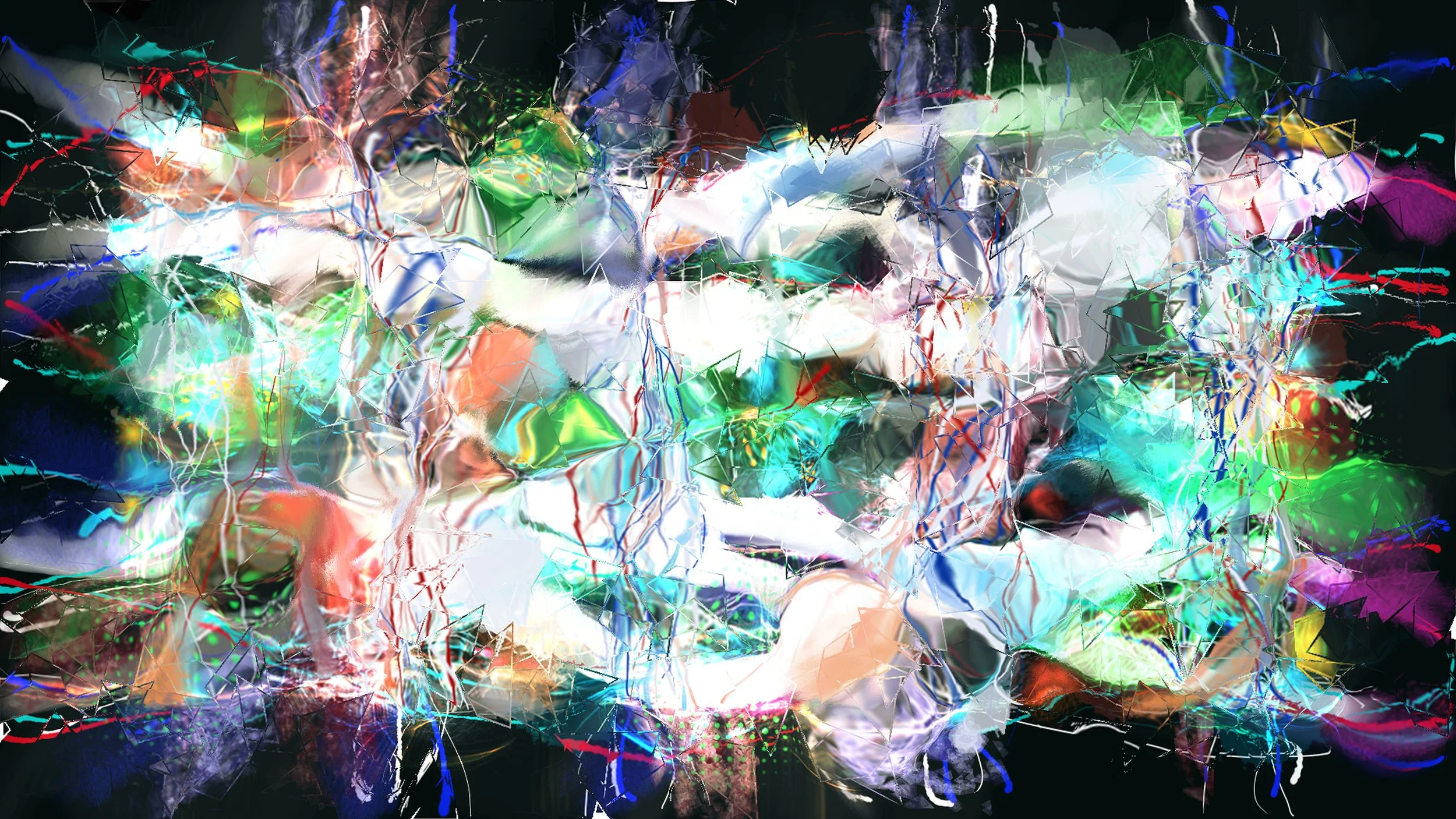
Electro-Cosmic Waves © Albert Deak

Ice and Fire in space © Albert Deak
How do you usually begin a new piece? Do you start with a sketch, an idea, or an experiment with materials?
For me, beginning a new work is a ritualistic process, standing at the intersection of intuition, knowledge, and mystery. The first step is almost always meditation, a moment of silence in which I clear my mind and connect to a higher source of inspiration. From this state, ideas, images, or abstract forms emerge, becoming the nucleus of the work. Sometimes I start with a quick sketch, other times with a concept or even with an experiment using materials, but there is always an inner thread guiding the process.
I am deeply passionate about science, mysticism, and cosmic explorations. I read scientific articles and follow theories about futurology and the possibility of life on other planets. These studies often spark ideas that I try to transpose onto canvas in a different manner, as if reality were being viewed from another dimension. Art gives me the possibility to transform scientific concepts and cosmic visions into visual language, to elevate them to an extrasensory level, and to immerse the viewer in another reality, one that raises existential questions.
In this way, each work becomes a dialogue between reality and myth, between superstition and lived experience, between science and mystery. I seek to ask questions about the fragility of life, the infinity of the universe, and our place within it.
The material, whether canvas, ceramics, or digital media, becomes a vehicle for these ideas, a space where concrete observation meets metaphysical intuition.
Thus, the beginning of a work is never rigid or predetermined. It may start with a sketch, an intuition, or an experiment, but it is always guided by the desire to transform science, mystery, and inner experience into a visual language that provokes emotion and reflection.
You work across ceramics, acrylic painting, and digital abstraction. Do you have a preferred medium, or do they each serve a different purpose?
For me, each artistic medium has a distinct role and offers different possibilities of expression. Ceramics remains a constant passion, especially in the field of product design, where I combine aesthetic elements with utility. It is a discipline that connects me to tradition and to the rigor of process, but also to the idea of transforming functional objects into works of art.
In acrylic painting, I integrate my passion for science, cosmology, and futurology in a very deliberate way. I enjoy combining abstraction with figuration, overlaying seemingly classical zones with abstract dynamism so that they intersect and interconnect. The result is an apparent reality, sometimes ghostly, sometimes clear, sometimes in chiaroscuro or in mist. Acrylics allow me to explore these visual intersections and to convey to the viewer an intense experience that lies at the boundary between science and mystery.
In digital painting, my approach is different: I prefer to create purely abstract, non-figurative art, based on the dynamics of color and its expansive movement. I focus on the intersections of lines, hatching, and overlays, building compositions that transmit energy and vibration. The digital medium offers me an infinite laboratory of experimentation, where I can explore visual dimensions that would be impossible to achieve in traditional media.
I cannot say that I have a single preferred medium, because each serves a different purpose. Ceramics gives me rigor and a connection to the object, acrylic painting allows me to explore the intersection of abstract and figurative, while digital abstraction opens conceptual and cosmic horizons. Together, these media form a complete artistic universe, where material and immaterial, tradition and innovation, meet and complement each other.

Star from water, steam and fire © Albert Deak
Your work often explores symbolism and geometric forms. What draws you to these themes?
My attraction to symbolism and geometric forms comes from the belief that they represent a universal language capable of expressing fundamental truths about existence. Geometry, for me, is not simply a mathematical or physical exercise, but a spiritual experience: a form of energy that transforms and fuses with the universe. In my works, geometric forms can be seen as portals to multiple dimensions, bridges between the abstract world and the reality we live in.
Circles, triangles, squares, and spirals are not merely visual shapes, but ancestral symbols that speak of infinity, balance, ascension, and cycles. They have fascinated humanity throughout history, from primitive and sacred architecture to the great civilizations of Egypt, Greece, Rome, China, Japan, and across Asia. In these cultures, geometry was used not only as an aesthetic tool but also as a way to express cosmic mysteries and spiritual beliefs.
In my practice, geometry also connects to industrial and product design, where aesthetic and utilitarian elements merge into coherent forms. I enjoy exploring this dual nature: geometry as functional structure and, at the same time, as a symbol of unseen realities. Thus, each form becomes a space for meditation, a portal to spatial planes or dimensions not yet elucidated, mysteries still unknown.
Symbolism and geometry allow me to transpose scientific, cosmological, and mystical ideas into an extrasensory visual language. I do not approach geometry as a mathematician or physicist, but as a being who shifts astral form and energy in fusion with the universe. Through these forms, I invite viewers to reflect on the fragility of life, the infinity of the cosmos, and the mysteries that remain unresolved. In my work, geometry is not just a compositional tool, but a gateway to parallel realities, to hidden dimensions, and to the profound union between humanity and the cosmos.
You’ve participated in many exhibitions over the years. How do audiences typically respond to your work?
Audiences often react with surprise and deep interest because my works propose an experience very different from what they are accustomed to seeing in exhibitions. Many tell me that they do not perceive my art as simple wall decoration, but rather as a space for reflection. Instead of a still life or a familiar landscape, they encounter themes such as space, time, and the inner and outer universe, subjects rarely explored in traditional shows.
This difference draws them in and makes them linger longer in front of the works. I have observed intense reactions: long gazes, moments of silence, sometimes even a shiver or a sense of puzzlement. Some become melancholic, others enter a meditative state, as if trying to decipher a hidden message or step into another reality.
Curators and professionals usually remark on the rigor of my process and the coherence of my compositions, but also on the poetic dimension, the way my art connects the aesthetic with the utilitarian, the material with the immaterial, science with mysticism. For me, the most valuable feedback is when people leave an exhibition with a strong emotion or an existential question.
This shows that my works are not just visual objects, but experiences that open an inner dialogue and invite exploration of deeper dimensions of reality.

The two universes and their inner music © Albert Deak

Travelers from other worlds © Albert Deak
Which artists or movements have influenced your style the most?
My style has been shaped through a continuous dialogue with the masters of modern art, the sacred traditions of humanity, and my own reflections. Jackson Pollock inspired me with the freedom of gesture and the raw energy of his painting, where movement itself becomes pure expression. Gerhard Richter influenced me through his ability to oscillate between abstraction and figuration, creating a tension between clarity and ambiguity. Wassily Kandinsky remains a fundamental reference, with his vision of art as a universal language of the soul, where color and form carry spiritual resonance. Salvador Dalí, through his surrealism, opened the path for me to explore the subconscious and mystical dimensions, showing how dreams and imagination can be transformed into powerful visual realities.
I have also admired the Romanian artist Sabin Bălașa, considered by some to be the father of Romanian neosurrealism. His monumental frescoes and what he called “cosmic romanticism” fascinated me with their vision of infinite blue, love, and the cosmos intertwined. This cosmic sensibility resonated deeply with my own artistic concerns about space, time, and the mysteries of the universe.
At the same time, surrealism gave me the freedom to integrate mystery and dream, while abstract expressionism showed me how color and form can become extrasensory energy. Minimalism and conceptual art taught me the power of simplicity and pure idea, influences that I reinterpret through geometry and symbolic language in my own works. Sacred art and ancient architecture, Egyptian, Greek, Roman, and Asian, remain a constant reference, where geometry and symbols were used to express cosmic mysteries and spiritual beliefs.
It is important to emphasize that I do not copy anyone’s style. I meditate on their works to understand their essence, but I use this reflection as a starting point to shape my own original voice.
My style is a synthesis: Pollock gave me freedom of gesture, Richter the tension between abstraction and figuration, Kandinsky the spirituality of color, Dalí the power of dream, and Bălașa the cosmic dimension. Combined with my personal and professional experiences, from ceramics and industrial design to digital painting, these influences converge into a unique language, where art becomes a portal to unseen dimensions and a space for existential reflection.
How has your practice evolved since moving to the UK and joining the local art community?
Moving to the United Kingdom marked a profound transformation in my artistic practice. In the early years, I carefully studied British modern and contemporary art, while also visiting galleries to contemplate classical British art. This dual experience, between tradition and modernity, gave me a broader perspective on cultural diversity and the many ways of approaching art.
Unlike Romania, where exhibitions feature mainly Romanian artists trained in local schools, talented and integrated into international currents, in the UK, I discovered a much greater diversity of ideas and styles. I encountered contemporary African and Asian art alongside European and Western works, all coexisting in a vibrant dialogue.
Here, art has a stronger dynamic and a wider variety of innovative voices. This brought fresh energy to my mind and challenged me to reflect, yet I have tried not to let these influences alter my style too much. I have remained faithful to my originality.
It is important to emphasize that this diversity does not diminish the value of Romanian art, which I consider one of the most constructive and original in the world, though still little known to Western audiences.
In this process, I often recall the example of the Romanian sculptor Constantin Brâncuși. He studied Neolithic, African, and Asian art, extracting their essence and transforming it into a new style, simplified, geometric, and revealing the core of the subject. This synthesis established him as a pioneer of modernism and allowed him to profoundly influence international art. I see his journey as a model: like Brâncuși, I absorb and meditate on the diversity around me, but my goal is not to copy or follow amorphous trends. Instead, I strive to create an original style with relevance for centuries to come.
My vision is to bring something new, building bridges between art, technology, mythology, mysticism, and space exploration. My practice in the UK has thus become a process of absorption and reflection: I welcome cultural diversity as a creative stimulus, but I preserve the original nucleus of my style. Ultimately, my aim is not to reproduce what I have seen, but to contribute with my own authentic voice to the international artistic dialogue.
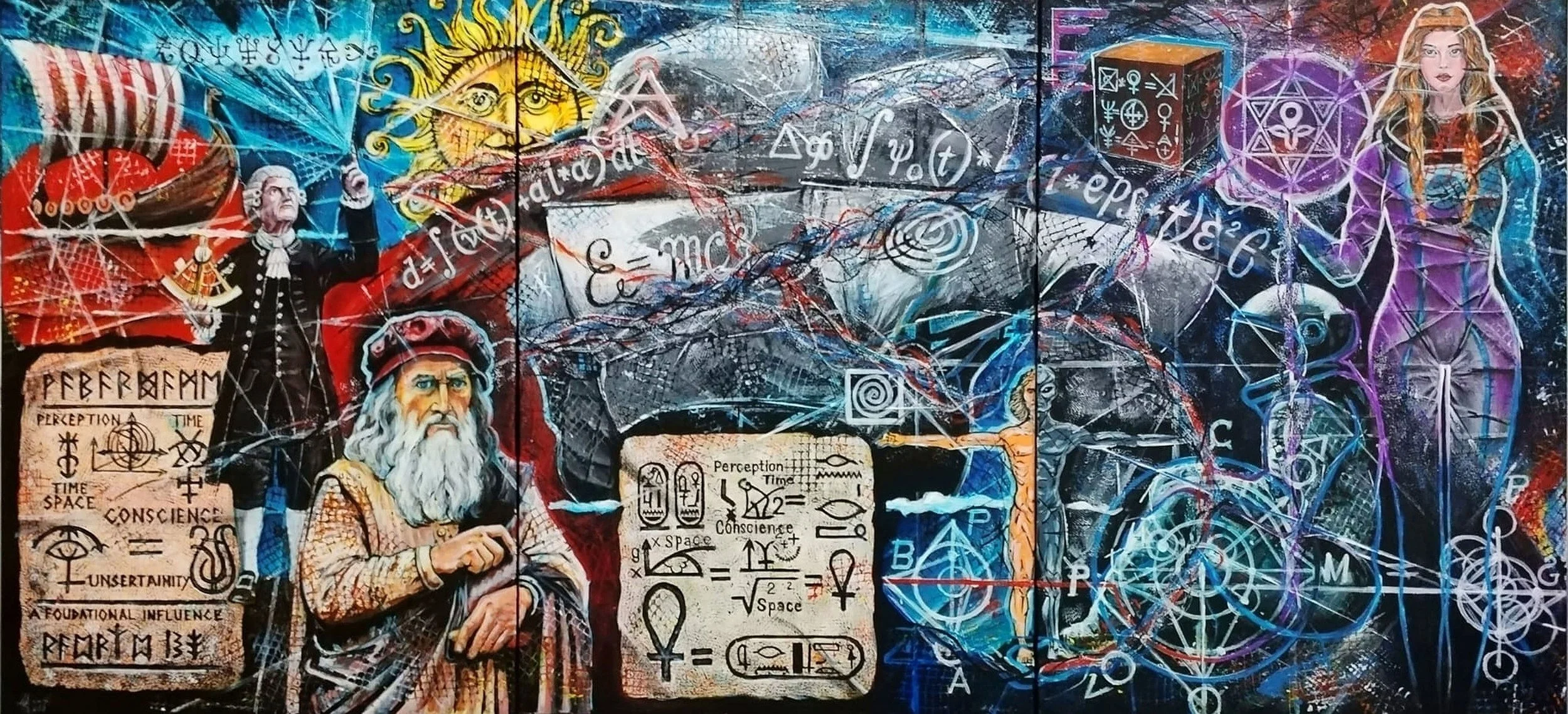
Space-Time © Albert Deak
Lastly, what projects or ideas are you looking forward to exploring in the near future?
In the near future, I intend to develop projects that further expand the dialogue between art, technology, and the cosmic dimension. I want to create immersive works that go beyond the traditional format of the canvas and become multisensory experiences, inviting the viewer to step into a symbolic and meditative universe.
I also plan to explore the digital realm more deeply, combining traditional painting with generative art tools, augmented reality, and interactive media. I believe these technologies can open new pathways of communication between artist and audience, transforming art into a living, dynamic space.
Another important direction is to deepen themes related to mythology, mysticism, and space exploration. I want to create a series of works that reflect the connection between ancestral myths and contemporary scientific discoveries, building bridges between past and future, imagination and reality.
Looking ahead, I aspire to create large-scale works ranging from 2 to 10 meters. For this, I need a much more spacious studio, and one of my key objectives is to move into such a space. This will allow me to produce monumental pieces, including multi-panel and combined compositions. In the longer term, I envision organizing a multidisciplinary exhibition that brings together ceramics, traditional painting on canvas, and digital art printed on canvas. This combination would reflect my artistic journey and demonstrate how different media can coexist in a coherent dialogue, offering audiences a complex and innovative experience.
At the same time, I aim to continue collaborations with galleries and international artistic communities, bringing my work to diverse audiences and contributing to the global dialogue about the role of art in contemporary society. For me, every future project is an opportunity to bring something new, to create a visual language that remains relevant not only today but also for generations to come.
Artist’s Talk
Al-Tiba9 Interviews is a promotional platform for artists to articulate their vision and engage them with our diverse readership through a published art dialogue. The artists are interviewed by Mohamed Benhadj, the founder & curator of Al-Tiba9, to highlight their artistic careers and introduce them to the international contemporary art scene across our vast network of museums, galleries, art professionals, art dealers, collectors, and art lovers across the globe.


Kathy (Kaixi) Yu is a Los Angeles-based motion designer and digital artist working across motion graphics, 3D design, and visual storytelling. Her practice uses composition, materials, lighting, and animation to translate experiences of creative pressure, time, and imagination into stylized characters and digital environments.