

10 Questions with Shinyoung Kim
Born in Seoul and raised between Shanghai and New York, Shinyoung grew up navigating multiple cultures and visual languages. This diverse upbringing shaped her sensitivity to how design communicates across different environments and communities. She moved to New York in 2019, a transition that became a defining moment in her creative development. Shinyoung went on to study Communication Design at Parsons School of Design, where she refined her approach to branding, typography, and visual systems.
Today, she works as a graphic and branding designer and art director in New York City, currently collaborating with KTM Group on branding and visual identity projects within the hospitality industry. Her work focuses on branding for K-dining and contemporary Korean cuisine, translating culinary narratives into cohesive visual systems that balance tradition and modernity. She has developed brand identities, environmental graphics, social media, photography, and visual storytelling for restaurant and food brands, including HOWOO, DubuHaus, MUSAEK, and Food Gallery 32, shaping dining experiences that extend beyond the plate.
Through close collaboration with founders, chefs, and operators, Shinyoung bridges cultural context and contemporary design, creating brand identities that resonate with both local and global audiences. Outside of her professional practice, she explores New York City as an ongoing source of inspiration, documenting street scenes, signage, textures, and everyday mark-making. These observations inform her work in branding, typography, and illustration, grounding her practice in lived experience, cultural awareness, and place.
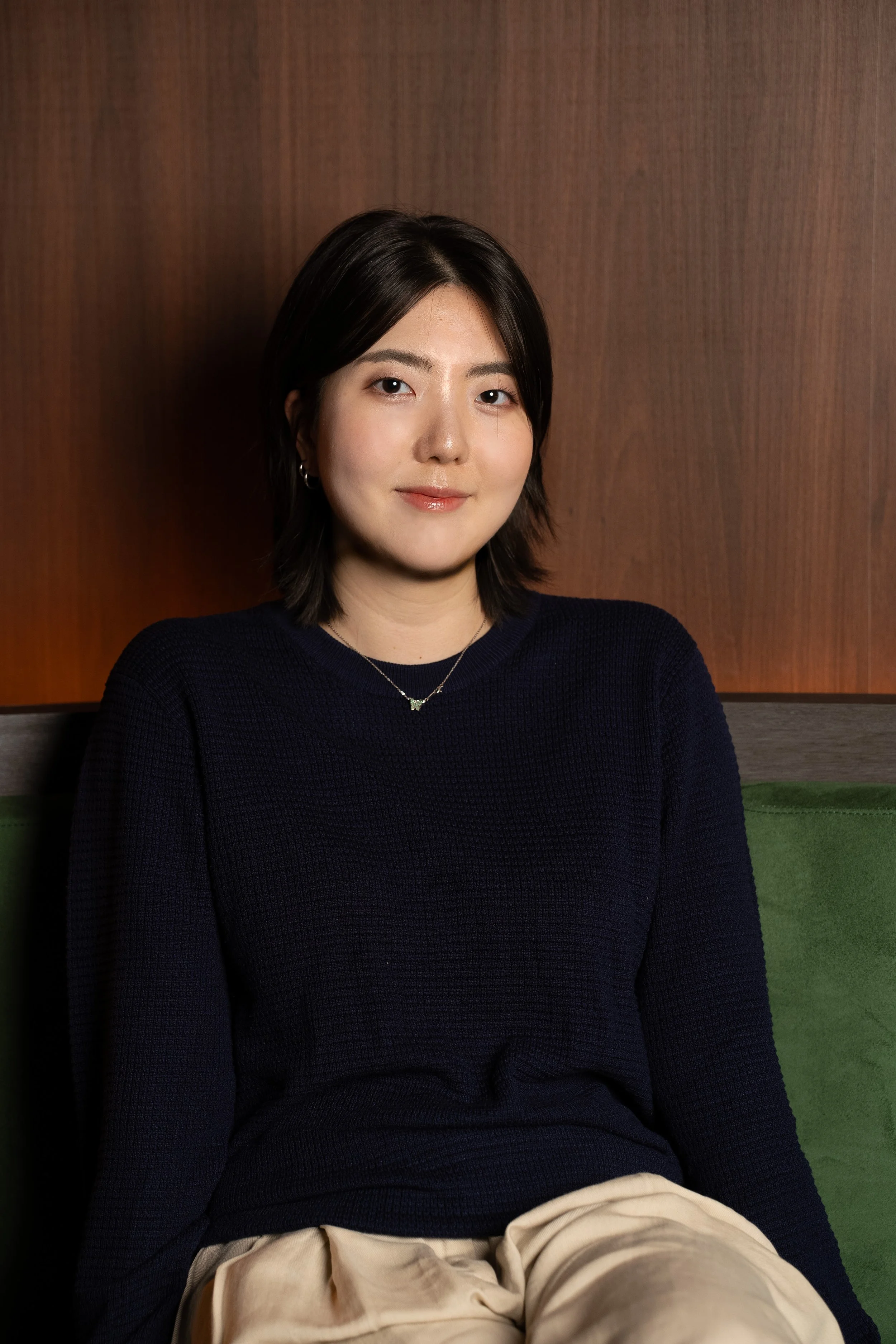
Shinyoung Kim - Portrait
ARTIST STATEMENT
Living in New York since 2019 has shaped Shinyoung’s approach to design as a form of cultural communication. The city’s dense visual environment, layered signage, informal typography, and improvised graphic systems reveal how everyday mark-making functions as a tool for visibility, identity, and spatial presence. This understanding informs both her professional branding work and her independent design practice.
Trained in Communication Design at Parsons School of Design and shaped by living between Seoul, Shanghai, and New York, Shinyoung brings a cross-cultural perspective to branding, typography, and visual systems. Her professional work focuses on branding for Korean and contemporary Korean cuisine in New York, where she collaborates with chefs, founders, and operators to translate Korean culture into cohesive visual identities for American dining contexts. Through brand systems, environmental graphics, menus, and spatial storytelling, she develops design languages that balance cultural authenticity with contemporary expression.
Alongside her professional practice, Shinyoung maintains an independent body of work centered on type design and image-based experimentation inspired by the city. By drawing typefaces from found letterforms, signage, and everyday visual rhythms, she uses type design as a process of learning, studying how a new cultural environment communicates visually and how those systems can be interpreted and reimagined. This personal practice functions as ongoing research, deepening her understanding of place, language, and adaptation.
Together, her professional and personal work positions design as a bridge between cultures. Through branding, type design, and visual systems, Shinyoung seeks to contribute to the visibility of Korean culture abroad while embracing the visual language of the city she inhabits. Her practice reflects an ongoing negotiation between heritage and environment, using design to create meaningful, culturally responsive public experiences.
Capital, Typeface design, digital, 2023 © Shinyoung Kim
INTERVIEW
You were born in Seoul and raised between Shanghai and New York. How did growing up between these cities shape the way you see and understand visual culture?
Growing up between Seoul, Shanghai, and New York shaped the way I see visual culture as something fluid rather than fixed. Being exposed to such different environments at a young age taught me to observe closely and adapt quickly. I learned that visuals don’t exist in isolation; they’re deeply tied to context, behavior, and place. That awareness continues to influence my work today. I’m always thinking about how design can feel authentic across cultures, how it can translate rather than imitate, and how it can create a sense of familiarity even in unfamiliar spaces.
Moving to New York in 2019 was an important moment for you. How did that transition influence your creative direction?
Moving to New York in 2019 was a defining moment for me creatively. It was the first time I was fully immersed in an environment where art, design, fashion, and culture constantly intersected in real time. The city’s intensity, its pace, diversity, and density of ideas pushed me to become more intentional and confident in my point of view.
As I later moved into the hospitality industry, working on restaurant brands rooted in Korean culture, that perspective deepened even further. My role requires me to think carefully about how culture evolves when it exists within another culture. I’m constantly designing work that is deeply grounded in Korean traditions, aesthetics, and values, while making sure it feels open and approachable to a non-Korean audience.
That balance has strongly influenced my creative direction. It taught me that good design isn’t about translating culture literally, but about interpreting it thoughtfully, finding a visual language that respects its origins while allowing it to adapt, grow, and resonate in a new context.

Grand Central, Typeface Design, Digital, 2024 (ongoing) © Shinyoung Kim
You studied Communication Design at Parsons. What did that experience give you in terms of tools, language, or confidence as a designer?
Studying Communication Design at Parsons didn’t necessarily give me a fixed set of answers, but it gave me the space to question how design functions in the real world. While school itself doesn’t always prepare you directly for industry, and I think that’s true of college in general, it did give me something equally important: a community, a shared language, and a way of thinking.
Parsons helped me learn how to talk about my work, critique ideas, and understand design as a form of communication rather than just aesthetics. The real growth, though, came after graduating. Most of my technical skills and confidence were built through hands-on experience, working with real clients, navigating constraints, and seeing my work exist in the world. That’s where confidence naturally followed.
Looking back, school gave me the foundation to ask the right questions, but work gave me the answers.
Your work spans branding, typography, and visual systems. Why do you feel graphic and branding design is the right medium for your ideas?
Graphic and branding design feels like the right medium for my ideas because it sits at the intersection of culture, communication, and experience. Visual language is often the most immediate and accessible way to communicate ideas across different cultures, it can transcend language barriers and create understanding before words are even needed.
Branding allows me to think holistically. I’m able to combine typography, imagery, spatial considerations, and storytelling into a cohesive system that shapes how people perceive and interact with a brand over time. Especially in hospitality, branding becomes something people physically engage with, on menus, walls, packaging, and within space, which makes the work feel tangible and alive.
I’m drawn to this medium because it allows my ideas to exist beyond a single format. A strong visual system can adapt, evolve, and grow with a brand, creating a shared point of connection between cultures while remaining rooted in a clear identity.
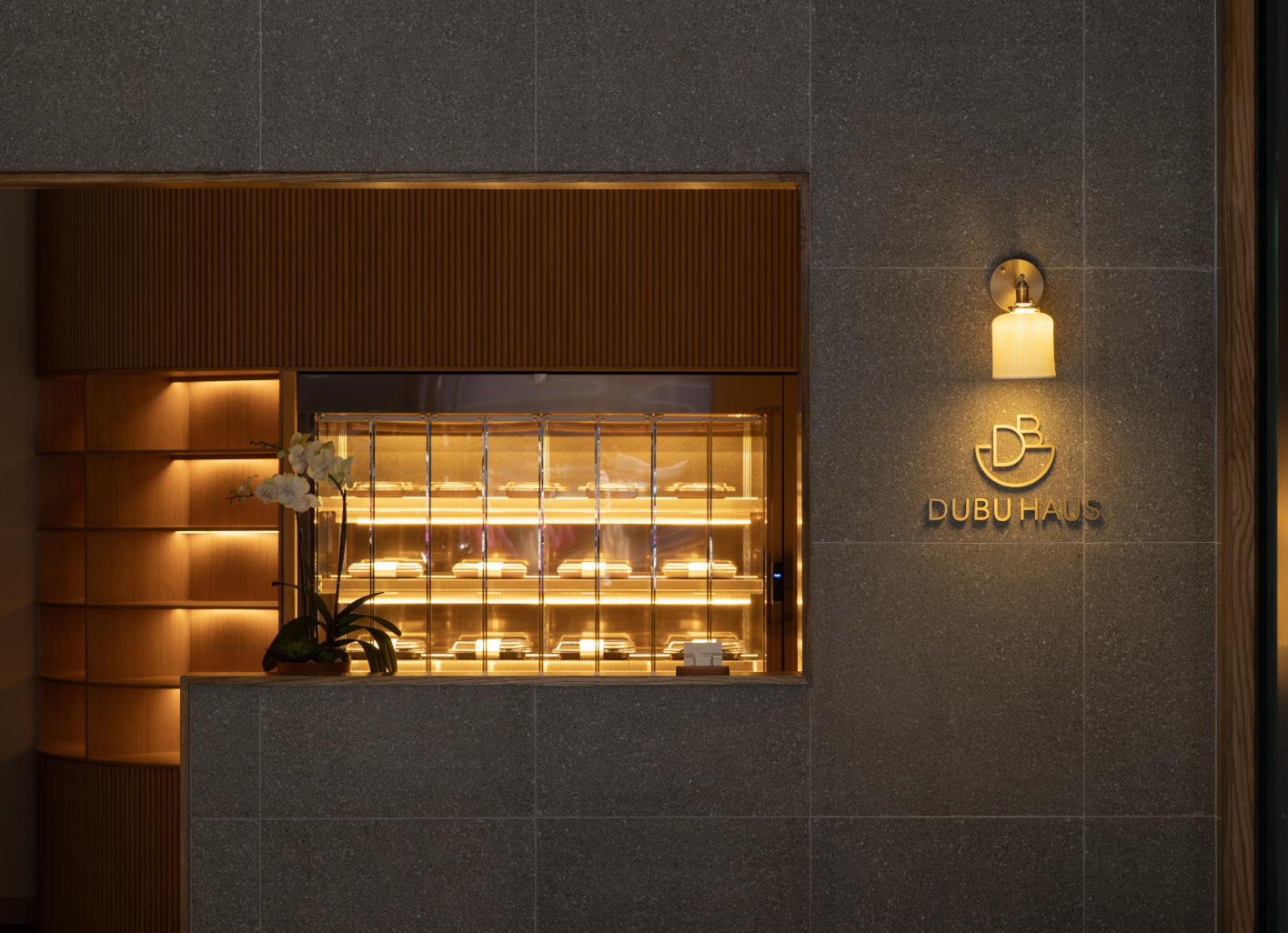
DubuHaus, Branding, 2025 © Shinyoung Kim

MUSAEK, Branding, 2025 © Shinyoung Kim
Much of your practice focuses on Korean dining and hospitality in New York. What draws you to food and hospitality as a space for cultural storytelling?
What draws me to food and hospitality as a space for cultural storytelling is that it’s inherently experiential; people don’t just see it, they taste it, feel it, and live it. Restaurants are living spaces where culture comes to life, and design can shape how that story is understood and felt.
Working with Korean dining specifically has deepened my awareness of how culture can evolve and translate across contexts. My role is to create designs that are deeply rooted in Korean traditions and aesthetics, but also accessible and inviting to a non-Korean audience. This balance, honoring origin while fostering connection, makes hospitality an ideal space for storytelling. It’s a medium where visuals, space, and narrative come together to create experiences that resonate emotionally, culturally, and socially.
When working on projects like HOWOO, DubuHaus, MUSAEK, or Food Gallery 32, how do you balance Korean cultural references with a contemporary American context?
Projects like HOWOO, DubuHaus, MUSAEK, and Food Gallery 32 are never the work of just one person; they’re the result of close collaboration across multiple teams, each bringing different skills and perspectives.
For example, HOWOO, which means “heavy rain” in Korean but also hints at “good beef,” is a name that plays with the Korean language while being easy for Americans to pronounce. On the design side, our interior team uses materials familiar in American restaurants to create comfort, while incorporating subtle touches of Korean aesthetics to honor the culture. On the menu, traditional Korean dishes are prepared with authentic ingredients, but we also include elements familiar to American diners so the flavors feel approachable.

HOWOO, Branding, 2025 © Shinyoung Kim
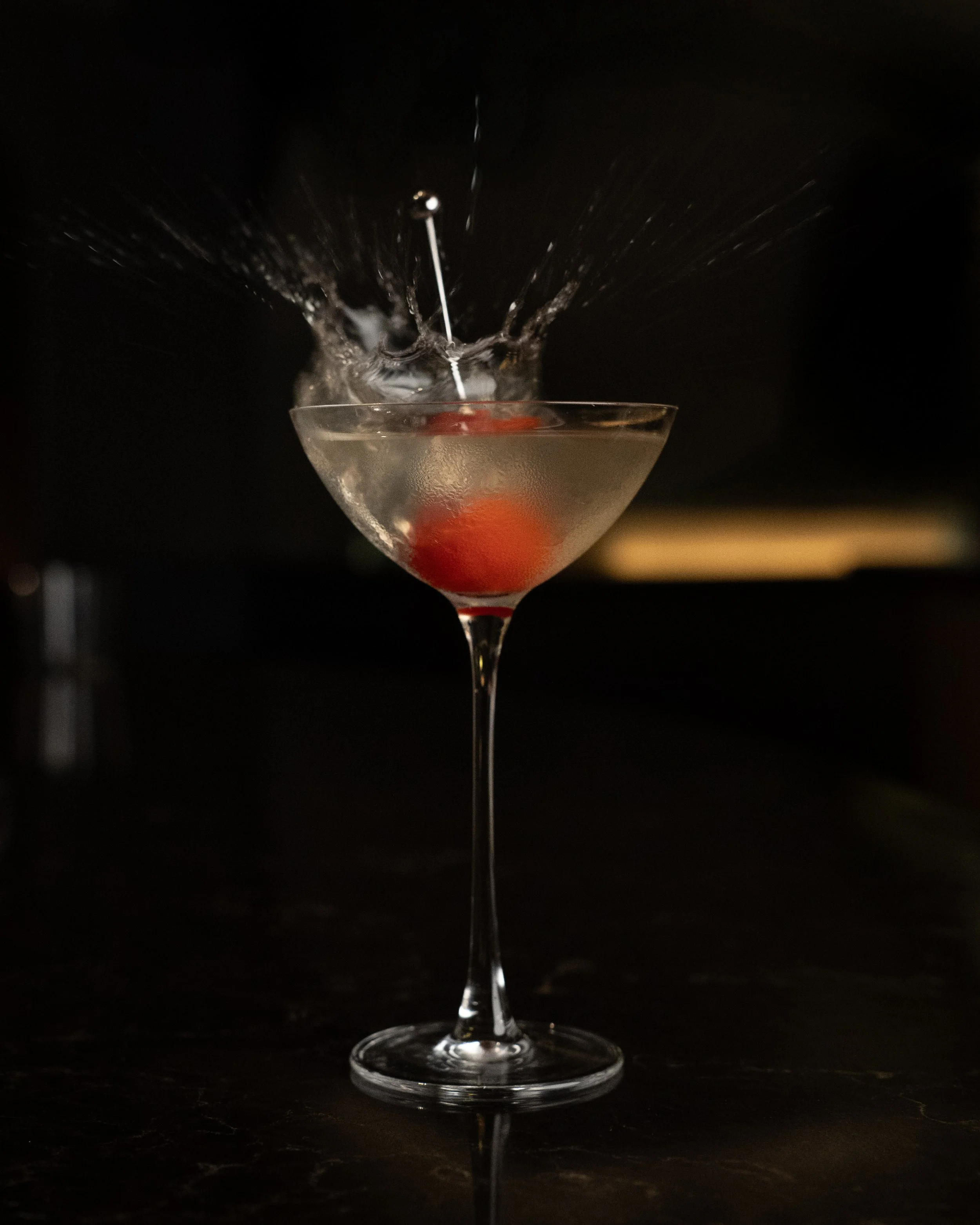
MUSAEK, Photography, 2025 © Shinyoung Kim
You collaborate closely with chefs and founders. How does this dialogue influence the final visual identity of a project?
Internal communication is a key part of my process, especially at my company. When I meet with founders, I focus on understanding their vision for the brand and translating that into design. I aim to propose directions that I genuinely believe in, so that whatever path we choose feels thoughtful and cohesive.
Chefs aren’t always directly involved in shaping the visual identity, but we maintain close communication with them, especially when finalizing menus and plating, because the food itself heavily influences the tone, mood, and overall experience of the brand. This dialogue ensures that every aspect, from visuals to taste, aligns and feels like a unified story.
You often observe and document New York’s street signage and everyday typography. How does this personal research feed into your design work?
I started documenting New York’s street signage and everyday typography purely as a personal interest, but over time, I realized it was also a way of seeking connection in this vast, sometimes lonely city. I became fascinated by the traces people leave behind, handwritten signs, stickers, posters, and how those traces communicate visually and interact with the environment.
Watching how people engage with these elements on the street also inspired ideas in my professional work. For example, it led to creative approaches for marketing campaigns, like street posters and QR codes, where I could design visuals that feel approachable, interactive, and part of the urban fabric. This personal research has taught me to observe closely, think about human interaction, and translate those insights into designs that feel alive and meaningful.

The Art of Mark-Making, Editorial, 6.5x9.5 in, 2023 © Shinyoung Kim
Your practice often moves between heritage and environment. Do you see design as a way to bridge cultures, and what does that mean to you?
I see design as a powerful bridge between cultures. It serves as an archive that can be passed down to future generations, preserving what is meaningful from a culture while also making it accessible and engaging to others. Through thoughtful design, people from different backgrounds can connect with, understand, and even participate in a culture that might be new to them.
At the same time, the lines between cultures are becoming increasingly fluid due to the rapid exchange of information and ideas. This offers exciting opportunities for cross-cultural dialogue, but it also presents challenges; traditions can be diluted or lost. For me, one of the responsibilities of a designer is to honor heritage while presenting it in a way that resonates with contemporary audiences, ensuring that cultural knowledge and values are preserved and shared thoughtfully.
Lastly, looking ahead, what kinds of projects or directions are you interested in exploring next?
Looking ahead, I’m particularly interested in exploring Korean Hangul typography and typeface design. Since my design education and most of my professional work have been in the U.S., everything I’ve studied and produced has been Latin-based. I want to deepen my understanding of Hangul to honor my heritage and explore ways to bridge Korean and English design systems, creating work that is culturally rooted yet globally accessible.
Artist’s Talk
Al-Tiba9 Interviews is a curated promotional platform that offers artists the opportunity to articulate their vision and engage with our diverse international readership through insightful, published dialogues. Conducted by Mohamed Benhadj, founder and curator of Al-Tiba9, these interviews spotlight the artists’ creative journeys and introduce their work to the global contemporary art scene.
Through our extensive network of museums, galleries, art professionals, collectors, and art enthusiasts worldwide, Al-Tiba9 Interviews provides a meaningful stage for artists to expand their reach and strengthen their presence in the international art discourse.


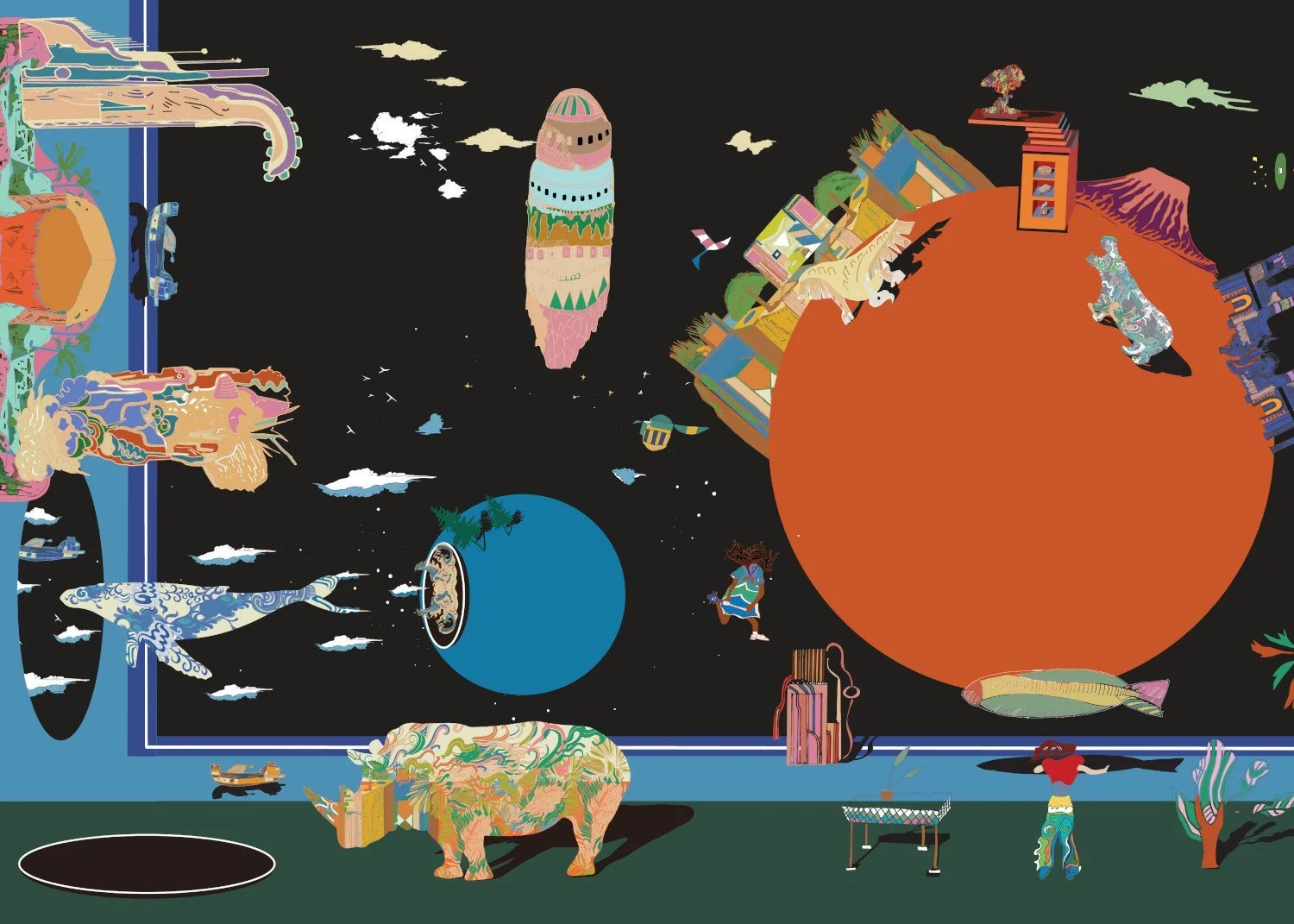
Graphic designer and educator Lucy Zou specialises in branding, typography, and visual storytelling. She is invested in projects that work with cultural institutions, public systems and histories, and cross-cultural contexts. Some recurring themes in her work include notions of interpretation, navigation, and understanding, and how visual language around things can impact how we experience them.