
10 Questions with Simon Gama
Simon Gama is a self-taught painter based in New York. He began painting as a child beside his father, who painted and sold his own work, and built his practice through observation, documentaries, and stubborn daily making, trusting his hands before any theory.
He works with industrial materials, factory paint, filler, surfaces people call cheap, because he spent years inside that world, and its cheapness is part of the work's truth. Strong color, irregular forms, and worn, weathered surfaces define his paintings: diaries of the day he lived, each one hiding names, phrases, and private material underneath that he will never show.
His completed series American Dream (sixteen works, 2021–2025) looks at labor, migration, identity, and survival and asks a hard question of its own title. His recent Autumn works and Studies on Paper continue the same inquiry in black and white, texture, and gesture: tenderness, anger, emptiness, memory, curiosity. A human being is both.
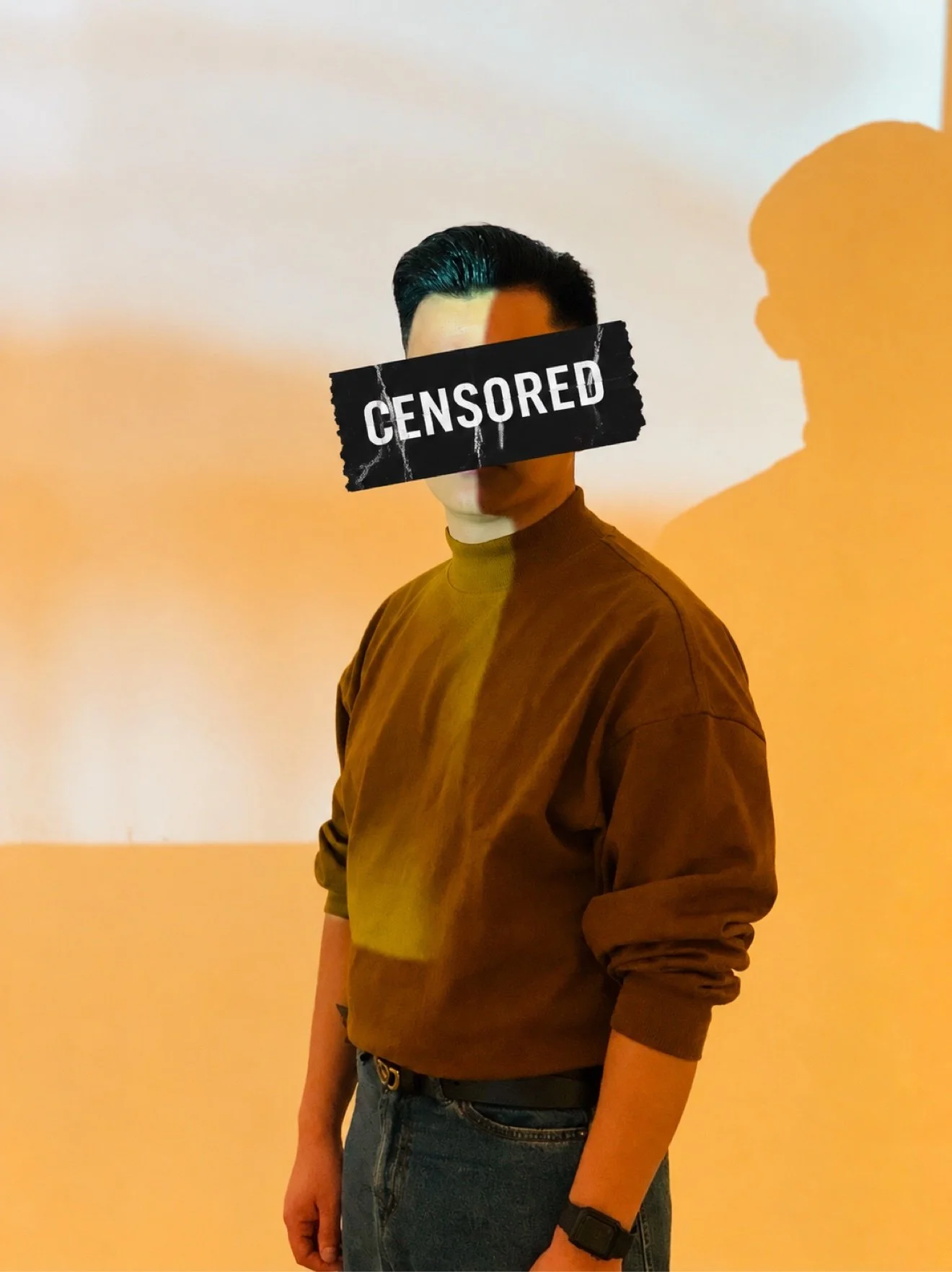
Simon Gama - Portrait
ARTIST STATEMENT
Simon Gama doesn't paint to be liked. He paints what he must. Since he was a child, he knew he was an artist. His father painted and sold his paintings, and he grew up with paint on his fingers, painting beside him. Largely self-taught, through documentaries, observation, and small clay houses, his hands were always making things. His father told him he had something different. He believed him.
He begins with curiosity, books, images, clean lines, body shapes, and then he disrupts it. Anxiety arrives, and he tears into the composition. That disruption is not the opposite of his work. It is his work. Strong color, irregular forms, and worn, weathered surfaces emerge: doubt turned into beauty. Then he fills what survives with the day he lived, what he felt, what he saw, what he read, what he couldn't stop thinking about. His paintings are diaries. Every one hides something underneath, names, phrases, private material, that he'll never show. Every one has to hold the memory of the time it was made.
He works with industrial materials, factory paint, filler, things people call cheap. He spent years observing that world, and its cheapness is part of the work's truth. What matters is never what the material costs, but the idea and the condition it carries.
His series American Dream (sixteen works, 2021–2025) looks at labor, migration, and survival, and asks a hard question of its own title. It is political, because he won't look away from what's in front of him. But he refuses to be only that. Feelings are disappearing; people don't show them anymore. So he paints those too, tenderness, anger, emptiness, memory, curiosity. A human being is both.
His early works were his education: small, stubborn pieces made with whatever he had, where he learned to trust his hands before any theory. American Dream was the reckoning. Autumn, four works from a season of going inward, is where he stands now: black and white, heavy texture, memory pressed into the surface, even a small photograph of himself hidden in one of them. The Studies on Paper are his laboratory: nine small experiments in color and gesture, where he lets himself play. The Autumn works, and the Studies are available from the studio; a finished painting wants to live somewhere, not in storage.
He makes this work for himself, to prove to himself that he can, not to defeat anyone. He'd rather you feel disgusted than feel nothing.
If you see injustice, say something. Speak up. Don't be part of it.
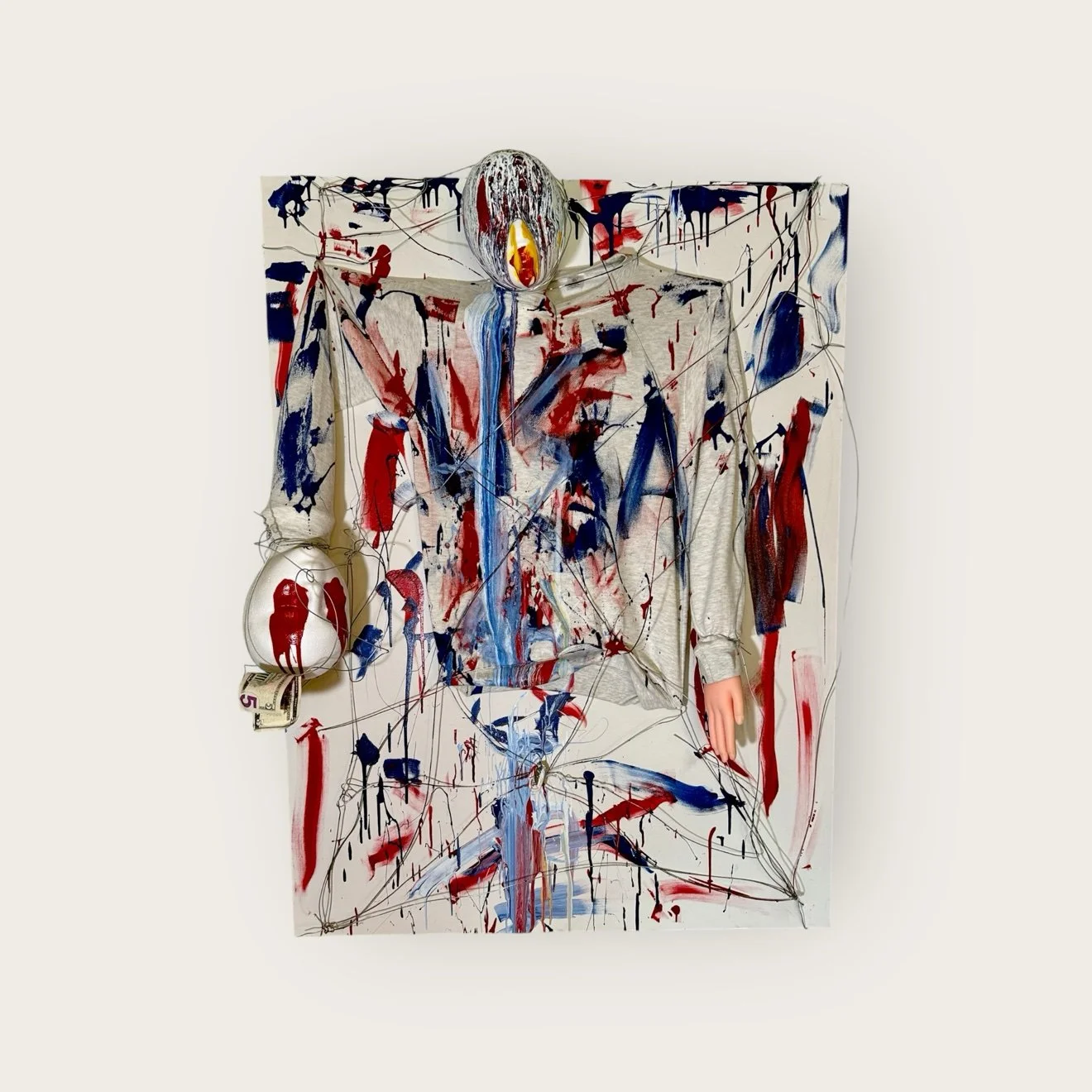
American Swag - The New American Flag, Mixed media on canvas, 36x48x1.5 in, 2021-2025 © Simon Gama
INTERVIEW
Let's start with your background. You began painting as a child alongside your father. How did those early experiences shape your relationship with art?
I did not only paint alongside my father, I also painted with my mother. Both of them were a very important part of my love for art, for making things, for using my creativity. We had very little money when I was a child, but my parents were always finding a way to move forward. One of the things I remember most is my father's creativity: he could make something out of nothing, and he made it look good, good enough to sell. We painted vases, my father made lamps, we made relief paintings and all kinds of things. But the person who has influenced me the most, besides my father, is my mother. Much of what I do today as an artist, I dedicate to her, to my father too, but above all to her, because my mother taught me to follow my dreams, to never let myself be defeated, and to fight for what I love, which is art. My father is a great inspiration as well: he is a man with a lot of resilience. But my mother has twice his resilience.
You are largely self-taught. How did you develop your artistic language through observation, experimentation, and practice?
That question is a little tricky for me, because in my view nobody is one hundred percent self-taught. People sometimes think that being self-taught means it all comes from your soul, that you simply do it, but that is not true. Behind every work, every artistic project, there is research, and that research is not something you produce alone: it rests on people who wrote about it, who studied it, who made works about it, with theory and everything. To be completely self-taught, you would have to work from the most primitive part of your being, and that is not really how it happens. As a self-taught artist you also have to study: color theory, assemblage, and the artists who inspire you. What being self-taught has given me is the freedom to skip the rules, to skip what is established, to create and to look for new horizons, for things that are not written down, the way many artists of the past have done. But as I said: nobody is one hundred percent self-taught, at least in my view.
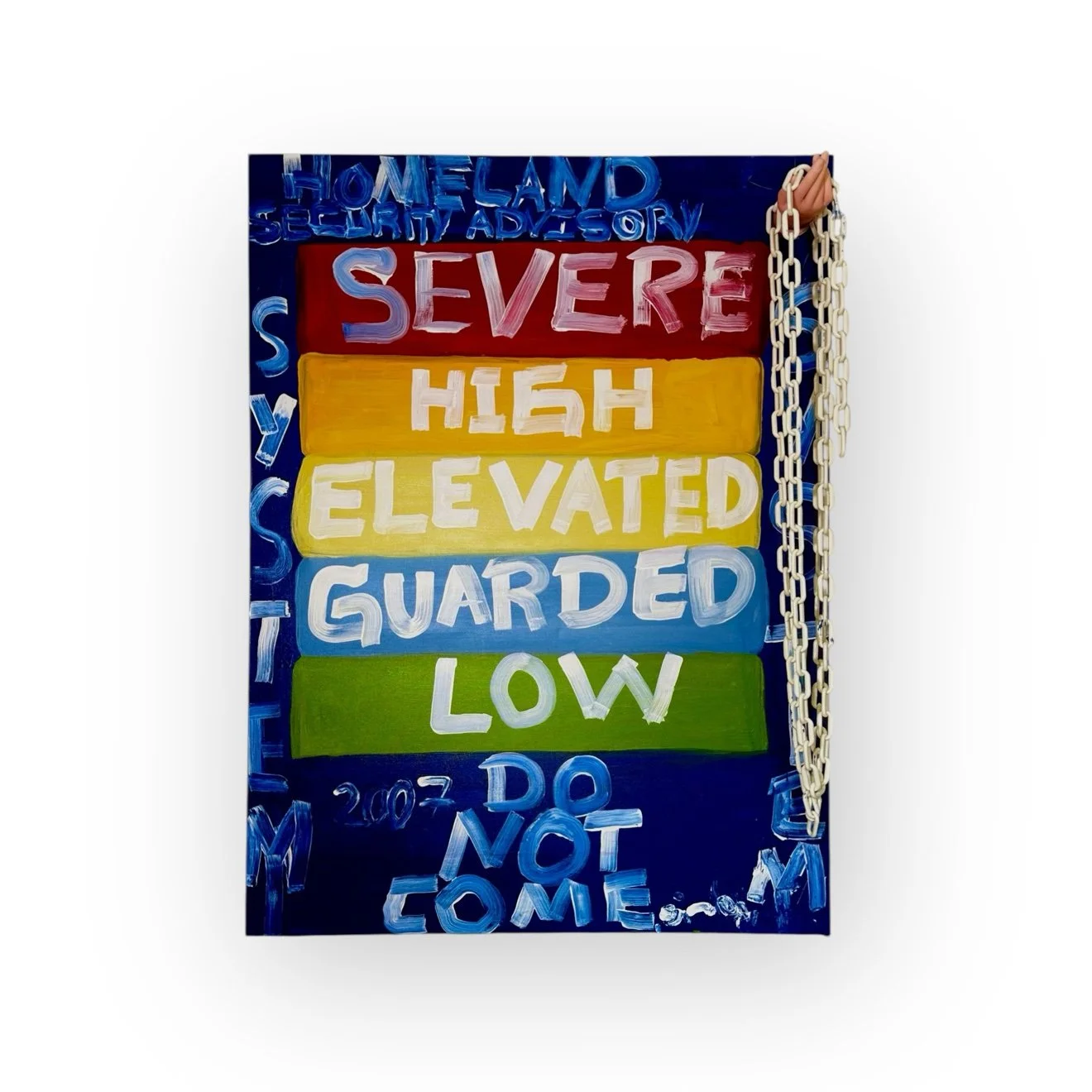
Homeland Security Rainbow, Mixed media on canvas, 36x48 in, 2021-2025 © Simon Gama
You work with industrial materials such as factory paint and filler. What attracts you to these materials, and how do they influence your work?
I don't know; I feel industrial materials have a certain beauty. They have that wear, that used look, that attracts me and stirs things in me; at times it even moves me. I remember once going to an exhibition where there was a lot of arte povera, and I fell in love from that moment. Most of the people around me were saying it was horrible, ugly, but not to me. They seemed to me to be unsettling materials, materials that can hold beauty, disillusion, sadness, joy: it all depends on the meaning the artist gives the material. They are also tied to us as human beings; we see them everywhere, in everything. And besides being beautiful, and able to carry immense meanings, they are one hundred per cent combinable. And they are accessible. For emerging artists like me, that matters: compare industrial materials with fine-art materials and there is a huge gap. Quality art materials are extremely expensive, and not every emerging artist can afford them. To understand industrial materials, that povera way of working, you need a very developed taste. There is a beauty inside them; it depends on how the artist uses them.
Your paintings often begin with an idea or a clear composition before being disrupted by anxiety and spontaneous gestures, as you mention in your statement. Can you describe your creative process?
Yes, of course. When I start to create, I already have an idea. I have a process: I research, I assemble the ideas, sometimes I even have the materials ready, prepared in advance. But I don't know if it is only me, or if it happens to many artists. There are artists who know how to control their emotions very well. I never could, not since I was born. I am a very sensitive person, to many things. Sometimes I feel like a ghost living on this planet. Sometimes I feel that I do not belong to this world. What I am going to say may sound strange, but sometimes I feel like a computer chip living in a body. And that has a lot to do with my creativity, with the artistic part I want to develop, with the project I want to make. Anxiety gets the better of me, anxiety and insecurities, more than many things. And in the end, when I create, when I take up paint or materials, all that anxiety, all that frustration, all those fears, or joys, end up reflected in my paintings. Yes: in the end, anxiety can be stronger than the idea, than the project I wanted to make. At times it bothers
me. But well, that is how I am. I am human.
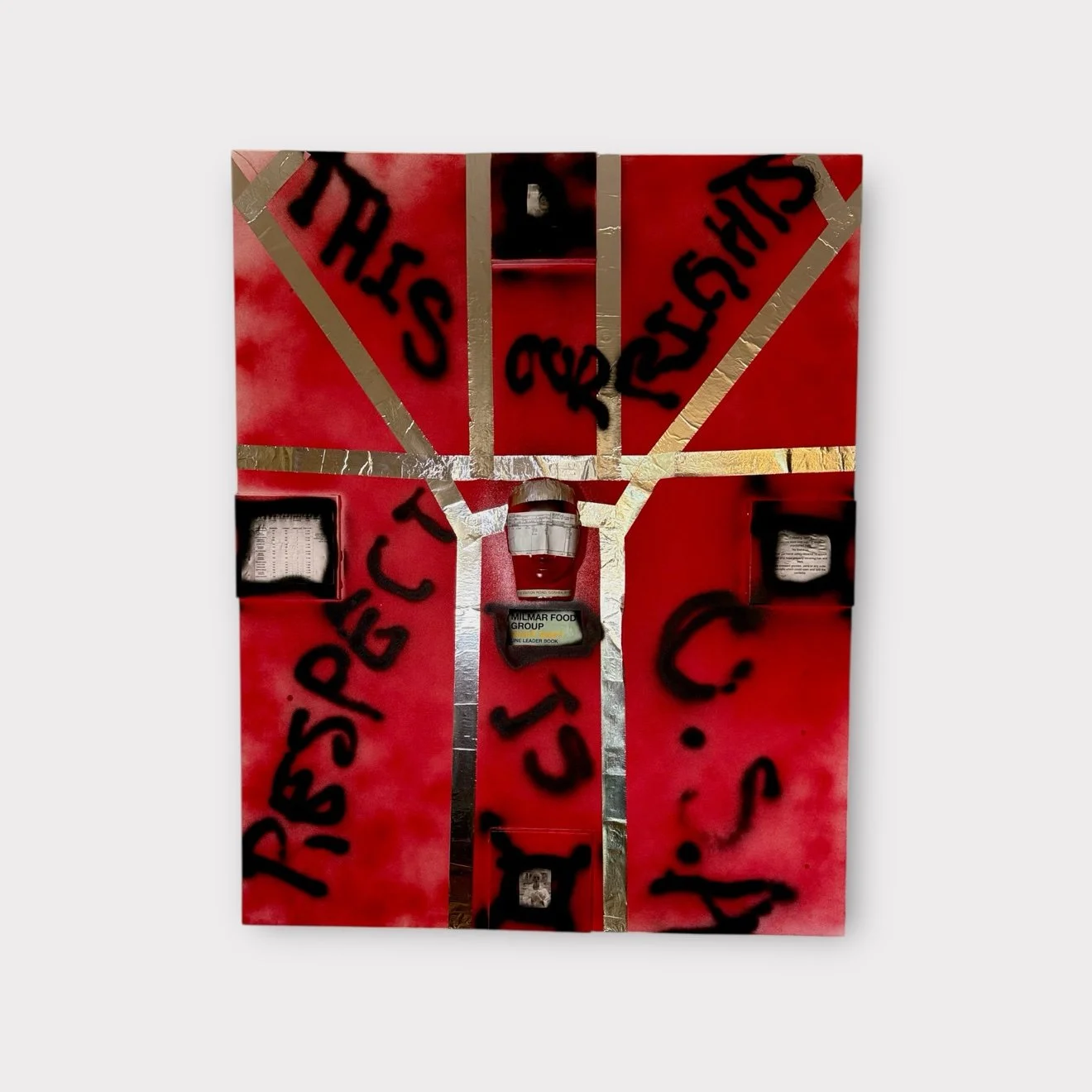
Respect, Mixed media on canvas, 48x60x1.5 in, 2021-2025 © Simon Gama
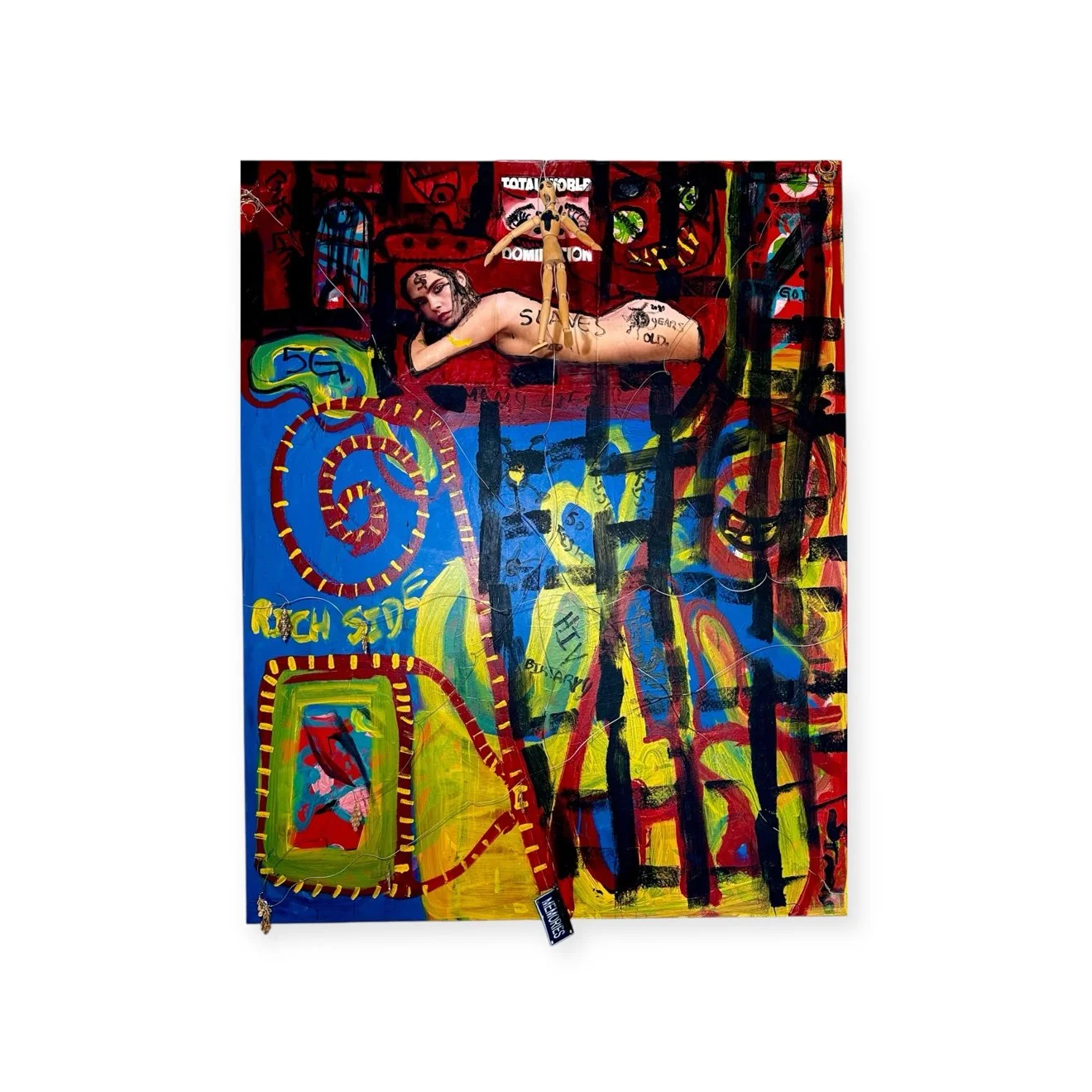
Vida en Tiempos de COVID, Mixed media on canvas, 48x60x1.5 in, 2021-2025 © Simon Gama
You have described your paintings as diaries that preserve memories, emotions, and experiences. What role does your personal life play in your work?
My personal life plays many roles. First, because in some of my works there are written messages. Many people ask me why I put those messages there, and I have told them: some of them embarrass me, some I simply want to set down there and forget them, and some are only mine, I don't want anyone to know them. And as for the role of my personal life in the work, I believe it is everything. And not only for me as an artist, for all artists. The work of artists has a great deal to do with their personal lives. There are artists who are completely transparent, who reflect their personal lives in their work. We have a very contemporary example: Tracey Emin, who is so experiential when she embodies an artistic idea, her bed, in which she showed her emotions and what she was living at that moment. I believe personal life is a blessing for artists, for people who create, because so much comes out of it. American Dream, my last big project, was born from what I lived, from internal questions I had, internal conflicts I needed to resolve. And the only way to resolve them, to heal all of that, was through that project. Everything we live as human beings has a great deal to do with how we create, with the art we leave embodied.
Your series American Dream explores labor, migration, identity, and survival. What inspired you to develop this body of work, and how has your understanding of the American Dream evolved through it?
What inspired me to make the series? The truth is that I lived those things myself. The series was a protest, but a one hundred per cent lived protest, if you understand me. It was something I lived, something I wanted to say, something I went through myself: a way of denouncing something that happens, that happened, and that keeps happening, not only in this country; I imagine in the whole world. That is why the American Dream was born, and also to give a voice to people who sometimes have no voice. There are people who have no voice, no matter how much they make us believe that we do, that we have a voice, that we are important, that we have rights, that we are protected. It is not true. Not all of us have the same rights. Not all of us have the same voice. Not all of us have the same advantages. In the series, each work carries a piece of that life: Employee #911-94094X, built with found labor documents and the materials of the factory floor; Detained, built around a pair of sweatpants given to me by a person detained by ICE. And how has my American dream changed? I feel my American dream changed a long time ago, not just now. I believe the American dream has been crumbling, little by little, not only for me, but for all the people who live in America.
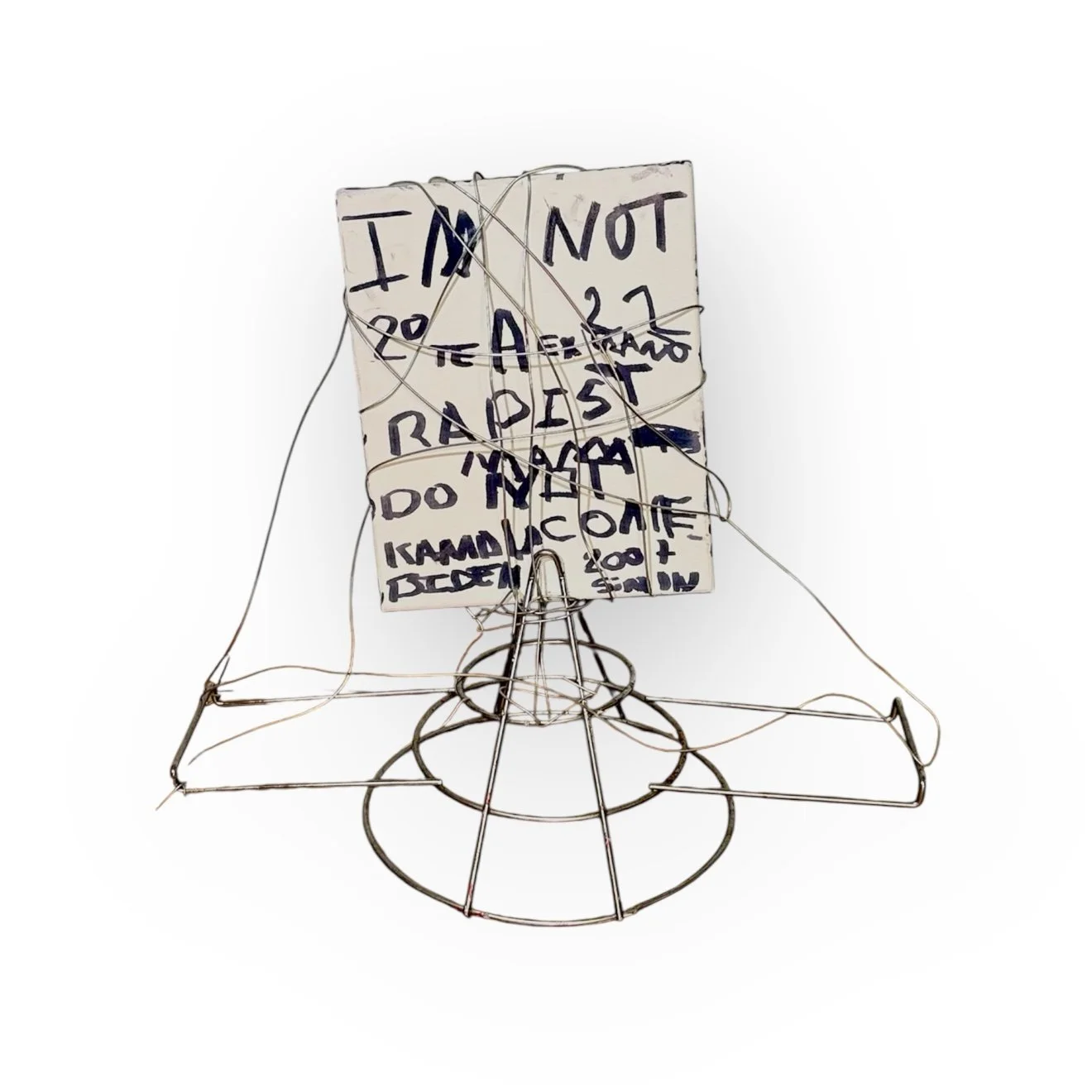
I’m Not a Rapist, Sculpture, inverted oil strainer, wire, small canvas, Small scale, 2021-2025 © Simon Gama
Your recent Autumn works use black and white, heavy textures, and hidden personal elements. What led you towards this more introspective direction?
Lately, as part of my creative process, I have been taking risks: doing different things, using other kinds of materials, trying other kinds of ideas, not only looking back at myself, but also taking things from my everyday life, from everything I see, everything I experience and explore. But what led me to Autumn was a deep look back at my emotions. During that season, when I made those works, I was carrying many things, many internal things. And the colors I saw were black and white, or greyish, those were the colors I felt immersed in. Autumn was a way of thinking, of seeing how I felt at that moment. My passport, the photo in my passport. I felt enclosed, immersed in something, and the only way I had to find myself was to identify myself: to identify myself as a person, as a human being, as someone who was alive. There was a date of birth, there was a name, there was a number that was there, but that also was not there, do you understand? I was immersed in that pain, in that suffering I was feeling at that moment. That is what I wanted to embody in Autumn.
You describe your Studies on Paper as a laboratory for experimenting with colour and gesture. How does working on paper differ from working on your larger paintings?
The difference, I think, is that when I work on paper I feel less stressed than when I am painting on a canvas, or on wood, or on something more structured. The exercises on paper are like going to your studio and wanting to create, but not wanting to go into something so deep, so profound. It is a way of playing, of letting your creativity fly. The large works are different: they carry more work, more research, more responsibility. The studies on paper are a form of relaxation; sometimes they can even be very intimate. And because they are smaller, you can take a little more time, make them more detailed. As an artist you discover many things: you discover new colors, new techniques, new textures, and that is very important. I believe all artists should do studies on paper; they help you develop so much. I also think that curators, and people who dedicate themselves to discovering artists, should take a look at their studies on paper, at their drawings. They say a great deal about the artist. The large works are more for exhibition, or for sale, and sometimes the studies on paper get left aside. I see it like when a child is given a box of colors, a small child who is learning to draw, or to write, or to develop his creativity, and someone gives him a little box of crayons. That is how I see it. It is like happiness.
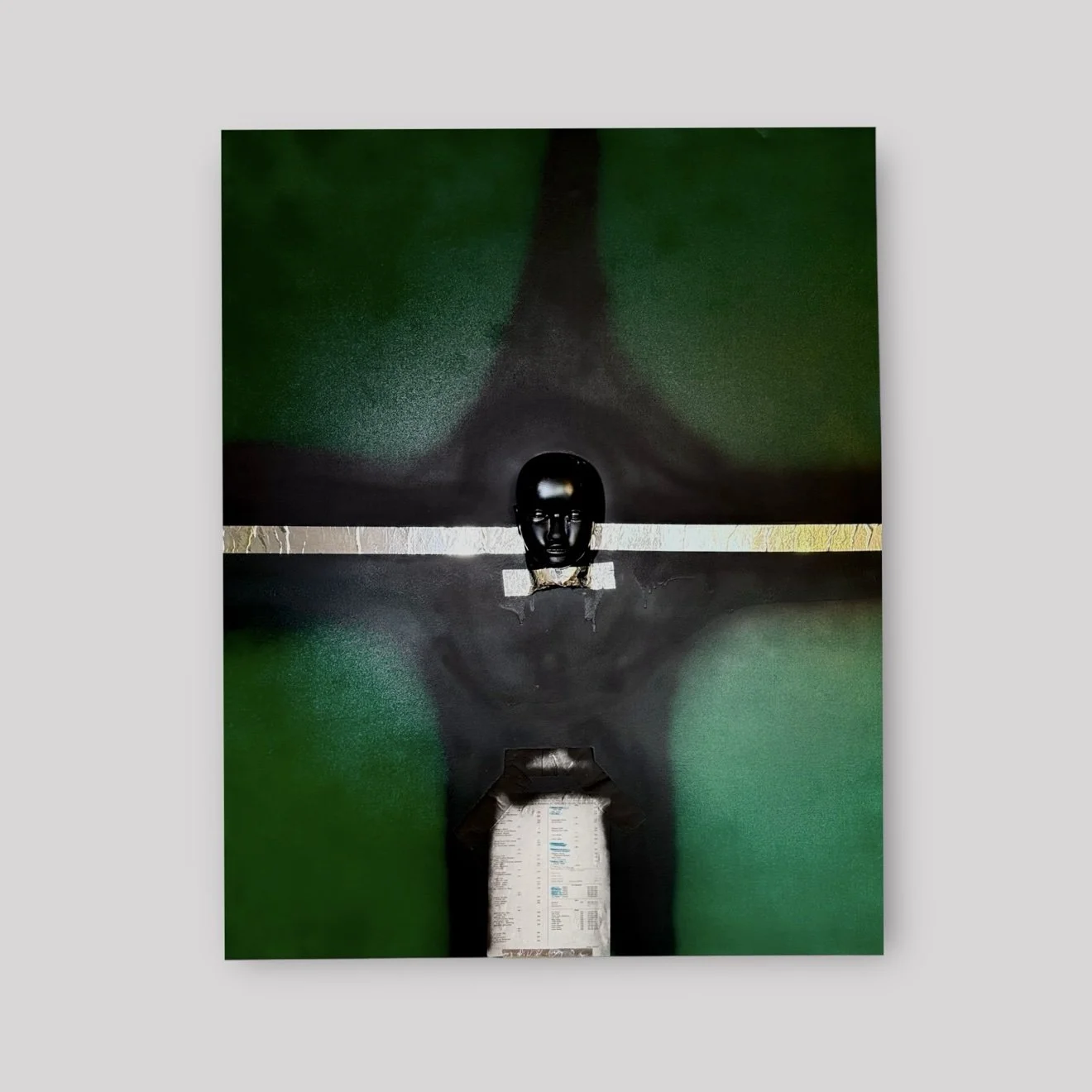
Employee #911-94094X, Mixed media on canvas, 48x60x1.5 in, 2021-2025 © Simon Gama
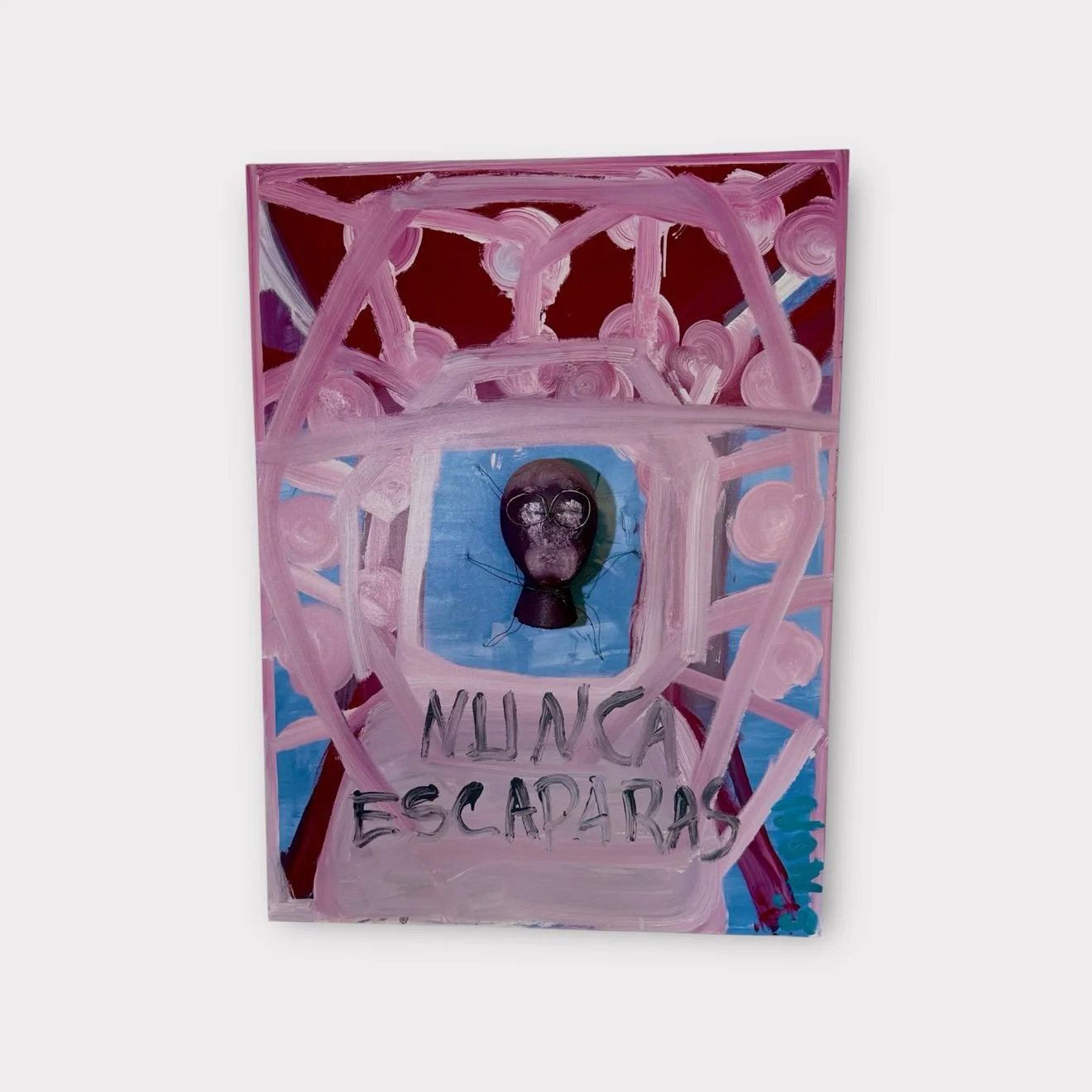
Nunca Escaparás, Mixed media on canvas, 36x48 in, 2021-2025 © Simon Gama
Ultimately, what message do you want to convey with your work? What do you hope viewers will feel, question, or reconsider when they encounter your work?
I have always said that every work has to have a message. If the work has no message, it doesn't work. If there is nothing inside what you embodied, it is worthless. I want people to stop and question what is in front of them. As an artist, I believe that if I hang something, or install something, in any space, gallery or not, and people do not stop to look at it, the work failed. It didn't work. But if people ask themselves questions, if it causes them some emotion, then the work worked. Every work transmits different emotions. I do seek to transmit something, displeasure, relief, an emotion, something grotesque, whatever it may be. I want people to feel some sensitivity toward what they are seeing, and perhaps to leave with a learning, why not? With American Dream, what I seek is empathy, that people have empathy for others. We know not all of us live the same life: some live better, others live worse. But I want us to discover that, in the end, we are all human beings. And if we see something unjust, we denounce it; we speak and raise our voice, because that is very important for everyone. With American Dream, I also want to say that we have to be very careful with the politicians we choose, with the people we raise into politics. That matters greatly, because we must not forget that they are the ones who rule our future, who make our decisions, whether we want it or not, because that is how the world is. That is what I seek: that people feel, question, and act.
And lastly, looking ahead, how do you see your work evolving in the future? Do you have any new project or series you would like to develop?
When people ask me how I see my work, how I analyze it, whether I believe it is advancing or not, the truth is, I don't know. I am not an art critic. Obviously one advances: in techniques, in materials, in ideas, as I said. But I believe my work is advancing well. I am learning more and more: learning from artists I meet, incredible artists, and from the advice of people I am meeting in this world, who give me ideas. And yes, of course I have many projects in mind. But unfortunately, for emerging artists it is very hard to carry out our projects, because as I said, it is expensive. And I like to create large projects, more than ten, twelve works, so that the idea is complete and can be understood well. I have several projects in mind, and I hope to find some kind of support, or someone who takes an interest in my art and helps me show it to the world.
Artist’s Talk
Al-Tiba9 Interviews is a promotional platform for artists to articulate their vision and engage them with our diverse readership through a published art dialogue. The artists are interviewed by Mr. Mohamed Benhadj, the founder & curator of Al-Tiba9 Contemporary, to highlight their artistic careers and introduce them to the international contemporary art scene across our vast network of museums, galleries, art professionals, art dealers, collectors, and art lovers across the globe.



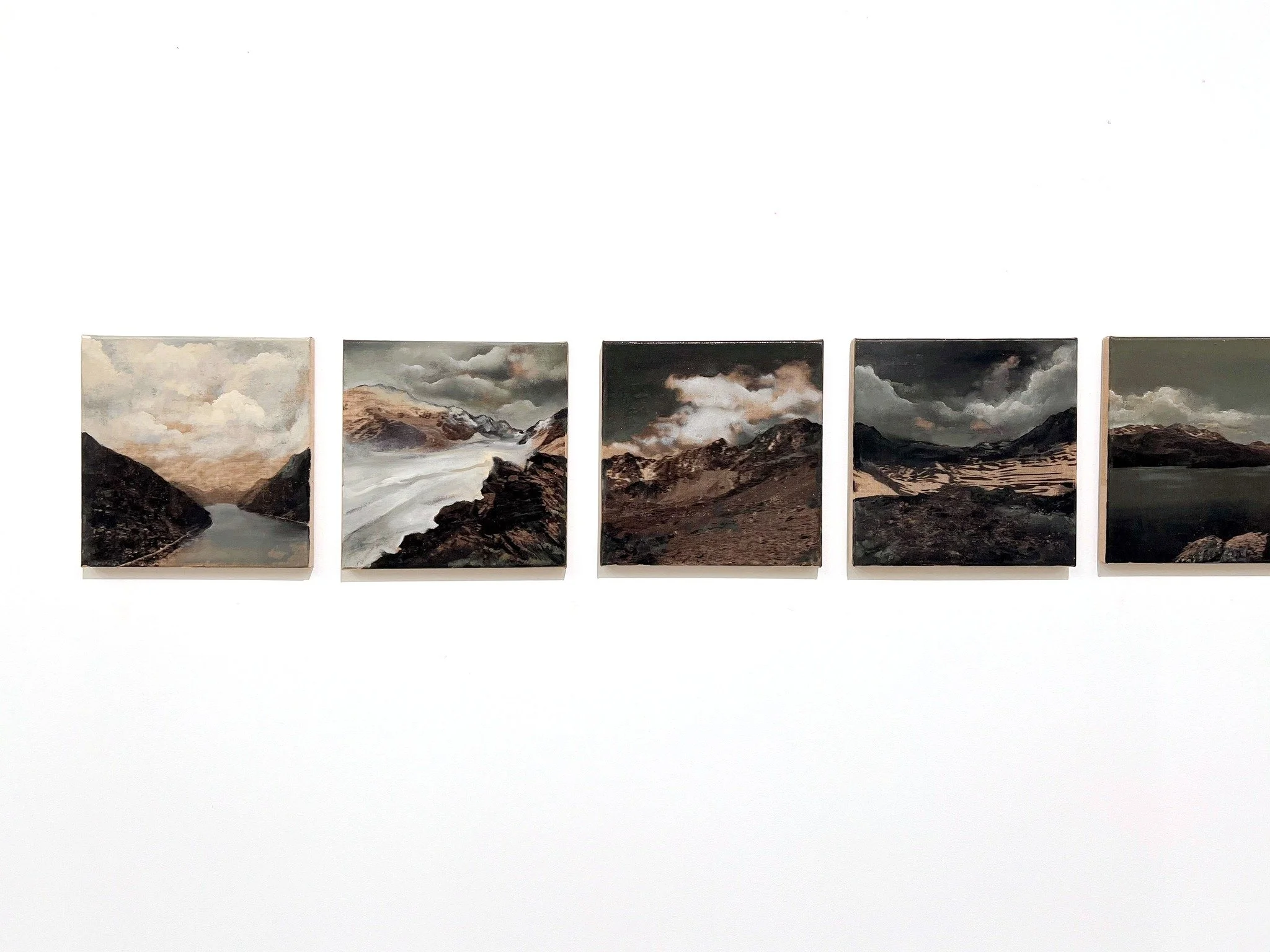
Nataraj von Allmen is a painter based in Switzerland. Often taking photographic material as a starting point, he weaves together landscapes, mythological archetypes, Christian symbolism, and contemporary socio-political themes into complex paintings. Oscillating between figuration and abstraction, his work investigates transformation, collective memory, and the human condition.