
10 Questions with Helena Bunina
Helena Bunina is a Ukrainian contemporary artist and muralist based in Las Vegas, Nevada. Her multidisciplinary practice spans painting, mixed media, and large-scale murals, exploring vulnerability, identity, emotional resilience, memory, and transformation through neo-pop aesthetics and emotional symbolism. Drawing from personal experience, street culture, and color, Bunina creates vibrant works that balance playful imagery with psychological depth. Her ongoing series, Fragile Tensions and ABSURD, explore human connection, inner conflict, freedom, and personal transformation. Her work has been exhibited in the United States and Europe and presented on international platforms including Artsy and Saatchi Art. In 2026, Bunina became a member of the Las Vegas Artists’ Guild (LVAG) and the International Association of Art – USA (IAA-USA), an AIAP-UNESCO affiliated organization. She is also a member of the National Association of Artists and Sculptors of Ukraine (NAAS).
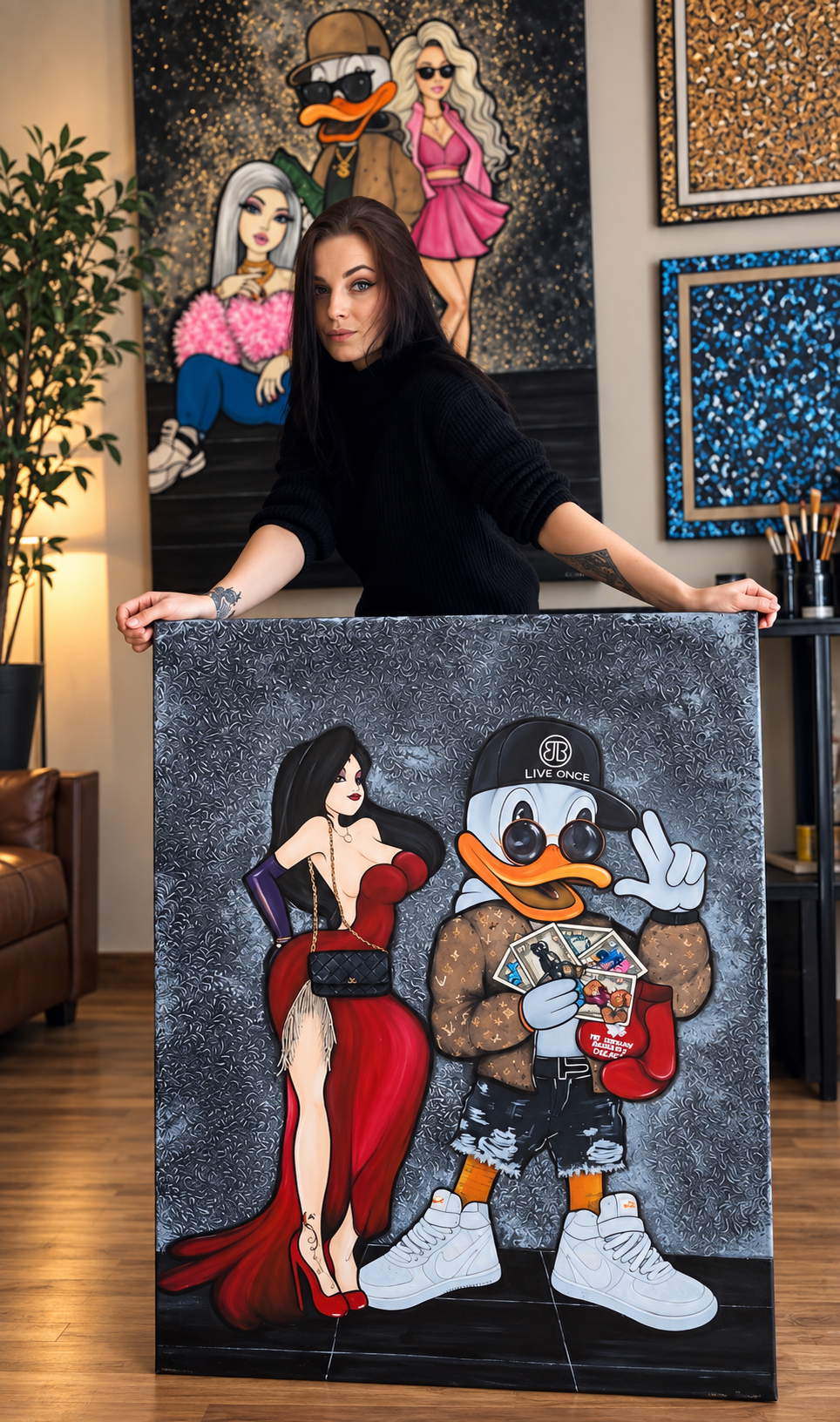
Helena Bunina - Portrait
ARTIST STATEMENT
“Fragile Tension” explores the delicate space between vulnerability and strength, attachment and freedom. Throughout the series, hands become a recurring visual language, holding, protecting, supporting, or trying not to let something slip away. Hearts, balloons, and fragile figures become symbols of emotions and inner states that are difficult to control or preserve. The works are built around a contrast between tenderness and tension. Soft, almost playful characters and recognizable symbols exist within dark, heavily textured environments created through layered paint, aerosol, and expressive marks. This contrast reflects the complexity of emotional experience: something can appear beautiful and innocent while carrying fear, pressure, or the possibility of loss beneath the surface. The title “Fragile Tension” refers to this unstable balance. To hold something close can mean protecting it, but it can also mean preventing it from becoming free. The series reflects on attachment, emotional vulnerability, the desire for freedom, and the human instinct to hold on to what matters most. For me, these works are not about fragility as weakness. They are about the strength required to remain sensitive in a world that constantly creates pressure to become harder.
“Absurd” is a series about everyday reality gradually turning into the absurd. In these works, I place characters within familiar urban environments, courtyards, apartment buildings, entrances, and spaces that feel ordinary and recognizable. Yet within these familiar settings, strange, ironic, and sometimes unsettling situations unfold. I am interested in the moment when something familiar stops feeling normal. Through humor, grotesque imagery, and unexpected combinations of characters and situations, I explore human behavior, social roles, loneliness, the desire to be seen, and the ways people adapt to the reality around them. The title “Absurd” refers not only to the unusual narratives within the works. Absurdity becomes a way of looking at reality from a distance and noticing what we often stop seeing in everyday life. I use vivid characters and details against colder, more muted urban environments, creating a contrast between visual attraction and underlying emotional tension. For me, the series is a form of observation, of people and society through irony. Sometimes what appears funny can be unsettling, while an apparently ridiculous situation can reveal something deeply familiar and human.
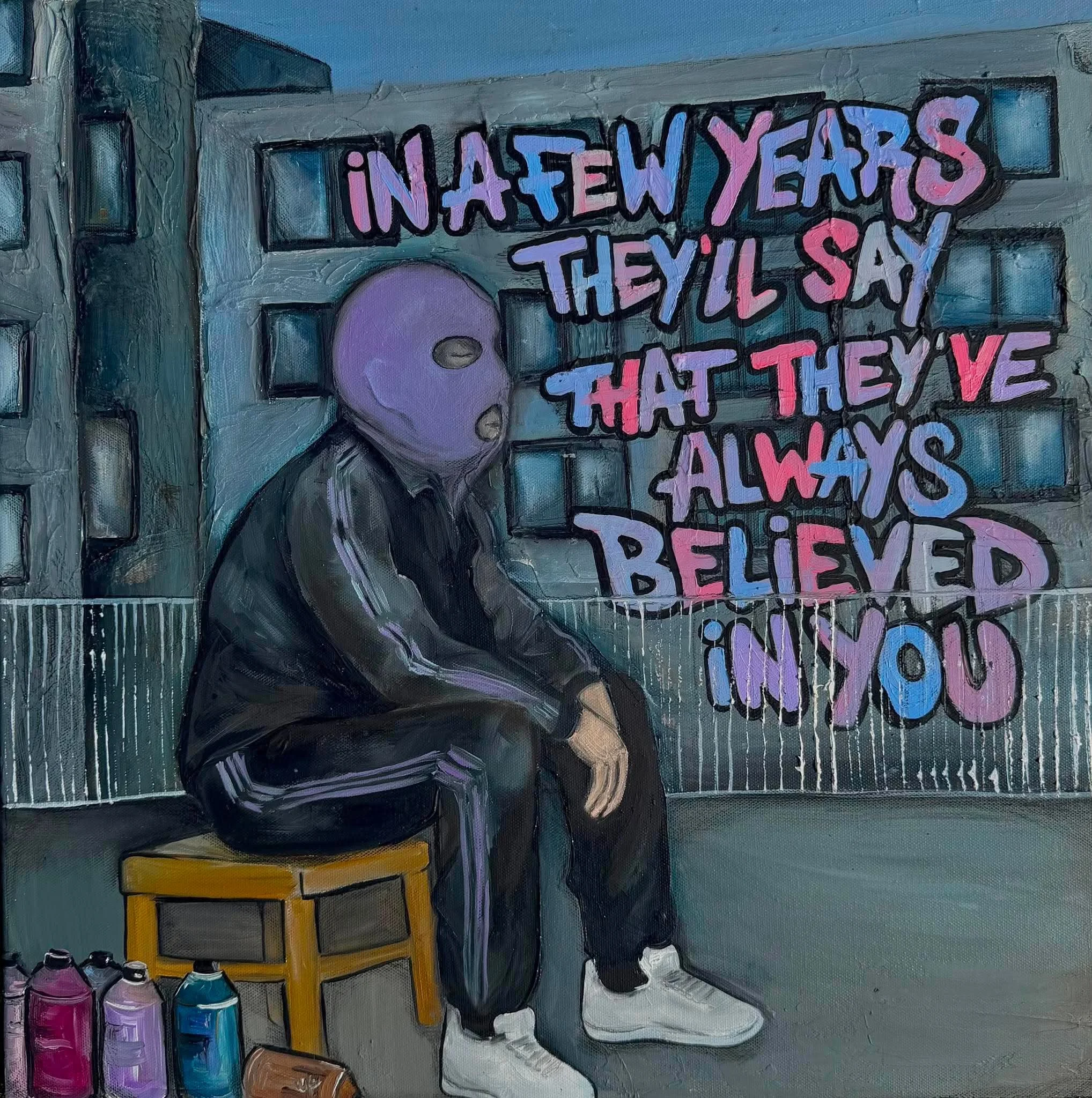
Biggest Fans, Oil, texture paste on canvas, 20 × 20 in, 2026 © Helena Bunina
INTERVIEW
To start, could you share a bit about yourself and how you first got interested in art?
I never formally studied art and never intended to become an artist. To me, being an artist always felt like something extraordinary, a career reserved for people with exceptional talent and specialized knowledge. In fact, as a kid, I dreamed of becoming a forensic pathologist!
When I was 16, I left Ukraine to study in Poland. Every day, I took a 45-minute bus ride home from the university, and that's when I started sketching during my commute just to pass the time. I had no idea those little sketches would lead to anything serious. Then, completely by chance, I met a tattoo artist who saw my work and invited me to design flash sheets for their studio. That’s how my journey into the art world began.
I never actively sought out a career in art, in a way, art found me. What started as a way to kill time on a bus gradually turned into something I can no longer imagine my life without. Looking back, I realize that sometimes you don't choose your path; you find it by following unexpected opportunities.
How has your experience as a Ukrainian artist living in Las Vegas influenced your artistic practice?
Moving from Ukraine to the US completely shifted my perspective. When you find yourself in a different cultural environment, you realize how much ideas of what’s normal, acceptable, or desirable can vary.
I’m naturally drawn to situations that feel both funny and awkward. I love creating imagery that initially feels light and playful, but conceals a deeper, more complex meaning underneath.
Las Vegas itself is like a theatrical stage, it’s filled with exaggerated figures, fantasy, contrasts, and performative displays. It gives me a front-row seat to how people present themselves to the world and how starkly external impressions can differ from reality.
That said, I don't want to literally depict everything around me. I find it much more interesting to explore these contradictions through my own visual language, giving viewers a chance to look beneath the surface, ask questions, and decide for themselves what they see in my work.
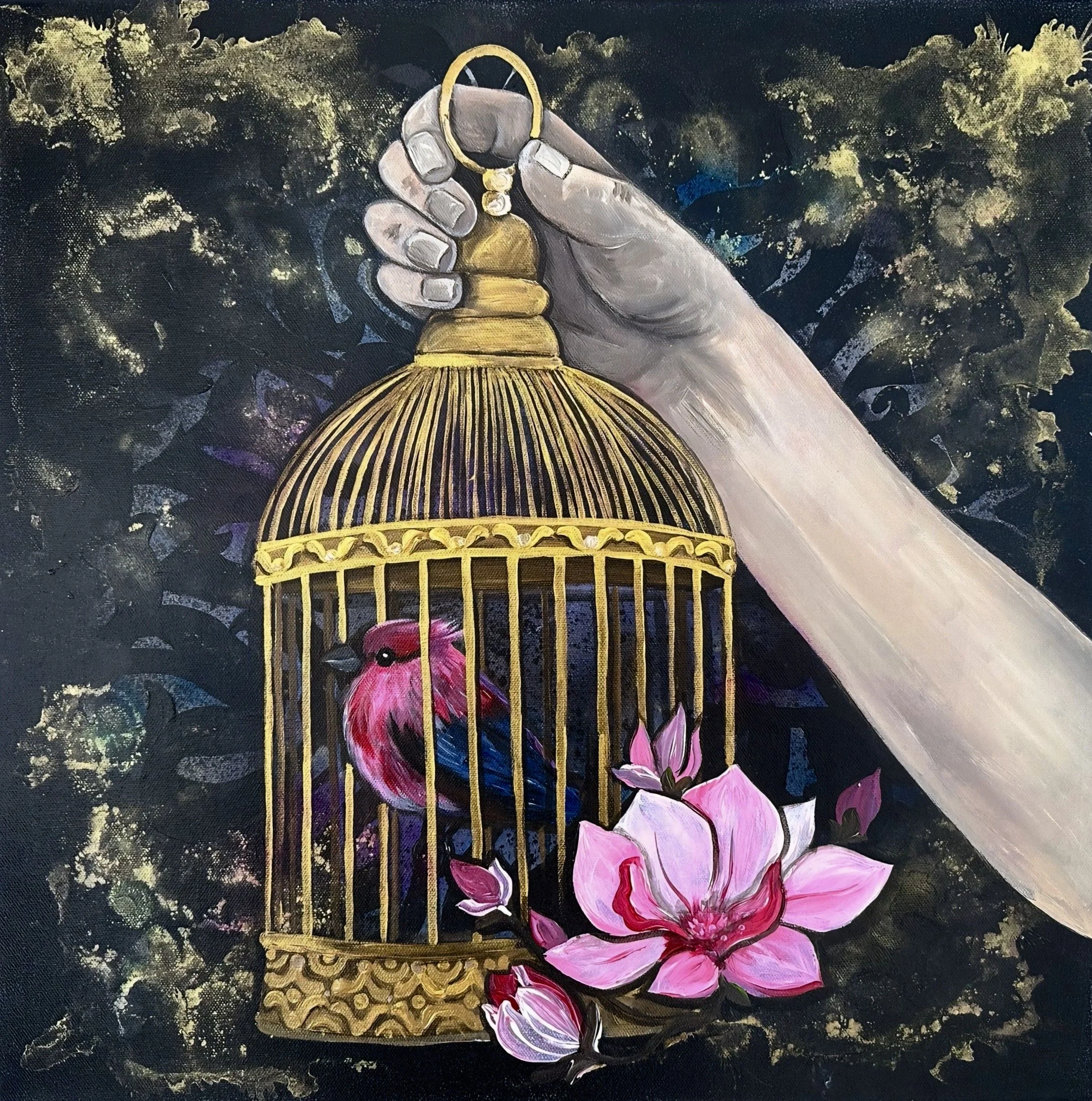
Held Freedom (Series Fragile Tension), Acrylic on canvas, aerosol paints, varnish, 20 × 20 in, 2026 © Helena Bunina
You work across different mediums: painting, mixed media, and large-scale murals. How do you choose the medium and technique for each project?
For me, everything begins with an idea. I start with what I want to express, and then I select the materials and techniques that best help bring that vision to life.
Throughout the creative process, the original concept often evolves. I might layer on textures, integrate new materials, or tweak the composition. I enjoy letting a piece develop naturally rather than sticking strictly to a blueprint.
Canvas grants me absolute creative freedom, I can fully follow my own vision. Murals are a bit different because you have to account for the physical space, surface textures, and client expectations. I enjoy navigating that balance between someone else’s vision and my own artistic approach.
Mixed media opens up even more room for experimentation. Sometimes I want to add dimensional volume, an expressive texture, or an unexpected medium. I don't believe an artist should be confined to a single technique. To me, materials are tools to express an idea, not boundaries I'm forced to stay within.
What does your creative process typically look like, from the first idea to the finished piece?
My creative process is fairly chaotic. New ideas are constantly popping into my head, and sometimes it's hard to even keep up with them. Navigating ADHD can be a challenge, but at the same time, it’s an integral part of how I generate concepts and process the world around me.
Ideas often hit me unexpectedly, from a random image, a sensation, a passing observation, or a memory. A piece might start with one thought and evolve into something entirely different by the end.
When I dive into painting, I completely lose track of time, I get so locked into the flow state that the outside world just fades away.
The hardest part for me is knowing when a piece is finished. I always feel like I could add one more detail, tweak something, or refine a line. I could easily revisit the same painting forever. That's why I'm learning to accept that a finished work doesn't need to be flawless. Sometimes the most important step is simply knowing when to step back and let it exist as it is.
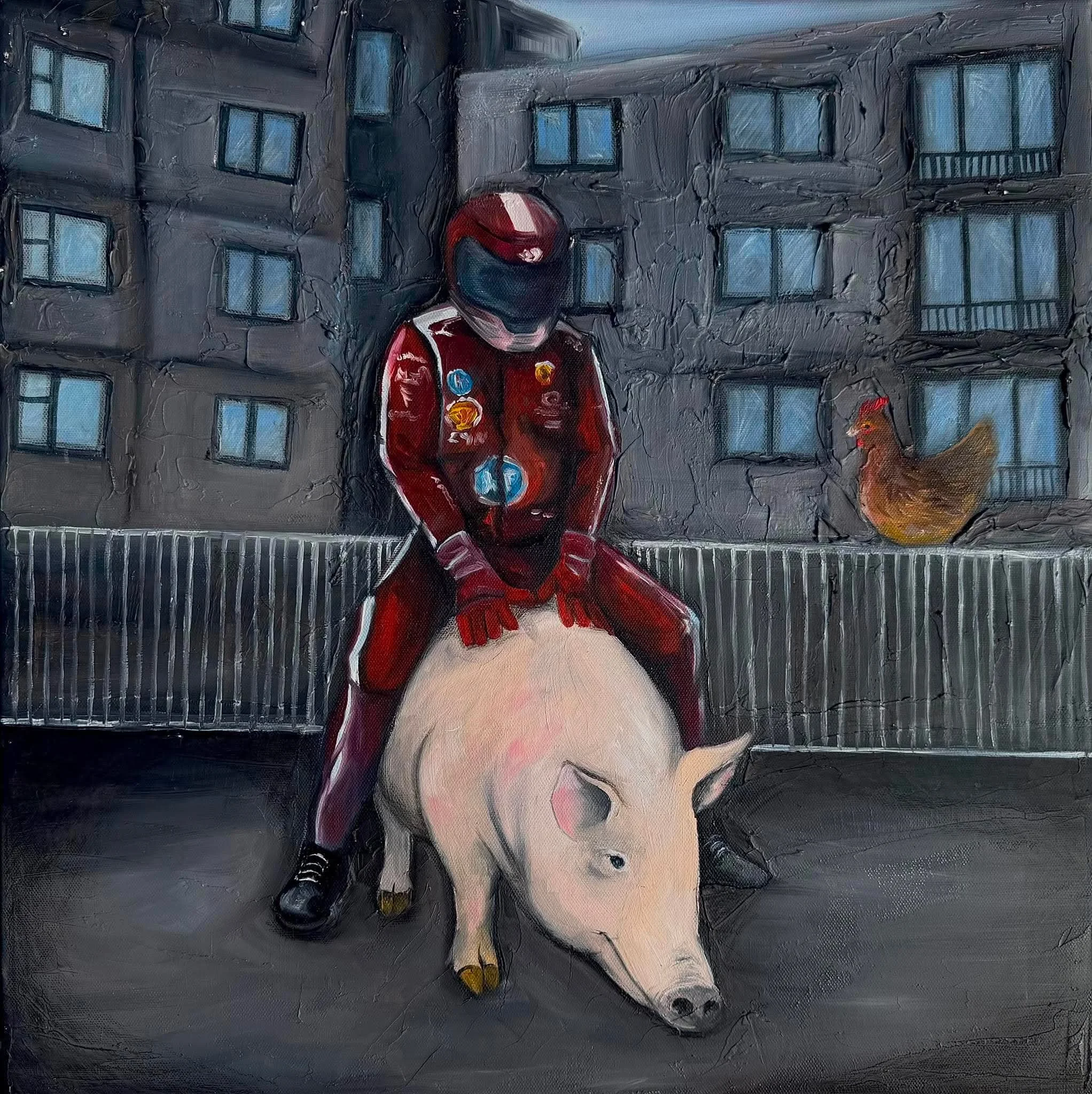
F… Your Speed, Oil, texture paste on canvas, 20 × 20 in, 2026 © Helena Bunina
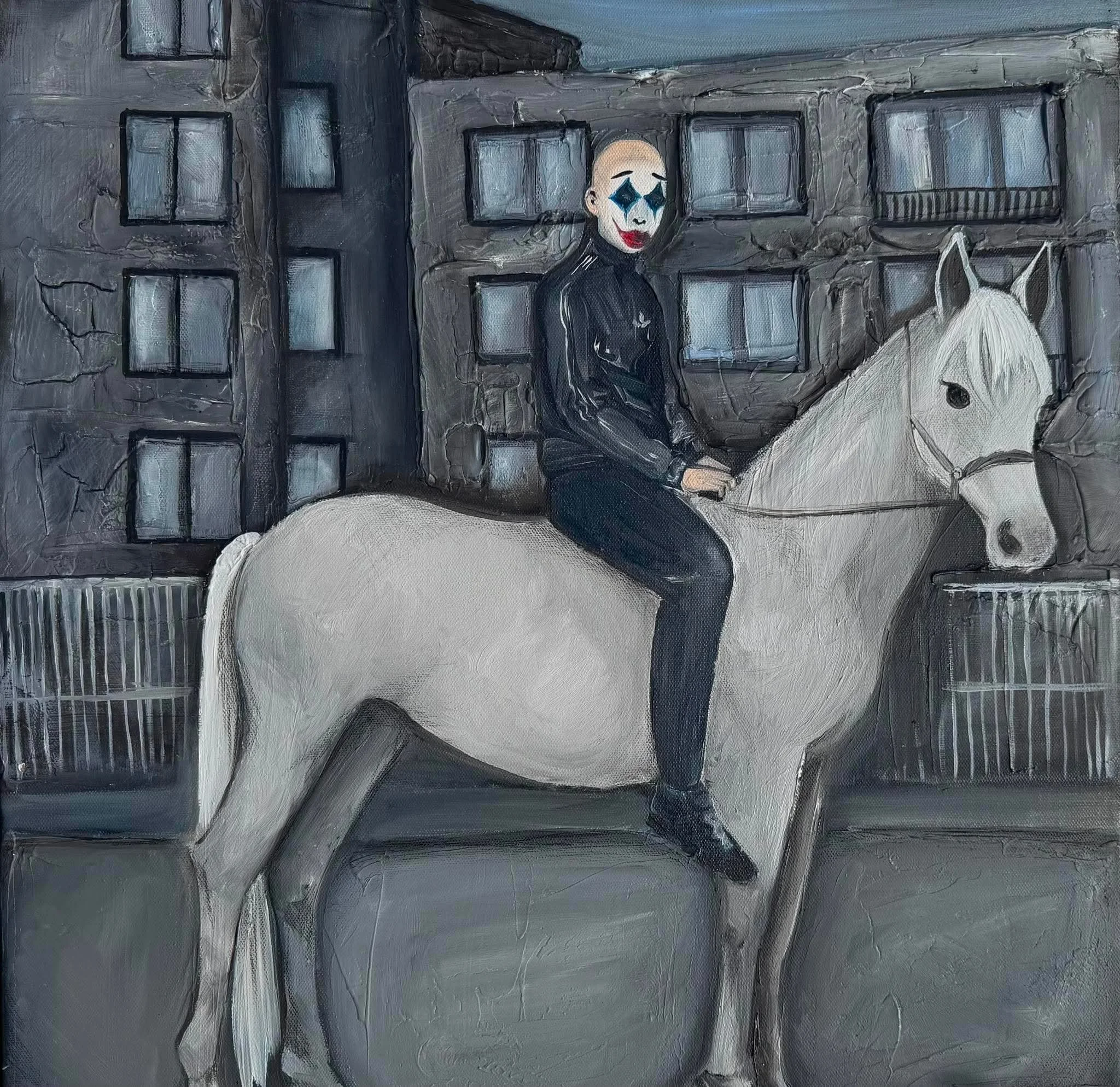
Fairytale Idiot, Oil, texture paste on canvas, 20 × 20 in, 2026 © Helena Bunina
Your work combines neo-pop aesthetics, vibrant colors, and emotional symbolism. How do you balance playful imagery with deeper psychological themes?
Even in the brightest, most playful imagery in my work, there's often something darker lurking beneath the surface. I’ve always resonated with the idea that every joke carries a grain of truth.
I love working with bold colors and striking imagery that instantly hook your attention. But to me, vibrant color isn't just about making a canvas visually engaging, behind an inviting surface, a completely different mood or narrative can be hiding. Sometimes the contrast between what we see and what we feel becomes the core of the piece.
What appears funny or absurd at first glance can unexpectedly expose something deeply real. I love that moment when a viewer looks at a painting and thinks, 'Oh, cool!', and then notices a detail that subtly unnerves them or makes them pause.
I'm fascinated by the shift from humorous to unsettling, from alluring to uncomfortable. A neon palette or an eccentric character can often convey complex emotions far more powerfully than a literal representation ever could.
I don't want to spell everything out or offer easy answers. I find it much more compelling when viewers discover something that resonates with them on a personal level. Sometimes, what's left unsaid is exactly what makes a painting come alive.
In your Fragile Tensions series, you explore vulnerability, attachment, and freedom. What inspired you to explore these themes through recurring symbols such as hands, hearts, and balloons?
In my 'Fragile Tensions' series, hands serve as the unifying thread. They appear in every painting, performing specific actions, holding on, supporting, or restraining. I’m fascinated by how the exact same gesture can be interpreted differently depending on the viewer’s personal history and emotional lens.
For instance, in 'Held Freedom', a hand holds a vibrant bird inside a golden cage. For me, this painting speaks to the boundaries we construct for ourselves. The cage symbolizes internal limitations: fear of judgment, self-doubt, and worrying about what others will think. We often hold ourselves back from reaching our full potential, even when the door to freedom is already wide open.
In the piece, the cage door is open, yet the bird remains inside. No one is forcing it to stay, at least, that’s how I interpret it. It’s an allegory for the internal conflict between longing for freedom and fearing what happens when we actually take it.
Across the series, hands interact with different vivid figures, creating new dynamic tension and leaving room for interpretation. While my personal narrative serves as the catalyst, I love when viewers project their own lived experiences onto the canvas.
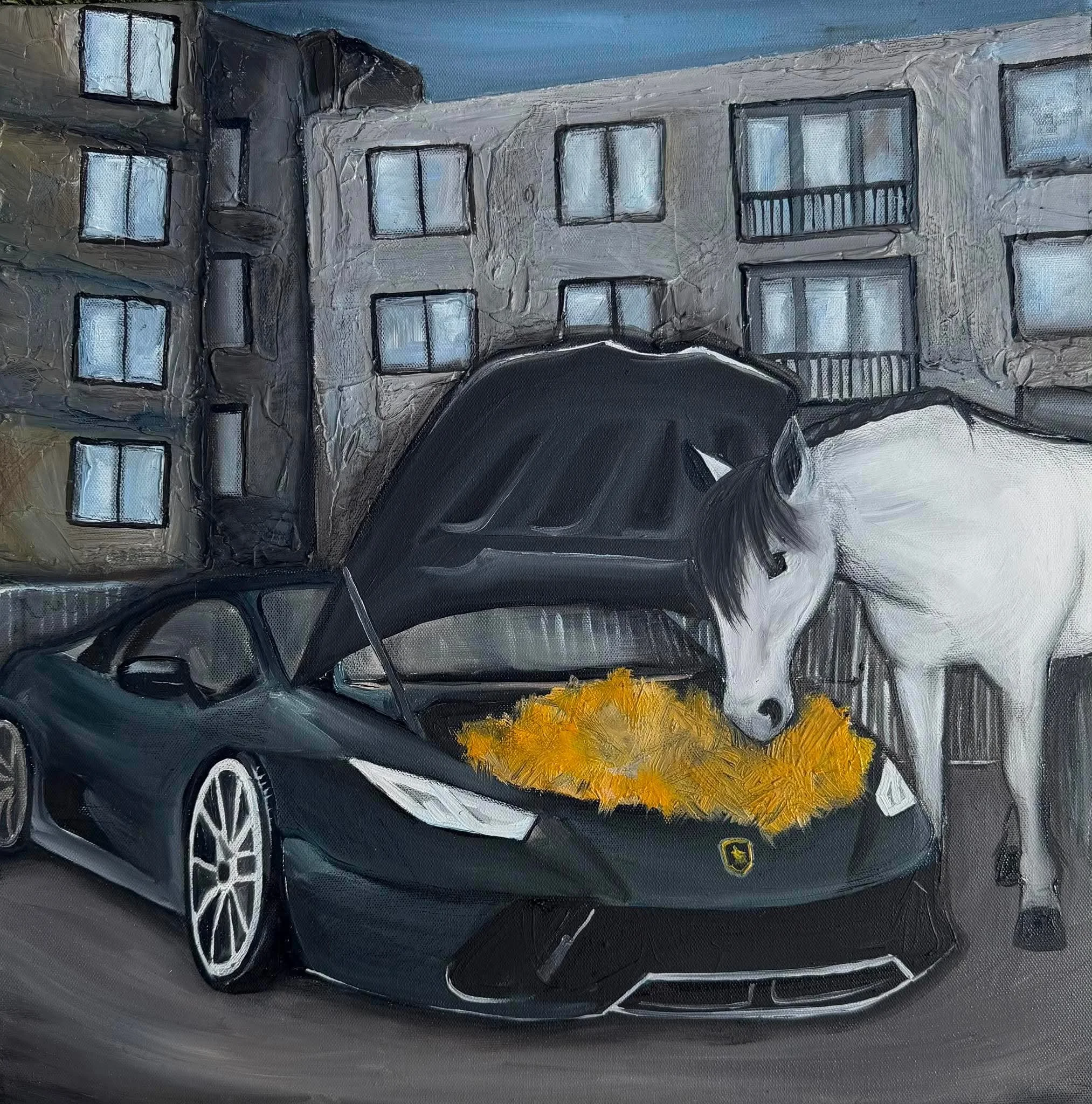
Luxurious Luxury, Oil, texture paste on canvas, 20 × 20 in, 2026 © Helena Bunina
Your Absurd series captures strange and unsettling moments in familiar urban environments. What draws you to the absurdity of everyday life?
To me, the absurdity of everyday life lies in unexpected moments, strange human behaviors, and the contradictions we encounter daily. Sometimes something is so ridiculous you can't help but laugh, yet behind that absurdity sits a genuine story.
In my 'ABSURD — Everything Is Fine' series, many figures stem from personal memories and observations. I love transforming real-life situations into eccentric characters and motifs that feel simultaneously humorous, bizarre, and slightly ominous.
For example, 'Strange Lady Across' was inspired by a childhood memory of a neighbor named Vera, who used to chase us kids with a stick whenever we picked apples from her trees. I can still vividly recall her face and how terrifyingly larger-than-life she felt back then. Years later, I reinterpreted that memory by portraying her as a young, armed woman with a gun, resulting in a bold, uncanny, and unsettling figure.
'Fuck Your Speed' came from another childhood memory. My grandmother had these massive pigs, and we used to ride them, pretending we were race car drivers. To us, it was hilarious. But the piece also carries a broader commentary: no matter how expensive or fast your car is, if you truly possess grit and resourcefulness, you can adapt to any circumstance and reach your goal in the most unexpected way.
In 'Luxurious Luxury', I question where value actually originates. What happens when you take a high-end luxury vehicle and fill it with ordinary hay, as if it were a livestock trough? Does the vehicle itself change, or just our perception of its worth? I’m intrigued by how we assign prestige to objects and how much their value depends on what they symbolize to us.
I love placing humor alongside the uncomfortable. I don't aim to over-explain every detail or push a single narrative. I prefer creating imagery that makes people smile at first, only to leave them thinking deeper afterward. Absurdity isn't always made up, sometimes you just have to look closer at reality.
How do your personal experiences and observations influence the stories and characters in your work?
Many of the figures in my work are based on real people I’ve crossed paths with who felt unique, eccentric, or unforgettable. I observe others, but I also look inward just as often. I’ve never seen myself as entirely conventional, which is probably why I’m so drawn to characters who stand out from the crowd.
My personal experiences heavily shape my artistic output. Sometimes I directly translate real memories onto the canvas; other times, I alter details, exaggerate traits, or twist a situation into something surreal. I don't need to tell a story literally to evoke the underlying emotion.
There are also darker, more painful experiences in my life that I’m not quite ready to talk about publicly yet. Certain topics are only now beginning to be spoken about openly, whereas before they were swept under the rug. Sometimes I feel like I could build an entire series around those stories, though I don't yet know when or in what format I'll be ready to unpack them.
In a sense, that hesitation is its own internal cage, the fear of how people will react or what they will say. Painting serves as my way of approaching subjects that are still too difficult to address head-on.
Interestingly, despite the vivid colors and expressive figures on the surface, the memories behind them aren't always bright or happy. There’s a distinct contrast between what the viewer sees at first glance and the vulnerability raw underneath. Art gives me a safe space to speak about difficult things, even if I’m not ready to tell every story out loud.
Has your artistic practice evolved since moving to the United States, and are there new directions you’re looking to explore?
Relocating to the US opened up incredible new avenues for my professional and creative growth. There’s a rich ecosystem of grants, open calls, and collaborative projects here that encourage artists to push boundaries, experiment with fresh approaches, and step outside their comfort zones.
I love that I can build on my foundation while simultaneously diving into unfamiliar mediums. For instance, I recently submitted an application for the 'Keep Las Vegas Beautiful — Recycled Art Contest 2026', which focuses on artwork created from reclaimed materials. I’ve never incorporated post-consumer waste into my paintings before, so the opportunity to experiment with a completely new medium was really exciting. I’m currently awaiting the results.
Naturally, every environment I live in leaves its mark on how I perceive the world. I’m meeting new people, noticing different urban textures, and accumulating new experiences. But inspiration can strike from anywhere, I like allowing ideas to evolve organically without boxing myself into a fixed theme, style, or medium.
I’ve never wanted to be an artist who spends a lifetime working in just one niche. I thrive on experimenting, exploring different scales, and discovering new possibilities.
It feels like my mind generates ideas at twenty-five thousand miles an hour! Sometimes I can barely predict where they’ll take me a month or two down the road. That sense of constant discovery is what keeps this journey so exciting for me.
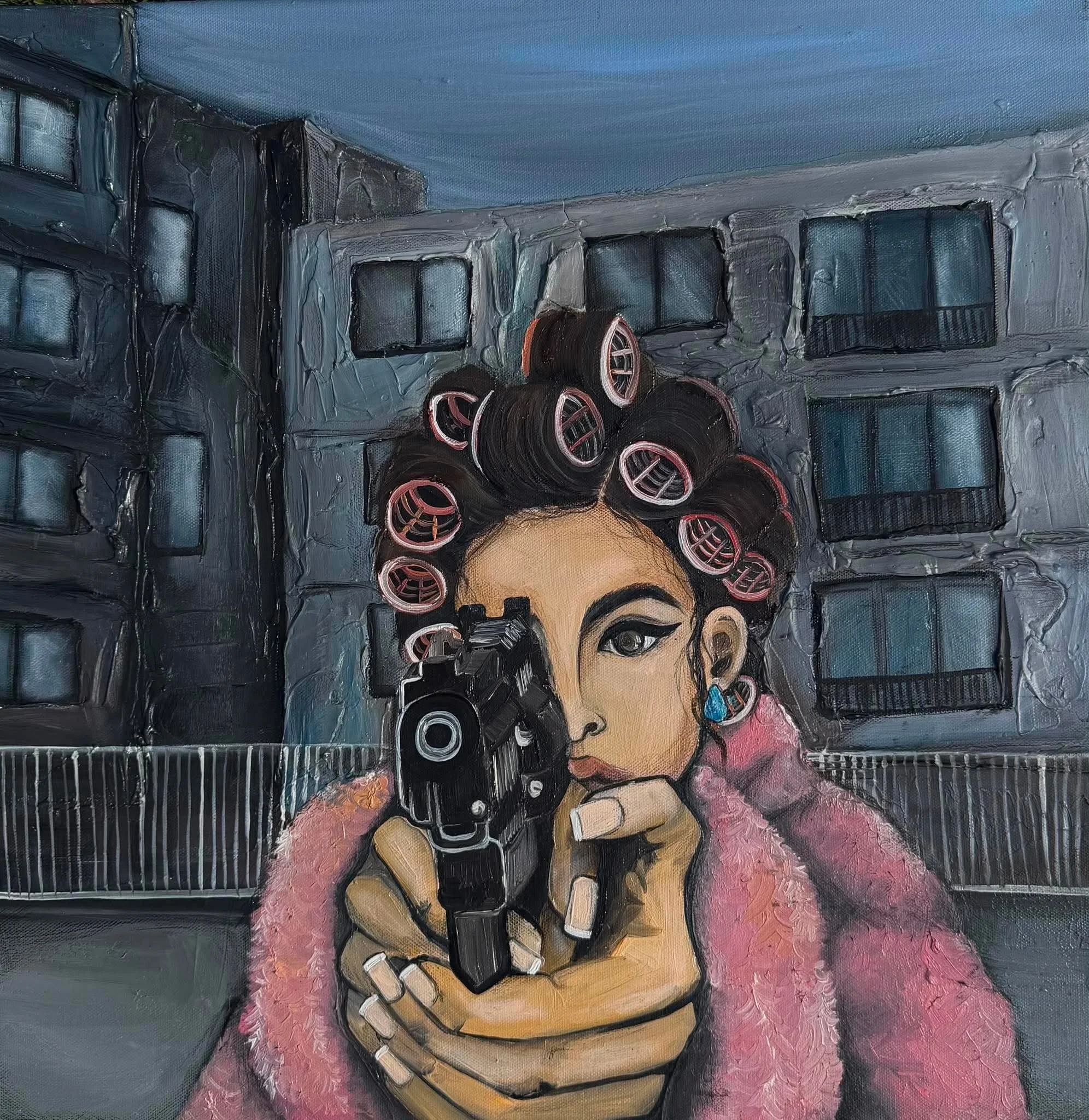
Strange Lady Across, Oil, texture paste on canvas, 20 × 20 in, 2026 © Helena Bunina
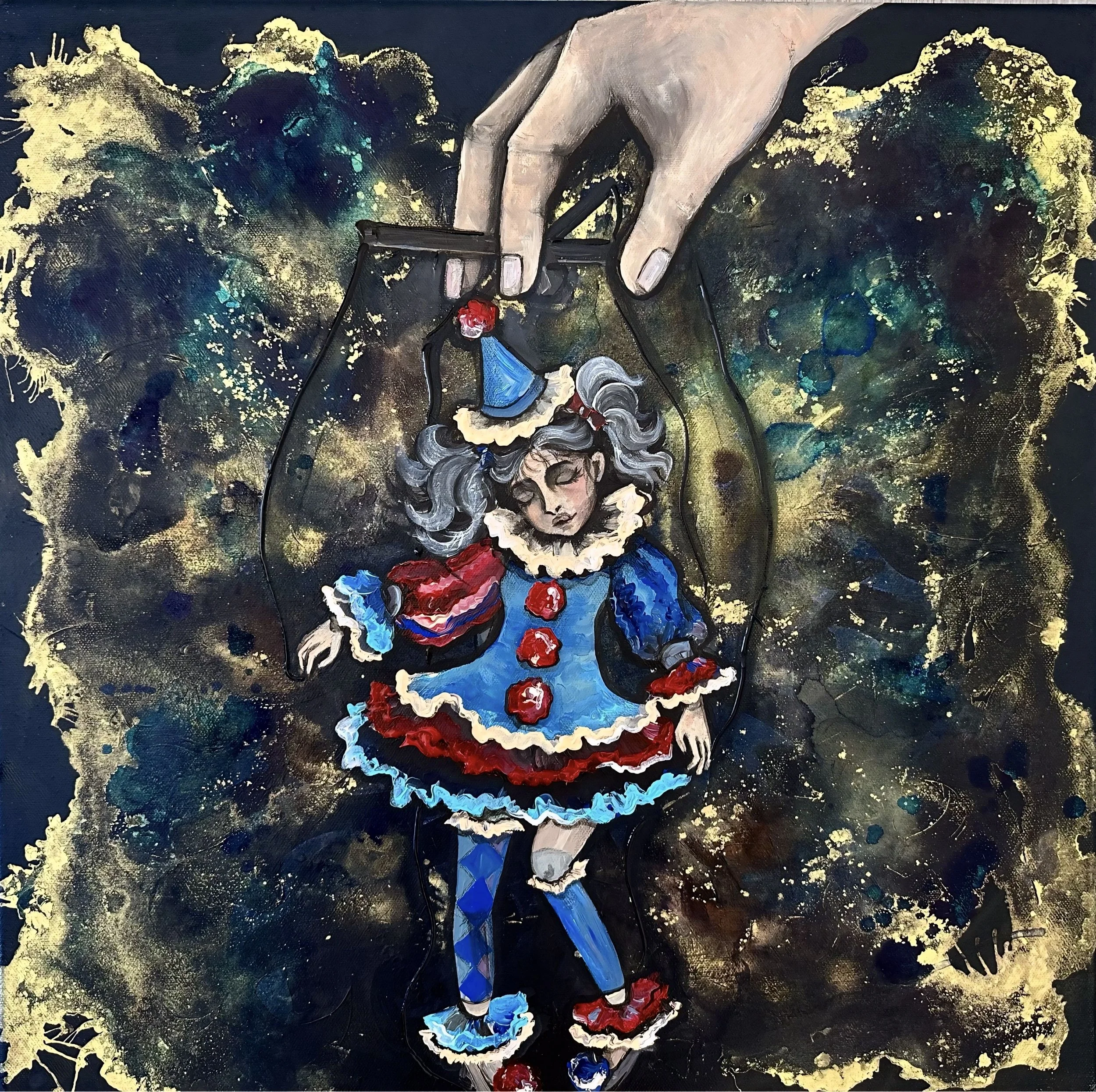
Strings of Innocence (Series Fragile Tension), Acrylic on canvas, aerosol paints, varnish, 20 × 20 in, 2026 © Helena Bunina
Finally, what are you currently working on, and what can we look forward to from your upcoming projects?
I currently have several bodies of work developing simultaneously, and I plan to keep expanding them by exploring new sub-themes within each.
One of my core series is "ABSURD — Everything Is Fine". I view it as an ongoing umbrella project that I can continually return to over time. Within it, I’m launching smaller, themed sub-series.
One of these upcoming sub-series is titled "Padik: Memory Unlocked". The word "padik" is local slang for the gritty, communal stairwells and entryways of traditional Ukrainian and post-Soviet apartment blocks (like classic khruschevka or panel buildings). This series reflects on childhood memories: kids who were friends for years, hanging out on cold concrete stair landings, making up games, and spending hours together.
I want to capture that contrast: warm, cherished childhood memories set against the bleak, cold, and rough environment of those old stairwells. The space itself was gray and uninviting, yet it served as the backdrop for defining moments of friendship, adventure, and nostalgia.
Another direction is my "Everything Fine, I Have Wings" series. It currently consists of three paintings, and I intentionally conceived it as a tight, focused collection. At the center of these works are origami birds folded from real hundred-dollar bills. I'm exploring the theme of money and its profound impact on our sense of security, stability, and agency.
The title, "Everything Fine, I Have Wings," ties directly to this concept. When you have financial abundance, it feels like you have a safety net, freedom, and the wings to navigate life's challenges. But when money is tight, even the simplest daily task can feel overwhelming. In these paintings, the bright money-birds sit against dark, heavily textured backdrops. The winding lines and swirls represent life’s unpredictable path, its twists, friction, and complexities. I want the tension between the vibrant central motif and the moody background to amplify the core message. I don't plan on making this a massive series. It’s important for me to deliver a concise commentary on how deeply money dictates our lives and the contradictions tied to wealth. That said, I’m not restricting myself exclusively to these projects. I want to keep experimenting with materials, chasing unexpected ideas, and allowing my practice to evolve. I don't know where my next project will take me, and that unpredictability is what I love most. I hope to keep surprising viewers with what comes next, you’ll definitely be hearing more from me.
Artist’s Talk
Al-Tiba9 Interviews is a promotional platform for artists to articulate their vision and engage them with our diverse readership through a published art dialogue. The artists are interviewed by Mr. Mohamed Benhadj, the founder & curator of Al-Tiba9 Contemporary, to highlight their artistic careers and introduce them to the international contemporary art scene across our vast network of museums, galleries, art professionals, art dealers, collectors, and art lovers across the globe.



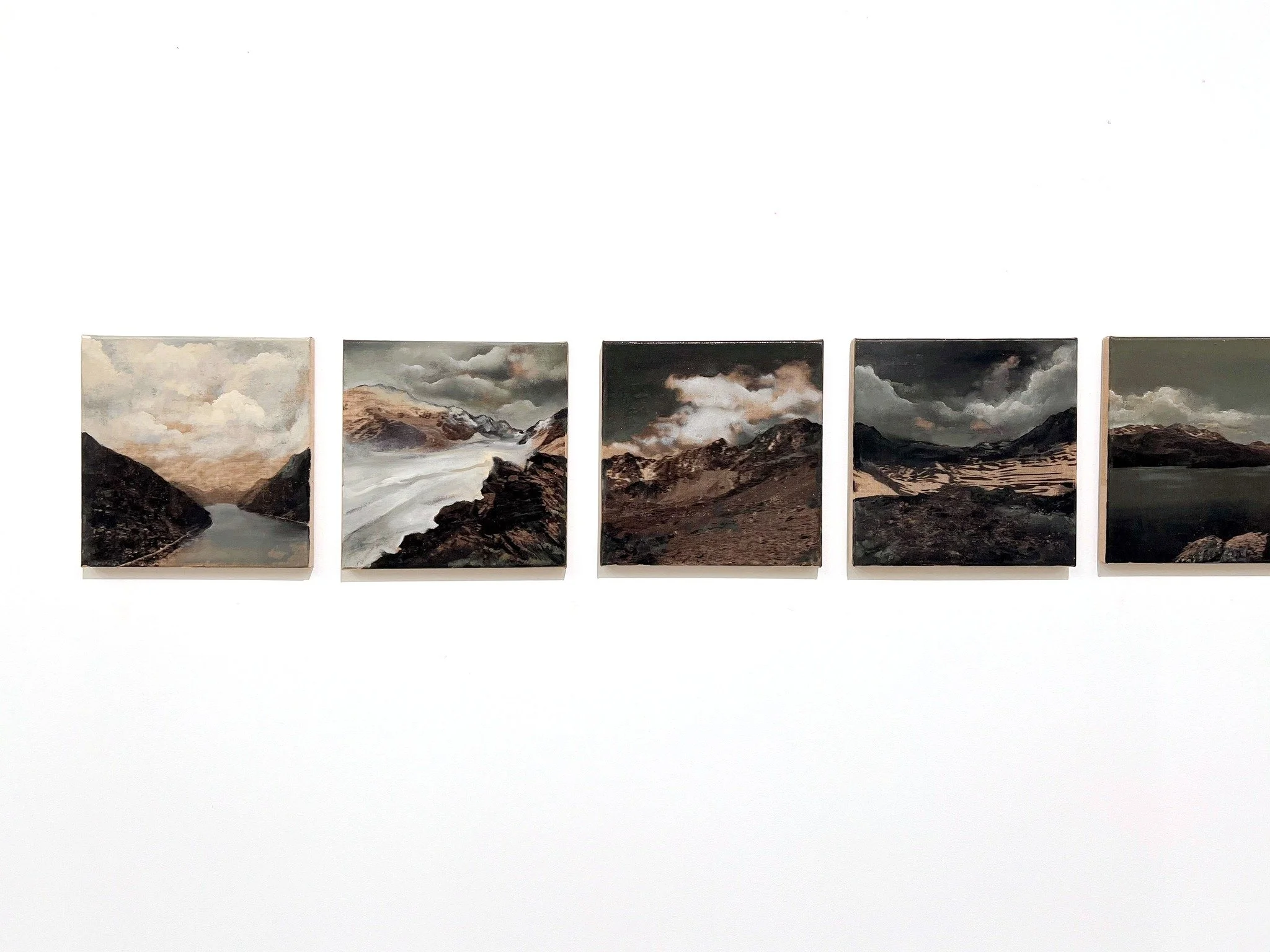
Nataraj von Allmen is a painter based in Switzerland. Often taking photographic material as a starting point, he weaves together landscapes, mythological archetypes, Christian symbolism, and contemporary socio-political themes into complex paintings. Oscillating between figuration and abstraction, his work investigates transformation, collective memory, and the human condition.