
10 Questions with Franchesca Medios
Franchesca Art is a Colombian-American visual artist whose practice operates under the concept of Neo-Virtualism, a framework that examines the tension between human presence and hyper-digital culture. Born in Bogotá and shaped by a screen-free childhood grounded in nature and sensory experience, she has developed a visual language that questions how technology reshapes perception, emotion, and identity.
Her practice spans painting, sculptural interventions using mobile phones, and hybrid works that integrate augmented and digital layers, creating multisensory pieces that function as both aesthetic objects and social signals. Through her recent collections, she explores themes such as digital dependency, loss of ancestral wisdom, attention fragmentation, and the search for inner signal in an algorithmic world.
Exhibited across Europe and the United States, her work positions art as a conscious counter-gesture: not a rejection of technology, but a critical dialogue with it. Franchesca Art's works invite viewers to pause, reflect, and reconnect with what remains essentially human within an accelerated virtual era.
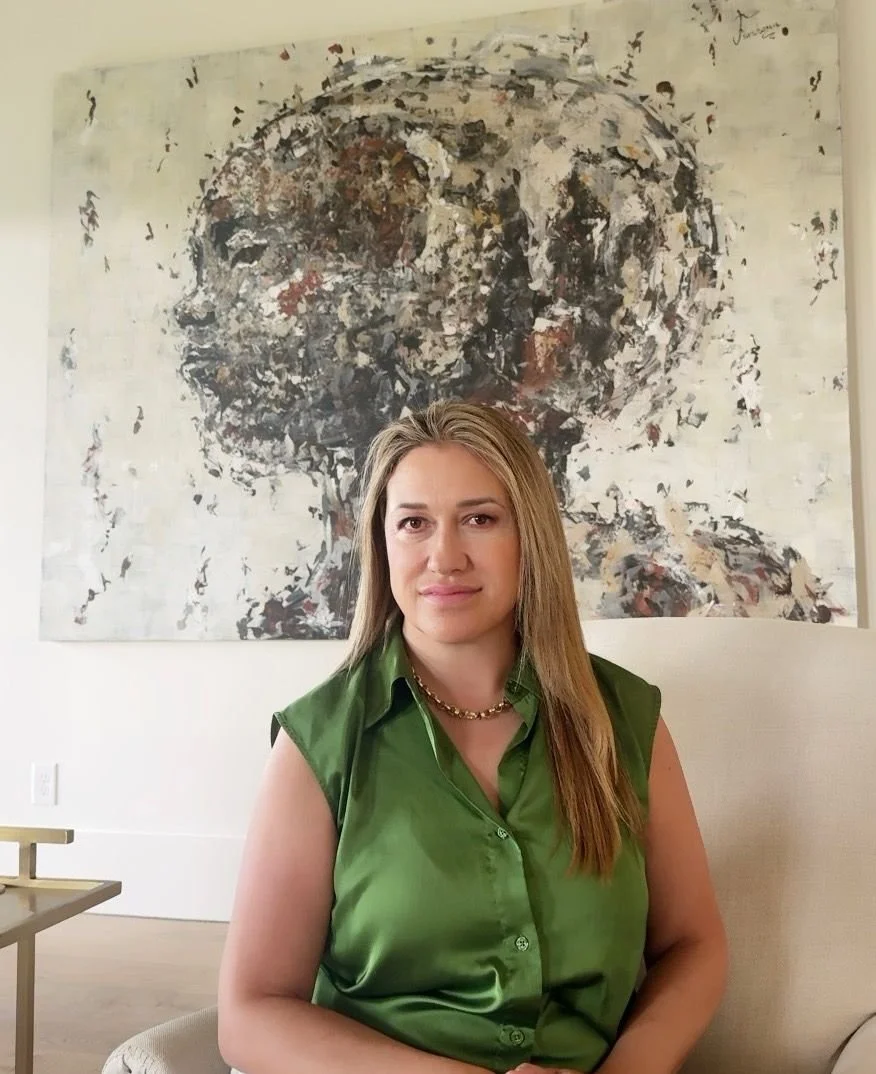
Franchesca Medios - Portrait
ARTIST STATEMENT
Franchesca Art was born in Bogotá, Colombia, and raised without screens. Her earliest memories are tactile: the weight of clay, the smell of earth, the unhurried rhythm of a childhood grounded in sensory presence. That origin brings her nostalgia, and it is also the foundation from which she understands what we have lost.
Her work develops under the concept she has called Neo-Virtualism, a framework positioning art as a critical, embodied response to hyperdigital culture, a demand to remain conscious within technology, not to reject it.
Her primary medium is the oversized sculptural iPhone: 24"×36" mixed-media works that critique the device they mimic. Faces and figures emerge in three dimensions from the phone's surface, integrated with resin, acrylic, natural materials, and social media iconography.
An augmented reality (AR) layer, viewable via a mobile device, brings the work to life, delivering its full message through the very screen it critiques. She transformed the phone into both subject and object, turning it into the stage for its own critique, confronting viewers with what the device is doing to them.
Her series Searching for a Signal Within You, nearly twenty-six pieces, addresses specific dimensions of our digital crisis. Each begins as a dramatic physical work and, through AR, transforms into a digital video message, inviting us to live consciously between the real and digital worlds.
Virtual Prison shows hands gripping the bars of an iPhone-shaped jail, its surface covered in likes, downloads, and follower counts. On the sculpted hands, there is a ring, and in the AR video the figure breaks free from the bars to embrace their family, evoking what has always been there, waiting outside the screen.
Lost Wisdom presents the face of an Indigenous elder emerging from a shattered screen surrounded by Google, TikTok, and Pinterest icons, a direct confrontation with ancestral knowledge being lost to algorithmic distraction. Its AR video evokes the research and recovery of ancestral wisdom and medicine.
Gaming Disorders shows a child with a charging cable connected to their skull: the first generation born already inside the network, carrying from childhood the neurological and emotional consequences of excessive screen exposure.
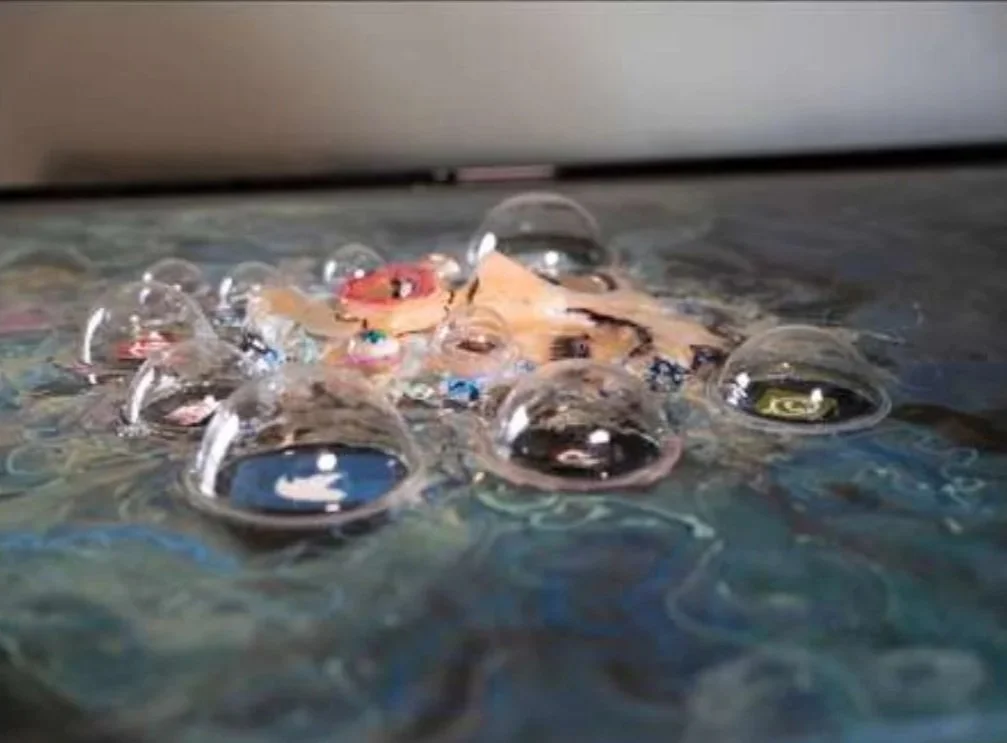
iPollen imagines a phone whose Photos app is overtaken and invaded by pollen and insects: nature reclaiming the device we abandoned it for.
These works are not mere illustrations; they are emotional events. Viewers often describe physical discomfort, not from violence, but from recognition: seeing themselves in the prison, the sleepless face, or the elder whose wisdom no algorithm can index.
As a Colombian woman with exhibitions in the U.S. and Europe, Franchesca Art understands what’s at stake for communities vulnerable to algorithmic erasure. Neo-Virtualism is her answer: using digital tools in art to insist on what can’t be replaced.
Her works function simultaneously as aesthetic objects and social signals. The invitation to the viewer is always the same: pause, look away from the screen in your hand, and find the signal that was already within you.

I POLLEN, hybrid media, 24X36 in, 2023 © Franchesca Medios
INTERVIEW
To start, can you tell us about your upbringing in Bogotá and how growing up without screens shaped your relationship with the world today?
I grew up completely away from screens. My childhood was spent in nature, fishing, riding horses, hiking through the countryside, and enjoying family gatherings with music, dancing, and bonfires under the open sky. It was a tactile, present life, full of real connections. When I moved to the United States and the world started digitalizing at a rapid pace, I felt a very deep rupture. That transition was not just geographical but also sensory. I went from a world where everything was touched, smelled, and lived through the body, to one where most of experience happens through a screen. That fracture is the heart of my work.
What led you to become an artist, and when did you first start questioning the impact of digital culture on perception and identity?
Art has been part of me for as long as I can remember. I studied Marketing and Advertising in Colombia, and my entrepreneurial spirit led me to found Franchesca Decorating in Atlanta. But beyond the business side of things, I always felt the need to explore my own artistic voice. I was watching with growing clarity how technology, which promised to connect us, was also beginning to redefine our attention, our relationships, and our identity. The moment everything shifted was when I returned to live in a rural environment. That reconnection with nature was a real awakening. I understood how much we had lost without even noticing, and the need to express that through art was born.

VIRTUAL PRISON, hybrid media, 24X36 in, 2023 © Franchesca Medios
How did your personal and cultural background influence the development of Neo-Virtualism?
Neo-Virtualism grew directly out of my experience as a Colombian woman living between two worlds. On one side, a Latin American childhood deeply rooted in nature, family, oral tradition, and culture. On the other, full immersion in a highly digitalized Western society. That tension between the two worlds never went away. It became my language. Neo-Virtualism is my attempt to name it, to create a conceptual framework for a kind of experience that millions of people live but few have ever put into visual form. I do not fully belong to either world, and that position gives me a particular perspective to see what both of them are losing.
Neo-Virtualism explores the tension between human presence and hyper-digital life. How would you describe this idea in simple terms?
It is very simple: we live two lives at the same time. One in front of the screen and one away from it. And the question I ask myself, and that I ask the viewer, is how much of the second one we are sacrificing for the first. It is not about rejecting technology. It is about recovering awareness. About choosing when to be connected and when to be present. Neo-Virtualism is a reminder that that choice still exists, even if it gets harder to make every day.
You use the oversized sculptural iPhone as a central element in your work. What led you to choose this object as a symbol?
The phone is the most powerful and ever-present object of our era. It is in every pocket, on every table, in every hand. It is the first thing we look at when we wake up and the last thing before we sleep. It is at once a window to the world and a barrier between us and the real world. Choosing the iPhone as the format for my sculptures was a very deliberate conceptual decision. I do not paint on a canvas. I paint inside the very screen I am critiquing. That creates an immediate and productive discomfort: the viewer holds in their hands the same object the work is questioning.
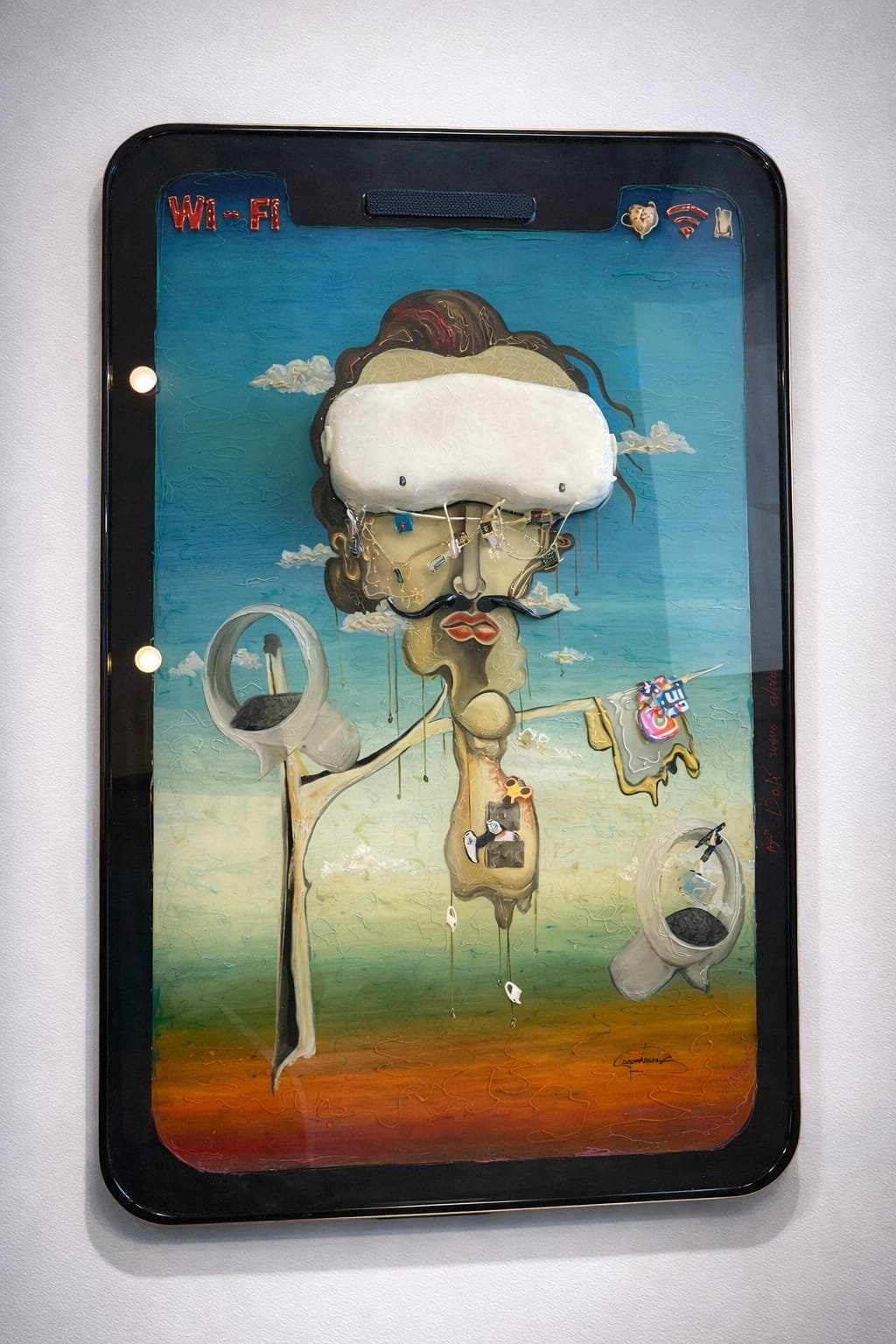
IF DALI WERE ALIVE, hybrid media, 24X36 in, 2024 © Franchesca Medios

IF DALI WERE ALIVE (detail), 2024 © Franchesca Medios
Your works combine painting, sculpture, and augmented reality. How do these different layers interact in your creative process?
Each layer has a distinct function, and all three are necessary for the work to carry its full meaning. The painting establishes the emotional and visual world of the piece. The sculpture makes it physical, tangible, three-dimensional. It enters the viewer's space and forces a bodily relationship with the work. And the augmented reality reveals the resolution: what exists beyond the critique, the possibility of recovery, of reconnection, of freedom. Without the AR, the work is just a question. With the AR, it becomes an answer. Or at least the suggestion that an answer exists.
Many of your pieces include emotionally charged and sometimes uncomfortable imagery. What kind of response are you hoping to activate in the viewer?
I am looking for recognition. That moment when the viewer looks at the work and thinks, "that is me." The hands gripping the bars of the iPhone, the face drowning at 1:00 in the morning, the elder whose wisdom no algorithm can index. Discomfort is not the final goal. It is the threshold. The uncomfortable moment is the instant when the work stops being art and becomes a mirror. And what happens after that recognition, that is the real conversation I am interested in.
Works like Lost Wisdom and Virtual Prison deal with themes of digital dependency and ancestral memory. How do you approach these sensitive subjects?
With a lot of respect and from personal experience. I do not approach these themes from the outside as an observer, but from the inside as someone who has lived them. With Lost Wisdom, I think about the voices of my elders, about knowledge that was passed down from generation to generation and that now competes with algorithms designed to capture attention. With Virtual Prison, I think about how many times I have looked at my phone instead of looking at the people in front of me. The sensitivity of the subject demands honesty. I cannot talk about loss if I have not felt that loss myself. And I believe that comes through in the work.

GENETICALLY MODIFIED WORLD, hybrid media, 24X36 in, 2023 © Franchesca Medios

LAST BREATHE, hybrid media, 24X36 in, 2023 © Franchesca Medios
You describe your works as "emotional events" rather than illustrations of ideas. What do you mean by that?
An illustration explains something you already know. An event happens to you. It transforms you. It leaves you different from who you were before it occurred. I want people to leave the experience of my work different from how they came in. Not necessarily with answers, but with questions they did not have before. I want something to shift inside, for the body to react before the mind can explain it. That does not happen with illustrations. It happens with presence. And that is why every material, every scene, every AR activation is designed to provoke an experience, not to deliver a message.
Finally, what are you currently working on, and do you have any upcoming exhibitions or projects you would like to share with us?
This is a very active time for me. I have works in the process of being submitted to the Lumen Prize 2026, the international reference award in art and technology, as well as other international open calls that are helping me expand the visibility of the series across Europe and the United States. I am continuing to develop more sculptural phones that address the tensions of our digital era, going deeper into how AR can transform not just the visual experience but also the emotional message of each piece. That is the part of the process that excites me most right now: finding ways for technology to become the vehicle for recovering what technology itself is taking from us. I am also exploring the possibility of bringing the collection into a fully immersive installation format, where the viewer does not just look at the works but literally enters the universe of Neo-Virtualism. That is something I am very excited about and hope to bring to life soon.
Artist’s Talk
Al-Tiba9 Interviews is a promotional platform for artists to articulate their vision and engage them with our diverse readership through a published art dialogue. The artists are interviewed by Mr. Mohamed Benhadj, the founder & curator of Al-Tiba9 Contemporary, to highlight their artistic careers and introduce them to the international contemporary art scene across our vast network of museums, galleries, art professionals, art dealers, collectors, and art lovers across the globe.


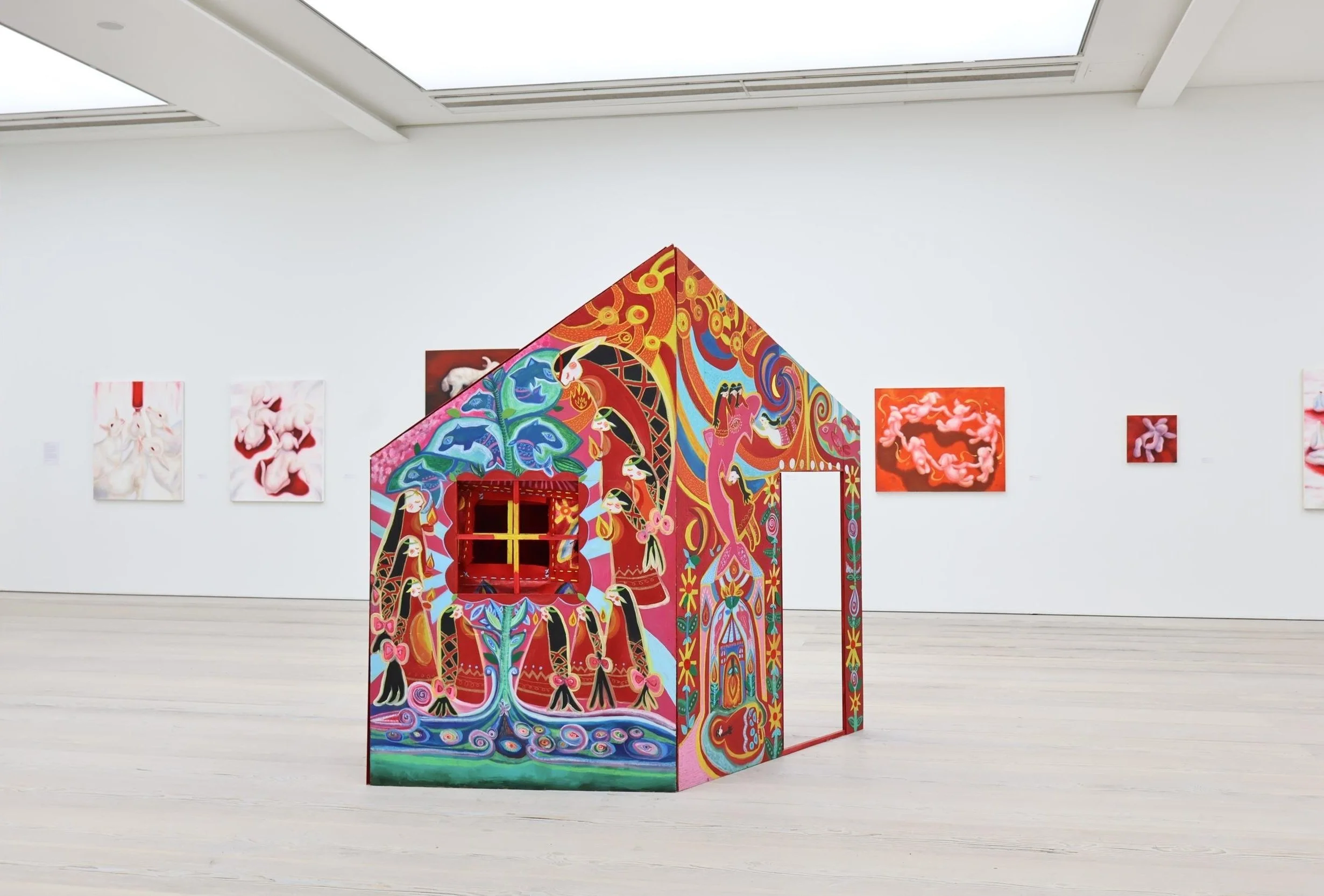


Yuhan Gu is a New York–based industrial designer whose work explores the intersection of function, emotion, and sculptural form. TACTO reflects Gu’s interest in the emotional relationship between people and the objects they keep close in their daily workspace. Designed as a cactus-shaped memo holder, the project transforms a familiar natural form into a playful and functional desktop object.